


 Скачать презентацию Approaches to Home Connectivity T-109 7510 Research Seminar
c1ed8e7f17b2aff3ccf1ef9f34458ffc.ppt
- Количество слайдов: 19
 Approaches to Home Connectivity T-109. 7510 Research Seminar on Telecommunications Business Marko Berg
 Agenda l l l l Background for Home Connectivity Exemplary Use Case Scenarios Current Technologies Universal Plug and Play (UPn. P) Digital Living Network Alliance (DLNA) UPn. P and DLNA in the Market Conclusions Questions
 Need for Home Connectivity l Technological advances Ø Resulting in more devices and new functions • Picture and voice quality • Network bandwidth • Connection options • Communication mechanisms and mobility
 Need for Home Connectivity (2) l New ways of acquiring content Ø Resulting in the need to transfer content between several devices • Over the Internet • From local network • Cameras • Audio and video recording devices • Broadcast systems
 Need for Home Connectivity (3) l Technical solutions exist for most problems • Discovery of devices in the network • Connecting over different types of networks • Transferring images, audio and video • Storing and sourcing media in a network Ø The issue is one of interoperability and transparency – standardization needed
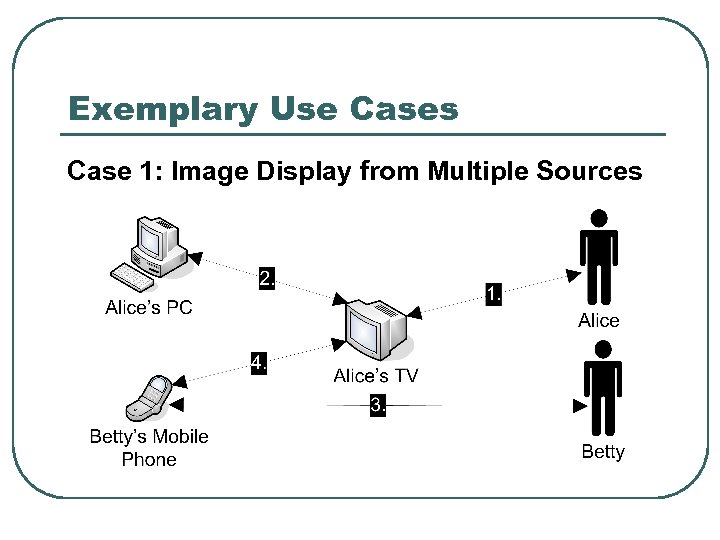 Exemplary Use Cases Case 1: Image Display from Multiple Sources
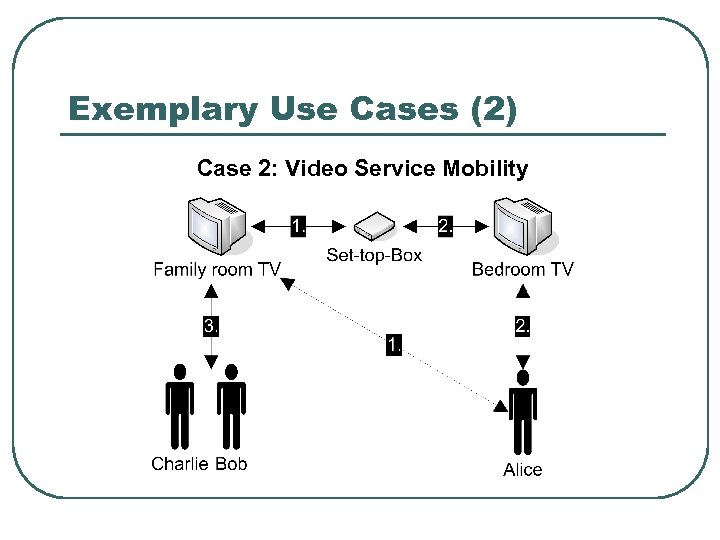 Exemplary Use Cases (2) Case 2: Video Service Mobility
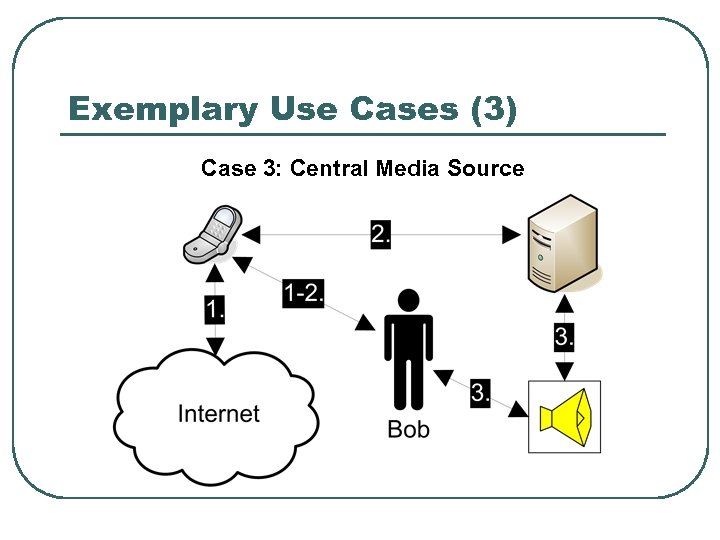 Exemplary Use Cases (3) Case 3: Central Media Source
 Current Technologies l Zeroconf l Jini l Universal Plug and Play (UPn. P) Digital Living Network Alliance (DLNA l • Bonjour by Apple • Java technology
 Universal Plug and Play l Standards developed by UPn. P Forum l Designed as a interoperable M 2 M, P 2 P protocol • Est. 1999 • More than 800 members • Independent of network, protocol, language • Device-agnostic – mobile, fixed, CE, PC, . . . • Platform-independent, for virtually any purpose
 Universal Plug and Play (2) l Defines Device Control Protocols (DCP) in six device categories • Audio/Video • Home Automation • Networking • Printer • Remoting • Scanner
 Universal Plug and Play (3) l Protocol functionality • Addressing • Discovery • Description • Control • Eventing • Presentation
 Digital Living Network Alliance l DLNA is an industry consortium l Home environment seen as three islands of devices • Est. 2003, more than 200 members • Develops guidelines for home connectivity • Consumer Electronics • Mobile Devices • PCs and Peripherals
 DLNA (2) l Use cases used as a basis for guidelines • Use cases built on technology-independent needs – not likely to change soon l Accepted standards and practices used • Not necessarily open, but accessible
 DLNA (3) l Guidelines define building blocks for implementation • Technologies defined for all parts of interconnection • Network technology • Device discovery • Media transport • Content formats • Communication protocols
 DLNA (4) l Three device categories l Targeted only to home environment • Home Network Devices • Mobile Network Devices • Home Interoperability Devices • Future extensions possible
 UPn. P and DLNA in the Market l More UPn. P devices l Devices available in all DLNA categories • Longer availability • Suitable for more specific purposes • More promotion by the consortium • DLNA also targets consumers
 Conclusions l l l Establisment of DLNA might indicate deficiencies in UPn. P leaves a lot up to the implementations • Interoperability might remain partial and focused DLNA provides a heavier, but also more comprehensive solution • • Impressive support from the industry Might have better chances in the long run
 Questions? Thank you!