 Скачать презентацию APPROACH TO ENERGY CONSCIOUS RETROFIT OF SLOVENIAN BUILDING
817029a05ff8021449e09c74e4ecdb0e.ppt
- Количество слайдов: 30



APPROACH TO ENERGY CONSCIOUS RETROFIT OF SLOVENIAN BUILDING STOCK Marjana ŠIJANEC ZAVRL ZRMK, Technological Building and Civil Engineering Institute, Ljubljana, Slovenia
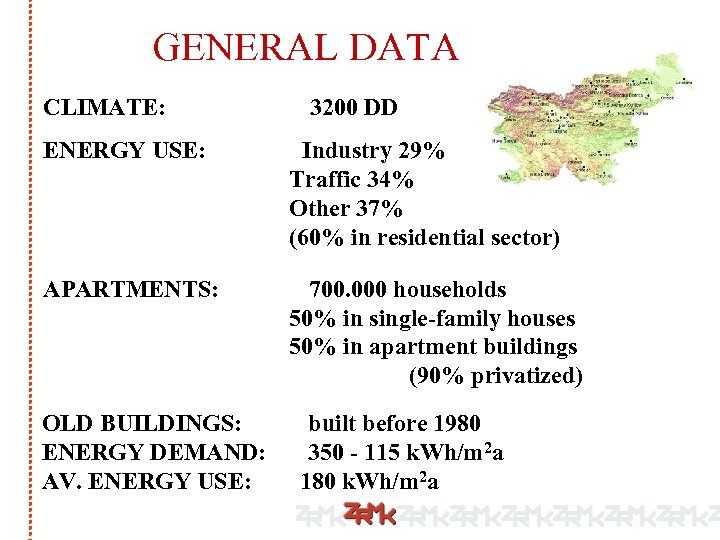
GENERAL DATA CLIMATE: 3200 DD ENERGY USE: Industry 29% Traffic 34% Other 37% (60% in residential sector) APARTMENTS: 700. 000 households 50% in single-family houses 50% in apartment buildings (90% privatized) OLD BUILDINGS: ENERGY DEMAND: AV. ENERGY USE: built before 1980 350 - 115 k. Wh/m 2 a 180 k. Wh/m 2 a
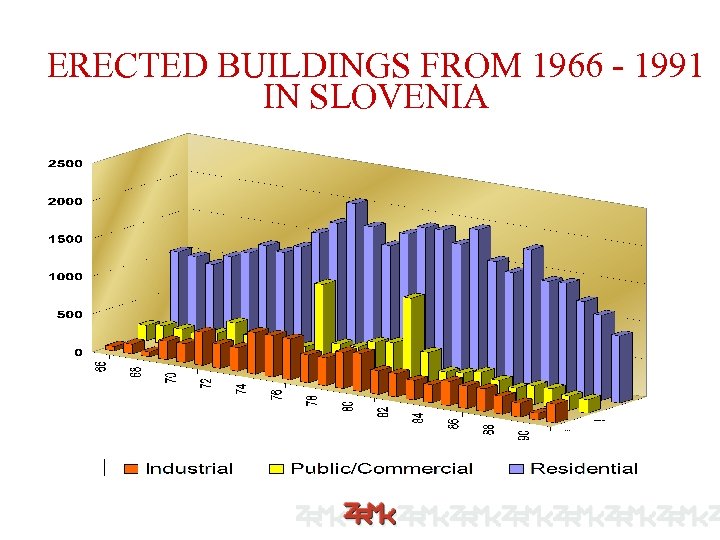
ERECTED BUILDINGS FROM 1966 - 1991 IN SLOVENIA
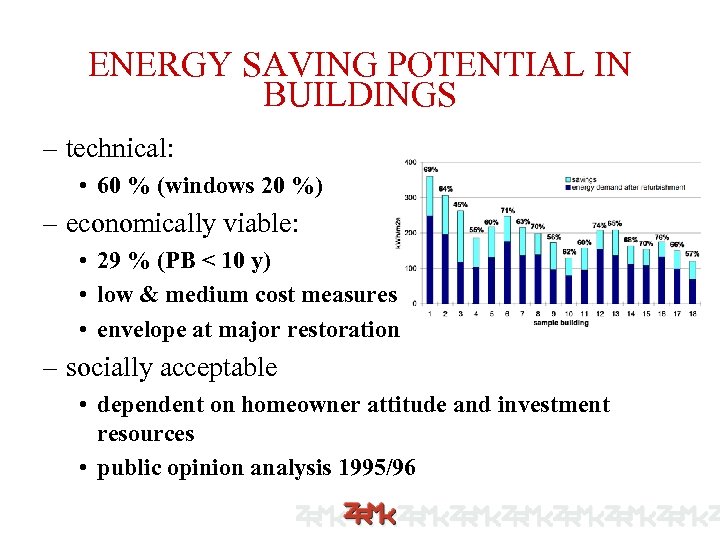
ENERGY SAVING POTENTIAL IN BUILDINGS – technical: • 60 % (windows 20 %) – economically viable: • 29 % (PB < 10 y) • low & medium cost measures • envelope at major restoration – socially acceptable • dependent on homeowner attitude and investment resources • public opinion analysis 1995/96
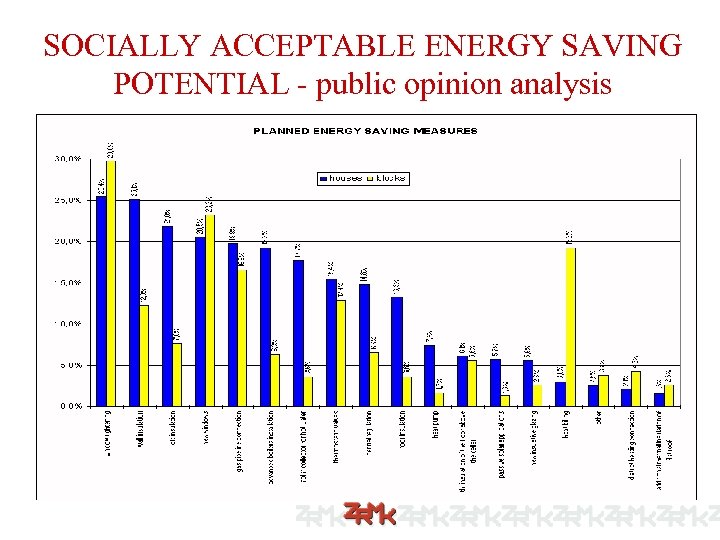
SOCIALLY ACCEPTABLE ENERGY SAVING POTENTIAL - public opinion analysis
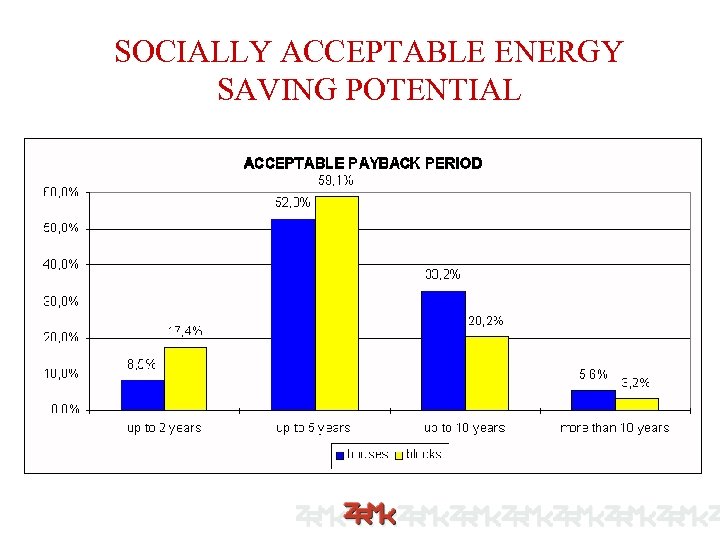
SOCIALLY ACCEPTABLE ENERGY SAVING POTENTIAL
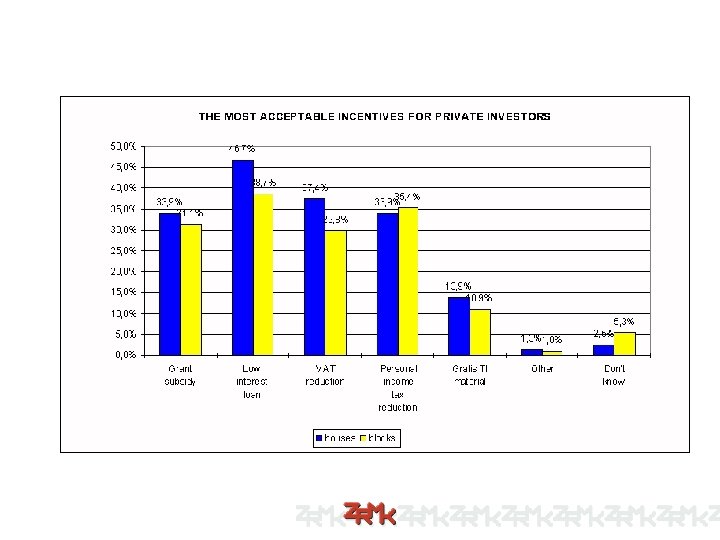
…
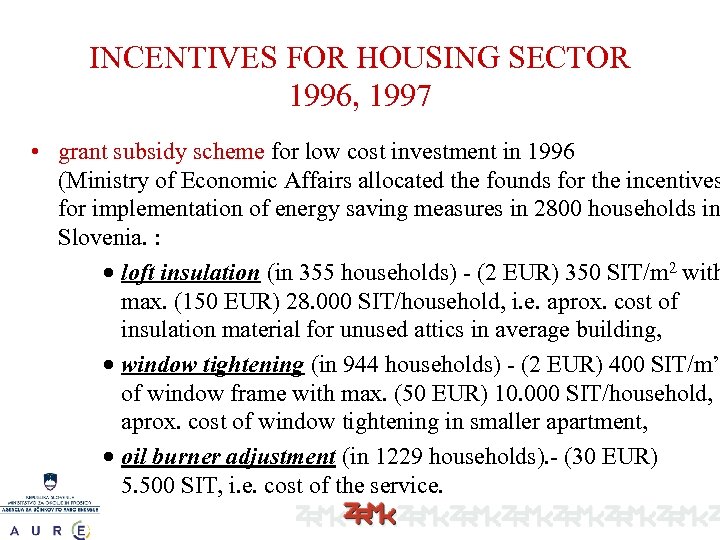
INCENTIVES FOR HOUSING SECTOR 1996, 1997 • grant subsidy scheme for low cost investment in 1996 (Ministry of Economic Affairs allocated the founds for the incentives for implementation of energy saving measures in 2800 households in Slovenia. : · loft insulation (in 355 households) - (2 EUR) 350 SIT/m 2 with max. (150 EUR) 28. 000 SIT/household, i. e. aprox. cost of insulation material for unused attics in average building, · window tightening (in 944 households) - (2 EUR) 400 SIT/m’ of window frame with max. (50 EUR) 10. 000 SIT/household, aprox. cost of window tightening in smaller apartment, · oil burner adjustment (in 1229 households). - (30 EUR) 5. 500 SIT, i. e. cost of the service.
INCENTIVES FOR HOUSING SECTOR 1998 - 2002 • grant subsidy scheme for medium cost investments - implementation of EE windows and glazing in existing and new houses – anticipated rate of window exchange in households: • 21 % in 5 years …public opinion analysis • aprox. 640. 000 EUR of subsidies allocated to the households · EE windows and glazing (in 2985 households) - (average subsidy 200 EUR/household; i. e. 10 -15% investment or the incremental investment in energy efficient glazing, average pay back 2 - 2. 5 years · savings 11600 MWh/year, CO 2 reduction 2458 tons/year
SUBSIDISED WINDOW TECHNOLOGY • FRAMES – U < 1. 6 W/m 2 K • GLAZING – U < 1. 4 W/m 2 K • OVERALL – U < 1. 6 W/m 2 K (ISO/DIS 10077) • LOW AIR PERMEABILITY – Class C (SIST 1018)
“QUALITY LABEL IN CIVIL ENGINEERING” PRODUCT CHARACTERISTICS PRODUCTION PROCESS QUALITY OF SERVICE INTEGRAL SUSTAINABLE CRITERIA IN THE DECISION-MAKING PROCESS
NON-OBLIGATORY CERTIFICATION LABEL NATIONAL CHARACTER SUPPORTING IDENTIFICATION OF EE WINDOWS EVALUATION SCHEME PONDERED CRITERIA RESULTS TRANSFORMED INTO POINTS
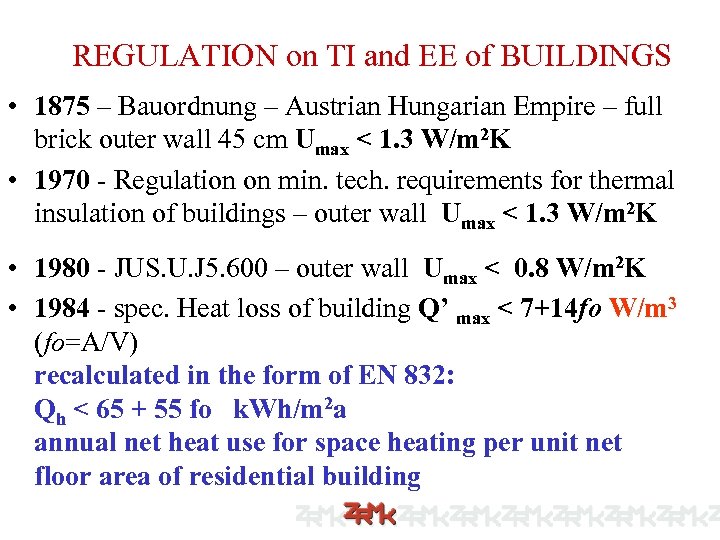
REGULATION on TI and EE of BUILDINGS • 1875 – Bauordnung – Austrian Hungarian Empire – full brick outer wall 45 cm Umax < 1. 3 W/m 2 K • 1970 - Regulation on min. tech. requirements for thermal insulation of buildings – outer wall Umax < 1. 3 W/m 2 K • 1980 - JUS. U. J 5. 600 – outer wall Umax < 0. 8 W/m 2 K • 1984 - spec. Heat loss of building Q’ max < 7+14 fo W/m 3 (fo=A/V) recalculated in the form of EN 832: Qh < 65 + 55 fo k. Wh/m 2 a annual net heat use for space heating per unit net floor area of residential building
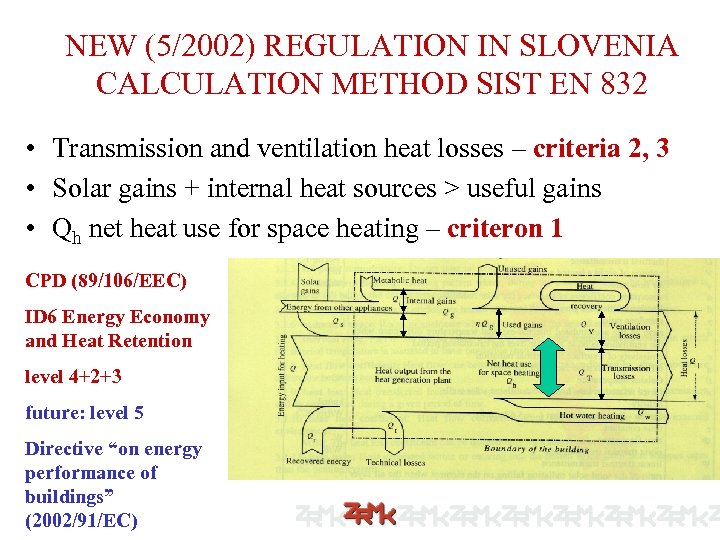
NEW (5/2002) REGULATION IN SLOVENIA CALCULATION METHOD SIST EN 832 • Transmission and ventilation heat losses – criteria 2, 3 • Solar gains + internal heat sources > useful gains • Qh net heat use for space heating – criteron 1 CPD (89/106/EEC) ID 6 Energy Economy and Heat Retention level 4+2+3 future: level 5 Directive “on energy performance of buildings” (2002/91/EC)
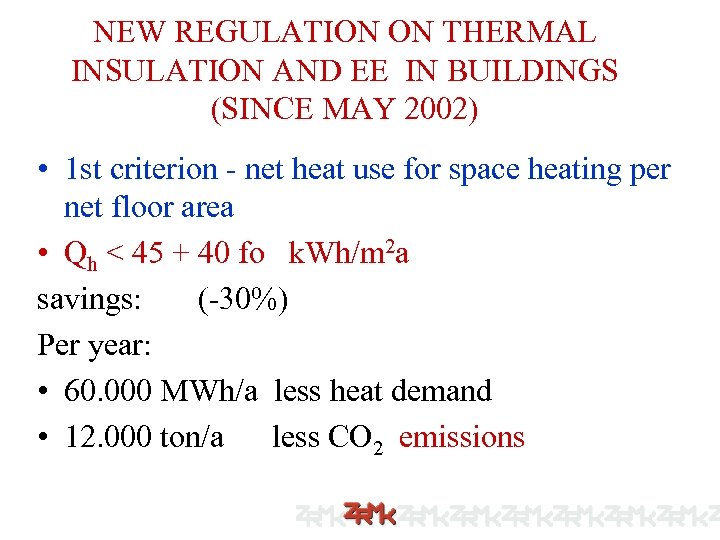
NEW REGULATION ON THERMAL INSULATION AND EE IN BUILDINGS (SINCE MAY 2002) • 1 st criterion - net heat use for space heating per net floor area • Qh < 45 + 40 fo k. Wh/m 2 a savings: (-30%) Per year: • 60. 000 MWh/a less heat demand • 12. 000 ton/a less CO 2 emissions
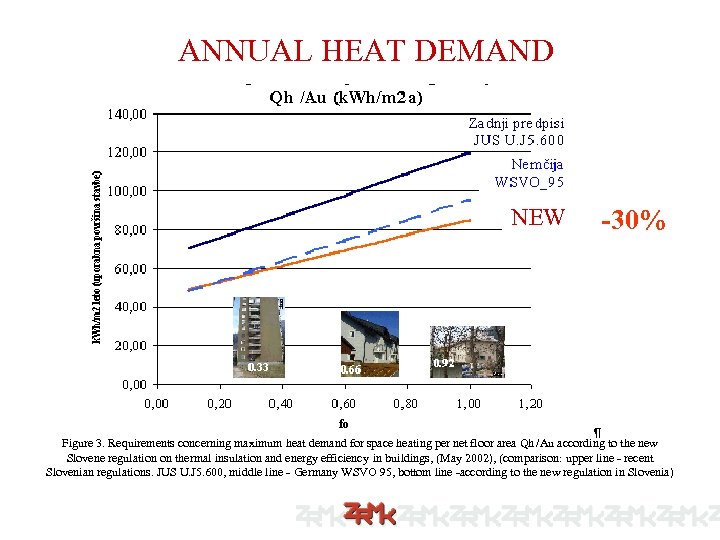
ANNUAL HEAT DEMAND NEW -30% Figure 3. Requirements concerning maximum heat demand for space heating per net floor area Qh /Au according to the new Slovene regulation on thermal insulation and energy efficiency in buildings, (May 2002), (comparison: upper line - recent Slovenian regulations. JUS U. J 5. 600, middle line - Germany WSVO 95, bottom line -according to the new regulation in Slovenia)
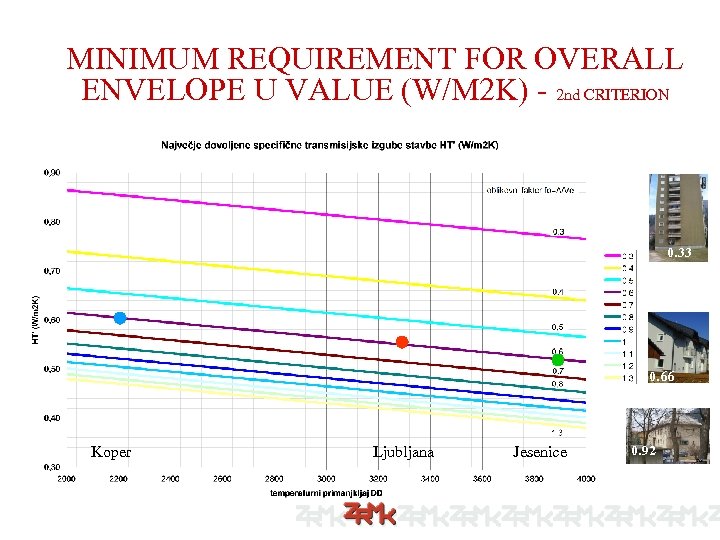
MINIMUM REQUIREMENT FOR OVERALL ENVELOPE U VALUE (W/M 2 K) - 2 nd CRITERION 0. 33 0. 66 Koper Ljubljana Jesenice 0. 92
Economic impact • JUS. U. J 5. 600 for outer wall 5 cm TI oz. U=0. 7 W/m 2 K • New regulation U=0. 42 W/m 2 K • difference 0. 28 W/m 2 K compensated 3 cm - 4 cm TI • Additional investment 20 do 35 EUR per m 2 facade • For a single family house additional TI cost 200 to 500 EUR! • savings 15 k. Wh/m 2 a, pay back 3 -5 let
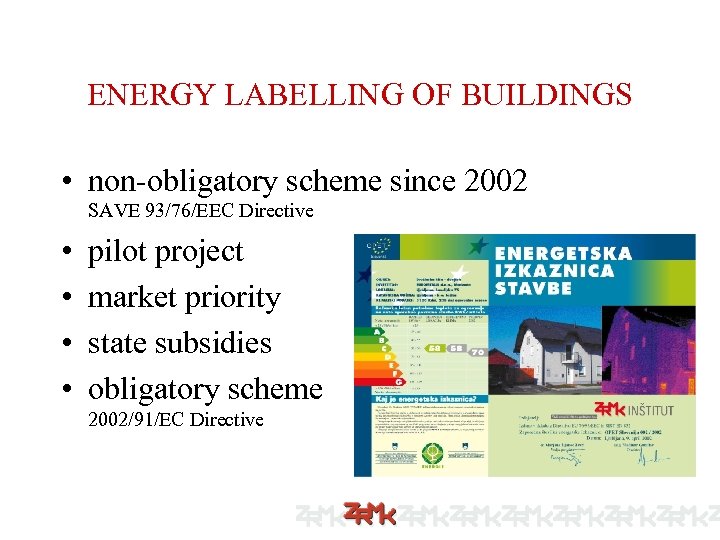
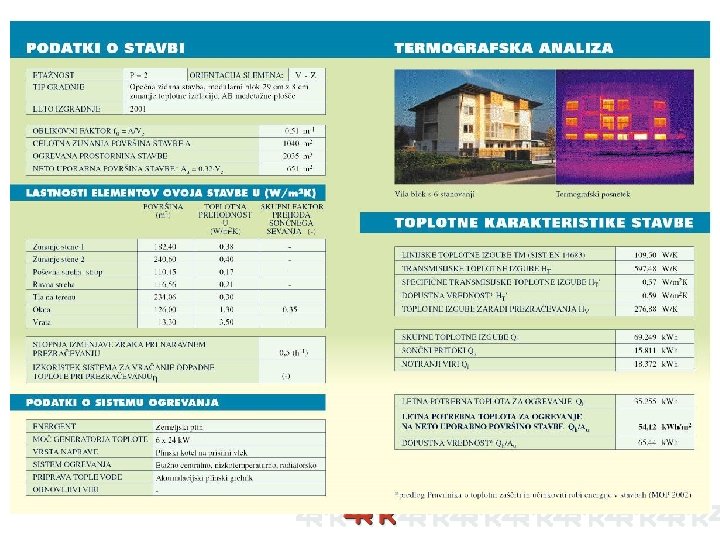
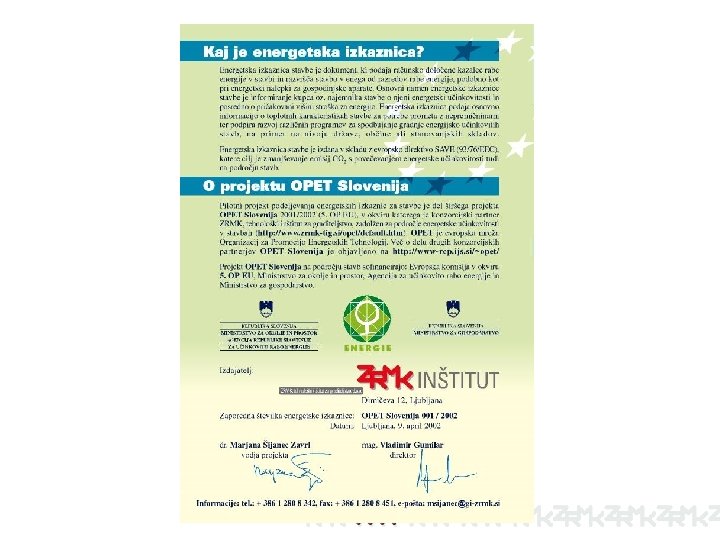
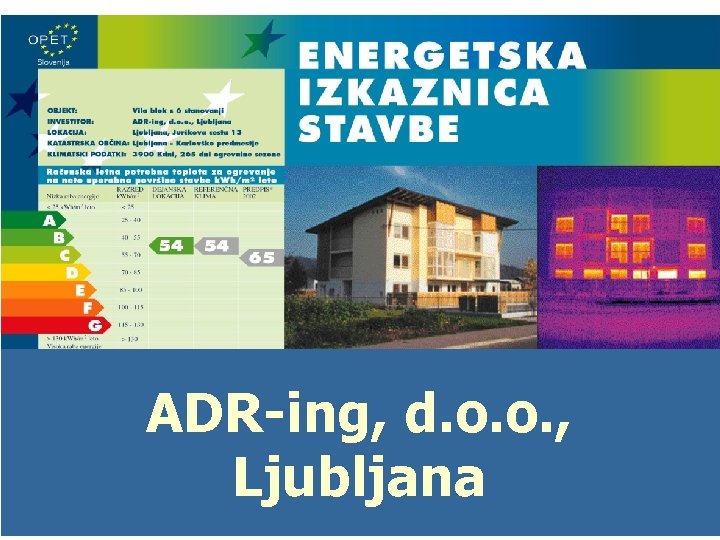
ENERGY LABELLING OF BUILDINGS • non-obligatory scheme since 2002 SAVE 93/76/EEC Directive • • pilot project market priority state subsidies obligatory scheme 2002/91/EC Directive
ADR-ing, d. o. o. , Ljubljana
OVERVIEW OF ACTIVITIES TOWARDS IMPROVED EE OF SLOVENIAN BUILDINGS • concept of national program of EE rehabilitation of existing buildings (identification of energy saving potential) 1994 -1996 • energy advisory network ENSVET (advisory offices in municipality, advice for homeowners) since 1992 • feasibility study for implementation of EE measures in housing - public opinion analysis on social acceptability 1995/96 • incentives for EE investments in housing (grant subsidies scheme for loft insulation. . , solar collectors, greenhouses, biomass boilers, . . EE windows… - low and medium cost investments) 1996 -2002 • development of “Quality Mark in Buildings and C. E. ” (“ZKG” - non-obligatory certification scheme for building products and services, i. e. EE windows) since 1997
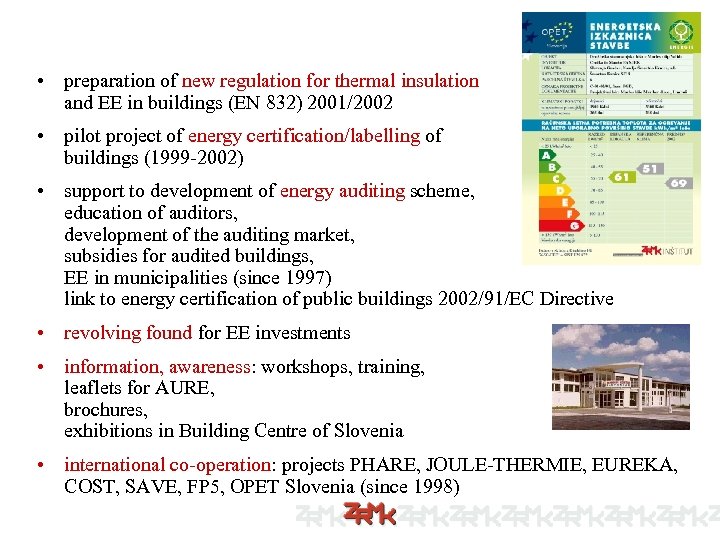
• preparation of new regulation for thermal insulation and EE in buildings (EN 832) 2001/2002 • pilot project of energy certification/labelling of buildings (1999 -2002) • support to development of energy auditing scheme, education of auditors, development of the auditing market, subsidies for audited buildings, EE in municipalities (since 1997) link to energy certification of public buildings 2002/91/EC Directive • revolving found for EE investments • information, awareness: workshops, training, leaflets for AURE, brochures, exhibitions in Building Centre of Slovenia • international co-operation: projects PHARE, JOULE-THERMIE, EUREKA, COST, SAVE, FP 5, OPET Slovenia (since 1998)

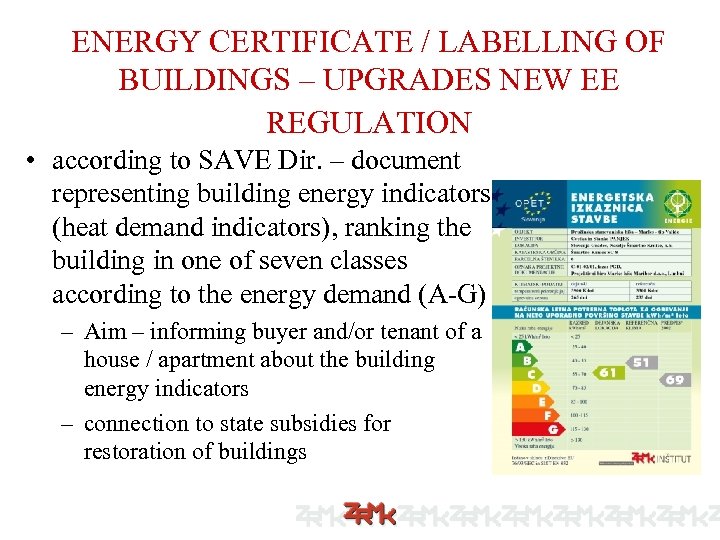
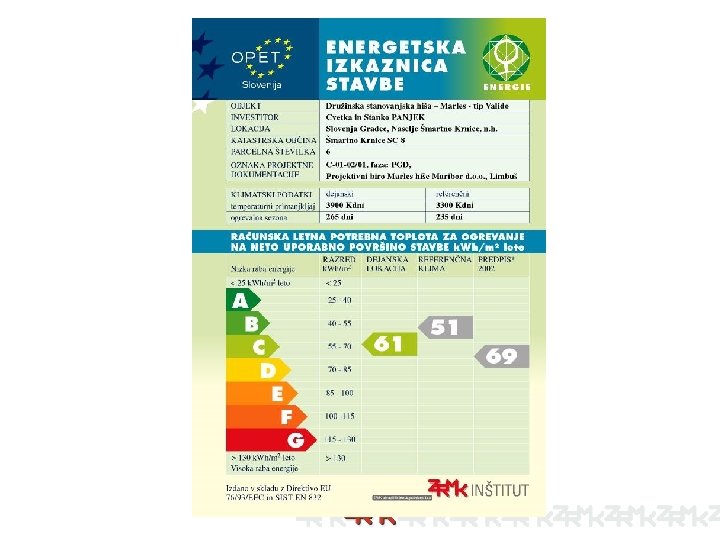
ENERGY CERTIFICATE / LABELLING OF BUILDINGS – UPGRADES NEW EE REGULATION • according to SAVE Dir. – document representing building energy indicators (heat demand indicators), ranking the building in one of seven classes according to the energy demand (A-G) – Aim – informing buyer and/or tenant of a house / apartment about the building energy indicators – connection to state subsidies for restoration of buildings
EVALUATED (SUSTAINABLE) CRITERIA: measurable technical criteria non-measurable technical criteria environmental criteria efficiency and quality of production processes satisfaction of buyers fulfilment of the company’s business plan global impact on the society and environment
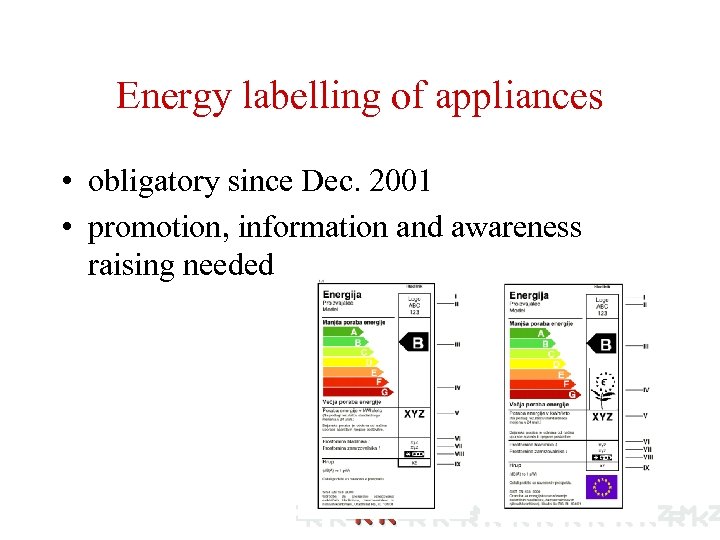
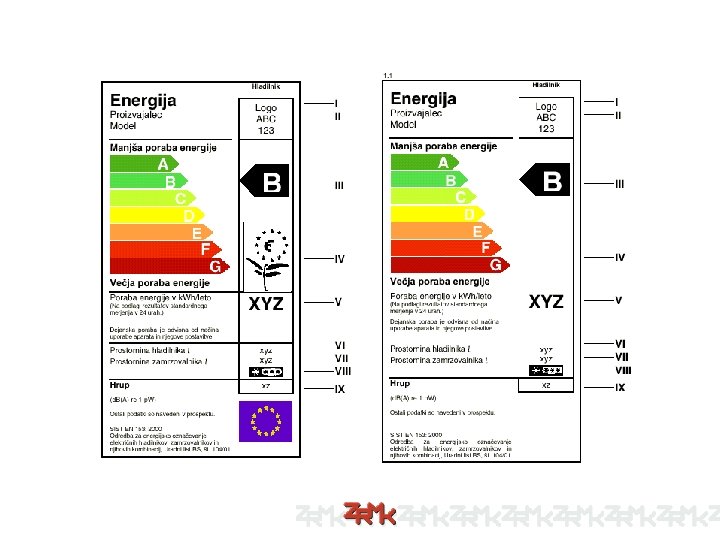
Energy labelling of appliances • obligatory since Dec. 2001 • promotion, information and awareness raising needed
 Скачать презентацию APPROACH TO ENERGY CONSCIOUS RETROFIT OF SLOVENIAN BUILDING
817029a05ff8021449e09c74e4ecdb0e.ppt