


 Скачать презентацию Apportionment Schemes Dan Villarreal MATH 490 -02 Tuesday
0e6ce1454d1d73dfca9bfe8614bfedf9.ppt
- Количество слайдов: 73
 Apportionment Schemes Dan Villarreal MATH 490 -02 Tuesday, Sept. 15, 2009
 But first…a quick PSA Sept. 15, 2009 Apportionment Schemes
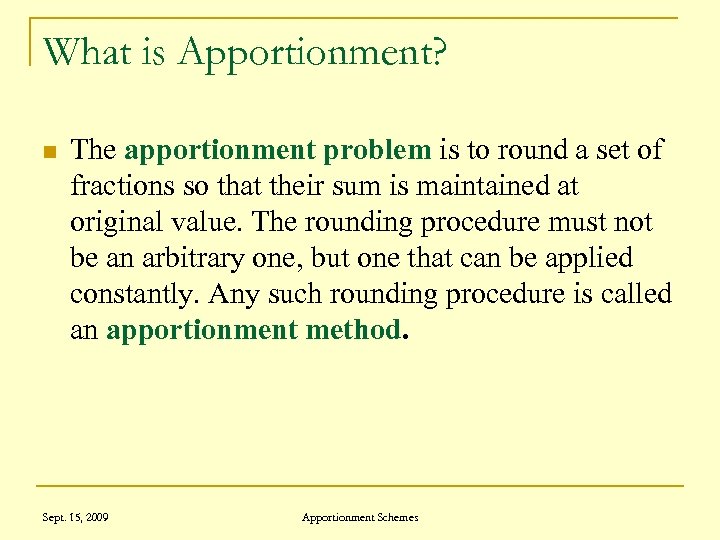 What is Apportionment? n The apportionment problem is to round a set of fractions so that their sum is maintained at original value. The rounding procedure must not be an arbitrary one, but one that can be applied constantly. Any such rounding procedure is called an apportionment method. Sept. 15, 2009 Apportionment Schemes
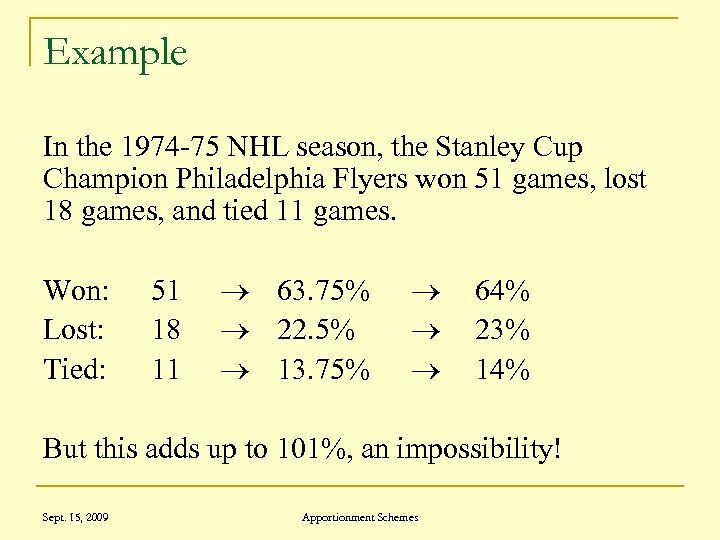 Example In the 1974 -75 NHL season, the Stanley Cup Champion Philadelphia Flyers won 51 games, lost 18 games, and tied 11 games. Won: Lost: Tied: 51 18 11 63. 75% 22. 5% 13. 75% 64% 23% 14% But this adds up to 101%, an impossibility! Sept. 15, 2009 Apportionment Schemes
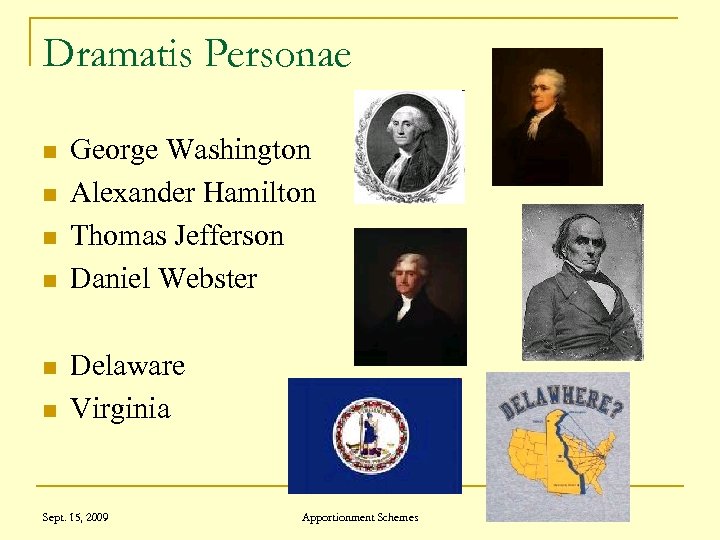 Dramatis Personae n n n George Washington Alexander Hamilton Thomas Jefferson Daniel Webster Delaware Virginia Sept. 15, 2009 Apportionment Schemes
 The Constitution n. Amendment 14, Section 2: “Representatives shall be apportioned among the several States according to their respective numbers, counting the whole number of persons in each State” §Article I, Section 2: “The actual Enumeration shall be made within three Years after the first Meeting of the Congress of the United States, and within every subsequent Term of ten Years, in such Manner as they shall by Law direct. The Number of Representatives shall not exceed one for every thirty Thousand, but each State shall have at Least one Representative” Sept. 15, 2009 Apportionment Schemes
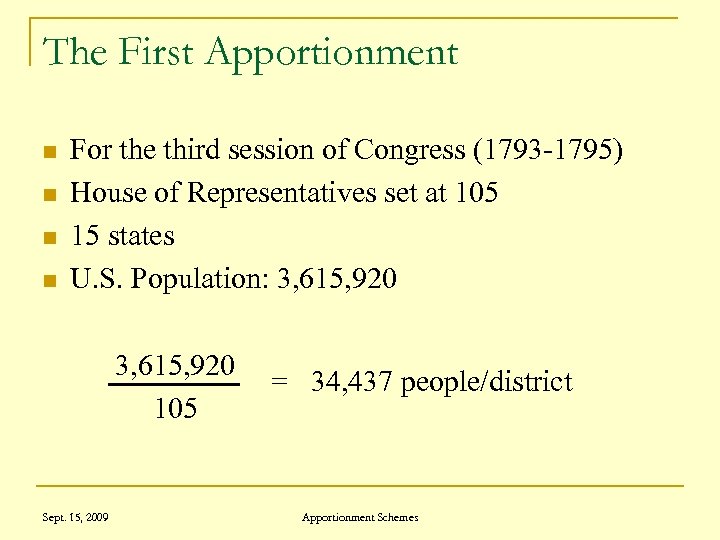 The First Apportionment n n For the third session of Congress (1793 -1795) House of Representatives set at 105 15 states U. S. Population: 3, 615, 920 n Sept. 15, 2009 3, 615, 920 105 = 34, 437 people/district Apportionment Schemes
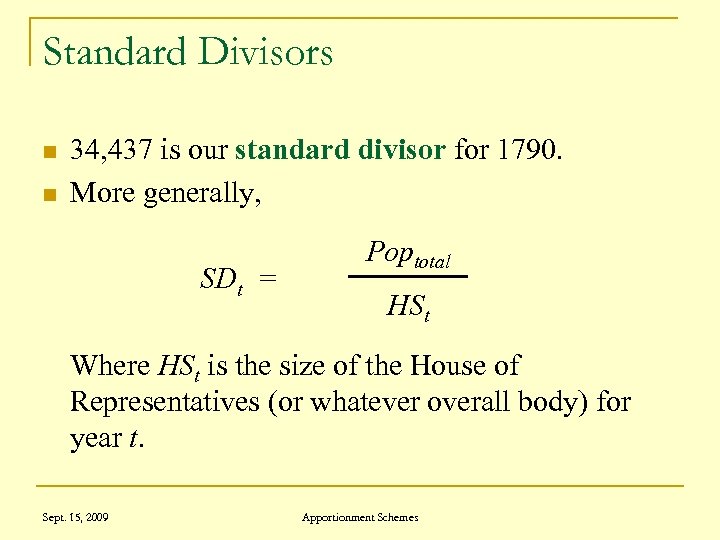 Standard Divisors n n 34, 437 is our standard divisor for 1790. More generally, SDt = Poptotal HSt Where HSt is the size of the House of Representatives (or whatever overall body) for year t. Sept. 15, 2009 Apportionment Schemes
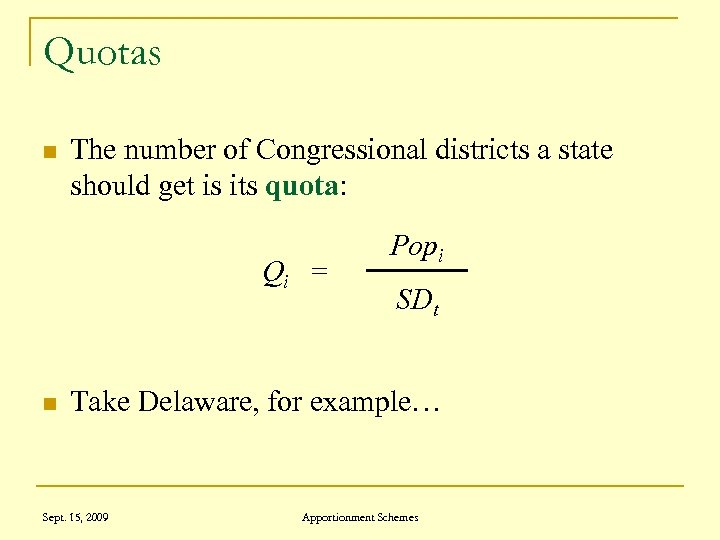 Quotas n The number of Congressional districts a state should get is its quota: Qi = n Popi SDt Take Delaware, for example… Sept. 15, 2009 Apportionment Schemes
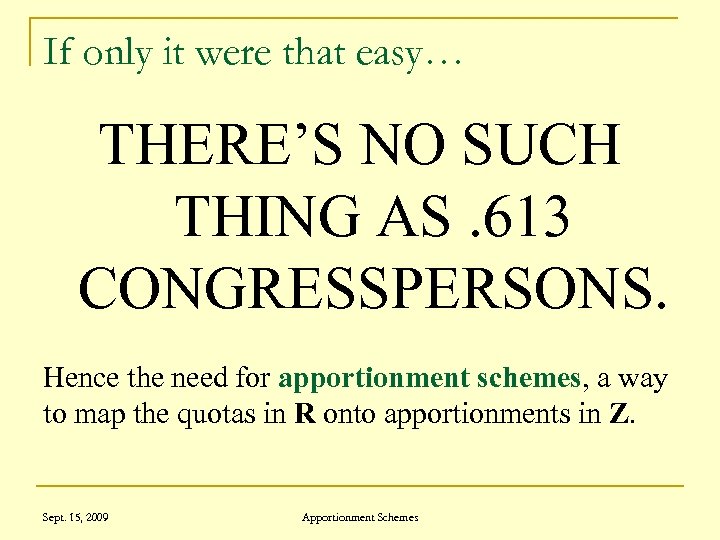 If only it were that easy… THERE’S NO SUCH THING AS. 613 CONGRESSPERSONS. Hence the need for apportionment schemes, a way to map the quotas in R onto apportionments in Z. Sept. 15, 2009 Apportionment Schemes
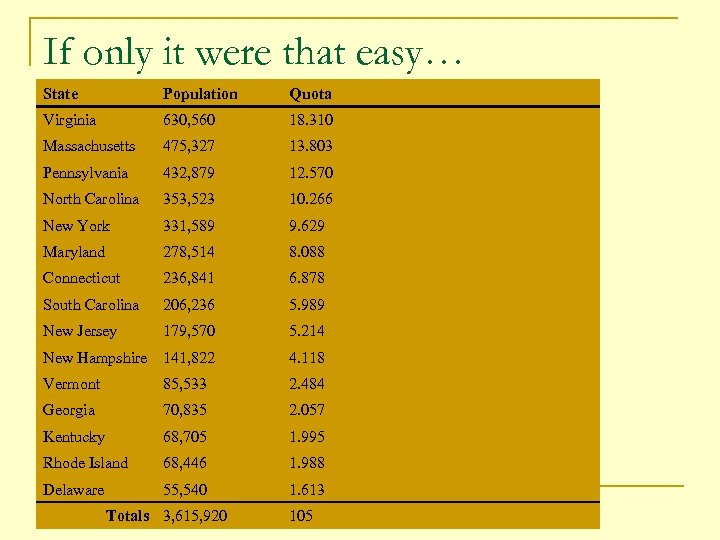 If only it were that easy… State Population Quota Virginia 630, 560 18. 310 Massachusetts 475, 327 13. 803 Pennsylvania 432, 879 12. 570 North Carolina 353, 523 10. 266 New York 331, 589 9. 629 Maryland 278, 514 8. 088 Connecticut 236, 841 6. 878 South Carolina 206, 236 5. 989 New Jersey 179, 570 5. 214 New Hampshire 141, 822 4. 118 Vermont 85, 533 2. 484 Georgia 70, 835 2. 057 Kentucky 68, 705 1. 995 Rhode Island 68, 446 1. 988 Delaware 55, 540 1. 613 Sept. 15, 2009 Totals 3, 615, 920 Apportionment Schemes 105
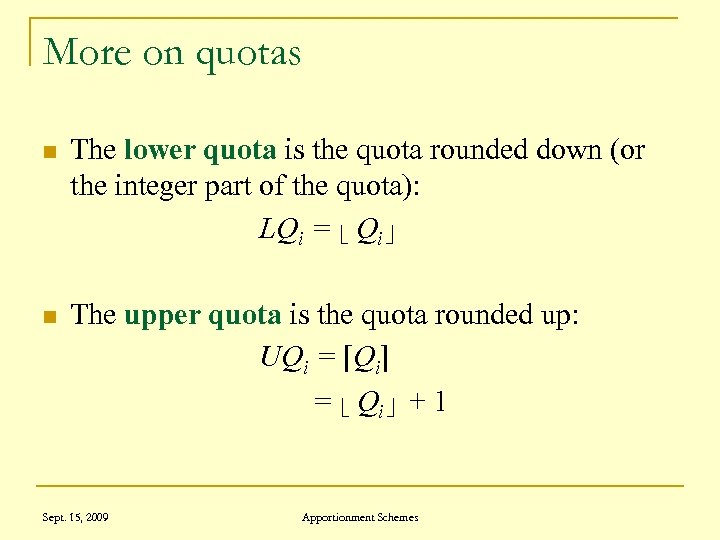 More on quotas n The lower quota is the quota rounded down (or the integer part of the quota): LQi = ⌊ Qi⌋ n The upper quota is the quota rounded up: UQi = ⌈Qi⌉ = ⌊ Qi ⌋ + 1 Sept. 15, 2009 Apportionment Schemes
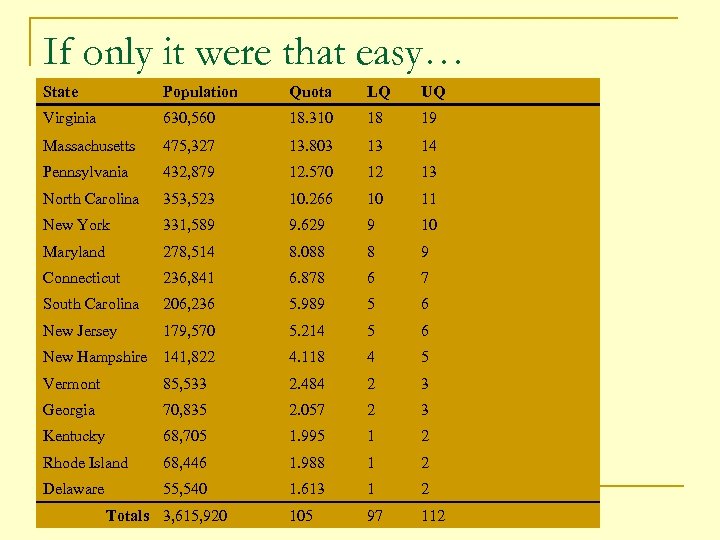 If only it were that easy… State Population Quota LQ UQ Virginia 630, 560 18. 310 18 19 Massachusetts 475, 327 13. 803 13 14 Pennsylvania 432, 879 12. 570 12 13 North Carolina 353, 523 10. 266 10 11 New York 331, 589 9. 629 9 10 Maryland 278, 514 8. 088 8 9 Connecticut 236, 841 6. 878 6 7 South Carolina 206, 236 5. 989 5 6 New Jersey 179, 570 5. 214 5 6 New Hampshire 141, 822 4. 118 4 5 Vermont 85, 533 2. 484 2 3 Georgia 70, 835 2. 057 2 3 Kentucky 68, 705 1. 995 1 2 Rhode Island 68, 446 1. 988 1 2 Delaware 55, 540 1. 613 1 2 Sept. 15, 2009 Totals 3, 615, 920 105 97 Apportionment Schemes 112
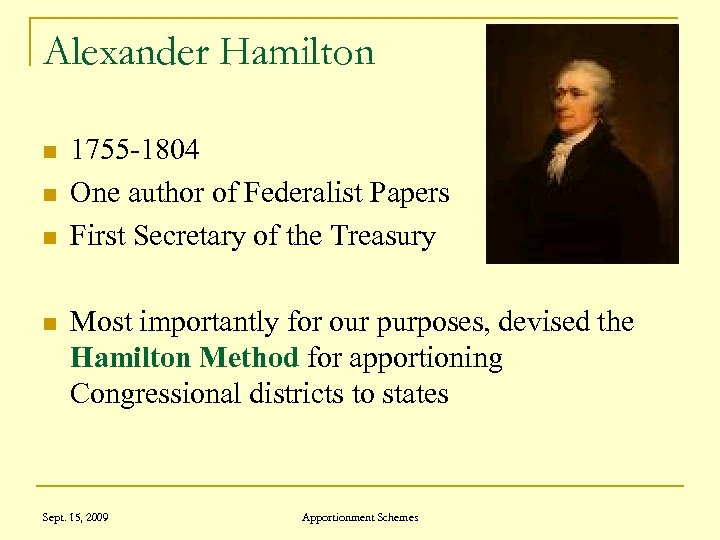 Alexander Hamilton n n 1755 -1804 One author of Federalist Papers First Secretary of the Treasury Most importantly for our purposes, devised the Hamilton Method for apportioning Congressional districts to states Sept. 15, 2009 Apportionment Schemes
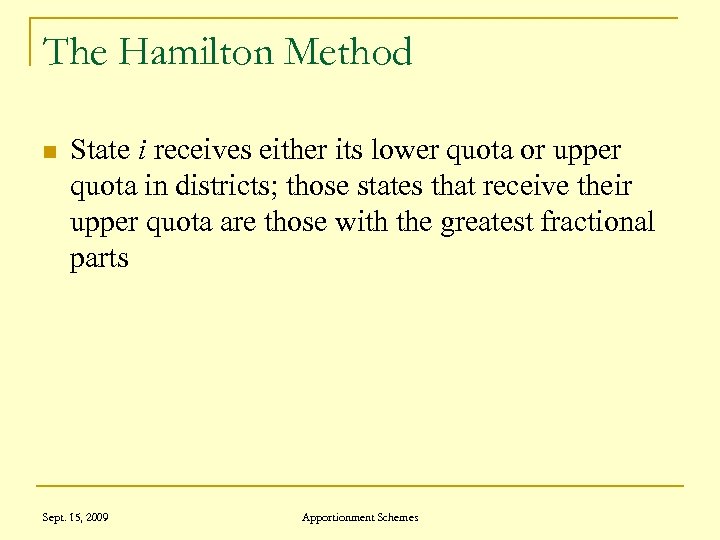 The Hamilton Method n State i receives either its lower quota or upper quota in districts; those states that receive their upper quota are those with the greatest fractional parts Sept. 15, 2009 Apportionment Schemes
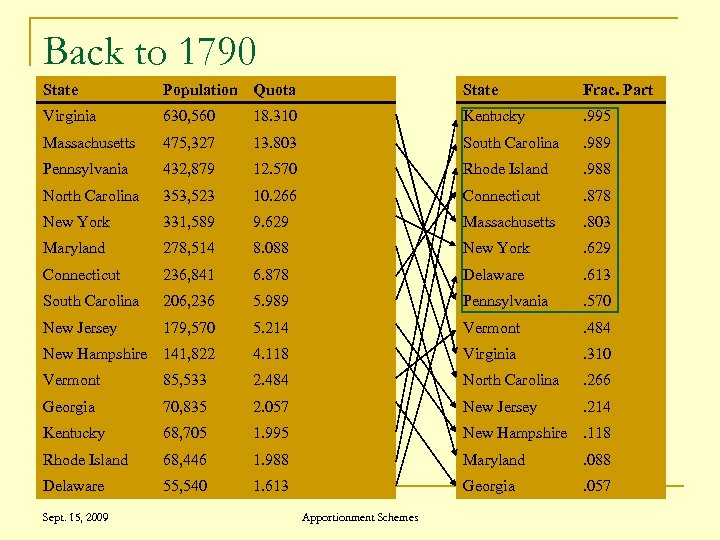 Back to 1790 State Population Quota Frac. Part State Frac. Part Virginia 630, 560 18. 310 Kentucky . 995 Massachusetts 475, 327 13. 803 South Carolina . 989 Pennsylvania 432, 879 12. 570 Rhode Island . 988 North Carolina 353, 523 10. 266 Connecticut . 878 New York 331, 589 9. 629 Massachusetts . 803 Maryland 278, 514 8. 088 New York . 629 Connecticut 236, 841 6. 878 Delaware . 613 South Carolina 206, 236 5. 989 Pennsylvania . 570 New Jersey 179, 570 5. 214 Vermont . 484 New Hampshire 141, 822 4. 118 Virginia . 310 Vermont 85, 533 2. 484 North Carolina . 266 Georgia 70, 835 2. 057 New Jersey . 214 Kentucky 68, 705 1. 995 New Hampshire. 118 Rhode Island 68, 446 1. 988 Maryland . 088 Delaware 55, 540 1. 613 Georgia . 057 Sept. 15, 2009 Apportionment Schemes
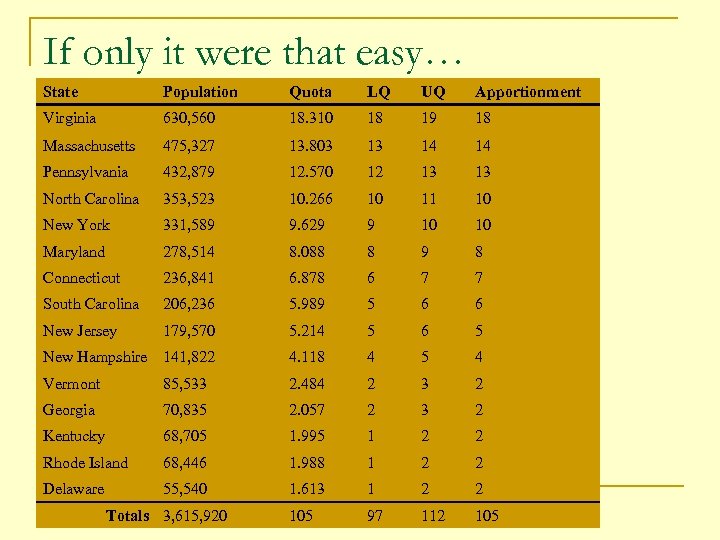 If only it were that easy… State Population Quota LQ UQ Apportionment Virginia 630, 560 18. 310 18 19 18 Massachusetts 475, 327 13. 803 13 14 14 Pennsylvania 432, 879 12. 570 12 13 13 North Carolina 353, 523 10. 266 10 11 10 New York 331, 589 9. 629 9 10 10 Maryland 278, 514 8. 088 8 9 8 Connecticut 236, 841 6. 878 6 7 7 South Carolina 206, 236 5. 989 5 6 6 New Jersey 179, 570 5. 214 5 6 5 New Hampshire 141, 822 4. 118 4 5 4 Vermont 85, 533 2. 484 2 3 2 Georgia 70, 835 2. 057 2 3 2 Kentucky 68, 705 1. 995 1 2 2 Rhode Island 68, 446 1. 988 1 2 2 Delaware 55, 540 1. 613 1 2 2 Sept. 15, 2009 Totals 3, 615, 920 105 97 Apportionment Schemes 112 105
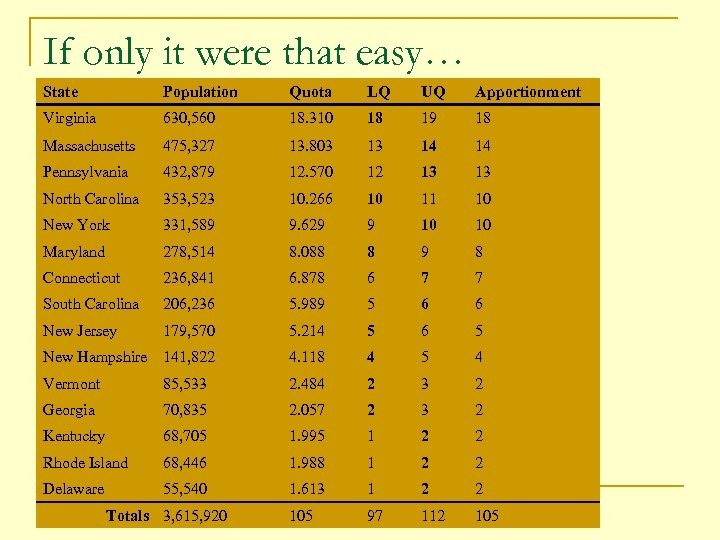 If only it were that easy… State Population Quota LQ UQ Apportionment Virginia 630, 560 18. 310 18 19 18 Massachusetts 475, 327 13. 803 13 14 14 Pennsylvania 432, 879 12. 570 12 13 13 North Carolina 353, 523 10. 266 10 11 10 New York 331, 589 9. 629 9 10 10 Maryland 278, 514 8. 088 8 9 8 Connecticut 236, 841 6. 878 6 7 7 South Carolina 206, 236 5. 989 5 6 6 New Jersey 179, 570 5. 214 5 6 5 New Hampshire 141, 822 4. 118 4 5 4 Vermont 85, 533 2. 484 2 3 2 Georgia 70, 835 2. 057 2 3 2 Kentucky 68, 705 1. 995 1 2 2 Rhode Island 68, 446 1. 988 1 2 2 Delaware 55, 540 1. 613 1 2 2 Sept. 15, 2009 Totals 3, 615, 920 105 97 Apportionment Schemes 112 105
 Sept. 15, 2009 Apportionment Schemes
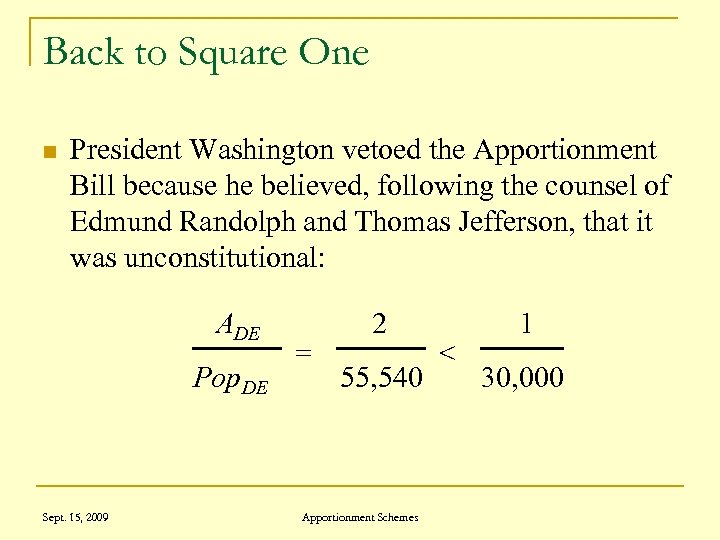 Back to Square One n President Washington vetoed the Apportionment Bill because he believed, following the counsel of Edmund Randolph and Thomas Jefferson, that it was unconstitutional: ADE Pop. DE Sept. 15, 2009 = 2 55, 540 Apportionment Schemes < 1 30, 000
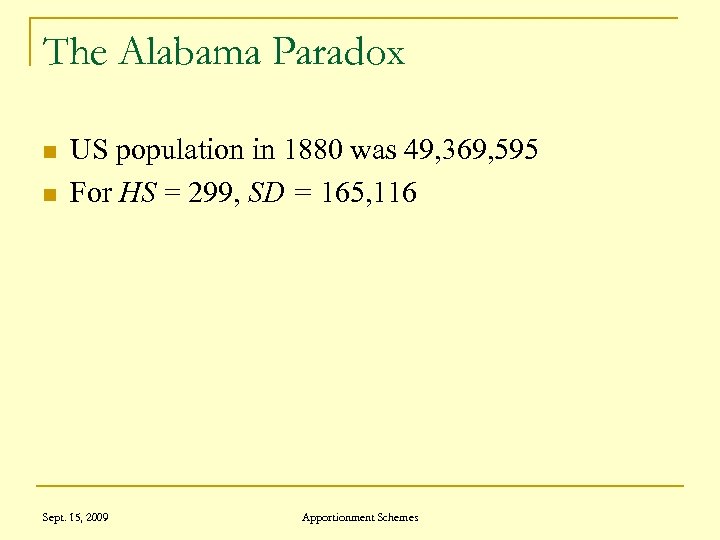
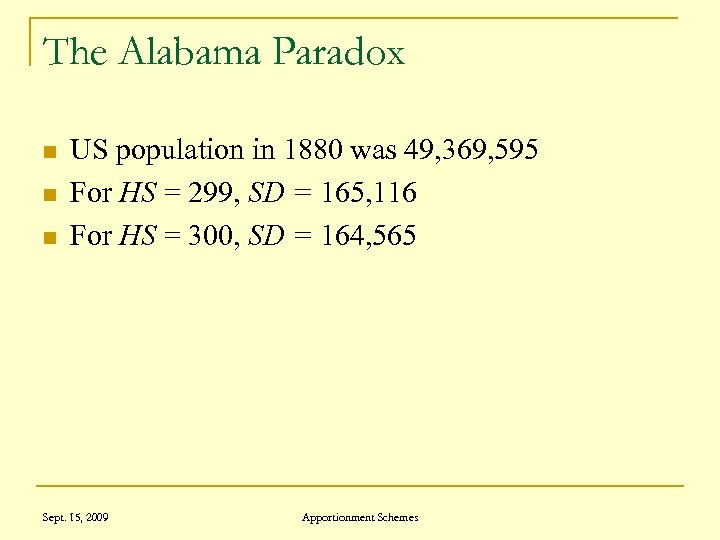
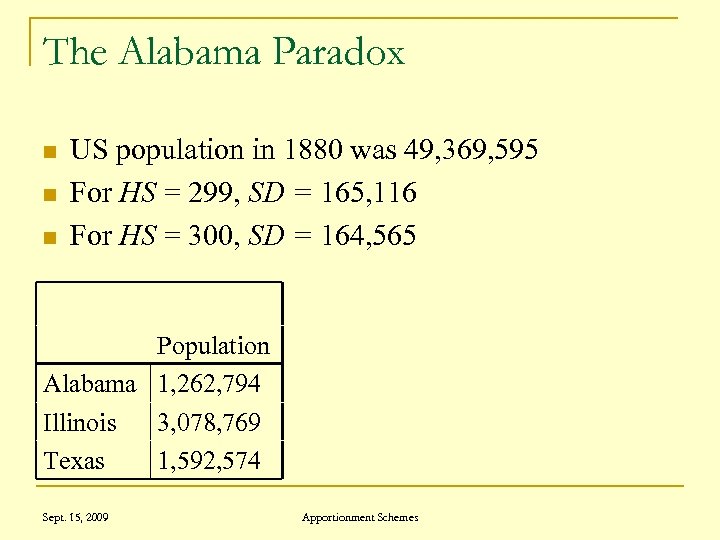
 The Alabama Paradox n n The Hamilton Method was Congress’s preferred method of apportionment from 1850 to 1900. In 1881, the Alabama Paradox was first discovered. The Census Bureau, as a matter of course, calculated apportionments for a range of House sizes; in this case, 275 -350 Something interesting and very weird happened between the tables for HS = 299 and 300… Sept. 15, 2009 Apportionment Schemes
 The Alabama Paradox n US population in 1880 was 49, 369, 595 Sept. 15, 2009 Apportionment Schemes
 The Alabama Paradox n n US population in 1880 was 49, 369, 595 For HS = 299, SD = 165, 116 Sept. 15, 2009 Apportionment Schemes
 The Alabama Paradox n n n US population in 1880 was 49, 369, 595 For HS = 299, SD = 165, 116 For HS = 300, SD = 164, 565 Sept. 15, 2009 Apportionment Schemes
 The Alabama Paradox n n n US population in 1880 was 49, 369, 595 For HS = 299, SD = 165, 116 For HS = 300, SD = 164, 565 Population Alabama 1, 262, 794 Illinois 3, 078, 769 Texas 1, 592, 574 Sept. 15, 2009 Apportionment Schemes
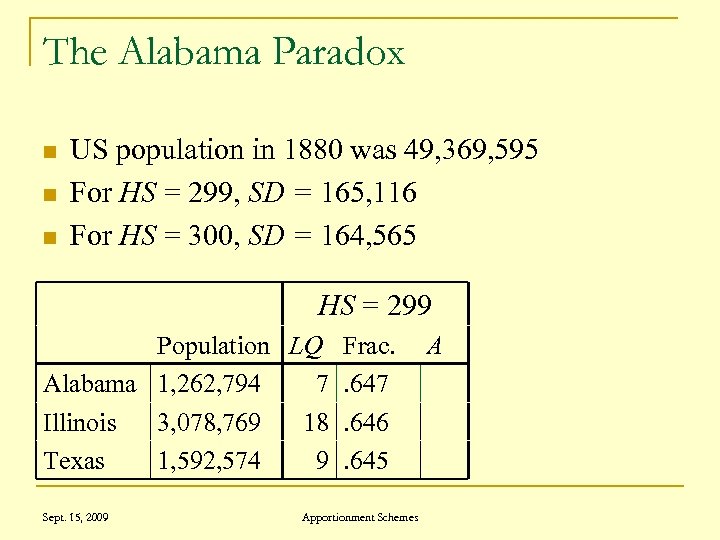 The Alabama Paradox n n n US population in 1880 was 49, 369, 595 For HS = 299, SD = 165, 116 For HS = 300, SD = 164, 565 HS = 299 Population LQ Frac. Alabama 1, 262, 794 7. 647 Illinois 3, 078, 769 18. 646 Texas 1, 592, 574 9. 645 Sept. 15, 2009 Apportionment Schemes A
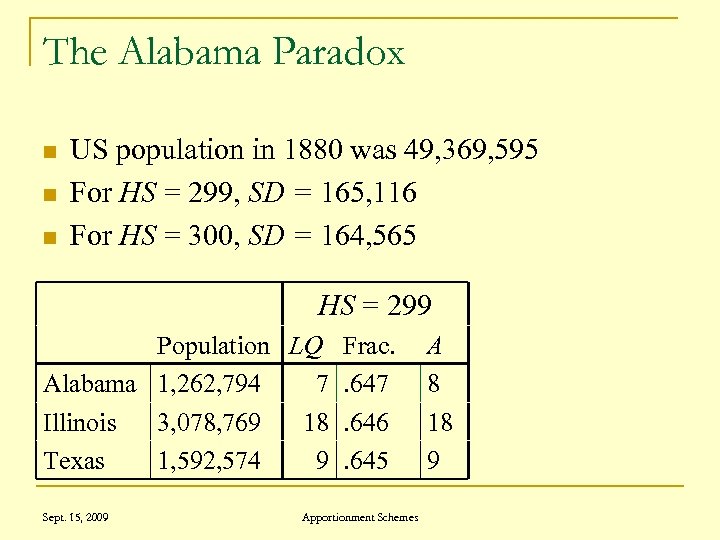 The Alabama Paradox n n n US population in 1880 was 49, 369, 595 For HS = 299, SD = 165, 116 For HS = 300, SD = 164, 565 HS = 299 Population LQ Frac. Alabama 1, 262, 794 7. 647 Illinois 3, 078, 769 18. 646 Texas 1, 592, 574 9. 645 Sept. 15, 2009 Apportionment Schemes A 8 18 9
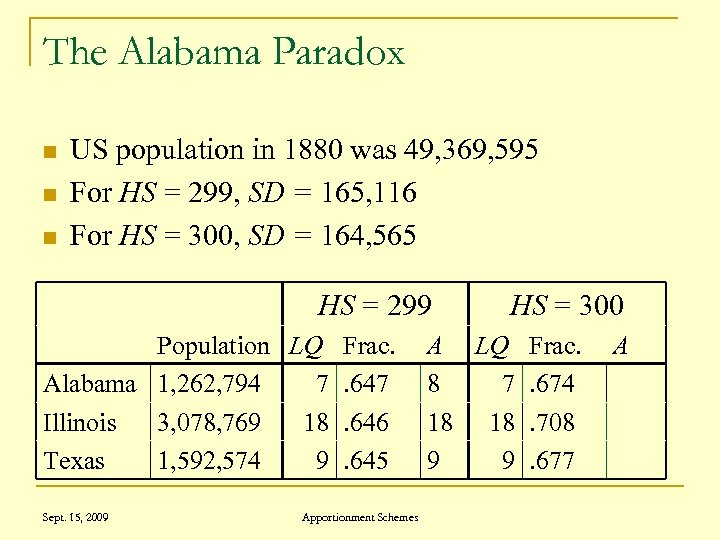 The Alabama Paradox n n n US population in 1880 was 49, 369, 595 For HS = 299, SD = 165, 116 For HS = 300, SD = 164, 565 HS = 299 Population LQ Frac. Alabama 1, 262, 794 7. 647 Illinois 3, 078, 769 18. 646 Texas 1, 592, 574 9. 645 Sept. 15, 2009 Apportionment Schemes HS = 300 A LQ Frac. 8 7. 674 18 18. 708 9 9. 677 A
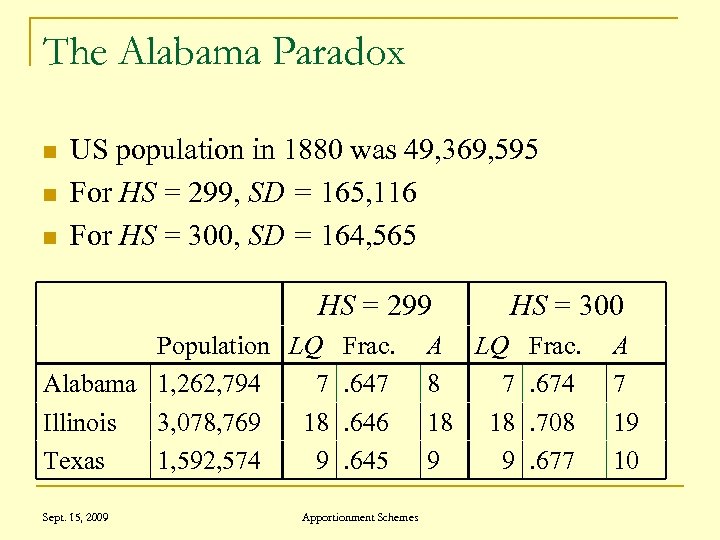 The Alabama Paradox n n n US population in 1880 was 49, 369, 595 For HS = 299, SD = 165, 116 For HS = 300, SD = 164, 565 HS = 299 Population LQ Frac. Alabama 1, 262, 794 7. 647 Illinois 3, 078, 769 18. 646 Texas 1, 592, 574 9. 645 Sept. 15, 2009 Apportionment Schemes HS = 300 A LQ Frac. 8 7. 674 18 18. 708 9 9. 677 A 7 19 10
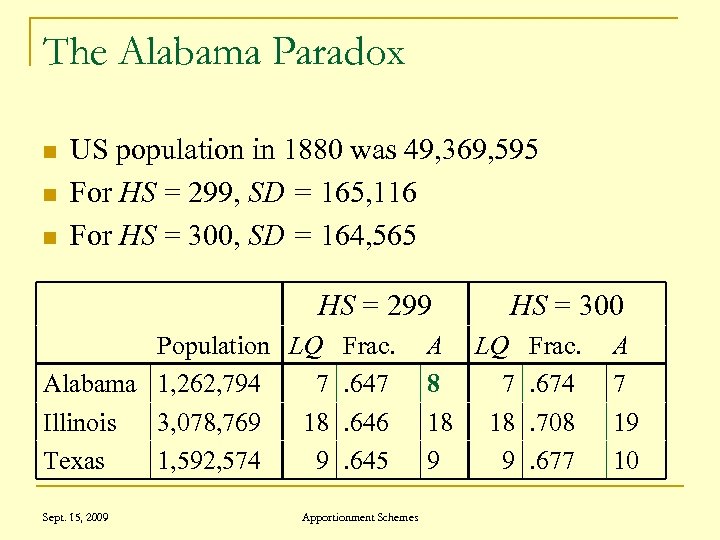 The Alabama Paradox n n n US population in 1880 was 49, 369, 595 For HS = 299, SD = 165, 116 For HS = 300, SD = 164, 565 HS = 299 Population LQ Frac. Alabama 1, 262, 794 7. 647 Illinois 3, 078, 769 18. 646 Texas 1, 592, 574 9. 645 Sept. 15, 2009 Apportionment Schemes HS = 300 A LQ Frac. 8 7. 674 18 18. 708 9 9. 677 A 7 19 10
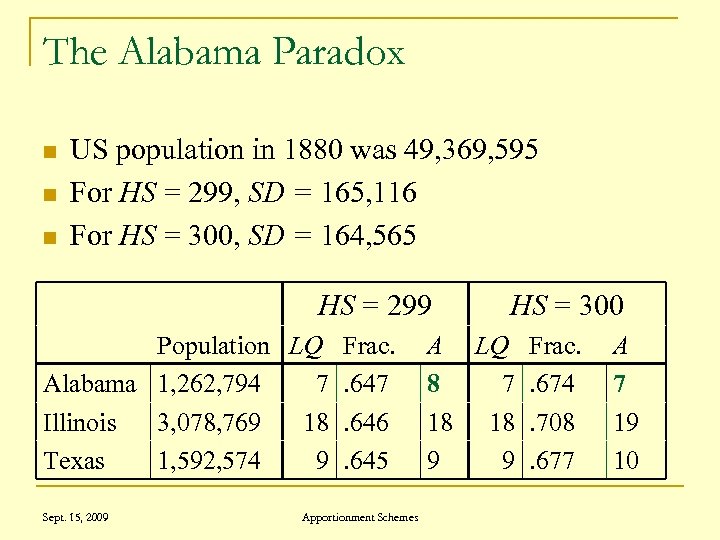 The Alabama Paradox n n n US population in 1880 was 49, 369, 595 For HS = 299, SD = 165, 116 For HS = 300, SD = 164, 565 HS = 299 Population LQ Frac. Alabama 1, 262, 794 7. 647 Illinois 3, 078, 769 18. 646 Texas 1, 592, 574 9. 645 Sept. 15, 2009 Apportionment Schemes HS = 300 A LQ Frac. 8 7. 674 18 18. 708 9 9. 677 A 7 19 10
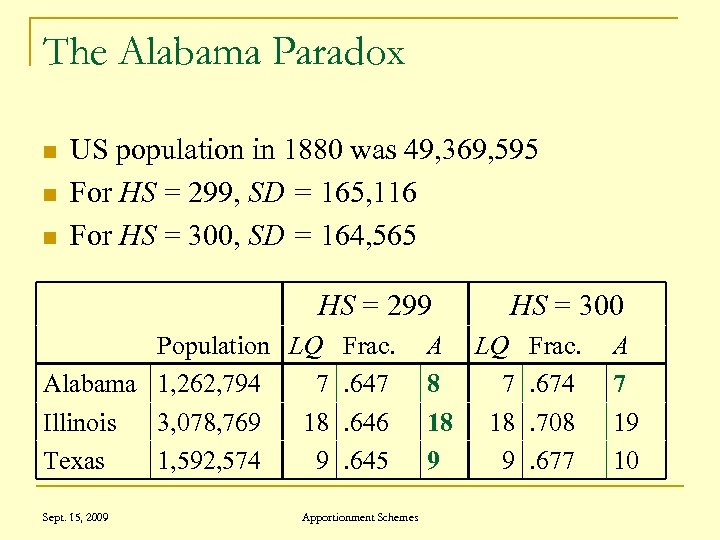 The Alabama Paradox n n n US population in 1880 was 49, 369, 595 For HS = 299, SD = 165, 116 For HS = 300, SD = 164, 565 HS = 299 Population LQ Frac. Alabama 1, 262, 794 7. 647 Illinois 3, 078, 769 18. 646 Texas 1, 592, 574 9. 645 Sept. 15, 2009 Apportionment Schemes HS = 300 A LQ Frac. 8 7. 674 18 18. 708 9 9. 677 A 7 19 10
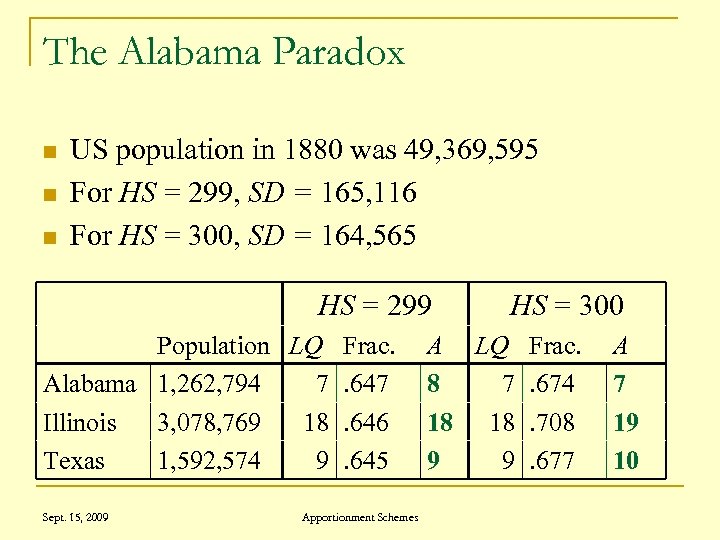 The Alabama Paradox n n n US population in 1880 was 49, 369, 595 For HS = 299, SD = 165, 116 For HS = 300, SD = 164, 565 HS = 299 Population LQ Frac. Alabama 1, 262, 794 7. 647 Illinois 3, 078, 769 18. 646 Texas 1, 592, 574 9. 645 Sept. 15, 2009 Apportionment Schemes HS = 300 A LQ Frac. 8 7. 674 18 18. 708 9 9. 677 A 7 19 10
 Back to 1793… n n This particular issue with the Hamilton Method was not discovered until 1881, but the Constitutional constraints meant that it could not be used in 1793. A new method was proposed by Thomas Jefferson: the Jefferson Method. Sept. 15, 2009 Apportionment Schemes
 Thomas Jefferson n Biographical Information: You know this all already… n Had the good fortune never to take a class in Morton Hall Sept. 15, 2009 Apportionment Schemes
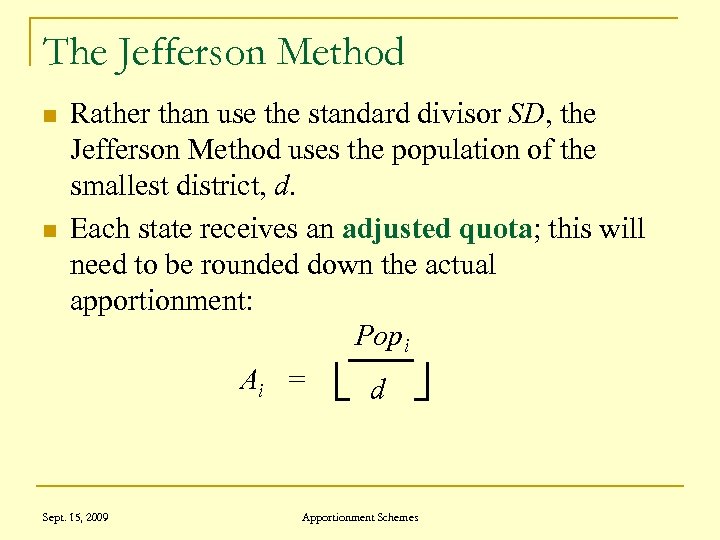 The Jefferson Method n n Rather than use the standard divisor SD, the Jefferson Method uses the population of the smallest district, d. Each state receives an adjusted quota; this will need to be rounded down the actual apportionment: Popi Ai = d ⌊ ⌋ Sept. 15, 2009 Apportionment Schemes
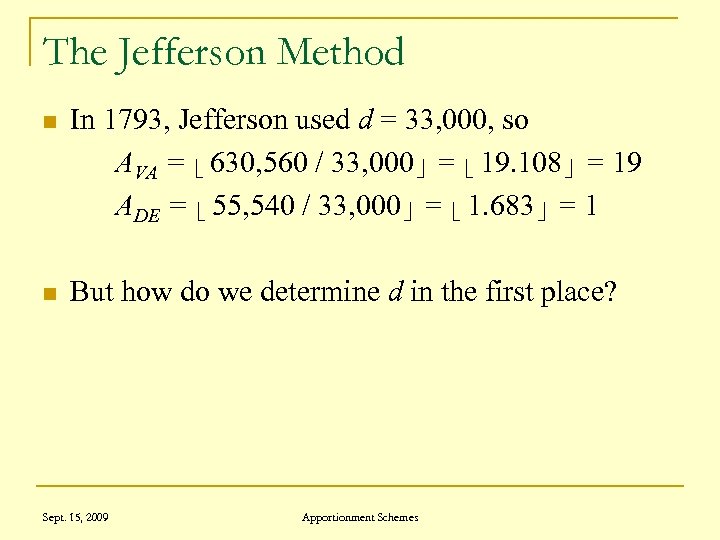 The Jefferson Method n In 1793, Jefferson used d = 33, 000, so AVA = ⌊ 630, 560 / 33, 000⌋ = ⌊ 19. 108⌋ = 19 ADE = ⌊ 55, 540 / 33, 000⌋ = ⌊ 1. 683⌋ = 1 n But how do we determine d in the first place? Sept. 15, 2009 Apportionment Schemes
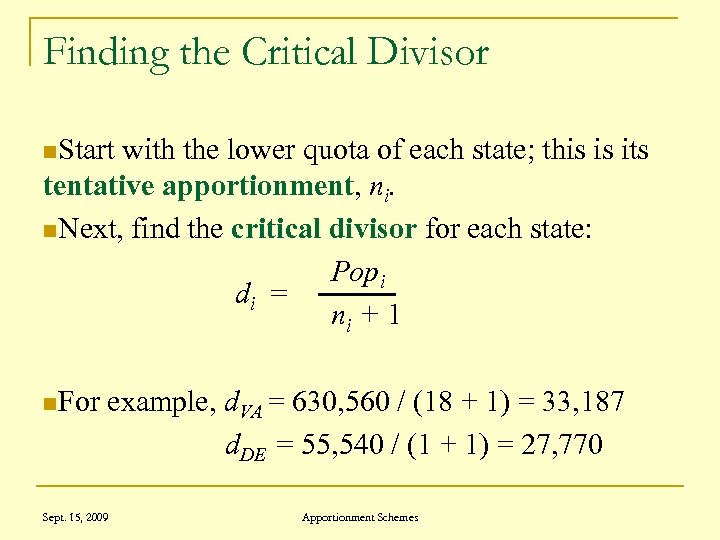 Finding the Critical Divisor n. Start with the lower quota of each state; this is its tentative apportionment, ni. n. Next, find the critical divisor for each state: Popi di = ni + 1 n. For example, d. VA = 630, 560 / (18 + 1) = 33, 187 d. DE = 55, 540 / (1 + 1) = 27, 770 Sept. 15, 2009 Apportionment Schemes
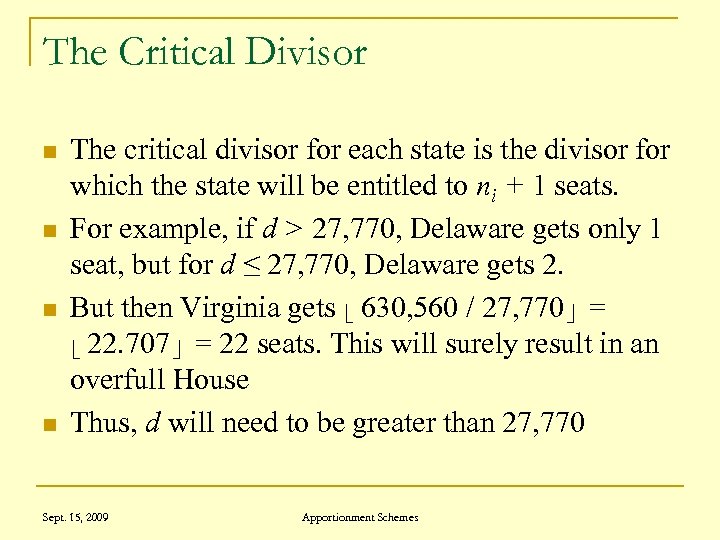 The Critical Divisor n n The critical divisor for each state is the divisor for which the state will be entitled to ni + 1 seats. For example, if d > 27, 770, Delaware gets only 1 seat, but for d ≤ 27, 770, Delaware gets 2. But then Virginia gets ⌊ 630, 560 / 27, 770⌋ = ⌊ 22. 707⌋ = 22 seats. This will surely result in an overfull House Thus, d will need to be greater than 27, 770 Sept. 15, 2009 Apportionment Schemes
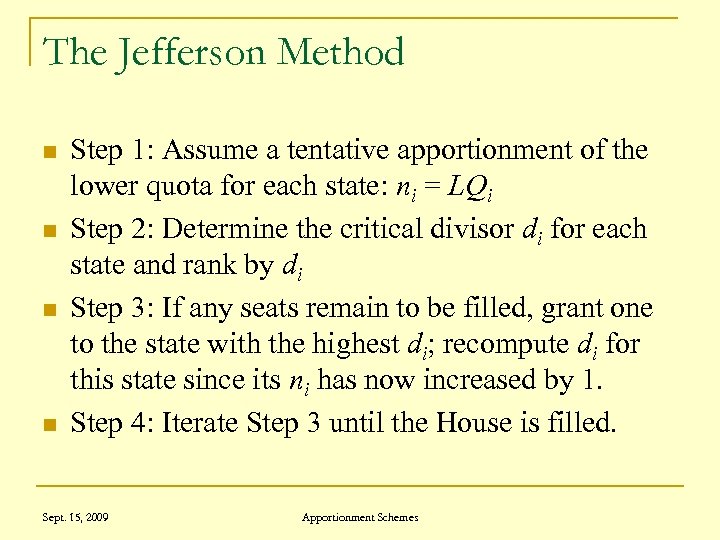 The Jefferson Method n n Step 1: Assume a tentative apportionment of the lower quota for each state: ni = LQi Step 2: Determine the critical divisor di for each state and rank by di Step 3: If any seats remain to be filled, grant one to the state with the highest di; recompute di for this state since its ni has now increased by 1. Step 4: Iterate Step 3 until the House is filled. Sept. 15, 2009 Apportionment Schemes
 The Jefferson Method n n This method actually was used for the 1793 apportionment, and it resulted in Virginia receiving 19 seats to Delaware’s one. Used until about 1840 Not subject to the Alabama paradox But fails to satisfy the quota condition… Sept. 15, 2009 Apportionment Schemes
 The Quota Condition n n The quota condition is twofold: q 1. No state may receive fewer seats than its lower quota q 2. No state may receive more seats than its upper quota The Jefferson Method does just fine with 1, but not 2 Sept. 15, 2009 Apportionment Schemes
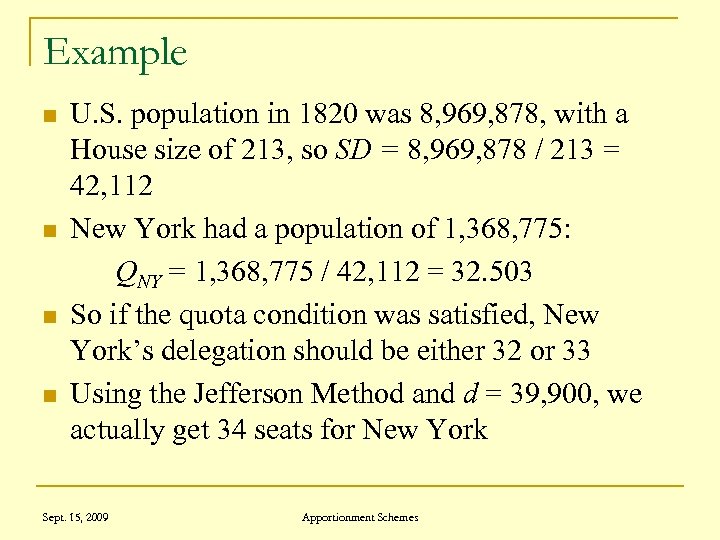 Example n n U. S. population in 1820 was 8, 969, 878, with a House size of 213, so SD = 8, 969, 878 / 213 = 42, 112 New York had a population of 1, 368, 775: QNY = 1, 368, 775 / 42, 112 = 32. 503 So if the quota condition was satisfied, New York’s delegation should be either 32 or 33 Using the Jefferson Method and d = 39, 900, we actually get 34 seats for New York Sept. 15, 2009 Apportionment Schemes
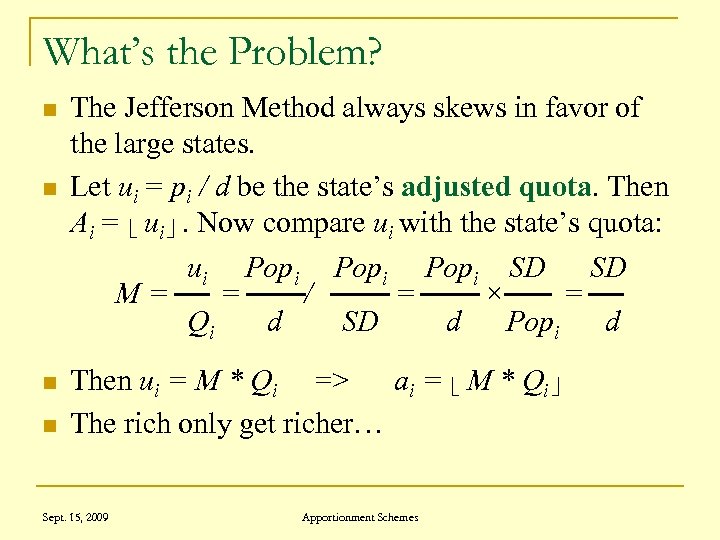 What’s the Problem? n n The Jefferson Method always skews in favor of the large states. Let ui = pi / d be the state’s adjusted quota. Then Ai = ⌊ ui⌋. Now compare ui with the state’s quota: M= n n ui Qi = Popi d / Popi SD = Popi d × SD Popi Then ui = M * Qi => ai = ⌊ M * Qi⌋ The rich only get richer… Sept. 15, 2009 Apportionment Schemes = SD d
 The Webster Method n n Daniel Webster devised an apportionment method that was similar in nature to Jefferson’s, but that did not unconditionally favor large states. Used for 1840 -1850 reapportionments, then 19001930 Sept. 15, 2009 Apportionment Schemes
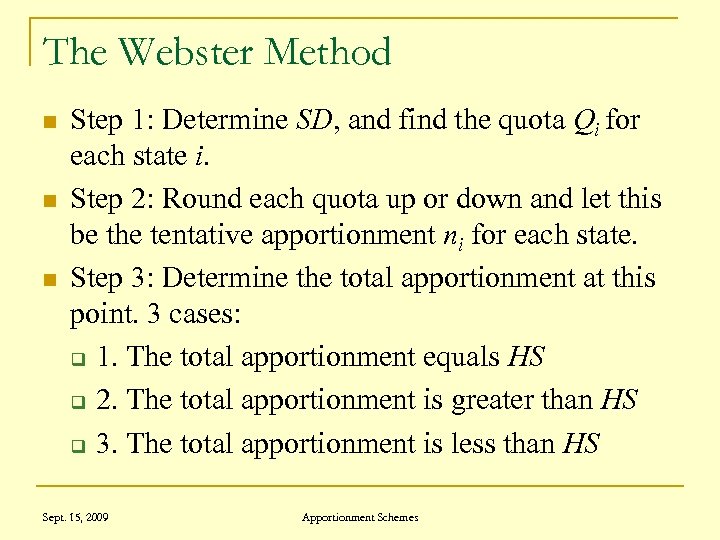 The Webster Method n n n Step 1: Determine SD, and find the quota Qi for each state i. Step 2: Round each quota up or down and let this be the tentative apportionment ni for each state. Step 3: Determine the total apportionment at this point. 3 cases: q 1. The total apportionment equals HS q 2. The total apportionment is greater than HS q 3. The total apportionment is less than HS Sept. 15, 2009 Apportionment Schemes
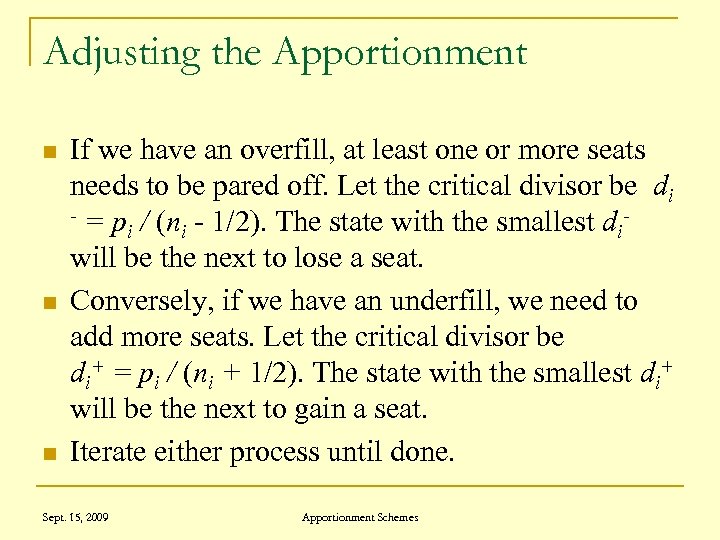 Adjusting the Apportionment n n n If we have an overfill, at least one or more seats needs to be pared off. Let the critical divisor be di - = p / (n - 1/2). The state with the smallest d i i i will be the next to lose a seat. Conversely, if we have an underfill, we need to add more seats. Let the critical divisor be di+ = pi / (ni + 1/2). The state with the smallest di+ will be the next to gain a seat. Iterate either process until done. Sept. 15, 2009 Apportionment Schemes
 Large State Bias n n How does the Webster Method avoid susceptibility to the large-state bias exhibited by the Jefferson Method? We get a similar expression for M: M = SD/d Sept. 15, 2009 Apportionment Schemes
 Large State Bias n n M > 1 when there is an underfill, thus in this circumstance, the larger states are more likely to receive another seat But when there is an overfill and we must subtract, M < 1, and the larger states are more likely to get a seat subtracted Equally likely to get an overfill or underfill Thus, equally likely that the Webster Method will favor neither large nor small Sept. 15, 2009 Apportionment Schemes
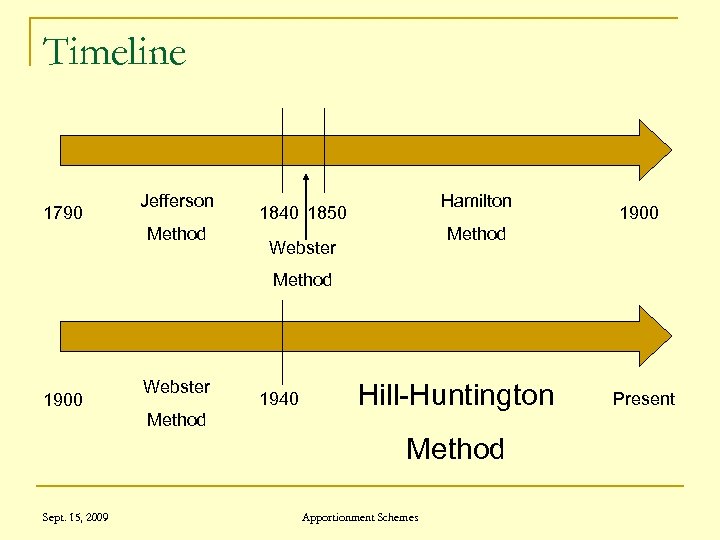 Timeline 1790 Jefferson Method Hamilton 1840 1850 1900 Method Webster Method 1900 Webster Method 1940 Hill-Huntington Method Sept. 15, 2009 Apportionment Schemes Present
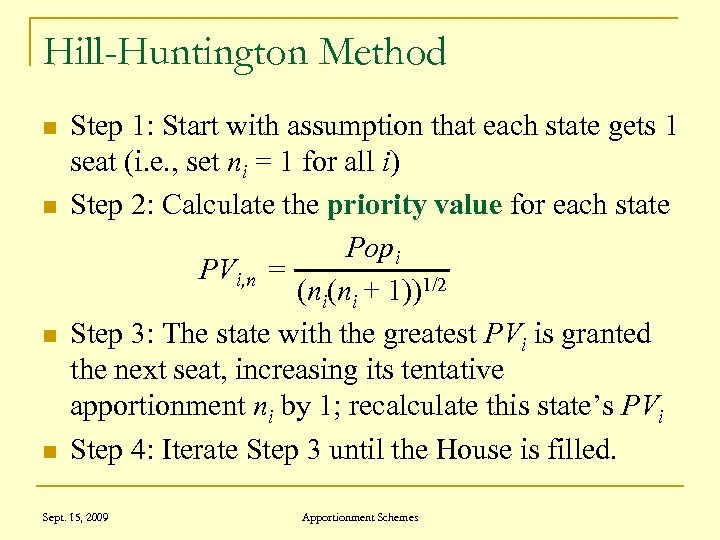 Hill-Huntington Method n n Step 1: Start with assumption that each state gets 1 seat (i. e. , set ni = 1 for all i) Step 2: Calculate the priority value for each state Popi PVi, n = (ni(ni + 1))1/2 Step 3: The state with the greatest PVi is granted the next seat, increasing its tentative apportionment ni by 1; recalculate this state’s PVi Step 4: Iterate Step 3 until the House is filled. Sept. 15, 2009 Apportionment Schemes
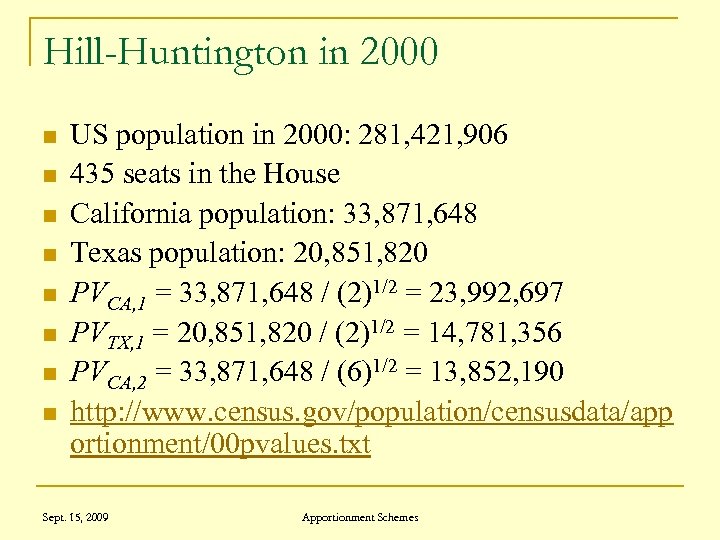 Hill-Huntington in 2000 n n n n US population in 2000: 281, 421, 906 435 seats in the House California population: 33, 871, 648 Texas population: 20, 851, 820 PVCA, 1 = 33, 871, 648 / (2)1/2 = 23, 992, 697 PVTX, 1 = 20, 851, 820 / (2)1/2 = 14, 781, 356 PVCA, 2 = 33, 871, 648 / (6)1/2 = 13, 852, 190 http: //www. census. gov/population/censusdata/app ortionment/00 pvalues. txt Sept. 15, 2009 Apportionment Schemes
 The Population Paradox n n n The Hill-Huntington Method is immune to the Alabama paradox, but may violate the quota condition. In the 1970 s, two mathematicians attempted to devise a method that was immune to both violations, and they did…but another paradox popped up: the population paradox. This paradox occurs when the population of one state increases at a greater rate than others, but fails to gain a seat. Sept. 15, 2009 Apportionment Schemes
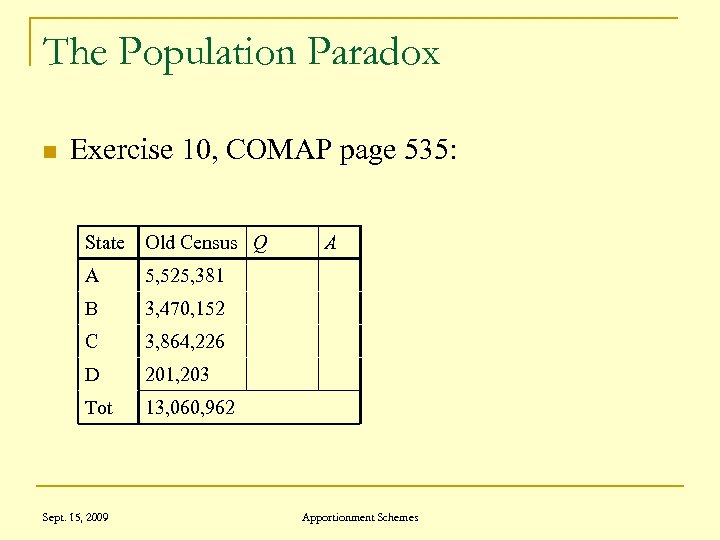 The Population Paradox n Exercise 10, COMAP page 535: State Old Census Q A 5, 525, 381 B 3, 470, 152 C 3, 864, 226 D 201, 203 Tot 13, 060, 962 Sept. 15, 2009 A Apportionment Schemes
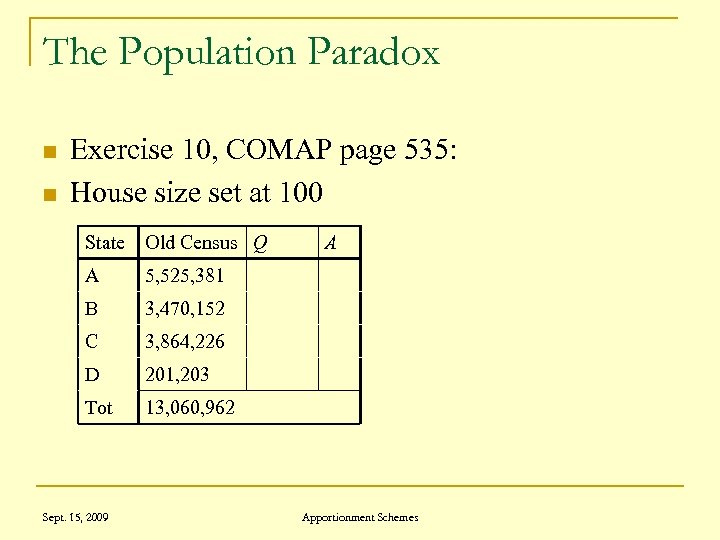 The Population Paradox n n Exercise 10, COMAP page 535: House size set at 100 State Old Census Q A 5, 525, 381 B 3, 470, 152 C 3, 864, 226 D 201, 203 Tot 13, 060, 962 Sept. 15, 2009 A Apportionment Schemes
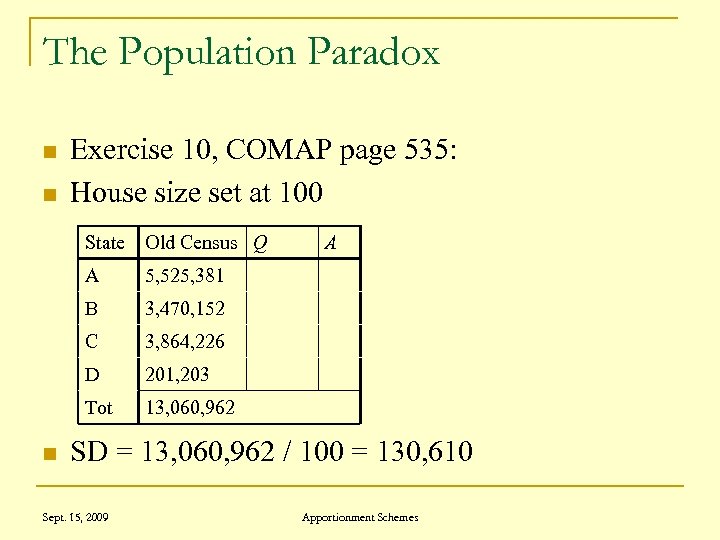 The Population Paradox n n Exercise 10, COMAP page 535: House size set at 100 State A 5, 525, 381 B 3, 470, 152 C 3, 864, 226 D 201, 203 Tot n Old Census Q A 13, 060, 962 SD = 13, 060, 962 / 100 = 130, 610 Sept. 15, 2009 Apportionment Schemes
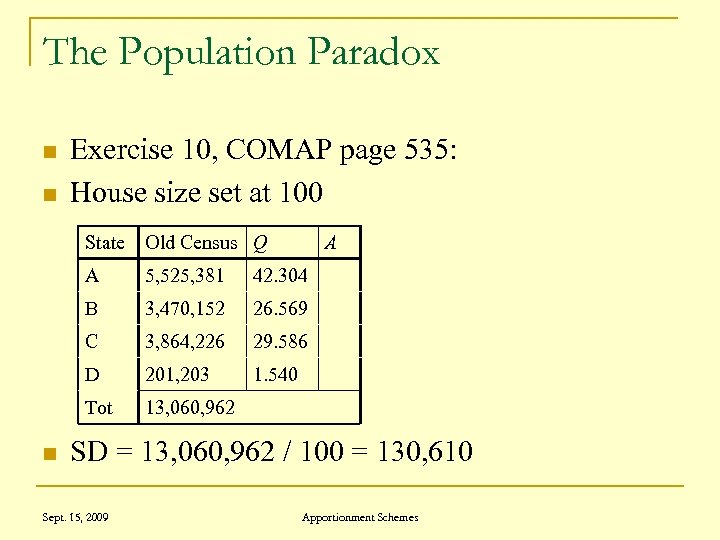 The Population Paradox n n Exercise 10, COMAP page 535: House size set at 100 State A 5, 525, 381 42. 304 B 3, 470, 152 26. 569 C 3, 864, 226 29. 586 D 201, 203 1. 540 Tot n Old Census Q A 13, 060, 962 SD = 13, 060, 962 / 100 = 130, 610 Sept. 15, 2009 Apportionment Schemes
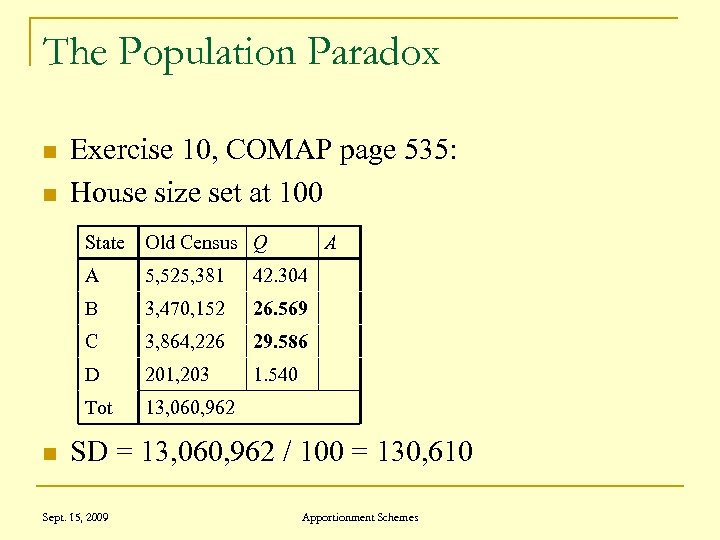 The Population Paradox n n Exercise 10, COMAP page 535: House size set at 100 State A 5, 525, 381 42. 304 B 3, 470, 152 26. 569 C 3, 864, 226 29. 586 D 201, 203 1. 540 Tot n Old Census Q A 13, 060, 962 SD = 13, 060, 962 / 100 = 130, 610 Sept. 15, 2009 Apportionment Schemes
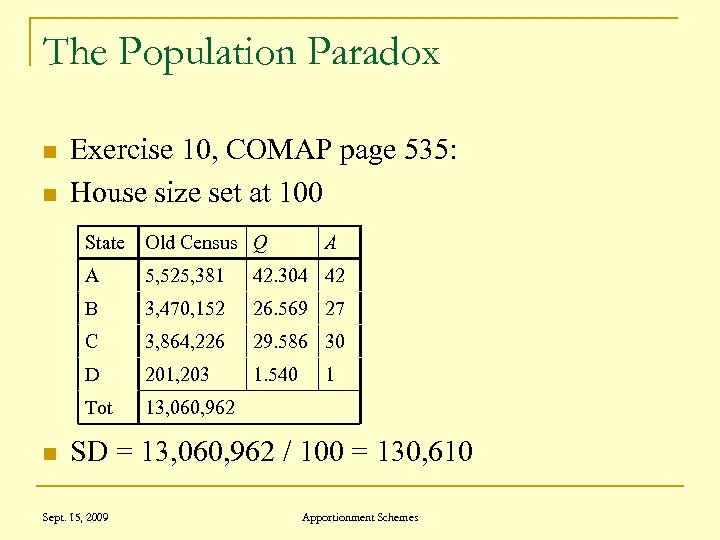 The Population Paradox n n Exercise 10, COMAP page 535: House size set at 100 State A 5, 525, 381 42. 304 42 B 3, 470, 152 26. 569 27 C 3, 864, 226 29. 586 30 D 201, 203 1. 540 Tot n Old Census Q A 13, 060, 962 1 SD = 13, 060, 962 / 100 = 130, 610 Sept. 15, 2009 Apportionment Schemes
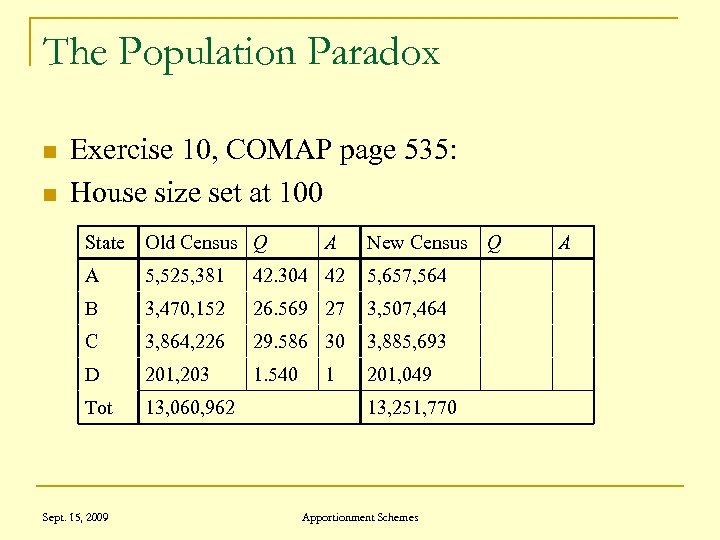 The Population Paradox n n Exercise 10, COMAP page 535: House size set at 100 State Old Census Q A 5, 525, 381 42. 304 42 5, 657, 564 B 3, 470, 152 26. 569 27 3, 507, 464 C 3, 864, 226 29. 586 30 3, 885, 693 D 201, 203 1. 540 201, 049 Tot 13, 060, 962 Sept. 15, 2009 A 1 New Census Q 13, 251, 770 Apportionment Schemes A
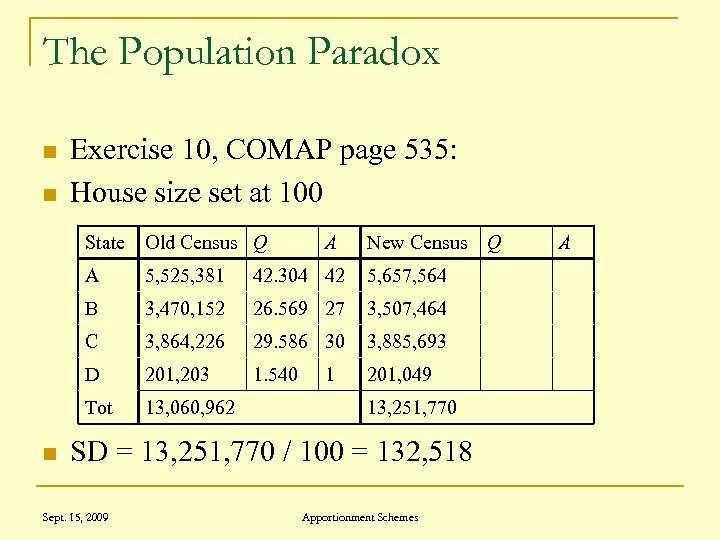 The Population Paradox n n Exercise 10, COMAP page 535: House size set at 100 State A 5, 525, 381 42. 304 42 5, 657, 564 B 3, 470, 152 26. 569 27 3, 507, 464 C 3, 864, 226 29. 586 30 3, 885, 693 D 201, 203 1. 540 201, 049 Tot n Old Census Q A 13, 060, 962 1 New Census Q 13, 251, 770 SD = 13, 251, 770 / 100 = 132, 518 Sept. 15, 2009 Apportionment Schemes A
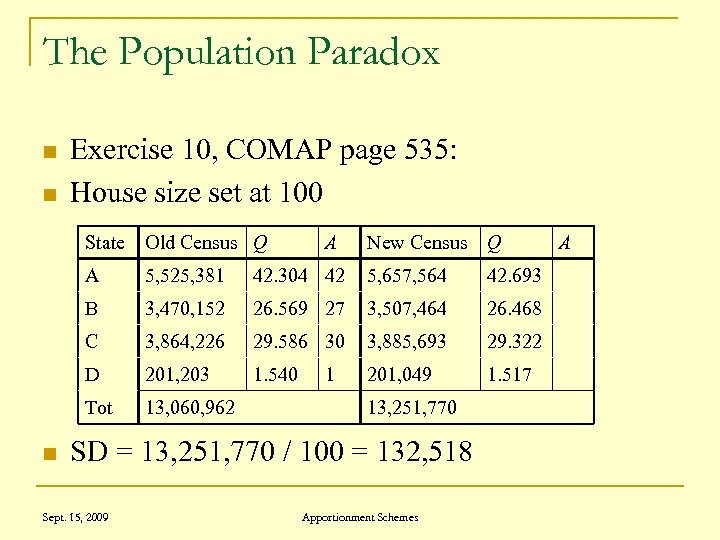 The Population Paradox n n Exercise 10, COMAP page 535: House size set at 100 State A 5, 525, 381 42. 304 42 5, 657, 564 42. 693 B 3, 470, 152 26. 569 27 3, 507, 464 26. 468 C 3, 864, 226 29. 586 30 3, 885, 693 29. 322 D 201, 203 1. 540 201, 049 1. 517 Tot n Old Census Q A 13, 060, 962 1 New Census Q 13, 251, 770 SD = 13, 251, 770 / 100 = 132, 518 Sept. 15, 2009 Apportionment Schemes A
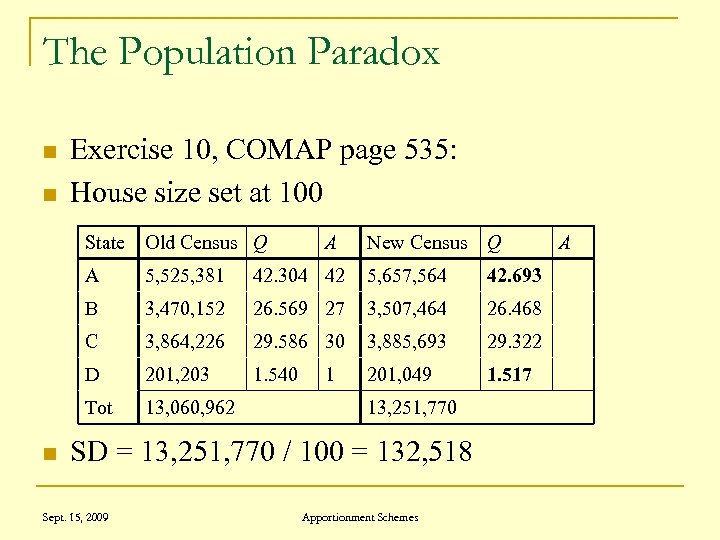 The Population Paradox n n Exercise 10, COMAP page 535: House size set at 100 State A 5, 525, 381 42. 304 42 5, 657, 564 42. 693 B 3, 470, 152 26. 569 27 3, 507, 464 26. 468 C 3, 864, 226 29. 586 30 3, 885, 693 29. 322 D 201, 203 1. 540 201, 049 1. 517 Tot n Old Census Q A 13, 060, 962 1 New Census Q 13, 251, 770 SD = 13, 251, 770 / 100 = 132, 518 Sept. 15, 2009 Apportionment Schemes A
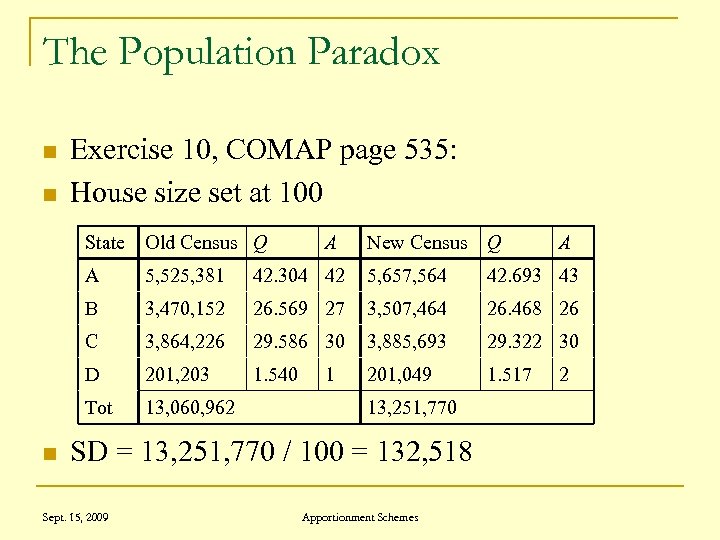 The Population Paradox n n Exercise 10, COMAP page 535: House size set at 100 State A 5, 525, 381 42. 304 42 5, 657, 564 42. 693 43 B 3, 470, 152 26. 569 27 3, 507, 464 26. 468 26 C 3, 864, 226 29. 586 30 3, 885, 693 29. 322 30 D 201, 203 1. 540 201, 049 1. 517 Tot n Old Census Q A 13, 060, 962 1 New Census Q 13, 251, 770 SD = 13, 251, 770 / 100 = 132, 518 Sept. 15, 2009 Apportionment Schemes A 2
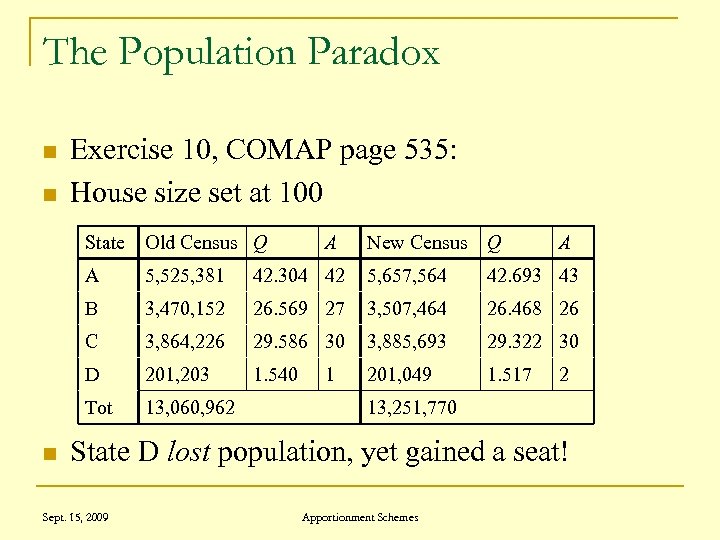 The Population Paradox n n Exercise 10, COMAP page 535: House size set at 100 State A 5, 525, 381 42. 304 42 5, 657, 564 42. 693 43 B 3, 470, 152 26. 569 27 3, 507, 464 26. 468 26 C 3, 864, 226 29. 586 30 3, 885, 693 29. 322 30 D 201, 203 1. 540 201, 049 1. 517 Tot n Old Census Q A 13, 060, 962 1 New Census Q A 2 13, 251, 770 State D lost population, yet gained a seat! Sept. 15, 2009 Apportionment Schemes
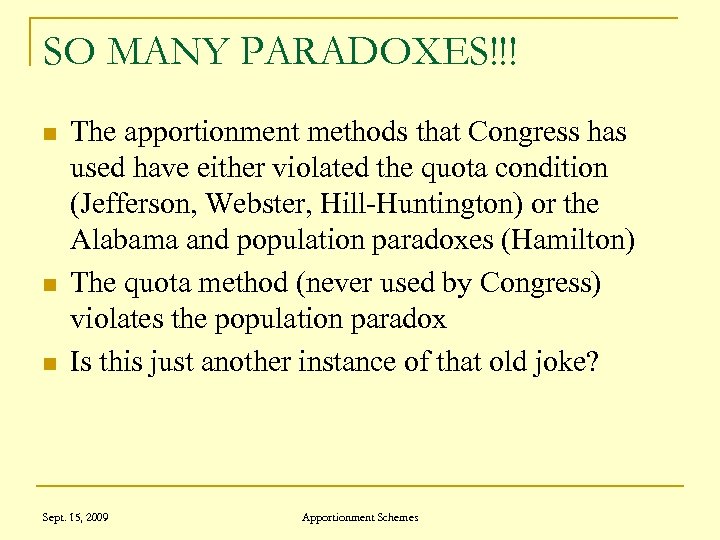 SO MANY PARADOXES!!! n n n The apportionment methods that Congress has used have either violated the quota condition (Jefferson, Webster, Hill-Huntington) or the Alabama and population paradoxes (Hamilton) The quota method (never used by Congress) violates the population paradox Is this just another instance of that old joke? Sept. 15, 2009 Apportionment Schemes
 SO MANY PARADOXES!!! n n It turns out that this is endemic to the situation Theorem “No apportionment method that satisfies the quota condition is free of paradoxes” (COMAP, p. 519) Proof The only methods that are free of paradoxes are the divisor methods (Jefferson, Webster, Hill. Huntington). But the divisor methods are all subject to violating the quota condition. Thus, we are basically screwed. Sept. 15, 2009 Apportionment Schemes
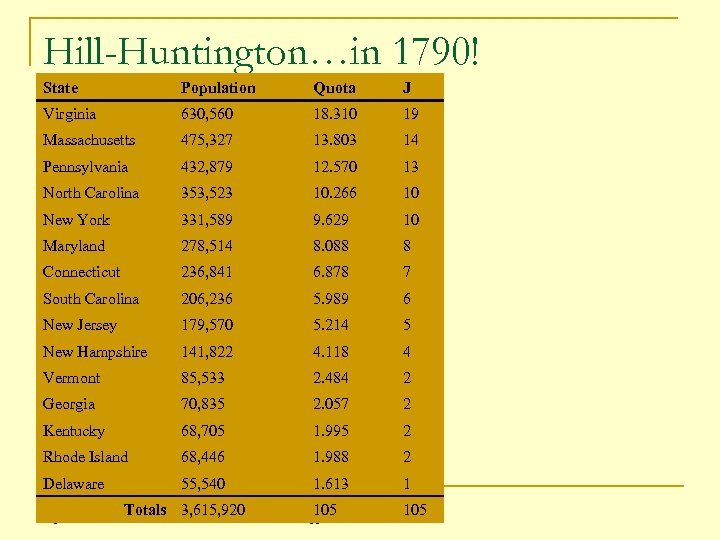 Hill-Huntington…in 1790! State Population Quota J Virginia 630, 560 18. 310 19 Massachusetts 475, 327 13. 803 14 Pennsylvania 432, 879 12. 570 13 North Carolina 353, 523 10. 266 10 New York 331, 589 9. 629 10 Maryland 278, 514 8. 088 8 Connecticut 236, 841 6. 878 7 South Carolina 206, 236 5. 989 6 New Jersey 179, 570 5. 214 5 New Hampshire 141, 822 4. 118 4 Vermont 85, 533 2. 484 2 Georgia 70, 835 2. 057 2 Kentucky 68, 705 1. 995 2 Rhode Island 68, 446 1. 988 2 Delaware 55, 540 1. 613 1 Sept. 15, 2009 Totals 3, 615, 920 105 Apportionment Schemes
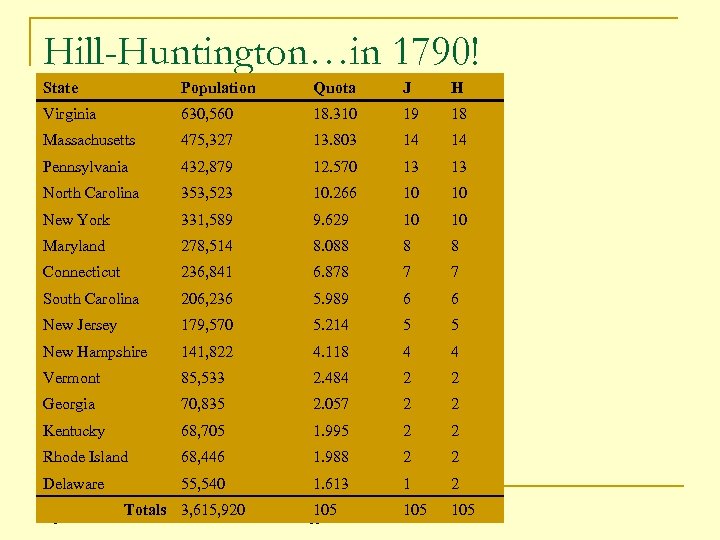 Hill-Huntington…in 1790! State Population Quota J H Virginia 630, 560 18. 310 19 18 Massachusetts 475, 327 13. 803 14 14 Pennsylvania 432, 879 12. 570 13 13 North Carolina 353, 523 10. 266 10 10 New York 331, 589 9. 629 10 10 Maryland 278, 514 8. 088 8 8 Connecticut 236, 841 6. 878 7 7 South Carolina 206, 236 5. 989 6 6 New Jersey 179, 570 5. 214 5 5 New Hampshire 141, 822 4. 118 4 4 Vermont 85, 533 2. 484 2 2 Georgia 70, 835 2. 057 2 2 Kentucky 68, 705 1. 995 2 2 Rhode Island 68, 446 1. 988 2 2 Delaware 55, 540 1. 613 1 2 Sept. 15, 2009 Totals 3, 615, 920 105 Apportionment Schemes 105
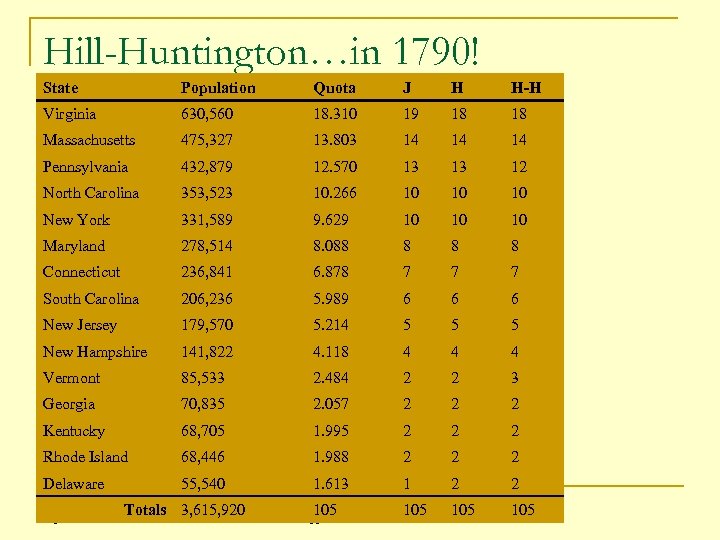 Hill-Huntington…in 1790! State Population Quota J H H-H Virginia 630, 560 18. 310 19 18 18 Massachusetts 475, 327 13. 803 14 14 14 Pennsylvania 432, 879 12. 570 13 13 12 North Carolina 353, 523 10. 266 10 10 10 New York 331, 589 9. 629 10 10 10 Maryland 278, 514 8. 088 8 Connecticut 236, 841 6. 878 7 7 7 South Carolina 206, 236 5. 989 6 6 6 New Jersey 179, 570 5. 214 5 5 5 New Hampshire 141, 822 4. 118 4 4 4 Vermont 85, 533 2. 484 2 2 3 Georgia 70, 835 2. 057 2 2 2 Kentucky 68, 705 1. 995 2 2 2 Rhode Island 68, 446 1. 988 2 2 2 Delaware 55, 540 1. 613 1 2 2 105 Sept. 15, 2009 Totals 3, 615, 920 105 Apportionment Schemes
 The point of the story being… n Delaware should’ve gotten 2 seats. Sept. 15, 2009 Apportionment Schemes
 Selected Sources n n n COMAP, For All Practical Purposes, 7 th ed. (2006), Chapter 14 Wikipedia (multiple pages) http: //www. usconstitution. net/const. html http: //www 2. census. gov/prod 2/statcomp/documen ts/1880 -01. pdf http: //www. ams. org/featurecolumn/archive/apport ion 2. html Sept. 15, 2009 Apportionment Schemes
 Photo Credits Images: n George Washington: http: //www. morallaw. org/images/George%20 Washington%20 portrait. gif n Alexander Hamilton: http: //igs. berkeley. edu/library/hot_topics/2008/Dec. 2008/Images/Alexander_H amilton_portrait_by_John_Trumbull_1806. jpg n Jefferson: http: //www. usnews. com/dbimages/master/3165/FE_DA_080128 moore_vert_2 0410. jpg n Webster: http: //en. wikipedia. org/wiki/Daniel_Webster n Delaware: http: //www. national 5 and 10. com/images/grey%20 Delawhere%20 tshirt. JPG n Virginia: http: //wwp. greenwichmeantime. com/timezone/usa/virginia/images/state-flag-virginia. jpg n Constitution: http: //cache. boston. com/bonzaifba/Globe_Photo/2008/08/15/we__1218837534_8547. jpg n Veto: http: //kraigpaulsen. com/blog/wp-content/uploads/2009/05/veto. png Sept. 15, 2009 Apportionment Schemes