 Скачать презентацию Applying Web Engineering 淡江大學 資訊管理系所 侯 永 昌
21e07982d481069a95292596c7ba852a.ppt
- Количество слайдов: 116




Applying Web Engineering 淡江大學 資訊管理系所 侯 永 昌 http: //mail. im. tku. edu. tw/~ychou ftp: //mail. im. tku. edu. tw/Prof_Hou

Web Engineering 淡江大學資管系所 侯永昌 1
Web Applications § Web. Apps encompass: l l l complete Web sites • Simple information Web sites • Complex e-Commerce of other sites with embedded functionality and data retrieval • Complex Web sites that are interoperable with other legacy software and systems specialized functionality within Web sites information processing applications that reside on the Internet or on an intranet or extranet. 淡江大學資管系所 侯永昌 2
Web. App Attributes—I § Network intensiveness. A Web. App resides on a network and must serve the needs of a diverse community of clients. § Concurrency. A large number of users may access the Web. App at one time; patterns of usage among end-users will vary greatly. § Unpredictable load. The number of users of the Web. App may vary by orders of magnitude from day to day. 淡江大學資管系所 侯永昌 3
Web. App Attributes—II § Performance. If a Web. App user must wait too long (for access, for server-side processing, for client-side formatting and display), he or she may decide to go elsewhere. § Availability. Although expectation of 100 percent availability is unreasonable, users of popular Web. Apps often demand access on a “ 24/7/365” basis. § Data driven. The primary function of many Web. Apps is to use hypermedia to present text, graphics, audio, and video content to the end-user. 淡江大學資管系所 侯永昌 4
Web. App Attributes—III § Content sensitive. The quality and aesthetic nature of content remains an important determinant of the quality of a Web. App. § Continuous evolution. Unlike conventional application software that evolves over a series of planned, chronologically-spaced releases, Web applications evolve continuously. § Immediacy. Web. Apps often exhibit a time to market that can be a matter of a few days or weeks. l With modern tools, sophisticated Web pages can be produced in only a few hours. 淡江大學資管系所 侯永昌 5
Web. App Attributes—IV § Security. In order to protect sensitive content and provide secure modes of data transmission, strong security measures must be implemented throughout the infrastructure that supports a Web. App and within the application itself. § Aesthetics. When an application has been designed to market or sell products or ideas, aesthetics may have as much to do with success as technical design. 淡江大學資管系所 侯永昌 6
Web. App Categories § informational—read-only content is provided with simple navigation and links § download—a user downloads information from the appropriate server § customizable—the user customizes content to specific needs § interaction—communication among a community of users occurs via chatroom, bulletin boards, or instant messaging § user input—forms-based input is the primary mechanism for communicating need 淡江大學資管系所 侯永昌 7
Web. App Categories § transaction-oriented—the user makes a request (e. g. , places an order) that is fulfilled by the Web. App § service-oriented—the application provides a service to the user, e. g. , assists the user in determining a mortgage payment § Portal—the application channels the user to other Web content or services outside the domain of the portal application § database access—the user queries a large database and extracts information § data warehousing—the user queries a collection of large databases and extracts information 淡江大學資管系所 侯永昌 8
Web Engineering “Web development is an adolescent … Like most adolescents, it wants to be accepted as an adult as it tries to pull away from its parents. If it is going to reach its full potential, it must take a few lessons from the more seasoned world of software development. ” Doug Wallace et al 淡江大學資管系所 侯永昌 9
The Web. E Process § Must accommodate: l l l Incremental delivery Frequent changes Short timeline § Therefore, l l An incremental process model should be used in virtually all situations An agile process model is appropriate in many situations 淡江大學資管系所 侯永昌 10
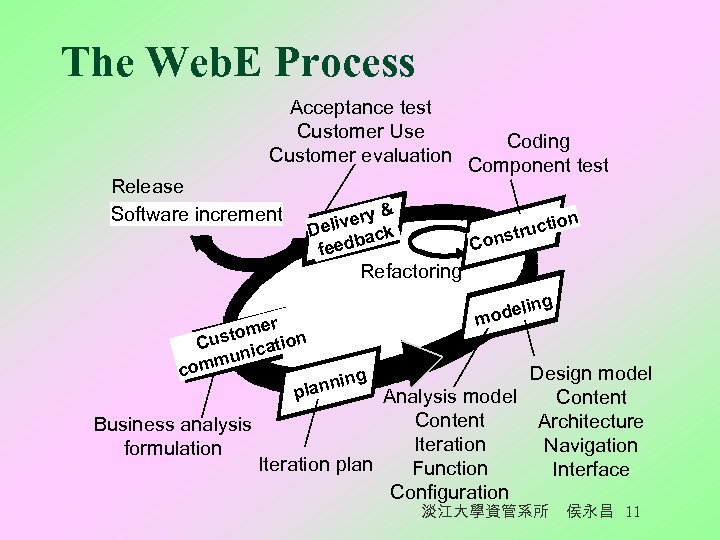
The Web. E Process Acceptance test Customer Use Coding Customer evaluation Component test Release Software increment y& liver k De ac eedb f ion t struc on C Refactoring c er stom tion Cu ica mun om ing el mod Design model Analysis model Content Architecture Business analysis Iteration Navigation formulation Iteration plan Function Interface Configuration ng ni plan 淡江大學資管系所 侯永昌 11
The Web. E Process Framework—I § Customer communication l l Business analysis defines the business/ organizational context for the Web. App. Formulation is a requirements gathering activity involving all stakeholders. The intent is to describe the problem that the Web. App is to solve § Planning l The “plan” consists of a task definition and a timeline schedule for the time period (usually measured in weeks) projected for the development of the Web. App increment. 淡江大學資管系所 侯永昌 12
The Web. E Process Framework—II § Modeling l l Analysis model— establishes a basis for design • Content Analysis. • Interaction Analysis. • Functional Analysis. • Configuration Analysis. Design model— represents key Web. App elements • Interface design • Aesthetic design • Content design • Navigation design • Architectural design • Component design 淡江大學資管系所 侯永昌 13
The Web. E Process Framework—III § Construction l l Web. E tools and technology are applied to construct the Web. App that has been modeled Testing of all design elements § Delivery and Evaluation (Deployment) l l configure for its operational environment deliver to end-users, and Evaluation feedback is presented to the Web. E team the increment is modified as required (the beginning of the next incremental cycle) 淡江大學資管系所 侯永昌 14
Web. E—Basic Questions—I § How important is a Web site home page? § What is the most effective page layout (e. g. , menu on top, on the right or left? ) and does it vary depending upon the type of Web. App being developed? § Which media options (e. g. , graphics, text, images, video or audio? ) have the most impact? § How much work can we expect a user to do when he or she is looking for information? How many clicks are people willing to make? § How important are navigational aids when Web. Apps are complex? 淡江大學資管系所 侯永昌 15
Web. E—Basic Questions—II § How complex can forms input be before it becomes irritating for the user? How can forms input be expedited? § How important are search capabilities? What percentage of users browse, and what percentage use specific searches? How important is it to structure each page in a manner that assumes a link from some outside source? § Will the Web. App be designed in a manner that makes it accessible to those who have physical or other disabilities? Susan Weinshenk 淡江大學資管系所 侯永昌 16
Web. E—Best Practices—I § Take the time to understand the business needs and product objectives, even if the details of the Web. App are vague. § Describe how users will interact with the Web. App using a scenario-based approach § Develop a project plan, even it its very brief. § Spend some time modeling what it is that you’re going to build. § Review the models for consistency and quality. 淡江大學資管系所 侯永昌 17
Web. E—Best Practices—II § Use tools and technology that enable you to construct the system with as many reusable components as possible. § Don’t rely on early users to debug the Web. App— design comprehensive tests and execute them before releasing the system. 淡江大學資管系所 侯永昌 18
Formulation and Planning for Web Engineering 淡江大學資管系所 侯永昌 19
Formulation § § begins with the identification of business need moves into a description of Web. App objectives defines major features and functions establishes a requirements gathering activity that will lead to the development of an analysis model § allows stakeholders and the web engineering team to establish a common set of goals and objectives for the construction of the Web. App. l identifies the scope of the development effort l provides a means for determining a successful, outcome. . 淡江大學資管系所 侯永昌 20
Formulation Questions § What is the main motivation (business need) for the Web. App? § What are the objectives that the Web. App must fulfill? § Who will use the Web. App? Answers provide … § Informational goals—indicate an intention to provide specific content and/or information for the end-user § Applicative goals—indicate the ability to perform some task within the Web. App 淡江大學資管系所 侯永昌 21
Web. E Requirements Gathering § Ask stakeholders to define user categories and develop descriptions for each category § Communicate with stakeholders to define basic Web. App requirements § Analyze information gathered and use information to follow-up with stakeholders § Define use-cases that describe interaction scenarios for each user class 淡江大學資管系所 侯永昌 22
Defining User Categories § What is the user’s overall objective when using the Web. App? § What is the user’s background and sophistication relative to the content and functionality of the Web. App? § How will the user arrive at the Web. App? § What generic Web. App characteristics does the user like/dislike? 淡江大學資管系所 侯永昌 23
Preliminary Analysis § Categorize information gathered by user class and transaction type § Develop lists of … l l content objects operations that are applied to content objects within a specific user transaction functions (e. g. , informational, computational, logical, and help-oriented) that the Web. App provides for end-users other non-functional requirements that are noted during the communication activities. 淡江大學資管系所 侯永昌 24
Use-Cases § Provide the detail necessary to create an effective analysis model § Help the developer to understand how users perceive their interaction with the Web. App § Use-cases help to compartmentalize Web engineering work § Use-cases provide important guidance for those who must test the Web. App 淡江大學資管系所 侯永昌 25
The Web. E Team § Web. E team roles l l l Content Developer/Providers Web Publisher Web Engineer Business domain experts Support Specialist Administrator (a. k. a. “Web Master”) 淡江大學資管系所 侯永昌 26
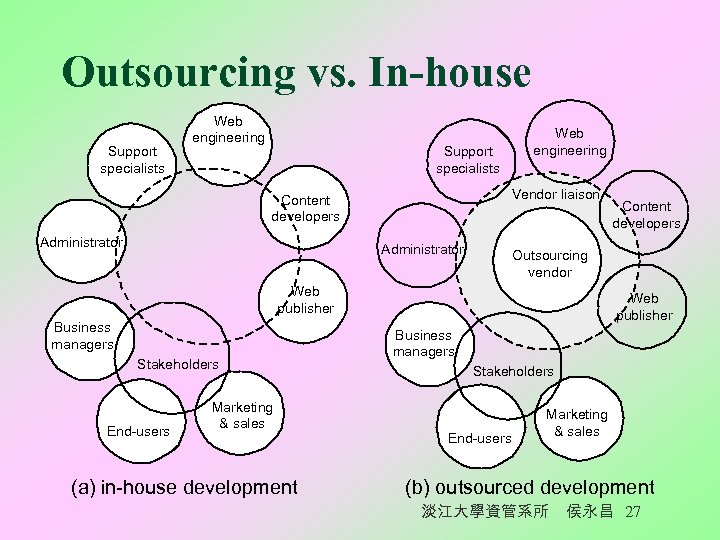
Outsourcing vs. In-house Support specialists Web engineering Support specialists Vendor liaison Content developers Administrator Outsourcing vendor Web publisher Business managers Stakeholders End-users Marketing & sales (a) in-house development Content developers Web publisher Business managers Stakeholders End-users Marketing & sales (b) outsourced development 淡江大學資管系所 侯永昌 27
Web. App Outsourcing - I § Initiate the project by performing the following tasks internally l l l Gather requirements Develop a “rough design” Develop a rough schedule with delivery dates • Consider increments Make a list of responsibilities • For in-house staff • For outsourcing vendor Define liaison mechanisms 淡江大學資管系所 侯永昌 28
Web. App Outsourcing - II § Select candidate outsourcing vendors § Assess the validity of price quotes and the reliability of estimates l l Does the quoted cost of the Web. App provide a direct or indirect return-on-investment that justifies the project? Does the vendor that has provided the quote exhibit the professionalism and experience we require? § Understand the degree of project management you can expect/perform § Assess the development schedule § Manage scope 淡江大學資管系所 侯永昌 29
Web. App Planning - In-House § Understand scope, the dimensions of change, and project constraints § Define an incremental project strategy § Perform risk analysis § Develop a quick estimate § Select a task set (process description) § Establish a schedule § Define project tracking mechanisms § Establish a change management approach 淡江大學資管系所 侯永昌 30
Web. E “Worst Practices” § We have a great idea, so lets begin building the Web. App—now. § Stuff will change constantly, so there’s no point in trying to understand Web. App requirements. § Developers whose dominant experience has been in traditional software development can develop Web. Apps immediately. No new training is required. § Be bureaucratic. § Testing? Why bother? 淡江大學資管系所 侯永昌 31
Analysis Modeling for Web. Apps 淡江大學資管系所 侯永昌 32
Analysis • Content Analysis. The full spectrum of content to be provided by the Web. App is identified, including text, graphics and images, video, and audio data. Data modeling can be used to identify and describe each of the data objects. • Interaction Analysis. The manner in which the user interacts with the Web. App is described in detail. Use-cases can be developed to provide detailed descriptions of this interaction. • Functional Analysis. The usage scenarios (use-cases) created as part of interaction analysis define the operations that will be applied to Web. App content and imply other processing functions. All operations and functions are described in detail. • Configuration Analysis. The environment and infrastructure in which the Web. App resides are described in detail. 淡江大學資管系所 侯永昌 33
When Do We Perform Analysis? § In some Web. E situations, analysis and design merge. However, an explicit analysis activity occurs when … l the Web. App to be built is large and/or complex l the number of stakeholders is large l the number of Web engineers and other contributors is large l the goals and objectives (determined during formulation) for the Web. App will effect the business’ bottom line l the success of the Web. App will have a strong bearing on the success of the business 淡江大學資管系所 侯永昌 34
Refining the Use-Case Model § Use-cases are organized into functional packages § Each package is assessed to ensure that it is: l l Comprehensible—all stakeholders understand the purpose of the package Cohesive—the package addresses functions that are closely related to one another Loosely coupled—functions or classes within the package collaborate with one another, but collaboration outside the package are kept to a minimum. Hierarchically shallow—deep functional hierarchies are difficult to navigate and hard for end-users to understand; therefore, the number of levels within a use-case hierarchy should be minimized whenever possible. 淡江大學資管系所 侯永昌 35
The Content Model § Content objects are extracted from use-cases l examine the scenario description for direct and indirect references to content § Attributes of each content object are identified § The relationships among content objects and/or the hierarchy of content maintained by a Web. App l l Relationships—entity-relationship diagram or UML Hierarchy—data tree or UML 淡江大學資管系所 侯永昌 36
Analysis Classes § Analysis classes are derived by examining each use-case § A grammatical parse is used to identify candidate classes § A UML class diagram is developed for each analysis class 淡江大學資管系所 侯永昌 37
The Interaction Model § Composed of four elements: l l use-cases sequence diagrams state diagrams a user interface prototype 淡江大學資管系所 侯永昌 38
The Functional Model § The functional model addresses two processing elements of the Web. App l l user observable functionality that is delivered by the Web. App to end-users the operations contained within analysis classes that implement behaviors associated with the class. § An activity diagram can be used to represent processing flow 淡江大學資管系所 侯永昌 39
The Configuration Model § Server-side l l l Server hardware and operating system environment must be specified Interoperability considerations on the server-side must be considered Appropriate interfaces, communication protocols and related collaborative information must be specified § Client-side l l Browser configuration issues must be identified Testing requirements should be defined 淡江大學資管系所 侯永昌 40
Navigation Analysis § Navigation analysis—examines how users might access individual elements or groups of elements § Navigation is not only the action of jumping from page to page, but the idea of moving through an information space 淡江大學資管系所 侯永昌 41
Navigation Analysis-I § Should certain elements be easier to reach (require fewer navigation steps) than others? What is the priority for presentation? § Should certain elements be emphasized to force users to navigate in their direction? § Should navigation to related groups of elements be given priority over navigation to a specific element. § Should navigation be accomplished via links, via search-based access, or by some other means? 淡江大學資管系所 侯永昌 42
Navigation Analysis-II § Should a full navigation map or menu (as opposed to a single “back” link or directed pointer) be available at every point in a user’s interaction? § Should navigation design be driven by the most commonly expected user behaviors or by the perceived importance of the defined Web. App elements? 淡江大學資管系所 侯永昌 43
Design Modeling for Web. Apps 淡江大學資管系所 侯永昌 44
Design & Web. Apps § When should we emphasize Web. App design? l l l when content and function are complex when the size of the Web. App encompasses hundreds of content objects, functions, and analysis classes when the success of the Web. App will have a direct impact on the success of the business 淡江大學資管系所 侯永昌 45
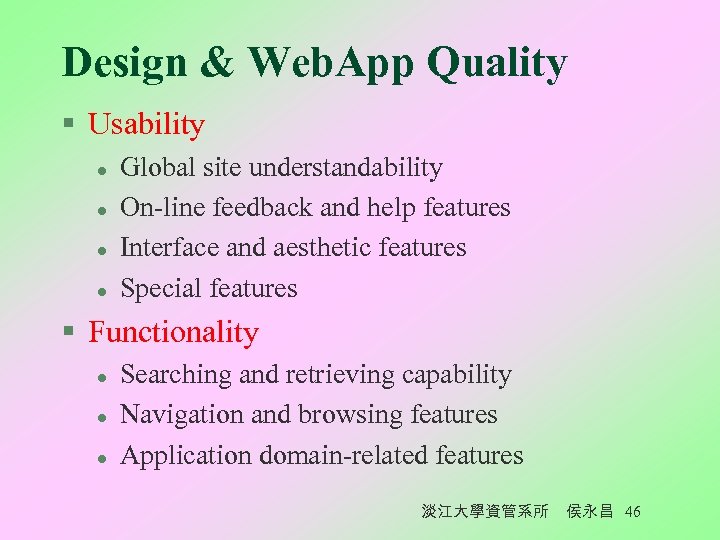
Design & Web. App Quality § Usability l l Global site understandability On-line feedback and help features Interface and aesthetic features Special features § Functionality l l l Searching and retrieving capability Navigation and browsing features Application domain-related features 淡江大學資管系所 侯永昌 46
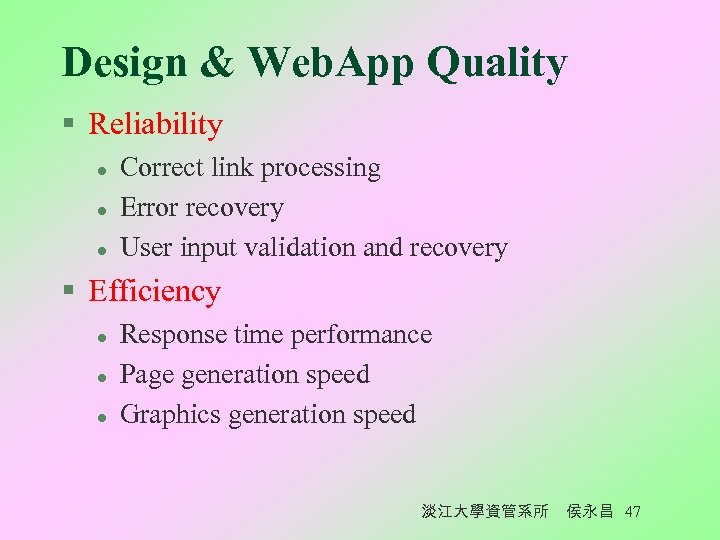
Design & Web. App Quality § Reliability l l l Correct link processing Error recovery User input validation and recovery § Efficiency l l l Response time performance Page generation speed Graphics generation speed 淡江大學資管系所 侯永昌 47
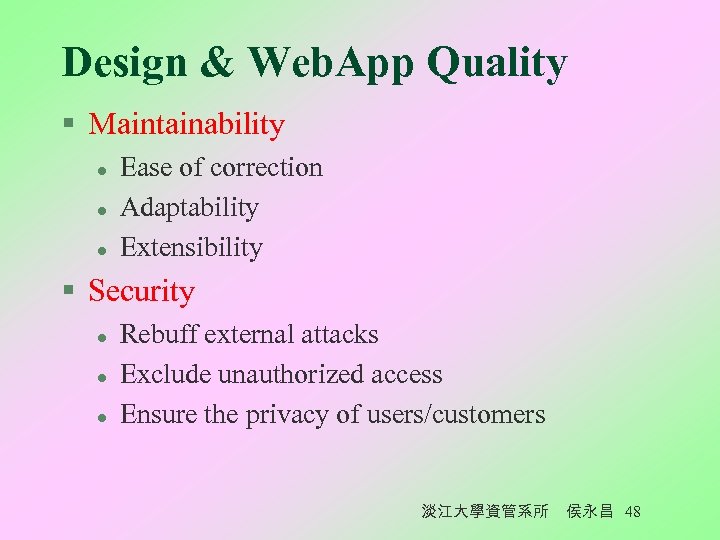
Design & Web. App Quality § Maintainability l l l Ease of correction Adaptability Extensibility § Security l l l Rebuff external attacks Exclude unauthorized access Ensure the privacy of users/customers 淡江大學資管系所 侯永昌 48
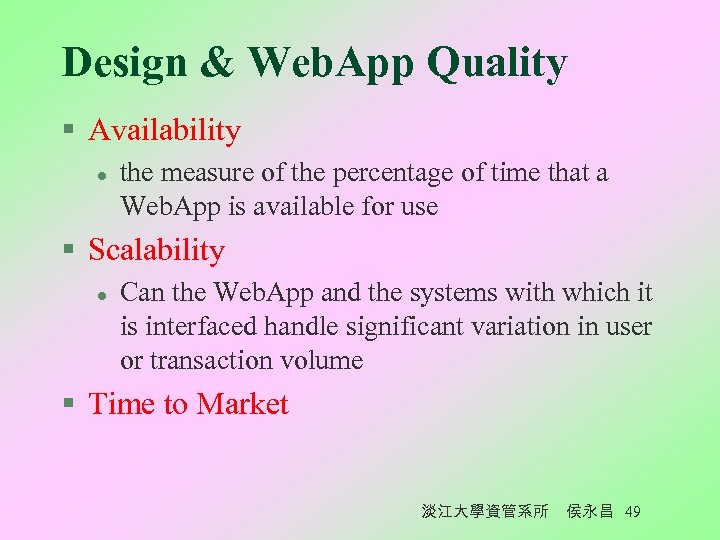
Design & Web. App Quality § Availability l the measure of the percentage of time that a Web. App is available for use § Scalability l Can the Web. App and the systems with which it is interfaced handle significant variation in user or transaction volume § Time to Market 淡江大學資管系所 侯永昌 49

Quality Dimensions for End-Users § Timeliness l How much has a Web site changed since the last upgrade? l How do you highlight the parts that have changed? § Structural l How well do all of the parts of the Web site hold together. l Are all links inside and outside the Web site working? l Do all of the images work? l Are there parts of the Web site that are not connected? 淡江大學資管系所 侯永昌 50
Quality Dimensions for End-Users § Content l Does the content of critical pages match what is supposed to be there? l Do key phrases exist continually in highlychangeable pages? l Do critical pages maintain quality content from version to version? l What about dynamically generated HTML pages? 淡江大學資管系所 侯永昌 51
Quality Dimensions for End-Users § Accuracy and Consistency l Are today's copies of the pages downloaded the same as yesterday's? Close enough? l Is the data presented accurate enough? How do you know? § Response Time and Latency l Does the Web site server respond to a browser request within certain parameters? l In an E-commerce context, how is the end to end response time after a SUBMIT? l Are there parts of a site that are so slow the user declines to continue working on it? 淡江大學資管系所 侯永昌 52

Quality Dimensions for End-Users § Performance l Is the Browser-Web site-Web-Browser connection quick enough? l How does the performance vary by time of day, by load and usage? l Is performance adequate for E-commerce applications? 淡江大學資管系所 侯永昌 53
Web. App Design Goals § Consistency l l l Content should be constructed consistently Graphic design (aesthetics) should present a consistent look across all parts of the Web. App Architectural design should establish templates that lead to a consistent hypermedia structure Interface design should define consistent modes of interaction, navigation and content display Navigation mechanisms should be used consistently across all Web. App elements 淡江大學資管系所 侯永昌 54
Web. App Design Goals § Simplicity l Better to strive for moderation and simplicity § Identity l The aesthetic, interface, and navigation design of a Web. App must be consistent with the application domain for which it is to be built § Robustness l The user expects robust content and functions that are relevant to the user’s needs 淡江大學資管系所 侯永昌 55
Web. App Design Goals § Navigability l designed in a manner that is intuitive and predictable § Visual appeal l the look and feel of content, interface layout, color coordination, the balance of text, graphics and other media, navigation mechanisms must appeal to endusers § Compatibility l With all appropriate environments and configurations 淡江大學資管系所 侯永昌 56
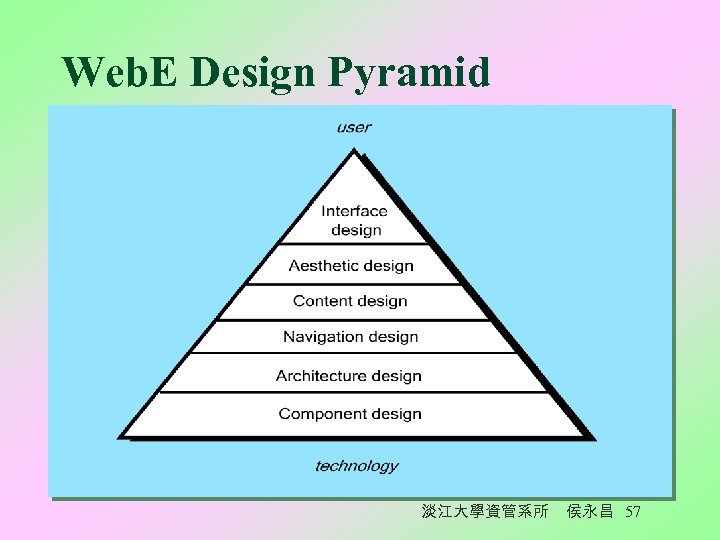
Web. E Design Pyramid 淡江大學資管系所 侯永昌 57
Web. E Design Pyramid § Interface design: describes the structure and organization of the user interface. Includes a representation of screen layout, a definition of the modes of interaction, and a description of navigation mechanisms. § Aesthetic design: also called graphic design, describes the “look and feel” of the Web. App. Includes color schemes, geometric layout, text size, font and placement, the use of graphics, and related aesthetic decisions 淡江大學資管系所 侯永昌 58
Web. E Design Pyramid § Contend design: defines the layout, structure, and outline for all content that is represented as part of the Web. App. Establishes the relationships between content objects. § Navigation design: represents the navigational flow between content objects and for all Web. App functions. § Architecture design: identifies the overall hypermedia structure for the Web. App. § Component design: develops the detailed processing logic required to implement functional components 淡江大學資管系所 侯永昌 59
Web. App Interface Design § Where am I? The interface should l provide an indication of the Web. App that has been accessed l inform the user of her location in the content hierarchy. § What can I do now? The interface should always help the user understand his current options l what functions are available? l what links are live? l what content is relevant? § Where have I been, where am I going? The interface must facilitate navigation. l Provide a “map” (implemented in a way that is easy to understand) of where the user has been and what paths may be taken to move elsewhere within the Web. App. 淡江大學資管系所 侯永昌 60
Interface Design Workflow-I § Review information contained in the analysis model and refine as required. § Develop a rough sketch of the Web. App interface layout. § Map user objectives into specific interface actions. § Define a set of user tasks that are associated with each action. § Storyboard screen images for each interface action. § Refine interface layout and storyboards using input from aesthetic design. 淡江大學資管系所 侯永昌 61
Interface Design Workflow-II § Identify user interface objects that are required to implement the interface. § Develop a procedural representation of the user’s interaction with the interface. § Develop a behavioral representation of the interface. § Describe the interface layout for each state. § Refine and review the interface design model. 淡江大學資管系所 侯永昌 62
Aesthetic Design § Don’t be afraid of white space. § Emphasize content. § Organize layout elements from top-left to bottom right. § Group navigation, content, and function geographically within the page. § Don’t extend your real estate with the scrolling bar. § Consider resolution and browser window size when designing layout. 淡江大學資管系所 侯永昌 63
Content Design § Develops a design representation for content objects § Represents the mechanisms required to instantiate their relationships to one another. § A content object has attributes that include content-specific information and implementation-specific attributes that are specified as part of design 淡江大學資管系所 侯永昌 64
Architecture Design § Content architecture focuses on the manner in which content objects (or composite objects such as Web pages) are structured for presentation and navigation. § Web. App architecture addresses the manner in which the application is structured to manage user interaction, handle internal processing tasks, effect navigation, and present content. § Architecture design is conducted in parallel with interface design, aesthetic design and content design. 淡江大學資管系所 侯永昌 65
Navigation Design § Begins with a consideration of the user hierarchy and related use-cases. Each actor may use the Web. App somewhat differently and therefore have different navigation requirements § As each user interacts with the Web. App, she encounters a series of navigation semantic units (NSUs)—“a set of information and related navigation structures that collaborate in the fulfillment of a subset of related user requirements” which represents the best navigation way or path for users with certain profiles to achieve their desired goal or sub-goal. 淡江大學資管系所 侯永昌 66
Navigation Syntax § Individual navigation link—text-based links, icons, buttons and switches, and graphical metaphors. . § Horizontal navigation bar—lists major content or functional categories in a bar containing appropriate links. In general, between 4 and 7 categories are listed. § Vertical navigation column l lists major content or functional categories l lists virtually all major content objects within the Web. App. 淡江大學資管系所 侯永昌 67
Navigation Syntax § Tabs—a metaphor that is nothing more than a variation of the navigation bar or column, representing content or functional categories as tab sheets that are selected when a link is required. § Site maps—provide an all-inclusive tab of contents for navigation to all content objects and functionality contained within the Web. App. 淡江大學資管系所 侯永昌 68
Component-Level Design § Web. App components implement the following functionality l l perform localized processing to generate content and navigation capability in a dynamic fashion provide computation or data processing capability that are appropriate for the Web. App’s business domain provide sophisticated database query and access establish data interfaces with external corporate systems. 淡江大學資管系所 侯永昌 69
Hypermedia Design Patterns-I § Architectural patterns. l assist in the design of content and Web. App architecture § Component construction patterns. l recommend methods for combining Web. App components (e. g. , content objects, functions) into composite components. § Navigation patterns. l assist in the design of NSUs, navigation links and the overall navigation flow of the Web. App. 淡江大學資管系所 侯永昌 70
Hypermedia Design Patterns-II § Presentation patterns l l l how to organize user interface control functions for better usability how to show the relationship between a interface action and the content objects it affects how to establish effective content hierarchies, and many others. 淡江大學資管系所 侯永昌 71
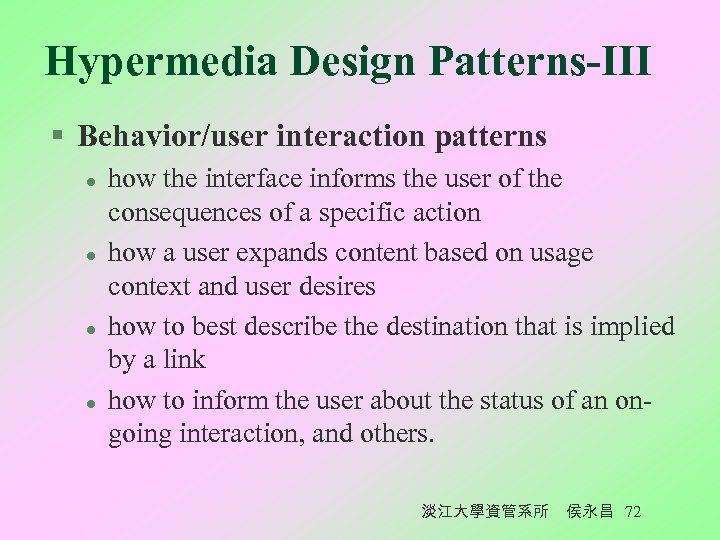
Hypermedia Design Patterns-III § Behavior/user interaction patterns l l how the interface informs the user of the consequences of a specific action how a user expands content based on usage context and user desires how to best describe the destination that is implied by a link how to inform the user about the status of an ongoing interaction, and others. 淡江大學資管系所 侯永昌 72
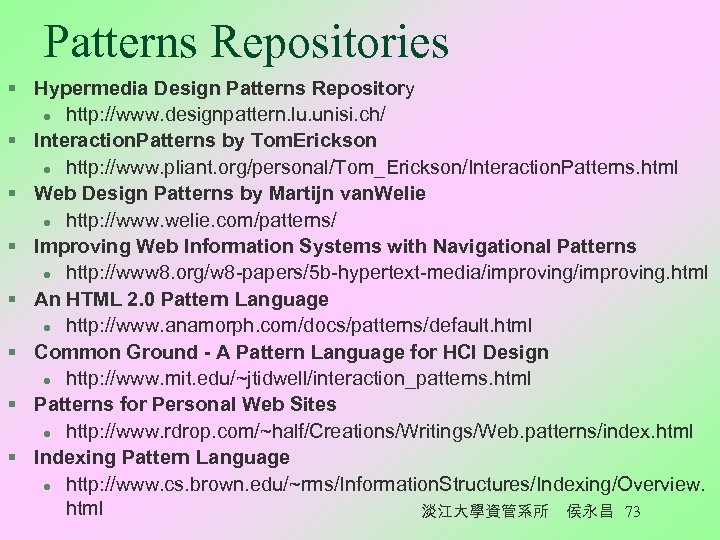
Patterns Repositories § Hypermedia Design Patterns Repository l http: //www. designpattern. lu. unisi. ch/ § Interaction. Patterns by Tom. Erickson l http: //www. pliant. org/personal/Tom_Erickson/Interaction. Patterns. html § Web Design Patterns by Martijn van. Welie l http: //www. welie. com/patterns/ § Improving Web Information Systems with Navigational Patterns l http: //www 8. org/w 8 -papers/5 b-hypertext-media/improving. html § An HTML 2. 0 Pattern Language l http: //www. anamorph. com/docs/patterns/default. html § Common Ground - A Pattern Language for HCI Design l http: //www. mit. edu/~jtidwell/interaction_patterns. html § Patterns for Personal Web Sites l http: //www. rdrop. com/~half/Creations/Writings/Web. patterns/index. html § Indexing Pattern Language l http: //www. cs. brown. edu/~rms/Information. Structures/Indexing/Overview. html 淡江大學資管系所 侯永昌 73
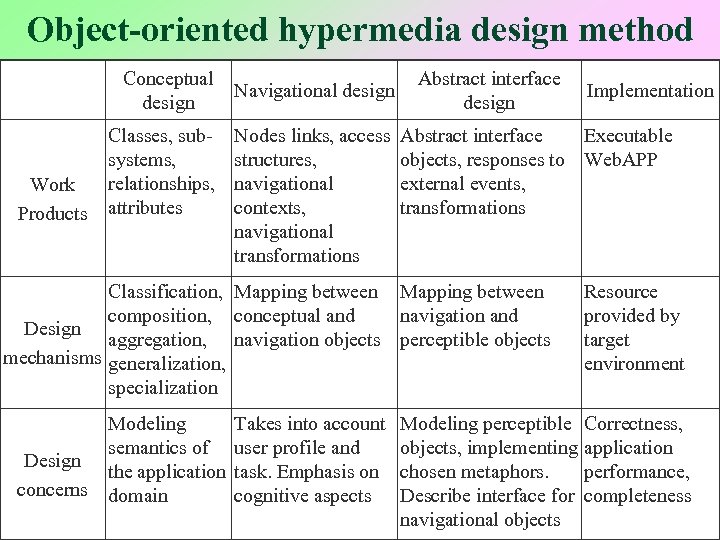
Object-oriented hypermedia design method Conceptual design Work Products Classes, subsystems, relationships, attributes Navigational design Nodes links, access structures, navigational contexts, navigational transformations Abstract interface design Abstract interface Executable objects, responses to Web. APP external events, transformations Classification, Mapping between composition, conceptual and navigation and Design aggregation, navigation objects perceptible objects mechanisms generalization, specialization Modeling semantics of Design the application concerns domain Takes into account user profile and task. Emphasis on cognitive aspects Implementation Resource provided by target environment Modeling perceptible Correctness, objects, implementing application chosen metaphors. performance, Describe interface for completeness 淡江大學資管系所 navigational objects 侯永昌 74
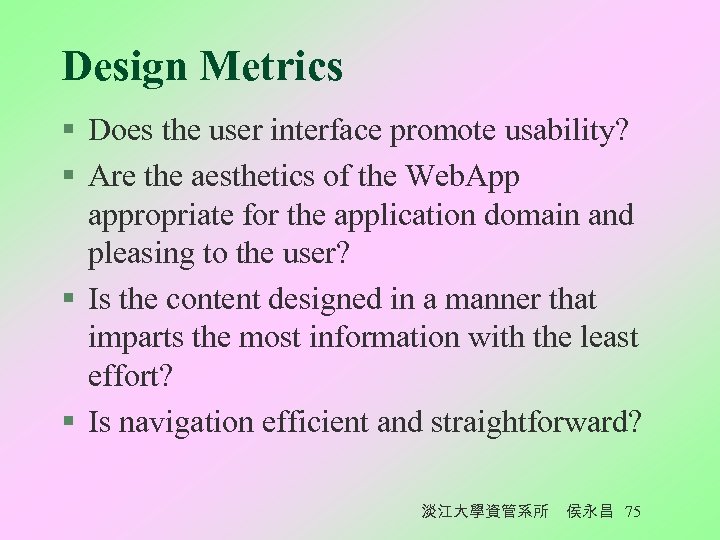
Design Metrics § Does the user interface promote usability? § Are the aesthetics of the Web. App appropriate for the application domain and pleasing to the user? § Is the content designed in a manner that imparts the most information with the least effort? § Is navigation efficient and straightforward? 淡江大學資管系所 侯永昌 75
Design Metrics § Has the Web. App architecture been designed to accommodate the special goals and objectives of Web. App users, the structure of content and functionality, and the flow of navigation required to use the system effectively? § Are components designed in a manner that reduces procedural complexity and enhances the correctness, reliability and performance? 淡江大學資管系所 侯永昌 76
Testing Web Applications 淡江大學資管系所 侯永昌 77
Testing Quality Dimensions-I § Content is evaluated at both a syntactic and semantic level. l syntactic level—spelling, punctuation and grammar are assessed for text-based documents. l semantic level—correctness (of information presented), consistency (across the entire content object and related objects) and lack of ambiguity are all assessed. § Function is tested for correctness, instability, and general conformance to appropriate implementation standards (e. g. , Java or XML language standards). 淡江大學資管系所 侯永昌 78
Testing Quality Dimensions-II § Structure is assessed to ensure that it l properly delivers Web. App content and function l is extensible l can be supported as new content or functionality is added. § Usability is tested to ensure that each category of user l is supported by the interface l can learn and apply all required navigation syntax and semantics 淡江大學資管系所 侯永昌 79

Testing Quality Dimensions-III § Navigability is tested to ensure that l all navigation syntax and semantics are exercised to uncover any navigation errors (e. g. , dead links, improper links, erroneous links). § Performance is tested under a variety of operating conditions, configurations, and loading to ensure that l the system is responsive to user interaction l the system handles extreme loading without unacceptable operational degradation 淡江大學資管系所 侯永昌 80
Testing Quality Dimensions-IV § Compatibility is tested by executing the Web. App in a variety of different host configurations on both the client and server sides. l The intent is to find errors that are specific to a unique host configuration. § Interoperability is tested to ensure that the Web. App properly interfaces with other applications and/or databases. § Security is tested by assessing potential vulnerabilities and attempting to exploit each. l Any successful penetration attempt is deemed a security failure. 淡江大學資管系所 侯永昌 81
Web. App Testing Strategy-I § The content model for the Web. App is reviewed to uncover errors. § The interface model is reviewed to ensure that all use-cases can be accommodated. § The design model for the Web. App is reviewed to uncover navigation errors. § The user interface is tested to uncover errors in presentation and/or navigation mechanics. § Selected functional components are unit tested. 淡江大學資管系所 侯永昌 82
Web. App Testing Strategy-II § Navigation throughout the architecture is tested. § The Web. App is implemented in a variety of different environmental configurations and is tested for compatibility with each configuration. § Security tests are conducted in an attempt to exploit vulnerabilities in the Web. App or within its environment. § Performance tests are conducted. 淡江大學資管系所 侯永昌 83
Web. App Testing Strategy-III § The Web. App is tested by a controlled and monitored population of end-users l the results of their interaction with the system are evaluated for content and navigation errors, usability concerns, compatibility concerns, and Web. App reliability and performance. 淡江大學資管系所 侯永昌 84
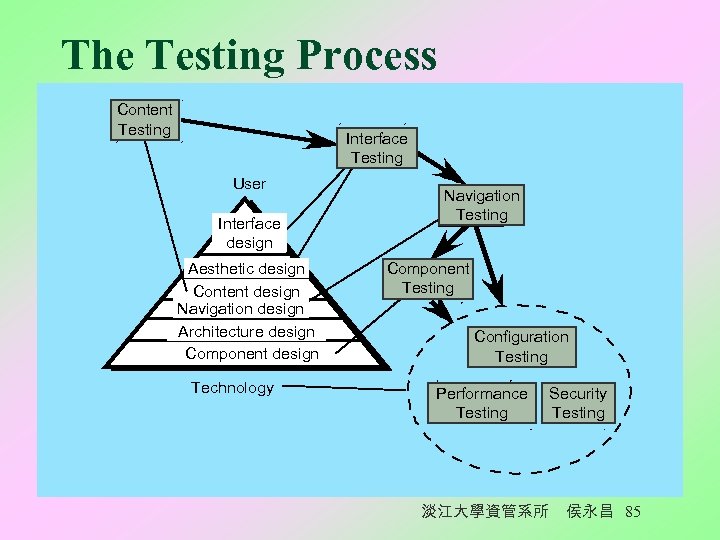
The Testing Process Content Testing Interface Testing User Interface Int erf ace design d esig n Aest het ic esig n Aesthetic ddesign Co nt esig n Content ddesign Navig at io n d esig n Navigation design Archit ect ure design Architectured esig n Co m p o nent d design Componentesig n Technology Navigation Testing Component Testing C o nf i g ur a t i o Configurationn T s t i ng Testing Pe r f o r m a Performance T e s t i ng Testing Security Testing S e c ur i t y T e s t i ng 淡江大學資管系所 侯永昌 85
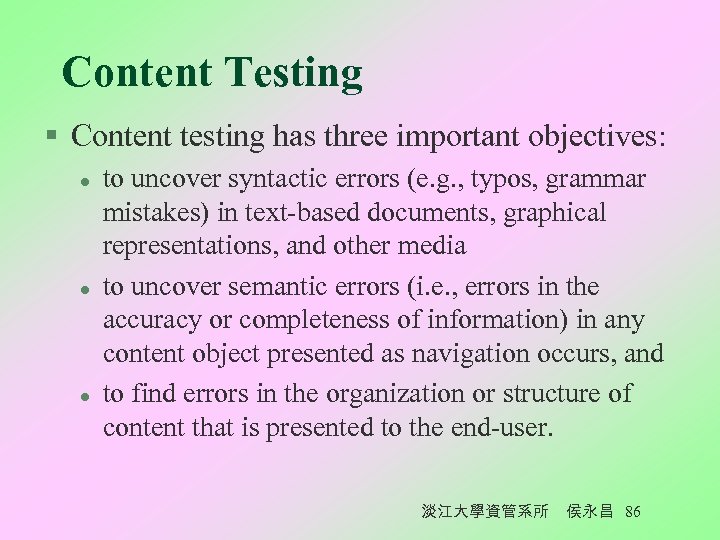
Content Testing § Content testing has three important objectives: l l l to uncover syntactic errors (e. g. , typos, grammar mistakes) in text-based documents, graphical representations, and other media to uncover semantic errors (i. e. , errors in the accuracy or completeness of information) in any content object presented as navigation occurs, and to find errors in the organization or structure of content that is presented to the end-user. 淡江大學資管系所 侯永昌 86
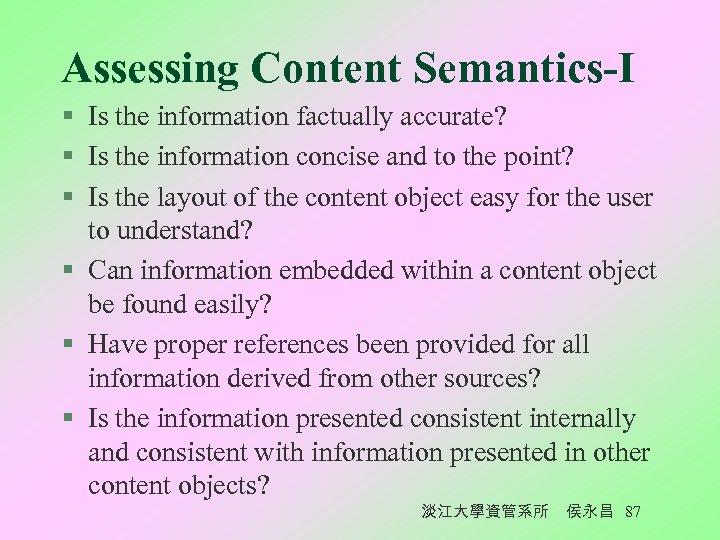
Assessing Content Semantics-I § Is the information factually accurate? § Is the information concise and to the point? § Is the layout of the content object easy for the user to understand? § Can information embedded within a content object be found easily? § Have proper references been provided for all information derived from other sources? § Is the information presented consistent internally and consistent with information presented in other content objects? 淡江大學資管系所 侯永昌 87
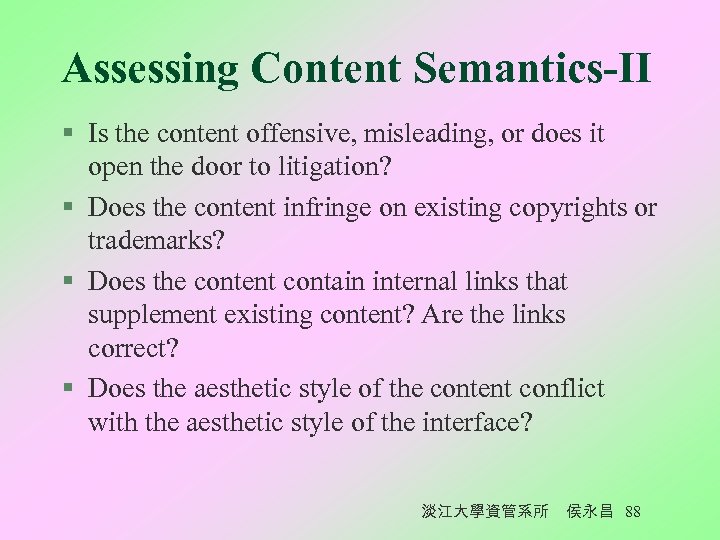
Assessing Content Semantics-II § Is the content offensive, misleading, or does it open the door to litigation? § Does the content infringe on existing copyrights or trademarks? § Does the content contain internal links that supplement existing content? Are the links correct? § Does the aesthetic style of the content conflict with the aesthetic style of the interface? 淡江大學資管系所 侯永昌 88
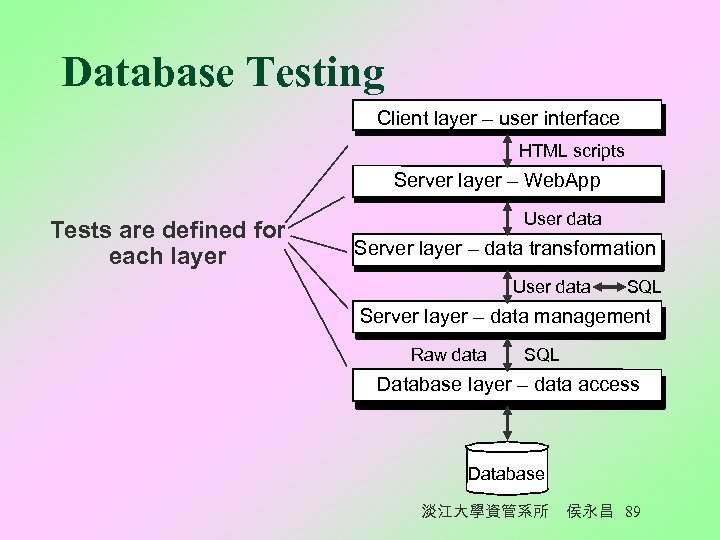
Database Testing Client layer – user interface HTML scripts Server layer – Web. App Tests are defined for each layer User data Server layer – data transformation User data SQL Server layer – data management Raw data SQL Database layer – data access Database 淡江大學資管系所 侯永昌 89
User Interface Testing-I § Interface features are tested to ensure that design rules, aesthetics, and related visual content is available for the user without error. § Individual interface mechanisms are tested in a manner that is analogous to unit testing. § Each interface mechanism is tested within the context of a use-case or navigation semantic units (NSU) for a specific user category. 淡江大學資管系所 侯永昌 90
User Interface Testing-II § The complete interface is tested against selected usecases and NSUs to uncover errors in the semantics of the interface. § The interface is tested within a variety of environments (e. g. , browsers) to ensure that it will be compatible. 淡江大學資管系所 侯永昌 91
Testing Interface Mechanisms-I § Links—navigation mechanisms that link the user to some other content object or function. § Forms—a structured document containing blank fields that are filled in by the user. The data contained in the fields are used as input to one or more Web. App functions. § Client-side scripting—a list of programmed commands in a scripting language (e. g. , Javascript) that handle information input via forms or other user interactions 淡江大學資管系所 侯永昌 92
Testing Interface Mechanisms-II § Dynamic HTML—leads to content objects that are manipulated on the client side using scripting or cascading style sheets (CSS). § Client-side pop-up windows—small windows that pop-up without user interaction. These windows can be content-oriented and may require some form of user interaction. 淡江大學資管系所 侯永昌 93
Testing Interface Mechanisms-III § CGI scripts—a common gateway interface (CGI) script implements a standard method that allows a Web server to interact dynamically with users (e. g. , a Web. App that contains forms may use a CGI script to process the data contained in the form once it is submitted by the user). § Streaming content—rather than waiting for a request from the client-side, content objects are downloaded automatically from the server side. This approach is sometimes called “push” technology because the server pushes data to the client. 淡江大學資管系所 侯永昌 94
Testing Interface Mechanisms-IV § Cookies—a block of data sent by the server and stored by a browser as a consequence of a specific user interaction. The content of the data is Web. Appspecific (e. g. , user identification data or a list of items that have been selected for purchase by the user). § Application specific interface mechanisms—include one or more “macro” interface mechanisms such as a shopping cart, credit card processing, or a shipping cost calculator. 淡江大學資管系所 侯永昌 95
Usability Tests-I § Design by Web. E team … executed by end-users § Testing sequence … l l l Define a set of usability testing categories and identify goals for each. Design tests that will enable each goal to be evaluated. Select participants who will conduct the tests. Instrument participants’ interaction with the Web. App while testing is conducted. Develop a mechanism for assessing the usability of the Web. App 淡江大學資管系所 侯永昌 96
Usability Tests-II § different levels of abstraction: l l l the usability of a specific interface mechanism (e. g. , a form) can be assessed the usability of a complete Web page (encompassing interface mechanisms, data objects and related functions) can be evaluated the usability of the complete Web. App can be considered. 淡江大學資管系所 侯永昌 97
Compatibility Testing-I § Compatibility testing is to define a set of “commonly encountered” client side computing configurations and their variants § Create a tree structure identifying l each computing platform l typical display devices l the operating systems supported on the platform l the browsers available l likely Internet connection speeds l similar information. 淡江大學資管系所 侯永昌 98
Compatibility Testing-II § Derive a series of compatibility validation tests l derived from existing interface tests, navigation tests, performance tests, and security tests. l intent of these tests is to uncover errors or execution problems that can be traced to configuration differences. 淡江大學資管系所 侯永昌 99
Component-Level Testing § Focuses on a set of tests that attempt to uncover errors in Web. App functions § Conventional black-box and white-box test case design methods can be used § Database testing is often an integral part of the component-testing regime 淡江大學資管系所 侯永昌 100
Navigation Testing-I § The following navigation mechanisms should be tested: l l Navigation links—these mechanisms include internal links within the Web. App, external links to other Web. Apps, and anchors within a specific Web page. Redirects—these links come into play when a user requests a non-existent URL or selects a link whose destination has been removed or whose name has changed. 淡江大學資管系所 侯永昌 101
Navigation Testing-II l l l Bookmarks—although bookmarks are a browser function, the Web. App should be tested to ensure that a meaningful page title can be extracted as the bookmark is created. Frames and framesets—tested for correct content, proper layout and sizing, download performance, and browser compatibility Site maps—Each site map entry should be tested to ensure that the link takes the user to the proper content or functionality. 淡江大學資管系所 侯永昌 102

Navigation Testing-III l Internal search engines—Search engine testing validates the accuracy and completeness of the search, the error-handling properties of the search engine, and advanced search features 淡江大學資管系所 侯永昌 103
Testing Navigation Semantics-I § Is the NSU achieved in its entirety without error? § Is every navigation node (defined for a NSU) reachable within the context of the navigation paths defined for the NSU? § If the NSU can be achieved using more than one navigation path, has every relevant path been tested? § If guidance is provided by the user interface to assist in navigation, are directions correct and understandable as navigation proceeds? 淡江大學資管系所 侯永昌 104
Testing Navigation Semantics-II § Is there a mechanism (other than the browser ‘back’ arrow) for returning to the preceding navigation node and to the beginning of the navigation path. § Do mechanisms for navigation within a large navigation node (i. e. , a long web page) work properly? § If a function is to be executed at a node and the user chooses not to provide input, can the remainder of the NSU be completed? § If a function is executed at a node and an error in function processing occurs, can the NSU be 淡江大學資管系所 侯永昌 105 completed?
Testing Navigation Semantics-III § Is there a way to discontinue the navigation before all nodes have been reached, but then return to where the navigation was discontinued and proceed from there? § Is every node reachable from the site map? Are node names meaningful to end-users? § If a node within an NSU is reached from some external source, is it possible to process to the next node on the navigation path. Is it possible to return to the previous node on the navigation path? § Does the user understand his location within the content architecture as the NSU is executed? 淡江大學資管系所 侯永昌 106
Configuration Testing: Server-side § Is the Web. App fully compatible with the server OS? § Are system files, directories, and related system data created correctly when the Web. App is operational? § Do system security measures (e. g. , firewalls or encryption) allow the Web. App to execute and service users without interference or performance degradation? § Has the Web. App been tested with the distributed server configuration (if one exists) that has been chosen? 淡江大學資管系所 侯永昌 107
Configuration Testing: Server-side § Is the Web. App properly integrated with database software? Is the Web. App sensitive to different versions of database software? § Do server-side Web. App scripts execute properly? § Have system administrator errors been examined for their affect on Web. App operations? § If proxy servers are used, have differences in their configuration been addressed with on-site testing? 淡江大學資管系所 侯永昌 108
Configuration Testing: Client-side § Hardware—CPU, memory, storage and printing devices § Operating systems—Linux, Macintosh OS, Microsoft Windows, a mobile-based OS § Browser software—Internet Explorer, Mozilla/ Netscape, Opera, Safari, and others § User interface components—Active X, Java applets and others § Plug-ins—Quick. Time, Real. Player, and many others § Connectivity—cable, DSL, regular modem, T 1 § The number of configuration variables must be reduced to a manageable number 淡江大學資管系所 侯永昌 109

Security Testing § Designed to probe vulnerabilities of the client-side environment, the network communications that occur as data are passed from client to server and back again, and the server-side environment § On the client-side, vulnerabilities can often be traced to pre-existing bugs in browsers, e-mail programs, or communication software. § On the server-side, vulnerabilities include denialof-service attacks and malicious scripts that can be passed along to the client-side or used to disable server operations 淡江大學資管系所 侯永昌 110
Performance Testing-I § Does the server response time degrade to a point where it is noticeable and unacceptable? § At what point (in terms of users, transactions or data loading) does performance become unacceptable? § What system components are responsible for performance degradation? § What is the average response time for users under a variety of loading conditions? § Does performance degradation have an impact on system security? 淡江大學資管系所 侯永昌 111
Performance Testing-II § Is Web. App reliability or accuracy affected as the load on the system grows? § What happens when loads that are greater than maximum server capacity are applied? 淡江大學資管系所 侯永昌 112
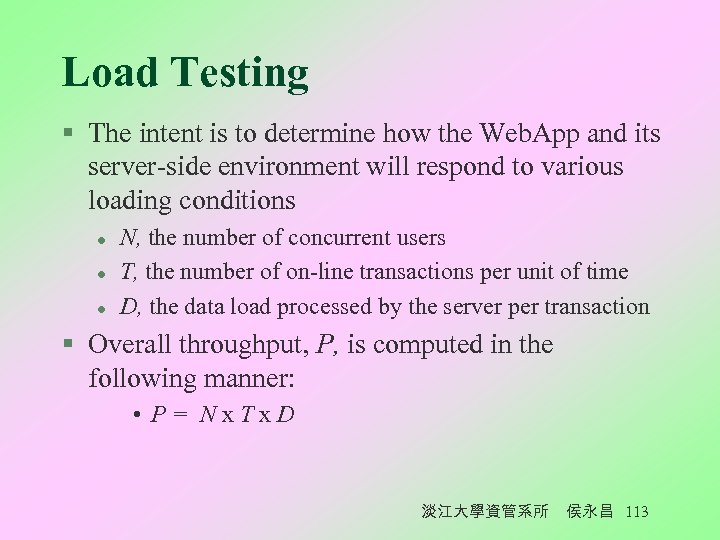
Load Testing § The intent is to determine how the Web. App and its server-side environment will respond to various loading conditions l l l N, the number of concurrent users T, the number of on-line transactions per unit of time D, the data load processed by the server per transaction § Overall throughput, P, is computed in the following manner: • P= Nx. Tx. D 淡江大學資管系所 侯永昌 113
Stress Testing-I § Does the system degrade ‘gently’ or does the server shut down as capacity is exceeded? § Does server software generate “server not available” messages? More generally, are users aware that they cannot reach the server? § Does the server queue requests for resources and empty the queue once capacity demands diminish? § Are transactions lost as capacity is exceeded? § Is data integrity affected as capacity is exceeded? 淡江大學資管系所 侯永昌 114
Stress Testing-II § What values of N, T, and D force the server environment to fail? How does failure manifest itself? Are automated notifications sent to technical support staff at the server site? § If the system does fail, how long will it take to come back on-line? § Are certain Web. App functions (e. g. , compute intensive functionality, data streaming capabilities) discontinued as capacity reaches the 80 or 90 percent level? 淡江大學資管系所 侯永昌 115
Скачать презентацию Applying Web Engineering 淡江大學 資訊管理系所 侯 永 昌
21e07982d481069a95292596c7ba852a.ppt