


 Скачать презентацию Applying Human Factors Principles for an Effective Counting
67fe84d7695c855de0d8daed56468f61.ppt
- Количество слайдов: 21
 Applying Human Factors Principles for an Effective Counting Process Kathleen A. Harder, Ph. D. Center for Human Factors Systems Research and Design University of Minnesota
 Objective • Offer recommendations to help with implementing an effective and reliable count process for use with vaginal delivery. • Present ideas for an effective implementation process.
 When to count? • Baseline Count—An accurate baseline count is essential. It establishes the “bar” for subsequent count(s). – Recommendation—baseline count must be completed for countable items (sponges, sharps, misc. ) placed on the tray before they are used. • When countable items are added to the field. • Whenever there is permanent relief of the Labor and Delivery nurse. (For temporary relief of staff, give update about count at handoff. ) • At the end of the delivery—before the physician or midwife leaves the room.
 Who Counts? • Two people must count together. • One must be an RN, the other must be trained in the count process—when and how to count.
 How to Count?
 Visualizing Counts • Recommendation—both people should concurrently view the items in the count while standing near each other. • Essential to engrain concurrent visualization of the items in the behavior of the co-checkers. • Will be tempting for co-checker to engage in another task while counting which means that he or she is not giving full attention to the items being counted. • If the two people involved in the count do not look at the items together, the double check does not occur— and an error is more likely.
 Verbalizing Counts • Recommendation—The RN and second person trained in count process must count out loud together. • If only one person counts, it is not apparent that the second person is paying sufficient attention. Counting together serves as a double check • Counting together may feel silly, but if they can do a verbal double check at Starbuck’s, then… • The RN and second person trained in the count process must be informed of the importance of verbalizing the count together—provide the rationale.
 Count Sequence • If items are not counted in a scripted sequence, it becomes easier to miss some items. • Recommendations—(1) items should be counted systematically in the same sequence in the baseline and subsequent counts; (2) staff should count items in the order they are listed on a permanently inscribed preformatted white board or count worksheet. – – – Sponges/soft goods Sharps Fetal scalp electrodes Intrauterine pressure catheters Umbilical tapes Etc.
 Count Display • Recommendation—a pre-formatted white board should be used to display the counts of sponges, sharps, and instruments. Then, the whole team can independently view the count record. [Enter added items on a piece of scratch paper (serves as a memory aid) in rooms in which the white board is difficult to access. ] • If the room is too small to accommodate a preformatted white board, then use a count worksheet. • Very important that a standardized method of documenting the counts be implemented and utilized.
 Timeliness of Recording Counts • Very often the RN does not update the count (when countable items are added to field) immediately because he or she is distracted by another task. • This delay is a problem—working memory is easily disrupted, and if the count is not recorded immediately, errors are more likely to occur. • Recommendation—if the nurse is not near the white board, he or she should document the added item on a piece of scratch paper initially, then, as soon as possible, should record the count on the whiteboard, so it can be seen by all the team.
 Hurried Counts • Mistakes are likely to occur when counts are hurried. • Recommendation—the RN and second person trained in the count process should be empowered with the option of calling a for a “Pause for the Count. ” – This might slow the process—however, we believe accurate counts are more important than finishing quickly.
 Distractions • Recommendation—Distractions are always present, but the count process should be given priority. • If a count is interrupted, start again. • Other team members should recognize when a count is occurring and learn not to interrupt.
 The Dedicated Receptacle • Use a dedicated receptacle or area to hold all the sponges/soft goods that will be counted. • Will facilitate ease in retrieving and counting items.
 Count Policy Text • Policies are often difficult to “digest” with regard to content, organization, and clarity. • Write your vaginal delivery count policy to make it more user-friendly from an information processing perspective. • Also write your policy with definitive requirements—using “must” rather than “should. ”
 Policy Implementation Recommendations • Healthcare practitioners are faced with many changes on a weekly basis. – Can lead to information acquisition fatigue • We know that practitioners are sometimes unaware of policy. • We also know there can be problems with communicating policy change. • Because of the frequency of changes some changes may be ignored. • We recommended that changes should be introduced and managed carefully.
 Effective implementation of the process is as important as the process itself.
 Policy Implementation Recommendations • Step 1: Present draft policy to management, physicians, nurses, scrubs • Step 2: Modify policy if necessary • Step 3: Establish a specific policy start date • Step 4: Establish policy review date—moratorium (suggest 12 months) on policy change until review occurs. • Step 5: Disseminate policy—acknowledge with signature and distribute hard copies with treat. • Step 6: Post-implementation monitoring • Step 7: Review policy at end of moratorium.
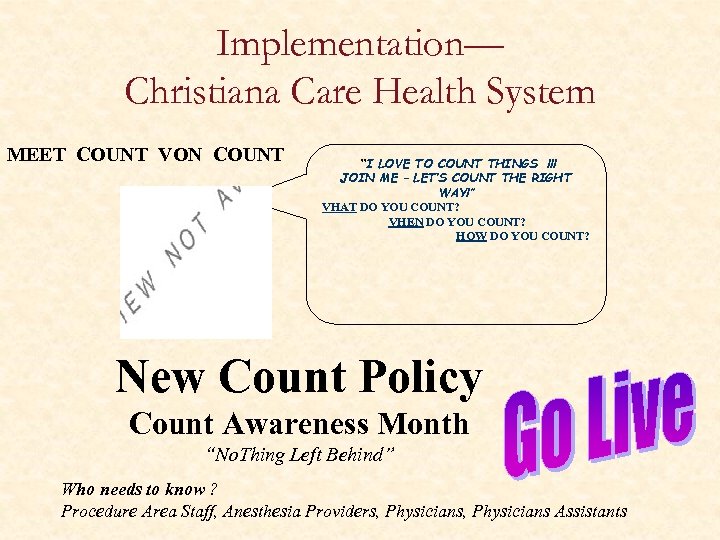 Implementation— Christiana Care Health System MEET COUNT VON COUNT “I LOVE TO COUNT THINGS !!! JOIN ME – LET’S COUNT THE RIGHT WAY!” VHAT DO YOU COUNT? VHEN DO YOU COUNT? HOW DO YOU COUNT? New Count Policy Count Awareness Month “No. Thing Left Behind” Who needs to know ? Procedure Area Staff, Anesthesia Providers, Physicians Assistants
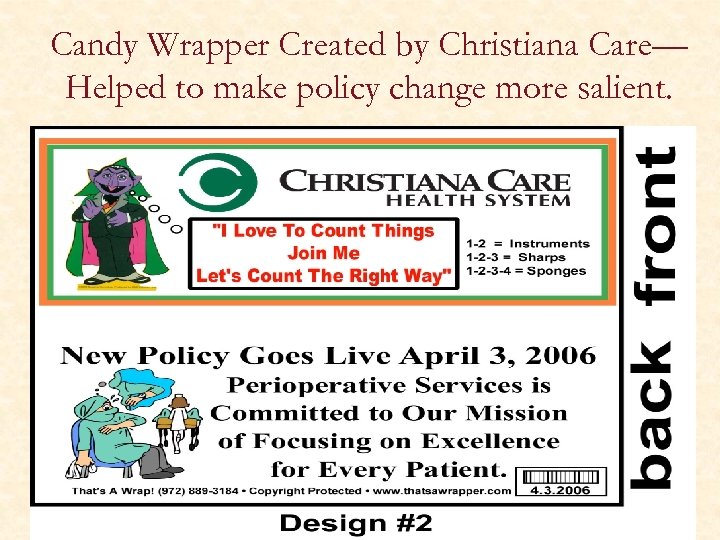 Candy Wrapper Created by Christiana Care— Helped to make policy change more salient.
 Goal • Develop a more rigorous and reliable count process to be used with vaginal delivery— emphasis on standardization. • Effectively implement the count process—all staff should understand what is expected of them.
 Thank you!