


 Скачать презентацию Applying for an Emergency Medicine Residency American College
54f1b787fc91e95ebf1702685f50109b.ppt
- Количество слайдов: 38
 Applying for an Emergency Medicine Residency American College of Emergency Physicians 1
 Goals • • How to prepare before you apply Choosing a program The application process The interview 2
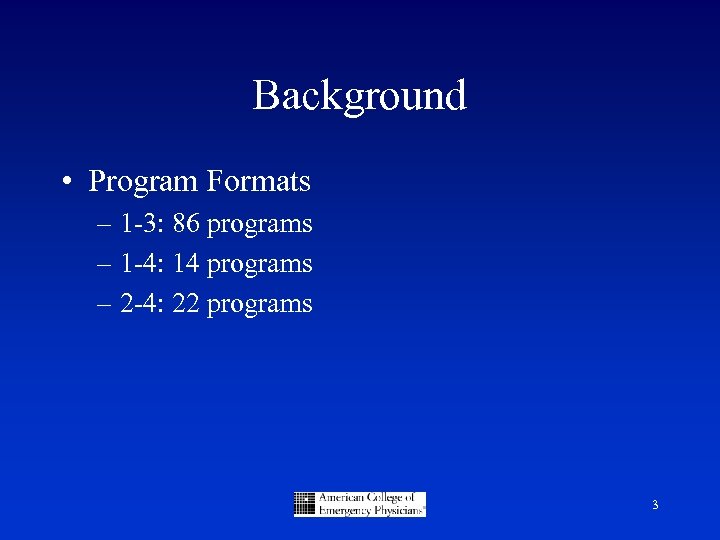 Background • Program Formats – 1 -3: 86 programs – 1 -4: 14 programs – 2 -4: 22 programs 3
 Homework • • Browse the web Know who’s who in EM Know the major clinical issues facing EM National EM organization membership – Including your local EM interest group 4
 Homework • Choose your mentor well • Carefully plan your final medical school years • Read the Macy report on EM • Purchase : Getting Into a Residency: A Guide for Medical Students • Talk to graduates/seniors from your school 5
 Browse the Web • • • Most EM program information is on line Most residencies have home pages Can contact programs via e-mail Can participate in EM discussion groups Many lectures are now electronic www. saem. org/rescat/contents 6
 Who’s Who in EM • • • Tintinalli and Rosen chapter authors Editorial boards of EM journals Keynote speakers National leaders Recurrent conference lecturers 7
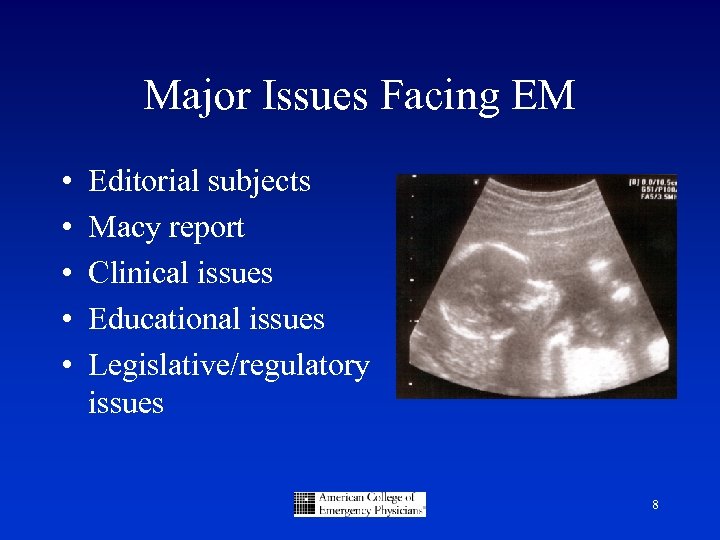 Major Issues Facing EM • • • Editorial subjects Macy report Clinical issues Educational issues Legislative/regulatory issues 8
 Emergency Medicine Organizations • American College of Emergency Physicians • Society for Academic Emergency Medicine • American Academy of Emergency Medicine • Emergency Medicine Residents’ Association 9
 Ken Iserson’s: Getting into a residency • • • Application process CVs Personal statements Letters of recommendation Interviewing tips 10
 Extra Credit • Participate in research – Know the details • EMS ride along • Leadership role in EM interest group 11
 The Match • • • 2000 NRMP data 971 PGY-I EM positions 794 (81. 7%) filled by US graduates 966 (99. 4%) filled in match 122 allopathic programs; 25 AOA programs 12
 Choosing a Program: The Big Picture • RRC role – Consistent educational elements – Ensures adequate exposure to various clinical scenarios • Your role – Maximize learning – (Have fun) 13
 Maximize Learning • Location – Hobbies – Spouse/SO • Educational/Teaching philosophy – County, community, private – Reading vs patient-based 14
 Maximize Learning • Special interests – Fellowship opportunities – EMS/Flight experience – HBO – International – Ultrasound – Will the program meet your needs? 15
 The Big Picture • Program accreditation • Length of re-certification – on probation • Financial stability 16
 The Application: “Begin with the End in Mind” • • • Dean’s letter Board scores Academic record Personal statement Letters of recommendation Outside interests/activities 17
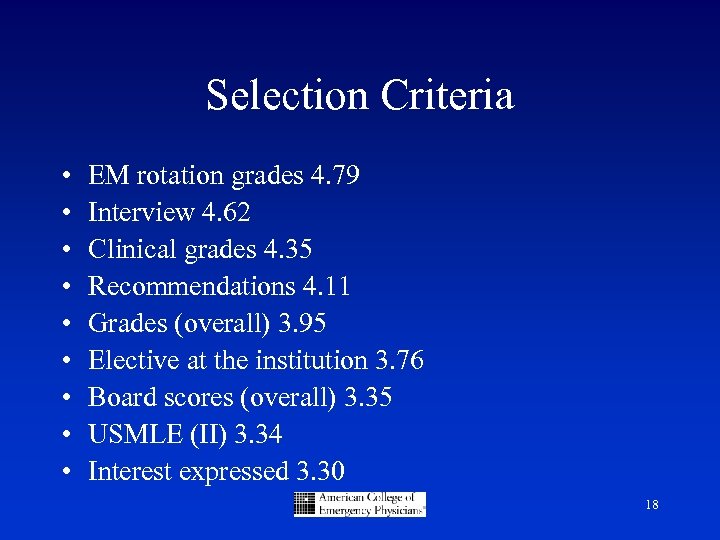 Selection Criteria • • • EM rotation grades 4. 79 Interview 4. 62 Clinical grades 4. 35 Recommendations 4. 11 Grades (overall) 3. 95 Elective at the institution 3. 76 Board scores (overall) 3. 35 USMLE (II) 3. 34 Interest expressed 3. 30 18
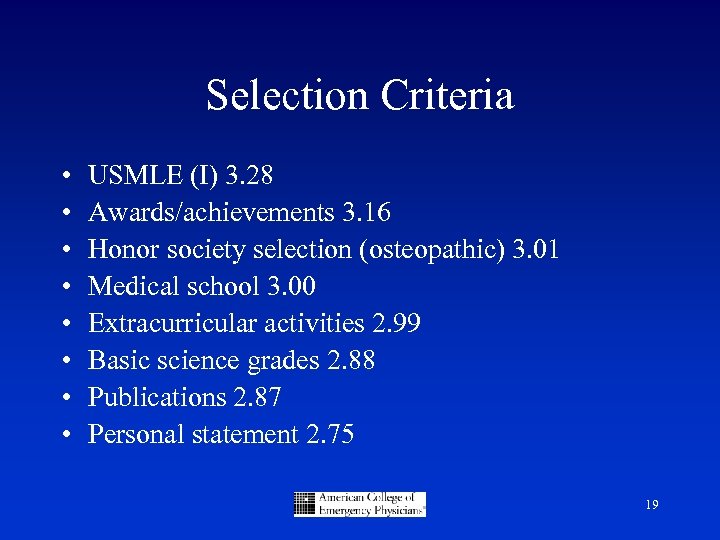 Selection Criteria • • USMLE (I) 3. 28 Awards/achievements 3. 16 Honor society selection (osteopathic) 3. 01 Medical school 3. 00 Extracurricular activities 2. 99 Basic science grades 2. 88 Publications 2. 87 Personal statement 2. 75 19
 Dean’s Letter • Medical Students – November 1 st – Review for accuracy/content – Meet with writer about special attributes • Program Directors – Class rank – Last paragraph – Rotation summary 20
 Board Scores • Medical Students – – • Do your best Study hard Rest before exam Only one part of picture Program Directors – Filter based on score – Only one part of picture after the filter 21
 Academic Record • Medical Students – Do your best – Study hard – Be prepared to explain low grades • Program Directors – Look for trends – Look for flags – Confusing scoring system 22
 Personal Statement • Medical Students – – – Chance to express yourself Why you would fit into the specialty Have others review/critique One page only Monitor spelling/grammar • Program Directors – Review hundreds – Unique character/quality 23
 Letters of Recommendation • Medical Students – – – – Need at least 3 At least 2 should be in your specialty Consider assistant / associate / program director Personal statement CV / USMLE / transcript SLOR format / EM score More valuable if from EM training programs Approach letter writer early while you are still fresh in their mind 24
 Letters of Recommendation • Program Directors – Do I know the person who wrote the letter? – How does this letter compare to others? 25
 Standard Letter of Recommendation • Title and position of author • Context that you know the applicant • EM grade • Commitment to EM • Work ethic • • • Treatment plan Personality Global assessment Match range Comments 26
 Outside Interests/Activities • Medical Students – Have fun – Become involved – Interest groups – Research • Program Directors – Quality of involvement – Leadership potential 27
 Before You Interview • Read: Koscove EM. An applicant’s evaluation of an Emergency Medicine Internship and Residency. Ann Emerg Med 19: 774, 1990 • Read: Getting into A Residency: A Guide for Medical Students by Kenneth Iserson • Read: EMRA. EM in Focus: A Guide for Medical Students 28
 The Interview • When – – November – January Winter weather travel Revisit program Rank list preparation • The Night Before – Prepare/review questions – Gather data: visit site 29
 The Interview • That day: – Be on time – Don’t over/under dress – Don’t dominate the interview – Be yourself – Ask questions – Take notes – How did it “feel” Program director Faculty Residents Support staff 30
 The Interview • • It’s a small world – make friends Never bad-mouth another program Don’t blow off an interview Follow-up letter or phone-call 31
 First and Second Year Students • • Observe in ED Summer research projects with EM staff EM interest group affiliation Be open to any medical specialty 32
 Third Year Students • See patients in ED on various rotations • Obtain EM physician as mentor • Start selecting fourth year rotations 33
 Fourth Year Students • Mandatory/Elective EM rotation – Shine • Consider extramural rotations – Community experience – Opportunity at a residency program • SAEM list of extramural EM rotations • Letters of recommendation 34
 Finally… Relax Have fun Choose your mentor well Talk to your peers Talk to your advisor 35
 Web Sites • • www. acgme. org www. ama-assn. org www. aamc. org www. acep. org www. saem. org www. aaem. org www. emra. org 36
 References to Read • AAMC. Medicare Payments for Graduate Medical Education: What Every Medical Student, Resident, and Advisor Needs to Know. Ivy Baer, JD MPH. Ibaer@aamc. org • Grum CM, Wooliscroft JO. Choosing a Specialty: A Guide for Students. JAMA 1993; 269: 1183, 1186 • Iserson K. Getting Into a Residency: A Guide for Medical Students Camden S. C. : Camden House Publishers 1996 • Klass D, Clauser B. Evaluating Clinical Skills: Getting It Right Slowly (editorial). Arch Pediatr Adolesc Med 1994; 148: 133 -134 • Miller RS et al. Employment-Seeking Experiences Resident Physicians Completing Training in 1996. JAMA 1998 280: 777 • Krane JT, Ferraro CM. Selection Criteria for Emergency Medicine Residency Applicants. Acad Emerg Med 2000, 7: 54 -60 37
 References to Read • Rosenblum ND, Wetzel M, Platt O, Daniels S, Crawford J, Rosenthal R. Predicting Medical Student Success in a Clinical Clerkship by Rating Students' Nonverbal Behavior. Arch Pediatr Adolesc Med 1994; 148: 213 -219 • Tracy E. How Graduate Medical Education Funding Affects Residency Program Changes. JAMA 1996; 276: 1536 • Wagoner NE, Suriano JR, Stoner JA. Factors Used by Program Directors to Select Residents. J Med Educ 1986; 61: 10 -21 • Wagoner and Suriano. Program Directors’ Responses To a Survey on Variables Used to Select Residents In A Time of Change. Acad Med 1999 74: 51 -58 38