 Скачать презентацию Applying Belief Change to Ontology Evolution Giorgos Flouris
09ac5a2a306fec9c4586420aa81c4e7b.ppt
- Количество слайдов: 23



Applying Belief Change to Ontology Evolution Giorgos Flouris Ph. D Thesis Summary Ph. D Student Computer Science Department University of Crete fgeo@csd. uoc. gr Research Assistant Institute of Computer Science FORTH fgeo@ics. forth. gr ISWDS 05 07/11/05
Part Overview (“Elevator Talk”)
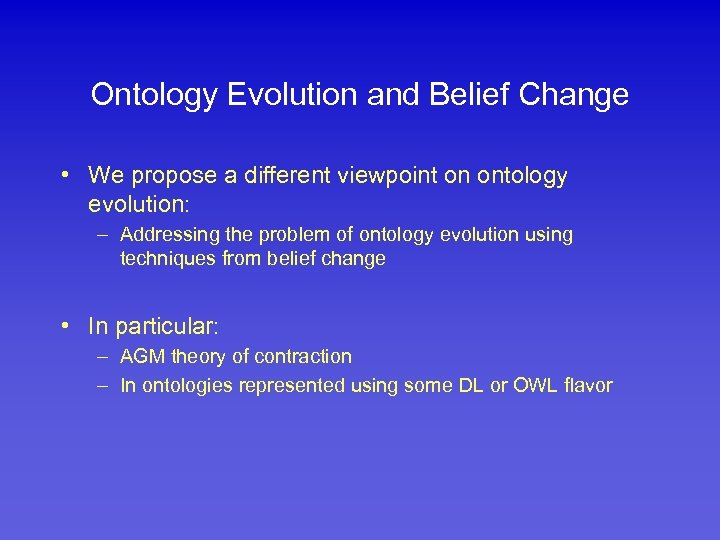
Ontology Evolution and Belief Change • We propose a different viewpoint on ontology evolution: – Addressing the problem of ontology evolution using techniques from belief change • In particular: – AGM theory of contraction – In ontologies represented using some DL or OWL flavor
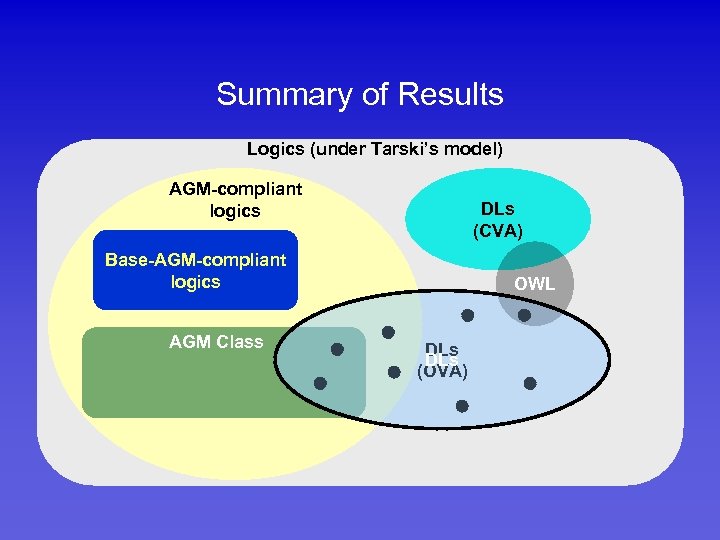
Summary of Results Logics (under Tarski’s model) AGM-compliant logics DLs (CVA) Base-AGM-compliant logics AGM Class OWL DLs (OVA)
Part Research Description
Ontology Evolution: Definition and Importance • Ontology evolution is the process of modifying an ontology in response to a certain change in the domain or its conceptualization • Main reasons for ontology evolution: – Dynamic domains – Change in users’ needs or perspective – New information (previously unknown, classified or unavailable) that improves the conceptualization – Errors during original conceptualization – Ontology dependency – …
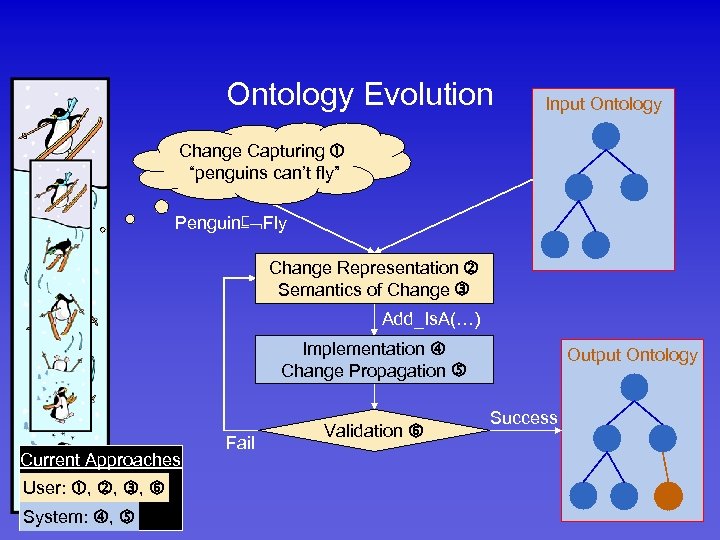
Ontology Evolution Input Ontology Change Capturing “penguins can’t fly” Penguin⊑ Fly Change Representation Semantics of Change Add_Is. A(…) Implementation Change Propagation Current Approaches User: , , , System: , Fail Validation Output Ontology Success
Limitations • Main limitations of current approaches: – Manual or semi-automatic approaches – Too many operators (complex and atomic) – No formal semantics • Cause problems: – – Automated agents and systems Scalability Formal properties unknown Bottleneck for current research
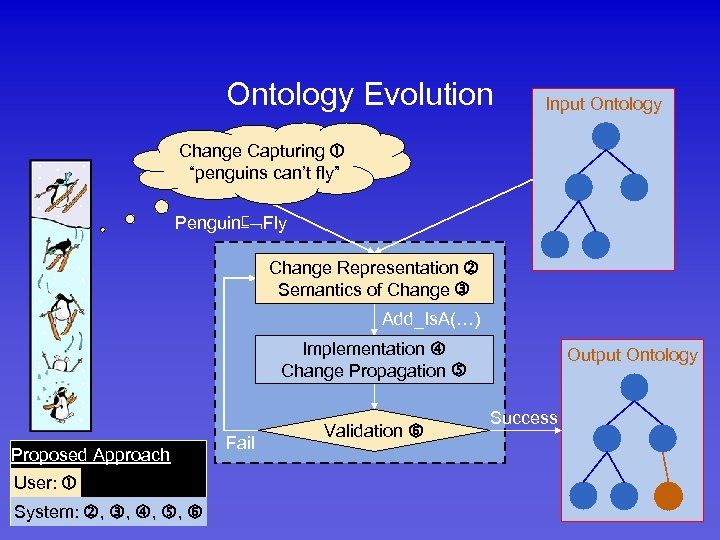
Ontology Evolution Input Ontology Change Capturing “penguins can’t fly” Penguin⊑ Fly Change Representation Semantics of Change Add_Is. A(…) Implementation Change Propagation Proposed Approach User: System: , , Fail Validation Output Ontology Success
Why Belief Change? (1/2) • Knowledge should be up-to-date: – Keeping KBs up-to-date: belief change – Keeping ontologies up-to-date: ontology evolution • Ontology evolution can be viewed as a special case of belief change: – View belief change techniques, ideas, intuitions, results, algorithms and methods under the prism of ontology evolution – We address ontology evolution using belief change
Why Belief Change? (2/2) • Belief change properties: – Mature – Formal – Automatic • Addresses important issues that have not been considered in ontology evolution: – – – Revision and Update Revision and Contraction Postulations vs Explicit Constructions Foundational vs Coherence Theories Principle of Minimal Change Principle of Primacy of New Information
Difficulties and Methodology • Belief change techniques are generally targeted at classical logic: – Their assumptions fail for DLs and other ontological languages – Cannot be directly used for such logics – But: the underlying intuitions are applicable • Belief change techniques need to be migrated to the ontology evolution context • Ph. D, Phase 1: – Set the foundations for future work on the subject – Very abstract, long-term and ambitious goal
A More Specific Approach: the AGM Theory • For the purposes of this Ph. D, we restricted ourselves to deal with: – The most influential belief change theory (AGM theory) – The most fundamental operation (contraction) – The most promising languages for ontological representation (DLs and OWL) • Ph. D, Phase 2: – Study the applicability of the AGM theory of contraction in DLs and OWL
AGM Theory • AGM theory (Alchourron, Gärdenfors, Makinson): – The most influential approach in belief change • Contraction: – The most fundamental operation for theoretical purposes – Deals with the removal of knowledge from a KB • Main contribution: 6 AGM postulates that determine whether a contraction operator behaves “rationally” • AGM theory is based on certain assumptions on the underlying logic, so, as usual: – Intuitions applicable in ontologies – Postulates and results not applicable in ontologies
AGM-Compliance • Dropped the AGM assumptions and considered the class of logics studied by Tarski: – Very general class of logics (that contains DLs) • We generalized the AGM theory (and postulates) to be applicable to Tarski’s class • Noticed that only some of the logics in this class admit an operator satisfying the generalized postulates (i. e. , a “rational” operator): – Termed AGM-compliant logics (3 characterizations)
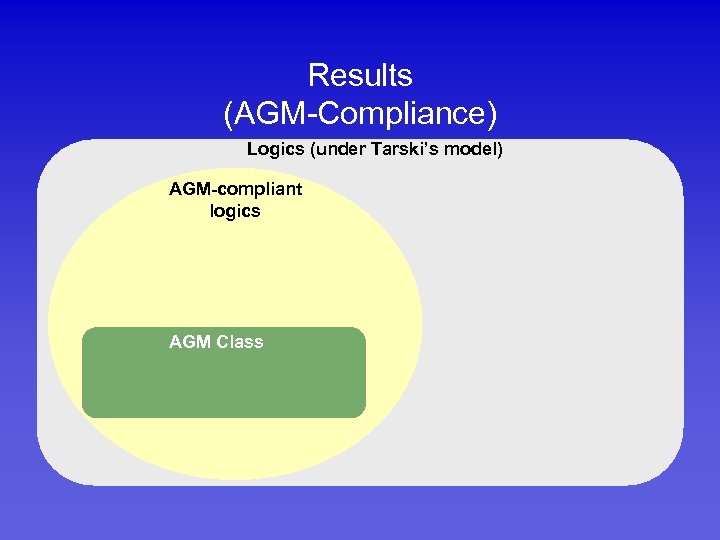
Results (AGM-Compliance) Logics (under Tarski’s model) AGM-compliant logics AGM Class
Further Results • Connection with lattice theory: – Every logic can be described by a lattice – AGM-compliance can be determined by the lattice’s structure • Connection with the foundational model: – AGM theory based on the coherence model – There are logics in which a “foundational AGM theory” can be applied – Termed base-AGM-compliant logics (2 characterizations)
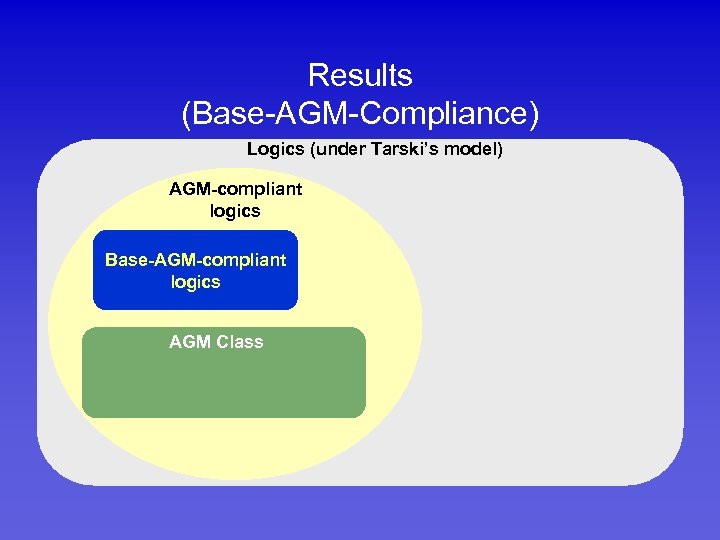
Results (Base-AGM-Compliance) Logics (under Tarski’s model) AGM-compliant logics Base-AGM-compliant logics AGM Class
AGM-Compliance and DLs • Studied DLs (two types) – CVA (Closed Vocabulary Assumption): allows the description of the ontological signature using DL axioms – OVA (Open Vocabulary Assumption): ignores the signature because it cannot be described using DL axioms • DLs (CVA): non-AGM-compliant • DLs (OVA): some are AGM-compliant, some are not – Introduced results, heuristics, rules of thumb • OWL (different flavors, CVA or OVA, annotation features, owl: imports): all non-AGM-compliant
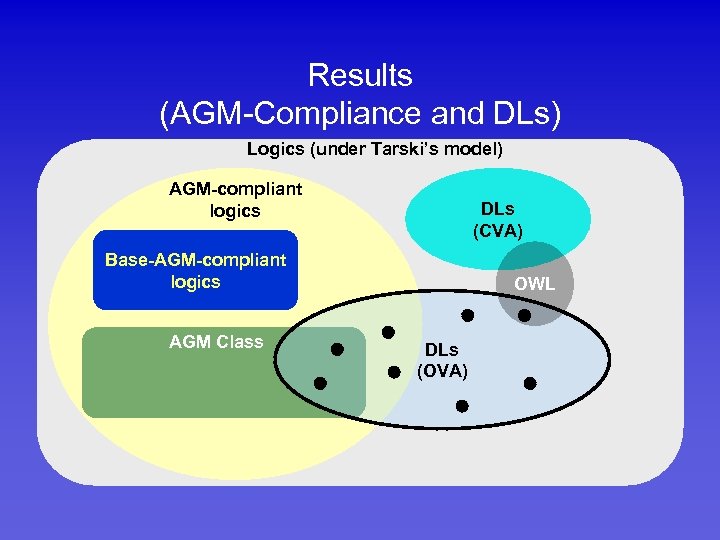
Results (AGM-Compliance and DLs) Logics (under Tarski’s model) AGM-compliant logics DLs (CVA) Base-AGM-compliant logics AGM Class OWL DLs (OVA)
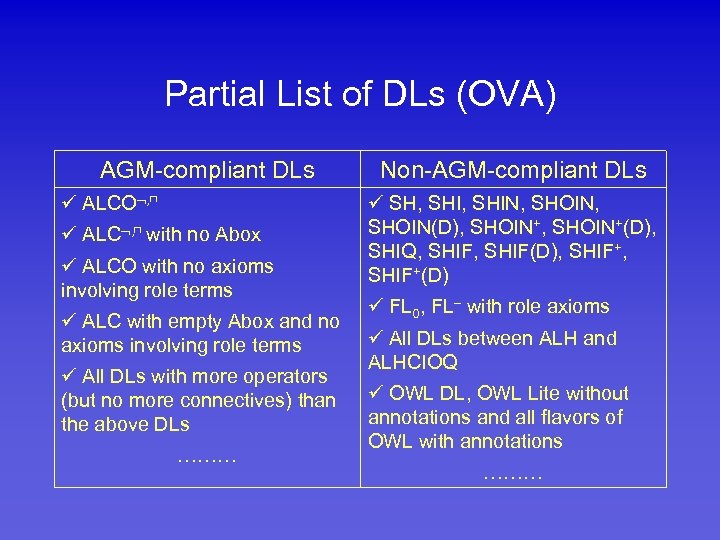
Partial List of DLs (OVA) AGM-compliant DLs ALCO , ⊓ ALC , ⊓ with no Abox ALCO with no axioms involving role terms ALC with empty Abox and no axioms involving role terms All DLs with more operators (but no more connectives) than the above DLs ……… Non-AGM-compliant DLs SH, SHIN, SHOIN(D), SHOIN+(D), SHIQ, SHIF(D), SHIF+(D) FL 0, FL with role axioms All DLs between ALH and ALHCIOQ OWL DL, OWL Lite without annotations and all flavors of OWL with annotations ………
Conclusion • Phase 1: – Proposed the study of ontology evolution from a different perspective, using belief change ideas and terminology • Phase 2: – Focused on the AGM theory of contraction – Determined its applicability to DLs and OWL
Future Work • Study other belief change approaches • Connection of AGM-compliance with other AGMrelated results: – The operation of revision – Levi identity – Representation theorems • The development and/or implementation of a specific algorithm for integration into ontology evolution tools
Скачать презентацию Applying Belief Change to Ontology Evolution Giorgos Flouris
09ac5a2a306fec9c4586420aa81c4e7b.ppt