 Скачать презентацию Applied Corporate Finance Corporate Securities bonds warrants convertible
ac86fddea5c6a90ea18926f613368a0a.ppt
- Количество слайдов: 74



Applied Corporate Finance Corporate Securities bonds, warrants, convertible and callable bonds Joao Amaro de Matos INSEAD/FEUNL
Corporate Securities • • Very similar to generalized options; Underlying is the value of the firm; Same valuation principles; CS may have complex contractual provisions, analysis may be more difficult; • A few differences between options and CS; • Notice that options are issued by individuals, CS are issued by firms; • Differences illustrated with 7 simple examples:
Corporate Securities 1. A single issue of zero-coupon bonds; 2. Senior and subordinated zero-coupon bonds; 3. Warrants; 4. Convertible Bonds; 5. Callable Bonds; 6. Callable Convertible Bonds; 7. Bonds with safety covenants;
Corporate Securities • Assume that all agents act in their own best interest; • Transaction costs, margin requirements and taxes can be ignored; • Firm may sell assets to finance payouts; • Bankruptcy happens if payment to a claim other than stock is not made; • No further securities will be issued.
Example 1: Zero Coupon Bonds • Lisbon holdings has all its funds invested in Barcelona common stock (1000 shares) • Barcelona stock trades at $127 per share, Jan 2 nd, 2008. • Lisbon holdings has 2 types of securities outstanding: 120 zero-coupon bonds and 1000 shares of its own stock. • Each bond promises to pay $1, 000 in July 18 th, 2008.
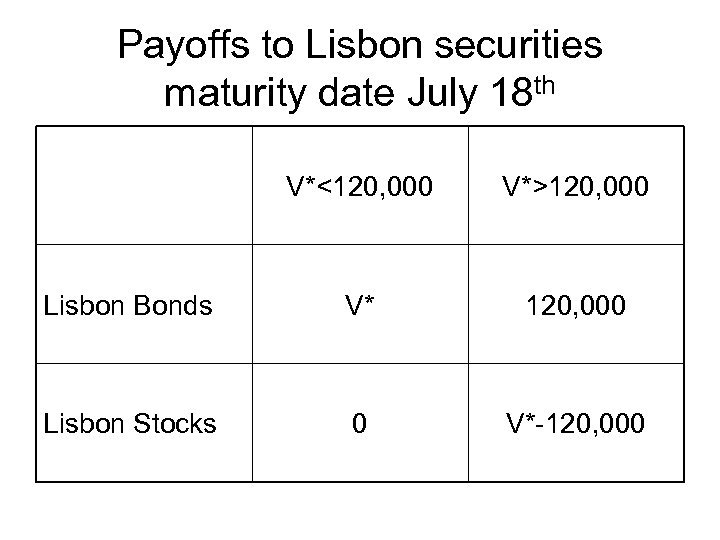
Payoffs to Lisbon securities maturity date July 18 th V*<120, 000 V*>120, 000 Lisbon Bonds V* 120, 000 Lisbon Stocks 0 V*-120, 000
Valuing Corporate Securities today • • What is value of Lisbon securities on Jan 2 nd? Value of all securities, Jan 2 nd: $127, 000; How is this divided between stocks & bonds? Each share of Lisbon stock has the payoff of a call option on one share of Barcelona with strike X=$120 and maturity July 18 th; • Bondholders position is equivalent to hold 1, 000 Barcelona shares and write 1, 000 such calls. • Check option prices on Jan 2 nd
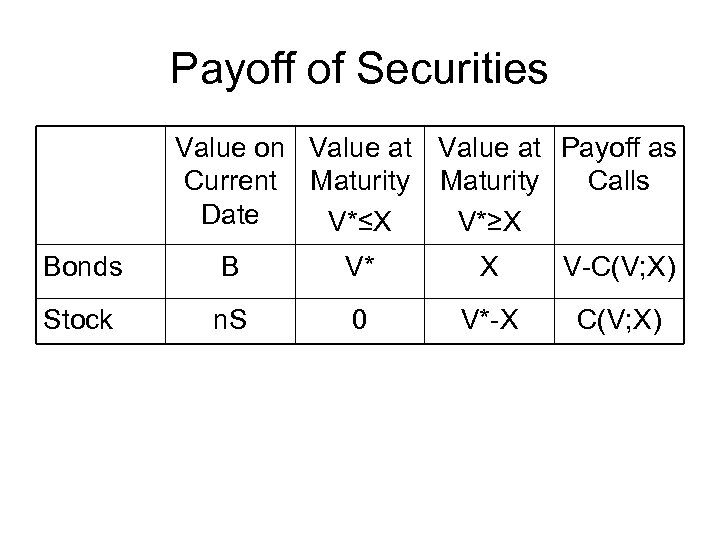
Payoff of Securities Value on Value at Payoff as Current Maturity Calls Date V*≤X V*≥X Bonds B V* X V-C(V; X) Stock n. S 0 V*-X C(V; X)
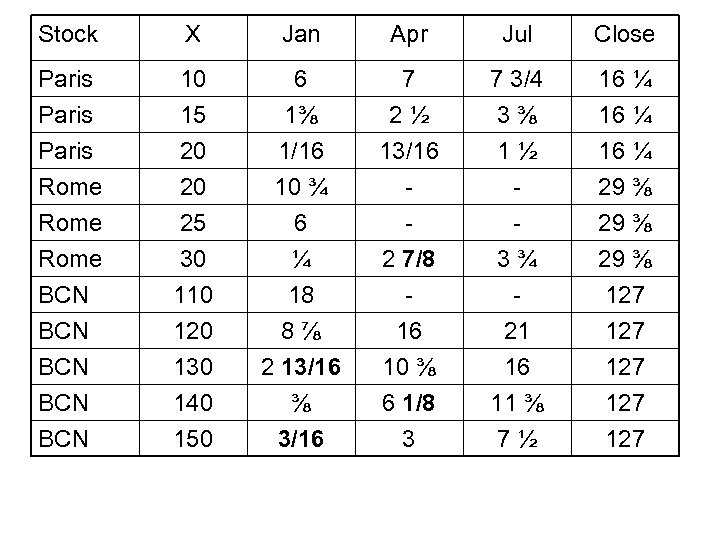
Stock X Jan Apr Jul Close Paris 10 6 7 7 3/4 16 ¼ Paris 15 20 1⅜ 1/16 2½ 13/16 3⅜ 1½ 16 ¼ Rome BCN BCN BCN 20 25 30 110 120 130 140 150 10 ¾ 6 ¼ 18 8⅞ 2 13/16 ⅜ 3/16 2 7/8 16 10 ⅜ 6 1/8 3 3¾ 21 16 11 ⅜ 7½ 29 ⅜ 127 127 127
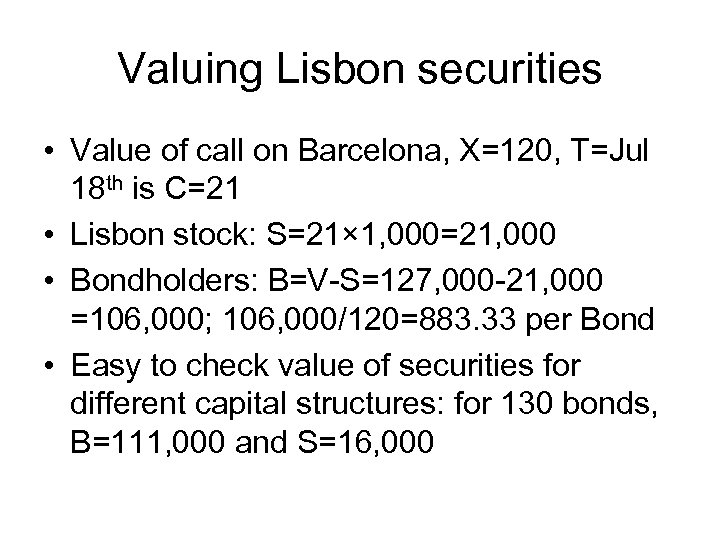
Valuing Lisbon securities • Value of call on Barcelona, X=120, T=Jul 18 th is C=21 • Lisbon stock: S=21× 1, 000=21, 000 • Bondholders: B=V-S=127, 000 -21, 000 =106, 000; 106, 000/120=883. 33 per Bond • Easy to check value of securities for different capital structures: for 130 bonds, B=111, 000 and S=16, 000
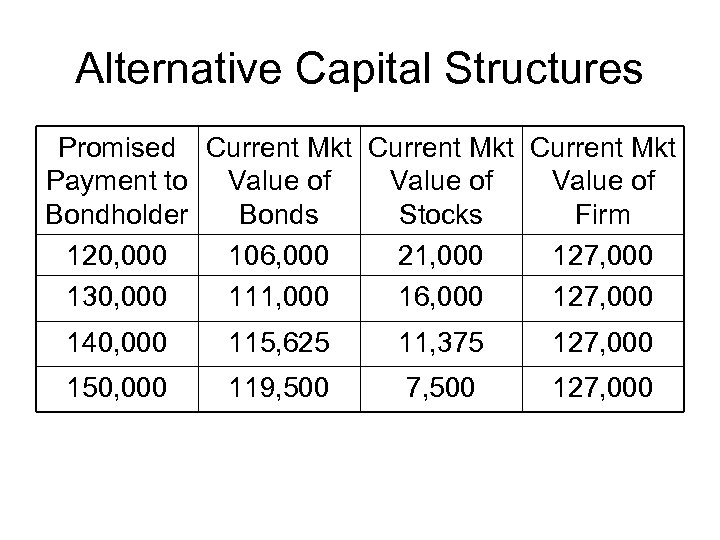
Alternative Capital Structures Promised Current Mkt Payment to Value of Bondholder Bonds Stocks Firm 120, 000 106, 000 21, 000 127, 000 130, 000 111, 000 16, 000 127, 000 140, 000 115, 625 11, 375 127, 000 150, 000 119, 500 7, 500 127, 000
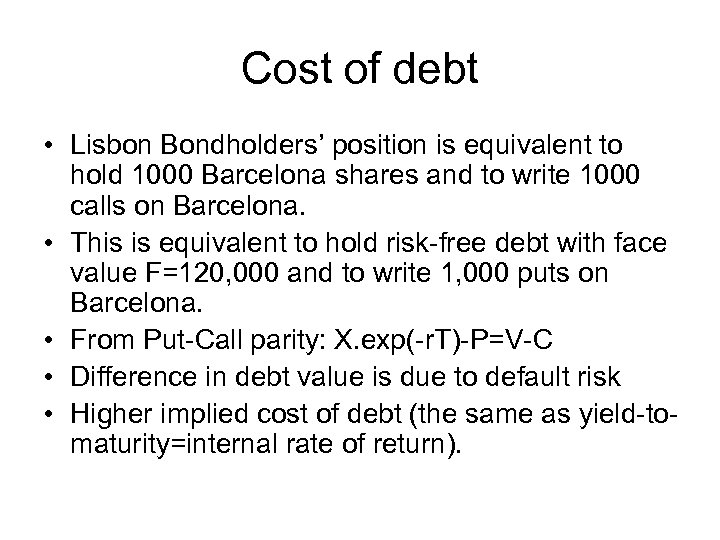
Cost of debt • Lisbon Bondholders’ position is equivalent to hold 1000 Barcelona shares and to write 1000 calls on Barcelona. • This is equivalent to hold risk-free debt with face value F=120, 000 and to write 1, 000 puts on Barcelona. • From Put-Call parity: X. exp(-r. T)-P=V-C • Difference in debt value is due to default risk • Higher implied cost of debt (the same as yield-tomaturity=internal rate of return).
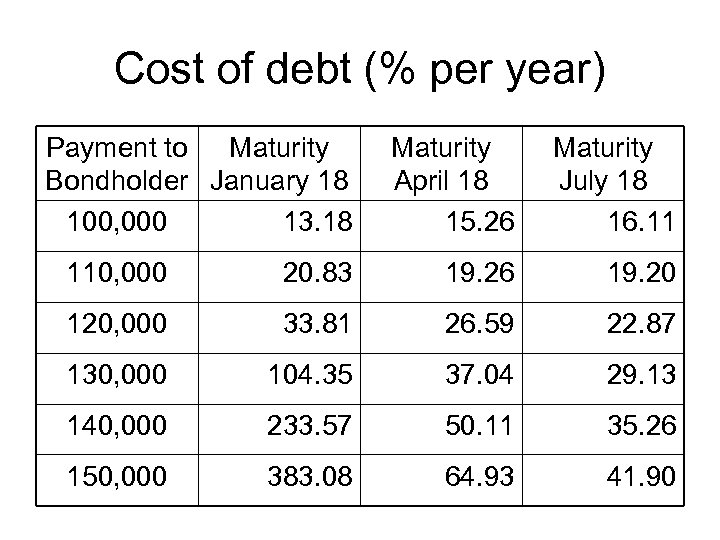
Cost of debt (% per year) Payment to Maturity Bondholder January 18 100, 000 13. 18 Maturity April 18 15. 26 Maturity July 18 16. 11 110, 000 20. 83 19. 26 19. 20 120, 000 33. 81 26. 59 22. 87 130, 000 104. 35 37. 04 29. 13 140, 000 233. 57 50. 11 35. 26 150, 000 383. 08 64. 93 41. 90
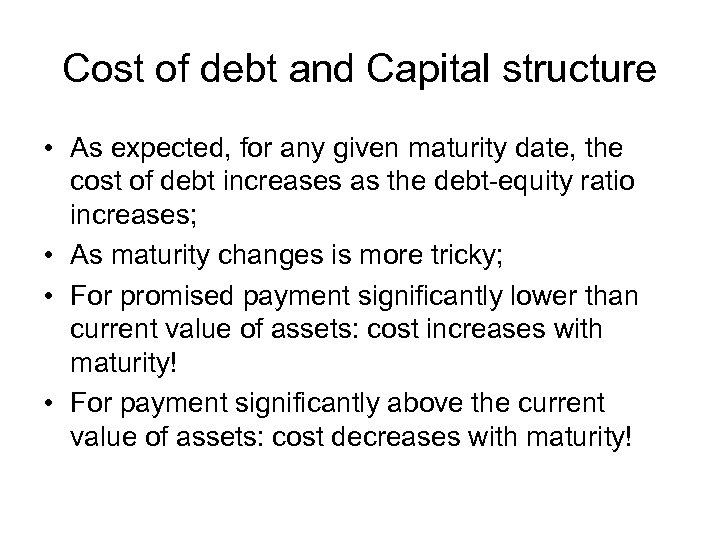
Cost of debt and Capital structure • As expected, for any given maturity date, the cost of debt increases as the debt-equity ratio increases; • As maturity changes is more tricky; • For promised payment significantly lower than current value of assets: cost increases with maturity! • For payment significantly above the current value of assets: cost decreases with maturity!
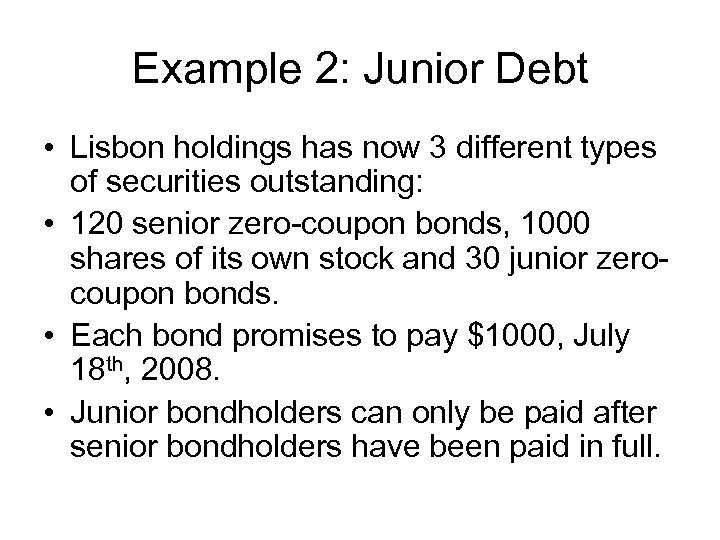
Example 2: Junior Debt • Lisbon holdings has now 3 different types of securities outstanding: • 120 senior zero-coupon bonds, 1000 shares of its own stock and 30 junior zerocoupon bonds. • Each bond promises to pay $1000, July 18 th, 2008. • Junior bondholders can only be paid after senior bondholders have been paid in full.
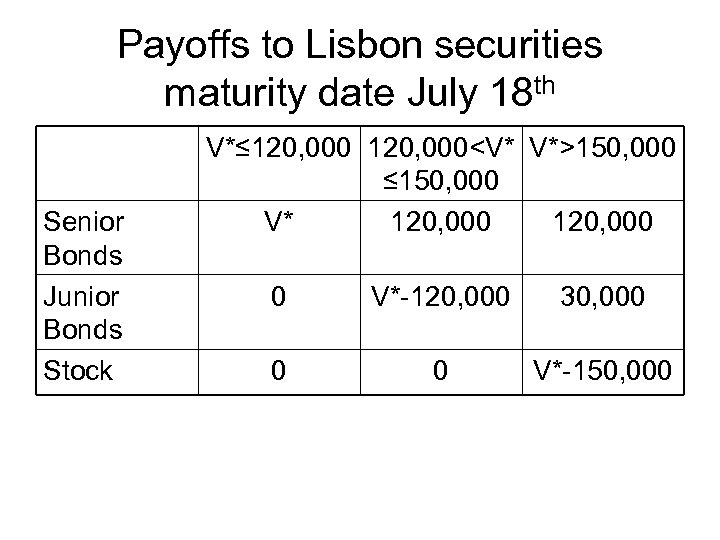
Payoffs to Lisbon securities maturity date July 18 th Senior Bonds Junior Bonds Stock V*≤ 120, 000<V* V*>150, 000 ≤ 150, 000 V* 120, 000 0 V*-120, 000 30, 000 0 0 V*-150, 000
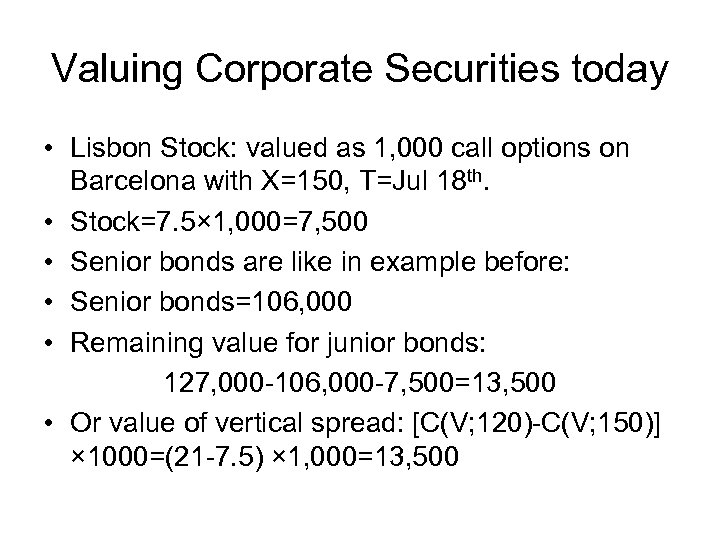
Valuing Corporate Securities today • Lisbon Stock: valued as 1, 000 call options on Barcelona with X=150, T=Jul 18 th. • Stock=7. 5× 1, 000=7, 500 • Senior bonds are like in example before: • Senior bonds=106, 000 • Remaining value for junior bonds: 127, 000 -106, 000 -7, 500=13, 500 • Or value of vertical spread: [C(V; 120)-C(V; 150)] × 1000=(21 -7. 5) × 1, 000=13, 500
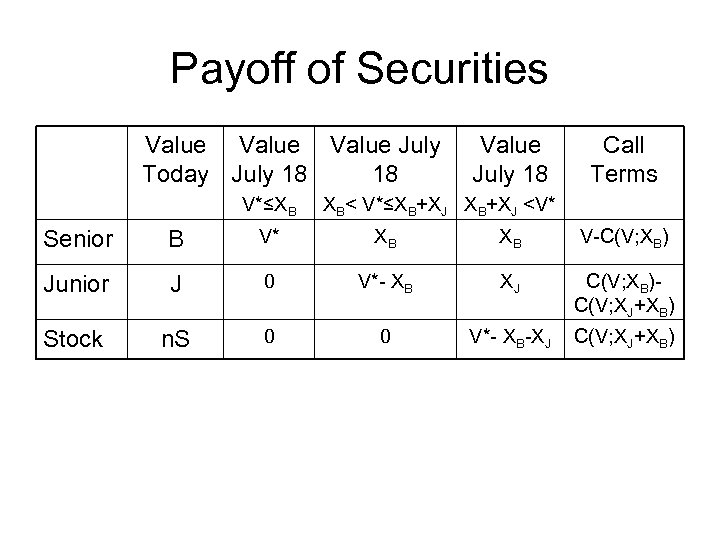
Payoff of Securities Value July Today July 18 18 V*≤XB Value July 18 Call Terms XB< V*≤XB+XJ <V* Senior B V* XB XB V-C(V; XB) Junior J 0 V*- XB XJ C(V; XB)C(V; XJ+XB) Stock n. S 0 0 V*- XB-XJ C(V; XJ+XB)
Junior bonds as a mix of stock and senior bonds • Unlike senior bonds, junior bonds can behave more like stock, for low values V as compared to XB+XJ. Value of junior bonds may be an increasing function of a) Interest rate; b) Time to maturity; c) Volatility of the value of the firm
Options versus Corporate securities: the first 3 differences 1. The underlying asset for corporate securities is the total market value of all the equities and liabilities of the firm; 2. The owners of corporate securities receive the payout made by the firm; 3. The issuers of corporate securities may have the power to change the firm’s decision with respect to investment, dividend and financing policy
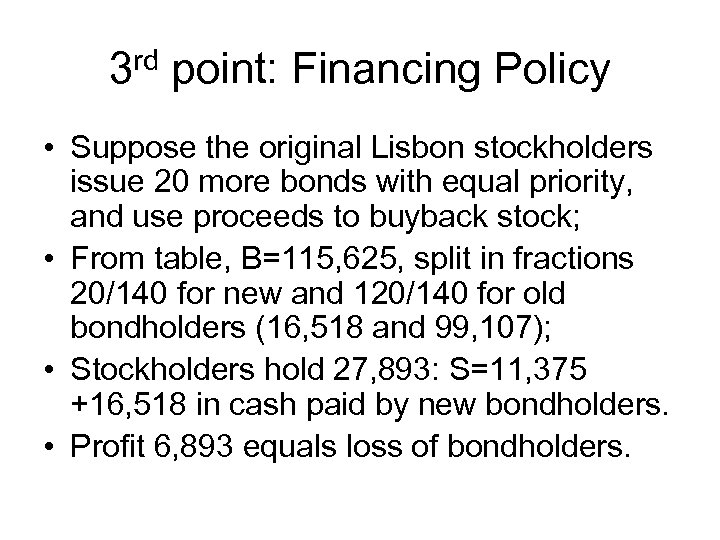
3 rd point: Financing Policy • Suppose the original Lisbon stockholders issue 20 more bonds with equal priority, and use proceeds to buyback stock; • From table, B=115, 625, split in fractions 20/140 for new and 120/140 for old bondholders (16, 518 and 99, 107); • Stockholders hold 27, 893: S=11, 375 +16, 518 in cash paid by new bondholders. • Profit 6, 893 equals loss of bondholders.
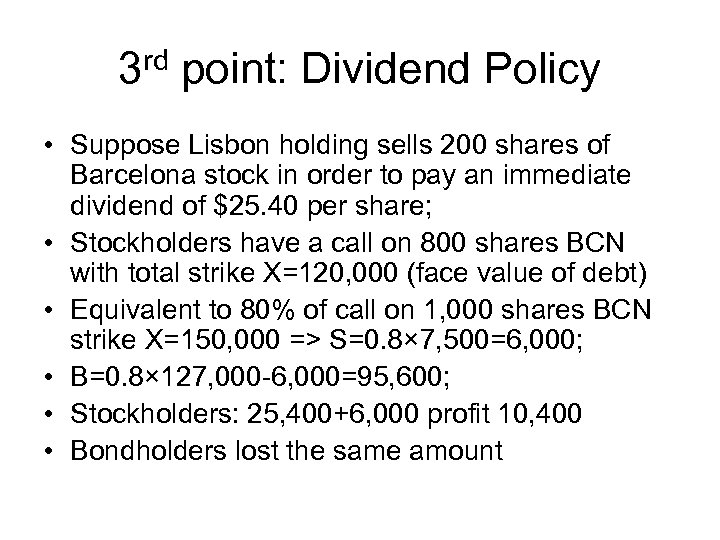
3 rd point: Dividend Policy • Suppose Lisbon holding sells 200 shares of Barcelona stock in order to pay an immediate dividend of $25. 40 per share; • Stockholders have a call on 800 shares BCN with total strike X=120, 000 (face value of debt) • Equivalent to 80% of call on 1, 000 shares BCN strike X=150, 000 => S=0. 8× 7, 500=6, 000; • B=0. 8× 127, 000 -6, 000=95, 600; • Stockholders: 25, 400+6, 000 profit 10, 400 • Bondholders lost the same amount
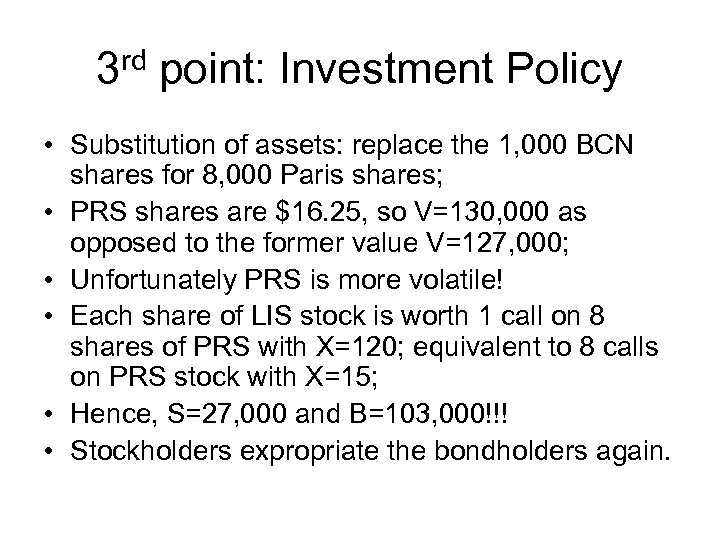
3 rd point: Investment Policy • Substitution of assets: replace the 1, 000 BCN shares for 8, 000 Paris shares; • PRS shares are $16. 25, so V=130, 000 as opposed to the former value V=127, 000; • Unfortunately PRS is more volatile! • Each share of LIS stock is worth 1 call on 8 shares of PRS with X=120; equivalent to 8 calls on PRS stock with X=15; • Hence, S=27, 000 and B=103, 000!!! • Stockholders expropriate the bondholders again.
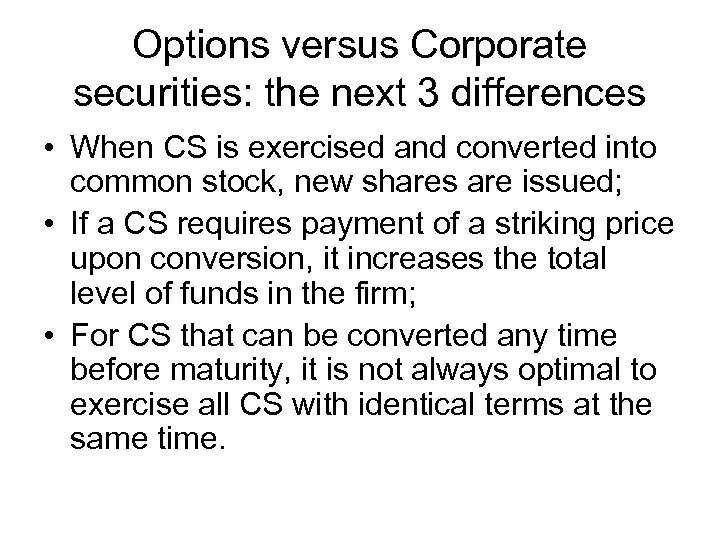
Options versus Corporate securities: the next 3 differences • When CS is exercised and converted into common stock, new shares are issued; • If a CS requires payment of a striking price upon conversion, it increases the total level of funds in the firm; • For CS that can be converted any time before maturity, it is not always optimal to exercise all CS with identical terms at the same time.
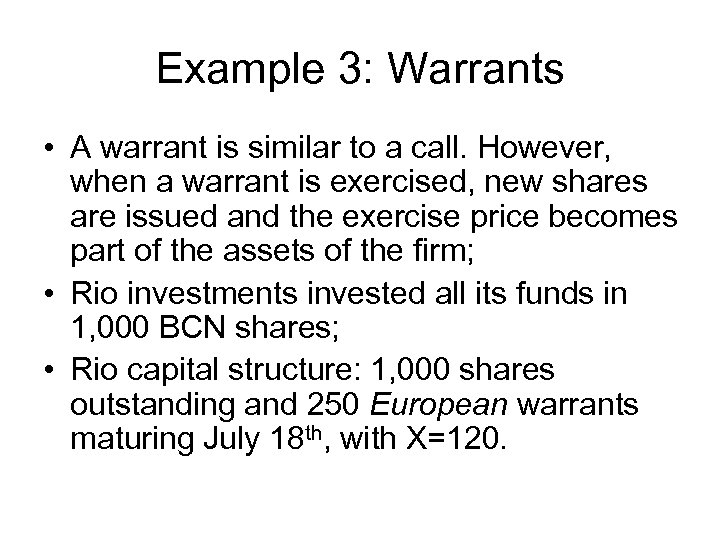
Example 3: Warrants • A warrant is similar to a call. However, when a warrant is exercised, new shares are issued and the exercise price becomes part of the assets of the firm; • Rio investments invested all its funds in 1, 000 BCN shares; • Rio capital structure: 1, 000 shares outstanding and 250 European warrants maturing July 18 th, with X=120.
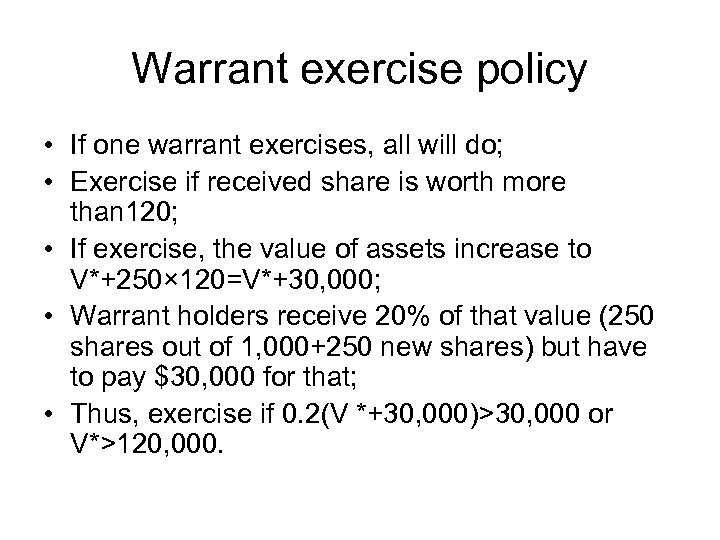
Warrant exercise policy • If one warrant exercises, all will do; • Exercise if received share is worth more than 120; • If exercise, the value of assets increase to V*+250× 120=V*+30, 000; • Warrant holders receive 20% of that value (250 shares out of 1, 000+250 new shares) but have to pay $30, 000 for that; • Thus, exercise if 0. 2(V *+30, 000)>30, 000 or V*>120, 000.
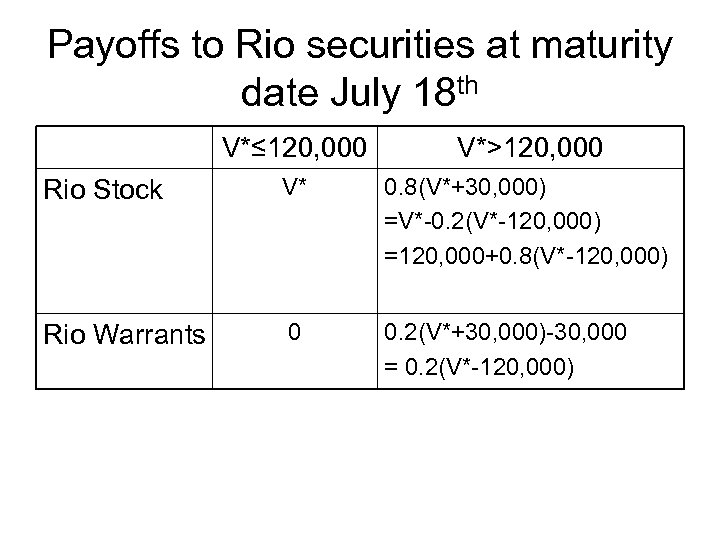
Payoffs to Rio securities at maturity date July 18 th V*≤ 120, 000 V*>120, 000 Rio Stock V* 0. 8(V*+30, 000) =V*-0. 2(V*-120, 000) =120, 000+0. 8(V*-120, 000) Rio Warrants 0 0. 2(V*+30, 000)-30, 000 = 0. 2(V*-120, 000)
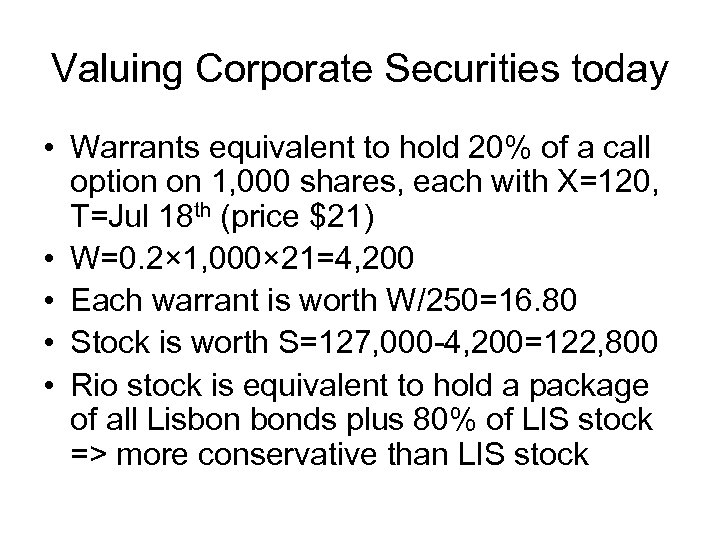
Valuing Corporate Securities today • Warrants equivalent to hold 20% of a call option on 1, 000 shares, each with X=120, T=Jul 18 th (price $21) • W=0. 2× 1, 000× 21=4, 200 • Each warrant is worth W/250=16. 80 • Stock is worth S=127, 000 -4, 200=122, 800 • Rio stock is equivalent to hold a package of all Lisbon bonds plus 80% of LIS stock => more conservative than LIS stock
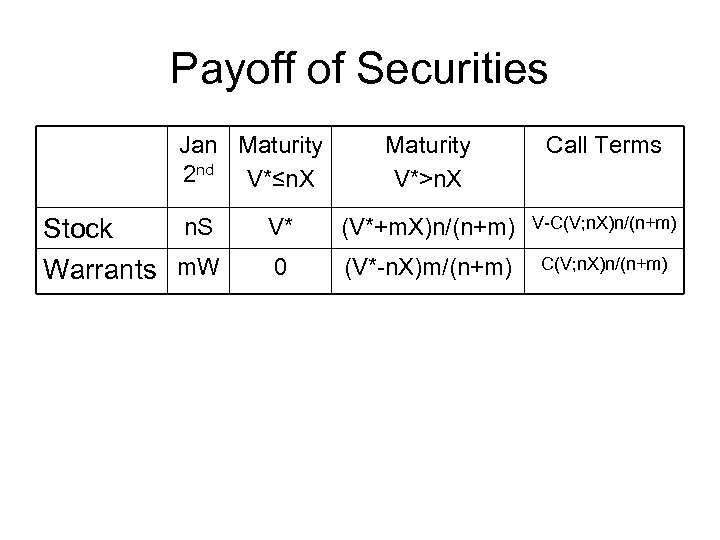
Payoff of Securities Jan Maturity 2 nd V*≤n. X n. S Stock Warrants m. W Maturity V*>n. X Call Terms V* (V*+m. X)n/(n+m) V-C(V; n. X)n/(n+m) 0 (V*-n. X)m/(n+m) C(V; n. X)n/(n+m)
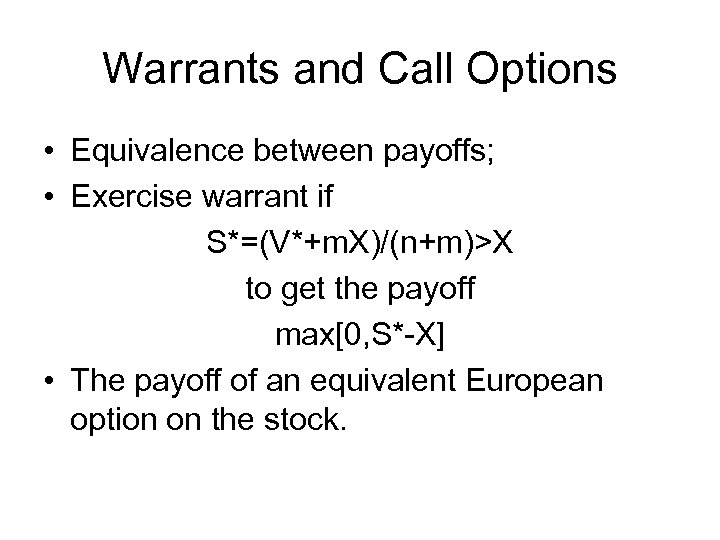
Warrants and Call Options • Equivalence between payoffs; • Exercise warrant if S*=(V*+m. X)/(n+m)>X to get the payoff max[0, S*-X] • The payoff of an equivalent European option on the stock.
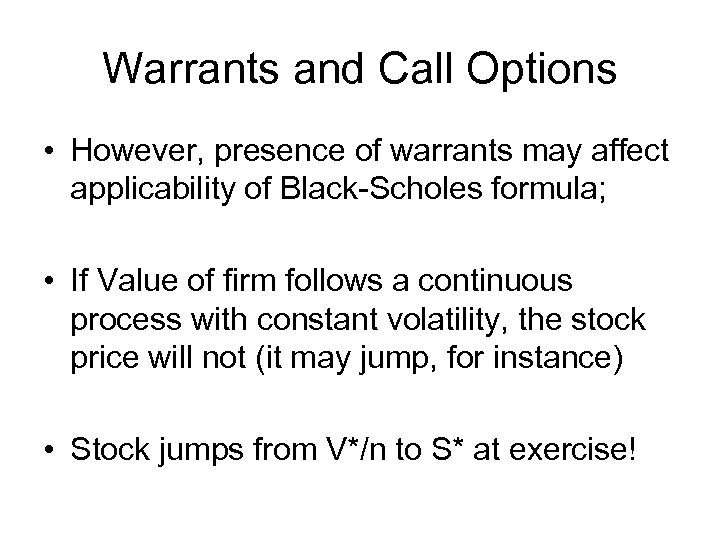
Warrants and Call Options • However, presence of warrants may affect applicability of Black-Scholes formula; • If Value of firm follows a continuous process with constant volatility, the stock price will not (it may jump, for instance) • Stock jumps from V*/n to S* at exercise!
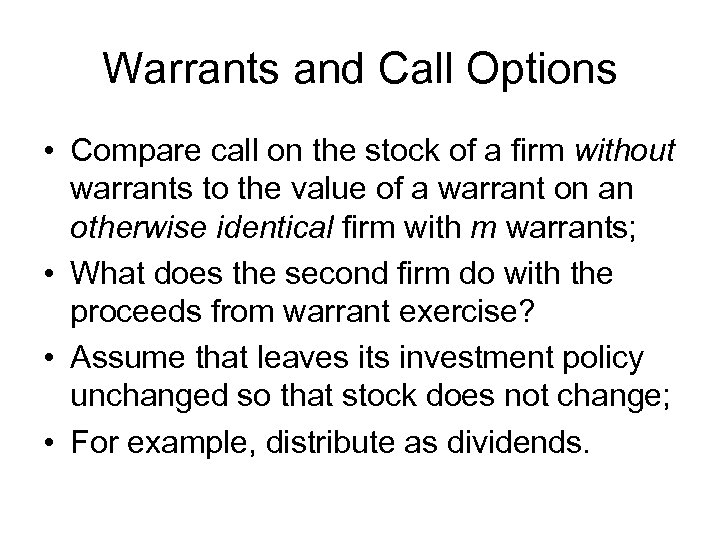
Warrants and Call Options • Compare call on the stock of a firm without warrants to the value of a warrant on an otherwise identical firm with m warrants; • What does the second firm do with the proceeds from warrant exercise? • Assume that leaves its investment policy unchanged so that stock does not change; • For example, distribute as dividends.
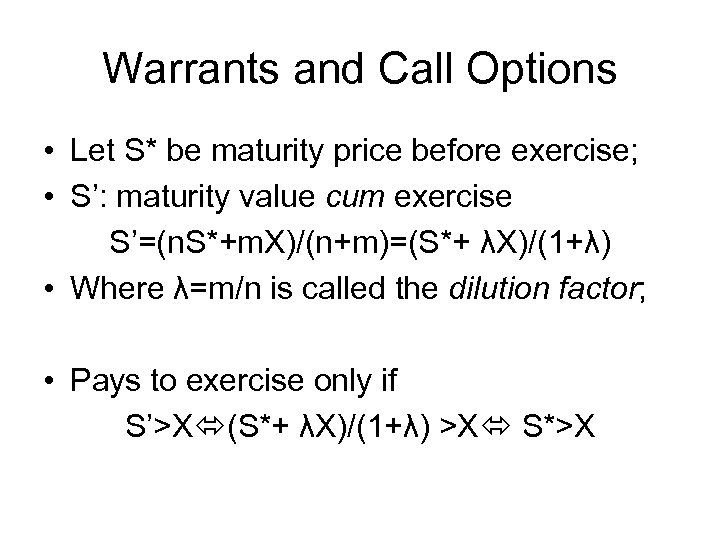
Warrants and Call Options • Let S* be maturity price before exercise; • S’: maturity value cum exercise S’=(n. S*+m. X)/(n+m)=(S*+ λX)/(1+λ) • Where λ=m/n is called the dilution factor; • Pays to exercise only if S’>X (S*+ λX)/(1+λ) >X S*>X
![Warrants and Call Options • Warrants are exercised with payoff W*=max[0, S’-K] =(S*-X )/(1+λ),](https://present5.com/presentation/ac86fddea5c6a90ea18926f613368a0a/image-34.jpg "Warrants and Call Options • Warrants are exercised with payoff W*=max[0, S’-K] =(S*-X )/(1+λ),")
Warrants and Call Options • Warrants are exercised with payoff W*=max[0, S’-K] =(S*-X )/(1+λ), if S*>X, =0 otherwise. • In contrast, options are exercised with payoff C*=max[0, S*-X] =(S*-X) if S*>X, =0 otherwise. => W=C/(1+λ)
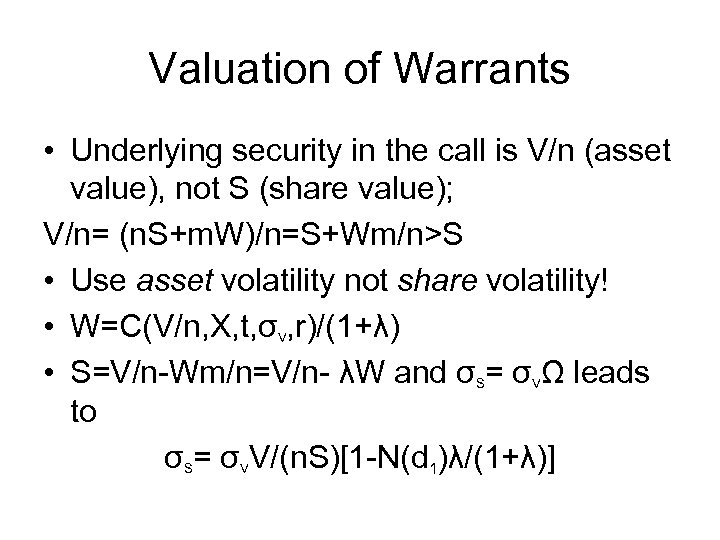
Valuation of Warrants • Underlying security in the call is V/n (asset value), not S (share value); V/n= (n. S+m. W)/n=S+Wm/n>S • Use asset volatility not share volatility! • W=C(V/n, X, t, σV, r)/(1+λ) • S=V/n-Wm/n=V/n- λW and σS= σVΩ leads to σS= σVV/(n. S)[1 -N(d 1)λ/(1+λ)]
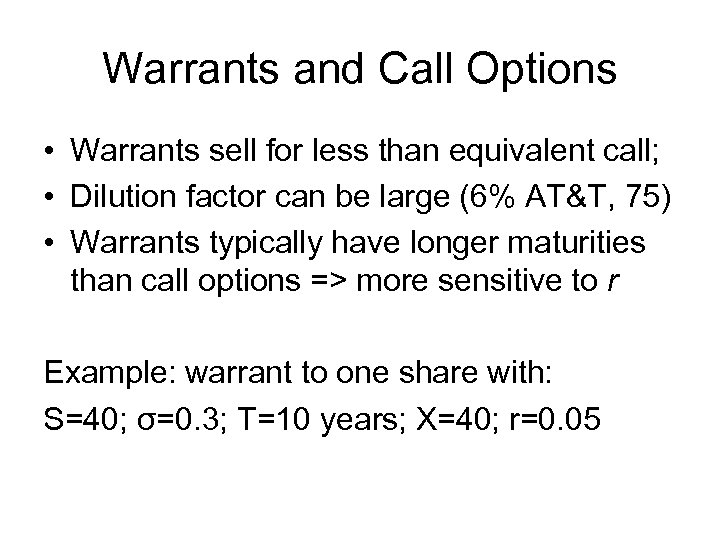
Warrants and Call Options • Warrants sell for less than equivalent call; • Dilution factor can be large (6% AT&T, 75) • Warrants typically have longer maturities than call options => more sensitive to r Example: warrant to one share with: S=40; σ=0. 3; T=10 years; X=40; r=0. 05
![Warrants and Call Options C=SN(d 1)-Xexp(-r. T)N(d 2) d 1=[ln(S/X)+(r+σ2/2)T]/σT 1/2 and d 2=d](https://present5.com/presentation/ac86fddea5c6a90ea18926f613368a0a/image-37.jpg "Warrants and Call Options C=SN(d 1)-Xexp(-r. T)N(d 2) d 1=[ln(S/X)+(r+σ2/2)T]/σT 1/2 and d 2=d")
Warrants and Call Options C=SN(d 1)-Xexp(-r. T)N(d 2) d 1=[ln(S/X)+(r+σ2/2)T]/σT 1/2 and d 2=d 1 - σT 1/2 d 1=(0. 05+0. 045)10/(0. 3× 3. 16)=1. 0014 ÞN(d 1)=0. 84168 d 2=(0. 05 -0. 045)10/(0. 3× 3. 16)=0. 0527 =>N(d 1)=0. 52102 C=40 N(d 1)-40 exp(-0. 05× 10)N(d 2)=21. 03
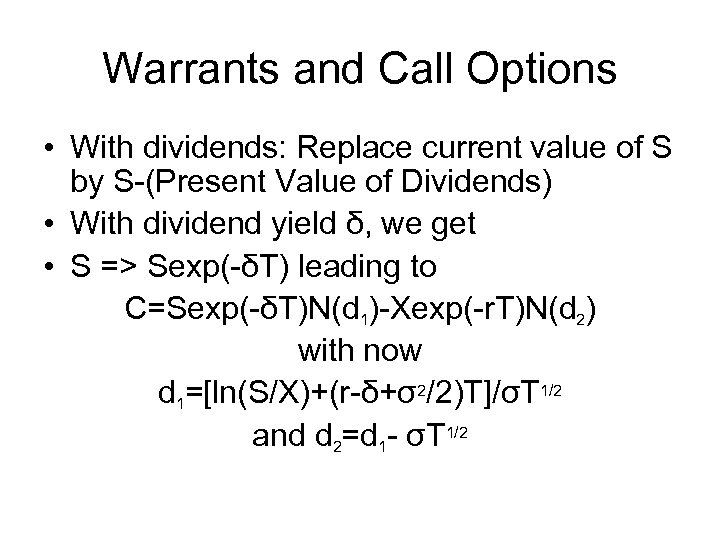
Warrants and Call Options • With dividends: Replace current value of S by S-(Present Value of Dividends) • With dividend yield δ, we get • S => Sexp(-δT) leading to C=Sexp(-δT)N(d 1)-Xexp(-r. T)N(d 2) with now d 1=[ln(S/X)+(r-δ+σ2/2)T]/σT 1/2 and d 2=d 1 - σT 1/2
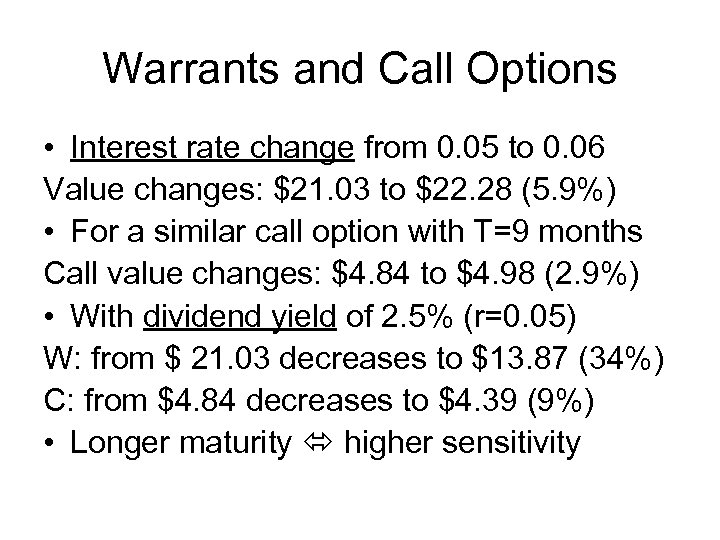
Warrants and Call Options • Interest rate change from 0. 05 to 0. 06 Value changes: $21. 03 to $22. 28 (5. 9%) • For a similar call option with T=9 months Call value changes: $4. 84 to $4. 98 (2. 9%) • With dividend yield of 2. 5% (r=0. 05) W: from $ 21. 03 decreases to $13. 87 (34%) C: from $4. 84 decreases to $4. 39 (9%) • Longer maturity higher sensitivity
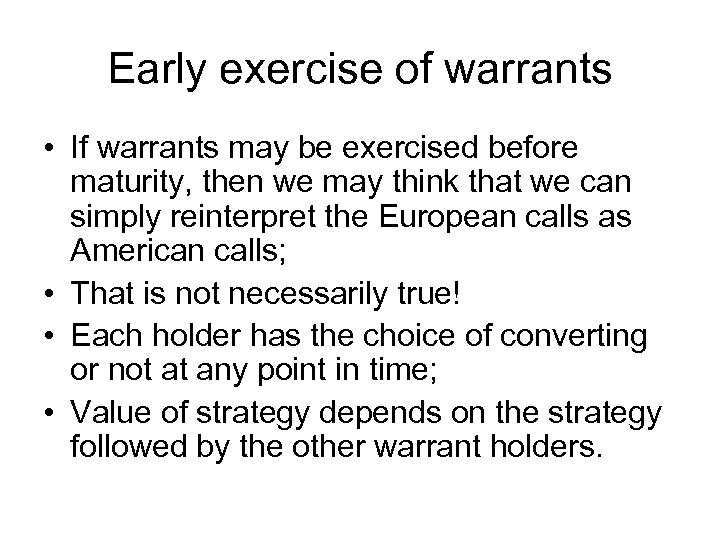
Early exercise of warrants • If warrants may be exercised before maturity, then we may think that we can simply reinterpret the European calls as American calls; • That is not necessarily true! • Each holder has the choice of converting or not at any point in time; • Value of strategy depends on the strategy followed by the other warrant holders.
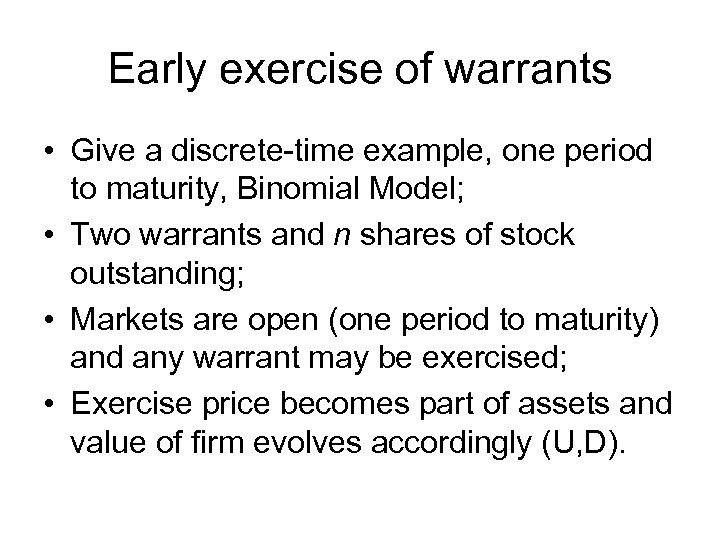
Early exercise of warrants • Give a discrete-time example, one period to maturity, Binomial Model; • Two warrants and n shares of stock outstanding; • Markets are open (one period to maturity) and any warrant may be exercised; • Exercise price becomes part of assets and value of firm evolves accordingly (U, D).
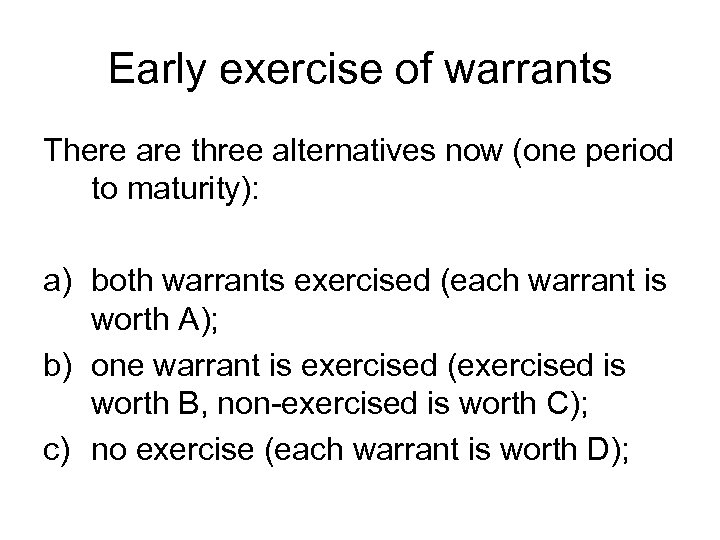
Early exercise of warrants There are three alternatives now (one period to maturity): a) both warrants exercised (each warrant is worth A); b) one warrant is exercised (exercised is worth B, non-exercised is worth C); c) no exercise (each warrant is worth D);
![Early exercise of warrants A=V/(n+2)-Xn/(n+2) B=V/(n+1)-Xn/(n+1)-C/(n+1) C=(p/R)×max[0, U(V+X)/(n+2)-X(n+1)/(n+2)] +(1 -p)/R×max[0, D(V+X)/(n+2)-X(n+1)/(n+2)] D=(p/R)×max[0, UV/(n+2)-Xn/(n+2)] +(1](https://present5.com/presentation/ac86fddea5c6a90ea18926f613368a0a/image-43.jpg "Early exercise of warrants A=V/(n+2)-Xn/(n+2) B=V/(n+1)-Xn/(n+1)-C/(n+1) C=(p/R)×max[0, U(V+X)/(n+2)-X(n+1)/(n+2)] +(1 -p)/R×max[0, D(V+X)/(n+2)-X(n+1)/(n+2)] D=(p/R)×max[0, UV/(n+2)-Xn/(n+2)] +(1")
Early exercise of warrants A=V/(n+2)-Xn/(n+2) B=V/(n+1)-Xn/(n+1)-C/(n+1) C=(p/R)×max[0, U(V+X)/(n+2)-X(n+1)/(n+2)] +(1 -p)/R×max[0, D(V+X)/(n+2)-X(n+1)/(n+2)] D=(p/R)×max[0, UV/(n+2)-Xn/(n+2)] +(1 -p)/R×max[0, DV/(n+2)-Xn/(n+2)]
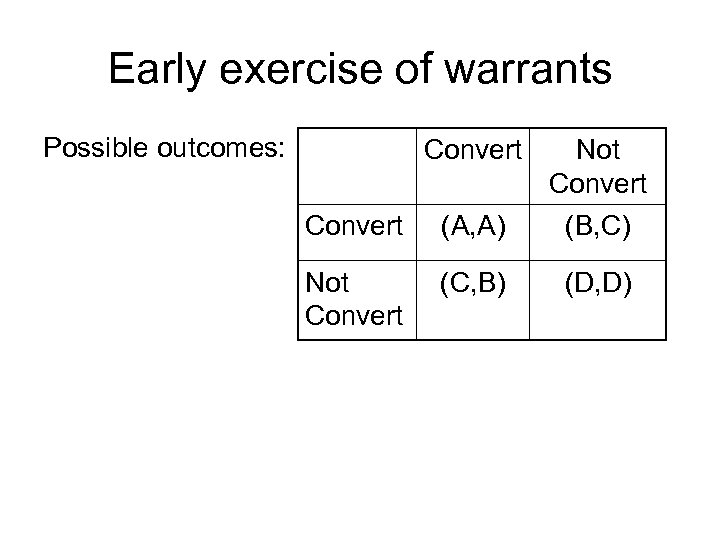
Early exercise of warrants Possible outcomes: Convert Not Convert (A, A) (B, C) Not Convert (C, B) (D, D)
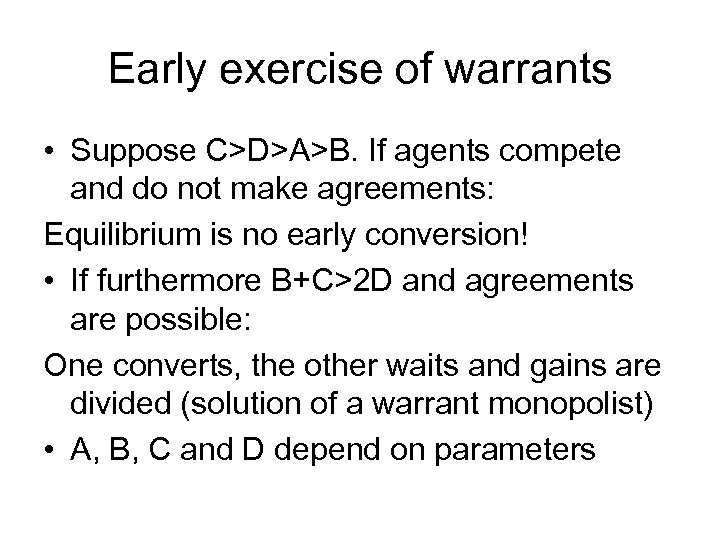
Early exercise of warrants • Suppose C>D>A>B. If agents compete and do not make agreements: Equilibrium is no early conversion! • If furthermore B+C>2 D and agreements are possible: One converts, the other waits and gains are divided (solution of a warrant monopolist) • A, B, C and D depend on parameters
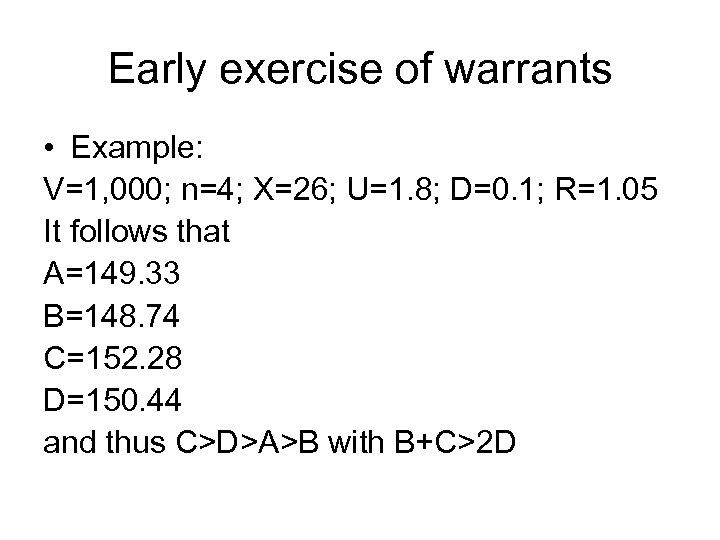
Early exercise of warrants • Example: V=1, 000; n=4; X=26; U=1. 8; D=0. 1; R=1. 05 It follows that A=149. 33 B=148. 74 C=152. 28 D=150. 44 and thus C>D>A>B with B+C>2 D
Example 4: Convertible Bonds • Mix properties of Bonds and Warrants • Like Bonds a) Receive coupons and principal payment b) Have priority over stock. • Like Warrants Can be surrendered to the firm at the discretion of their owner in exchange for shares of newly issued stock.
Convertible bonds • Exercise price of conversion can be taken as the value of the bond (present value of future coupons and principal that will not be received); • Convertible is a package of bond plus warrant; • Solves conflict of interest allowing bondholder to become stockholder;
Convertible bonds • Suppose Rio investments has issued convertible bonds instead of warrants; • Firm has 120 convertible bonds and 1, 000 shares of common stock outstanding; • At the maturity date each bond can be exchanged for 33 ⅓ shares of newly issued common stock.
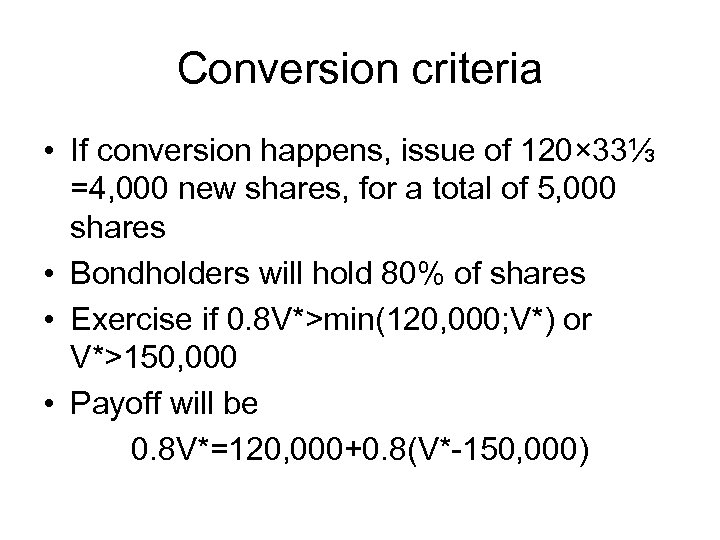
Conversion criteria • If conversion happens, issue of 120× 33⅓ =4, 000 new shares, for a total of 5, 000 shares • Bondholders will hold 80% of shares • Exercise if 0. 8 V*>min(120, 000; V*) or V*>150, 000 • Payoff will be 0. 8 V*=120, 000+0. 8(V*-150, 000)
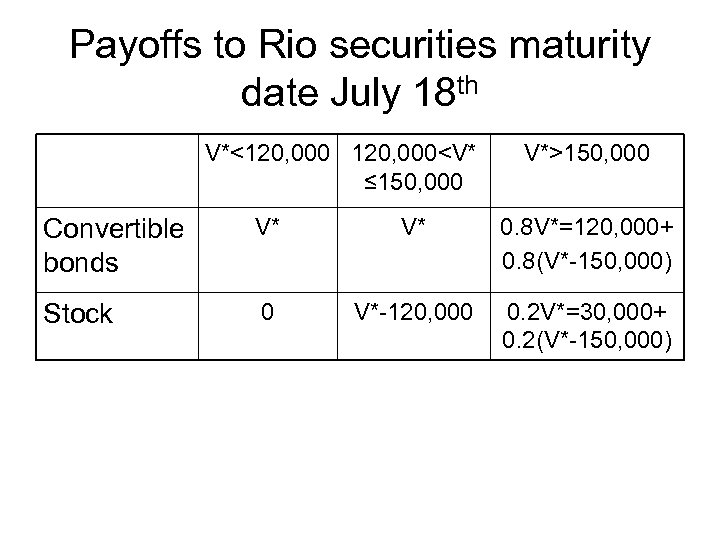
Payoffs to Rio securities maturity date July 18 th V*<120, 000<V* ≤ 150, 000 V*>150, 000 Convertible bonds V* V* 0. 8 V*=120, 000+ 0. 8(V*-150, 000) Stock 0 V*-120, 000 0. 2 V*=30, 000+ 0. 2(V*-150, 000)
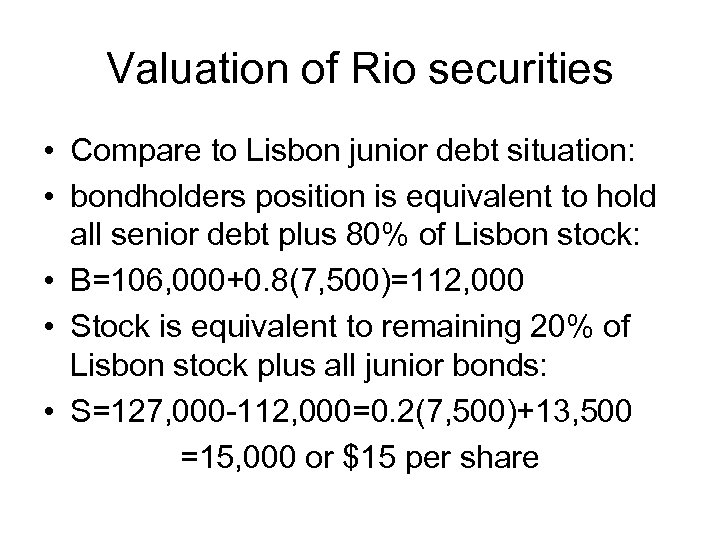
Valuation of Rio securities • Compare to Lisbon junior debt situation: • bondholders position is equivalent to hold all senior debt plus 80% of Lisbon stock: • B=106, 000+0. 8(7, 500)=112, 000 • Stock is equivalent to remaining 20% of Lisbon stock plus all junior bonds: • S=127, 000 -112, 000=0. 2(7, 500)+13, 500 =15, 000 or $15 per share
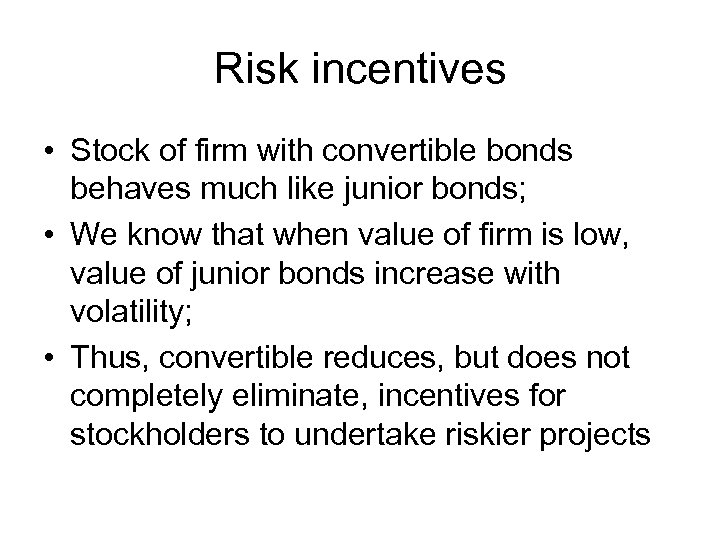
Risk incentives • Stock of firm with convertible bonds behaves much like junior bonds; • We know that when value of firm is low, value of junior bonds increase with volatility; • Thus, convertible reduces, but does not completely eliminate, incentives for stockholders to undertake riskier projects
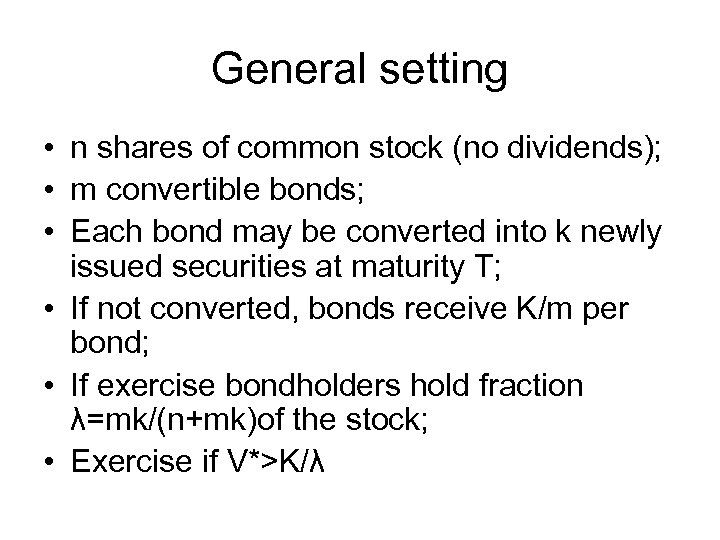
General setting • n shares of common stock (no dividends); • m convertible bonds; • Each bond may be converted into k newly issued securities at maturity T; • If not converted, bonds receive K/m per bond; • If exercise bondholders hold fraction λ=mk/(n+mk)of the stock; • Exercise if V*>K/λ
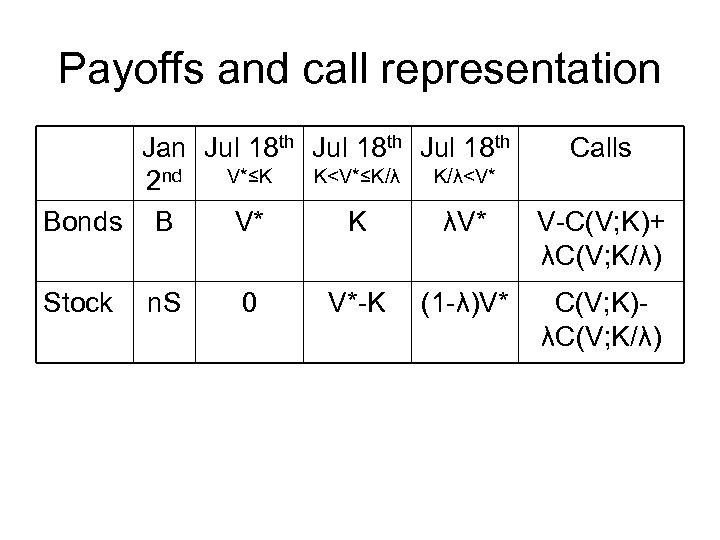
Payoffs and call representation Jan Jul 18 th Calls V*≤K K<V*≤K/λ K/λ<V* 2 nd Bonds B V* K λV* V-C(V; K)+ λC(V; K/λ) Stock n. S 0 V*-K (1 -λ)V* C(V; K)λC(V; K/λ)
Early exercise and dividends • Virtually all convertible are American; • As long as no dividends are paid, there will be no early exercise; • Representation of European options still valid for American convertibles; • With arbitrary payments, no longer true! • Nonetheless early exercise is never optimal if value of coupons are high enough: • critical value: λ times the value of dividends and coupons for all dates.
Example 5: Callable bonds • Most ordinary bonds, as well as convertibles, allow the firm to repurchase (call) the issue for a specified price plus accrued interest since last coupon date; • Typically initial call price is above the par value of bonds and may decrease gradually; • Sometimes you may call only after the bond has been outstanding for sometime.
Reasons for callable provision 1. Give firms opportunity to refinance on more favorable terms or the fortunes of the firm improve; 2. Bondholders protected with indenture restrictions may be an obstacle to some firm’s decisions (mergers, investments); 3. Unexpected decrease of inflation rate may compromise future dollar profits and ability to meet payments to bondholders.
General setting • Consider corporation with 2 types of securities outstanding; • n shares of common stock (no dividends); • A single issue of callable bonds, maturity T, specified coupons and final payment K; • Stockholders may buyback bond at any time ζ for an aggregate price Kζ, which may vary with time.
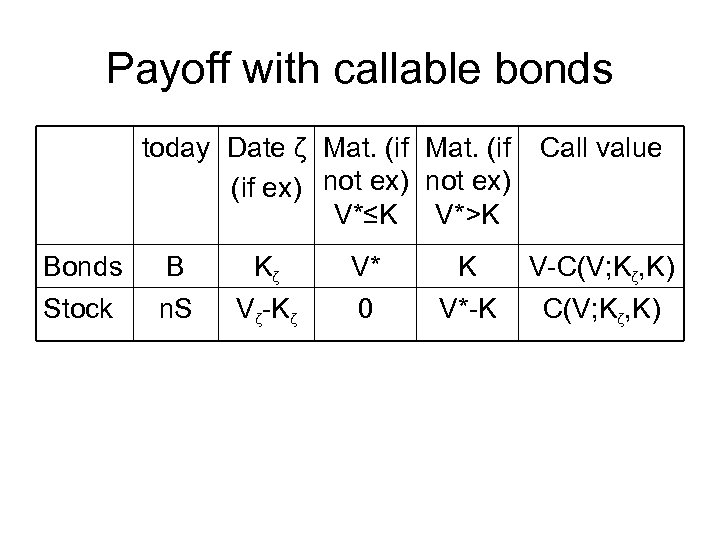
Payoff with callable bonds today Date ζ Mat. (if (if ex) not ex) V*≤K V*>K Call value Bonds B Kζ V* K V-C(V; Kζ, K) Stock n. S Vζ-Kζ 0 V*-K C(V; Kζ, K)
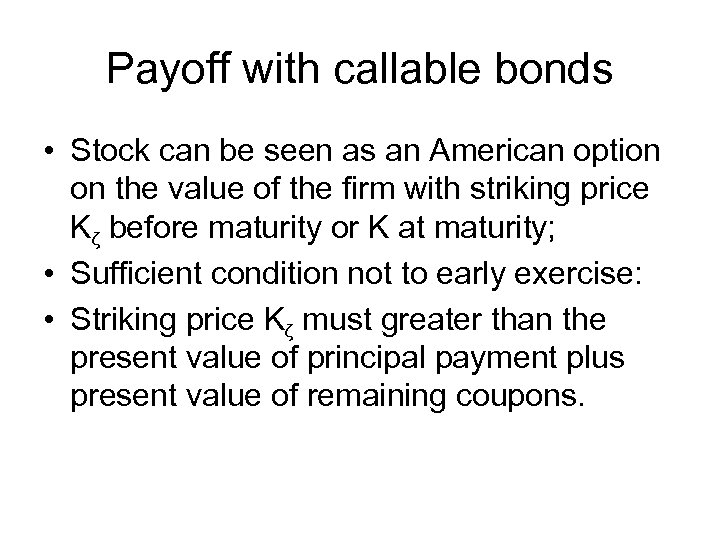
Payoff with callable bonds • Stock can be seen as an American option on the value of the firm with striking price Kζ before maturity or K at maturity; • Sufficient condition not to early exercise: • Striking price Kζ must greater than the present value of principal payment plus present value of remaining coupons.
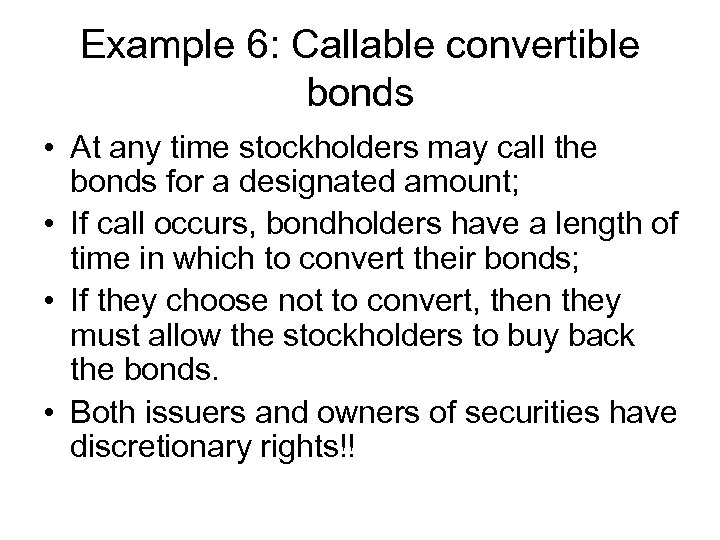
Example 6: Callable convertible bonds • At any time stockholders may call the bonds for a designated amount; • If call occurs, bondholders have a length of time in which to convert their bonds; • If they choose not to convert, then they must allow the stockholders to buy back the bonds. • Both issuers and owners of securities have discretionary rights!!
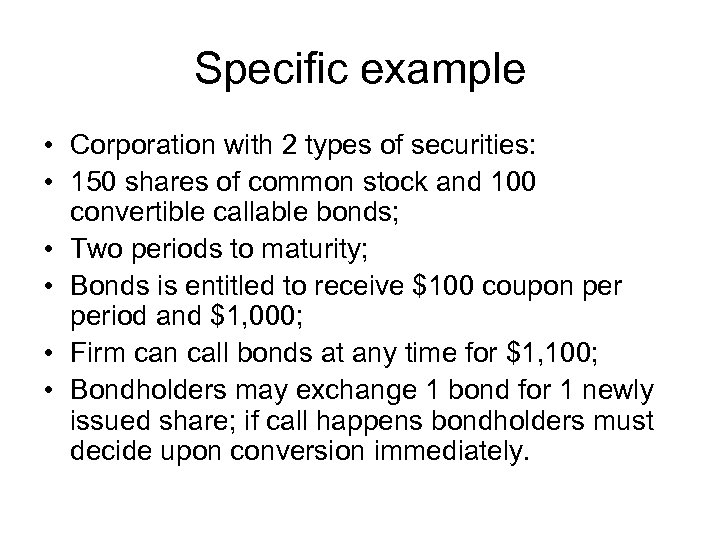
Specific example • Corporation with 2 types of securities: • 150 shares of common stock and 100 convertible callable bonds; • Two periods to maturity; • Bonds is entitled to receive $100 coupon period and $1, 000; • Firm can call bonds at any time for $1, 100; • Bondholders may exchange 1 bond for 1 newly issued share; if call happens bondholders must decide upon conversion immediately.
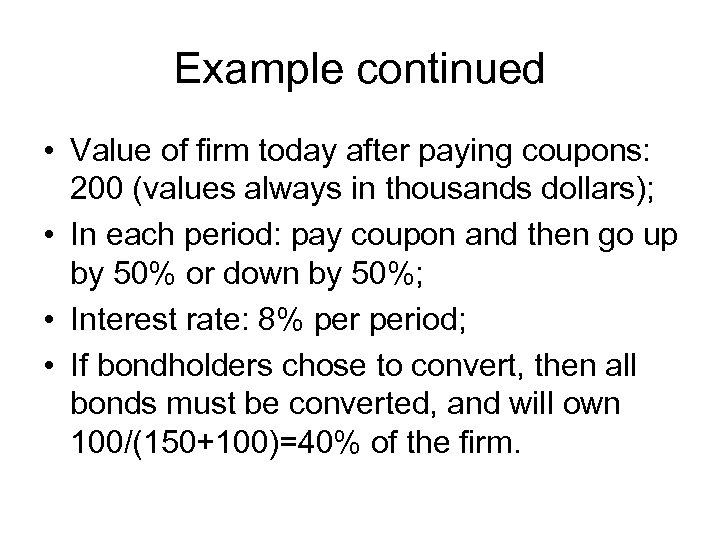
Example continued • Value of firm today after paying coupons: 200 (values always in thousands dollars); • In each period: pay coupon and then go up by 50% or down by 50%; • Interest rate: 8% period; • If bondholders chose to convert, then all bonds must be converted, and will own 100/(150+100)=40% of the firm.
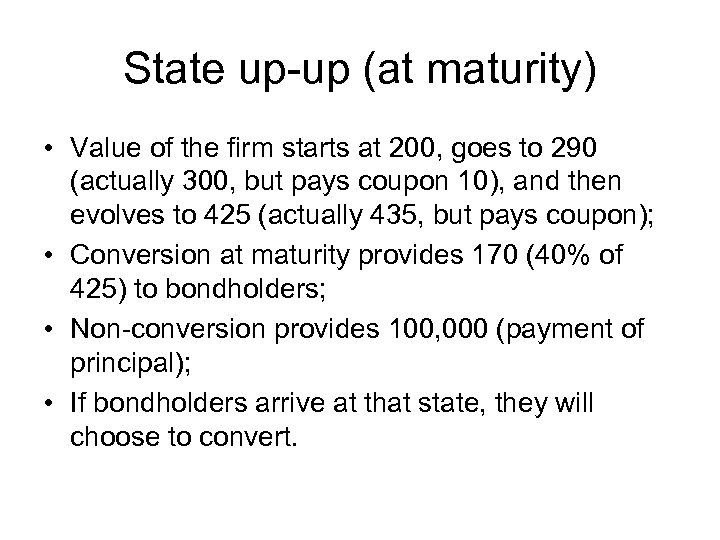
State up-up (at maturity) • Value of the firm starts at 200, goes to 290 (actually 300, but pays coupon 10), and then evolves to 425 (actually 435, but pays coupon); • Conversion at maturity provides 170 (40% of 425) to bondholders; • Non-conversion provides 100, 000 (payment of principal); • If bondholders arrive at that state, they will choose to convert.
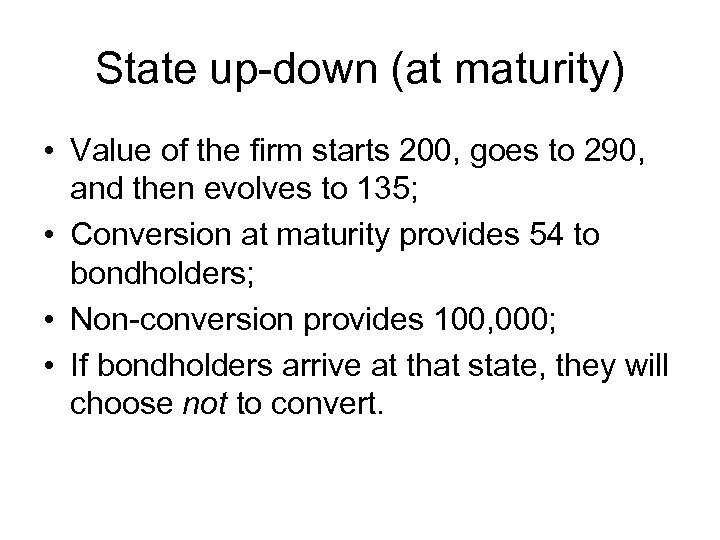
State up-down (at maturity) • Value of the firm starts 200, goes to 290, and then evolves to 135; • Conversion at maturity provides 54 to bondholders; • Non-conversion provides 100, 000; • If bondholders arrive at that state, they will choose not to convert.
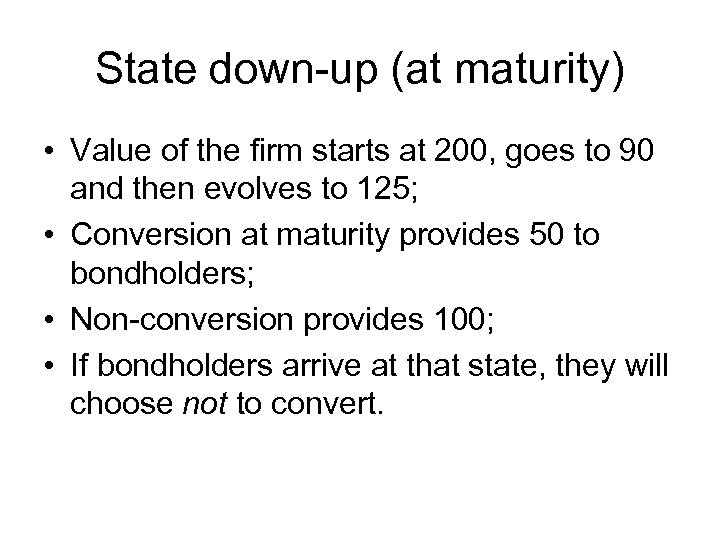
State down-up (at maturity) • Value of the firm starts at 200, goes to 90 and then evolves to 125; • Conversion at maturity provides 50 to bondholders; • Non-conversion provides 100; • If bondholders arrive at that state, they will choose not to convert.
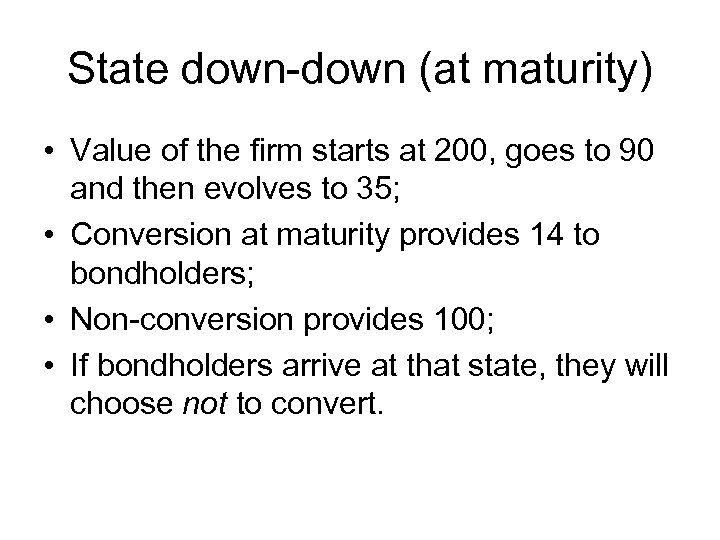
State down-down (at maturity) • Value of the firm starts at 200, goes to 90 and then evolves to 35; • Conversion at maturity provides 14 to bondholders; • Non-conversion provides 100; • If bondholders arrive at that state, they will choose not to convert.
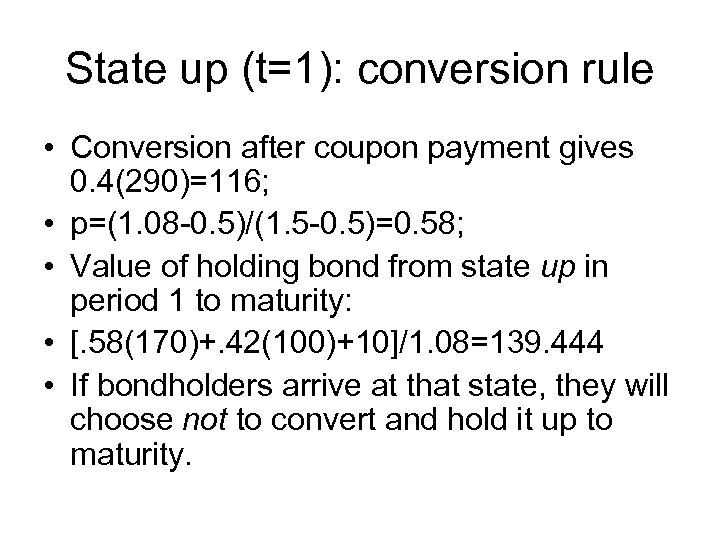
State up (t=1): conversion rule • Conversion after coupon payment gives 0. 4(290)=116; • p=(1. 08 -0. 5)/(1. 5 -0. 5)=0. 58; • Value of holding bond from state up in period 1 to maturity: • [. 58(170)+. 42(100)+10]/1. 08=139. 444 • If bondholders arrive at that state, they will choose not to convert and hold it up to maturity.
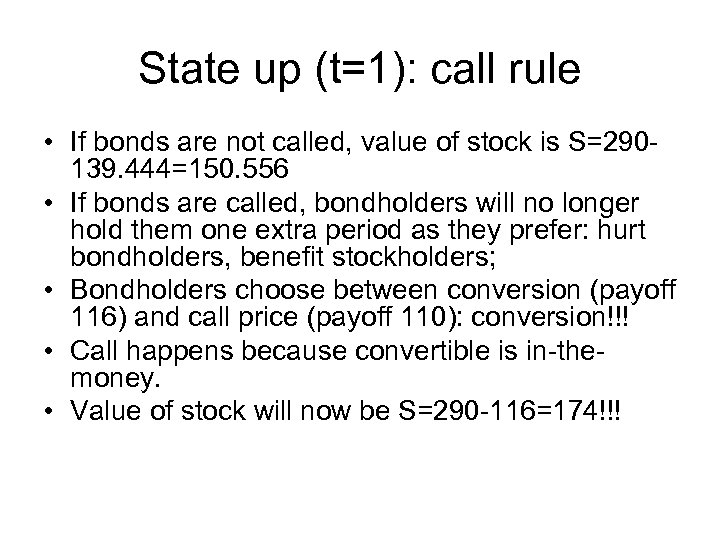
State up (t=1): call rule • If bonds are not called, value of stock is S=290139. 444=150. 556 • If bonds are called, bondholders will no longer hold them one extra period as they prefer: hurt bondholders, benefit stockholders; • Bondholders choose between conversion (payoff 116) and call price (payoff 110): conversion!!! • Call happens because convertible is in-themoney. • Value of stock will now be S=290 -116=174!!!
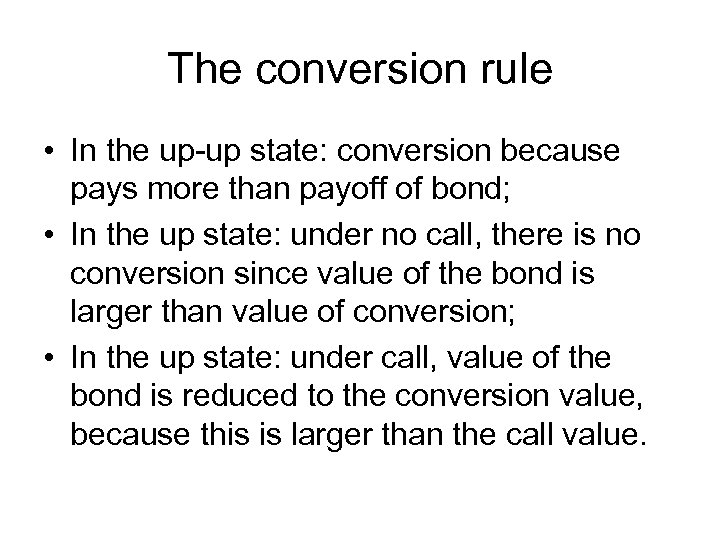
The conversion rule • In the up-up state: conversion because pays more than payoff of bond; • In the up state: under no call, there is no conversion since value of the bond is larger than value of conversion; • In the up state: under call, value of the bond is reduced to the conversion value, because this is larger than the call value.
State down (t=1): conversion rule • Conversion after coupon payment gives 0. 4(90)=36; • Value of holding bond from state down in period 1 to maturity: [. 58(100)+. 42(35)+10]/1. 08=76. 574 • If bondholders arrive at that state, choose not to convert and hold it one more period; • Clearly, stockholders prefer not to call.
Initial value of securities • At t=0, after coupon payment, if bonds are held over one more period, value is: [. 58(116)+. 42(76. 574)+10]/1. 08=101. 334 • Since 101. 334<110 there is no call! • Immediate conversion value is. 4(200)=80 • Bonds are not converted at t=0; • B=$101, 334 • S=$98, 666
Value of conversion and call • Value of otherwise identical nonconvertible bond is $93, 734; • Conversion feature is worth $7, 600 to bondholders. • Value of otherwise identical non-callable bond is $113, 924. 63; • Call feature decreases the value of the bonds by $12, 590, 63.
Скачать презентацию Applied Corporate Finance Corporate Securities bonds warrants convertible
ac86fddea5c6a90ea18926f613368a0a.ppt