


 Скачать презентацию Applications Outline Name Service DNS Traditional Applications Spring
2ca6f48cea8fea16b2ab1a6e05b19504.ppt
- Количество слайдов: 23
 Applications Outline Name Service (DNS) Traditional Applications Spring 2000 CS 461 1
 Naming Outline Terminology Domain Naming System Distributed File Systems Spring 2000 CS 461 2
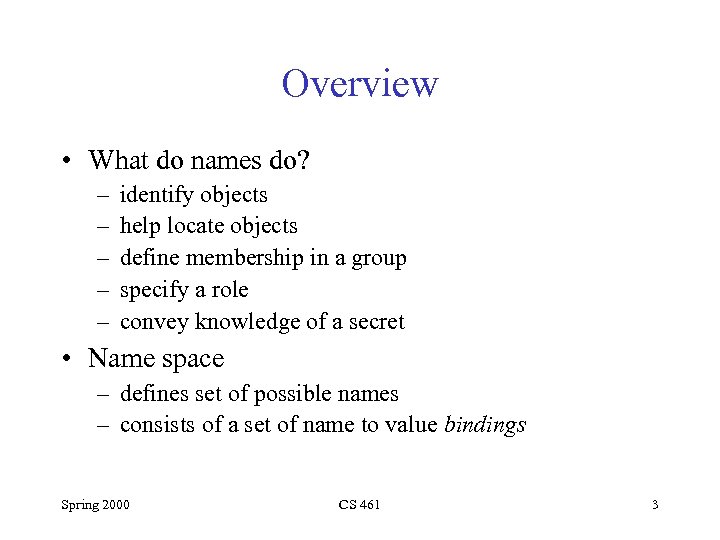 Overview • What do names do? – – – identify objects help locate objects define membership in a group specify a role convey knowledge of a secret • Name space – defines set of possible names – consists of a set of name to value bindings Spring 2000 CS 461 3
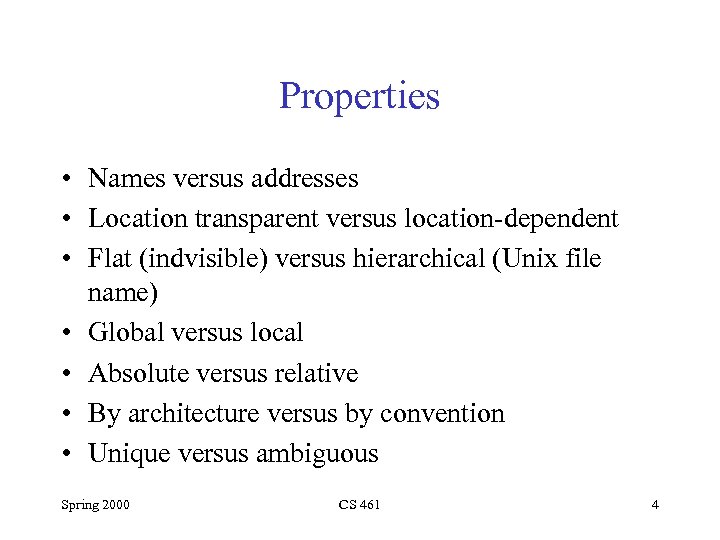 Properties • Names versus addresses • Location transparent versus location-dependent • Flat (indvisible) versus hierarchical (Unix file name) • Global versus local • Absolute versus relative • By architecture versus by convention • Unique versus ambiguous Spring 2000 CS 461 4
 DNS • The domain name system (DNS) is the way that Internet domain names are located and translated into Internet Protocol addresses. • A domain name is a meaningful and easy-toremember "handle" for an Internet address. • Because maintaining a central list of domain name/IP address correspondences would be impractical, the lists of domain names and IP addresses are distributed throughout the Internet in a hierarchy of authority. Spring 2000 CS 461 5
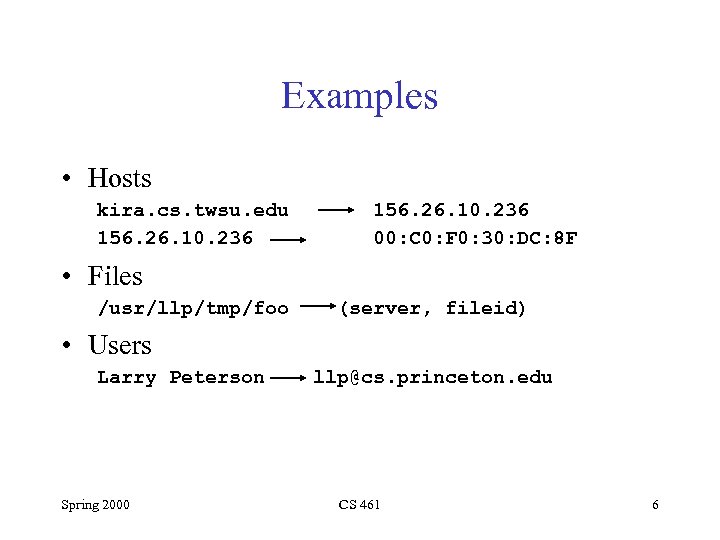 Examples • Hosts kira. cs. twsu. edu 156. 26. 10. 236 00: C 0: F 0: 30: DC: 8 F • Files /usr/llp/tmp/foo (server, fileid) • Users Larry Peterson Spring 2000 llp@cs. princeton. edu CS 461 6
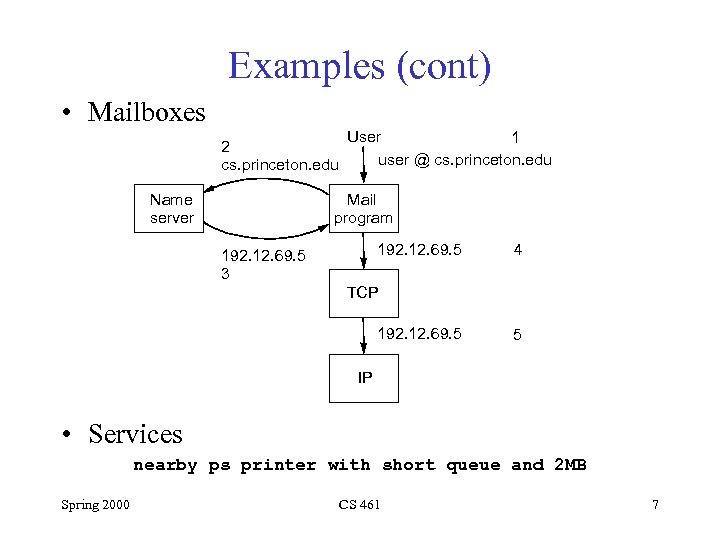 Examples (cont) • Mailboxes 2 cs. princeton. edu Name server User 1 user @ cs. princeton. edu Mail program 192. 12. 69. 5 3 4 TCP 192. 12. 69. 5 5 IP • Services nearby ps printer with short queue and 2 MB Spring 2000 CS 461 7
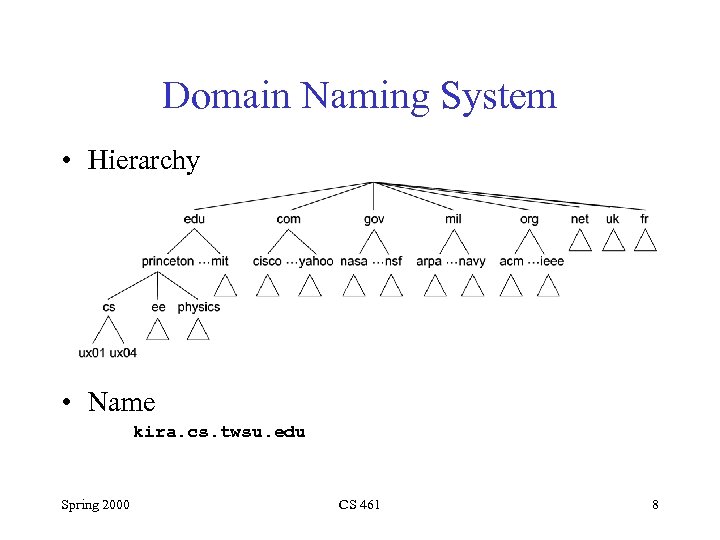 Domain Naming System • Hierarchy • Name kira. cs. twsu. edu Spring 2000 CS 461 8
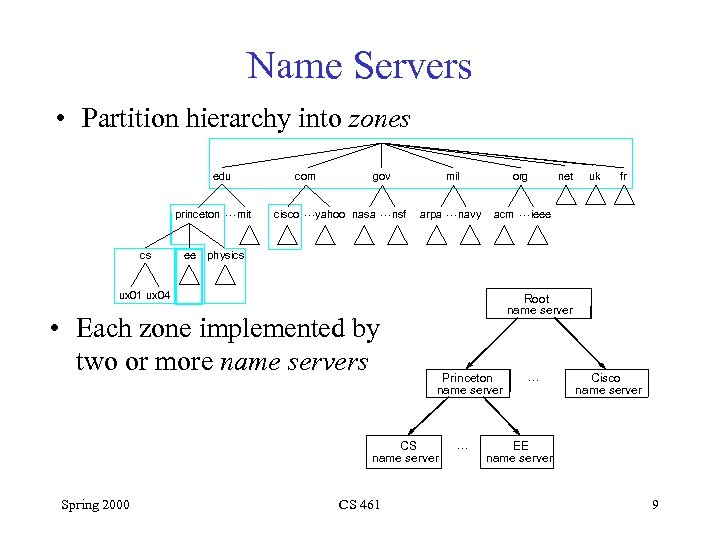 Name Servers • Partition hierarchy into zones edu princeton … mit cs ee com gov cisco … yahoo nasa … nsf mil org arpa … navy acm … ieee uk fr physics ux 01 ux 04 • Each zone implemented by two or more name servers Root name server Princeton name server CS name server Spring 2000 net CS 461 … … Cisco name server EE name server 9
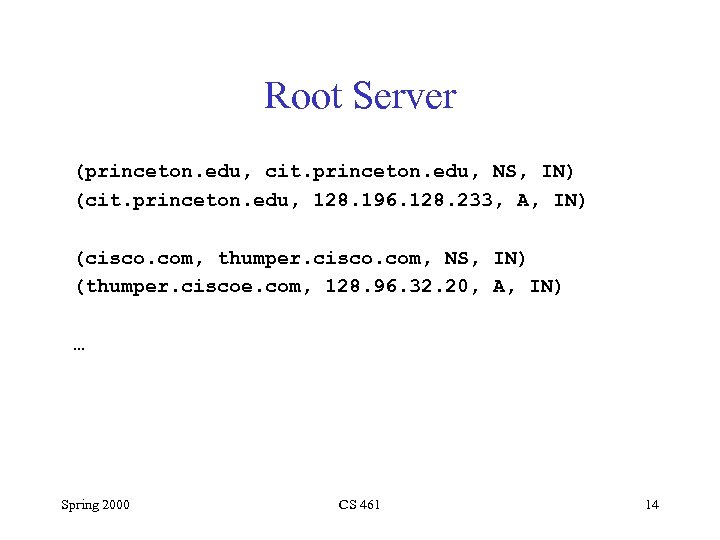
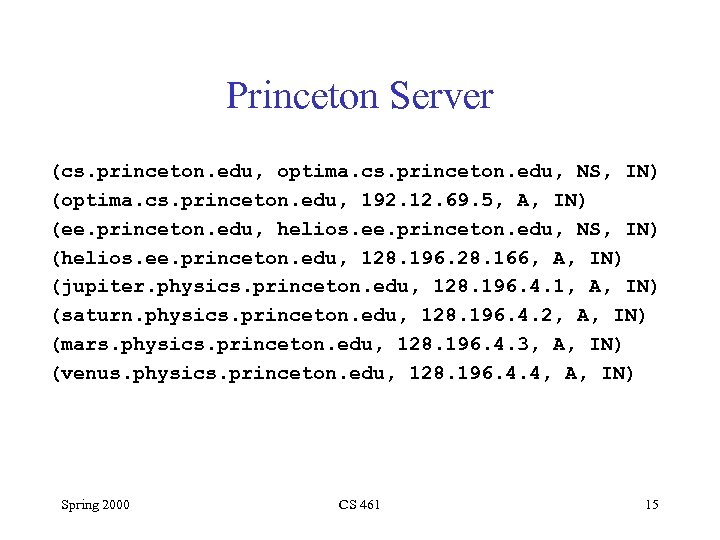
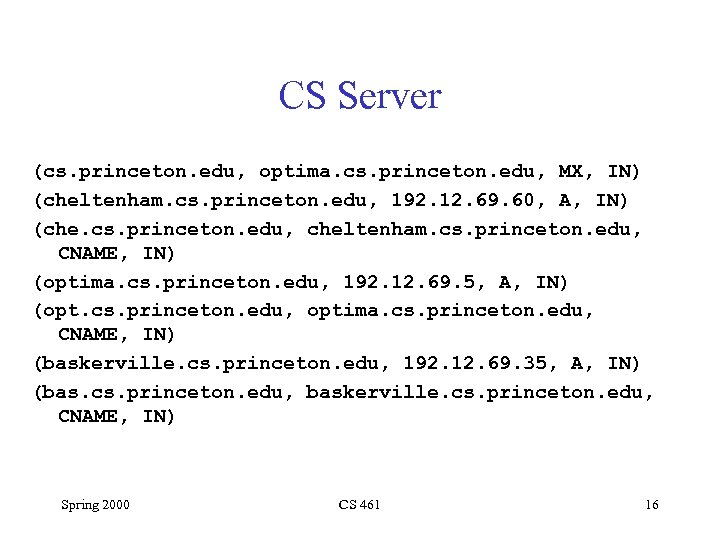
 Resource Records • Each name server maintains a collection of resource records which consists of five components: (Name, Value, Type, Class, TTL) – A Resource record starts with a domain name, usually a fully qualified domain name (A domain name that extends all the way back to root. gomer. gimboid. com. is an FQDN. ) – Second is the record value. It depends on record type. • IP addresses • If the record data includes a domain name that is not a Fully Qualified Domain Name it goes through the same appending process as the domain name at the start of the record. – Third is the record type: CNAME, PTR, A, etc. – Fourth is the Record class: Internet, Hesiod, or Chaos • Hesiod is only used at M. I. T, and maybe not even there anymore. • Chaos is almost extinct. – Fifth is the TTL, in seconds. – Many servers will permit comments as a sixth component. Spring 2000 CS 461 10
 Resource Records • Type – NS: Value gives domain name for host running name server that knows how to resolve names within specified domain. – CNAME: Value gives canonical name for particular host; used to define aliases. – MX: Value gives domain name for host running mail server that accepts messages for specified domain. – A: indicates the value is an IP address. • Class: allow other entities to define types. Only widely Class is the one used by the Internet denoted as IN. • TTL: Time To Live, the number of seconds remaining on a cached record before it is purged. Spring 2000 CS 461 11
 DNS • A Canonical Name (CNAME) is a host's official name as opposed to an alias. – The official name is the first hostname listed for its Internet address in the hostname database, /etc/hosts or the Network Information Service (NIS). – Network Information Service (NIS) is Sun Microsystems' Yellow Pages (yp) client-server protocol for distributing system configuration data such as user and host names between computers on a network. – You can find a host's canonical name using nslookup if you say set querytype=CNAME Spring 2000 CS 461 12
 DNS • Address Record (A Record), assigns an IP address to a domain name. When the domain name system was designed it was recommended that no two A records refer to the same IP address. • Pointer Record. Also called a reverse record. A PTR record associates an IP address with a canonical name. – PTR records should point to a name that can be resolved back to the IP address. – The name of the pointer record is not the IP address itself, but is the IP address’ four IP octets in reverse order followed by INADDR. ARPA. – for Example: 192. 168. 0. 1 becomes 1. 0. 168. 192. IN-ADDR. ARPA. Spring 2000 CS 461 13
 Root Server (princeton. edu, cit. princeton. edu, NS, IN) (cit. princeton. edu, 128. 196. 128. 233, A, IN) (cisco. com, thumper. cisco. com, NS, IN) (thumper. ciscoe. com, 128. 96. 32. 20, A, IN) … Spring 2000 CS 461 14
 Princeton Server (cs. princeton. edu, optima. cs. princeton. edu, NS, IN) (optima. cs. princeton. edu, 192. 12. 69. 5, A, IN) (ee. princeton. edu, helios. ee. princeton. edu, NS, IN) (helios. ee. princeton. edu, 128. 196. 28. 166, A, IN) (jupiter. physics. princeton. edu, 128. 196. 4. 1, A, IN) (saturn. physics. princeton. edu, 128. 196. 4. 2, A, IN) (mars. physics. princeton. edu, 128. 196. 4. 3, A, IN) (venus. physics. princeton. edu, 128. 196. 4. 4, A, IN) Spring 2000 CS 461 15
 CS Server (cs. princeton. edu, optima. cs. princeton. edu, MX, IN) (cheltenham. cs. princeton. edu, 192. 12. 69. 60, A, IN) (che. cs. princeton. edu, cheltenham. cs. princeton. edu, CNAME, IN) (optima. cs. princeton. edu, 192. 12. 69. 5, A, IN) (opt. cs. princeton. edu, optima. cs. princeton. edu, CNAME, IN) (baskerville. cs. princeton. edu, 192. 12. 69. 35, A, IN) (bas. cs. princeton. edu, baskerville. cs. princeton. edu, CNAME, IN) Spring 2000 CS 461 16
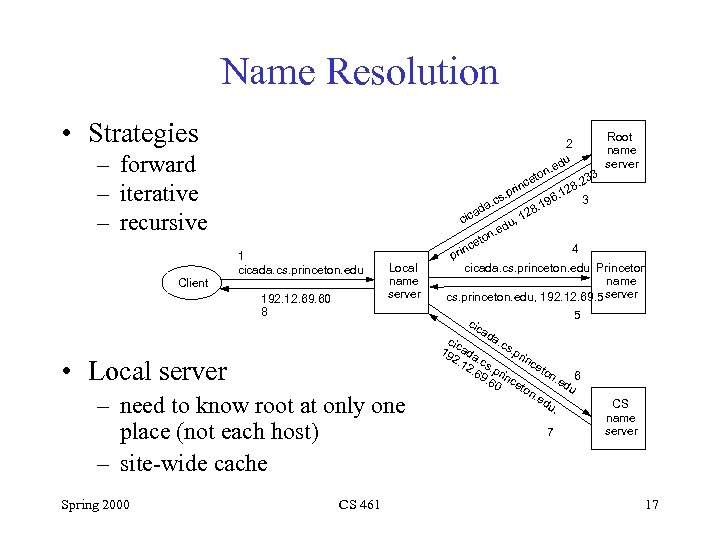 Name Resolution • Strategies – forward – iterative – recursive Client 1 cicada. cs. princeton. edu 192. 12. 69. 60 8 Local name server 5 cic • Local server – need to know root at only one place (not each host) – site-wide cache Spring 2000 Root 2 name u server. ed 3 on t. 23 ce 28 rin s. p 6. 1 3 a. c. 19 8 ad 12 cic u, . ed ton ce 4 rin p cicada. cs. princeton. edu Princeton name server cs. princeton. edu, 192. 12. 69. 5 CS 461 ad a. c cic s. p 19 ada rin 2. 1. c ce 2. 6 s. pr ton 9. 6 inc. ed 6 eto 0 u n. e du , 7 CS name server 17
 Distributed File Systems • Network File System (NFS) – Provides transparent file access for client applications. – Built on top of Sun RPC. – NFS is used predominately with UDP. The NFS server receives a clients request on port 2049. – It is common to start multiple instances of the server (nfsd). Spring 2000 CS 461 18
 Distributed File Systems • No Transparency Global AFS: /cs. princeton. edu/usr/llp/tmp/foo Windows: f: /usr/llp/tmp/foo • Transparency by Convention – NFS: /usr/llp/tmp/foo – Or Not: /n/fs/fac 5/llp/tmp/foo • Transparency by Architecture – Sprite: /usr/llp/tmp/foo • Private versus Shared – ASF: /usr/llp/tmp/foo versus /afs/shared Spring 2000 CS 461 19
 Applications • File Transfer Protocol (FTP) – FTP uses two TCP connections to transfer a file. – The control connection is established on port number 21. – The data connection is established through port 20. • SMTP (Simple Mail Transfer Protocol) is a TCP/IP protocol used in sending and receiving e-mail. • The Hypertext Transfer Protocol (HTTP) is the set of rules for exchanging files (text, graphic images, sound, video, and other multimedia files) on the World Wide Web. • Simple Network Management Protocol (SNMP) is the protocol governing network management and the monitoring of network devices and their functions. Spring 2000 CS 461 20
 RTP • The Real-Time Transport Protocol (RTP) is an Internet protocol standard that specifies a way for programs to manage the real-time transmission of multimedia data over either unicast or multicast network services. • RTP is commonly used in Internet telephony applications. RTP does not in itself guarantee realtime delivery of multimedia data. • RTP combines its data transport with a control protocol (RTCP), which makes it possible to monitor data delivery for large multicast networks. Spring 2000 CS 461 21
 Real-Time Transport Protocol (RTP) • Monitoring allows the receiver to detect – A sequence number is used to detect lost packets. – A timestamp detects different delay jitter. • Control Packets is sent periodically. – Measure loss rate (fraction of packets received since last report) – measure jitter. • RTP runs on top of the User Datagram Protocol (UDP), although it can use other transport protocols. Spring 2000 CS 461 22
 Session Control • Video conferencing requires session control. • The Session Initiation Protocol (SIP) is an Internet Engineering Task Force (IETF) standard protocol for initiating an interactive user session that involves multimedia elements such as video, voice, chat, gaming, and virtual reality. – SIP can establish multimedia sessions or Internet telephony calls, and modify, or terminate them. – SIP uses RTP. • H. 323 is a standard built on top of RTP and approved by the International Telecommunication Union (ITU) in 1996 to promote compatibility in videoconference transmissions over IP networks. Spring 2000 CS 461 23