


 Скачать презентацию Applications of Description Logics State of the Art
0891ef912defa5ee2fc69b8fe1694a29.ppt
- Количество слайдов: 50
 Applications of Description Logics State of the Art and Research Challenges Ian Horrocks
 Introduction to Description Logics Combining the strengths of UMIST and The Victoria University of Manchester
 What Are Description Logics? • A family of logic based Knowledge Representation formalisms – Descendants of semantic networks and KL-ONE – Describe domain in terms of concepts (classes), roles (properties, relationships) and individuals • Distinguished by: – Formal semantics (typically model theoretic) • Decidable fragments of FOL (often contained in C 2) • Closely related to Propositional Modal & Dynamic Logics • Closely related to Guarded Fragment – Provision of inference services • Decision procedures for key problems (satisfiability, subsumption, etc) • Implemented systems (highly optimised) Combining the strengths of UMIST and The Victoria University of Manchester
 DL Basics • Concept names are equivalent to unary predicates – In general, concepts equiv to formulae with one free variable • Role names are equivalent to binary predicates – In general, roles equiv to formulae with two free variables • Individual names are equivalent to constants • Operators restricted so that: – Language is decidable and, if possible, of low complexity – No need for explicit use of variables • Restricted form of 9 and 8 (direct correspondence with ◊ and []) – Features such as counting can be succinctly expressed Combining the strengths of UMIST and The Victoria University of Manchester
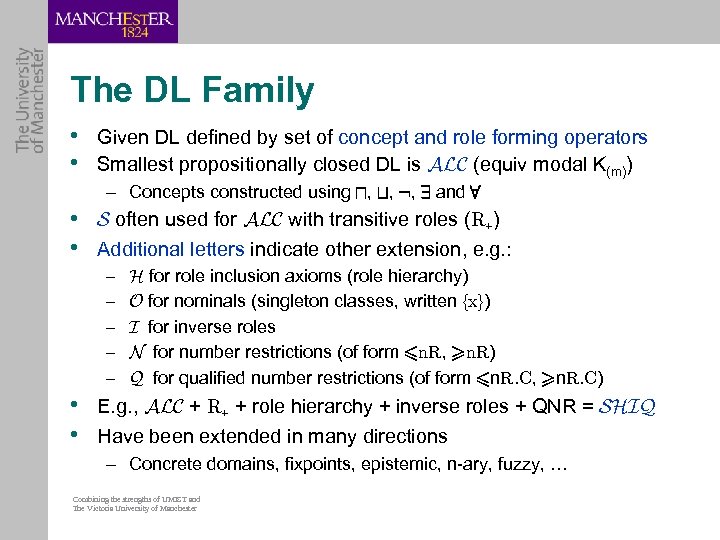 The DL Family • Given DL defined by set of concept and role forming operators • Smallest propositionally closed DL is ALC (equiv modal K(m)) – Concepts constructed using u, t, : , 9 and 8 • S often used for ALC with transitive roles (R+) • Additional letters indicate other extension, e. g. : – – – H for role inclusion axioms (role hierarchy) O for nominals (singleton classes, written {x}) I for inverse roles N for number restrictions (of form 6 n. R, >n. R) Q for qualified number restrictions (of form 6 n. R. C, >n. R. C) • E. g. , ALC + R+ + role hierarchy + inverse roles + QNR = SHIQ • Have been extended in many directions – Concrete domains, fixpoints, epistemic, n-ary, fuzzy, … Combining the strengths of UMIST and The Victoria University of Manchester
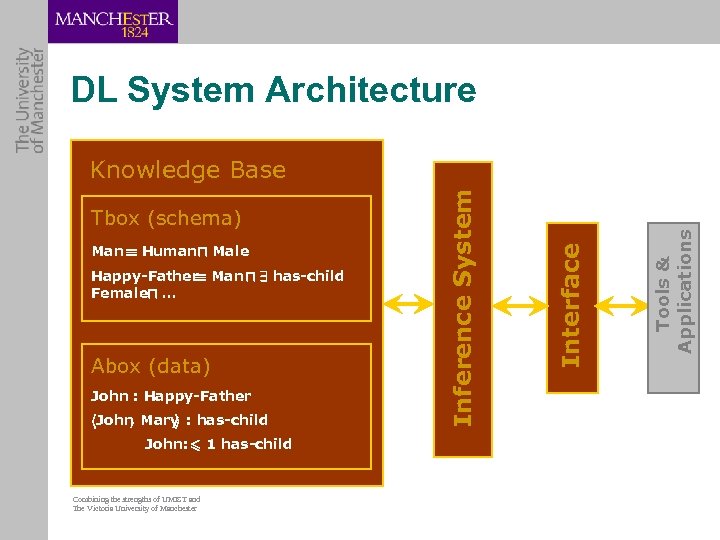 DL System Architecture Happy-Father Man u 9 has-child ´ Female u … Abox (data) John : Happy-Father h. John Mary : has-child , i John: 6 1 has-child Combining the strengths of UMIST and The Victoria University of Manchester Tools & Applications Man ´ Human u Male Interface Tbox (schema) Inference System Knowledge Base
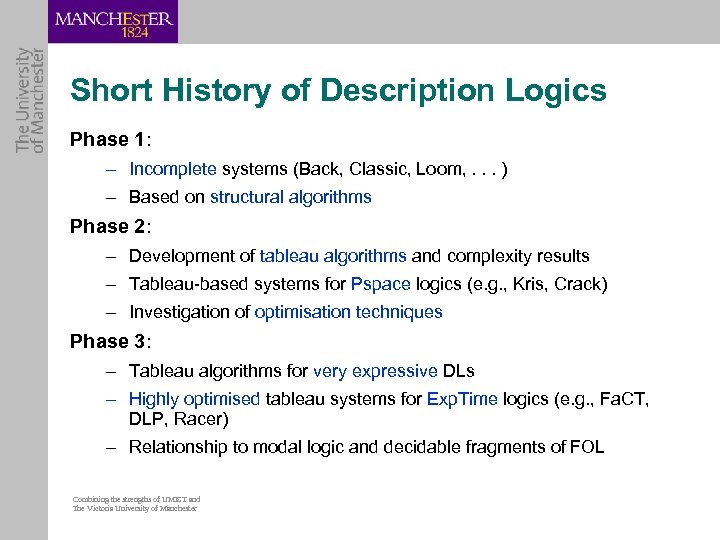 Short History of Description Logics Phase 1: – Incomplete systems (Back, Classic, Loom, . . . ) – Based on structural algorithms Phase 2: – Development of tableau algorithms and complexity results – Tableau-based systems for Pspace logics (e. g. , Kris, Crack) – Investigation of optimisation techniques Phase 3: – Tableau algorithms for very expressive DLs – Highly optimised tableau systems for Exp. Time logics (e. g. , Fa. CT, DLP, Racer) – Relationship to modal logic and decidable fragments of FOL Combining the strengths of UMIST and The Victoria University of Manchester
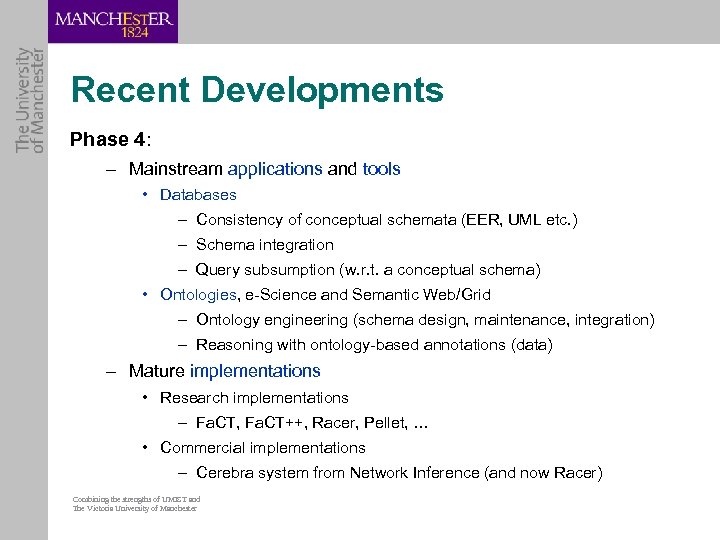 Recent Developments Phase 4: – Mainstream applications and tools • Databases – Consistency of conceptual schemata (EER, UML etc. ) – Schema integration – Query subsumption (w. r. t. a conceptual schema) • Ontologies, e-Science and Semantic Web/Grid – Ontology engineering (schema design, maintenance, integration) – Reasoning with ontology-based annotations (data) – Mature implementations • Research implementations – Fa. CT, Fa. CT++, Racer, Pellet, … • Commercial implementations – Cerebra system from Network Inference (and now Racer) Combining the strengths of UMIST and The Victoria University of Manchester
 Ontologies Combining the strengths of UMIST and The Victoria University of Manchester
 Ontology: Origins and History a philosophical discipline—a branch of philosophy that deals with the nature and the organisation of reality • Science of Being (Aristotle, Metaphysics, IV, 1) • Tries to answer (hard) questions such as: – What characterizes being? – Eventually, what is being? • Also addresses organisation of knowledge: – How should things be classified? Combining the strengths of UMIST and The Victoria University of Manchester
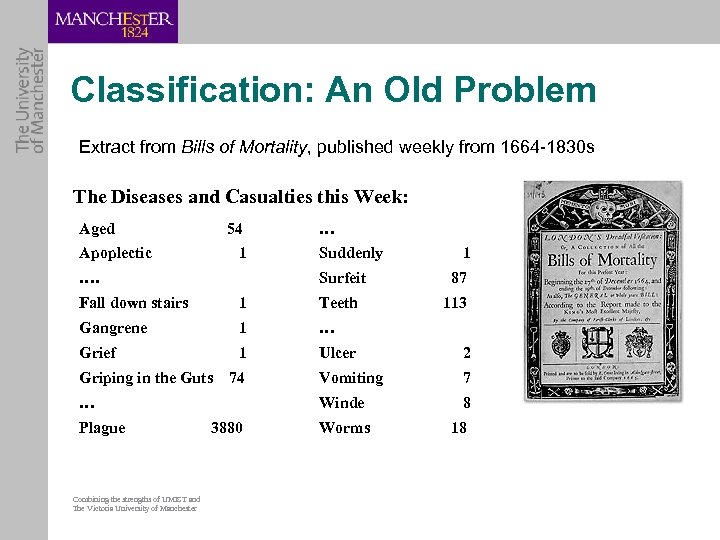 Classification: An Old Problem Extract from Bills of Mortality, published weekly from 1664 -1830 s The Diseases and Casualties this Week: Aged 54 Apoplectic 1 …. … Suddenly 1 Surfeit 87 113 Fall down stairs 1 Teeth Gangrene 1 … Grief 1 Ulcer 2 Vomiting 7 Winde 8 Griping in the Guts 74 … Plague Combining the strengths of UMIST and The Victoria University of Manchester 3880 Worms 18
 Ontology in Computer Science • An ontology is an engineering artefact consisting of: – A vocabulary used to describe (a particular view of) some domain – An explicit specification of the intended meaning of the vocabulary. • Often includes classification based information – Constraints capturing additional knowledge about the domain • Ideally, an ontology should: – Capture a shared understanding of a domain of interest – Provide a formal and machine manipulable model of the domain Combining the strengths of UMIST and The Victoria University of Manchester
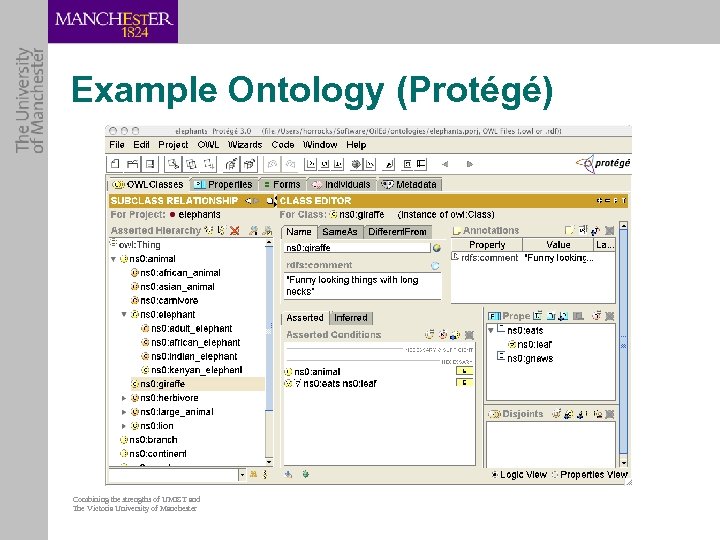 Example Ontology (Protégé) Combining the strengths of UMIST and The Victoria University of Manchester
 Where are ontologies used? • e-Science, e. g. , Bioinformatics – The Gene Ontology (GO) – The Protein Ontology (MGED) – “In silico” investigations relating theory and data • E. g. , relating data on phosphatases to (model of) biological knowledge • Medicine – Building/maintaining terminologies such as Snomed, NCI, Galen • Databases – Schema design and integration – Query optimisation • User interfaces • The Semantic Web and so-called Semantic Grid Combining the strengths of UMIST and The Victoria University of Manchester
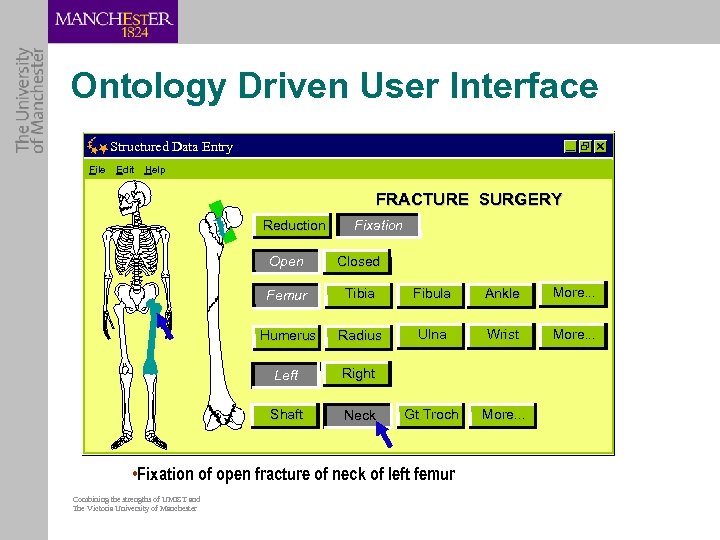 Ontology Driven User Interface Structured Data Entry File Edit Help FRACTURE SURGERY Reduction Fixation Open Closed Femur Tibia Fibula Ankle More. . . Humerus Radius Ulna Wrist More. . . Left Right Shaft Neck Gt Troch More. . . • Fixation of open fracture of neck of left femur Combining the strengths of UMIST and The Victoria University of Manchester
 Scientific American, May 2001: ! Combining the strengths of UMIST and The Victoria University of Manchester Beware of the Hype
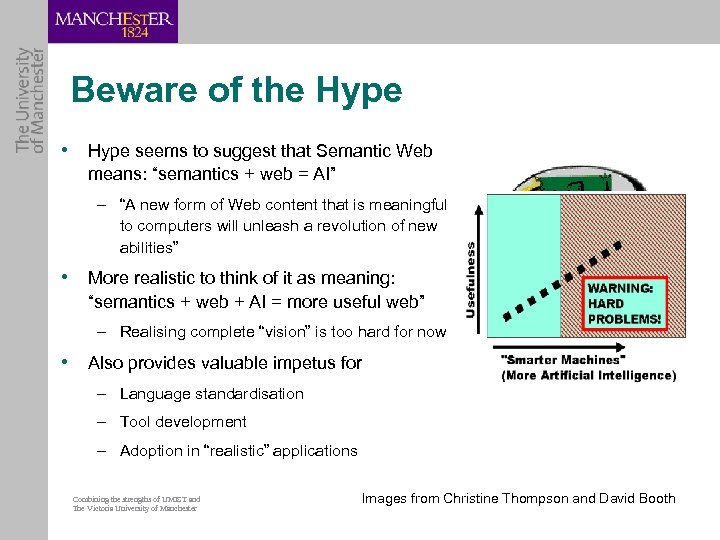 Beware of the Hype • Hype seems to suggest that Semantic Web means: “semantics + web = AI” – “A new form of Web content that is meaningful to computers will unleash a revolution of new abilities” • More realistic to think of it as meaning: “semantics + web + AI = more useful web” – Realising complete “vision” is too hard for now • Also provides valuable impetus for – Language standardisation – Tool development – Adoption in “realistic” applications Combining the strengths of UMIST and The Victoria University of Manchester Images from Christine Thompson and David Booth
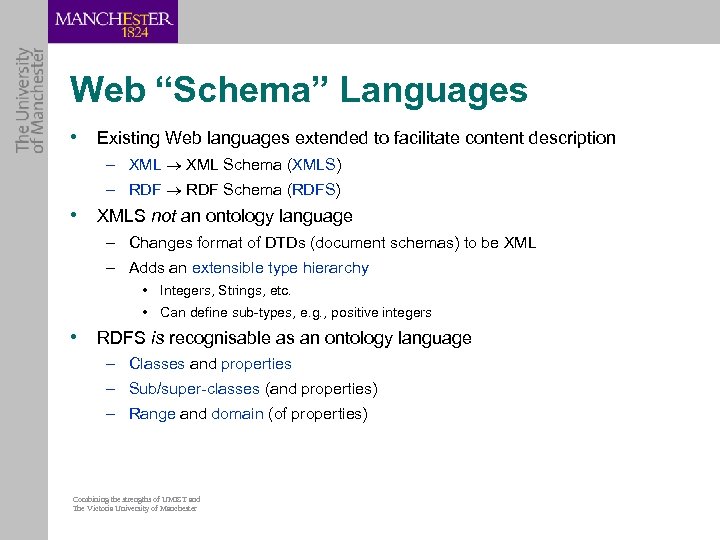 Web “Schema” Languages • Existing Web languages extended to facilitate content description – XML Schema (XMLS) – RDF Schema (RDFS) • XMLS not an ontology language – Changes format of DTDs (document schemas) to be XML – Adds an extensible type hierarchy • Integers, Strings, etc. • Can define sub-types, e. g. , positive integers • RDFS is recognisable as an ontology language – Classes and properties – Sub/super-classes (and properties) – Range and domain (of properties) Combining the strengths of UMIST and The Victoria University of Manchester
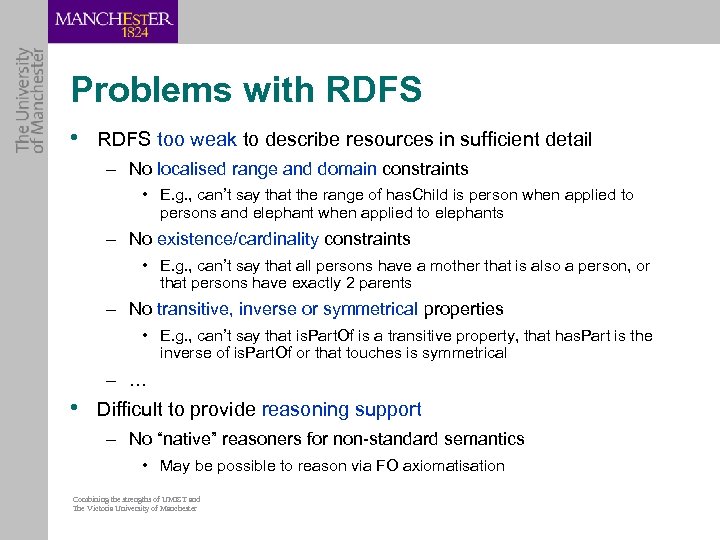 Problems with RDFS • RDFS too weak to describe resources in sufficient detail – No localised range and domain constraints • E. g. , can’t say that the range of has. Child is person when applied to persons and elephant when applied to elephants – No existence/cardinality constraints • E. g. , can’t say that all persons have a mother that is also a person, or that persons have exactly 2 parents – No transitive, inverse or symmetrical properties • E. g. , can’t say that is. Part. Of is a transitive property, that has. Part is the inverse of is. Part. Of or that touches is symmetrical – … • Difficult to provide reasoning support – No “native” reasoners for non-standard semantics • May be possible to reason via FO axiomatisation Combining the strengths of UMIST and The Victoria University of Manchester
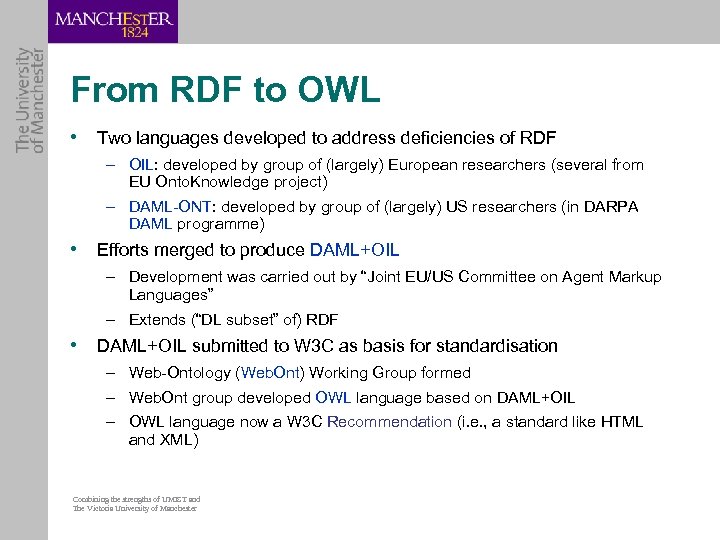 From RDF to OWL • Two languages developed to address deficiencies of RDF – OIL: developed by group of (largely) European researchers (several from EU Onto. Knowledge project) – DAML-ONT: developed by group of (largely) US researchers (in DARPA DAML programme) • Efforts merged to produce DAML+OIL – Development was carried out by “Joint EU/US Committee on Agent Markup Languages” – Extends (“DL subset” of) RDF • DAML+OIL submitted to W 3 C as basis for standardisation – Web-Ontology (Web. Ont) Working Group formed – Web. Ont group developed OWL language based on DAML+OIL – OWL language now a W 3 C Recommendation (i. e. , a standard like HTML and XML) Combining the strengths of UMIST and The Victoria University of Manchester
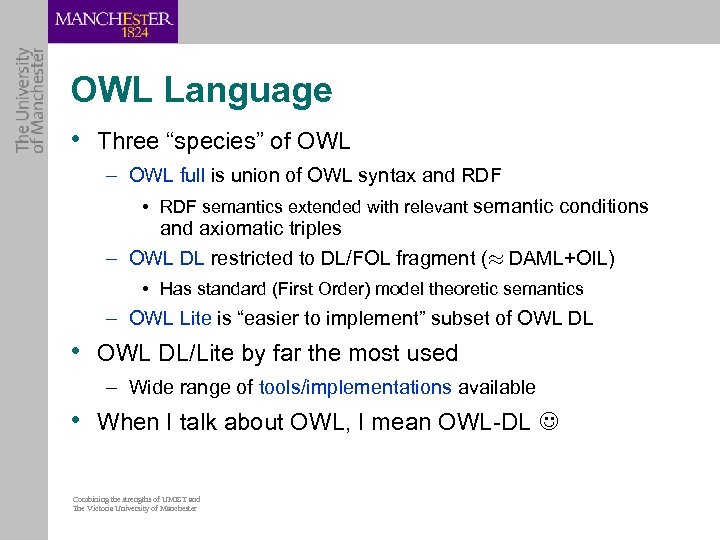 OWL Language • Three “species” of OWL – OWL full is union of OWL syntax and RDF • RDF semantics extended with relevant semantic conditions and axiomatic triples – OWL DL restricted to DL/FOL fragment (¼ DAML+OIL) • Has standard (First Order) model theoretic semantics – OWL Lite is “easier to implement” subset of OWL DL • OWL DL/Lite by far the most used – Wide range of tools/implementations available • When I talk about OWL, I mean OWL-DL Combining the strengths of UMIST and The Victoria University of Manchester
 Ontology Reasoning: Why do We Want It? Combining the strengths of UMIST and The Victoria University of Manchester
 Why Ontology Reasoning? • Given key role of ontologies in many applications, it is essential to provide tools and services to help users: – Design and maintain high quality ontologies, e. g. : • Meaningful — all named classes can have instances • Correct — captured intuitions of domain experts • Minimally redundant — no unintended synonyms • Richly axiomatised — (sufficiently) detailed descriptions – Answer queries over ontology classes and instances, e. g. : • Find more general/specific classes • Retrieve individuals/tuples matching a given query Combining the strengths of UMIST and The Victoria University of Manchester
 Why Decidable Reasoning? • OWL is a W 3 C standard DL based ontology language – OWL constructors/axioms restricted so reasoning is decidable • Consistent with Semantic Web's layered architecture – RDF(S) provides basic relational language and simple ontological primitives (or this is what RDF should be) – OWL provides powerful but still decidable ontology language – Further layers (e. g. SWRL) will extend OWL • May be undecidable • W 3 C requirement for “implementation experience” – “Practical” decision procedures – Several implemented systems – Evidence of empirical tractability Combining the strengths of UMIST and The Victoria University of Manchester
 Why Correct Reasoning? • Users need to have high level of confidence in reasoner – Automated systems expected to exhibit correct and consistent behaviour – Most interesting/useful inferences are those that were unexpected • Likely to be ignored/dismissed if reasoner believed to be unreliable • Many realistic (web) applications will be agent ↔ agent – No human intervention to spot glitches in reasoning Combining the strengths of UMIST and The Victoria University of Manchester
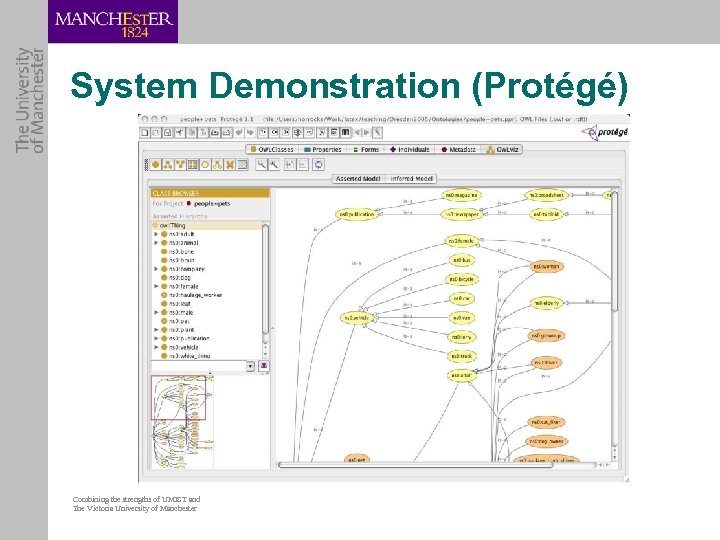 System Demonstration (Protégé) Combining the strengths of UMIST and The Victoria University of Manchester
 Ontology Reasoning: How do we do it? Combining the strengths of UMIST and The Victoria University of Manchester
 Use a (Description) Logic • OWL DL based on SHIQ Description Logic – In fact it is equivalent to SHOIN(Dn) DL • OWL DL Benefits from many years of DL research – Well defined semantics – Formal properties well understood (complexity, decidability) – Known reasoning algorithms – Implemented systems (highly optimised) • Foundational research was crucial to the design and standardisation of OWL – Informed decisions at every stage, e. g. : • “I want to extend the language with feature x, which is clearly harmless” • “No, adding x would lead to undecidability - see proof in […] Combining the strengths of UMIST and The Victoria University of Manchester
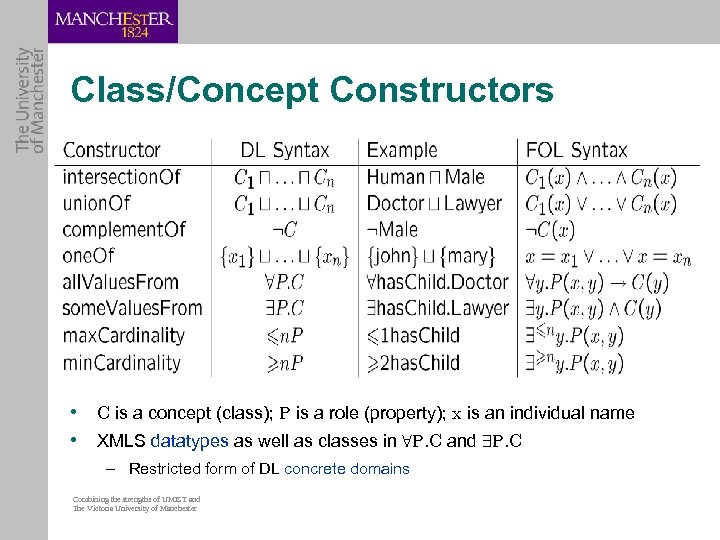 Class/Concept Constructors • C is a concept (class); P is a role (property); x is an individual name • XMLS datatypes as well as classes in 8 P. C and 9 P. C – Restricted form of DL concrete domains Combining the strengths of UMIST and The Victoria University of Manchester
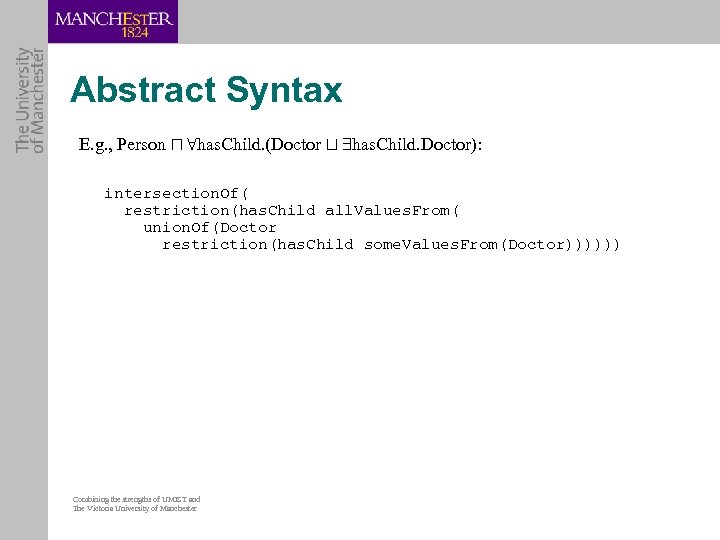 Abstract Syntax E. g. , Person u 8 has. Child. (Doctor t 9 has. Child. Doctor): intersection. Of( restriction(has. Child all. Values. From( union. Of(Doctor restriction(has. Child some. Values. From(Doctor)))))) Combining the strengths of UMIST and The Victoria University of Manchester
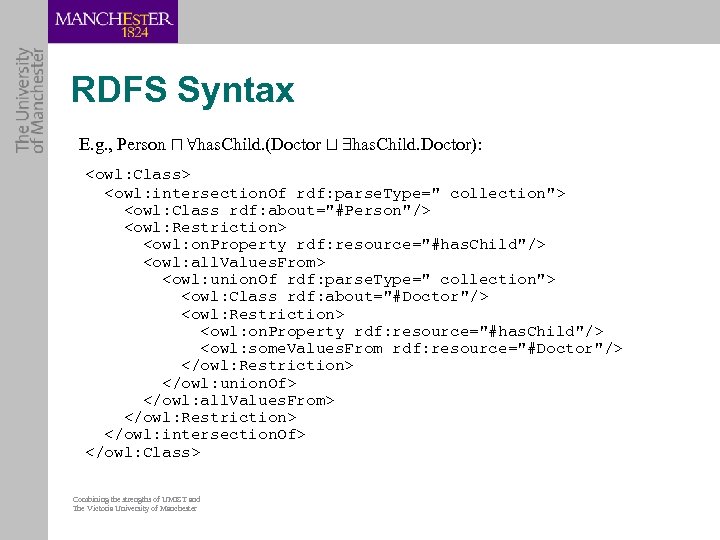 RDFS Syntax E. g. , Person u 8 has. Child. (Doctor t 9 has. Child. Doctor):
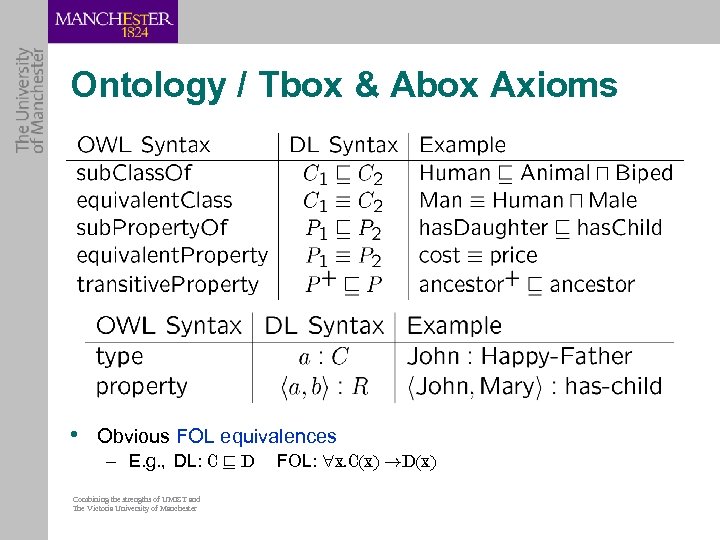 Ontology / Tbox & Abox Axioms • Obvious FOL equivalences – E. g. , DL: C v D Combining the strengths of UMIST and The Victoria University of Manchester FOL: x. C(x) !D(x)
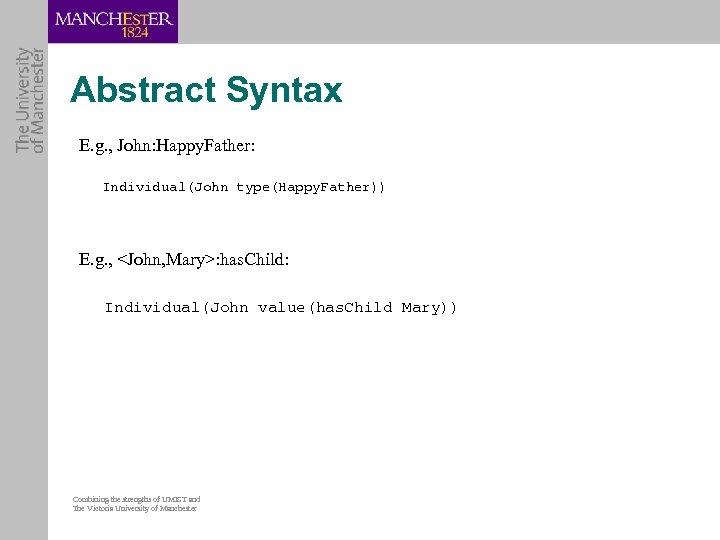 Abstract Syntax E. g. , John: Happy. Father: Individual(John type(Happy. Father)) E. g. ,
 Description Logic Reasoning Combining the strengths of UMIST and The Victoria University of Manchester
 DL Reasoning: Basics (I) • Key reasoning tasks reducible to (un)satisfiability – E. g. , C v D iff C u : D is not satisfiable • Tableau algorithms used to test satisfiability (consistency) • Try to build a tree-like model of the input concept C • Decompose C syntactically – Apply tableau expansion rules – Infer constraints on elements of model • Tableau rules correspond to constructors in logic (u, t etc) – Some rules are nondeterministic (e. g. , t, 6) – In practice, this means search • Stop when no more rules applicable or clash occurs – Clash is an obvious contradiction, e. g. , A(x), : A(x) Combining the strengths of UMIST and The Victoria University of Manchester
 DL Reasoning: Basics (II) • Cycle check (blocking) may be needed for termination • Algorithm is a decision procedure, i. e. , C satisfiable iff rules can be applied such that fully expanded clash free tree constructed: Terminating – Bounds on out-degree (rule applications per node) and depth (blocking) of tree Sound – Can construct a tableau, and hence a model, from a fully expanded and clash-free tree Complete – Can use a model to guide application of non-deterministic rules and so construct a clash-free tree Combining the strengths of UMIST and The Victoria University of Manchester
 DL Reasoning: Advanced Techniques • Satisfiability w. r. t. an Ontology O – For each axiom C v D 2 O , add : C t D to every node label • More expressive DLs – Basic technique can be extended to deal with • • • Role inclusion axioms (role hierarchy) Number restrictions Inverse roles Concrete domains/datatypes Aboxes etc. – Extend expansion rules and use more sophisticated blocking strategy – Forest instead of Tree (for Aboxes) • Root nodes correspond to individuals in Abox Combining the strengths of UMIST and The Victoria University of Manchester
 DL Reasoning: Optimised Implementations • Naive implementation can lead to effective non-termination – 10 GCIs £ 10 nodes → 2100 different possible expansions • Modern systems include MANY optimisations • Optimised classification (compute partial ordering) – Enhanced traversal (exploits information from previous tests) – Use structural information to select classification order • Optimised satisfiability/subsumption testing – – – Normalisation and simplification of concepts Absorption (simplification) of axioms Dependency directed backtracking Caching of satisfiability results and (partial) models Heuristic ordering of propositional and modal expansion … Combining the strengths of UMIST and The Victoria University of Manchester
 Research Challenges: What next? Combining the strengths of UMIST and The Victoria University of Manchester
 Increasing Expressive Power • OWL not expressive enough for some applications – Constructors mainly for classes (unary predicates) – No complex datatypes or built in predicates (e. g. , arithmetic) – No variables – No higher arity predicates • Extensions (of OWL) that have/are being considered include: – (Decidable) extensions to underlying DL – “Rule” language extensions • The focus of much research/debate – First order logic (e. g. , SWRL-FOL) – (Syntactically) higher order extensions (e. g. , Common Logic) Combining the strengths of UMIST and The Victoria University of Manchester
![Extending Description Logics • Nominals (already in OWL-DL) [Horrocks&Sattler, IJCAI-05] – E. g. ,](https://present5.com/presentation/0891ef912defa5ee2fc69b8fe1694a29/image-41.jpg "Extending Description Logics • Nominals (already in OWL-DL) [Horrocks&Sattler, IJCAI-05] – E. g. ,") Extending Description Logics • Nominals (already in OWL-DL) [Horrocks&Sattler, IJCAI-05] – E. g. , EU-Countries ´ {France, Germany, UK, …} • Complex role inclusion axioms [Horrocks&Sattler, IJCAI-03] – E. g. , has. Location ± part. Of v has. Location • Finite satisfiability [Calvanese, KR-96] – Important in database applications • Database style keys [Lutz et al, JAIR 2004] – E. g. , make + model + chassis-number is a key for Vehicles • Concrete domains/datatypes [Lutz, IJCAI-99; Pan et al, ISWC-03] – E. g. , value comparison (age > income), custom datatypes (integer >25) • … Combining the strengths of UMIST and The Victoria University of Manchester
Extending Description Logics • Nominals (already in OWL-DL) [Horrocks&Sattler, IJCAI-05] – E. g. , EU-Countries ´ {France, Germany, UK, …} • Complex role inclusion axioms [Horrocks&Sattler, IJCAI-03] – E. g. , has. Location ± part. Of v has. Location • Finite satisfiability [Calvanese, KR-96] – Important in database applications • Database style keys [Lutz et al, JAIR 2004] – E. g. , make + model + chassis-number is a key for Vehicles • Concrete domains/datatypes [Lutz, IJCAI-99; Pan et al, ISWC-03] – E. g. , value comparison (age > income), custom datatypes (integer >25) • … Combining the strengths of UMIST and The Victoria University of Manchester
 Rule Language Extensions (to OWL) • First Order extension (SWRL) already developed [Horrocks et al, JWS, 2005] – Horn clauses where predicates are OWL classes and properties – Resulting language is undecidable – Reasoning support currently only via FOL theorem provers (Hoolet) • Hybrid language extensions being investigated – Restricting language “interaction” maintains decidability • DL extended with Answer Set Programming [Eiter et al, KR-04] • DL extended with Datalog rules [Motik et al, ISWC-04; Rosati, JWS, 2005] • LP/F-logic rule language – Claimed “interoperability” with OWL via DLP subset [de Bruijn et al, WWW 05] Combining the strengths of UMIST and The Victoria University of Manchester
 Improving Scalability • Reasoning is hard (NExp. Time-complete for OWL-DL) • (Web) ontologies may grow very large • Good empirical evidence of scalability/tractability for conceptual reasoning with DL systems – E. g. , 5, 000 (complex) classes; 100, 000+ (simple) classes – But evidence mostly w. r. t. SHF (no inverse or nominals) • Reasoning with individuals may be problematical – Deployment of web ontologies will mean reasoning with (possibly very large numbers of) individuals/tuples – Unlikely that standard Abox techniques will be able to cope Combining the strengths of UMIST and The Victoria University of Manchester
![New Reasoning Techniques • Polynomial time algorithms for sub-ALC logics [Baader et al, IJCAI-05]](https://present5.com/presentation/0891ef912defa5ee2fc69b8fe1694a29/image-44.jpg "New Reasoning Techniques • Polynomial time algorithms for sub-ALC logics [Baader et al, IJCAI-05]") New Reasoning Techniques • Polynomial time algorithms for sub-ALC logics [Baader et al, IJCAI-05] – Graph based techniques for subsumption computation • “To-Do List” architecture [Tsarkov & Horrocks, IJCAI-05] – Better suited to dealing with nominals and inverse roles – Facilitates use of search heuristics • Reduction to disjunctive Datalog [Motik et at, KR-04] – Transform DL ontology to DatalogÇ rules – Use LP techniques to deal with large numbers of ground facts • Hybrid DL-DB systems [Horrocks et al, CADE-05] – Use DB to store “Abox” (individual) axioms – Cache inferences so that DB queries can be used to answer/scope logical queries Combining the strengths of UMIST and The Victoria University of Manchester
New Reasoning Techniques • Polynomial time algorithms for sub-ALC logics [Baader et al, IJCAI-05] – Graph based techniques for subsumption computation • “To-Do List” architecture [Tsarkov & Horrocks, IJCAI-05] – Better suited to dealing with nominals and inverse roles – Facilitates use of search heuristics • Reduction to disjunctive Datalog [Motik et at, KR-04] – Transform DL ontology to DatalogÇ rules – Use LP techniques to deal with large numbers of ground facts • Hybrid DL-DB systems [Horrocks et al, CADE-05] – Use DB to store “Abox” (individual) axioms – Cache inferences so that DB queries can be used to answer/scope logical queries Combining the strengths of UMIST and The Victoria University of Manchester
![Other Reasoning Tasks • Querying [Fikes et al, JWS, 2004] – Retrieval and instantiation](https://present5.com/presentation/0891ef912defa5ee2fc69b8fe1694a29/image-45.jpg "Other Reasoning Tasks • Querying [Fikes et al, JWS, 2004] – Retrieval and instantiation") Other Reasoning Tasks • Querying [Fikes et al, JWS, 2004] – Retrieval and instantiation wont be sufficient – Minimum requirement will be DB style query language – May also need “what can I say about x? ” style of query • Explanation [Schlobach & Cornet, DL-03; Borgida et al, ECAI-00] – To support ontology design – Justifications and proofs (e. g. , of query results) • “Non-Standard Inferences”, e. g. , LCS, matching [Küsters, 2001] – To support ontology integration – To support “bottom up” design of ontologies Combining the strengths of UMIST and The Victoria University of Manchester
Other Reasoning Tasks • Querying [Fikes et al, JWS, 2004] – Retrieval and instantiation wont be sufficient – Minimum requirement will be DB style query language – May also need “what can I say about x? ” style of query • Explanation [Schlobach & Cornet, DL-03; Borgida et al, ECAI-00] – To support ontology design – Justifications and proofs (e. g. , of query results) • “Non-Standard Inferences”, e. g. , LCS, matching [Küsters, 2001] – To support ontology integration – To support “bottom up” design of ontologies Combining the strengths of UMIST and The Victoria University of Manchester
 Tools and Infrastructure • Adoption of OWL and realisation of Semantic Web will require development of wide range of tools and infrastructure – Not just editors, but complete ontology development environments • NL based tools • Ontology extraction tools • “Bottom up” design tools (e. g. , FCA) – Annotation tools, including (semi-)automated annotation of existing content – Reasoning systems/query engines – … Combining the strengths of UMIST and The Victoria University of Manchester
 Summary • DLs are a family of logic based Knowledge Representation formalisms – Describe domain in terms of concepts, roles and individuals • DLs have many applications – But best known as basis of ontology languages such as OWL • Ontologies play a key role in many applications – e-Science, Medicine, Databases, Semantic Web, etc. Combining the strengths of UMIST and The Victoria University of Manchester
 Summary • Reasoning is crucial to use of ontologies – E. g. , in design, maintenance and deployment • Reasoning support via underlying logic – E. g. , based on DL systems • Many challenges remain – Including well founded language extensions Enough work to keep logic based KR community busy for many years to come Combining the strengths of UMIST and The Victoria University of Manchester
 Acknowledgements Thanks to my many friends in the DL and ontology communities, in particular: – Alan Rector – Franz Baader – Uli Sattler Combining the strengths of UMIST and The Victoria University of Manchester
 Resources • Slides from this talk – http: //www. cs. man. ac. uk/~horrocks/Slides/iccs 05. ppt • Fa. CT system (open source) – http: //www. cs. man. ac. uk/Fa. CT/ • Oil. Ed (open source) – http: //oiled. man. ac. uk/ • Protégé – http: //protege. stanford. edu/plugins/owl/ • W 3 C Web-Ontology (Web. Ont) working group (OWL) – http: //www. w 3. org/2001/sw/Web. Ont/ • DL Handbook, Cambridge University Press – http: //books. cambridge. org/0521781760. htm Combining the strengths of UMIST and The Victoria University of Manchester