


 Скачать презентацию Applications of Associative Model to Air Traffic Control
cda2ab6155870324d5ad175067a6095a.ppt
- Количество слайдов: 34
 Applications of Associative Model to Air Traffic Control Real-Time Research Project Computer Science Kent State University Dr. Frank Drews’ Visit October 18, 2006
 Implementing ATC on an Associative SIMD Computer Johnnie Baker Parallel and Associative Computing Group Computer Science Department Kent State University
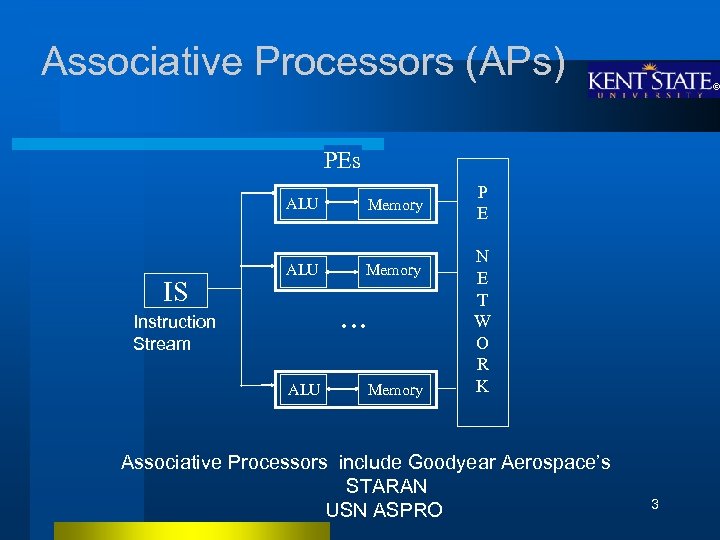 Associative Processors (APs) PEs ALU IS Memory ALU Memory Instruction Stream · · · ALU Memory P E N E T W O R K Associative Processors include Goodyear Aerospace’s STARAN USN ASPRO 3
 Associative Non-SIMD Properties Broadcast data in constant time. • Constant time global reduction of • Ø Boolean values using AND/OR. Ø Integer values using MAX/MIN. • Constant time data search ØProvides content addressable data. Ø Eliminates need for sorting and indexing. • Above properties supported in hardware with broadcast and reduction networks. Reference: M. Jin, J. Baker, and K. Batcher, “Timings of Associative Operations on the MASC model”. 4
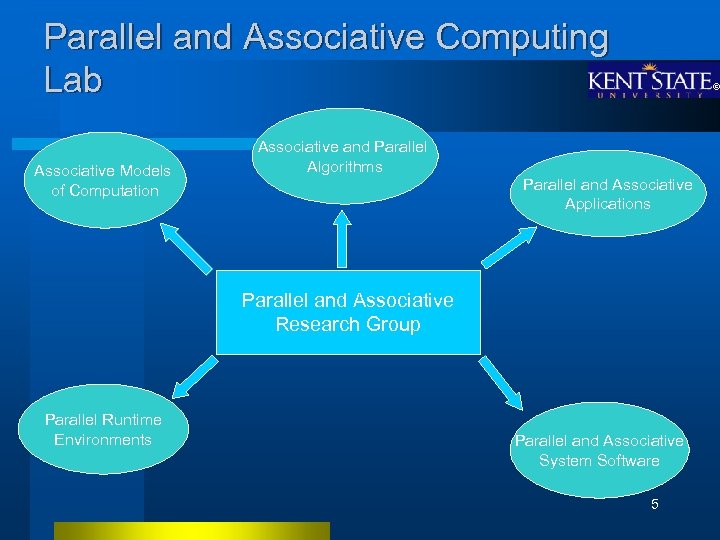 Parallel and Associative Computing Lab Associative Models of Computation Associative and Parallel Algorithms Parallel and Associative Applications Parallel and Associative Research Group Parallel Runtime Environments Parallel and Associative System Software 5
 ATC Fundamental Needs The best estimate of position, speed and heading of every aircraft in the environment at all times. l To satisfy the informational needs of all airline, commercial and general aviation users. l Some of these needs are: l – – – – Conflict detection and alert Conflict resolution Terrain avoidance Automatic VFR voice advisory Free flight Final approach spacing Cockpit display 6
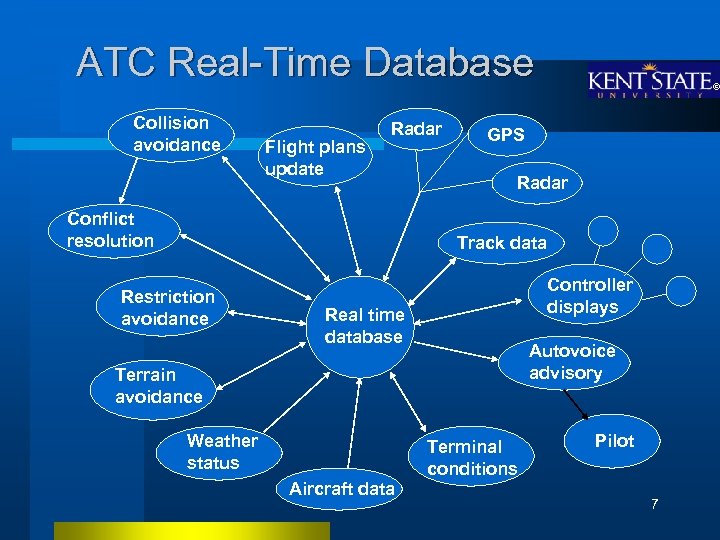 ATC Real-Time Database Collision avoidance Flight plans update Radar Conflict resolution GPS Radar Track data Restriction avoidance Controller displays Real time database Autovoice advisory Terrain avoidance Weather status Terminal conditions Aircraft data Pilot 7
 Some ATC Facilities Air Route Traffic Control Centers l Terminal Radar Control Systems l Air Traffic Control Towers l 20 186 300 The first two facility types are supplied with radar from about 630 radar systems. 8
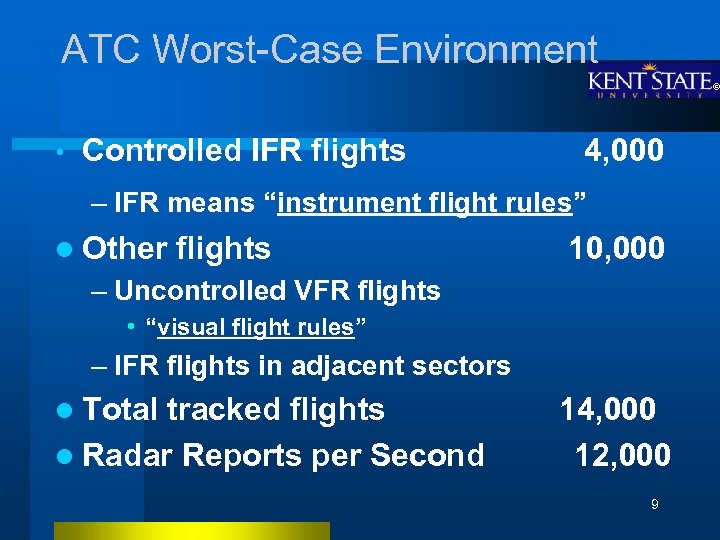 ATC Worst-Case Environment • Controlled IFR flights 4, 000 – IFR means “instrument flight rules” l Other flights 10, 000 – Uncontrolled VFR flights • “visual flight rules” – IFR flights in adjacent sectors l Total tracked flights l Radar Reports per Second 14, 000 12, 000 9
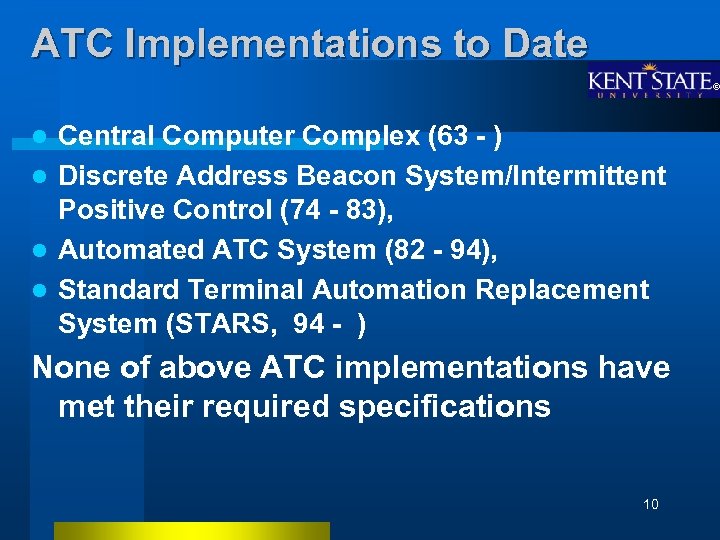 ATC Implementations to Date Central Computer Complex (63 - ) l Discrete Address Beacon System/Intermittent Positive Control (74 - 83), l Automated ATC System (82 - 94), l Standard Terminal Automation Replacement System (STARS, 94 - ) l None of above ATC implementations have met their required specifications 10
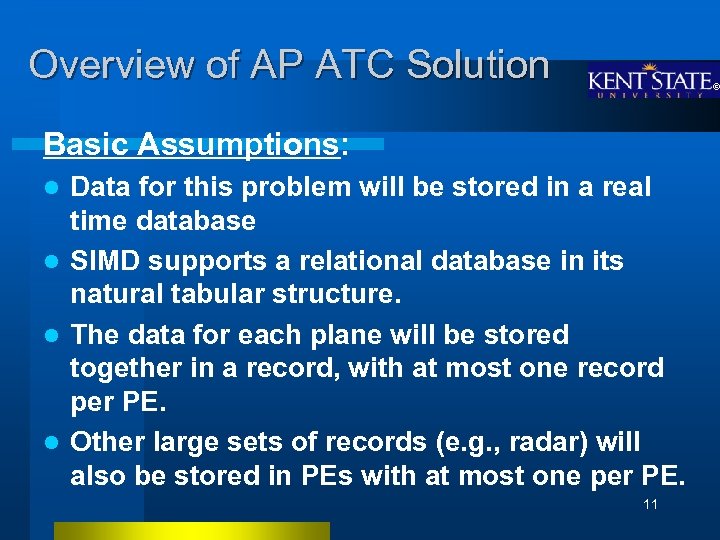 Overview of AP ATC Solution Basic Assumptions: Data for this problem will be stored in a real time database l SIMD supports a relational database in its natural tabular structure. l The data for each plane will be stored together in a record, with at most one record per PE. l Other large sets of records (e. g. , radar) will also be stored in PEs with at most one per PE. l 11
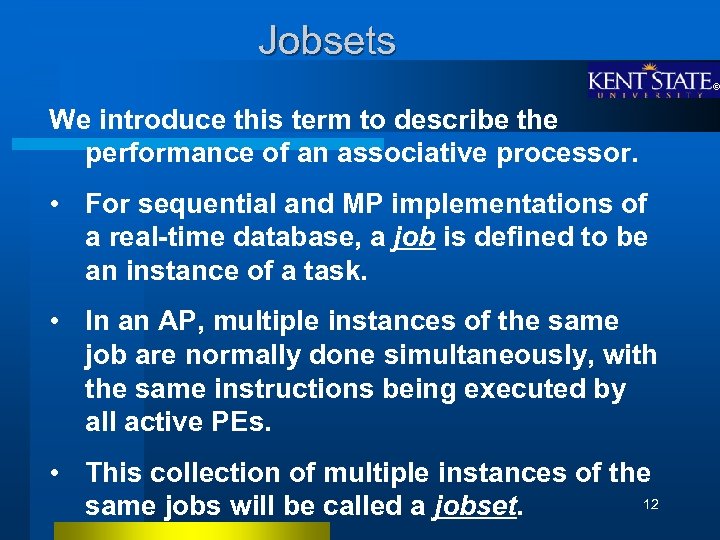 Jobsets We introduce this term to describe the performance of an associative processor. • For sequential and MP implementations of a real-time database, a job is defined to be an instance of a task. • In an AP, multiple instances of the same job are normally done simultaneously, with the same instructions being executed by all active PEs. • This collection of multiple instances of the 12 same jobs will be called a jobset.
 ATC Conflict Detection Using an Associative Processor A conflict occurs when aircraft are within 3 miles or 2, 000 feet in altitude of each other. • A test is made every 8 seconds for a possible future conflict within a 20 minute period • Each flight’s estimated future positions are computed as a space envelope into future time. • An intersection of all pairs of envelopes must be computed. • 13
 Conflict Detection Jobsets • The AP compares each of the IRF controlled flights ( 4000) with all remaining ( 13, 999) flights in constant time. – Envelopes that project the position of aircraft 20 minutes ahead are used. – The envelope data for a controlled flight is broadcast – The PE for each of the other flights simultaneously check if this envelope intersects the envelope for their aircraft. Since the comparison in each PE corresponds to a job, we call this AP set operation a jobset. l The entire ATC Conflict Detection algorithm 14 for the AP requires 4, 000 jobsets l
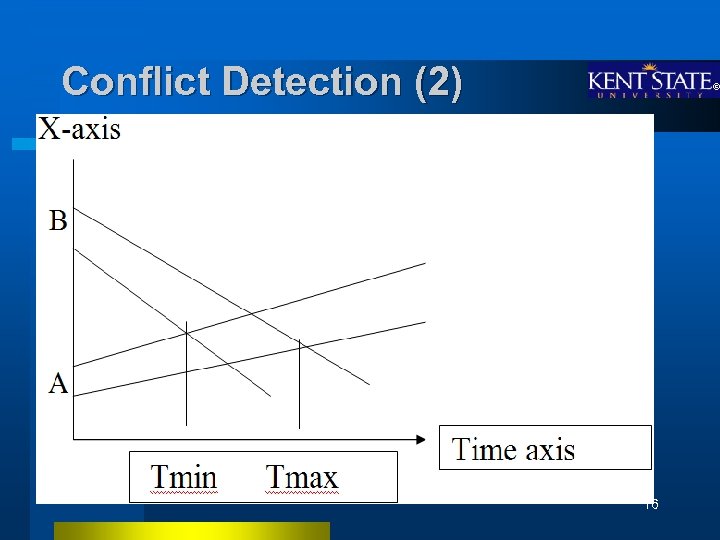
 Conflict Detection Algorithm (Batcher’s Algorithm) l Tracks projected 20 min ahead and each IFR track checked for conflict with all other tracks l For each dimension: – Compute min and max closing velocity – Compute min and max current track separation – Division gives min and max tolerance on the time for that dimension to coincide 15
 Conflict Detection (2) 16
 Conflict Detection (3) l. A potential conflict if, across the 3 dimensions, the biggest min-time is smaller than the smallest max-time l Conflict declared after two potential conflicts. l This is Batcher’s algorithm 17
 Multiprocessor Algorithm for Conflict Detection With multi-tasking solutions (on MIMDs/MPs), each envelope comparison is a separate job. – There are 13, 999 jobs per controlled flight. – This approach requires a total of roughly 56 million jobs. l Recall the AP algorithm required 3, 999 jobsets. – Each AP jobset required constant time. l The AP algorithm is O(n). l If the number of MP processors is small wrt n, then above MP algorithm is O(n(n+m)) or (n 2 ) l 18
 Conflict Resolution l Track heading or altitude adjusted and the conflict detection algorithm run again l This procedure continues until conflict is resolved and no new ones created. 19
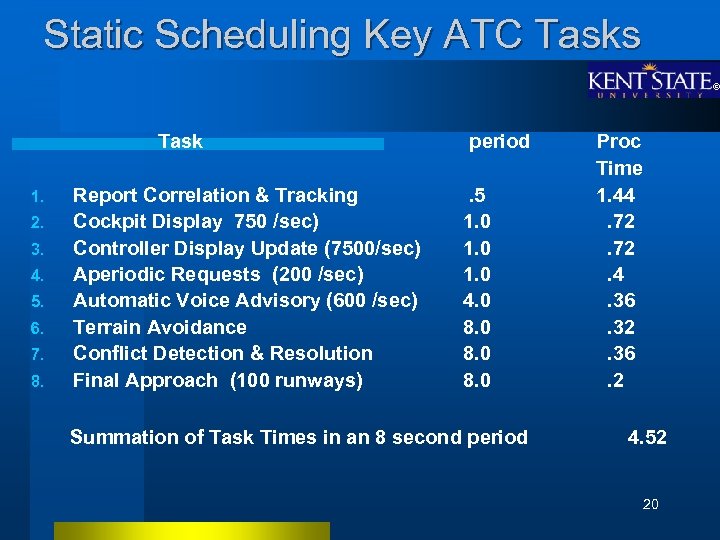 Static Scheduling Key ATC Tasks Task 1. 2. 3. 4. 5. 6. 7. 8. Report Correlation & Tracking Cockpit Display 750 /sec) Controller Display Update (7500/sec) Aperiodic Requests (200 /sec) Automatic Voice Advisory (600 /sec) Terrain Avoidance Conflict Detection & Resolution Final Approach (100 runways) period. 5 1. 0 4. 0 8. 0 Summation of Task Times in an 8 second period Proc Time 1. 44. 72. 4. 36. 32. 36. 2 4. 52 20
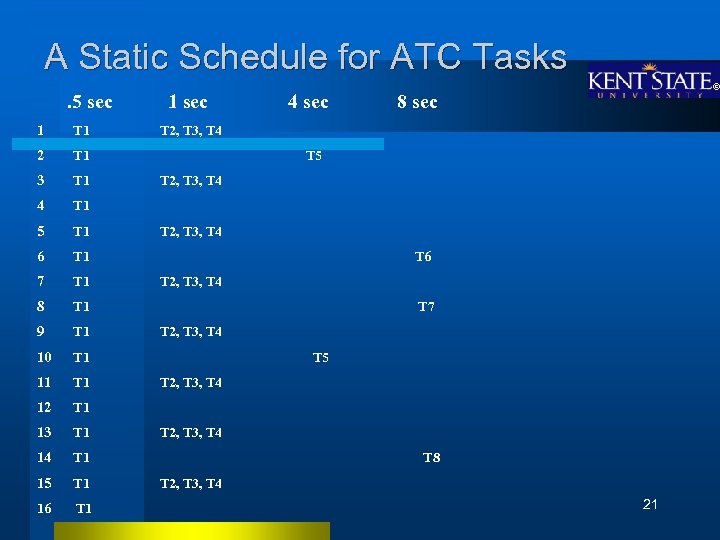 A Static Schedule for ATC Tasks. 5 sec 1 T 1 2 T 1 3 T 1 4 T 1 6 T 1 7 T 1 8 T 1 9 T 1 10 T 1 11 T 1 12 T 1 14 T 1 15 T 1 16 T 1 8 sec T 1 13 4 sec T 1 5 1 sec T 2, T 3, T 4 T 5 T 2, T 3, T 4 T 6 T 2, T 3, T 4 T 7 T 2, T 3, T 4 T 5 T 2, T 3, T 4 T 8 T 2, T 3, T 4 21
 Demo of AP Solution A demo of this hardware-software ATC system prototype was given for FAA at a Knoxville terminal in 1971 by Goodyear Aerospace: • Automatic radar tracking • Conflict detection • Conflict resolution • Terrain avoidance • Display processing • Automatic voice advisory for pilots l The 1971 AP demo provided ATC capabilities that are still not possible with current systems l l ATC Reference: Meilander, Jin, Baker, Tractable Real-Time Control Automation, Proc. of the 14 th IASTED Intl Conf. on Parallel and Distributed Systems,
 AP Installations A 1972 STARAN demonstration by Goodyear Aerospace showed a capability to simulate and process 7, 500 aircraft tracks performing the functions listed in last slide. l A military version of the STARAN, called ASPRO, was developed and delivered in 1983 to the USN for their airborne early command control system. l – Among other things it showed, as predicted, a capability to track 2000 primary radar targets in less than 0. 8 seconds. 23
 MP Problems for ATC Software Avoided by AP solution Each PE will contain a large number of records – e. g. , There are 14 K records just for planes l If multiple database records of the same type (e. g. , plane records) are stored in a single PE, these records be processed sequentially. l – Each task in each PE will normally require data from another PE, creating a large amount of communication l A distributed dynamic database must be supported that – Assures data serializability – Maintains data integrity – Manages concurrency – Manages data locking 24
 MP Problems for ATC Software Avoided by AP Solution (cont. ) l One or more dynamic task scheduling algorithms are needed – Normally dynamic scheduling is used to schedule ATC tasks – Data base maintenance activities must also be scheduled – Essentially all variation so this problem are NPhard • Must use heuristics, approximations, etc. to avoid exponential time solutions • Results in suboptimal and/or approximate results. 25
 MP Problems for ATC Software Avoided by AP Solution (cont. ) l l l Synchronization Load balancing between processors Data communication between processors more complex (due to using multi-tasking) Maintaining multiple sorted lists and indexes required for fast location of data Most MP solutions for ATC tasks have higher complexity (by a factor of n) than corresponding AP solution. 26
 Some Relevant Quotations l John Stankovic. . ; Ø“…complexity results show that most real-time multiprocessing scheduling is NP-hard. ” l Mark H. Klein et al, (Carnegie Mellon Univ. Computer, Jan. ’ 94) Ø “One guiding principle in real-time system resource management is predictability. The ability to determine for a given set of tasks whether the system will be able to meet all the timing requirements of those tasks. " 27
 SIMD vs MIMD Conclusions l. A simple low-order polynomial-time algorithm has been described for the ATC using an AP. l A polynomial time ATC algorithm for the MP is currently not expected. l Polynomial time algorithms should also be possible for other real-time problems using an AP – E. g. , “Command Control” problems. 28
 SIMD COTS Boards for ATC
 Modern SIMD Chips considered: l l 200 MHz CS 301 250 MHz CSX 600 due in Q 2 2005. These SIMD chips have: l l l l powerful PEs (Processing Elements) 64 – 96 PEs per chip floating and fixed point in every PE 4 – 6 k. B of “poly” RAM in each PE 96 GB/s load/store between poly RAM and register files fast I/O (up to 11 GB/s) each PE can specify its own address for I/O to external “mono” RAM 30
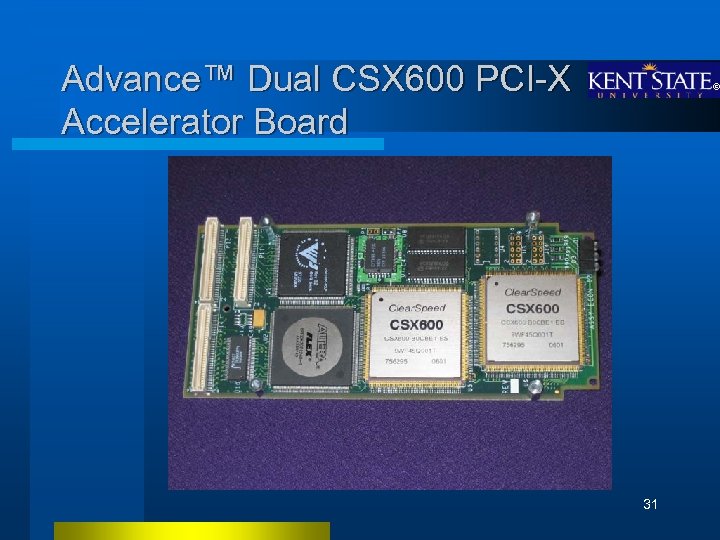 Advance™ Dual CSX 600 PCI-X Accelerator Board 31
 SIMD Boards CS 301 boards contain 2 CS 301 chips & 1 GB of “mono” DRAM. l Proprietary Clear. Connect bus runs from one CS 301, across the other CS 301 and (via FPGA) to DRAM l PCI interface connects to host computer such as a PC l Kent State University will use this COTS board l CSX 600 board has 2 SIMD chips, each with on-chip DRAM interface l Clear. Connect bus connects chips and (via FPGA) board 64 bit PCI-X interface 32 l
 WEBSITE http: //www. cs. kent. edu/~parallel Follow the pointer to “papers” 33
 References 1. 2. 3. 4. 5. M. Jin, J. Baker, and K. Batcher, Timings of Associative Operations on the MASC model, Proceedings of the International Parallel and Distributed Symposium (IPDPS’ 01), WMPP workshop, San Francisco, CA, April, 2001. (Unofficial version at www. cs. kent. edu/~parallel/ under “papers”) Meilander, Jin, Baker, Tractable Real-Time Control Automation, Proc. of the 14 th IASTED Intl Conf. on Parallel and Distributed Systems (PDCS 2002), pp. 483 -488. (Unofficial version at www. cs. kent. edu/~parallel/ under “: papers”) J. A. Stankovic, M. Spuri, K. Ramamritham and G. C. Buttazzo, Deadline Scheduling for Real-time Systems, Kluwer Academic Publishers, 1998. M. R. Garey and D. S. Johnson, Computers and Intractability: a Guide to the Theory of NP-completeness, W. H. Freeman, New York, 1979, pp. 65, pp. 238 -240. S. Reddaway, W. Meilander, J. Baker, and J. Kidman, Overview of Air Traffic Control using an SIMD COTS system, Proceedings of the International Parallel and Distributed Symposium (IPDPS’ 05), Denver, April, 2005. (Unofficial version at www. cs. kent. edu/~parallel/ under “papers”) 34