 Скачать презентацию Application platform routing protocols and behavior models in
74f0d03673071fc469f41db7aabb17f6.ppt
- Количество слайдов: 72



Application platform, routing protocols and behavior models in mobile disruption-tolerant networks (DTNs) Doctoral thesis defense Arezu Moghadam 13 May 2011 1
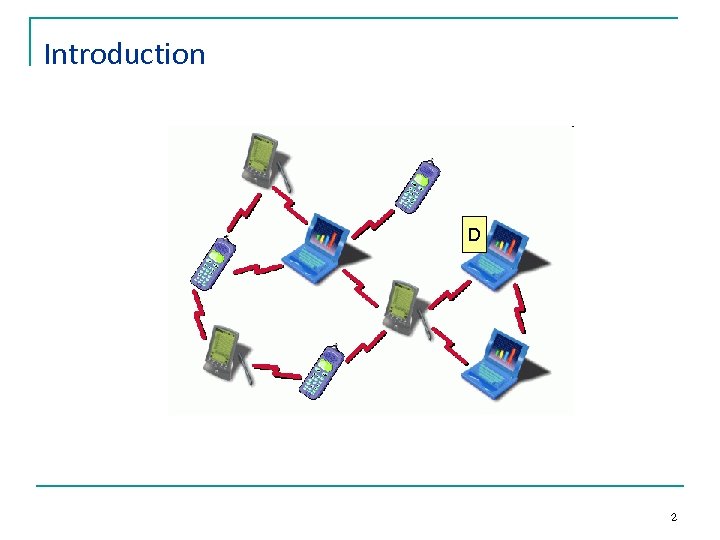
Introduction D D 2
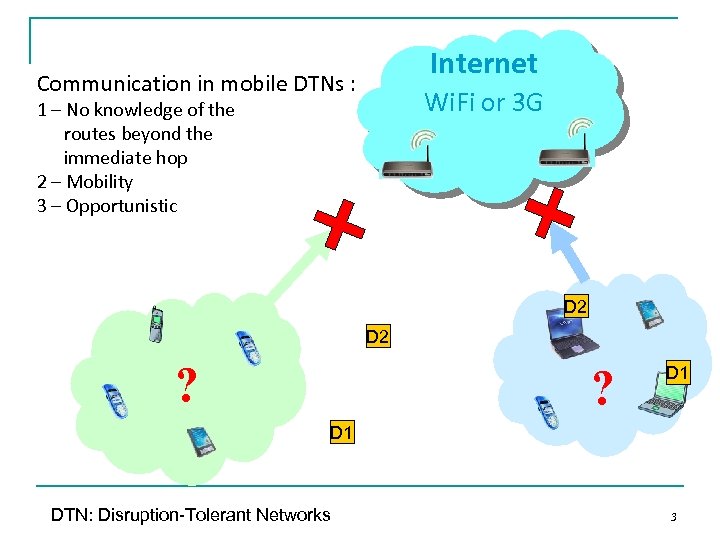
Internet Communication in mobile DTNs : Wi. Fi or 3 G 1 – No knowledge of the routes beyond the immediate hop 2 – Mobility 3 – Opportunistic D 2 ? ? D 1 DTN: Disruption-Tolerant Networks 3
Introduction n Applications of mobile DTNs: q q n Covering regions with no infrastructure, e. g. natural disasters Retrieving data from remote sensor networks Sharing music, news, pictures in the subway or networks of pedestrians Collaborative ad-hoc environments Challenges of mobile DTNs q q Networking and connectivity No application server or end-to-end communication path Different routing requirements and models Performance of the applications and routing algorithms relies on the mobility behavior of mobile users 4
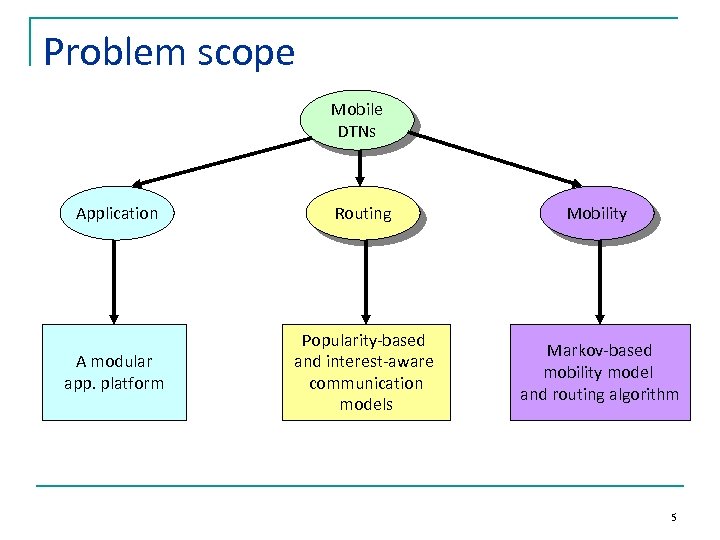
Problem scope Mobile DTNs Application Routing Mobility A modular app. platform Popularity-based and interest-aware communication models Markov-based mobility model and routing algorithm 5
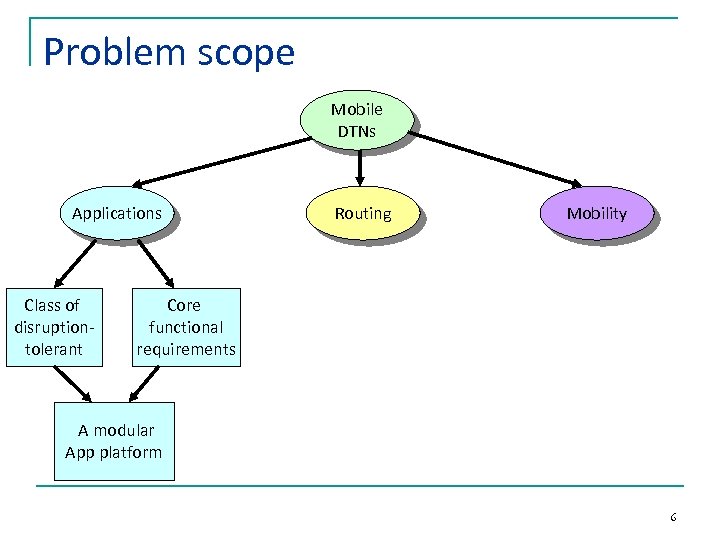
Problem scope Mobile DTNs Applications Class of disruptiontolerant Routing Mobility Core functional requirements A modular App platform 6
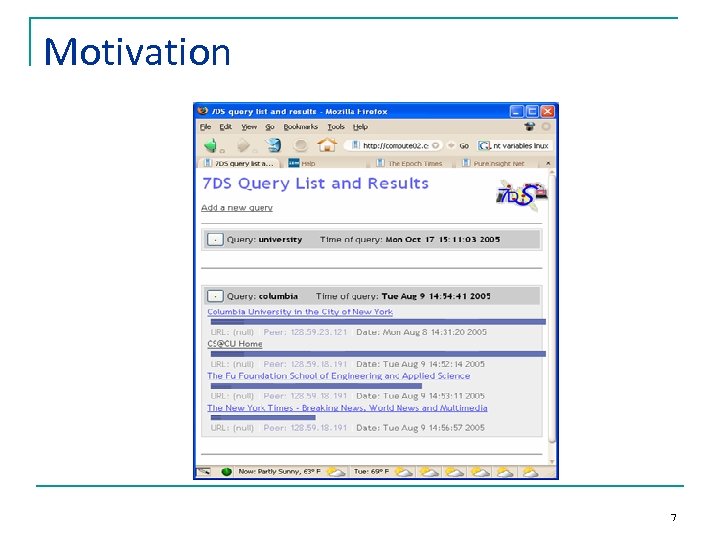
Motivation 7
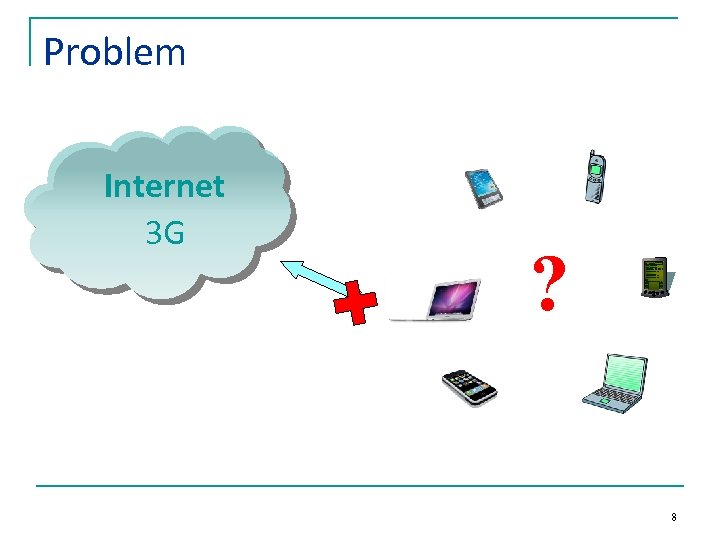
Problem Internet 3 G ? 8
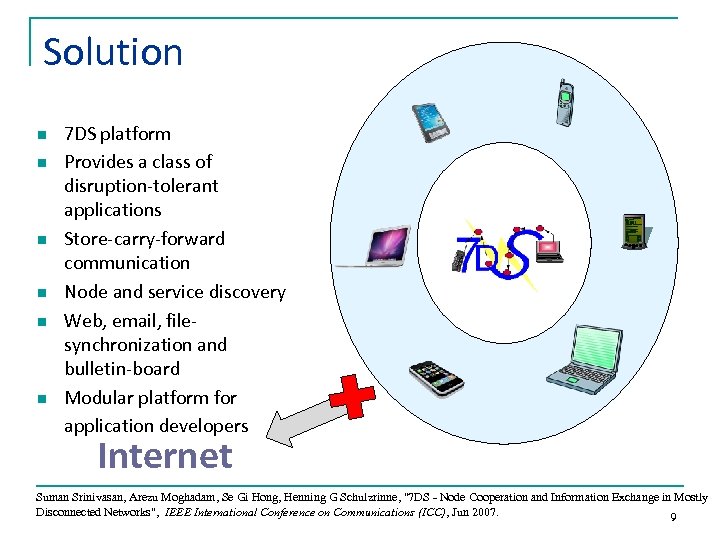
Solution n n n 7 DS platform Provides a class of disruption-tolerant applications Store-carry-forward communication Node and service discovery Web, email, filesynchronization and bulletin-board Modular platform for application developers Internet Suman Srinivasan, Arezu Moghadam, Se Gi Hong, Henning G Schulzrinne, "7 DS - Node Cooperation and Information Exchange in Mostly Disconnected Networks", IEEE International Conference on Communications (ICC), Jun 2007. 9
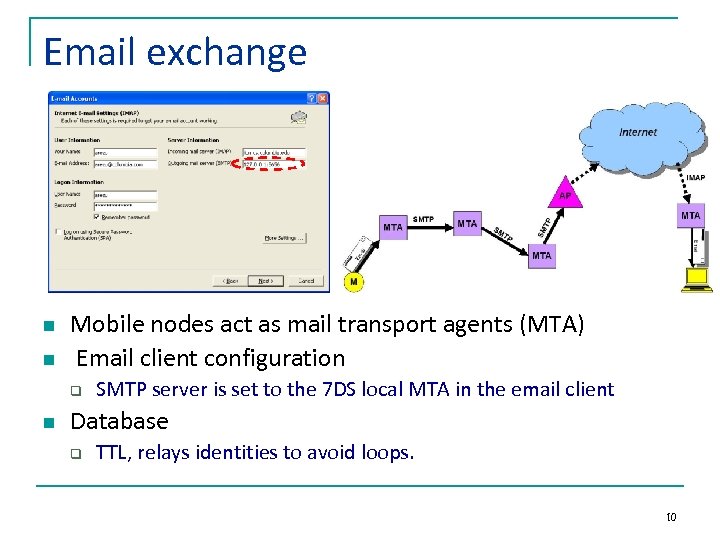
Email exchange n n Mobile nodes act as mail transport agents (MTA) Email client configuration q n SMTP server is set to the 7 DS local MTA in the email client Database q TTL, relays identities to avoid loops. 10
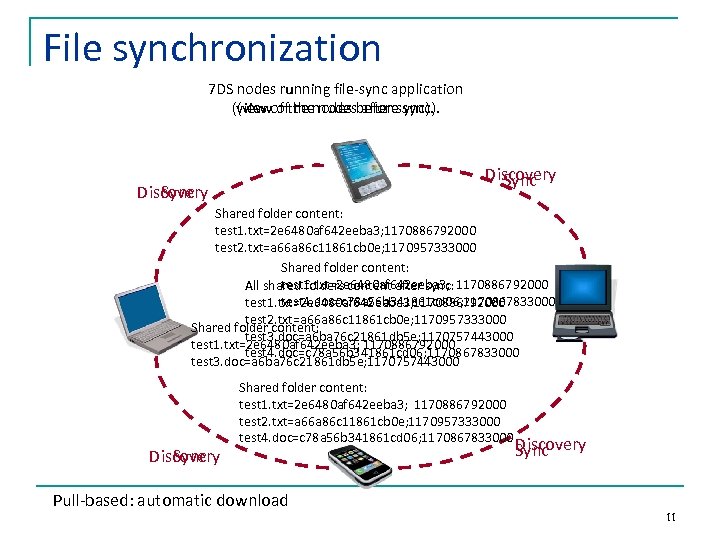
File synchronization 7 DS nodes running file-sync application (view of the nodes beforesync). (view of the nodes after sync). Discovery Sync Shared folder content: test 1. txt=2 e 6480 af 642 eeba 3; 1170886792000 test 2. txt=a 66 a 86 c 11861 cb 0 e; 1170957333000 Shared folder content: test 1. txt=2 e 6480 af 642 eeba 3; All shared folders content after sync: 1170886792000 test 4. doc=c 78 a 56 b 341861 cd 06; 1170867833000 test 1. txt=2 e 6480 af 642 eeba 3; 1170886792000 test 2. txt=a 66 a 86 c 11861 cb 0 e; 1170957333000 Shared folder content: test 3. doc=a 6 ba 76 c 21861 db 5 e; 1170757443000 test 1. txt=2 e 6480 af 642 eeba 3; 1170886792000 test 4. doc=c 78 a 56 b 341861 cd 06; 1170867833000 test 3. doc=a 6 ba 76 c 21861 db 5 e; 1170757443000 Discovery Sync Shared folder content: test 1. txt=2 e 6480 af 642 eeba 3; 1170886792000 test 2. txt=a 66 a 86 c 11861 cb 0 e; 1170957333000 test 4. doc=c 78 a 56 b 341861 cd 06; 1170867833000 Pull-based: automatic download Discovery Sync 11
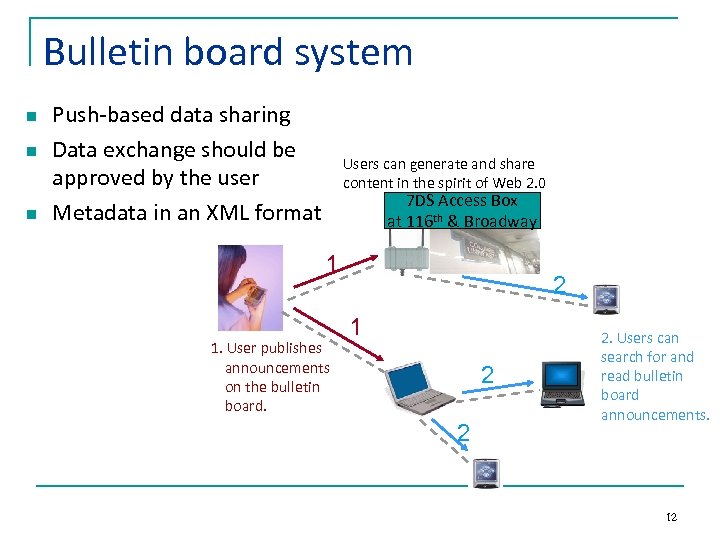
Bulletin board system n n n Push-based data sharing Data exchange should be approved by the user Metadata in an XML format Users can generate and share content in the spirit of Web 2. 0 7 DS Access Box at 116 th & Broadway 1 1. User publishes announcements on the bulletin board. 2 1 2 2 2. Users can search for and read bulletin board announcements. 12
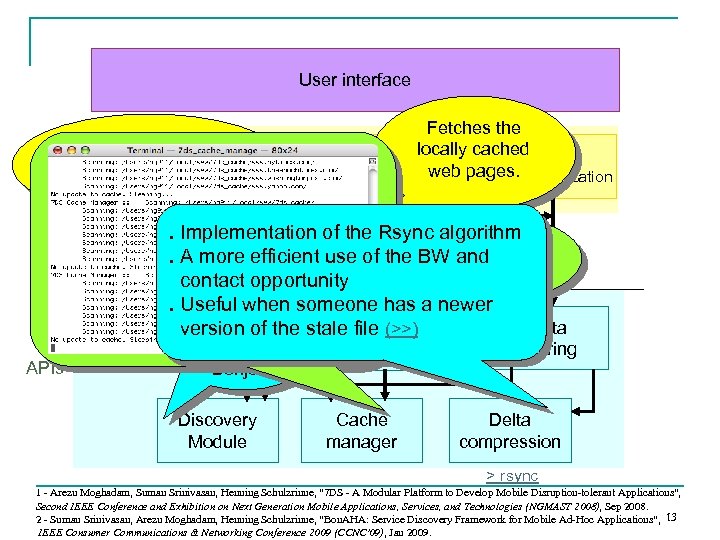
User interface Emulates a connected communication path in Web query Email APPs the absence of Internet APIs Fetches the locally Bulletin cached File web Synchronization Board pages. . Implementation of the Rsync algorithm Proxy Web Search the Support Query. A server use of server internal services more efficient the localthe BW and contact opportunity Bon. AHA neighbors cache A thin when someone has a newer. Usefulwrapper Mail around Data Multicast version of the stale file Search (>>) Transport Apple’s sharing engine Agent Bonjour Discovery Module Cache manager Delta compression > rsync 1 - Arezu Moghadam, Suman Srinivasan, Henning Schulzrinne, "7 DS - A Modular Platform to Develop Mobile Disruption-tolerant Applications", Second IEEE Conference and Exhibition on Next Generation Mobile Applications, Services, and Technologies (NGMAST 2008), Sep 2008. 2 - Suman Srinivasan, Arezu Moghadam, Henning Schulzrinne, "Bon. AHA: Service Discovery Framework for Mobile Ad-Hoc Applications", 13 IEEE Consumer Communications & Networking Conference 2009 (CCNC'09), Jan 2009.
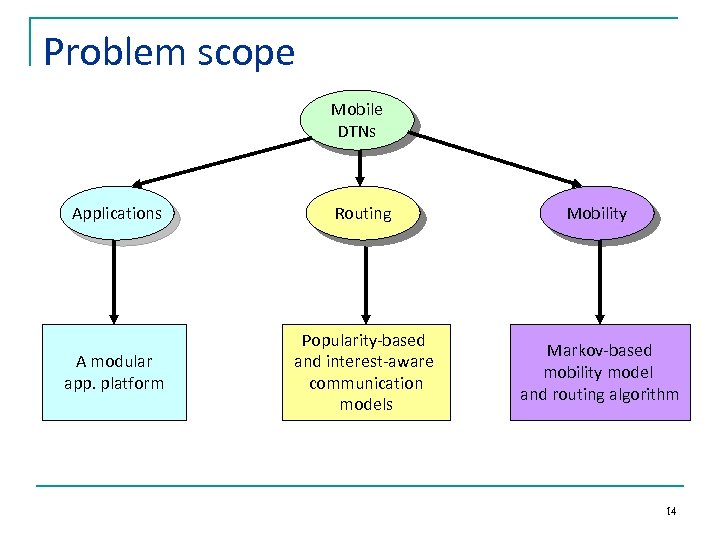
Problem scope Mobile DTNs Applications Routing Mobility A modular app. platform Popularity-based and interest-aware communication models Markov-based mobility model and routing algorithm 14
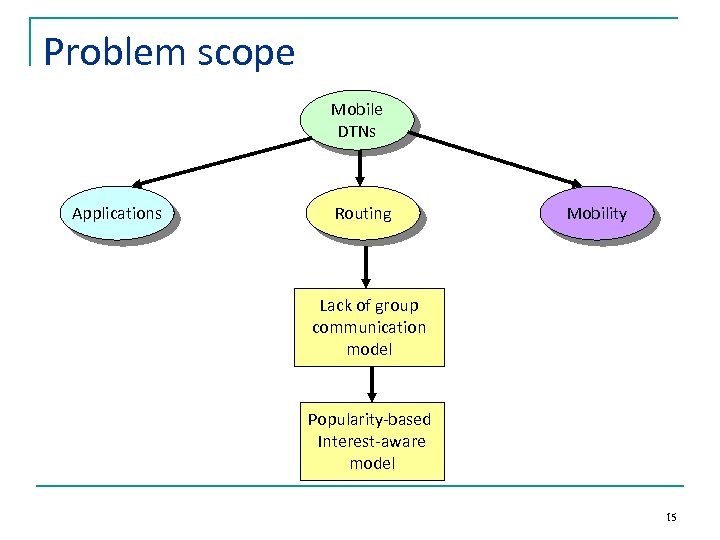
Problem scope Mobile DTNs Applications Routing Mobility Lack of group communication model Popularity-based Interest-aware model 15
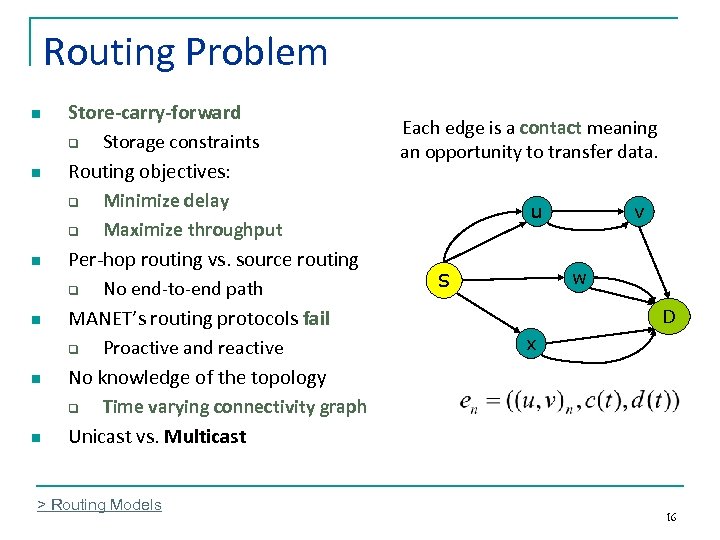
Routing Problem n n n Store-carry-forward q Storage constraints Routing objectives: q Minimize delay q Maximize throughput Per-hop routing vs. source routing q No end-to-end path MANET’s routing protocols fail q Proactive and reactive No knowledge of the topology q Time varying connectivity graph Unicast vs. Multicast > Routing Models Each edge is a contact meaning an opportunity to transfer data. u v w S D x 16
Problem – lack of group communication model for mobile DTNs? n Any cast communication model g q q q n Traditional multicast as a group communication model Fails! q q n n Emergencies uti c ro Traffic congestion inotifications idem Ep Severe weather alerts No knowledge of the topology No infrastructure to track group memberships Communication with communities of interest Even a harder problem! q q q Market news, sport events Scientific articles Advertisement about particular products 17
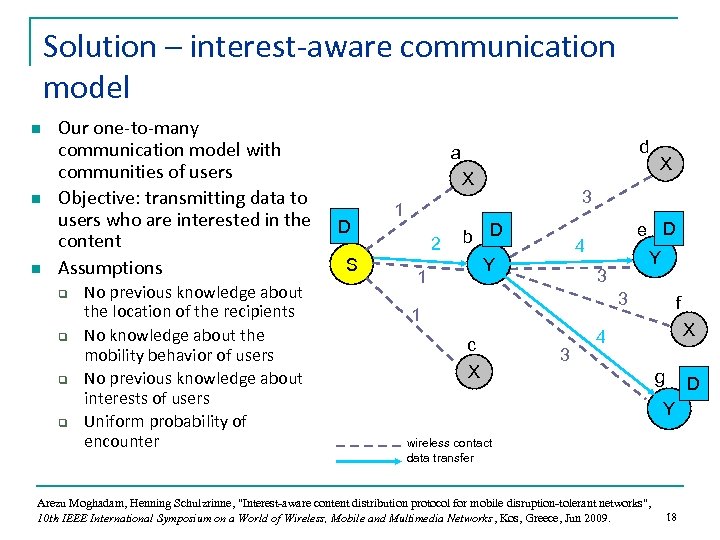
Solution – interest-aware communication model n n n Our one-to-many communication model with communities of users Objective: transmitting data to users who are interested in the content Assumptions q q No previous knowledge about the location of the recipients No knowledge about the mobility behavior of users No previous knowledge about interests of users Uniform probability of encounter d a X D S 3 1 2 b D e D 4 Y 1 X Y 3 3 1 c X 3 f X 4 g D Y wireless contact data transfer Arezu Moghadam, Henning Schulzrinne, "Interest-aware content distribution protocol for mobile disruption-tolerant networks", 10 th IEEE International Symposium on a World of Wireless, Mobile and Multimedia Networks, Kos, Greece, Jun 2009. 18
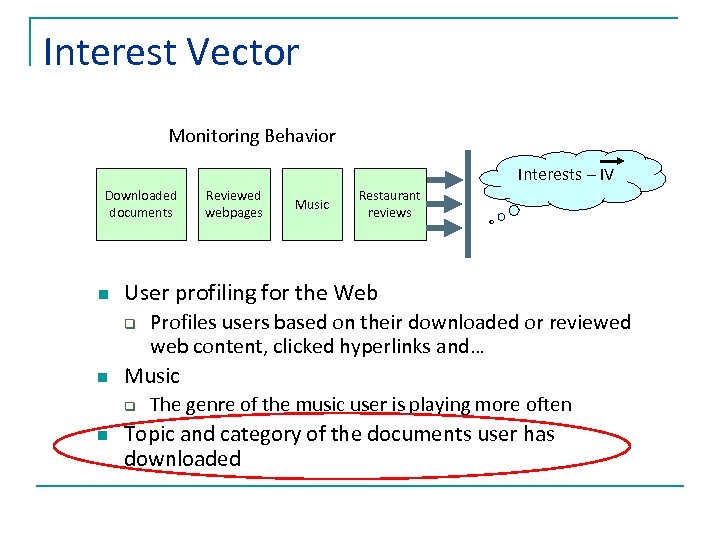
Interest Vector Monitoring Behavior Interests – IV Downloaded documents n n Music Restaurant reviews User profiling for the Web Profiles users based on their downloaded or reviewed web content, clicked hyperlinks and… Music q The genre of the music user is playing more often Topic and category of the documents user has downloaded q n Reviewed webpages
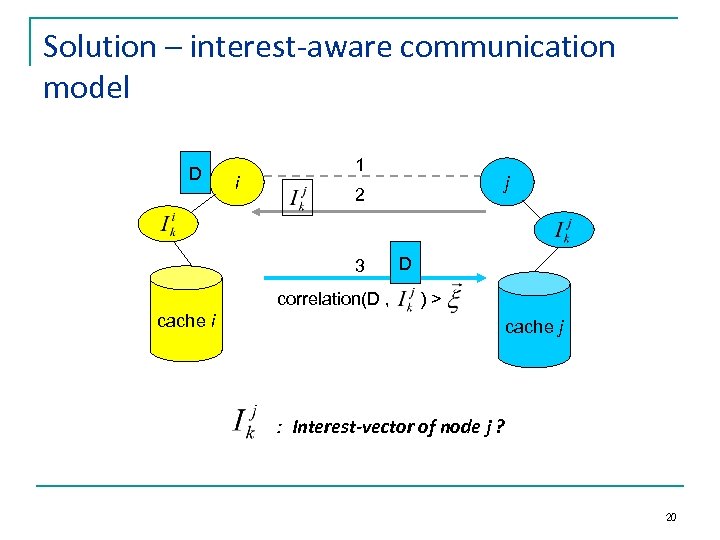
Solution – interest-aware communication model D i 1 j 2 3 correlation(D , D )> cache i cache j : Interest-vector of node j ? 20
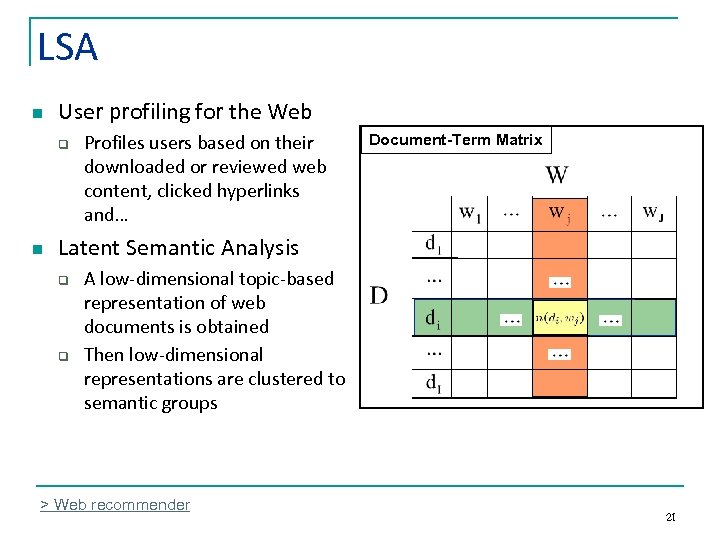
LSA n User profiling for the Web q n Profiles users based on their downloaded or reviewed web content, clicked hyperlinks and… Document-Term Matrix Latent Semantic Analysis q q A low-dimensional topic-based representation of web documents is obtained Then low-dimensional representations are clustered to semantic groups > Web recommender 21
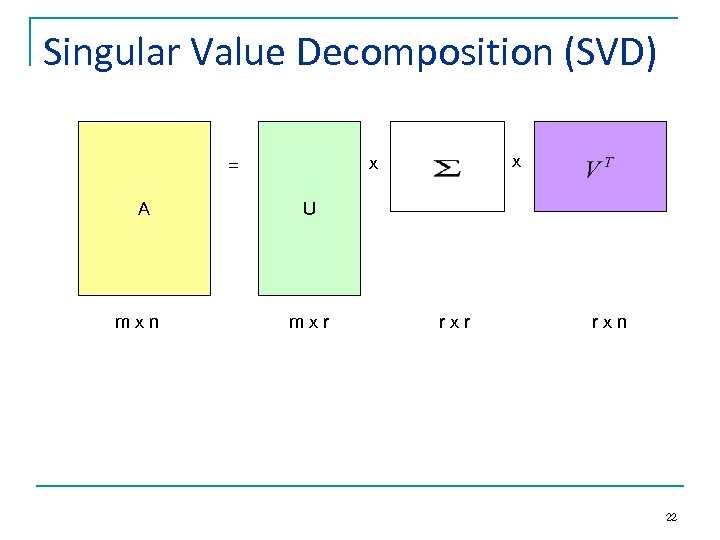
Singular Value Decomposition (SVD) A mxn x x = U mxr rxn 22
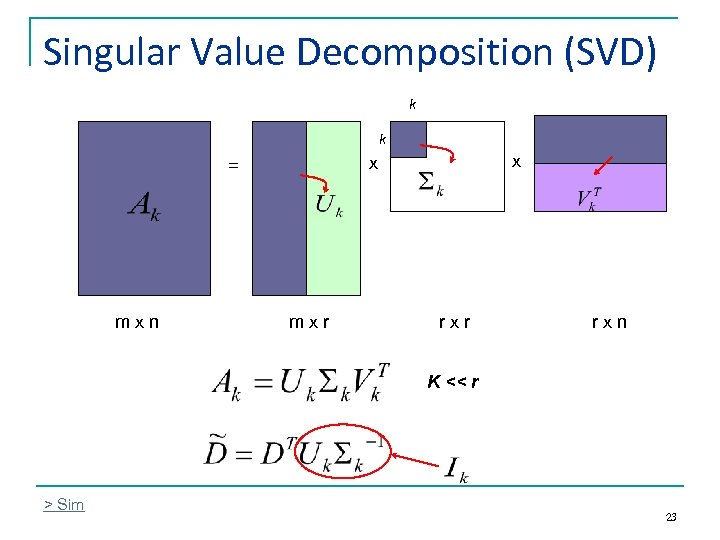
Singular Value Decomposition (SVD) k k mxn x x = mxr rxn K << r > Sim 23
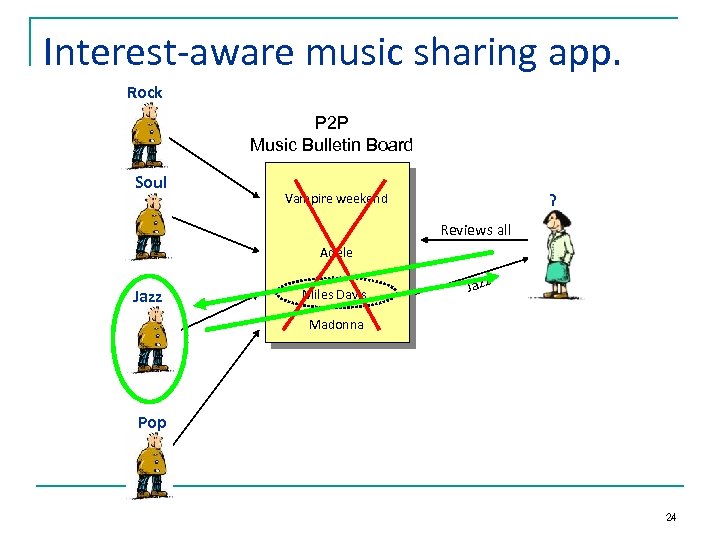
Interest-aware music sharing app. Rock P 2 P Music Bulletin Board Soul ? Vampire weekend Reviews all Adele Jazz Miles Davis Jazz Madonna Pop 24
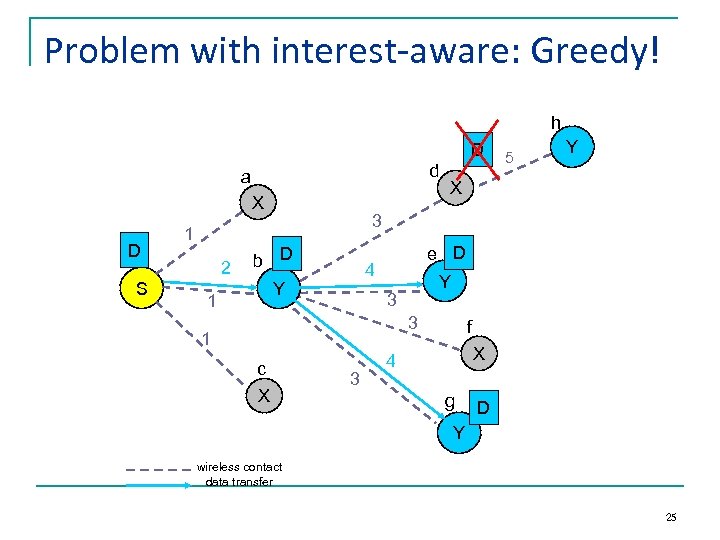
Problem with interest-aware: Greedy! h D d a X D S b D X e D 4 Y 1 Y 3 1 2 5 Y 3 3 1 c X 3 f X 4 g D Y wireless contact data transfer 25
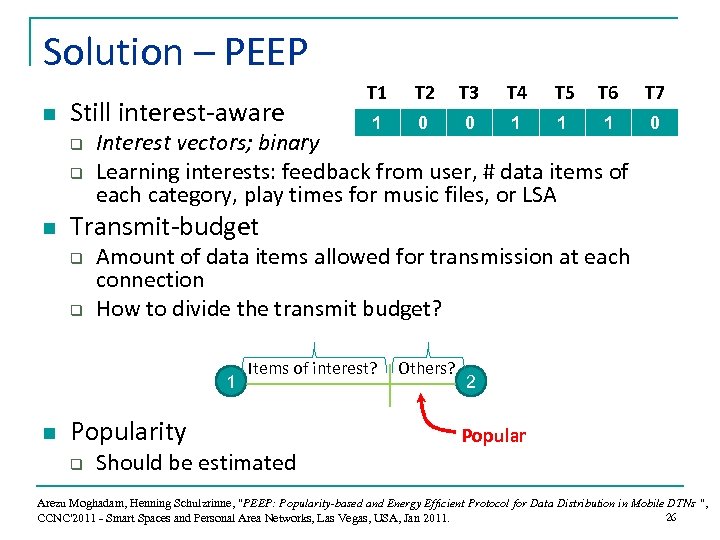
Solution – PEEP n Still interest-aware q q n T 2 T 3 T 4 T 5 T 6 T 7 1 0 0 1 1 1 0 Interest vectors; binary Learning interests: feedback from user, # data items of each category, play times for music files, or LSA Transmit-budget q q Amount of data items allowed for transmission at each connection How to divide the transmit budget? 1 n T 1 Popularity q Items of interest? Should be estimated Others? 2 Popular Arezu Moghadam, Henning Schulzrinne, "PEEP: Popularity-based and Energy Efficient Protocol for Data Distribution in Mobile DTNs ", 26 CCNC'2011 - Smart Spaces and Personal Area Networks, Las Vegas, USA, Jan 2011.
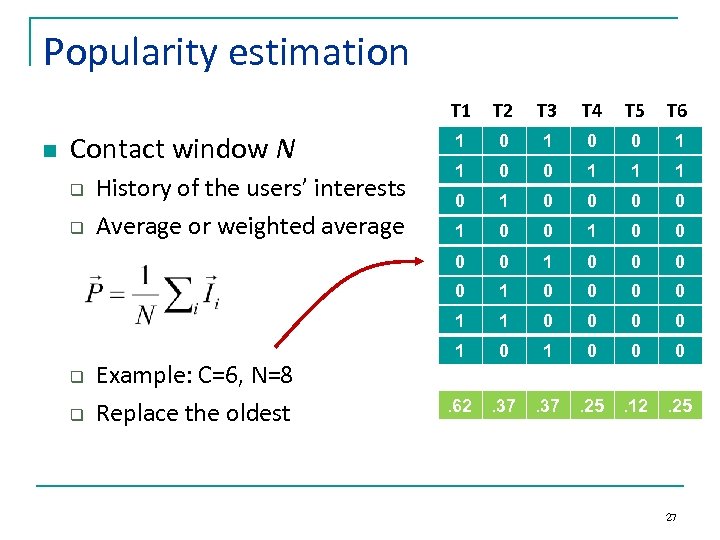
Popularity estimation T 1 n q q Example: C=6, N=8 Replace the oldest T 5 T 6 1 0 0 1 1 1 0 0 0 0 1 0 0 1 q History of the users’ interests Average or weighted average T 4 0 q T 3 0 Contact window N T 2 1 0 0 0 . 62 . 37 . 25 . 12 . 25 27
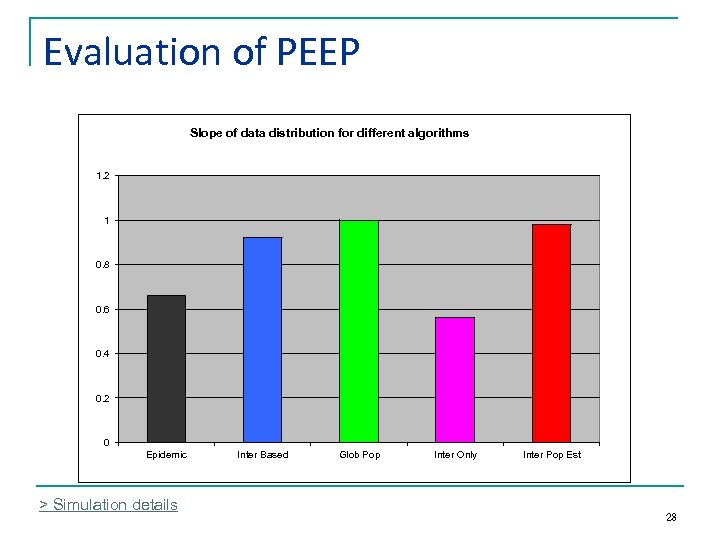
Evaluation of PEEP Slope of data distribution for different algorithms 1. 2 1 0. 8 0. 6 0. 4 0. 2 0 Epidemic > Simulation details Inter Based Glob Pop Inter Only Inter Pop Est 28
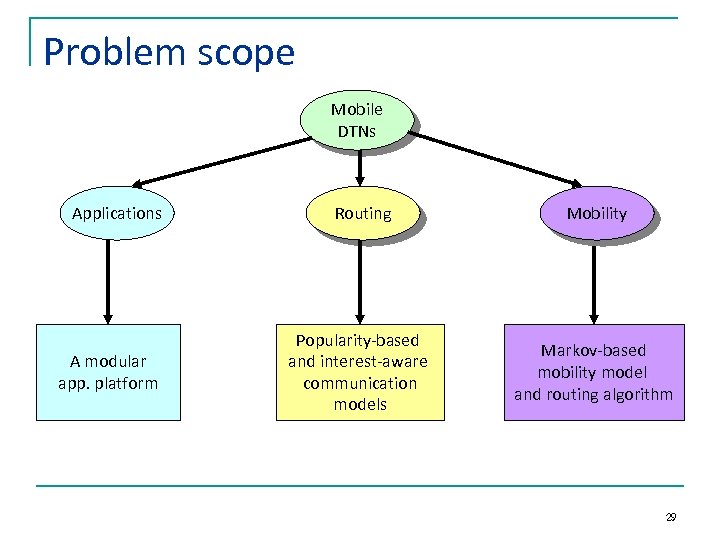
Problem scope Mobile DTNs Applications A modular app. platform Routing Mobility Popularity-based and interest-aware communication models Markov-based mobility model and routing algorithm 29
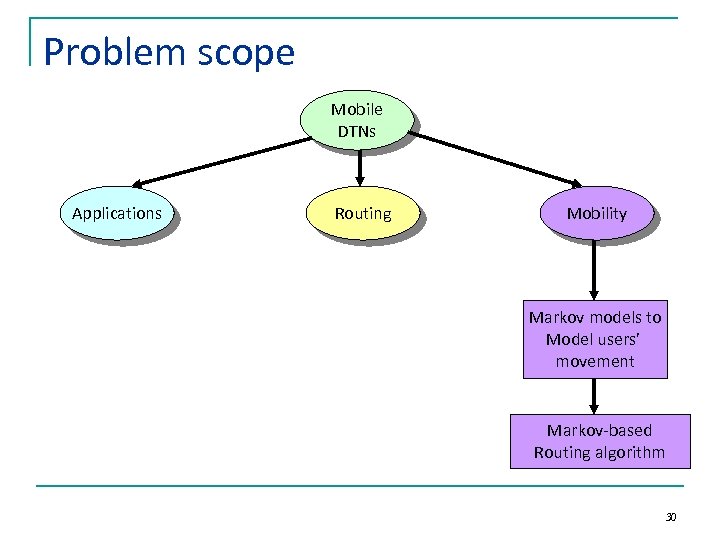
Problem scope Mobile DTNs Applications Routing Mobility Markov models to Model users’ movement Markov-based Routing algorithm 30
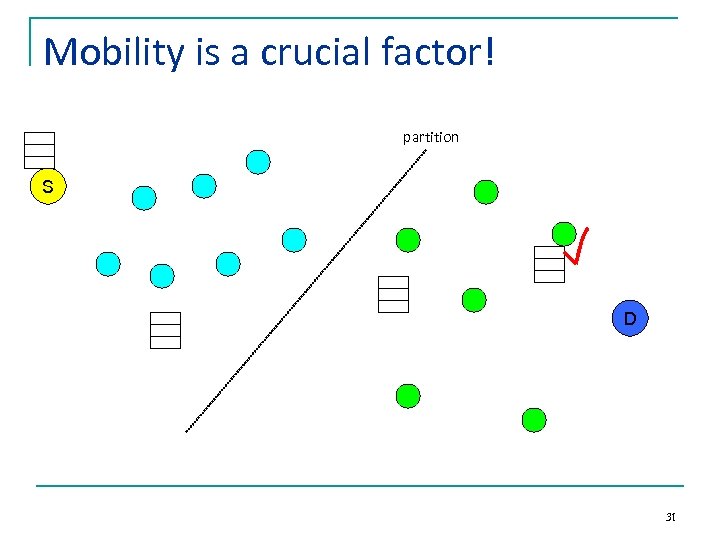
Mobility is a crucial factor! partition S D 31
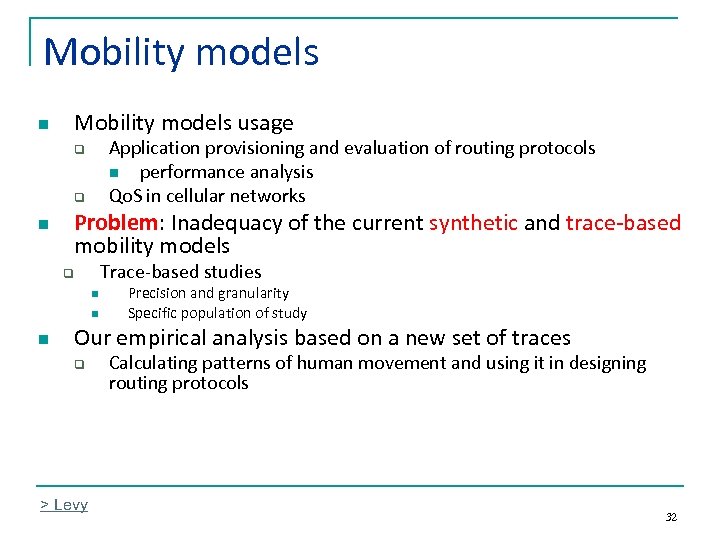
Mobility models usage n Application provisioning and evaluation of routing protocols n performance analysis Qo. S in cellular networks q q Problem: Inadequacy of the current synthetic and trace-based mobility models n Trace-based studies q n n n Precision and granularity Specific population of study Our empirical analysis based on a new set of traces q > Levy Calculating patterns of human movement and using it in designing routing protocols 32
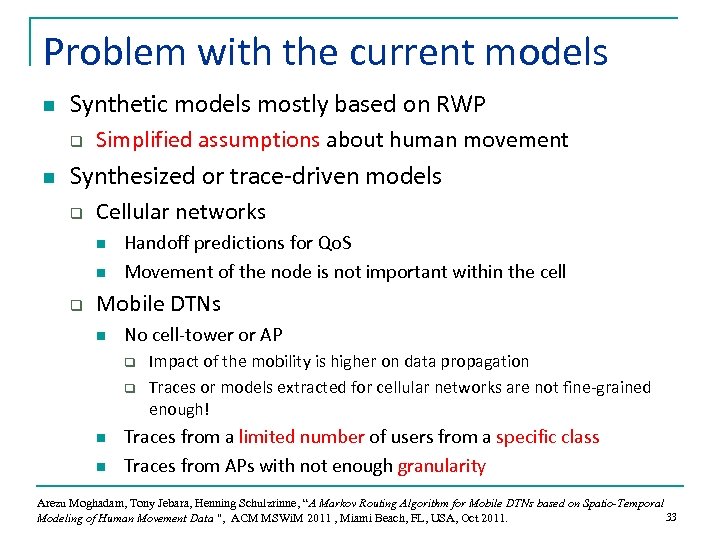
Problem with the current models n Synthetic models mostly based on RWP q n Simplified assumptions about human movement Synthesized or trace-driven models q Cellular networks n n q Handoff predictions for Qo. S Movement of the node is not important within the cell Mobile DTNs n No cell-tower or AP q q n n Impact of the mobility is higher on data propagation Traces or models extracted for cellular networks are not fine-grained enough! Traces from a limited number of users from a specific class Traces from APs with not enough granularity Arezu Moghadam, Tony Jebara, Henning Schulzrinne, “A Markov Routing Algorithm for Mobile DTNs based on Spatio-Temporal 33 Modeling of Human Movement Data ", ACM MSWi. M 2011 , Miami Beach, FL, USA, Oct 2011.
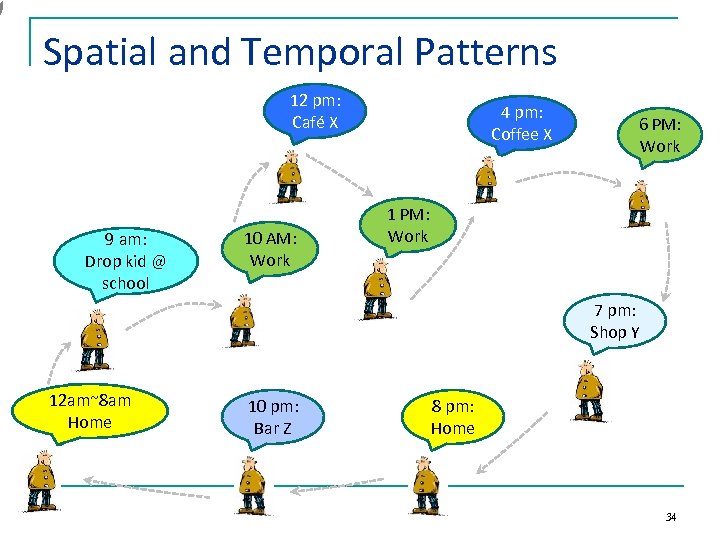
Spatial and Temporal Patterns 12 pm: Café X 9 am: Drop kid @ school 10 AM: Work 4 pm: Coffee X 6 PM: Work 1 PM: Work 7 pm: Shop Y 12 am~8 am 8 AM: Home 10 pm: Bar Z 8 pm: Home 34
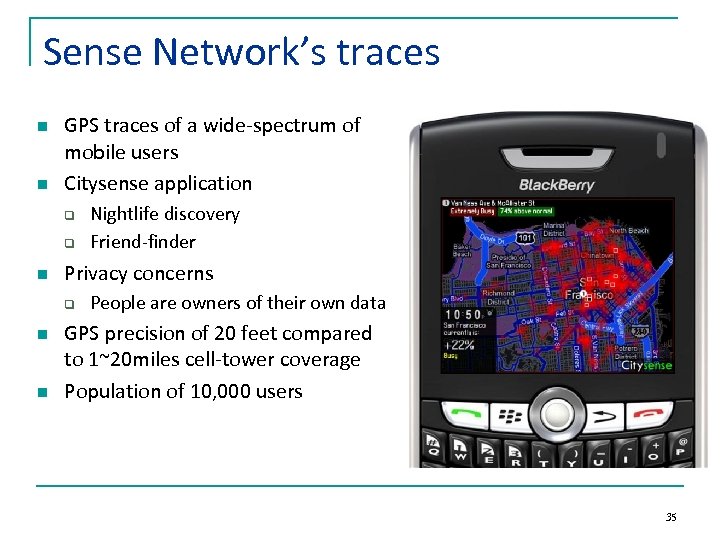
Sense Network’s traces n n GPS traces of a wide-spectrum of mobile users Citysense application q q n Privacy concerns q n n Nightlife discovery Friend-finder People are owners of their own data GPS precision of 20 feet compared to 1~20 miles cell-tower coverage Population of 10, 000 users 35
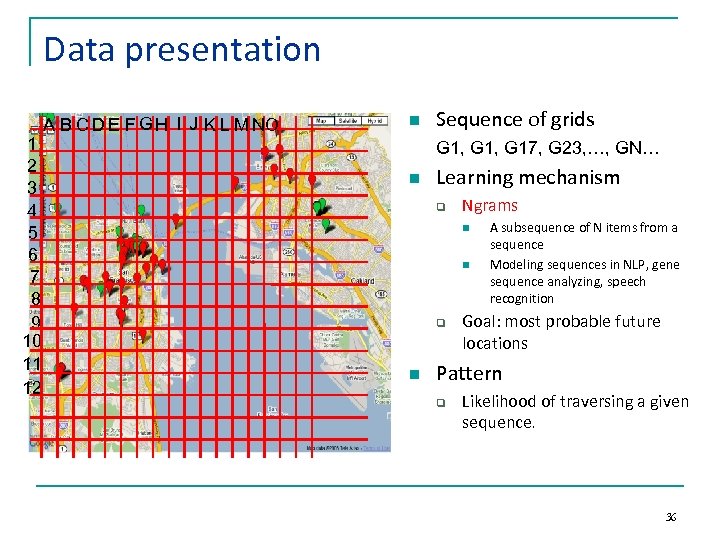
Data presentation 1 2 3 4 5 6 7 8 9 10 11 12 A B C D E F G H I J K L M NO n Sequence of grids G 1, G 17, G 23, …, GN… n Learning mechanism q Ngrams n n q n A subsequence of N items from a sequence Modeling sequences in NLP, gene sequence analyzing, speech recognition Goal: most probable future locations Pattern q Likelihood of traversing a given sequence. 36
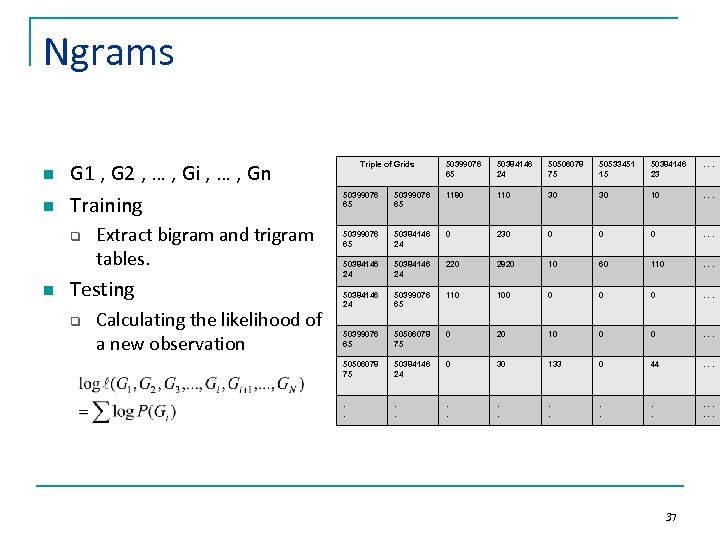
Ngrams n n G 1 , G 2 , … , Gi , … , Gn Training q n Extract bigram and trigram tables. Testing q Calculating the likelihood of a new observation Triple Tuples of of Grids 50399076 Grids 65 50399076 50386634 65 66 50384146 24 24 50506078 50384146 75 23 50533451 50600639 50384146 50533451. . . 1504 23 15 50399076 65 65 1370 50399076 65 10 1180 230 110 10 30 300 50386634 50399076 66 65 30 50384146 24 130 0 110 230 0 50384146 24 220 50384146 24 110 220 3420 2820 10 60 110 . . . 50384146 24 23 50399076 10 65 110 0 100 50 0 0 . . . 50399076 50600639 65 04 50506078 0 75 00 20 12 10 110 0 0 . . . 50506078 50533451 75 15 50384146 0 24 0 50 30 0 133 13 0 44 . . . . 0 0 14 176 10 30 0 0 . . 343 . . . 37
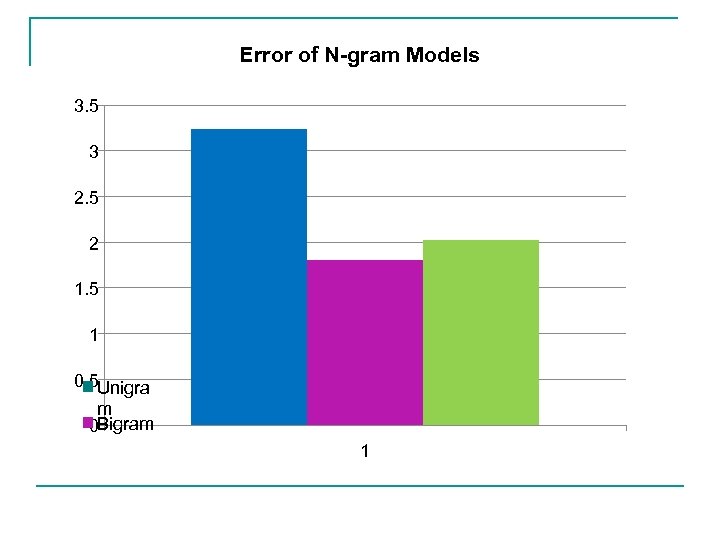
Error of N-gram Models 3. 5 3 2. 5 2 1. 5 1 0. 5 Unigra m 0 Bigram 1
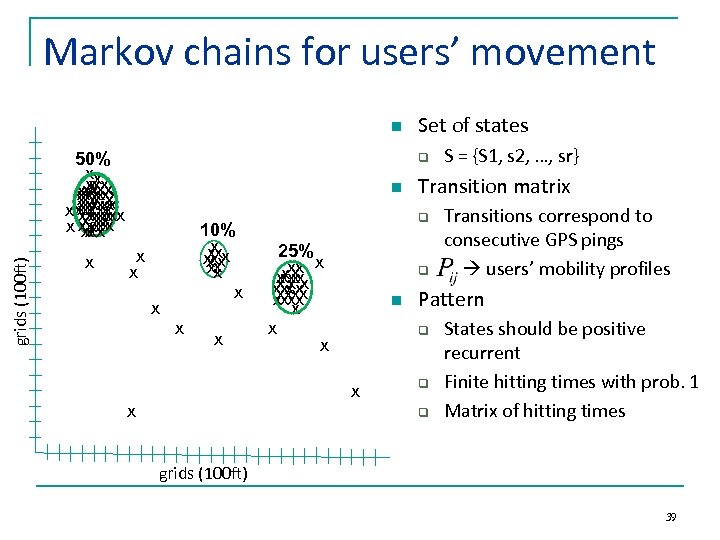
Markov chains for users’ movement n grids (100 ft) 50% xx x xxxxx xxxx xxxxx x x xxx xxxx xxx x x Set of states q n 10% x xx xxx xx x x x q n Transitions correspond to consecutive GPS pings users’ mobility profiles Pattern q x x Transition matrix q 25% x x xxxx xxxx x S = {S 1, s 2, …, sr} q q States should be positive recurrent Finite hitting times with prob. 1 Matrix of hitting times grids (100 ft) 39
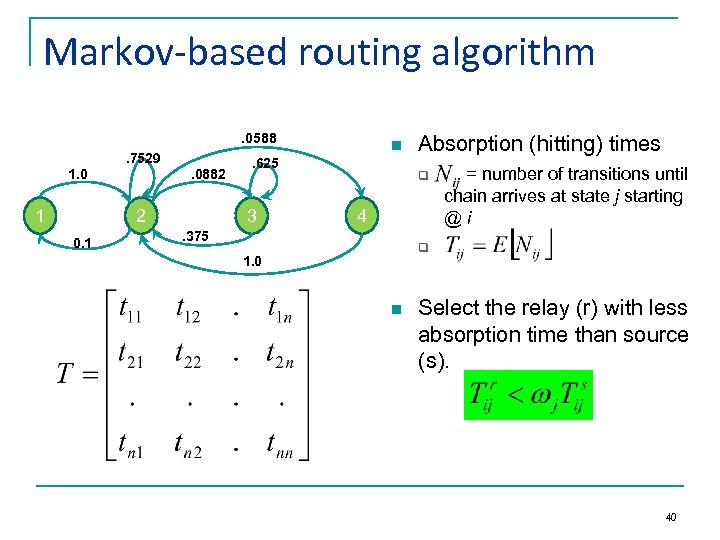
Markov-based routing algorithm. 0588 1. 0 1 . 7529. 0882 2 0. 1 n . 625 3 Absorption (hitting) times q 4 . 375 = number of transitions until chain arrives at state j starting @i q 1. 0 n Select the relay (r) with less absorption time than source (s). 40
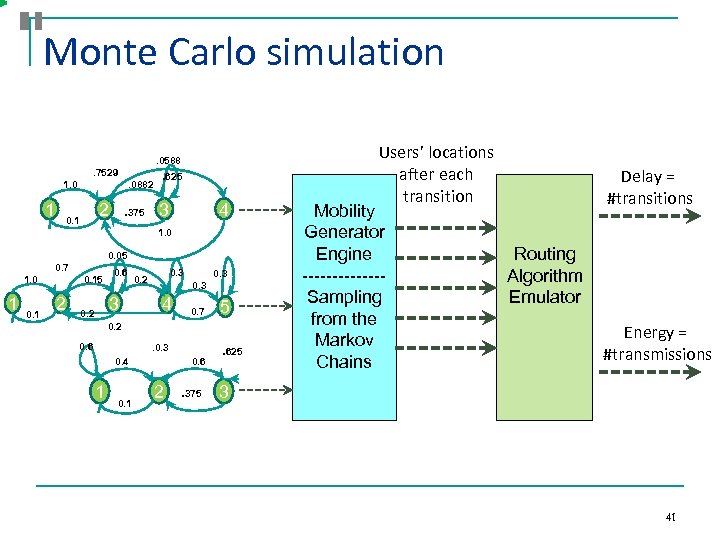
Monte Carlo simulation. 0588. 7529 1. 0 1 . 0882 2 0. 1 . 375 . 625 3 4 1. 0 0. 05 0. 7 0. 15 1. 0 1 0. 1 2 0. 6 3 0. 2 0. 3 4 0. 7 5 0. 2 0. 6 . 0. 3 0. 4 1 0. 6 2 . 375 . 625 Users’ locations after each transition Mobility Generator Engine -------Sampling from the Markov Chains Delay = #transitions Routing Algorithm Emulator Energy = #transmissions 3 41
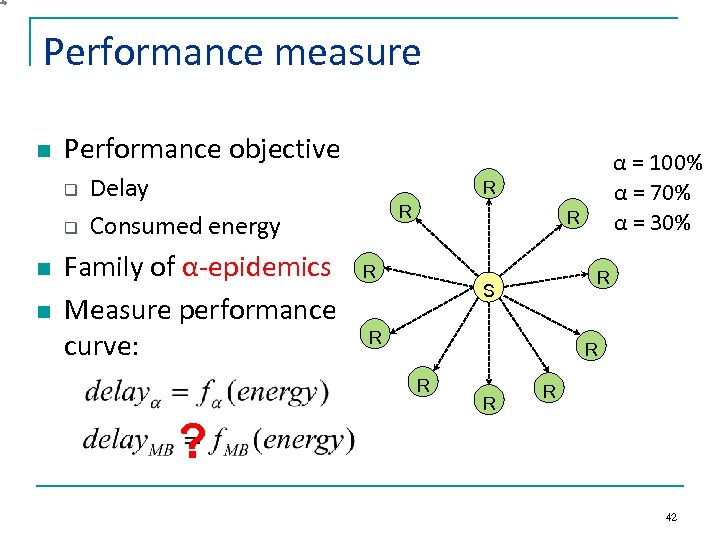
Performance measure n Performance objective q q n n Delay Consumed energy Family of α-epidemics Measure performance curve: α = 100% α = 70% α = 30% R R R S R R R ? 42
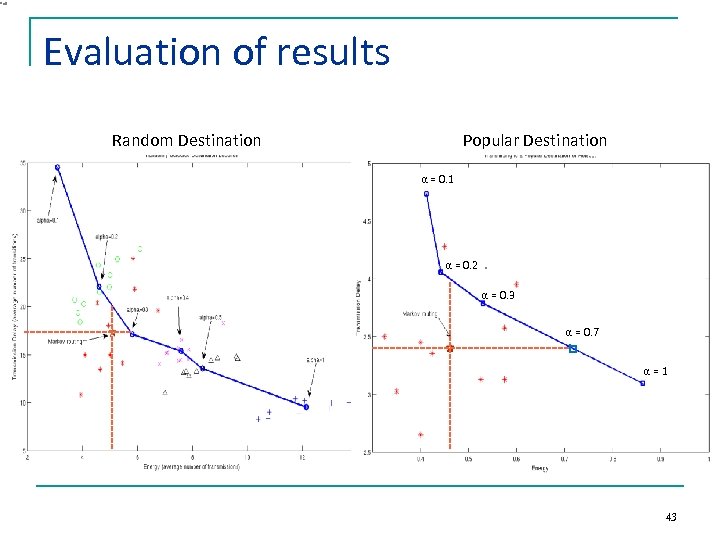
Evaluation of results Random Destination Popular Destination α = 0. 1 α = 0. 2 α = 0. 3 α = 0. 7 α=1 43
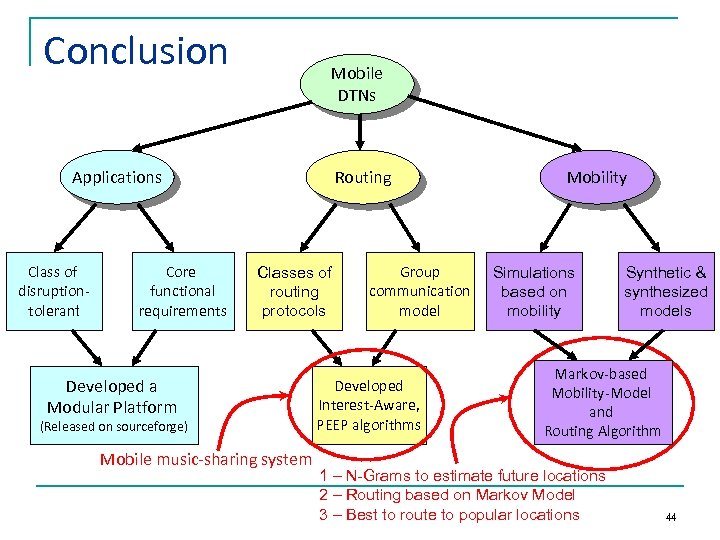
Conclusion Mobile DTNs Applications Class of disruptiontolerant Core functional requirements Routing Classes of routing protocols Developed a Modular Platform (Released on sourceforge) Mobile music-sharing system Group communication model Developed Interest-Aware, PEEP algorithms Mobility Simulations based on mobility Synthetic & synthesized models Markov-based Mobility-Model and Routing Algorithm 1 – N-Grams to estimate future locations 2 – Routing based on Markov Model 3 – Best to route to popular locations 44

45
Back up slides 46
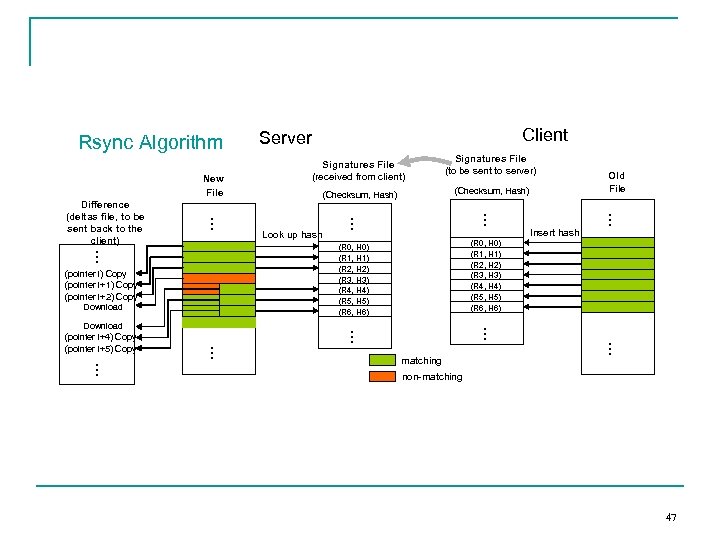
Rsync Algorithm New File (Checksum, Hash) Insert hash Old File … … Look up hash Signatures File (to be sent to server) (R 0, H 0) (R 1, H 1) (R 2, H 2) (R 3, H 3) (R 4, H 4) (R 5, H 5) (R 6, H 6) … (R 0, H 0) (R 1, H 1) (R 2, H 2) (R 3, H 3) (R 4, H 4) (R 5, H 5) (R 6, H 6) (pointer i) Copy (pointer i+1) Copy (pointer i+2) Copy Download … … matching … … … Download (pointer i+4) Copy (pointer i+5) Copy Signatures File (received from client) … … Difference (deltas file, to be sent back to the client) Client Server non-matching 47
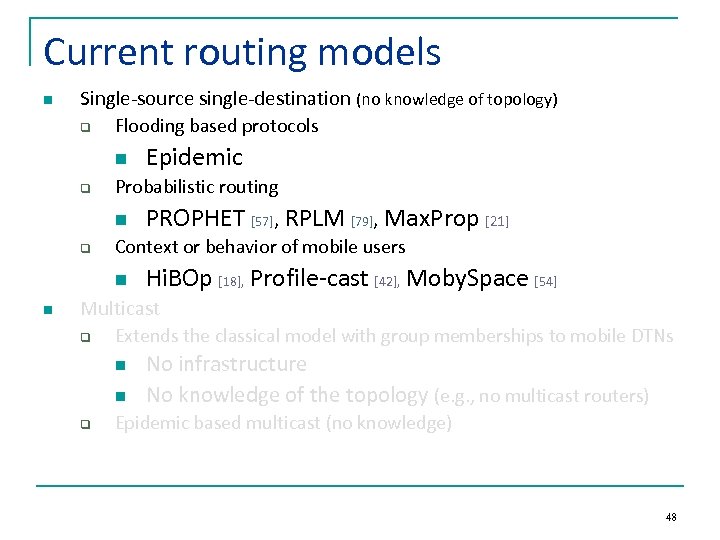
Current routing models n Single-source single-destination (no knowledge of topology) q Flooding based protocols n q Probabilistic routing n q PROPHET [57], RPLM [79], Max. Prop [21] Context or behavior of mobile users n n Epidemic Hi. BOp [18], Profile-cast [42], Moby. Space [54] Multicast q Extends the classical model with group memberships to mobile DTNs n n q No infrastructure No knowledge of the topology (e. g. , no multicast routers) Epidemic based multicast (no knowledge) 48
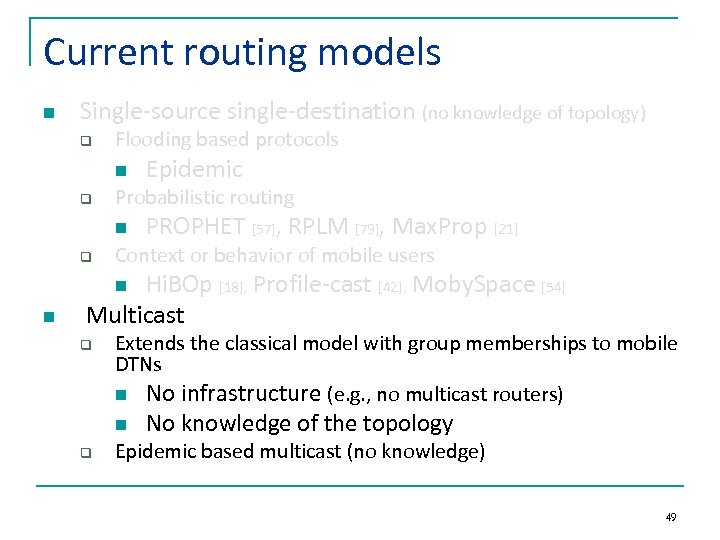
Current routing models n Single-source single-destination (no knowledge of topology) q Flooding based protocols n q Probabilistic routing n q Epidemic PROPHET [57], RPLM [79], Max. Prop [21] Context or behavior of mobile users Hi. BOp [18], Profile-cast [42], Moby. Space [54] Multicast n n q Extends the classical model with group memberships to mobile DTNs n No infrastructure (e. g. , no multicast routers) n q No knowledge of the topology Epidemic based multicast (no knowledge) 49
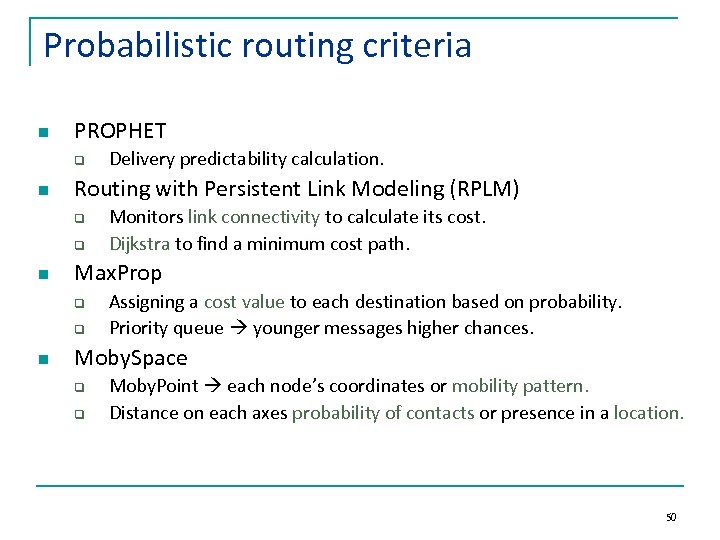
Probabilistic routing criteria n PROPHET q n Routing with Persistent Link Modeling (RPLM) q q n Monitors link connectivity to calculate its cost. Dijkstra to find a minimum cost path. Max. Prop q q n Delivery predictability calculation. Assigning a cost value to each destination based on probability. Priority queue younger messages higher chances. Moby. Space q q Moby. Point each node’s coordinates or mobility pattern. Distance on each axes probability of contacts or presence in a location. 50
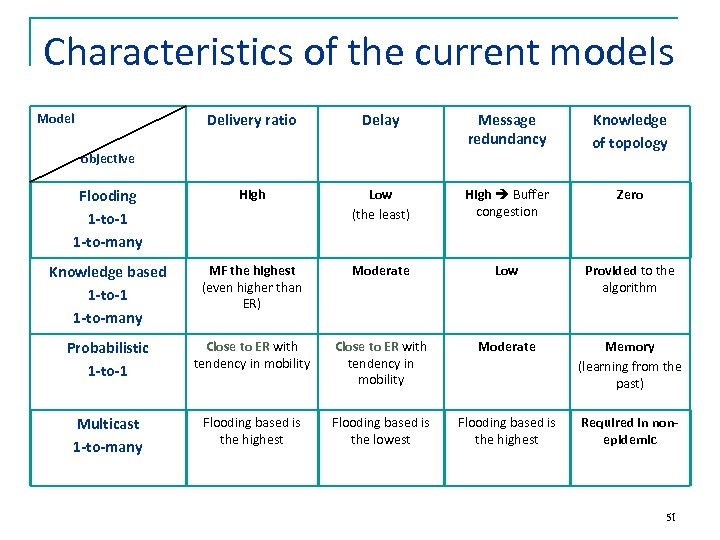
Characteristics of the current models Delivery ratio Delay Message redundancy Knowledge of topology Flooding 1 -to-1 1 -to-many High Low (the least) High Buffer congestion Zero Knowledge based 1 -to-1 1 -to-many MF the highest (even higher than ER) Moderate Low Provided to the algorithm Probabilistic 1 -to-1 Close to ER with tendency in mobility Moderate Memory (learning from the past) Multicast 1 -to-many Flooding based is the highest Flooding based is the lowest Flooding based is the highest Required in nonepidemic Model objective 51
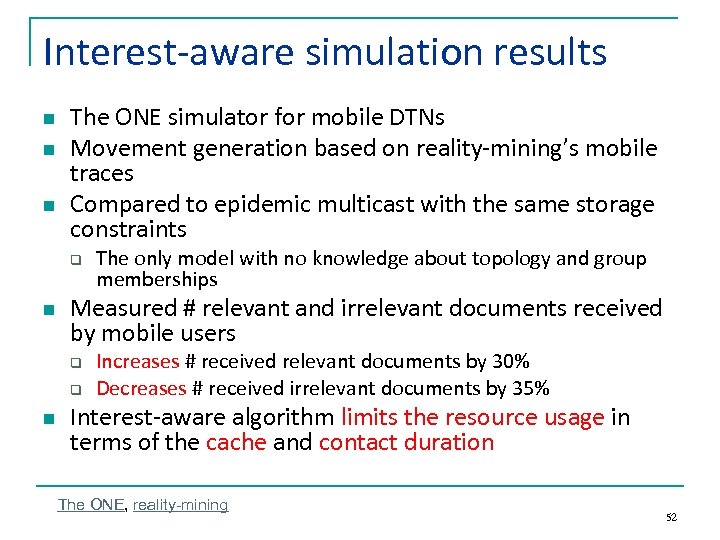
Interest-aware simulation results n n n The ONE simulator for mobile DTNs Movement generation based on reality-mining’s mobile traces Compared to epidemic multicast with the same storage constraints q n Measured # relevant and irrelevant documents received by mobile users q q n The only model with no knowledge about topology and group memberships Increases # received relevant documents by 30% Decreases # received irrelevant documents by 35% Interest-aware algorithm limits the resource usage in terms of the cache and contact duration The ONE, reality-mining 52
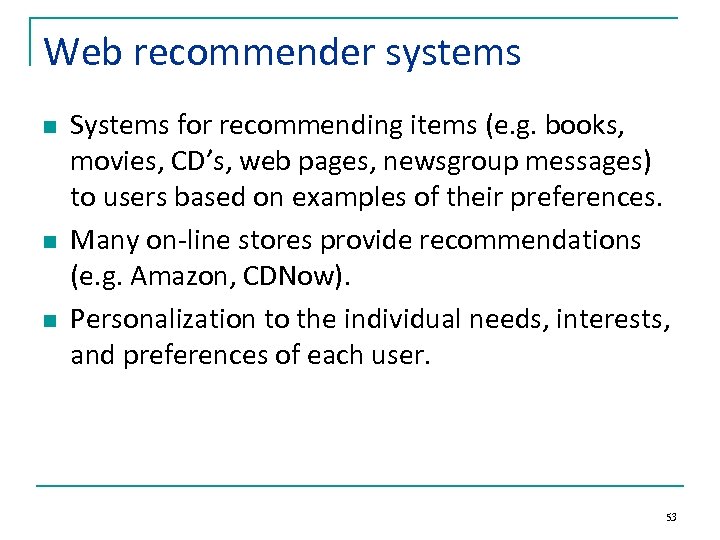
Web recommender systems n n n Systems for recommending items (e. g. books, movies, CD’s, web pages, newsgroup messages) to users based on examples of their preferences. Many on-line stores provide recommendations (e. g. Amazon, CDNow). Personalization to the individual needs, interests, and preferences of each user. 53
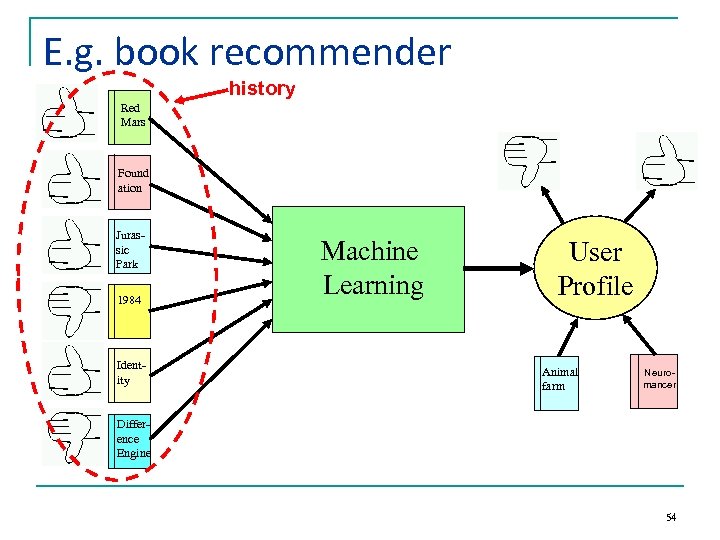
E. g. book recommender history Red Mars Found ation Jurassic Park 1984 Identity Machine Learning User Profile Animal farm Neuromancer Difference Engine 54
Collaborative filtering n n Maintains a database of many users’ ratings of a variety of items For a given user, find other similar users whose ratings strongly correlate with the current user Recommend items rated highly by these similar users, but not rated by the current user Almost all existing commercial recommenders use this approach (e. g. Amazon) 55
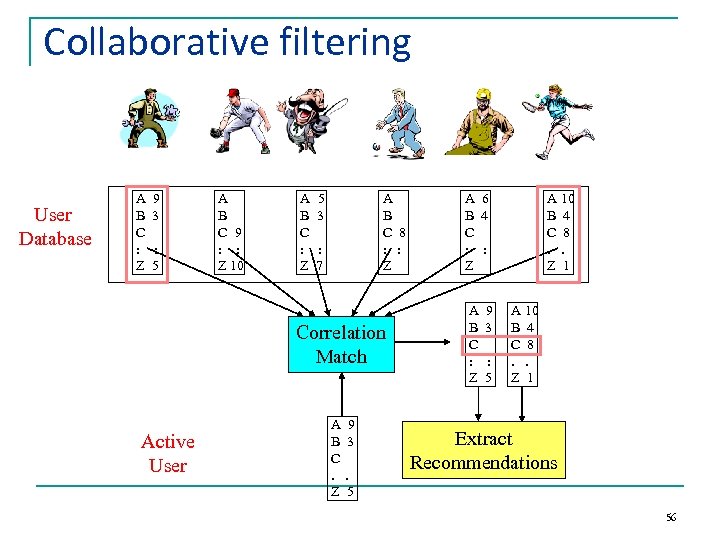
Collaborative filtering User Database A B C : Z 9 3 : 5 A B C 9 : : Z 10 A B C : Z 5 3 A B C 8 : : Z : 7 Correlation Match Active User A 9 B 3 C. . Z 5 A 6 B 4 C : : Z A B C : Z 9 3 : 5 A 10 B 4 C 8. . Z 1 Extract Recommendations 56
The ONE Simulator n n A modular simulation environment for mobile DTNs Routing package q q q n Internal and external mobility generation q q q n n Prophet Epidemic Spray and wait RWP Map based Stationary Internal and external message event generation Reports of connection and message passing 57
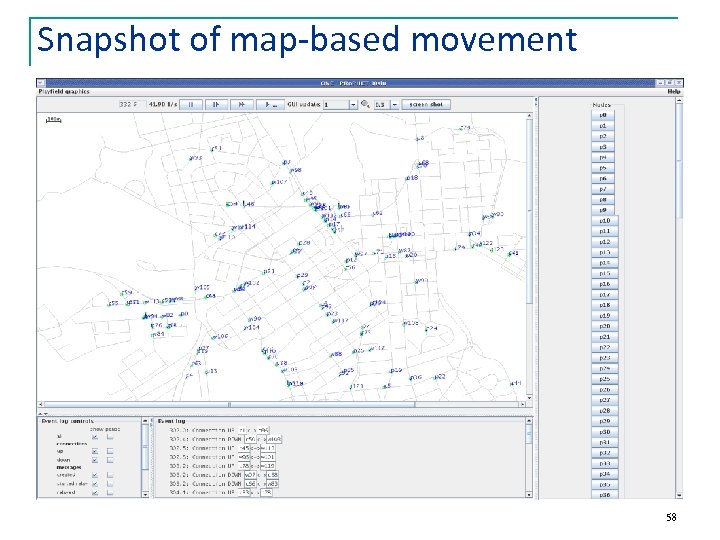
Snapshot of map-based movement 58
The ONE Simulator n n A modular simulation environment for mobile DTNs Implements routing packages for one-to-one model q q q n Internal and external mobility generation q q q n n Prophet Epidemic Spray and wait RWP Map based Stationary Internal and external message event generation Reports of contacts and message transmission 59
Interest-aware protocol implementation n n n Interest-aware routing as a new module for the routing package General categories for documents Each node randomly assigned with some interest in each category A sub-population is randomly selected to be in the same community of interest Documents/messages are generated from nodes outside this community Coverage, pollution and dropped messages 60
Choice of mobility model for interest-aware n Synthetic mobility traces q q q n n RWP Map-based Community-based Speed of nodes Residence time Directions More realistic simulation with real-world traces q Reality-mining traces 61
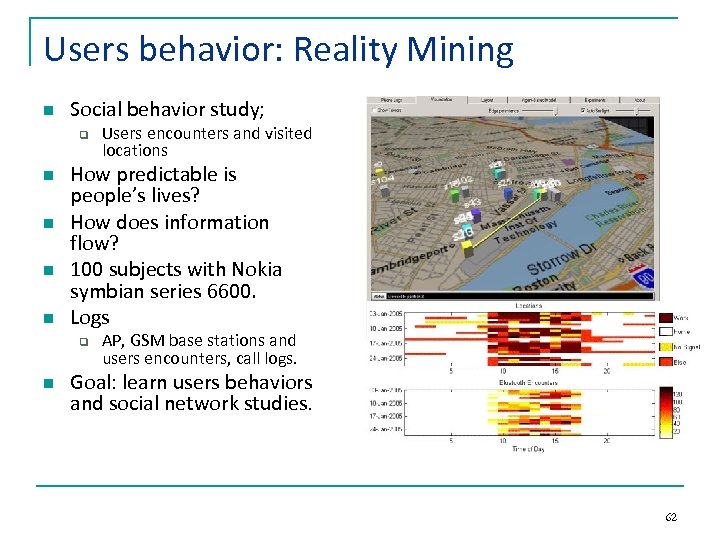
Users behavior: Reality Mining n Social behavior study; q n n How predictable is people’s lives? How does information flow? 100 subjects with Nokia symbian series 6600. Logs q n Users encounters and visited locations AP, GSM base stations and users encounters, call logs. Goal: learn users behaviors and social network studies. 62
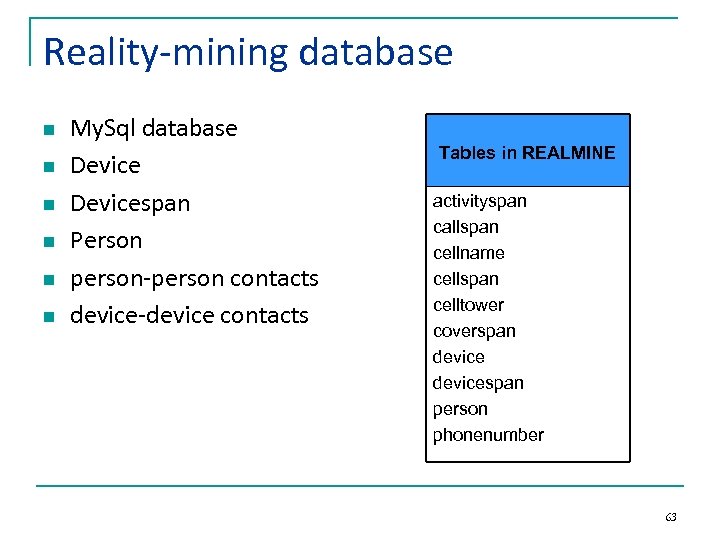
Reality-mining database n n n My. Sql database Devicespan Person person-person contacts device-device contacts Tables in REALMINE activityspan callspan cellname cellspan celltower coverspan devicespan person phonenumber 63
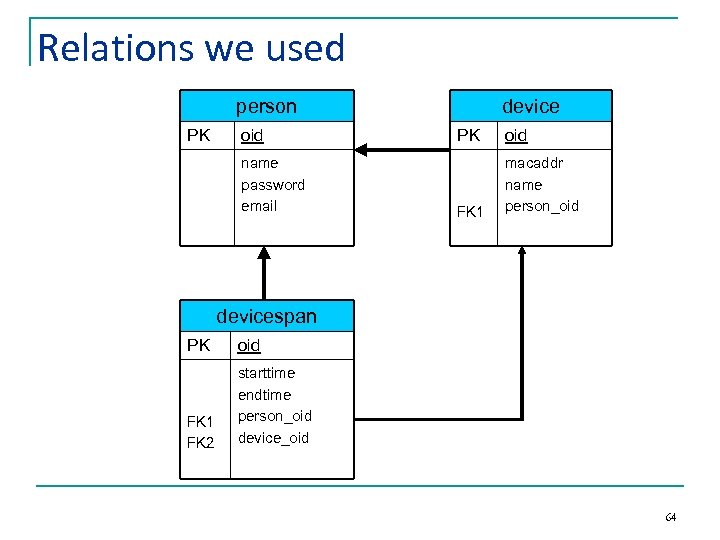
Relations we used person PK oid name password email device PK oid FK 1 macaddr name person_oid devicespan PK oid FK 1 FK 2 starttime endtime person_oid device_oid 64
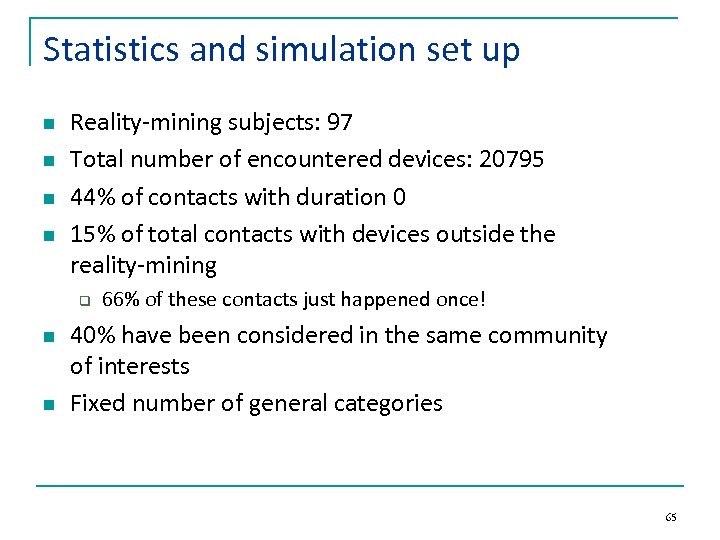
Statistics and simulation set up n n Reality-mining subjects: 97 Total number of encountered devices: 20795 44% of contacts with duration 0 15% of total contacts with devices outside the reality-mining q n n 66% of these contacts just happened once! 40% have been considered in the same community of interests Fixed number of general categories 65
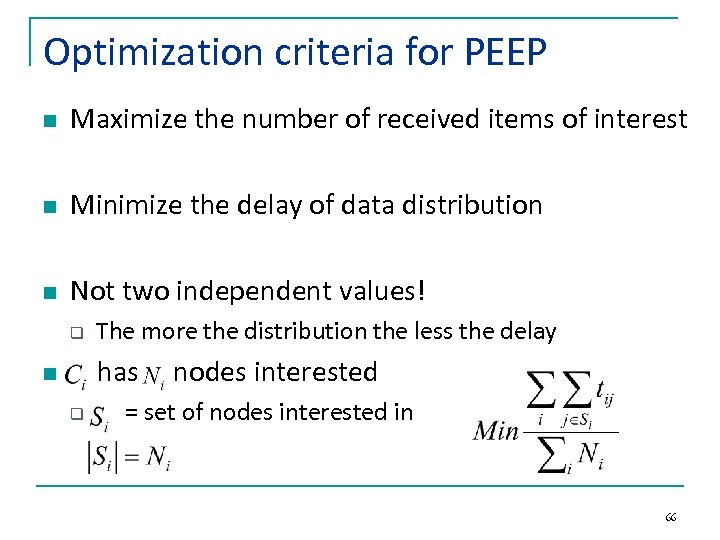
Optimization criteria for PEEP n Maximize the number of received items of interest n Minimize the delay of data distribution n Not two independent values! q The more the distribution the less the delay has n q nodes interested = set of nodes interested in 66
PEEP implementation in The ONE n n n PEEP routing as a new module for the routing package General categories for documents Each node is assigned some interest in each category based on Zipf distribution q Distribution of the popular items follows Zipf law No knowledge of the topology Documents/messages are generated uniformly from different sources Measurements: q q q Number of received documents of interest over time Number of received documents of interest over contacts Speed of the distribution (slope of the graph) 67
Choice of mobility model for PEEP n Synthetic mobility traces q q q n n n RWP Map-based Community-based Speed of nodes Residence time Directions The relative performance of the algorithm should be independent from the choice of the mobility model Our choice: RWP A constant slope verifies this fact 68
Evaluation of the results n If storage size is low buffer overflow happens too soon q n No chance for the items of interest to survive The most important difference with our previous work q q q Unlimited storage size Limited energy (transmit-budget) Not far from the reality 69
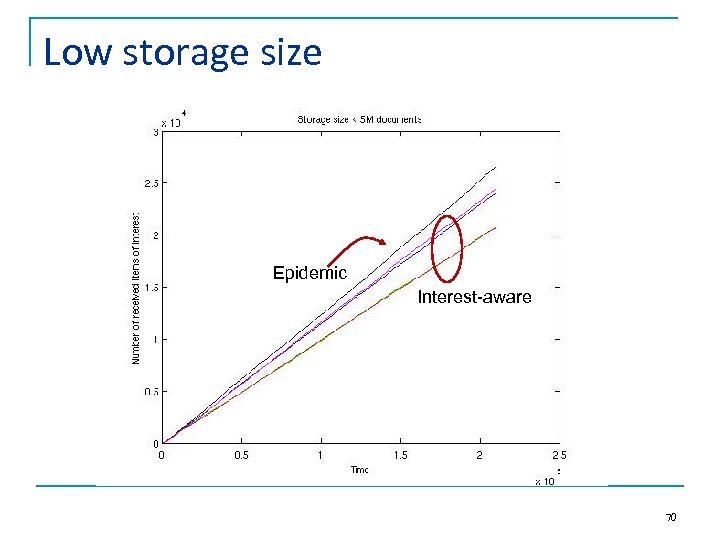
Low storage size Epidemic Interest-aware 70
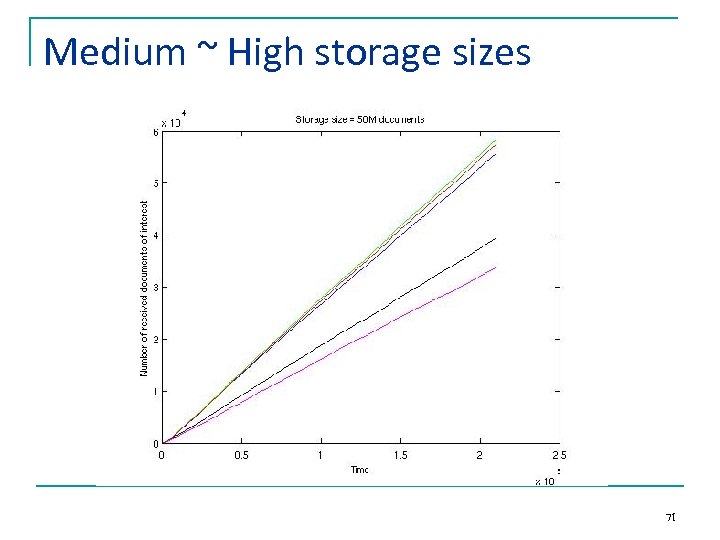
Medium ~ High storage sizes 71
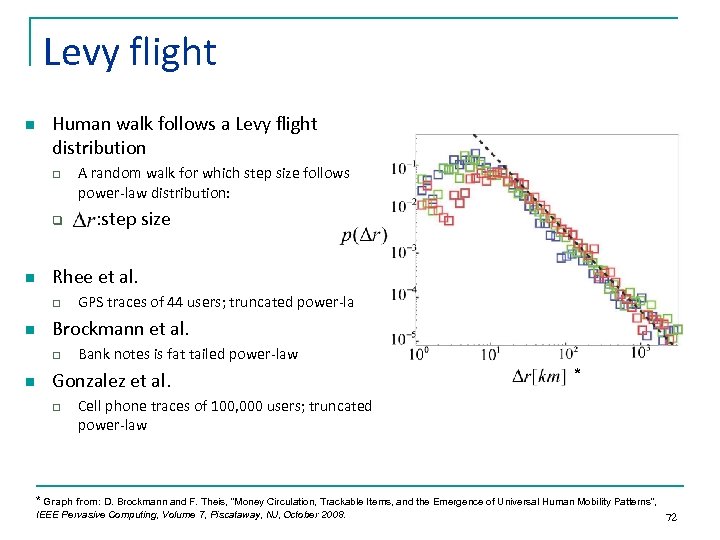
Levy flight n Human walk follows a Levy flight distribution q q n GPS traces of 44 users; truncated power-law Brockmann et al. q n : step size Rhee et al. q n A random walk for which step size follows a power-law distribution: Bank notes is fat tailed power-law Gonzalez et al. q * Cell phone traces of 100, 000 users; truncated power-law * Graph from: D. Brockmann and F. Theis, “Money Circulation, Trackable Items, and the Emergence of Universal Human Mobility Patterns“, IEEE Pervasive Computing, Volume 7, Piscataway, NJ, October 2008. 72
Скачать презентацию Application platform routing protocols and behavior models in
74f0d03673071fc469f41db7aabb17f6.ppt