


 Скачать презентацию APPLICATION OF VEHICLE GUIDANCE SYSTEMS FOR PRECISION AGRICULTURE
82e814e83fffc0207e4df35ac5e062a4.ppt
- Количество слайдов: 19
 APPLICATION OF VEHICLE GUIDANCE SYSTEMS FOR PRECISION AGRICULTURE
 Manual guidance means Ø Ø Disk markers Foam spray Flags – aerial spraying Tissue markers – aerial spraying
 Vehicle Automated Guidance Ø Ø Ø Furrow followers Cable tether Buried Cable Followers Machine Vision Positioning Systems
 Purpose Ø Ø Increase efficiency Reduce fatigue and boredom Save money Fewer operators
 Resistance Ø Ø Initial cost Reliability Elaborate set-up Ag machines are “iron tough”
 Vehicle Navigation Requirements Ø Ø Ø Parallel swathing Crop-edge tracking Precision path tracking Turning assists function Remote guidance Multi-vehicle cooperation
 First guidance attempt First furrow follower patented in 1924 Ø U. S. Patent 1, 506, 706 Ø Suggested use of guide wheel as a mechanical feeler tethered to the steering wheel so that the tractor could follow a furrow for cultivation
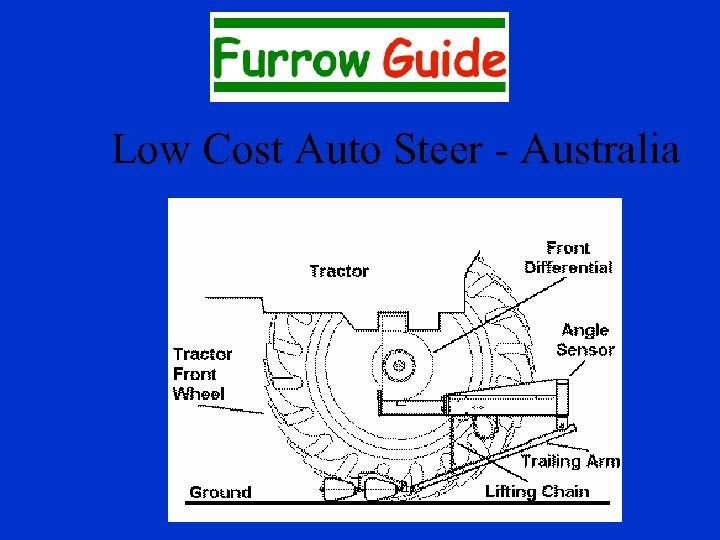 Low Cost Auto Steer - Australia
 Furrow Guide Ø Developed by University of Southern Queensland Nat’l Center for Engineeering Ø Speeds to 15 km/hr Ø Furrow following skids or chain Ø Accuracy of +/- 25 mm Ø U. S $6, 250
 Machine Vision Research Ø Carnegie-Mellon Robotics Institute (1996) NH Speedrower at 7. 2 km/hr Vision based perception of cut and uncut crop Ø Stanford University Carrier phase GPS on JD 7800 tractor Accuracy of 2. 5 cm, 0. 1 degree heading at 3. 25 km/hr Ø Michigan State University Straight row guidance of Case 7190 MFW tractor Error of 6 cm at 4. 8 km/hr, 12 cm at 12. 9 km/hr Ø University of Illinois Joint study with Hokkaido University, Japan Used GPS, vision, inertial, and geomagnetic sensors
 Other attempts Ø Tethered wire for circular operation, Univ. of Illinois, 1941 Ø Mechanical feelers Ø Buried cables Ø John Deere orchard sprayer
 US DOD Global Positioning System Ø 24 satellites, 6 orbital planes Ø Orbit height of 11, 000 miles Ø Four satellites needed for accurate positioning Ø Differential correction required for field navigation
 Hardware requirements Ø Ø GPS Receiver Differential correction signal receiver Differential correction antenna Computer/monitor interface
 GPS Light Bar Ø Ø Ø Ø WAAS or L Band correction Define first pass Bright color LEDs define on or off track Parallel, contour, or standard field tracking Cost $4, 000 - $5, 000 Operable day or night Tracking accuracy, 15 cm
 GPS Autoguidance Ø Ø Ø Ø Parallel, contour, or standard field tracking WAAS or L Band corection Increased field efficiency Increased equipment utilization Operable day or night 14 cm (6 inch) accuracy sysyem, $9500 One cm (one inch) accuracy, $40, 000+
 Manufacturers Ø Ø Ø Trimble Navigation Outback Guidance Novatel Beeline Technologies Greenstar (John Deere) Fieldstar (AGCO)
 Outback System claims Ø Ø Install in two hours or less Operate in 15 minutes or less Exclusive “Contour” driving Huge payback (dependent on crop)
 Future of Vehicle Guidance Ø Lightbar systems will be commonplace Ø Automated systems will increase in higher value crops Ø Multiple vehicle operation will be feasible Ø Remote vehicle operation will be feasible
 References Ø New Frontiers in the 21 st Century: A Status Report on Autonomous Guidance of Agricultural Vehicles in the U. S. , Dr. John Reid, University of Illinois Ø www. trimble. com Ø www. outbackguidance. com Ø “Driverless Tractors”; American Society of Agricultural Engineers, 2001, J. F. Reid & D. G. Niehubr Ø The Precision Farming Guide for Agriculturalists, Deere & Company, 1997