


 Скачать презентацию Application of UNDP s Capacity Development Process and Capacity
e3e3774d92c52540d9e2579eb1508d6b.ppt
- Количество слайдов: 81
 Application of UNDP’s Capacity Development Process and Capacity Diagnostics Methodology September 2006 19 Jan 2006
 Context UNDP’s Capacity Development Process and Capacity Diagnostics Methodology draw upon prior UNDP, UN system, and partner organisation capacity development and assessment documents, case studies and reviews, at the level of both the enabling environment and the institution. The methodology materials, consisting of the Practice Notes on Capacity Development and Capacity Assessment, User’s Guide and Supporting Tool, have benefited from a technical review provided by representatives from the Bureau for Development Policy as well as from the Regional Bureaux. All of the input provided has enriched both the process and the product, and we look forward to this being a continuous learning process for all of us. 2
 Introduction Purpose of Presentation Frame capacity diagnostics within UNDP’s capacity development process Familiarize audience with UNDP’s “default” capacity diagnostics methodology Enable practitioners to apply the methodology – from designing a diagnostic, to conducting an assessment exercise, to interpreting results Audience UN Country Offices Regional Programmes Government Partners Regional Institutions and Experts Related Materials Capacity Development Practice Note Capacity Assessment User’s Guide Capacity Assessment Supporting Tool 3
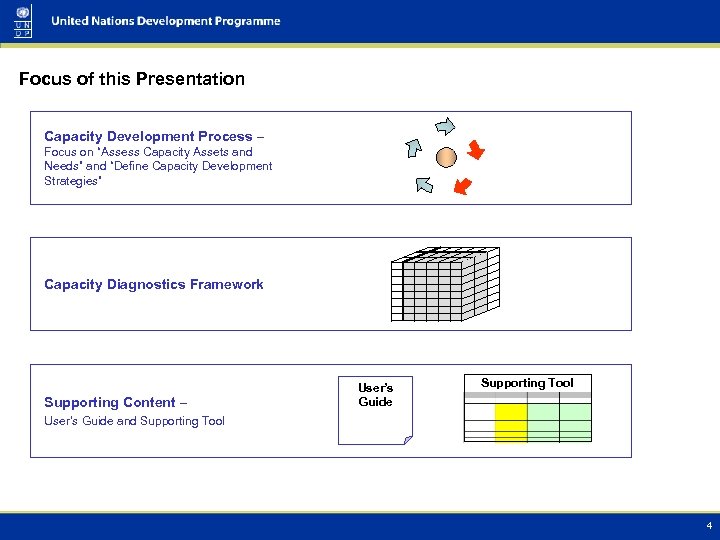 Focus of this Presentation Capacity Development Process – Focus on “Assess Capacity Assets and Needs” and “Define Capacity Development Strategies” Capacity Diagnostics Framework Supporting Content – User’s Guide Supporting Tool User’s Guide and Supporting Tool 4
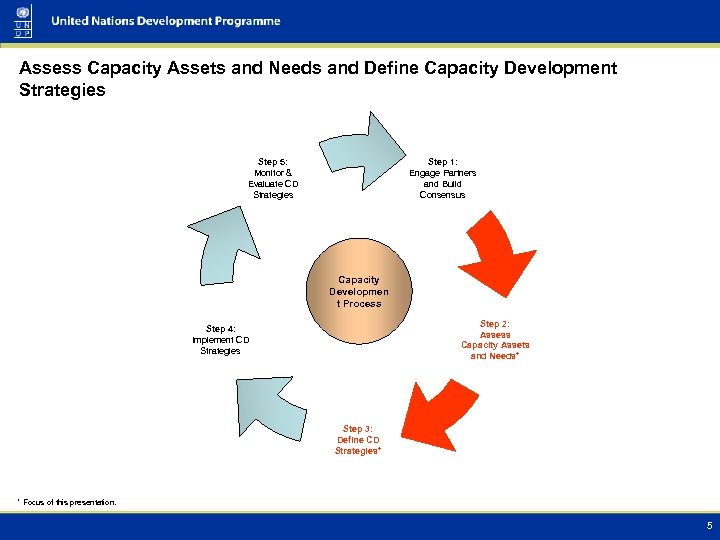 Assess Capacity Assets and Needs and Define Capacity Development Strategies Step 1: Engage Partners and Build Consensus Step 5: Monitor & Evaluate CD Strategies Capacity Developmen t Process Step 2: Assess Capacity Assets and Needs* Step 4: Implement CD Strategies Step 3: Define CD Strategies* * Focus of this presentation. 5
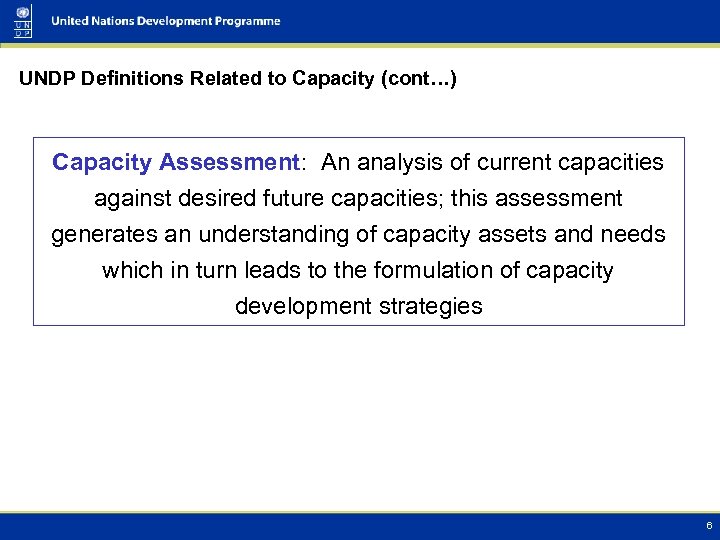 UNDP Definitions Related to Capacity (cont…) Capacity Assessment: An analysis of current capacities against desired future capacities; this assessment generates an understanding of capacity assets and needs which in turn leads to the formulation of capacity development strategies 6
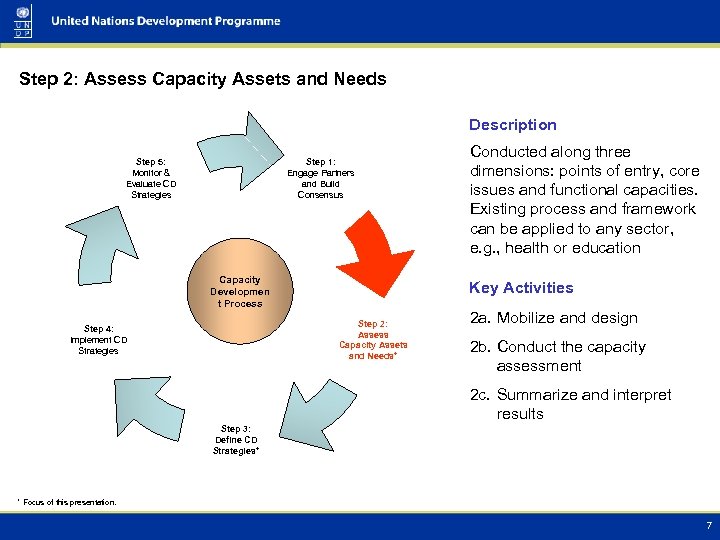 Step 2: Assess Capacity Assets and Needs Description Step 1: Engage Partners and Build Consensus Step 5: Monitor & Evaluate CD Strategies Capacity Developmen t Process Key Activities Step 2: Assess Capacity Assets and Needs* Step 4: Implement CD Strategies Conducted along three dimensions: points of entry, core issues and functional capacities. Existing process and framework can be applied to any sector, e. g. , health or education 2 a. Mobilize and design 2 b. Conduct the capacity assessment 2 c. Summarize and interpret results Step 3: Define CD Strategies* * Focus of this presentation. 7
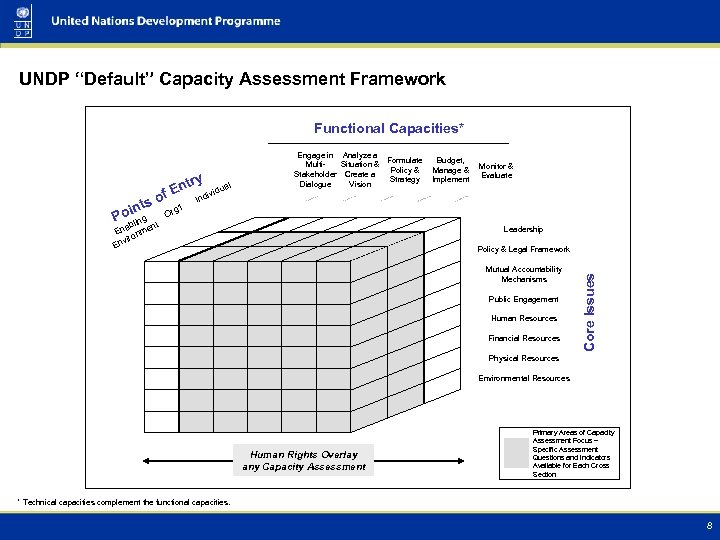 UNDP “Default” Capacity Assessment Framework Functional Capacities* try n P ing nt abl En onme vir En ’l Org ual vid ndi Budget, Manage & Implement Monitor & Evaluate I Leadership Policy & Legal Framework Mutual Accountability Mechanisms Public Engagement Human Resources Financial Resources Core Issues s t oin E of Engage in Analyze a Formulate Multi. Situation & Policy & Stakeholder Create a Strategy Dialogue Vision Physical Resources Environmental Resources Human Rights Overlay any Capacity Assessment Primary Areas of Capacity Assessment Focus – Specific Assessment Questions and Indicators Available for Each Cross Section * Technical capacities complement the functional capacities. 8
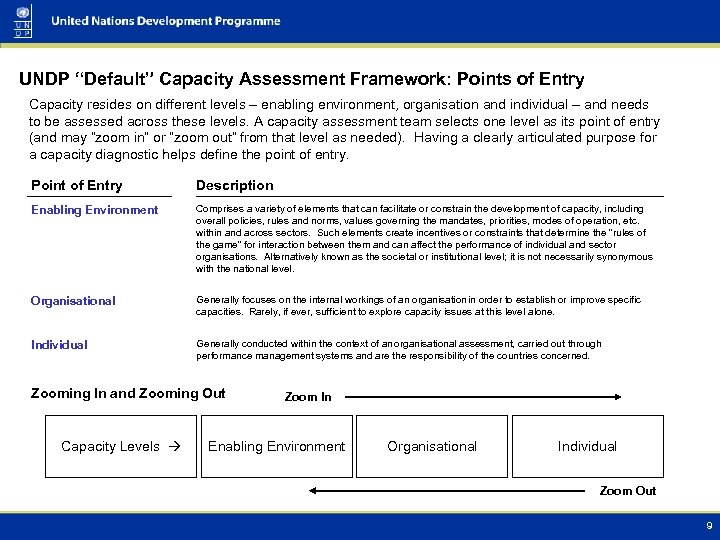 UNDP “Default” Capacity Assessment Framework: Points of Entry Capacity resides on different levels – enabling environment, organisation and individual – and needs to be assessed across these levels. A capacity assessment team selects one level as its point of entry (and may “zoom in” or “zoom out” from that level as needed). Having a clearly articulated purpose for a capacity diagnostic helps define the point of entry. Point of Entry Description Enabling Environment Comprises a variety of elements that can facilitate or constrain the development of capacity, including overall policies, rules and norms, values governing the mandates, priorities, modes of operation, etc. within and across sectors. Such elements create incentives or constraints that determine the “rules of the game” for interaction between them and can affect the performance of individual and sector organisations. Alternatively known as the societal or institutional level; it is not necessarily synonymous with the national level. Organisational Generally focuses on the internal workings of an organisation in order to establish or improve specific capacities. Rarely, if ever, sufficient to explore capacity issues at this level alone. Individual Generally conducted within the context of an organisational assessment, carried out through performance management systems and are the responsibility of the countries concerned. Zooming In and Zooming Out Capacity Levels Zoom In Enabling Environment Organisational Individual Zoom Out 9
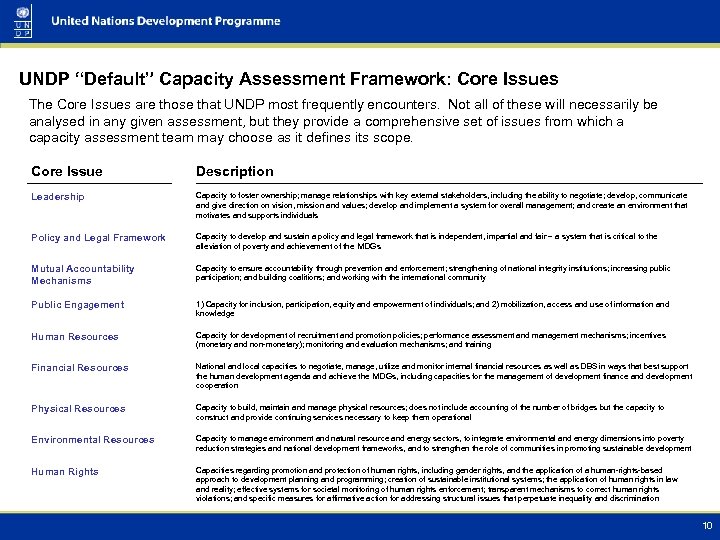 UNDP “Default” Capacity Assessment Framework: Core Issues The Core Issues are those that UNDP most frequently encounters. Not all of these will necessarily be analysed in any given assessment, but they provide a comprehensive set of issues from which a capacity assessment team may choose as it defines its scope. Core Issue Description Leadership Capacity to foster ownership; manage relationships with key external stakeholders, including the ability to negotiate; develop, communicate and give direction on vision, mission and values; develop and implement a system for overall management; and create an environment that motivates and supports individuals Policy and Legal Framework Capacity to develop and sustain a policy and legal framework that is independent, impartial and fair – a system that is critical to the alleviation of poverty and achievement of the MDGs Mutual Accountability Mechanisms Capacity to ensure accountability through prevention and enforcement; strengthening of national integrity institutions; increasing public participation; and building coalitions; and working with the international community Public Engagement 1) Capacity for inclusion, participation, equity and empowerment of individuals; and 2) mobilization, access and use of information and knowledge Human Resources Capacity for development of recruitment and promotion policies; performance assessment and management mechanisms; incentives (monetary and non-monetary); monitoring and evaluation mechanisms; and training Financial Resources National and local capacities to negotiate, manage, utilize and monitor internal financial resources as well as DBS in ways that best support the human development agenda and achieve the MDGs, including capacities for the management of development finance and development cooperation Physical Resources Capacity to build, maintain and manage physical resources; does not include accounting of the number of bridges but the capacity to construct and provide continuing services necessary to keep them operational Environmental Resources Capacity to manage environment and natural resource and energy sectors, to integrate environmental and energy dimensions into poverty reduction strategies and national development frameworks, and to strengthen the role of communities in promoting sustainable development Human Rights Capacities regarding promotion and protection of human rights, including gender rights, and the application of a human-rights-based approach to development planning and programming; creation of sustainable institutional systems; the application of human rights in law and reality; effective systems for societal monitoring of human rights enforcement; transparent mechanisms to correct human rights violations; and specific measures for affirmative action for addressing structural issues that perpetuate inequality and discrimination 10
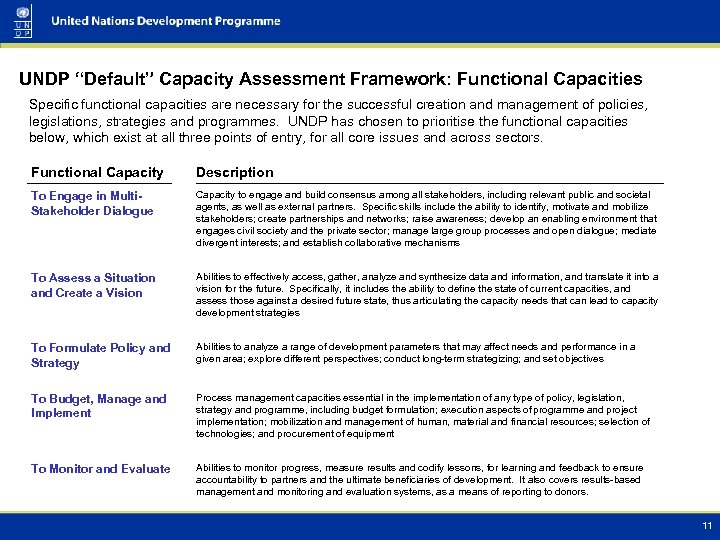 UNDP “Default” Capacity Assessment Framework: Functional Capacities Specific functional capacities are necessary for the successful creation and management of policies, legislations, strategies and programmes. UNDP has chosen to prioritise the functional capacities below, which exist at all three points of entry, for all core issues and across sectors. Functional Capacity Description To Engage in Multi. Stakeholder Dialogue Capacity to engage and build consensus among all stakeholders, including relevant public and societal agents, as well as external partners. Specific skills include the ability to identify, motivate and mobilize stakeholders; create partnerships and networks; raise awareness; develop an enabling environment that engages civil society and the private sector; manage large group processes and open dialogue; mediate divergent interests; and establish collaborative mechanisms To Assess a Situation and Create a Vision Abilities to effectively access, gather, analyze and synthesize data and information, and translate it into a vision for the future. Specifically, it includes the ability to define the state of current capacities, and assess those against a desired future state, thus articulating the capacity needs that can lead to capacity development strategies To Formulate Policy and Strategy Abilities to analyze a range of development parameters that may affect needs and performance in a given area; explore different perspectives; conduct long-term strategizing; and set objectives To Budget, Manage and Implement Process management capacities essential in the implementation of any type of policy, legislation, strategy and programme, including budget formulation; execution aspects of programme and project implementation; mobilization and management of human, material and financial resources; selection of technologies; and procurement of equipment To Monitor and Evaluate Abilities to monitor progress, measure results and codify lessons, for learning and feedback to ensure accountability to partners and the ultimate beneficiaries of development. It also covers results-based management and monitoring and evaluation systems, as a means of reporting to donors. 11
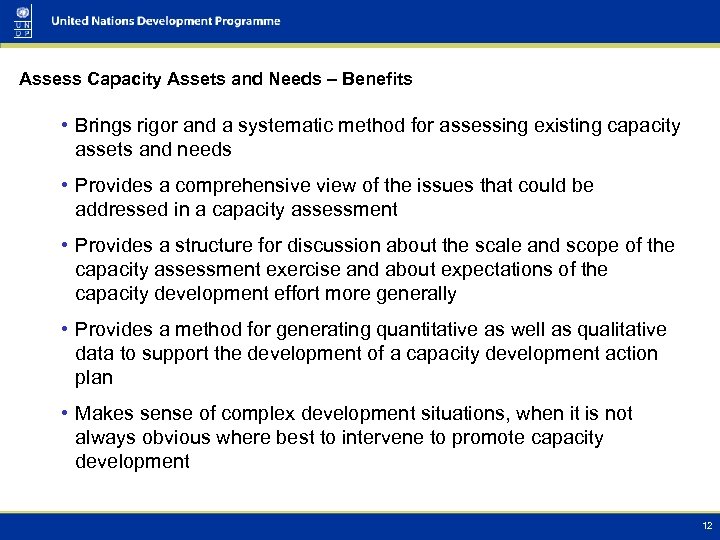 Assess Capacity Assets and Needs – Benefits • Brings rigor and a systematic method for assessing existing capacity assets and needs • Provides a comprehensive view of the issues that could be addressed in a capacity assessment • Provides a structure for discussion about the scale and scope of the capacity assessment exercise and about expectations of the capacity development effort more generally • Provides a method for generating quantitative as well as qualitative data to support the development of a capacity development action plan • Makes sense of complex development situations, when it is not always obvious where best to intervene to promote capacity development 12
 Assess Capacity Assets and Needs – Operational Considerations • Understand that capacity diagnostic is a set of activities, not a solution • Leverage the framework as a point of departure for a capacity diagnostic – it is flexible and needs to be customized by the assessment team to suit its specific needs/context • Define desired capacities prior to undertaking the diagnostic, as they do not emerge from a capacity diagnostic • Do not necessarily expect “surprises” from the diagnostic, but rather confirmation and consensus • Leave prioritization of investment until after the assessment of capacities has been completed • Consider a capacity diagnostic as a dynamic, ongoing process… not a one-time event 13
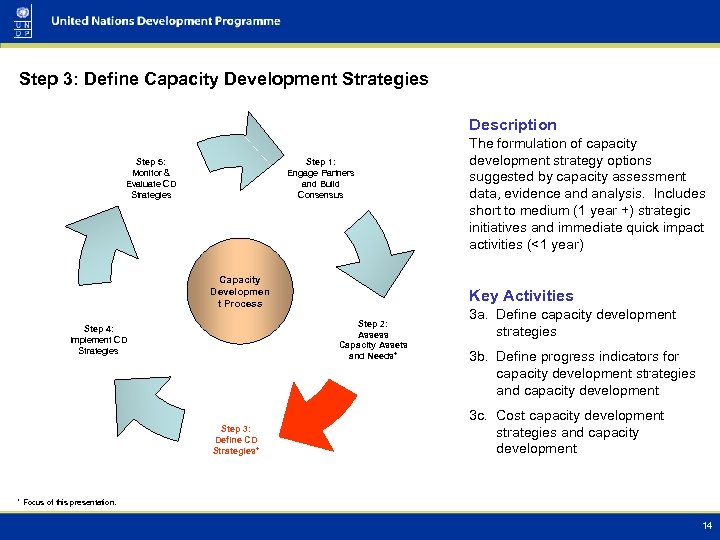 Step 3: Define Capacity Development Strategies Description Step 1: Engage Partners and Build Consensus Step 5: Monitor & Evaluate CD Strategies Capacity Developmen t Process Key Activities Step 2: Assess Capacity Assets and Needs* Step 4: Implement CD Strategies Step 3: Define CD Strategies* The formulation of capacity development strategy options suggested by capacity assessment data, evidence and analysis. Includes short to medium (1 year +) strategic initiatives and immediate quick impact activities (<1 year) 3 a. Define capacity development strategies 3 b. Define progress indicators for capacity development strategies and capacity development 3 c. Cost capacity development strategies and capacity development * Focus of this presentation. 14
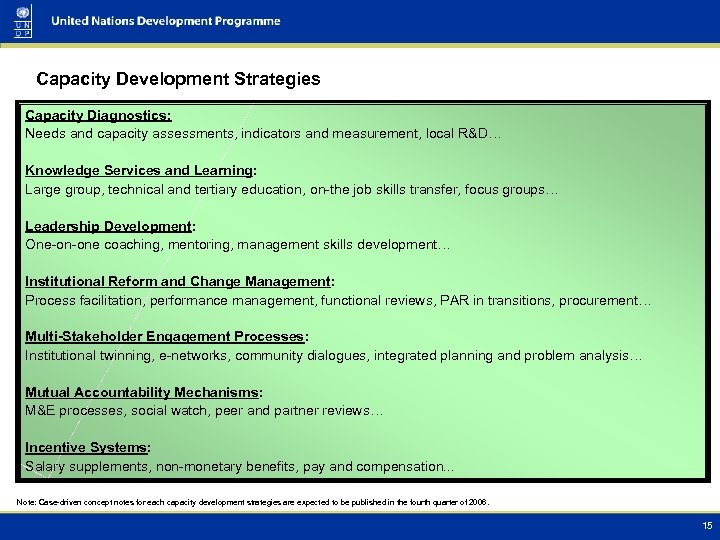 Capacity Development Strategies Capacity Diagnostics: Needs and capacity assessments, indicators and measurement, local R&D… Knowledge Services and Learning: Large group, technical and tertiary education, on-the job skills transfer, focus groups… Leadership Development: One-on-one coaching, mentoring, management skills development… Institutional Reform and Change Management: Process facilitation, performance management, functional reviews, PAR in transitions, procurement… Multi-Stakeholder Engagement Processes: Institutional twinning, e-networks, community dialogues, integrated planning and problem analysis… Mutual Accountability Mechanisms: M&E processes, social watch, peer and partner reviews… Incentive Systems: Salary supplements, non-monetary benefits, pay and compensation. . . Note: Case-driven concept notes for each capacity development strategies are expected to be published in the fourth quarter of 2006. 15
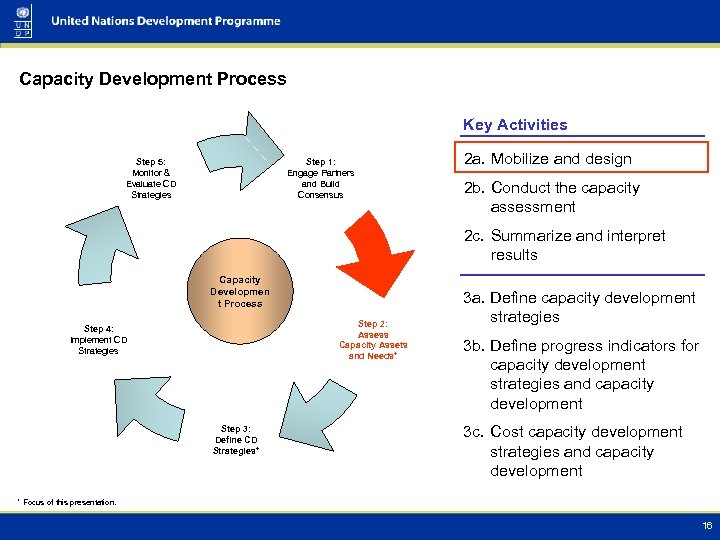 Capacity Development Process Key Activities Step 1: Engage Partners and Build Consensus Step 5: Monitor & Evaluate CD Strategies 2 a. Mobilize and design 2 b. Conduct the capacity assessment 2 c. Summarize and interpret results Capacity Developmen t Process Step 2: Assess Capacity Assets and Needs* Step 4: Implement CD Strategies Step 3: Define CD Strategies* 3 a. Define capacity development strategies 3 b. Define progress indicators for capacity development strategies and capacity development 3 c. Cost capacity development strategies and capacity development * Focus of this presentation. 16
 2 a. Mobilize and Design It is important for local participants to gain ownership of the exercise and for stakeholders to be identified and engaged appropriately – providing political and administrative oversight, assisting in the design and implementation, and ensuring thorough analysis and follow-up. • Clarify objectives and expectations with primary clients • Identify and engage national/local stakeholders throughout the process – design, assessment, interpretation and dialogue – to ensure ongoing success • Use UNDP Capacity Assessment Framework to suit local needs • Define the scale and scope of the capacity assessment by selecting point of entry, core issue(s) and functional capacity(ies) • Determine data collection and analysis approach • Review existing sources and knowledge • Determine how the assessment will be conducted (team, location) • Cost the capacity assessment exercise (based on team composition, duration and depth) 17
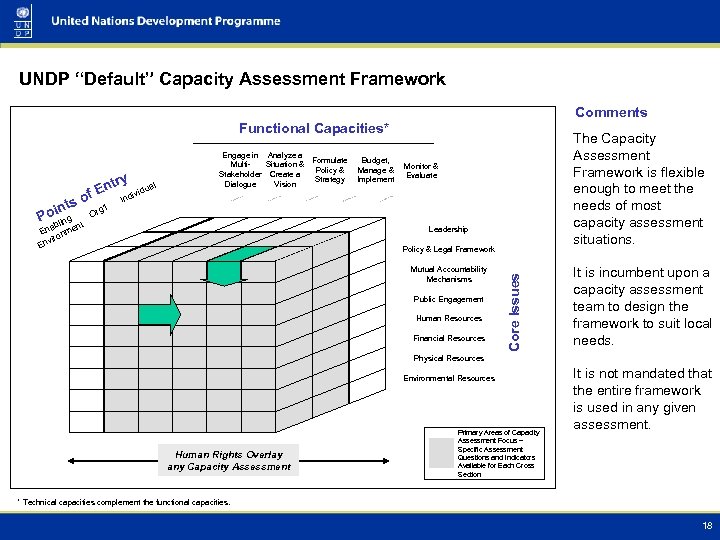 UNDP “Default” Capacity Assessment Framework Comments Functional Capacities* try l En ividua Budget, Manage & Implement Monitor & Evaluate Ind i nt abl En onme vir En Leadership Policy & Legal Framework Mutual Accountability Mechanisms Public Engagement Human Resources Financial Resources Core Issues f ts o rg’l in Po ng O Engage in Analyze a Formulate Multi. Situation & Policy & Stakeholder Create a Strategy Dialogue Vision The Capacity Assessment Framework is flexible enough to meet the needs of most capacity assessment situations. It is incumbent upon a capacity assessment team to design the framework to suit local needs. Physical Resources Environmental Resources Human Rights Overlay any Capacity Assessment Primary Areas of Capacity Assessment Focus – Specific Assessment Questions and Indicators Available for Each Cross Section It is not mandated that the entire framework is used in any given assessment. * Technical capacities complement the functional capacities. 18
 Design Considerations • Select one cross-section to all 100 cross-sections • Once a point of entry has been determined, use either a core issue(s) or a cross-cutting functional capacity(ies) as the primary driver of the assessment • Go into more depth on any given cross-section, e. g. , split “Budget, Manage & Implement” into three sub-capacities • Formulate questions as appropriate – use questions in User’s Guide; develop additional questions; break down questions provided into more sub-questions • Customize according to how much time is allotted for a given project – one week assessment or a three-month assessment It is incumbent upon a capacity assessment team to design the framework to suit local needs. 19
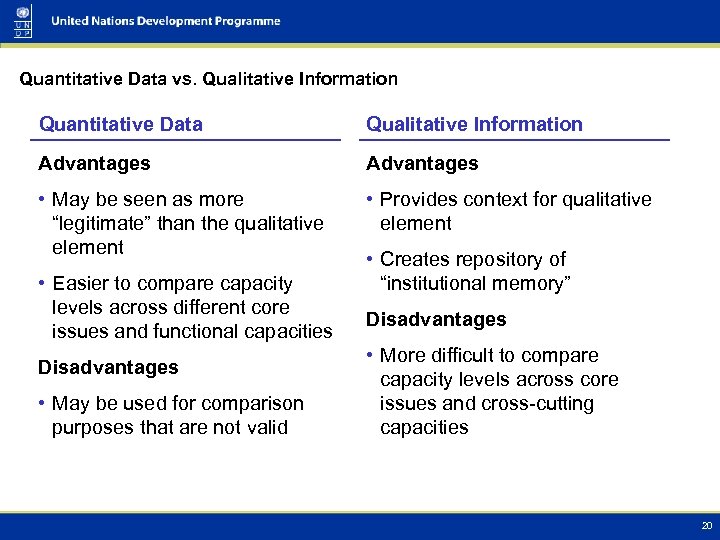 Quantitative Data vs. Qualitative Information Quantitative Data Qualitative Information Advantages • May be seen as more “legitimate” than the qualitative element • Provides context for qualitative element • Easier to compare capacity levels across different core issues and functional capacities Disadvantages • May be used for comparison purposes that are not valid • Creates repository of “institutional memory” Disadvantages • More difficult to compare capacity levels across core issues and cross-cutting capacities 20
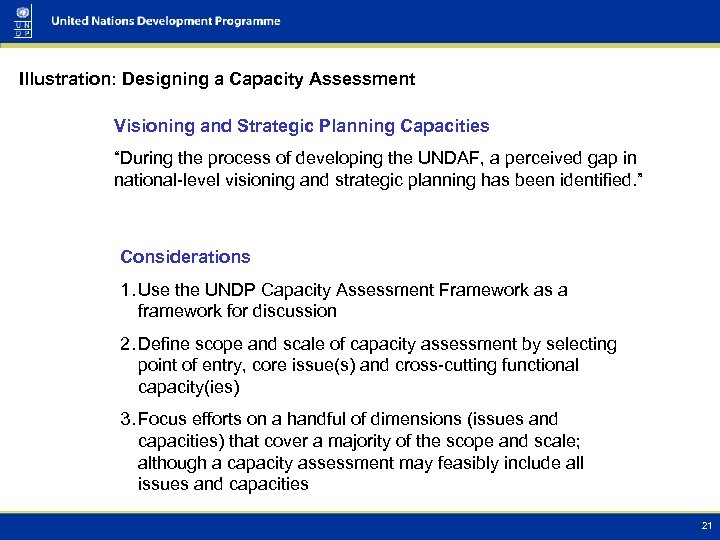 Illustration: Designing a Capacity Assessment Visioning and Strategic Planning Capacities “During the process of developing the UNDAF, a perceived gap in national-level visioning and strategic planning has been identified. ” Considerations 1. Use the UNDP Capacity Assessment Framework as a framework for discussion 2. Define scope and scale of capacity assessment by selecting point of entry, core issue(s) and cross-cutting functional capacity(ies) 3. Focus efforts on a handful of dimensions (issues and capacities) that cover a majority of the scope and scale; although a capacity assessment may feasibly include all issues and capacities 21
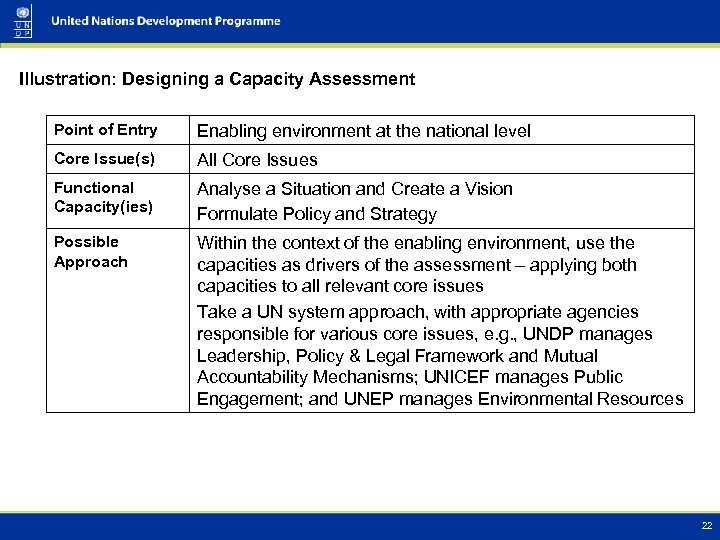 Illustration: Designing a Capacity Assessment Point of Entry Enabling environment at the national level Core Issue(s) All Core Issues Functional Capacity(ies) Analyse a Situation and Create a Vision Formulate Policy and Strategy Possible Approach Within the context of the enabling environment, use the capacities as drivers of the assessment – applying both capacities to all relevant core issues Take a UN system approach, with appropriate agencies responsible for various core issues, e. g. , UNDP manages Leadership, Policy & Legal Framework and Mutual Accountability Mechanisms; UNICEF manages Public Engagement; and UNEP manages Environmental Resources 22
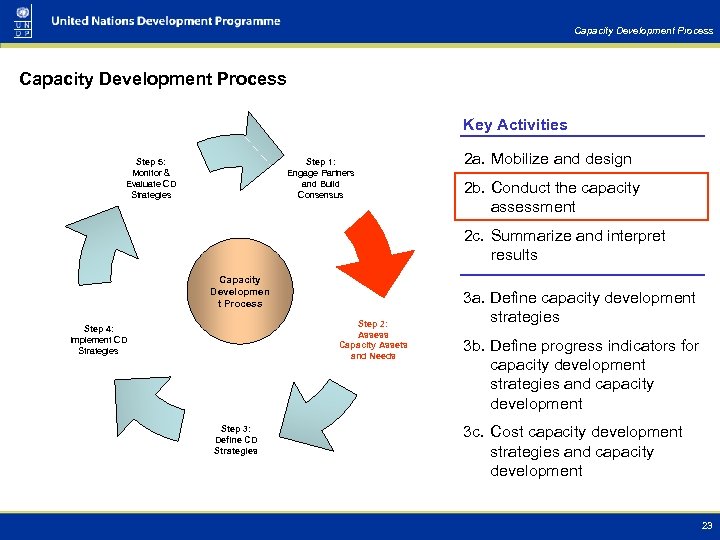 Capacity Development Process Key Activities Step 1: Engage Partners and Build Consensus Step 5: Monitor & Evaluate CD Strategies 2 a. Mobilize and design 2 b. Conduct the capacity assessment 2 c. Summarize and interpret results Capacity Developmen t Process Step 2: Assess Capacity Assets and Needs Step 4: Implement CD Strategies Step 3: Define CD Strategies 3 a. Define capacity development strategies 3 b. Define progress indicators for capacity development strategies and capacity development 3 c. Cost capacity development strategies and capacity development 23
 2 b. Conduct the Capacity Assessment Viable capacity development strategies nurture and reinforce existing capacities. The capacity assessment uses existing capacities as the starting point, and throughout the process, identifies capacity needs against pre-determined desired capacities. • Define desired future capacities – by articulating key questions • Define capacity levels • Assess existing capacity levels 24
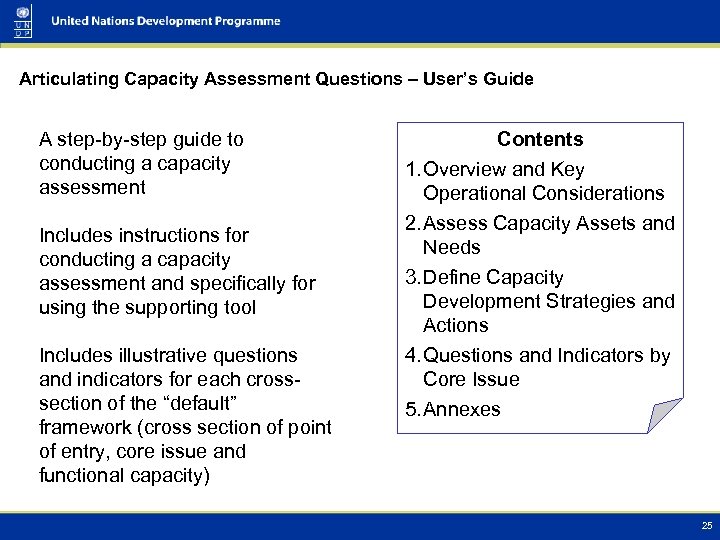 Articulating Capacity Assessment Questions – User’s Guide A step-by-step guide to conducting a capacity assessment Includes instructions for conducting a capacity assessment and specifically for using the supporting tool Includes illustrative questions and indicators for each crosssection of the “default” framework (cross section of point of entry, core issue and functional capacity) Contents 1. Overview and Key Operational Considerations 2. Assess Capacity Assets and Needs 3. Define Capacity Development Strategies and Actions 4. Questions and Indicators by Core Issue 5. Annexes 25
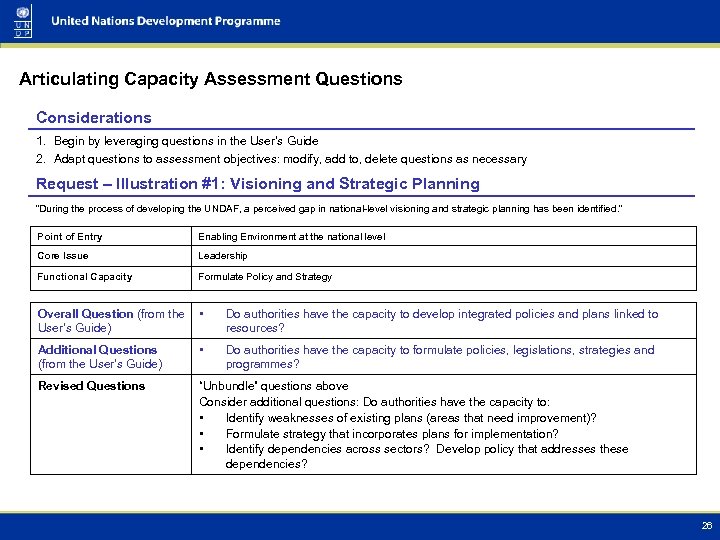 Articulating Capacity Assessment Questions Considerations 1. Begin by leveraging questions in the User’s Guide 2. Adapt questions to assessment objectives: modify, add to, delete questions as necessary Request – Illustration #1: Visioning and Strategic Planning “During the process of developing the UNDAF, a perceived gap in national-level visioning and strategic planning has been identified. ” Point of Entry Enabling Environment at the national level Core Issue Leadership Functional Capacity Formulate Policy and Strategy Overall Question (from the User’s Guide) • Do authorities have the capacity to develop integrated policies and plans linked to resources? Additional Questions (from the User’s Guide) • Do authorities have the capacity to formulate policies, legislations, strategies and programmes? Revised Questions “Unbundle” questions above Consider additional questions: Do authorities have the capacity to: • Identify weaknesses of existing plans (areas that need improvement)? • Formulate strategy that incorporates plans for implementation? • Identify dependencies across sectors? Develop policy that addresses these dependencies? 26
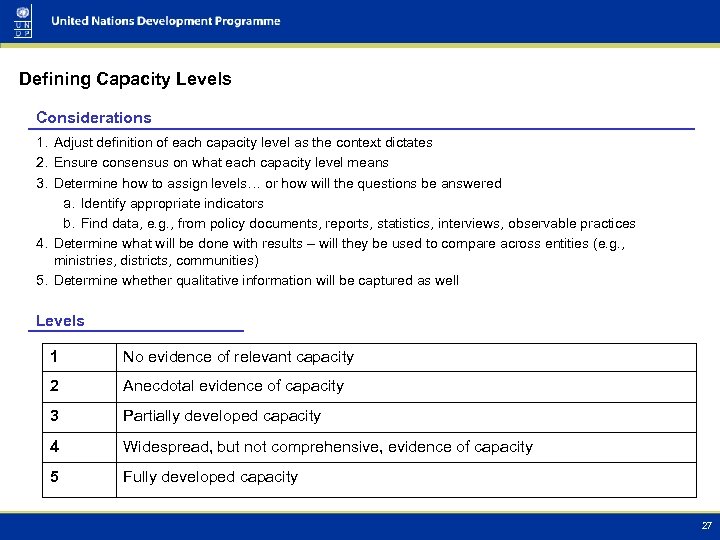 Defining Capacity Levels Considerations 1. Adjust definition of each capacity level as the context dictates 2. Ensure consensus on what each capacity level means 3. Determine how to assign levels… or how will the questions be answered a. Identify appropriate indicators b. Find data, e. g. , from policy documents, reports, statistics, interviews, observable practices 4. Determine what will be done with results – will they be used to compare across entities (e. g. , ministries, districts, communities) 5. Determine whether qualitative information will be captured as well Levels 1 No evidence of relevant capacity 2 Anecdotal evidence of capacity 3 Partially developed capacity 4 Widespread, but not comprehensive, evidence of capacity 5 Fully developed capacity 27
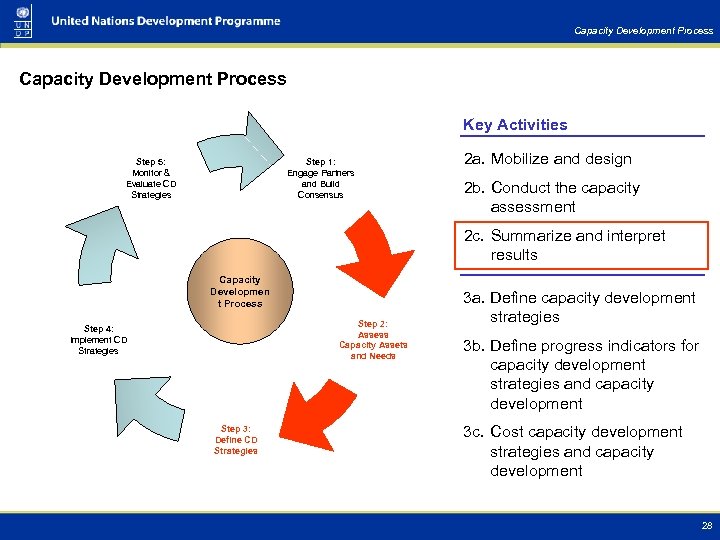 Capacity Development Process Key Activities Step 1: Engage Partners and Build Consensus Step 5: Monitor & Evaluate CD Strategies 2 a. Mobilize and design 2 b. Conduct the capacity assessment 2 c. Summarize and interpret results Capacity Developmen t Process Step 2: Assess Capacity Assets and Needs Step 4: Implement CD Strategies Step 3: Define CD Strategies 3 a. Define capacity development strategies 3 b. Define progress indicators for capacity development strategies and capacity development 3 c. Cost capacity development strategies and capacity development 28
 Capacity Development Process 2 c. Summarize and Interpret Results Once the assessment has been completed for selected crosssections, the assessment team compares the assessment results against the desired level of capacity, as determined during the Mobilize and Design phase. This comparison helps the team determine the level of improvement required, which in turn will provide direction in terms of which areas to focus capacity development strategies • Summarize results • Compare against desired level of capacity and interpret findings 29
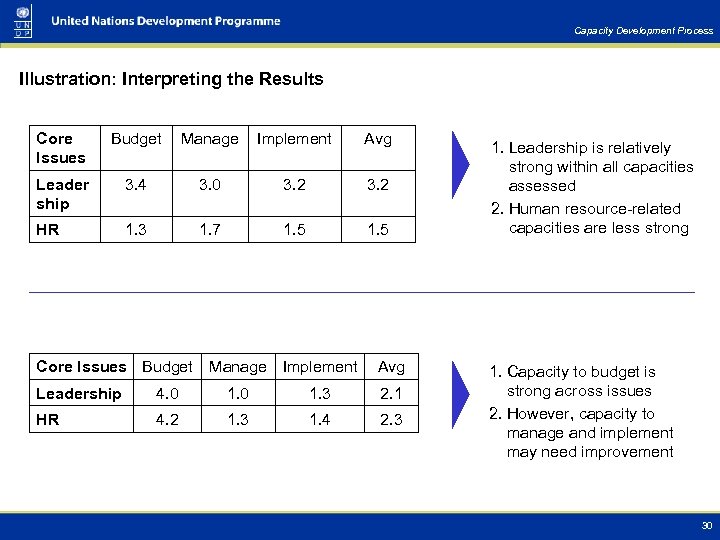 Capacity Development Process Illustration: Interpreting the Results Core Issues Budget Manage Implement Avg Leader ship 3. 4 3. 0 3. 2 HR 1. 3 1. 7 1. 5 Core Issues Budget Manage Implement Avg Leadership 4. 0 1. 3 2. 1 HR 4. 2 1. 3 1. 4 2. 3 1. Leadership is relatively strong within all capacities assessed 2. Human resource-related capacities are less strong 1. Capacity to budget is strong across issues 2. However, capacity to manage and implement may need improvement 30
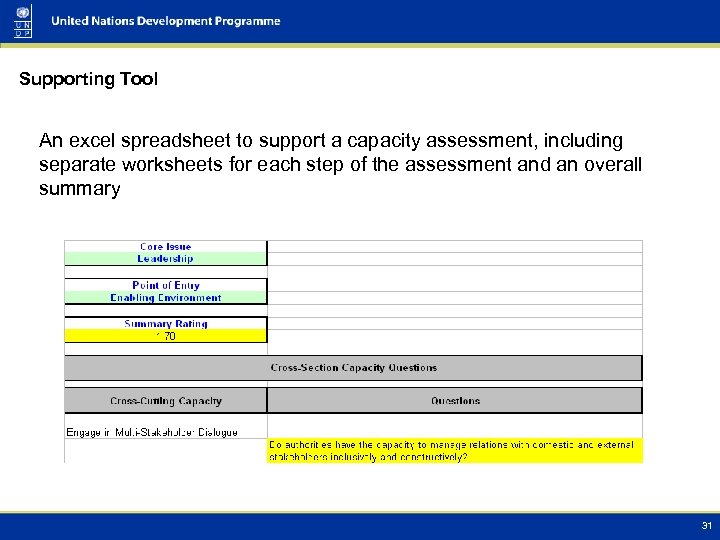 Supporting Tool An excel spreadsheet to support a capacity assessment, including separate worksheets for each step of the assessment and an overall summary 31
 User’s Guide and Supporting Tool – Benefits • Provides instructions for conducting a capacity assessment • Offers a starting point for capacity assessment exercises – Provides overall and detailed questions for each cross-section of the Capacity Assessment Framework – Provides indicators for each cross-section • Provides a tool for data collection and analysis 32
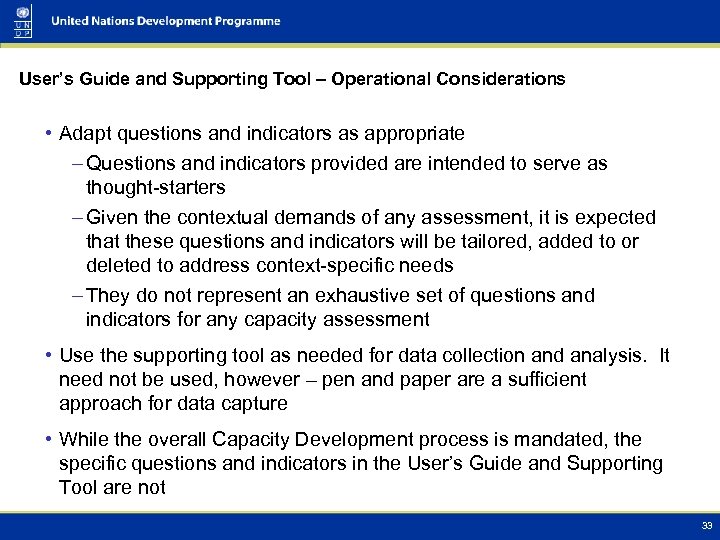 User’s Guide and Supporting Tool – Operational Considerations • Adapt questions and indicators as appropriate – Questions and indicators provided are intended to serve as thought-starters – Given the contextual demands of any assessment, it is expected that these questions and indicators will be tailored, added to or deleted to address context-specific needs – They do not represent an exhaustive set of questions and indicators for any capacity assessment • Use the supporting tool as needed for data collection and analysis. It need not be used, however – pen and paper are a sufficient approach for data capture • While the overall Capacity Development process is mandated, the specific questions and indicators in the User’s Guide and Supporting Tool are not 33
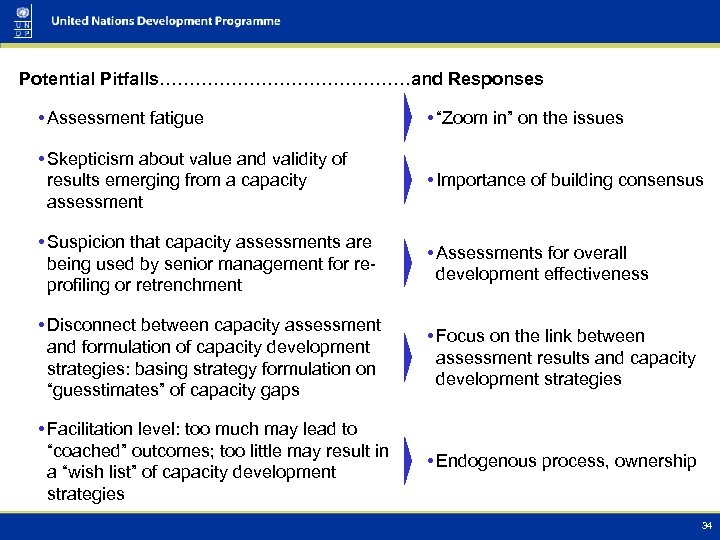 Potential Pitfalls…………………and Responses • Assessment fatigue • “Zoom in” on the issues • Skepticism about value and validity of results emerging from a capacity assessment • Importance of building consensus • Suspicion that capacity assessments are being used by senior management for reprofiling or retrenchment • Assessments for overall development effectiveness • Disconnect between capacity assessment and formulation of capacity development strategies: basing strategy formulation on “guesstimates” of capacity gaps • Focus on the link between assessment results and capacity development strategies • Facilitation level: too much may lead to “coached” outcomes; too little may result in a “wish list” of capacity development strategies • Endogenous process, ownership 34
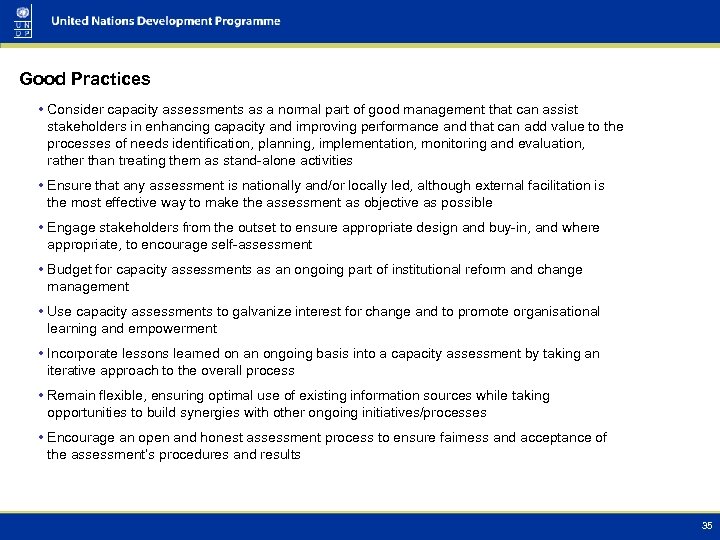 Good Practices • Consider capacity assessments as a normal part of good management that can assist stakeholders in enhancing capacity and improving performance and that can add value to the processes of needs identification, planning, implementation, monitoring and evaluation, rather than treating them as stand-alone activities • Ensure that any assessment is nationally and/or locally led, although external facilitation is the most effective way to make the assessment as objective as possible • Engage stakeholders from the outset to ensure appropriate design and buy-in, and where appropriate, to encourage self-assessment • Budget for capacity assessments as an ongoing part of institutional reform and change management • Use capacity assessments to galvanize interest for change and to promote organisational learning and empowerment • Incorporate lessons learned on an ongoing basis into a capacity assessment by taking an iterative approach to the overall process • Remain flexible, ensuring optimal use of existing information sources while taking opportunities to build synergies with other ongoing initiatives/processes • Encourage an open and honest assessment process to ensure fairness and acceptance of the assessment’s procedures and results 35
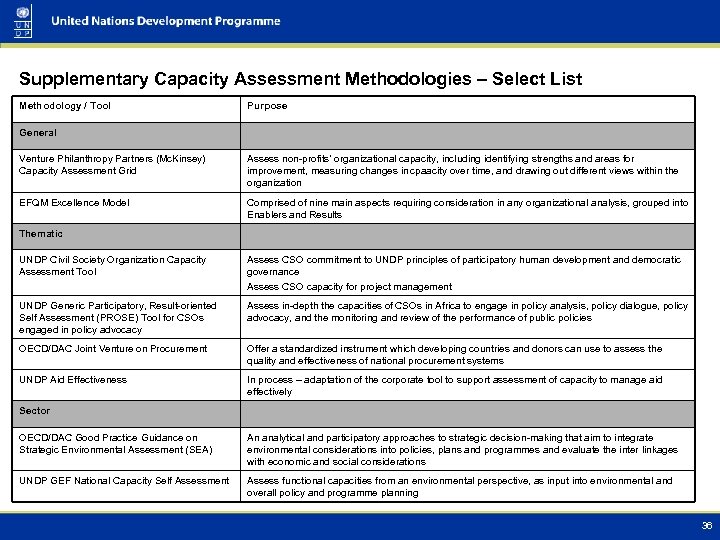 Supplementary Capacity Assessment Methodologies – Select List Methodology / Tool Purpose General Venture Philanthropy Partners (Mc. Kinsey) Capacity Assessment Grid Assess non-profits’ organizational capacity, including identifying strengths and areas for improvement, measuring changes in cpaacity over time, and drawing out different views within the organization EFQM Excellence Model Comprised of nine main aspects requiring consideration in any organizational analysis, grouped into Enablers and Results Thematic UNDP Civil Society Organization Capacity Assessment Tool Assess CSO commitment to UNDP principles of participatory human development and democratic governance Assess CSO capacity for project management UNDP Generic Participatory, Result-oriented Self Assessment (PROSE) Tool for CSOs engaged in policy advocacy Assess in-depth the capacities of CSOs in Africa to engage in policy analysis, policy dialogue, policy advocacy, and the monitoring and review of the performance of public policies OECD/DAC Joint Venture on Procurement Offer a standardized instrument which developing countries and donors can use to assess the quality and effectiveness of national procurement systems UNDP Aid Effectiveness In process – adaptation of the corporate tool to support assessment of capacity to manage aid effectively Sector OECD/DAC Good Practice Guidance on Strategic Environmental Assessment (SEA) An analytical and participatory approaches to strategic decision-making that aim to integrate environmental considerations into policies, plans and programmes and evaluate the inter linkages with economic and social considerations UNDP GEF National Capacity Self Assessment Assess functional capacities from an environmental perspective, as input into environmental and overall policy and programme planning 36
 • Breakout groups 37
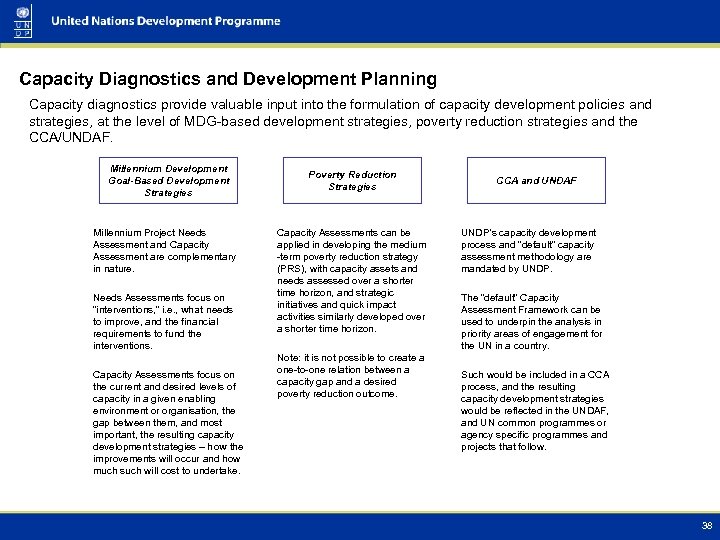 Capacity Diagnostics and Development Planning Capacity diagnostics provide valuable input into the formulation of capacity development policies and strategies, at the level of MDG-based development strategies, poverty reduction strategies and the CCA/UNDAF. Millennium Development Goal-Based Development Strategies Millennium Project Needs Assessment and Capacity Assessment are complementary in nature. Needs Assessments focus on “interventions, ” i. e. , what needs to improve, and the financial requirements to fund the interventions. Capacity Assessments focus on the current and desired levels of capacity in a given enabling environment or organisation, the gap between them, and most important, the resulting capacity development strategies – how the improvements will occur and how much such will cost to undertake. Poverty Reduction Strategies Capacity Assessments can be applied in developing the medium -term poverty reduction strategy (PRS), with capacity assets and needs assessed over a shorter time horizon, and strategic initiatives and quick impact activities similarly developed over a shorter time horizon. Note: it is not possible to create a one-to-one relation between a capacity gap and a desired poverty reduction outcome. CCA and UNDAF UNDP’s capacity development process and “default” capacity assessment methodology are mandated by UNDP. The “default” Capacity Assessment Framework can be used to underpin the analysis in priority areas of engagement for the UN in a country. Such would be included in a CCA process, and the resulting capacity development strategies would be reflected in the UNDAF, and UN common programmes or agency specific programmes and projects that follow. 38
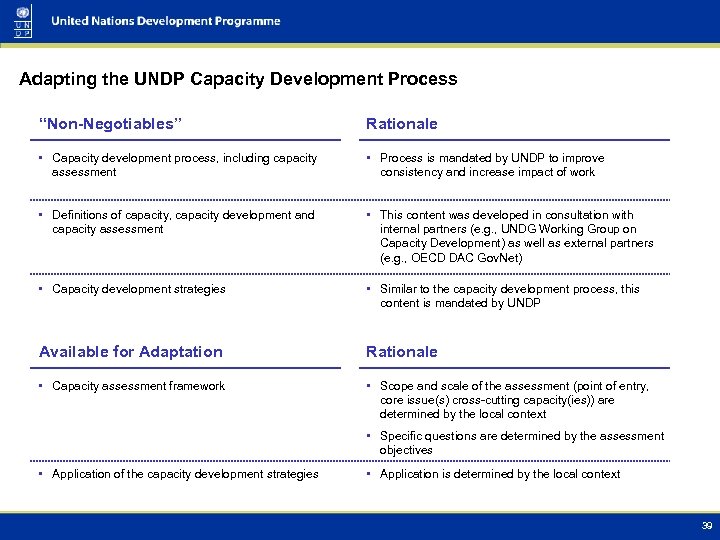 Adapting the UNDP Capacity Development Process “Non-Negotiables” Rationale • Capacity development process, including capacity assessment • Process is mandated by UNDP to improve consistency and increase impact of work • Definitions of capacity, capacity development and capacity assessment • This content was developed in consultation with internal partners (e. g. , UNDG Working Group on Capacity Development) as well as external partners (e. g. , OECD DAC Gov. Net) • Capacity development strategies • Similar to the capacity development process, this content is mandated by UNDP Available for Adaptation Rationale • Capacity assessment framework • Scope and scale of the assessment (point of entry, core issue(s) cross-cutting capacity(ies)) are determined by the local context • Specific questions are determined by the assessment objectives • Application of the capacity development strategies • Application is determined by the local context 39
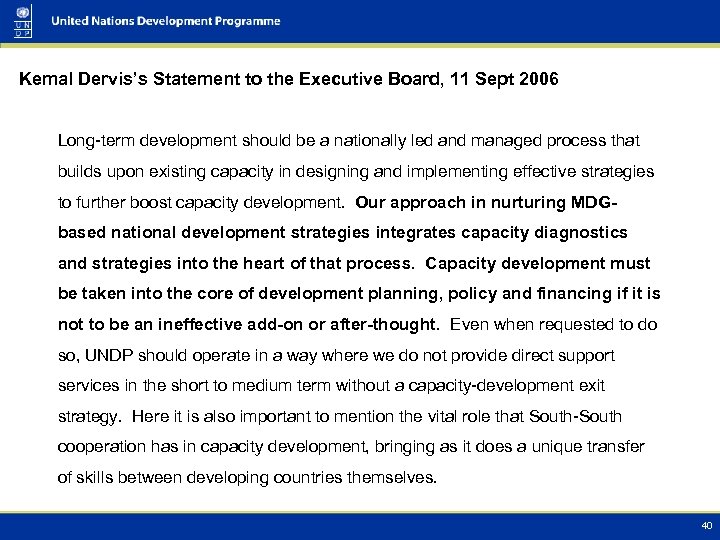 Kemal Dervis’s Statement to the Executive Board, 11 Sept 2006 Long-term development should be a nationally led and managed process that builds upon existing capacity in designing and implementing effective strategies to further boost capacity development. Our approach in nurturing MDGbased national development strategies integrates capacity diagnostics and strategies into the heart of that process. Capacity development must be taken into the core of development planning, policy and financing if it is not to be an ineffective add-on or after-thought. Even when requested to do so, UNDP should operate in a way where we do not provide direct support services in the short to medium term without a capacity-development exit strategy. Here it is also important to mention the vital role that South-South cooperation has in capacity development, bringing as it does a unique transfer of skills between developing countries themselves. 40
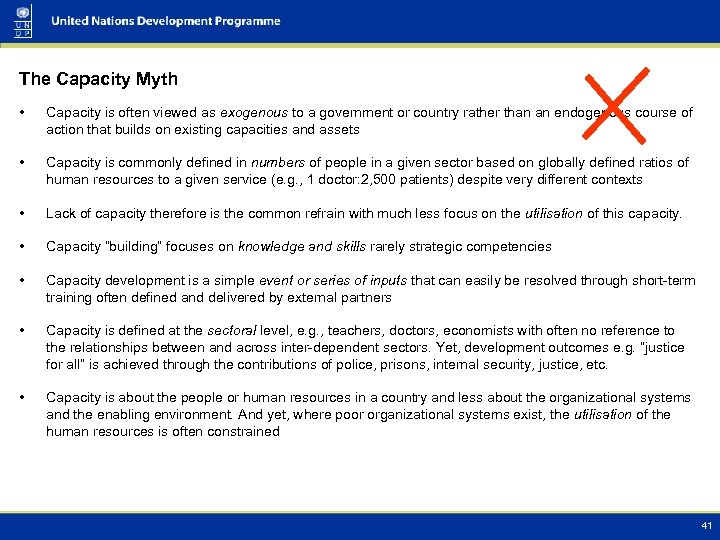 The Capacity Myth • Capacity is often viewed as exogenous to a government or country rather than an endogenous course of action that builds on existing capacities and assets • Capacity is commonly defined in numbers of people in a given sector based on globally defined ratios of human resources to a given service (e. g. , 1 doctor: 2, 500 patients) despite very different contexts • Lack of capacity therefore is the common refrain with much less focus on the utilisation of this capacity. • Capacity “building” focuses on knowledge and skills rarely strategic competencies • Capacity development is a simple event or series of inputs that can easily be resolved through short-term training often defined and delivered by external partners • Capacity is defined at the sectoral level, e. g. , teachers, doctors, economists with often no reference to the relationships between and across inter-dependent sectors. Yet, development outcomes e. g. “justice for all” is achieved through the contributions of police, prisons, internal security, justice, etc. • Capacity is about the people or human resources in a country and less about the organizational systems and the enabling environment. And yet, where poor organizational systems exist, the utilisation of the human resources is often constrained 41
 • Step 3 42
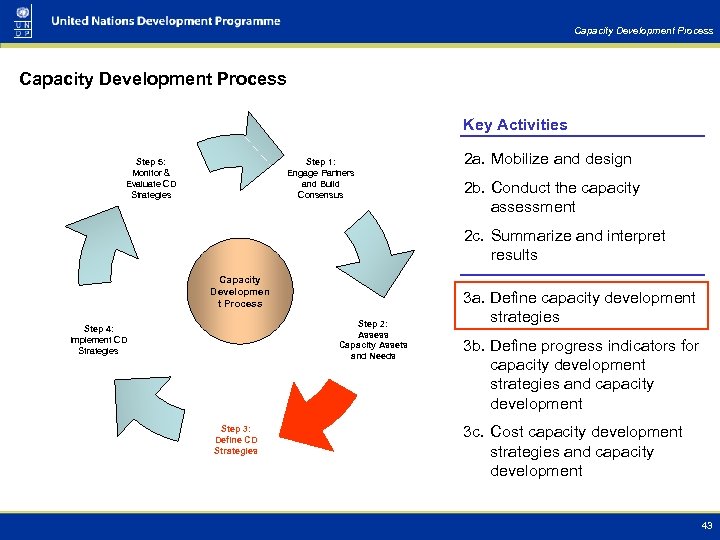 Capacity Development Process Key Activities Step 1: Engage Partners and Build Consensus Step 5: Monitor & Evaluate CD Strategies 2 a. Mobilize and design 2 b. Conduct the capacity assessment 2 c. Summarize and interpret results Capacity Developmen t Process Step 2: Assess Capacity Assets and Needs Step 4: Implement CD Strategies Step 3: Define CD Strategies 3 a. Define capacity development strategies 3 b. Define progress indicators for capacity development strategies and capacity development 3 c. Cost capacity development strategies and capacity development 43
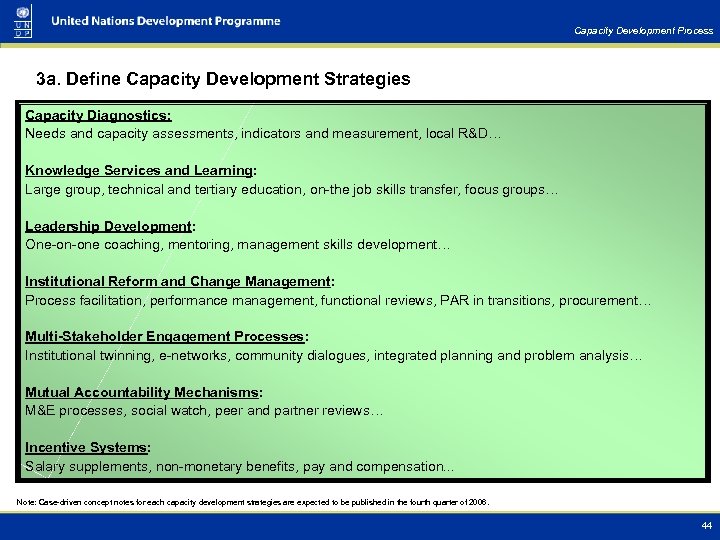 Capacity Development Process 3 a. Define Capacity Development Strategies Capacity Diagnostics: Needs and capacity assessments, indicators and measurement, local R&D… Knowledge Services and Learning: Large group, technical and tertiary education, on-the job skills transfer, focus groups… Leadership Development: One-on-one coaching, mentoring, management skills development… Institutional Reform and Change Management: Process facilitation, performance management, functional reviews, PAR in transitions, procurement… Multi-Stakeholder Engagement Processes: Institutional twinning, e-networks, community dialogues, integrated planning and problem analysis… Mutual Accountability Mechanisms: M&E processes, social watch, peer and partner reviews… Incentive Systems: Salary supplements, non-monetary benefits, pay and compensation. . . Note: Case-driven concept notes for each capacity development strategies are expected to be published in the fourth quarter of 2006. 44
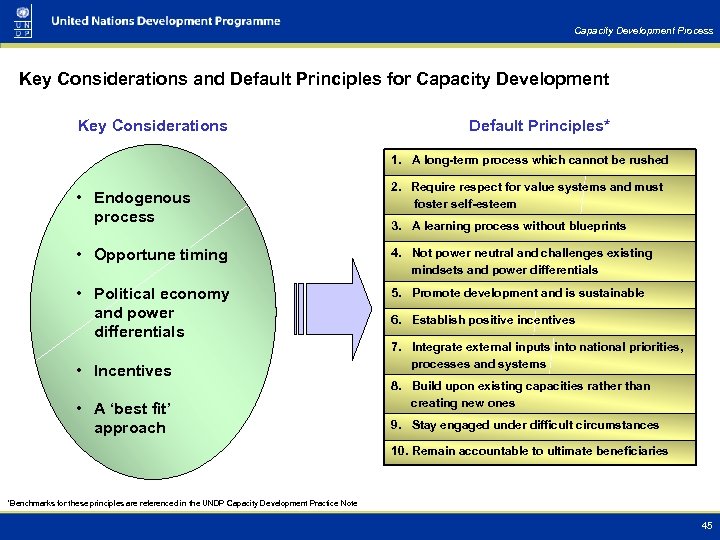 Capacity Development Process Key Considerations and Default Principles for Capacity Development Key Considerations Default Principles* 1. A long-term process which cannot be rushed • Endogenous process 2. Require respect for value systems and must foster self-esteem 3. A learning process without blueprints • Opportune timing 4. Not power neutral and challenges existing mindsets and power differentials • Political economy and power differentials 5. Promote development and is sustainable • Incentives • A ‘best fit’ approach 6. Establish positive incentives 7. Integrate external inputs into national priorities, processes and systems 8. Build upon existing capacities rather than creating new ones 9. Stay engaged under difficult circumstances 10. Remain accountable to ultimate beneficiaries *Benchmarks for these principles are referenced in the UNDP Capacity Development Practice Note 45
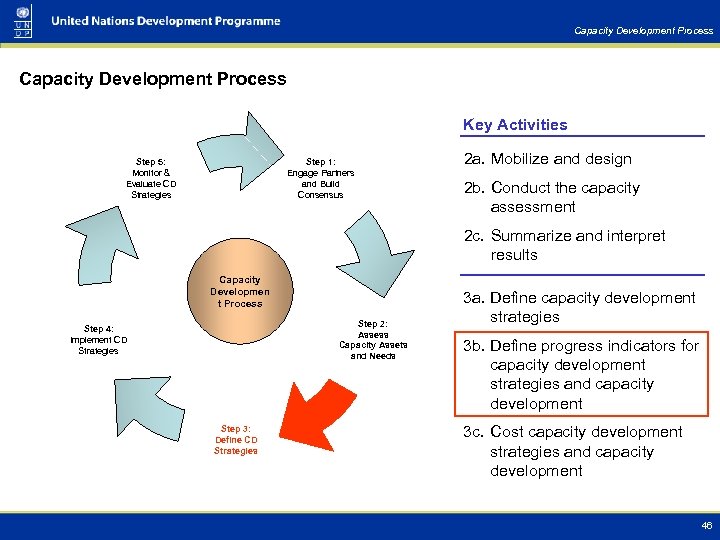 Capacity Development Process Key Activities Step 1: Engage Partners and Build Consensus Step 5: Monitor & Evaluate CD Strategies 2 a. Mobilize and design 2 b. Conduct the capacity assessment 2 c. Summarize and interpret results Capacity Developmen t Process Step 2: Assess Capacity Assets and Needs Step 4: Implement CD Strategies Step 3: Define CD Strategies 3 a. Define capacity development strategies 3 b. Define progress indicators for capacity development strategies and capacity development 3 c. Cost capacity development strategies and capacity development 46
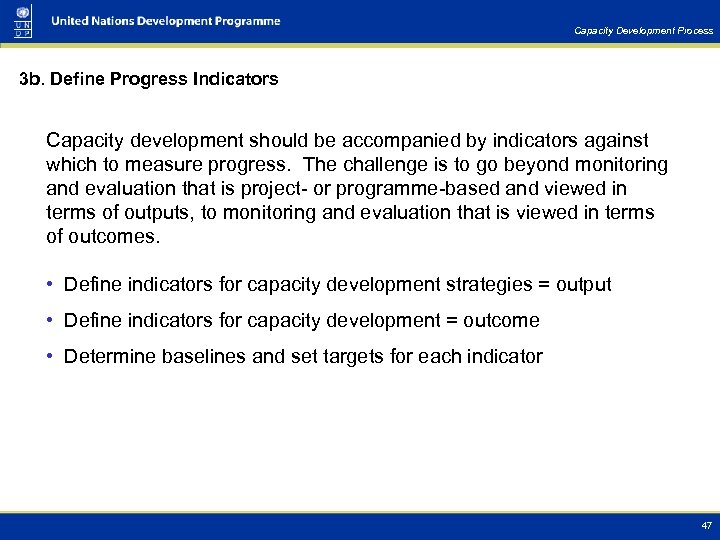 Capacity Development Process 3 b. Define Progress Indicators Capacity development should be accompanied by indicators against which to measure progress. The challenge is to go beyond monitoring and evaluation that is project- or programme-based and viewed in terms of outputs, to monitoring and evaluation that is viewed in terms of outcomes. • Define indicators for capacity development strategies = output • Define indicators for capacity development = outcome • Determine baselines and set targets for each indicator 47
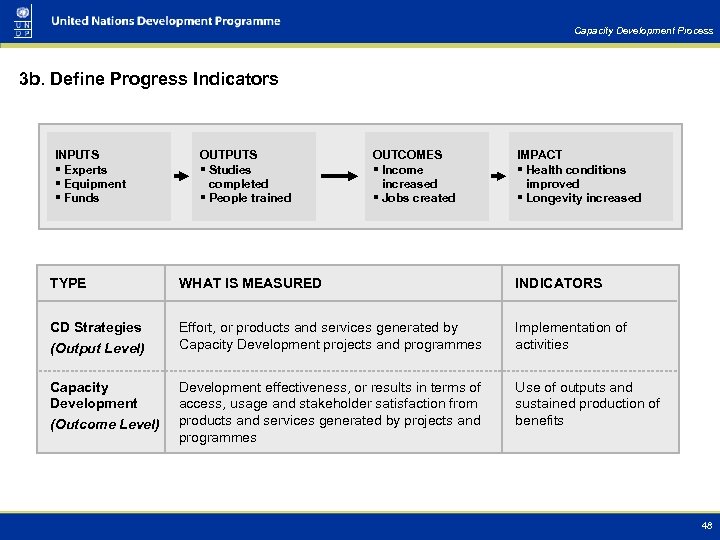 Capacity Development Process 3 b. Define Progress Indicators INPUTS § Experts § Equipment § Funds OUTPUTS § Studies completed § People trained OUTCOMES § Income increased § Jobs created IMPACT § Health conditions improved § Longevity increased TYPE WHAT IS MEASURED INDICATORS CD Strategies Effort, or products and services generated by Capacity Development projects and programmes Implementation of activities Development effectiveness, or results in terms of access, usage and stakeholder satisfaction from products and services generated by projects and programmes Use of outputs and sustained production of benefits (Output Level) Capacity Development (Outcome Level) 48
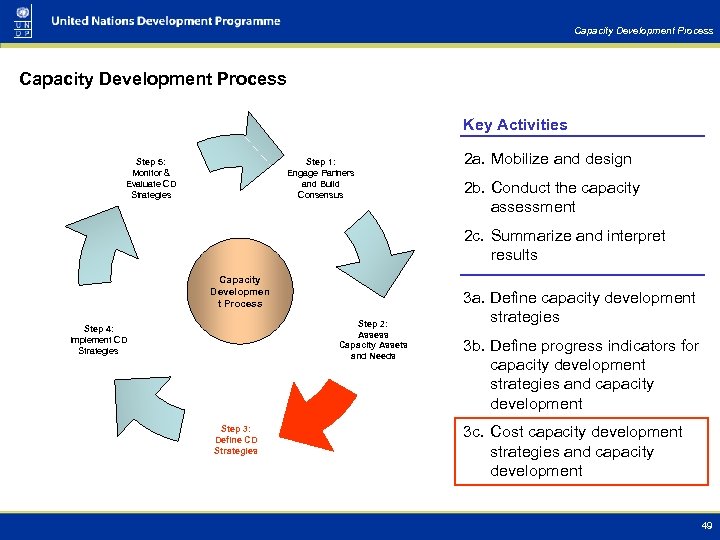 Capacity Development Process Key Activities Step 1: Engage Partners and Build Consensus Step 5: Monitor & Evaluate CD Strategies 2 a. Mobilize and design 2 b. Conduct the capacity assessment 2 c. Summarize and interpret results Capacity Developmen t Process Step 2: Assess Capacity Assets and Needs Step 4: Implement CD Strategies Step 3: Define CD Strategies 3 a. Define capacity development strategies 3 b. Define progress indicators for capacity development strategies and capacity development 3 c. Cost capacity development strategies and capacity development 49
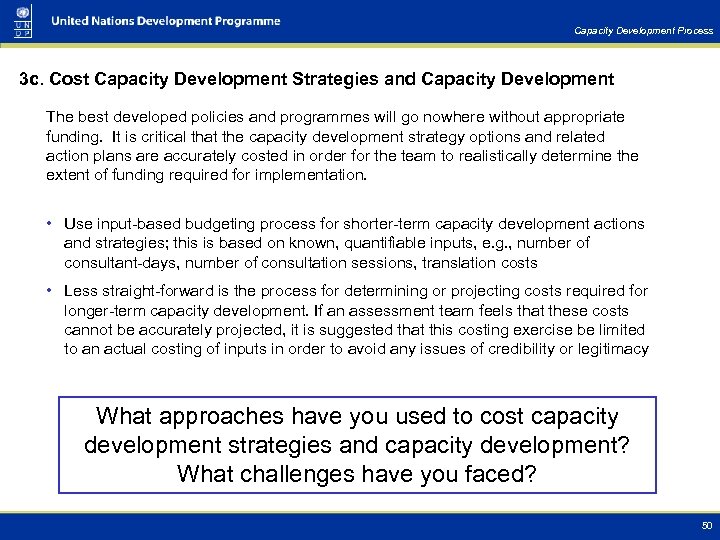 Capacity Development Process 3 c. Cost Capacity Development Strategies and Capacity Development The best developed policies and programmes will go nowhere without appropriate funding. It is critical that the capacity development strategy options and related action plans are accurately costed in order for the team to realistically determine the extent of funding required for implementation. • Use input-based budgeting process for shorter-term capacity development actions and strategies; this is based on known, quantifiable inputs, e. g. , number of consultant-days, number of consultation sessions, translation costs • Less straight-forward is the process for determining or projecting costs required for longer-term capacity development. If an assessment team feels that these costs cannot be accurately projected, it is suggested that this costing exercise be limited to an actual costing of inputs in order to avoid any issues of credibility or legitimacy What approaches have you used to cost capacity development strategies and capacity development? What challenges have you faced? 50
 • CDG Content and Resources 51
 Supporting Content UNDP Capacity Development Resources Theoretical and Case Study Publications • Capacity for Development: New Solutions to Old Problems • Developing Capacity through Technical Cooperation • Ownership, Leadership, and Transformation: Can We Do Better for Capacity Development? • Capacity Development Strategies: Let the Evidence Speak (A Case Book) (forthcoming) Policy and Practice Notes • Practice Note on Capacity Development • Practice Note on Capacity Assessment • Practice Notes on Aid Management, Procurement Capacities, Private Sector Development and PPP (forthcoming) • Practice Note on Localizing the MDGs (forthcoming) 52
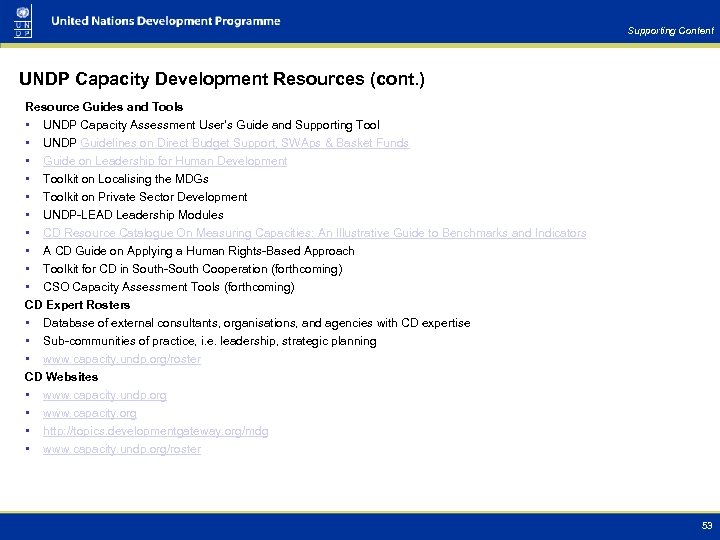 Supporting Content UNDP Capacity Development Resources (cont. ) Resource Guides and Tools • UNDP Capacity Assessment User’s Guide and Supporting Tool • UNDP Guidelines on Direct Budget Support, SWAps & Basket Funds • Guide on Leadership for Human Development • Toolkit on Localising the MDGs • Toolkit on Private Sector Development • UNDP-LEAD Leadership Modules • CD Resource Catalogue On Measuring Capacities: An Illustrative Guide to Benchmarks and Indicators • A CD Guide on Applying a Human Rights-Based Approach • Toolkit for CD in South-South Cooperation (forthcoming) • CSO Capacity Assessment Tools (forthcoming) CD Expert Rosters • Database of external consultants, organisations, and agencies with CD expertise • Sub-communities of practice, i. e. leadership, strategic planning • www. capacity. undp. org/roster CD Websites • www. capacity. undp. org • www. capacity. org • http: //topics. developmentgateway. org/mdg • www. capacity. undp. org/roster 53
 • Illustrations 54
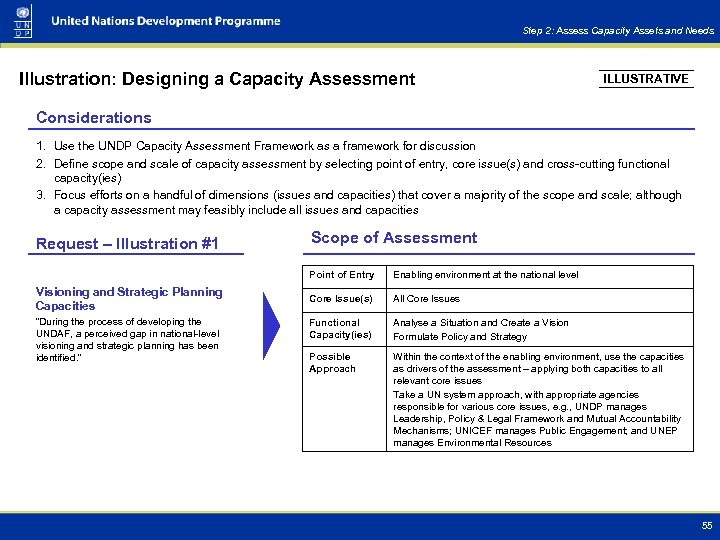 Step 2: Assess Capacity Assets and Needs Illustration: Designing a Capacity Assessment ILLUSTRATIVE Considerations 1. Use the UNDP Capacity Assessment Framework as a framework for discussion 2. Define scope and scale of capacity assessment by selecting point of entry, core issue(s) and cross-cutting functional capacity(ies) 3. Focus efforts on a handful of dimensions (issues and capacities) that cover a majority of the scope and scale; although a capacity assessment may feasibly include all issues and capacities Request – Illustration #1 Scope of Assessment Point of Entry Visioning and Strategic Planning Capacities “During the process of developing the UNDAF, a perceived gap in national-level visioning and strategic planning has been identified. ” Enabling environment at the national level Core Issue(s) All Core Issues Functional Capacity(ies) Analyse a Situation and Create a Vision Formulate Policy and Strategy Possible Approach Within the context of the enabling environment, use the capacities as drivers of the assessment – applying both capacities to all relevant core issues Take a UN system approach, with appropriate agencies responsible for various core issues, e. g. , UNDP manages Leadership, Policy & Legal Framework and Mutual Accountability Mechanisms; UNICEF manages Public Engagement; and UNEP manages Environmental Resources 55
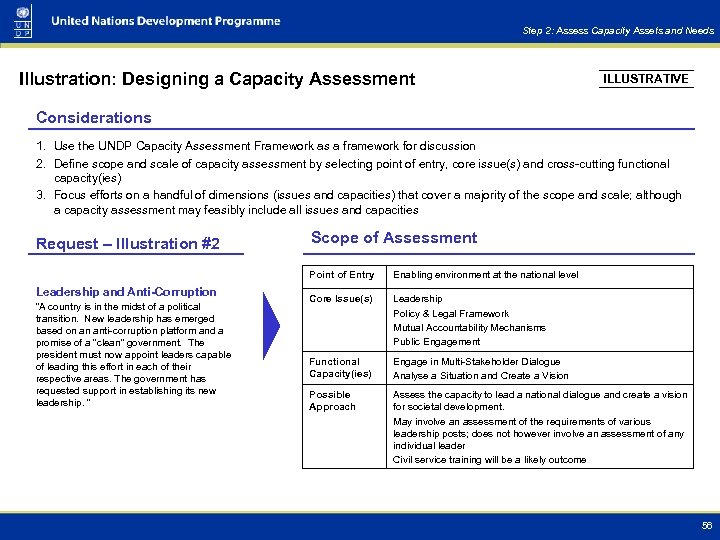 Step 2: Assess Capacity Assets and Needs Illustration: Designing a Capacity Assessment ILLUSTRATIVE Considerations 1. Use the UNDP Capacity Assessment Framework as a framework for discussion 2. Define scope and scale of capacity assessment by selecting point of entry, core issue(s) and cross-cutting functional capacity(ies) 3. Focus efforts on a handful of dimensions (issues and capacities) that cover a majority of the scope and scale; although a capacity assessment may feasibly include all issues and capacities Request – Illustration #2 Scope of Assessment Point of Entry Leadership and Anti-Corruption “A country is in the midst of a political transition. New leadership has emerged based on an anti-corruption platform and a promise of a “clean” government. The president must now appoint leaders capable of leading this effort in each of their respective areas. The government has requested support in establishing its new leadership. ” Enabling environment at the national level Core Issue(s) Leadership Policy & Legal Framework Mutual Accountability Mechanisms Public Engagement Functional Capacity(ies) Engage in Multi-Stakeholder Dialogue Analyse a Situation and Create a Vision Possible Approach Assess the capacity to lead a national dialogue and create a vision for societal development. May involve an assessment of the requirements of various leadership posts; does not however involve an assessment of any individual leader Civil service training will be a likely outcome 56
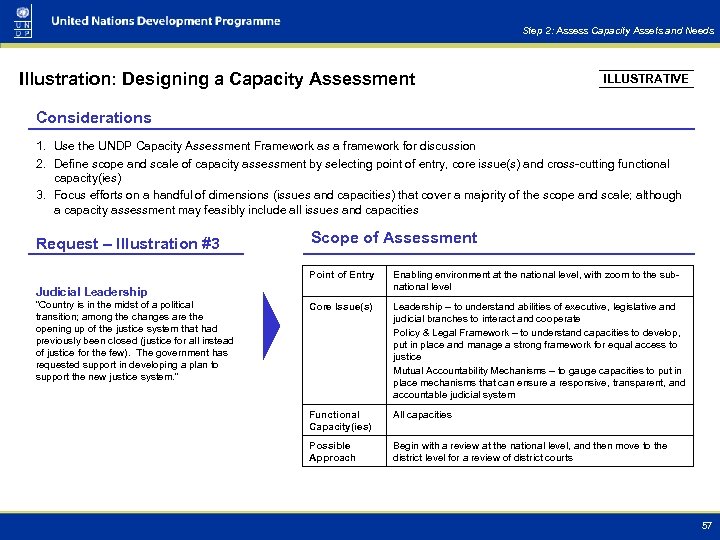 Step 2: Assess Capacity Assets and Needs Illustration: Designing a Capacity Assessment ILLUSTRATIVE Considerations 1. Use the UNDP Capacity Assessment Framework as a framework for discussion 2. Define scope and scale of capacity assessment by selecting point of entry, core issue(s) and cross-cutting functional capacity(ies) 3. Focus efforts on a handful of dimensions (issues and capacities) that cover a majority of the scope and scale; although a capacity assessment may feasibly include all issues and capacities Request – Illustration #3 Scope of Assessment Point of Entry Enabling environment at the national level, with zoom to the subnational level Core Issue(s) Leadership – to understand abilities of executive, legislative and judicial branches to interact and cooperate Policy & Legal Framework – to understand capacities to develop, put in place and manage a strong framework for equal access to justice Mutual Accountability Mechanisms – to gauge capacities to put in place mechanisms that can ensure a responsive, transparent, and accountable judicial system Functional Capacity(ies) All capacities Possible Approach Begin with a review at the national level, and then move to the district level for a review of district courts Judicial Leadership “Country is in the midst of a political transition; among the changes are the opening up of the justice system that had previously been closed (justice for all instead of justice for the few). The government has requested support in developing a plan to support the new justice system. ” 57
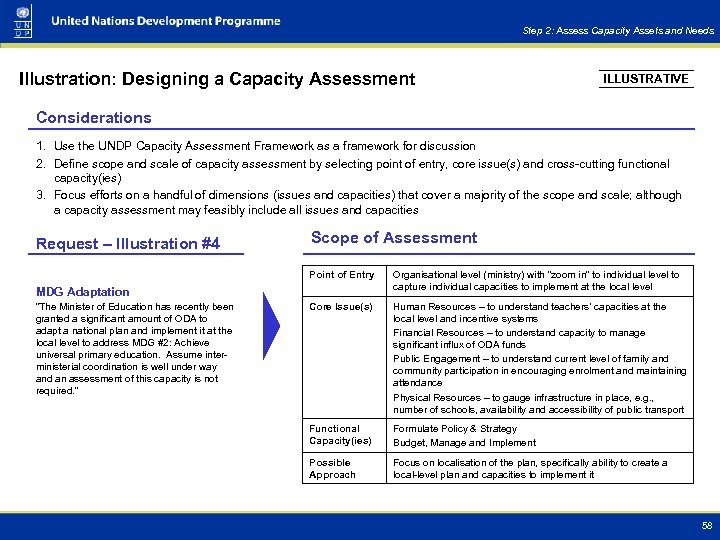 Step 2: Assess Capacity Assets and Needs Illustration: Designing a Capacity Assessment ILLUSTRATIVE Considerations 1. Use the UNDP Capacity Assessment Framework as a framework for discussion 2. Define scope and scale of capacity assessment by selecting point of entry, core issue(s) and cross-cutting functional capacity(ies) 3. Focus efforts on a handful of dimensions (issues and capacities) that cover a majority of the scope and scale; although a capacity assessment may feasibly include all issues and capacities Request – Illustration #4 Scope of Assessment Point of Entry Organisational level (ministry) with “zoom in” to individual level to capture individual capacities to implement at the local level Core Issue(s) Human Resources – to understand teachers’ capacities at the local level and incentive systems Financial Resources – to understand capacity to manage significant influx of ODA funds Public Engagement – to understand current level of family and community participation in encouraging enrolment and maintaining attendance Physical Resources – to gauge infrastructure in place, e. g. , number of schools, availability and accessibility of public transport Functional Capacity(ies) Formulate Policy & Strategy Budget, Manage and Implement Possible Approach Focus on localisation of the plan, specifically ability to create a local-level plan and capacities to implement it MDG Adaptation “The Minister of Education has recently been granted a significant amount of ODA to adapt a national plan and implement it at the local level to address MDG #2: Achieve universal primary education. Assume interministerial coordination is well under way and an assessment of this capacity is not required. ” 58
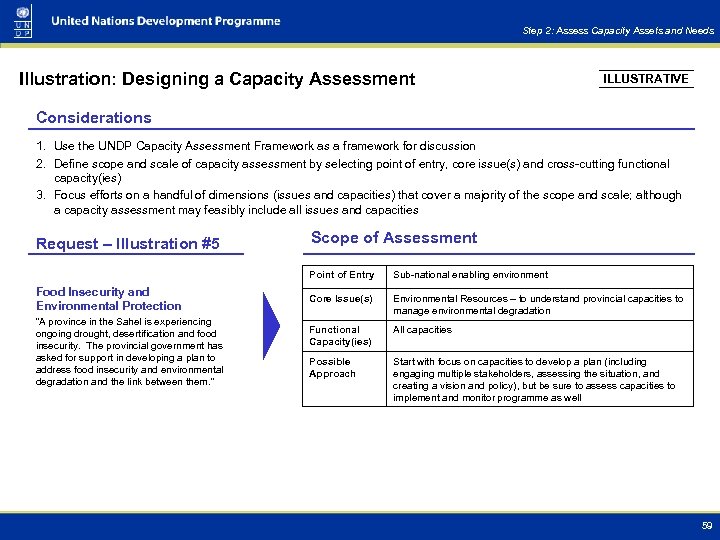 Step 2: Assess Capacity Assets and Needs Illustration: Designing a Capacity Assessment ILLUSTRATIVE Considerations 1. Use the UNDP Capacity Assessment Framework as a framework for discussion 2. Define scope and scale of capacity assessment by selecting point of entry, core issue(s) and cross-cutting functional capacity(ies) 3. Focus efforts on a handful of dimensions (issues and capacities) that cover a majority of the scope and scale; although a capacity assessment may feasibly include all issues and capacities Request – Illustration #5 Scope of Assessment Point of Entry Food Insecurity and Environmental Protection “A province in the Sahel is experiencing ongoing drought, desertification and food insecurity. The provincial government has asked for support in developing a plan to address food insecurity and environmental degradation and the link between them. ” Sub-national enabling environment Core Issue(s) Environmental Resources – to understand provincial capacities to manage environmental degradation Functional Capacity(ies) All capacities Possible Approach Start with focus on capacities to develop a plan (including engaging multiple stakeholders, assessing the situation, and creating a vision and policy), but be sure to assess capacities to implement and monitor programme as well 59
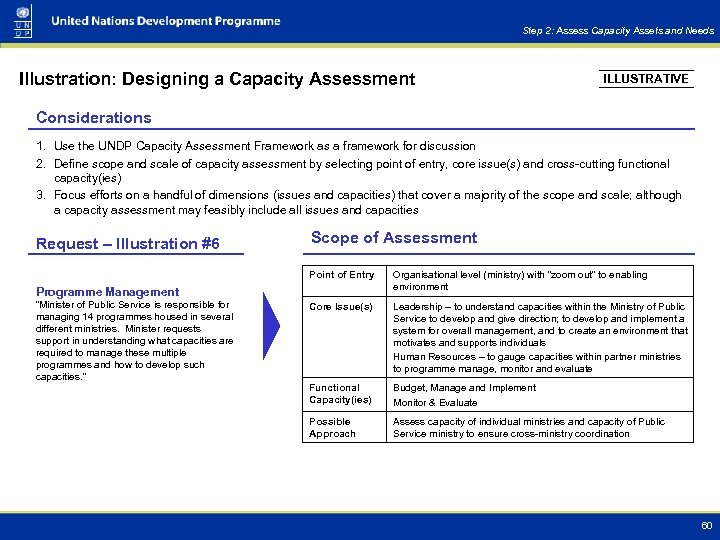 Step 2: Assess Capacity Assets and Needs Illustration: Designing a Capacity Assessment ILLUSTRATIVE Considerations 1. Use the UNDP Capacity Assessment Framework as a framework for discussion 2. Define scope and scale of capacity assessment by selecting point of entry, core issue(s) and cross-cutting functional capacity(ies) 3. Focus efforts on a handful of dimensions (issues and capacities) that cover a majority of the scope and scale; although a capacity assessment may feasibly include all issues and capacities Request – Illustration #6 Scope of Assessment Point of Entry Organisational level (ministry) with “zoom out” to enabling environment Core Issue(s) Leadership – to understand capacities within the Ministry of Public Service to develop and give direction; to develop and implement a system for overall management, and to create an environment that motivates and supports individuals Human Resources – to gauge capacities within partner ministries to programme manage, monitor and evaluate Functional Capacity(ies) Budget, Manage and Implement Monitor & Evaluate Possible Approach Assess capacity of individual ministries and capacity of Public Service ministry to ensure cross-ministry coordination Programme Management “Minister of Public Service is responsible for managing 14 programmes housed in several different ministries. Minister requests support in understanding what capacities are required to manage these multiple programmes and how to develop such capacities. ” 60
 • Supporting Tool Slides 61
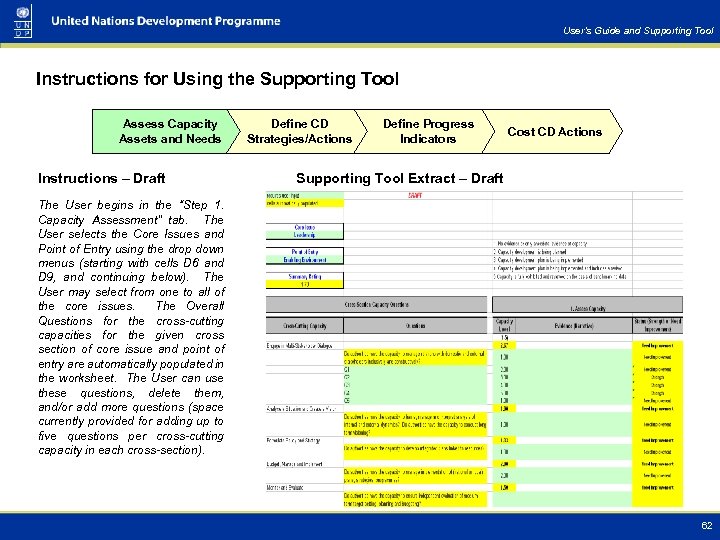 User’s Guide and Supporting Tool Instructions for Using the Supporting Tool Assess Capacity Assets and Needs Instructions – Draft Define CD Strategies/Actions Define Progress Indicators Cost CD Actions Supporting Tool Extract – Draft The User begins in the “Step 1. Capacity Assessment” tab. The User selects the Core Issues and Point of Entry using the drop down menus (starting with cells D 6 and D 9, and continuing below). The User may select from one to all of the core issues. The Overall Questions for the cross-cutting capacities for the given cross section of core issue and point of entry are automatically populated in the worksheet. The User can use these questions, delete them, and/or add more questions (space currently provided for adding up to five questions per cross-cutting capacity in each cross-section). 62
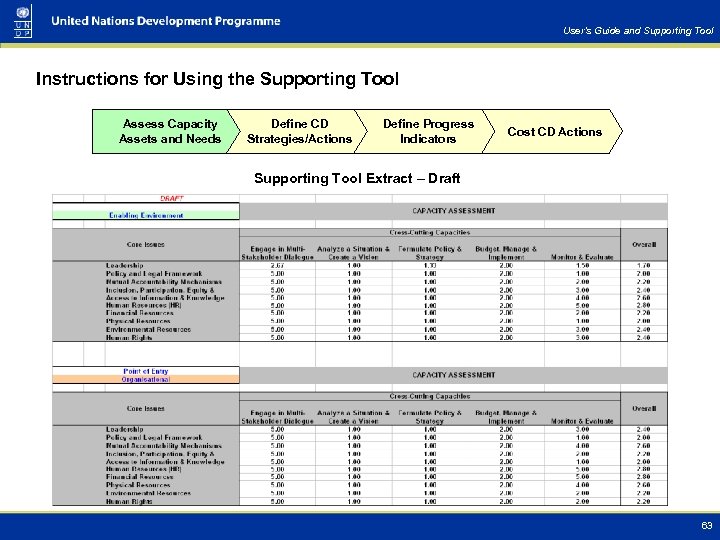 User’s Guide and Supporting Tool Instructions for Using the Supporting Tool Assess Capacity Assets and Needs Define CD Strategies/Actions Define Progress Indicators Cost CD Actions Supporting Tool Extract – Draft 63
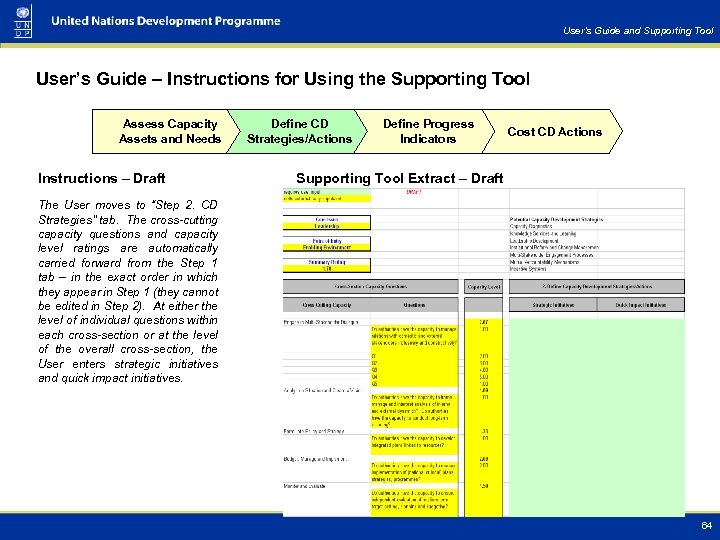 User’s Guide and Supporting Tool User’s Guide – Instructions for Using the Supporting Tool Assess Capacity Assets and Needs Instructions – Draft Define CD Strategies/Actions Define Progress Indicators Cost CD Actions Supporting Tool Extract – Draft The User moves to “Step 2. CD Strategies” tab. The cross-cutting capacity questions and capacity level ratings are automatically carried forward from the Step 1 tab – in the exact order in which they appear in Step 1 (they cannot be edited in Step 2). At either the level of individual questions within each cross-section or at the level of the overall cross-section, the User enters strategic initiatives and quick impact initiatives. 64
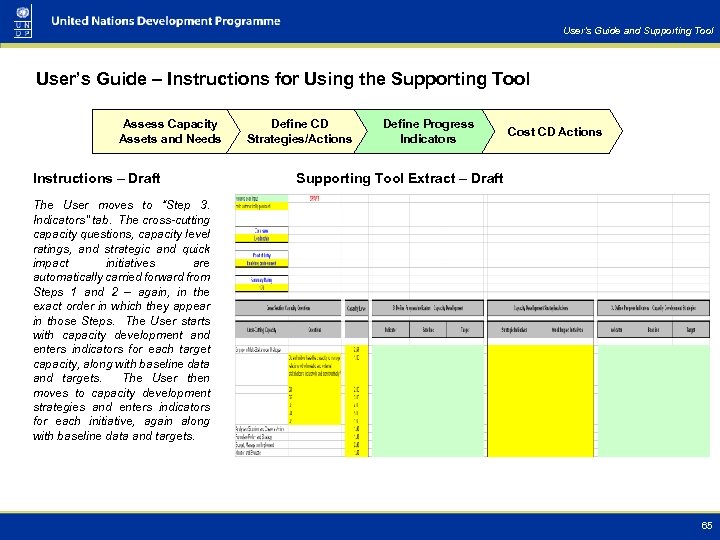 User’s Guide and Supporting Tool User’s Guide – Instructions for Using the Supporting Tool Assess Capacity Assets and Needs Instructions – Draft Define CD Strategies/Actions Define Progress Indicators Cost CD Actions Supporting Tool Extract – Draft The User moves to “Step 3. Indicators” tab. The cross-cutting capacity questions, capacity level ratings, and strategic and quick impact initiatives are automatically carried forward from Steps 1 and 2 – again, in the exact order in which they appear in those Steps. The User starts with capacity development and enters indicators for each target capacity, along with baseline data and targets. The User then moves to capacity development strategies and enters indicators for each initiative, again along with baseline data and targets. 65
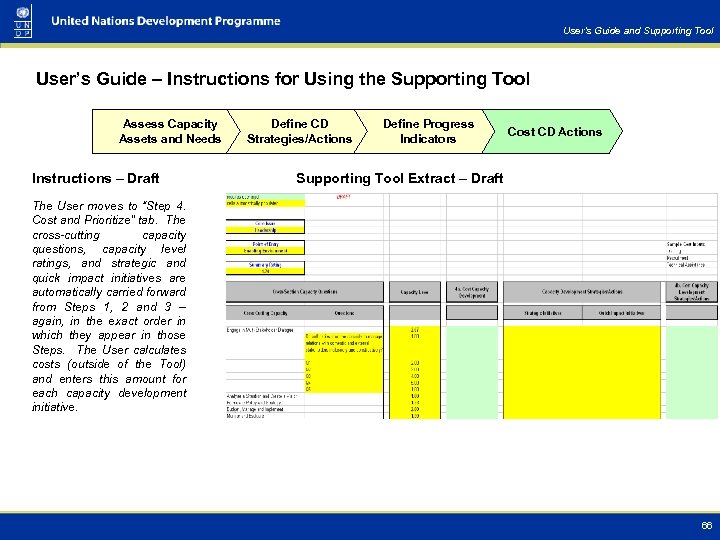 User’s Guide and Supporting Tool User’s Guide – Instructions for Using the Supporting Tool Assess Capacity Assets and Needs Instructions – Draft Define CD Strategies/Actions Define Progress Indicators Cost CD Actions Supporting Tool Extract – Draft The User moves to “Step 4. Cost and Prioritize” tab. The cross-cutting capacity questions, capacity level ratings, and strategic and quick impact initiatives are automatically carried forward from Steps 1, 2 and 3 – again, in the exact order in which they appear in those Steps. The User calculates costs (outside of the Tool) and enters this amount for each capacity development initiative. 66
 • Variations 67
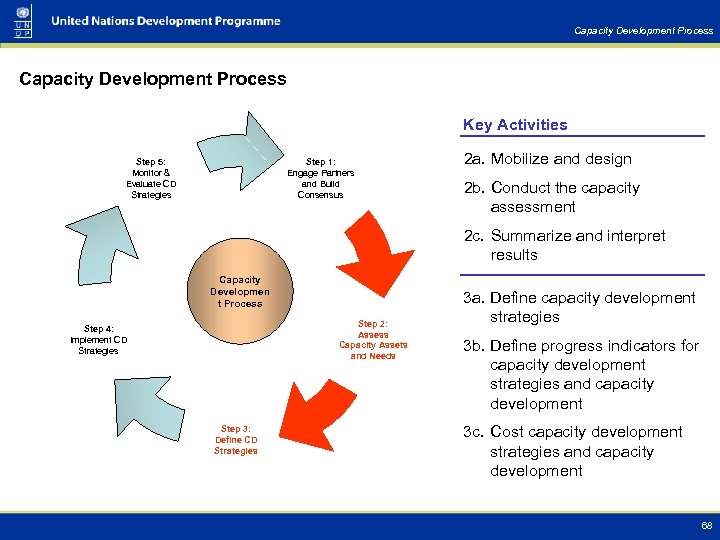 Capacity Development Process Key Activities Step 1: Engage Partners and Build Consensus Step 5: Monitor & Evaluate CD Strategies 2 a. Mobilize and design 2 b. Conduct the capacity assessment 2 c. Summarize and interpret results Capacity Developmen t Process Step 2: Assess Capacity Assets and Needs Step 4: Implement CD Strategies Step 3: Define CD Strategies 3 a. Define capacity development strategies 3 b. Define progress indicators for capacity development strategies and capacity development 3 c. Cost capacity development strategies and capacity development 68
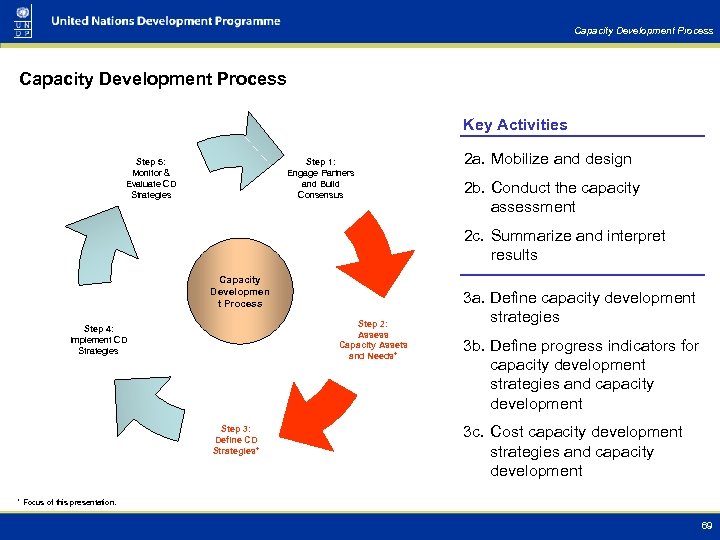 Capacity Development Process Key Activities Step 1: Engage Partners and Build Consensus Step 5: Monitor & Evaluate CD Strategies 2 a. Mobilize and design 2 b. Conduct the capacity assessment 2 c. Summarize and interpret results Capacity Developmen t Process Step 2: Assess Capacity Assets and Needs* Step 4: Implement CD Strategies Step 3: Define CD Strategies* 3 a. Define capacity development strategies 3 b. Define progress indicators for capacity development strategies and capacity development 3 c. Cost capacity development strategies and capacity development * Focus of this presentation. 69
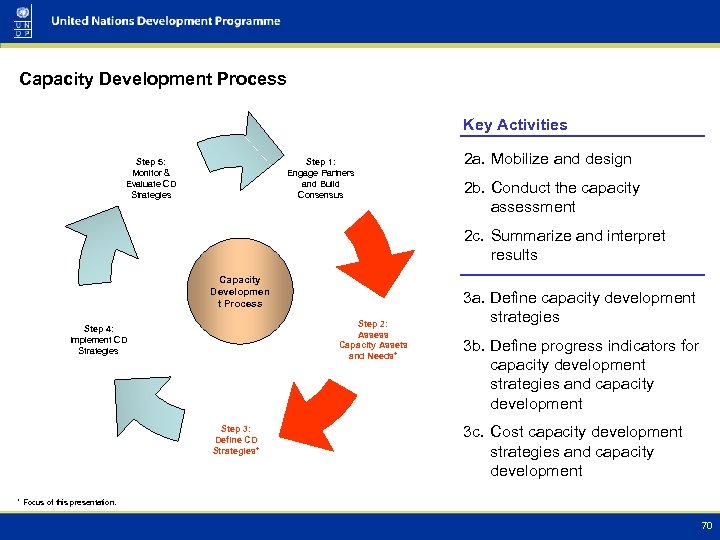 Capacity Development Process Key Activities Step 1: Engage Partners and Build Consensus Step 5: Monitor & Evaluate CD Strategies 2 a. Mobilize and design 2 b. Conduct the capacity assessment 2 c. Summarize and interpret results Capacity Developmen t Process Step 2: Assess Capacity Assets and Needs* Step 4: Implement CD Strategies Step 3: Define CD Strategies* 3 a. Define capacity development strategies 3 b. Define progress indicators for capacity development strategies and capacity development 3 c. Cost capacity development strategies and capacity development * Focus of this presentation. 70
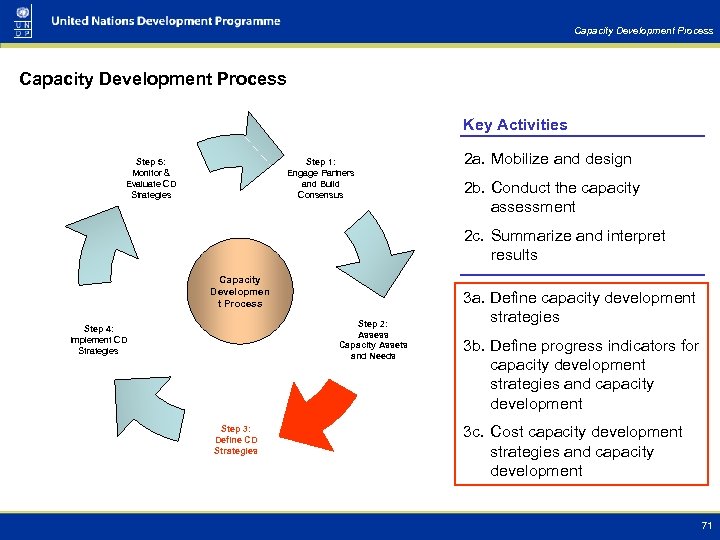 Capacity Development Process Key Activities Step 1: Engage Partners and Build Consensus Step 5: Monitor & Evaluate CD Strategies 2 a. Mobilize and design 2 b. Conduct the capacity assessment 2 c. Summarize and interpret results Capacity Developmen t Process Step 2: Assess Capacity Assets and Needs Step 4: Implement CD Strategies Step 3: Define CD Strategies 3 a. Define capacity development strategies 3 b. Define progress indicators for capacity development strategies and capacity development 3 c. Cost capacity development strategies and capacity development 71
 Addressing Common Pitfalls Potential Pitfalls • Assessment fatigue • Skepticism about value and validity of results emerging from a capacity assessment • Suspicion that capacity assessments are being used by senior management for re-profiling or retrenchment • Disconnect between capacity assessment and formulation of capacity development strategies: basing strategy formulation on “guesstimates” of capacity gaps • Facilitation level: too much may lead to “coached” outcomes; too little may result in a “wish list” of capacity development strategies What are some good practices in addressing each of these issues? 72
 Potential Pitfalls • Assessment fatigue • Skepticism about value and validity of results emerging from a capacity assessment • Suspicion that capacity assessments are being used by senior management for re-profiling or retrenchment • Disconnect between capacity assessment and formulation of capacity development strategies: basing strategy formulation on “guesstimates” of capacity gaps • Facilitation level: too much may lead to “coached” outcomes; too little may result in a “wish list” of capacity development strategies 73
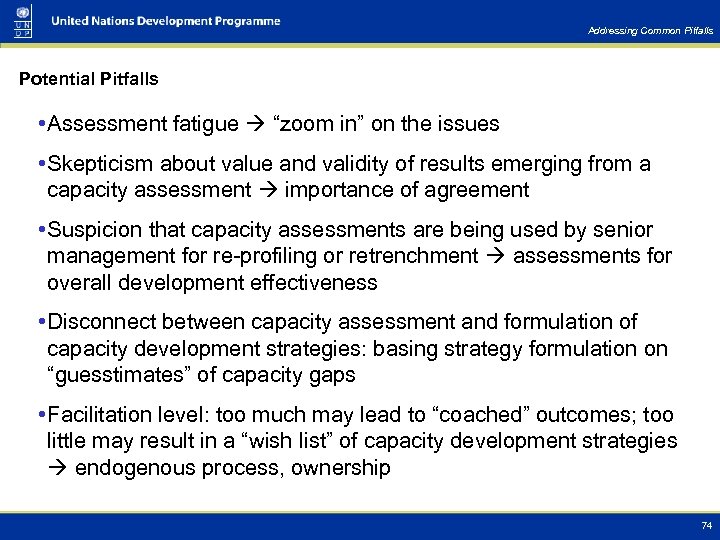 Addressing Common Pitfalls Potential Pitfalls • Assessment fatigue “zoom in” on the issues • Skepticism about value and validity of results emerging from a capacity assessment importance of agreement • Suspicion that capacity assessments are being used by senior management for re-profiling or retrenchment assessments for overall development effectiveness • Disconnect between capacity assessment and formulation of capacity development strategies: basing strategy formulation on “guesstimates” of capacity gaps • Facilitation level: too much may lead to “coached” outcomes; too little may result in a “wish list” of capacity development strategies endogenous process, ownership 74
 • RBA-Specific Slides 75
 Background RBA Adaptation UNDP’s Capacity Development Process and Capacity Diagnostics Methodology draw upon prior UNDP, UN system, and partner organisation capacity development and assessment documents, case studies and reviews, at the level of both the enabling environment and the institution. The methodology materials, consisting of the Practice Notes on Capacity Development and Capacity Assessment, User’s Guide and Supporting Tool, have benefited from a technical review provided by representatives from the Bureau for Development Policy as well as from the Regional Bureaux. Further RBA Consultations • RBA/CDG/SACI working session, including Cap 2015, PPPUE, Governance and HIV Groups (June 2006) • Presentation to Implementation Working Group (July 2006) • Presentation to Millennium Project (July 2006) • RBA/CDG/SACI and Cap 2015 working session (July 2006) All of the input provided has enriched both the process and the product, and we look forward to this being a continuous learning process for all of us. 76
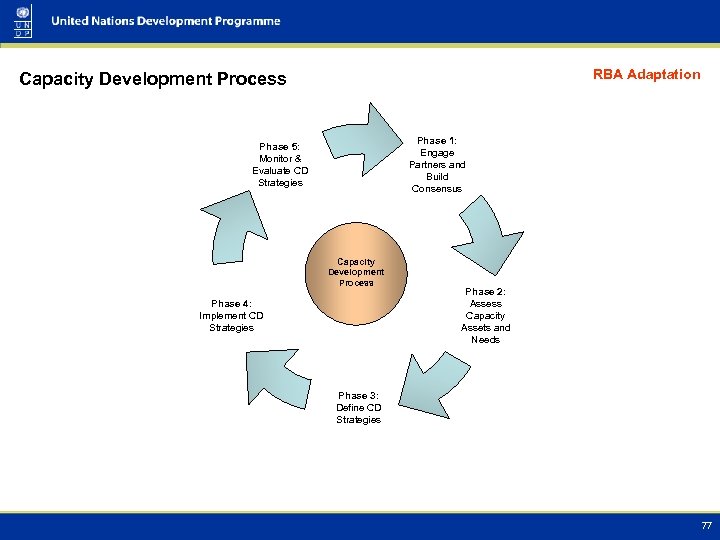 RBA Adaptation Capacity Development Process Phase 1: Engage Partners and Build Consensus Phase 5: Monitor & Evaluate CD Strategies Capacity Development Process Phase 4: Implement CD Strategies Phase 2: Assess Capacity Assets and Needs Phase 3: Define CD Strategies 77
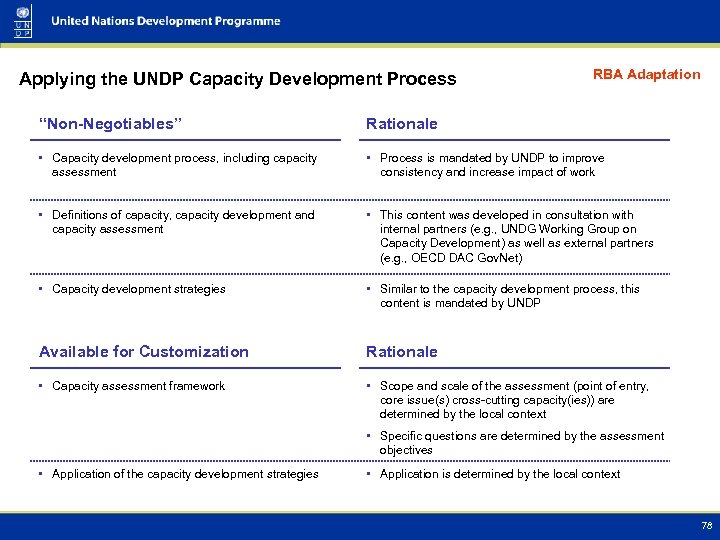 Applying the UNDP Capacity Development Process RBA Adaptation “Non-Negotiables” Rationale • Capacity development process, including capacity assessment • Process is mandated by UNDP to improve consistency and increase impact of work • Definitions of capacity, capacity development and capacity assessment • This content was developed in consultation with internal partners (e. g. , UNDG Working Group on Capacity Development) as well as external partners (e. g. , OECD DAC Gov. Net) • Capacity development strategies • Similar to the capacity development process, this content is mandated by UNDP Available for Customization Rationale • Capacity assessment framework • Scope and scale of the assessment (point of entry, core issue(s) cross-cutting capacity(ies)) are determined by the local context • Specific questions are determined by the assessment objectives • Application of the capacity development strategies • Application is determined by the local context 78
 Day 2 Reflections on Day 1 Capacity Development Process with Illustrative Country Scenarios (cont) Review of Supplementary Capacity Assessment Tools Addressing Common Pitfalls 79
 Capacity Development Process Phase 2 c: Summarize and Interpret Results Phase 3 a: Define Capacity Development Strategies Illustrative Country Scenario 80
 Capacity Development Process Phase 3 b: Define Progress Indicators Illustrative Country Scenario 81