


 Скачать презентацию Application of realtime geomagnetic field data at World
9c99ad7a49e022604f3a6d458926b938.ppt
- Количество слайдов: 42
 Application of realtime geomagnetic field data at World Data Center for Geomagnetism, Kyoto Nosé, M. , T. Iyemori, H. Toh, and M. Takeda 能勢正仁 World Data Center for Geomagnetism, Kyoto Graduate School of Science, Kyoto University 京都大学理学研究科・地磁気世界資料センター 1
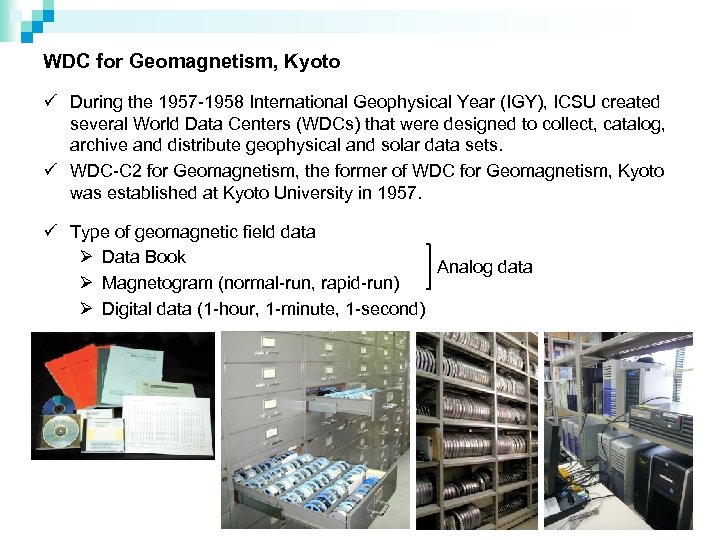 WDC for Geomagnetism, Kyoto ü During the 1957 -1958 International Geophysical Year (IGY), ICSU created several World Data Centers (WDCs) that were designed to collect, catalog, archive and distribute geophysical and solar data sets. ü WDC-C 2 for Geomagnetism, the former of WDC for Geomagnetism, Kyoto was established at Kyoto University in 1957. ü Type of geomagnetic field data Ø Data Book Analog data Ø Magnetogram (normal-run, rapid-run) Ø Digital data (1 -hour, 1 -minute, 1 -second) 2
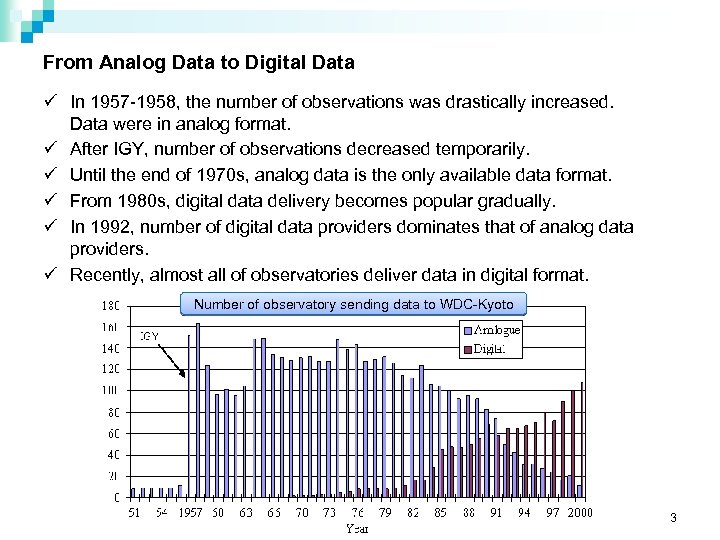 From Analog Data to Digital Data ü In 1957 -1958, the number of observations was drastically increased. Data were in analog format. ü After IGY, number of observations decreased temporarily. ü Until the end of 1970 s, analog data is the only available data format. ü From 1980 s, digital data delivery becomes popular gradually. ü In 1992, number of digital data providers dominates that of analog data providers. ü Recently, almost all of observatories deliver data in digital format. Number of observatory sending data to WDC-Kyoto 3
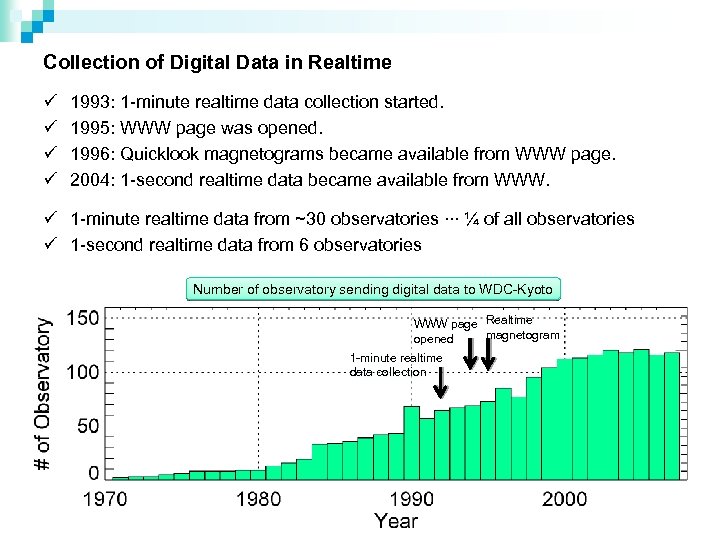 Collection of Digital Data in Realtime ü ü 1993: 1 -minute realtime data collection started. 1995: WWW page was opened. 1996: Quicklook magnetograms became available from WWW page. 2004: 1 -second realtime data became available from WWW. ü 1 -minute realtime data from ~30 observatories ∙∙∙ ¼ of all observatories ü 1 -second realtime data from 6 observatories Number of observatory sending digital data to WDC-Kyoto WWW page Realtime magnetogram opened 1 -minute realtime data collection 4
 Application of Realtime Data in WDC-Kyoto ü Collected realtime data are mainly used in the following 3 products. 1. Display of geomagnetic field variations in realtime (i. e. , Display of realtime magnetograms), 2. Derivation of the realtime Dst and AE indices, and 3. Realtime detection of a specific phenomenon related to substorms. 4. Future perspective of realtime data 5
 (1) Realtime Magnetograms 6
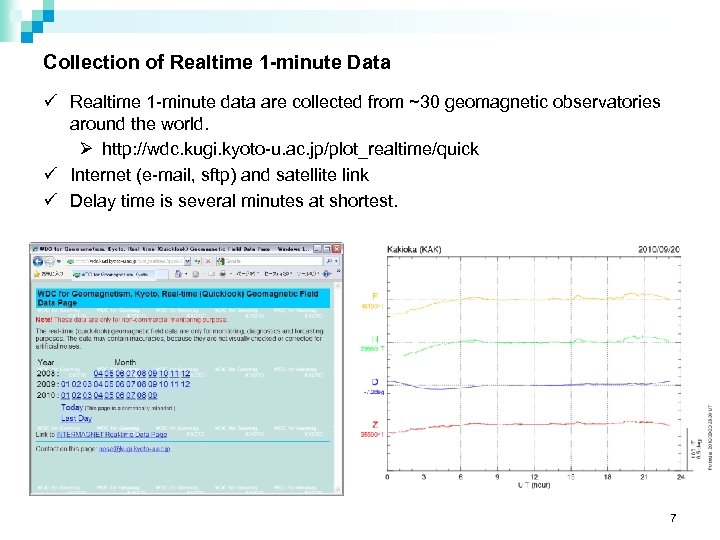 Collection of Realtime 1 -minute Data ü Realtime 1 -minute data are collected from ~30 geomagnetic observatories around the world. Ø http: //wdc. kugi. kyoto-u. ac. jp/plot_realtime/quick ü Internet (e-mail, sftp) and satellite link ü Delay time is several minutes at shortest. 7
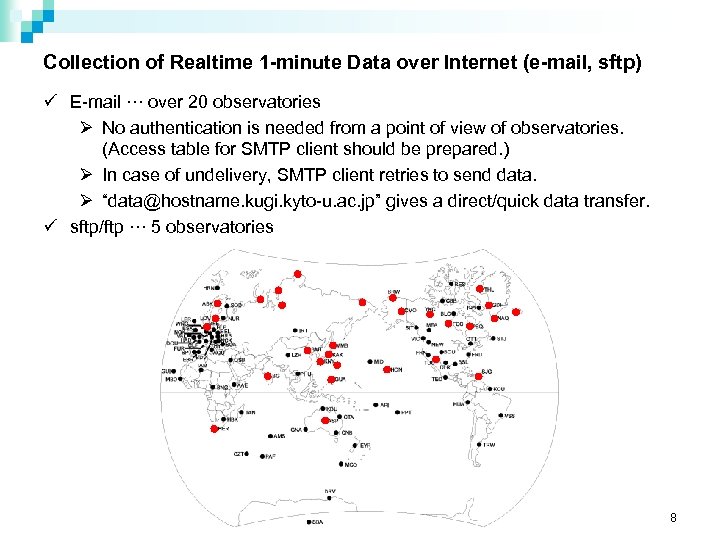 Collection of Realtime 1 -minute Data over Internet (e-mail, sftp) ü E-mail ··∙ over 20 observatories Ø No authentication is needed from a point of view of observatories. (Access table for SMTP client should be prepared. ) Ø In case of undelivery, SMTP client retries to send data. Ø “data@hostname. kugi. kyto-u. ac. jp” gives a direct/quick data transfer. ü sftp/ftp ··∙ 5 observatories 8
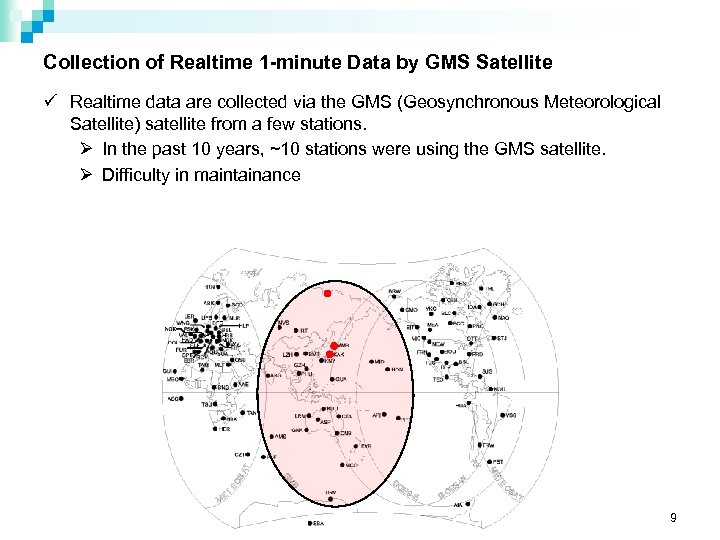 Collection of Realtime 1 -minute Data by GMS Satellite ü Realtime data are collected via the GMS (Geosynchronous Meteorological Satellite) satellite from a few stations. Ø In the past 10 years, ~10 stations were using the GMS satellite. Ø Difficulty in maintainance 9
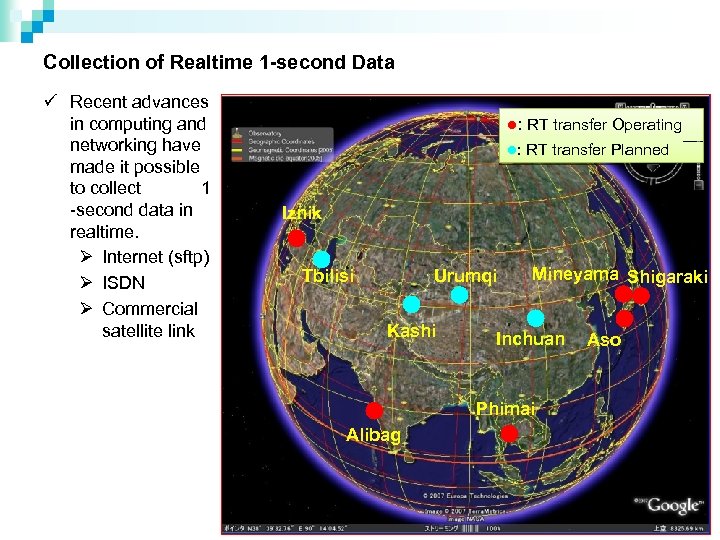 Collection of Realtime 1 -second Data ü Recent advances in computing and networking have made it possible to collect 1 -second data in realtime. Ø Internet (sftp) Ø ISDN Ø Commercial satellite link ●: RT transfer Operating ●: RT transfer Planned Iznik Tbilisi Urumqi Kashi Mineyama Shigaraki Inchuan Aso Phimai Alibag 10
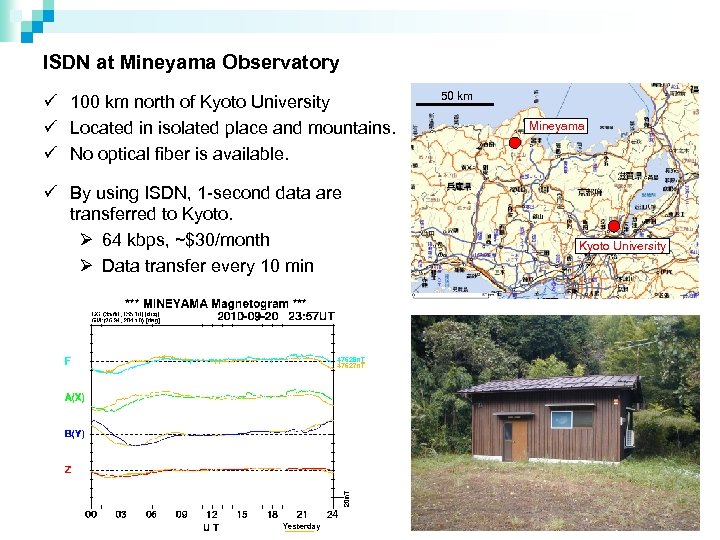 ISDN at Mineyama Observatory ü 100 km north of Kyoto University ü Located in isolated place and mountains. ü No optical fiber is available. ü By using ISDN, 1 -second data are transferred to Kyoto. Ø 64 kbps, ~$30/month Ø Data transfer every 10 min 50 km Mineyama Kyoto University 11
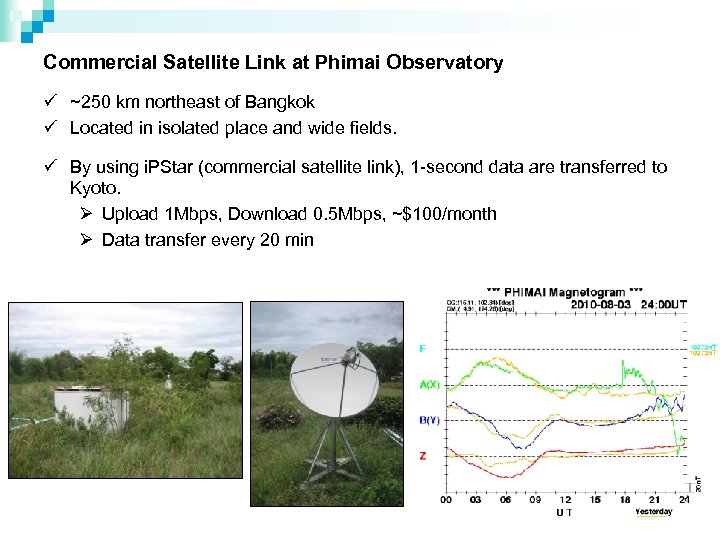 Commercial Satellite Link at Phimai Observatory ü ~250 km northeast of Bangkok ü Located in isolated place and wide fields. ü By using i. PStar (commercial satellite link), 1 -second data are transferred to Kyoto. Ø Upload 1 Mbps, Download 0. 5 Mbps, ~$100/month Ø Data transfer every 20 min 12
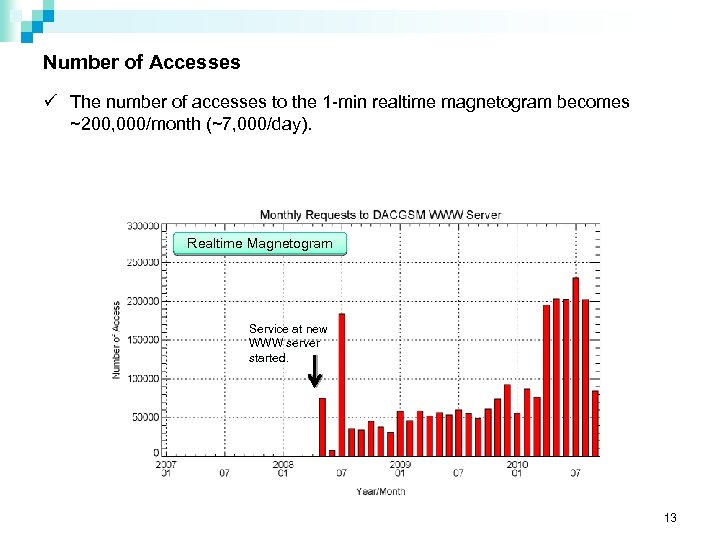 Number of Accesses ü The number of accesses to the 1 -min realtime magnetogram becomes ~200, 000/month (~7, 000/day). Realtime Magnetogram Service at new WWW server started. 13
 (2) Realtime Dst and AE Indices 14
![Derivation of Realtime Dst Index ü Dst index was proposed by Sugiura [1964]. ü](https://present5.com/presentation/9c99ad7a49e022604f3a6d458926b938/image-15.jpg "Derivation of Realtime Dst Index ü Dst index was proposed by Sugiura [1964]. ü") Derivation of Realtime Dst Index ü Dst index was proposed by Sugiura [1964]. ü A measure of the magnitude of the current which produces the symmetric disturbance field. ü Realtime derivation started in 1996. ü KAK Ø Japan Meteorological Agency Ø sftp, ~5 min delay ü HON, SJG Ø US Geological Survey Ø e-mail, ~12 min delay ü HER Ø Hermanus Magnetic Observatory Ø sftp, ~60 min delay 15
Derivation of Realtime Dst Index ü Dst index was proposed by Sugiura [1964]. ü A measure of the magnitude of the current which produces the symmetric disturbance field. ü Realtime derivation started in 1996. ü KAK Ø Japan Meteorological Agency Ø sftp, ~5 min delay ü HON, SJG Ø US Geological Survey Ø e-mail, ~12 min delay ü HER Ø Hermanus Magnetic Observatory Ø sftp, ~60 min delay 15
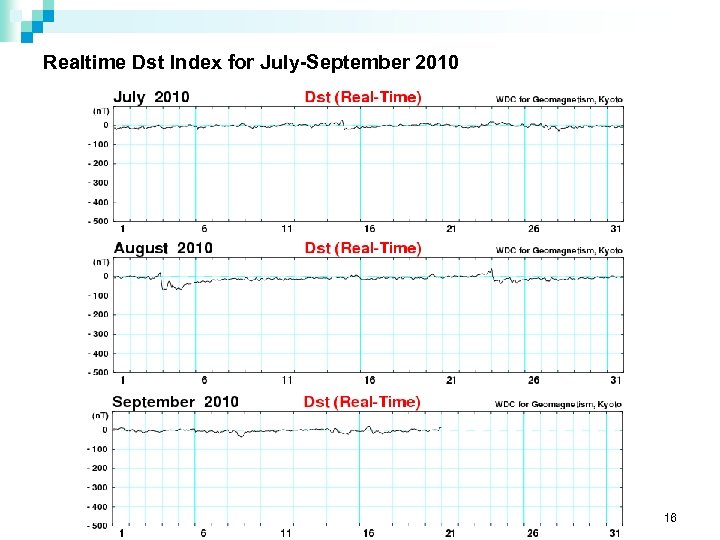 Realtime Dst Index for July-September 2010 16
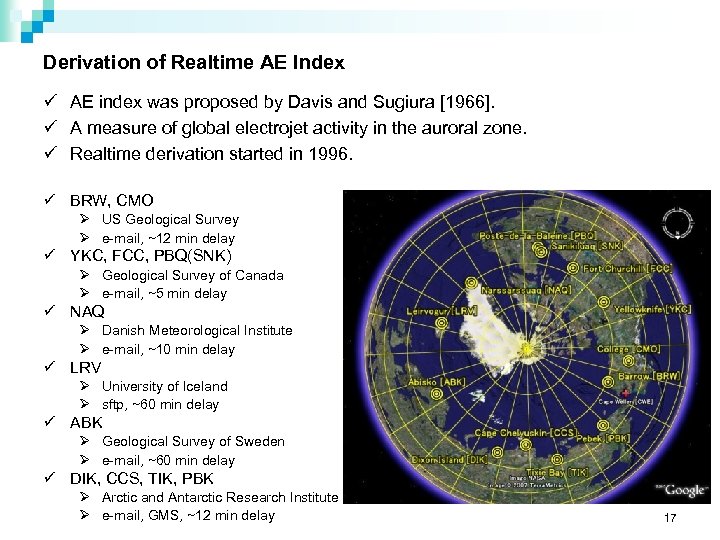 Derivation of Realtime AE Index ü AE index was proposed by Davis and Sugiura [1966]. ü A measure of global electrojet activity in the auroral zone. ü Realtime derivation started in 1996. ü BRW, CMO Ø US Geological Survey Ø e-mail, ~12 min delay ü YKC, FCC, PBQ(SNK) Ø Geological Survey of Canada Ø e-mail, ~5 min delay ü NAQ Ø Danish Meteorological Institute Ø e-mail, ~10 min delay ü LRV Ø University of Iceland Ø sftp, ~60 min delay ü ABK Ø Geological Survey of Sweden Ø e-mail, ~60 min delay ü DIK, CCS, TIK, PBK Ø Arctic and Antarctic Research Institute Ø e-mail, GMS, ~12 min delay 17
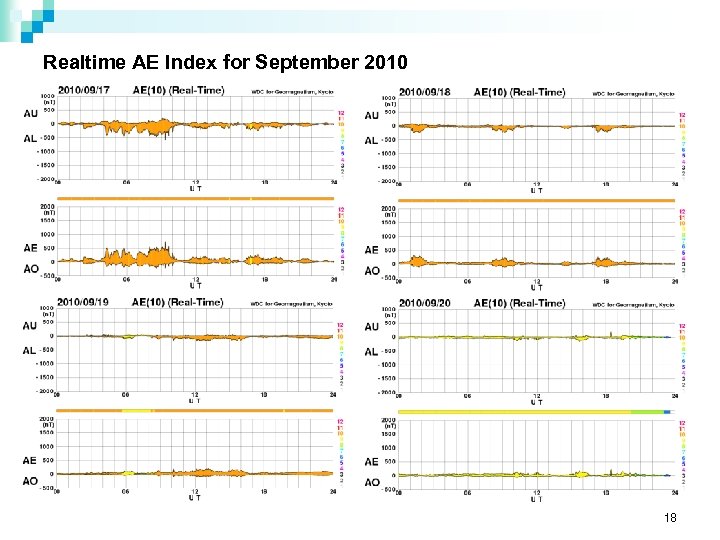 Realtime AE Index for September 2010 18
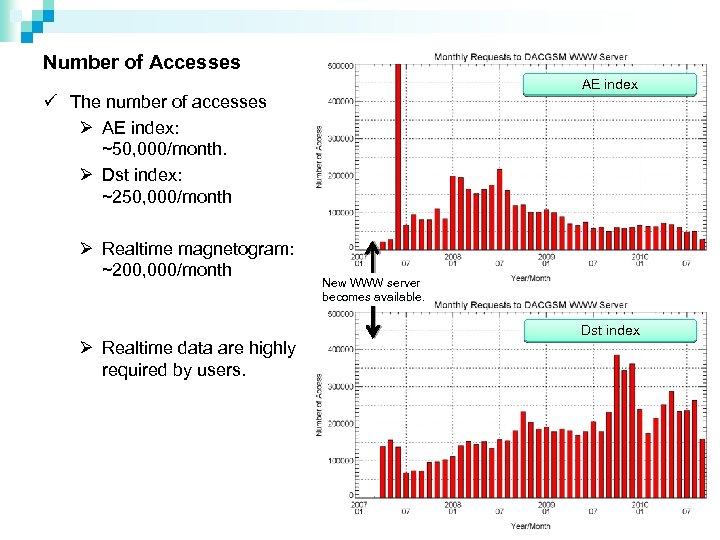 Number of Accesses AE index ü The number of accesses Ø AE index: ~50, 000/month. Ø Dst index: ~250, 000/month Ø Realtime magnetogram: ~200, 000/month Ø Realtime data are highly required by users. New WWW server becomes available. Dst index 19
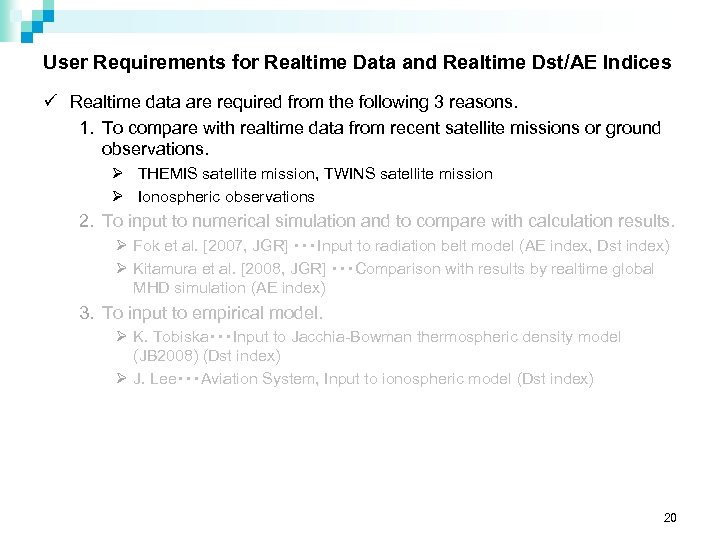 User Requirements for Realtime Data and Realtime Dst/AE Indices ü Realtime data are required from the following 3 reasons. 1. To compare with realtime data from recent satellite missions or ground observations. Ø THEMIS satellite mission, TWINS satellite mission Ø Ionospheric observations 2. To input to numerical simulation and to compare with calculation results. Ø Fok et al. [2007, JGR] ・・・Input to radiation belt model (AE index, Dst index) Ø Kitamura et al. [2008, JGR] ・・・Comparison with results by realtime global MHD simulation (AE index) 3. To input to empirical model. Ø K. Tobiska・・・Input to Jacchia-Bowman thermospheric density model (JB 2008) (Dst index) Ø J. Lee・・・Aviation System, Input to ionospheric model (Dst index) 20
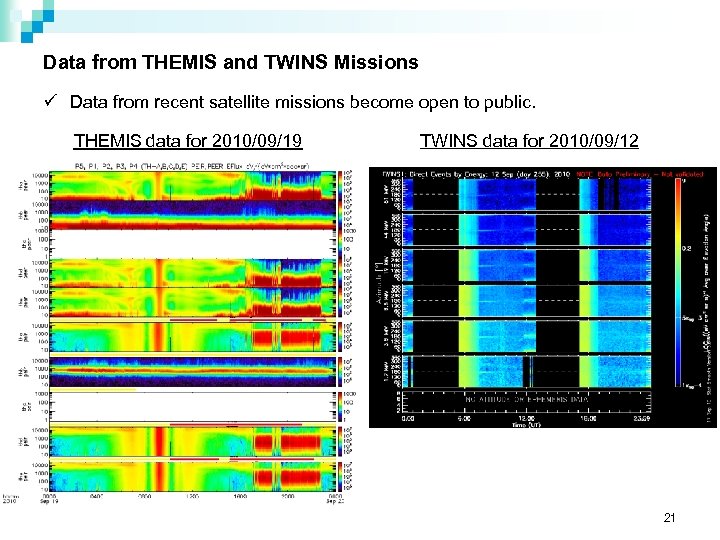 Data from THEMIS and TWINS Missions ü Data from recent satellite missions become open to public. THEMIS data for 2010/09/19 TWINS data for 2010/09/12 21
 User Requirements for Realtime Data and Realtime Dst/AE Indices ü Realtime data are required from the following 3 reasons. 1. To compare with realtime data from recent satellite missions or ground observations. Ø THEMIS satellite mission, TWINS satellite mission Ø Ionospheric observations 2. To input to numerical simulation and to compare with calculation results. Ø Fok et al. [2007, JGR] ・・・Input to radiation belt model (AE index, Dst index) Ø Kitamura et al. [2008, JGR] ・・・Comparison with results by realtime global MHD simulation (AE index) 3. To input to empirical model. Ø K. Tobiska・・・Input to Jacchia-Bowman thermospheric density model (JB 2008) (Dst index) Ø J. Lee・・・Aviation System, Input to ionospheric model (Dst index) 22
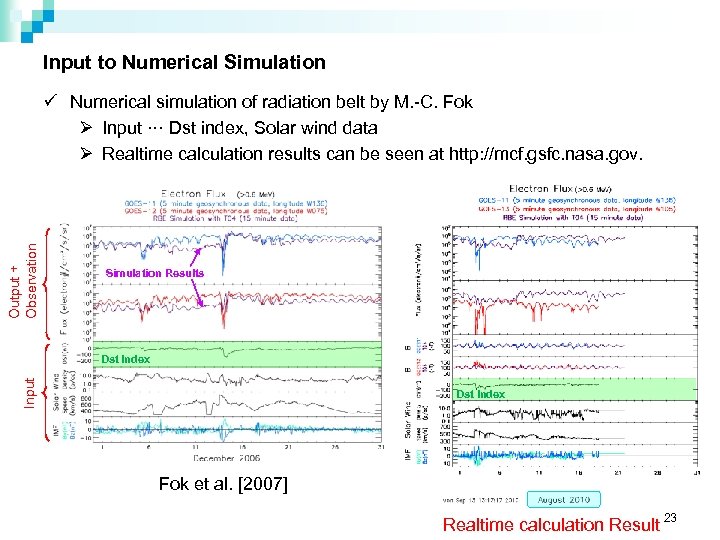 Input to Numerical Simulation Output + Observation ü Numerical simulation of radiation belt by M. -C. Fok Ø Input ∙·· Dst index, Solar wind data Ø Realtime calculation results can be seen at http: //mcf. gsfc. nasa. gov. Simulation Results Input Dst Index Fok et al. [2007] Realtime calculation Result 23
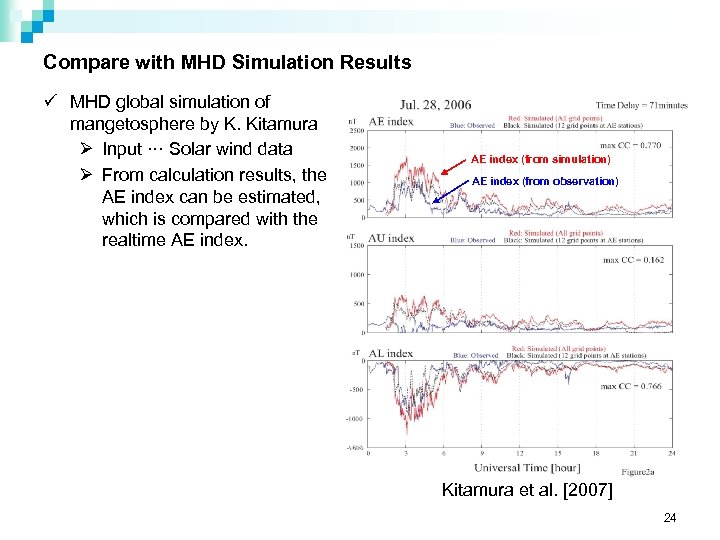 Compare with MHD Simulation Results ü MHD global simulation of mangetosphere by K. Kitamura Ø Input ∙·· Solar wind data Ø From calculation results, the AE index can be estimated, which is compared with the realtime AE index (from simulation) AE index (from observation) Kitamura et al. [2007] 24
 User Requirements for Realtime Data and Realtime Dst/AE Indices ü Realtime data are required from the following 3 reasons. 1. To compare with realtime data from recent satellite missions or ground observations. Ø THEMIS satellite mission, TWINS satellite mission Ø Ionospheric observations 2. To input to numerical simulation and to compare with calculation results. Ø Fok et al. [2007, JGR] ・・・Input to radiation belt model (AE index, Dst index) Ø Kitamura et al. [2008, JGR] ・・・Comparison with results by realtime global MHD simulation (AE index) 3. To input to empirical model. Ø K. Tobiska・・・Input to Jacchia-Bowman thermospheric density model (JB 2008) (Dst index) Ø J. Lee・・・Aviation System, Input to ionospheric model (Dst index) 25
 Summary for Realtime Data Collection ü Realtime data at WDC-Kyoto Ø 1 -minute realtime data from ~30 observatories Ø 1 -second realtime data from 6 observatories ü Number of accesses Ø Realtime 1 -minute magnetogram: ~200, 000/month Ø AE index: ~50, 000/month. Ø Dst index: ~250, 000/month ü Realtime data are highly demanded by users • To compare with realtime satellite/ground data, • To input to numerical simulation and to compare with calculation results, • To input to empirical model. 26
 (3) Realtime Detection of A Specific Phenomenon Related to Substorms 27
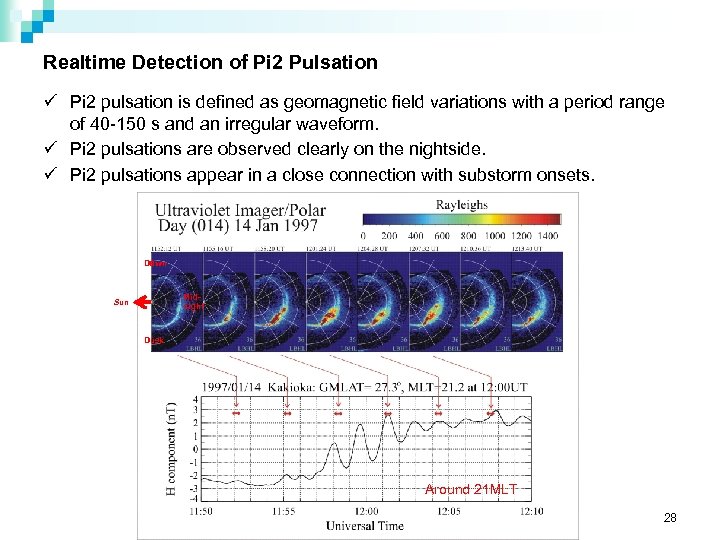 Realtime Detection of Pi 2 Pulsation ü Pi 2 pulsation is defined as geomagnetic field variations with a period range of 40 -150 s and an irregular waveform. ü Pi 2 pulsations are observed clearly on the nightside. ü Pi 2 pulsations appear in a close connection with substorm onsets. Dawn Midnight Sun Dusk Around 21 MLT 28
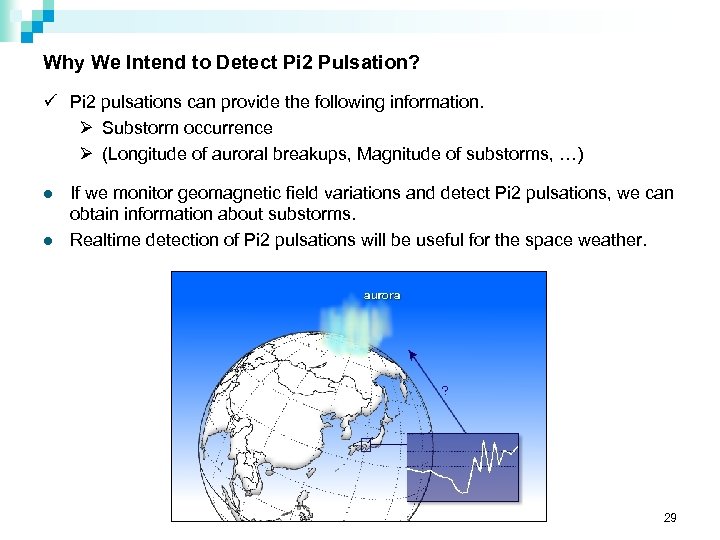 Why We Intend to Detect Pi 2 Pulsation? ü Pi 2 pulsations can provide the following information. Ø Substorm occurrence Ø (Longitude of auroral breakups, Magnitude of substorms, …) l l If we monitor geomagnetic field variations and detect Pi 2 pulsations, we can obtain information about substorms. Realtime detection of Pi 2 pulsations will be useful for the space weather. 29
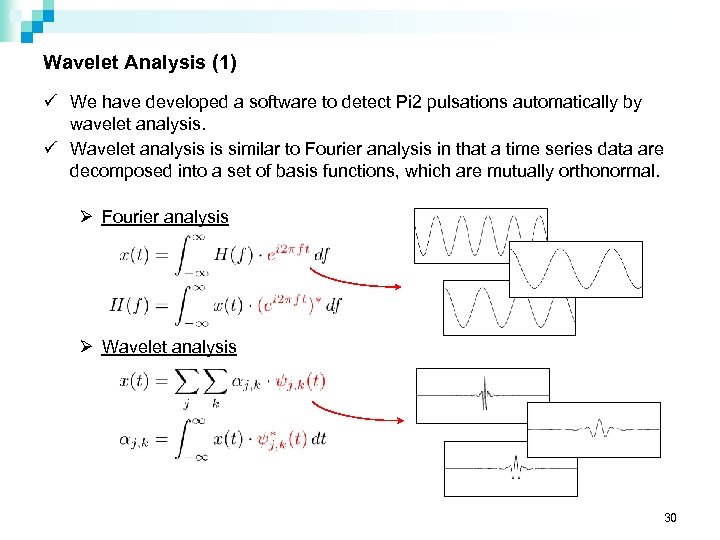 Wavelet Analysis (1) ü We have developed a software to detect Pi 2 pulsations automatically by wavelet analysis. ü Wavelet analysis is similar to Fourier analysis in that a time series data are decomposed into a set of basis functions, which are mutually orthonormal. Ø Fourier analysis Ø Wavelet analysis 30
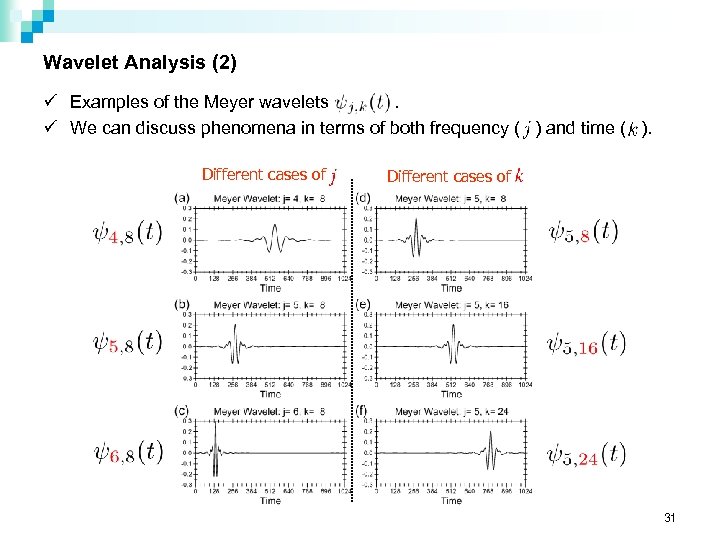 Wavelet Analysis (2) ü Examples of the Meyer wavelets . ü We can discuss phenomena in terms of both frequency ( ) and time ( ). Different cases of 31
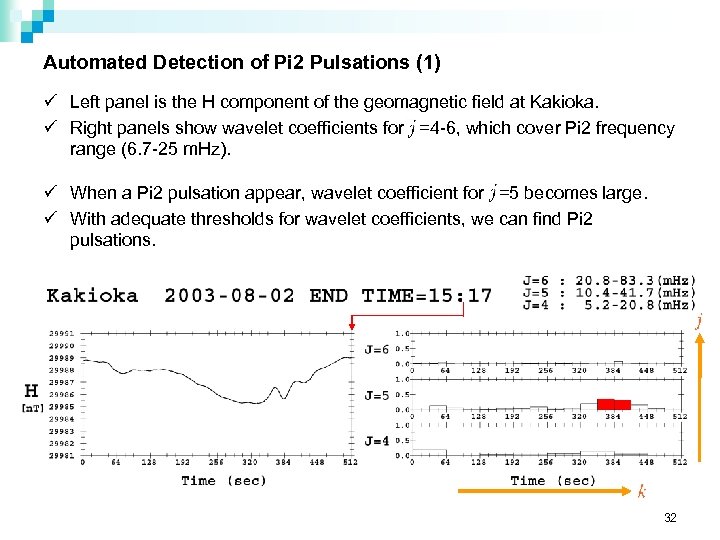 Automated Detection of Pi 2 Pulsations (1) ü Left panel is the H component of the geomagnetic field at Kakioka. ü Right panels show wavelet coefficients for =4 -6, which cover Pi 2 frequency range (6. 7 -25 m. Hz). ü When a Pi 2 pulsation appear, wavelet coefficient for =5 becomes large. ü With adequate thresholds for wavelet coefficients, we can find Pi 2 pulsations. 32
 Automated Detection of Pi 2 Pulsations (2) ü See the movie to know how Pi 2 pulsations are detected by wavelet analysis from real-time geomagnetic field data. 33
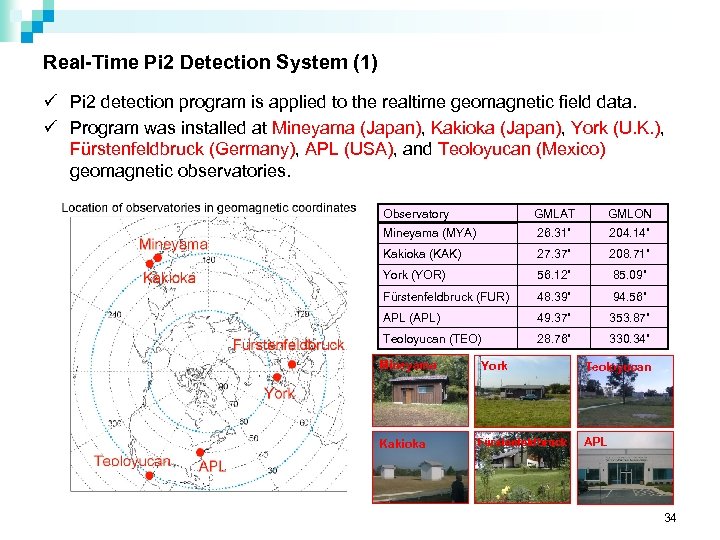 Real-Time Pi 2 Detection System (1) ü Pi 2 detection program is applied to the realtime geomagnetic field data. ü Program was installed at Mineyama (Japan), Kakioka (Japan), York (U. K. ), Fürstenfeldbruck (Germany), APL (USA), and Teoloyucan (Mexico) geomagnetic observatories. Observatory GMLAT GMLON Mineyama (MYA) 26. 31˚ 204. 14˚ Kakioka (KAK) 27. 37˚ 208. 71˚ York (YOR) 56. 12˚ 85. 09˚ Fürstenfeldbruck (FUR) 48. 39˚ 94. 56˚ APL (APL) 49. 37˚ 353. 87˚ Teoloyucan (TEO) 28. 76˚ 330. 34˚ Mineyama Kakioka York Fürstenfeldbruck Teoloyucan APL 34
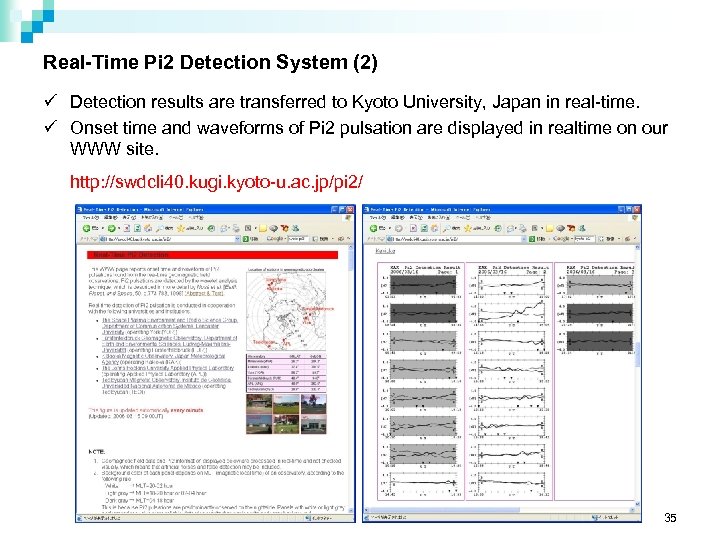 Real-Time Pi 2 Detection System (2) ü Detection results are transferred to Kyoto University, Japan in real-time. ü Onset time and waveforms of Pi 2 pulsation are displayed in realtime on our WWW site. http: //swdcli 40. kugi. kyoto-u. ac. jp/pi 2/ 35
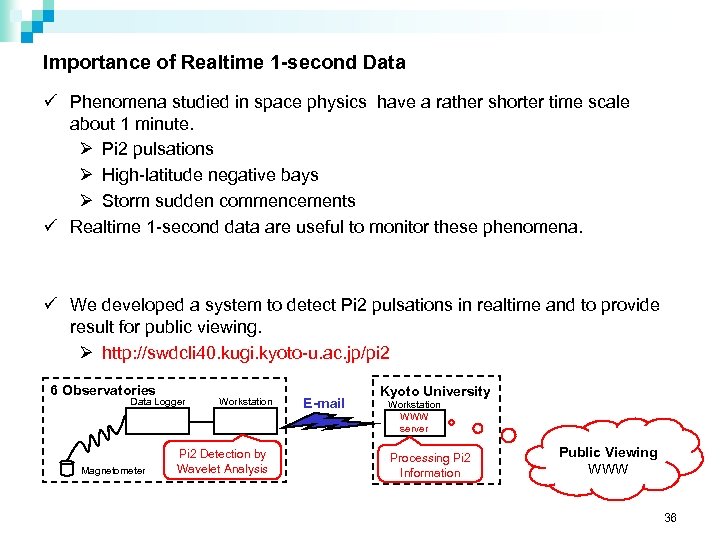 Importance of Realtime 1 -second Data ü Phenomena studied in space physics have a rather shorter time scale about 1 minute. Ø Pi 2 pulsations Ø High-latitude negative bays Ø Storm sudden commencements ü Realtime 1 -second data are useful to monitor these phenomena. ü We developed a system to detect Pi 2 pulsations in realtime and to provide result for public viewing. Ø http: //swdcli 40. kugi. kyoto-u. ac. jp/pi 2 6 Observatories Data Logger Magnetometer Workstation Pi 2 Detection by Wavelet Analysis E-mail Kyoto University Workstation WWW server Processing Pi 2 Information Public Viewing WWW 36
 (4) Future Perspective 37
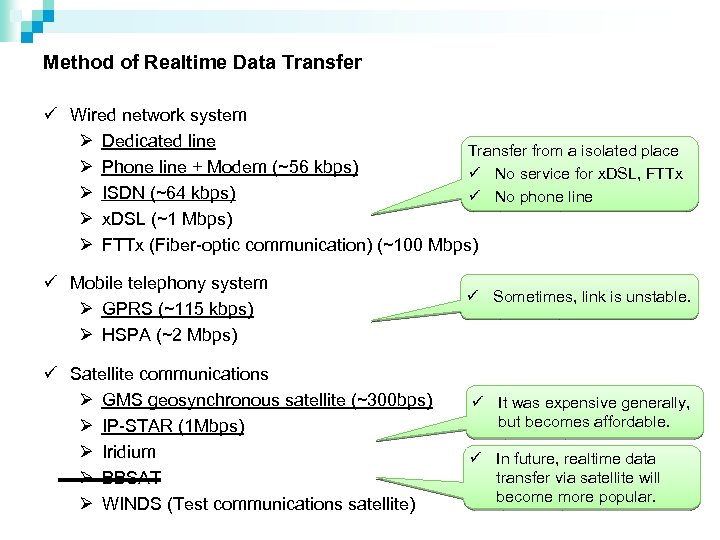 Method of Realtime Data Transfer ü Wired network system Ø Dedicated line Transfer from a isolated place Ø Phone line + Modem (~56 kbps) ü No service for x. DSL, FTTx Ø ISDN (~64 kbps) ü No phone line Ø x. DSL (~1 Mbps) Ø FTTx (Fiber-optic communication) (~100 Mbps) ü Mobile telephony system Ø GPRS (~115 kbps) Ø HSPA (~2 Mbps) ü Satellite communications Ø GMS geosynchronous satellite (~300 bps) Ø IP-STAR (1 Mbps) Ø Iridium Ø BBSAT Ø WINDS (Test communications satellite) ü Sometimes, link is unstable. ü It was expensive generally, but becomes affordable. ü In future, realtime data transfer via satellite will become more popular.
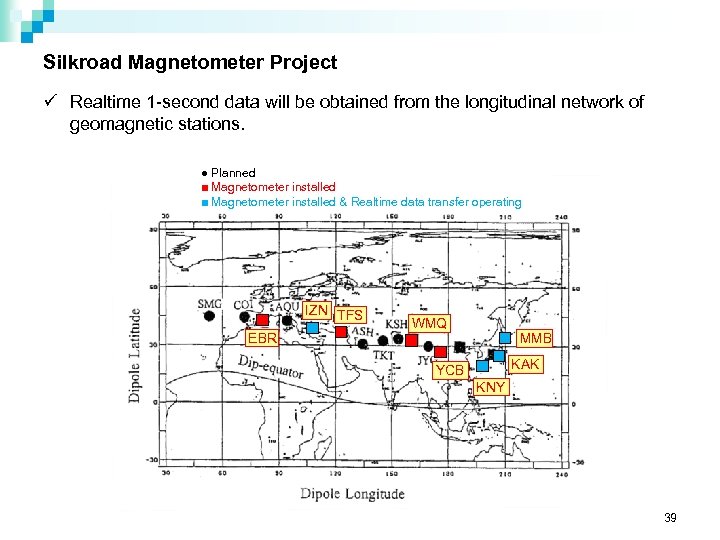 Silkroad Magnetometer Project ü Realtime 1 -second data will be obtained from the longitudinal network of geomagnetic stations. ● Planned ■ Magnetometer installed & Realtime data transfer operating IZN TFS EBR WMQ MMB KAK YCB KNY 39
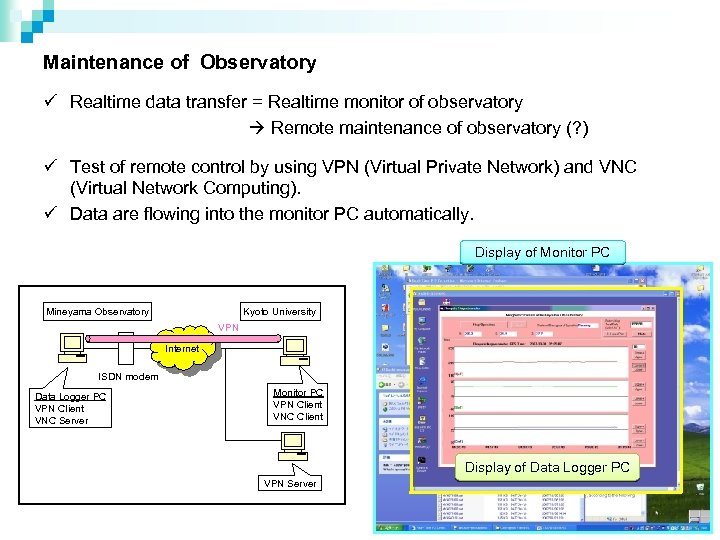 Maintenance of Observatory ü Realtime data transfer = Realtime monitor of observatory Remote maintenance of observatory (? ) ü Test of remote control by using VPN (Virtual Private Network) and VNC (Virtual Network Computing). ü Data are flowing into the monitor PC automatically. Display of Monitor PC Mineyama Observatory Kyoto University VPN Internet ISDN modem Data Logger PC VPN Client VNC Server Monitor PC VPN Client VNC Client Display of Data Logger PC VPN Server 40
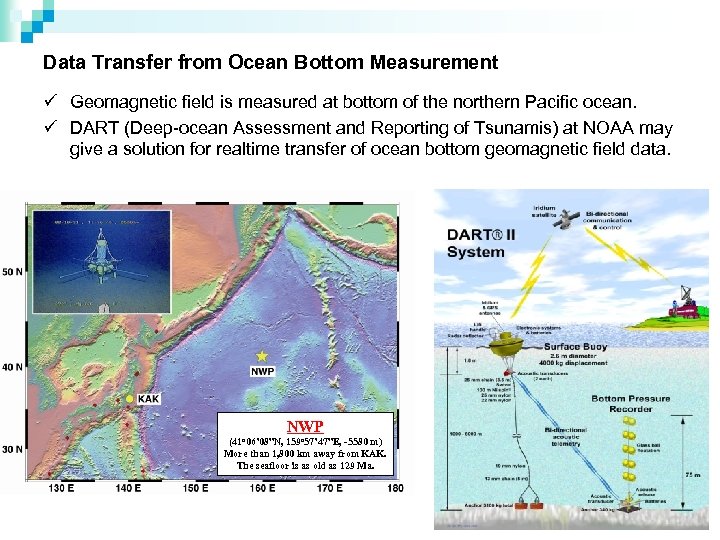 Data Transfer from Ocean Bottom Measurement ü Geomagnetic field is measured at bottom of the northern Pacific ocean. ü DART (Deep-ocean Assessment and Reporting of Tsunamis) at NOAA may give a solution for realtime transfer of ocean bottom geomagnetic field data. NWP (41 o 06’ 08”N, 159 o 57’ 47”E, -5580 m) More than 1, 800 km away from KAK. The seafloor is as old as 129 Ma. 41
 Summary ü WDC for Geomagnetism, Kyoto receives 1 -minute realtime data from ~30 observatories and 1 -second realtime data from 6 observatories. ü Collected realtime data are mainly used in the following 3 products. 1. Display of realtime magnetograms, 2. Derivation of the realtime Dst and AE indices, and 3. Automatical detection of Pi 2 pulsations. ü Realtime data are highly demanded by users • To compare with realtime satellite/ground data, • To input to numerical simulation and to compare with calculation results, • To input to empirical model. ü Realtime data are also useful for observers • To collect data, • To monitor geomagnetic condition, • To check observatory condition and to maintain the observatory. 42