


 Скачать презентацию Application of OWL 1 1 to Systems Engineering
59ba7efc11bd40a8f39279631b9d0da6.ppt
- Количество слайдов: 7
 Application of OWL 1. 1 to Systems Engineering 01 April 2008 Henson Graves Ian Horrocks
 Use of Knowledge Representation and Reasoning in Product Development n Current Systems Engineering languages, standards, and tools are l l n Restricted in (certain aspects of) their expressiveness and do not provide formal semantics Yet many activities involve (some form of) reasoning, e. g. , requirements verification Long history of attempts to use formal methods for engineering l n Too hard to use, don’t scale Can OWL 1. 1 provide a semantic integration framework? l For engineering domain, with ontology capturing meaning independent of interpretation by subject matter experts? l So automated reasoning can be used to check design properties such as consistency and conformance with specification? l Not to replace Sys. ML, UML, and engineering tools, but incorporate them into an integrated framework 2
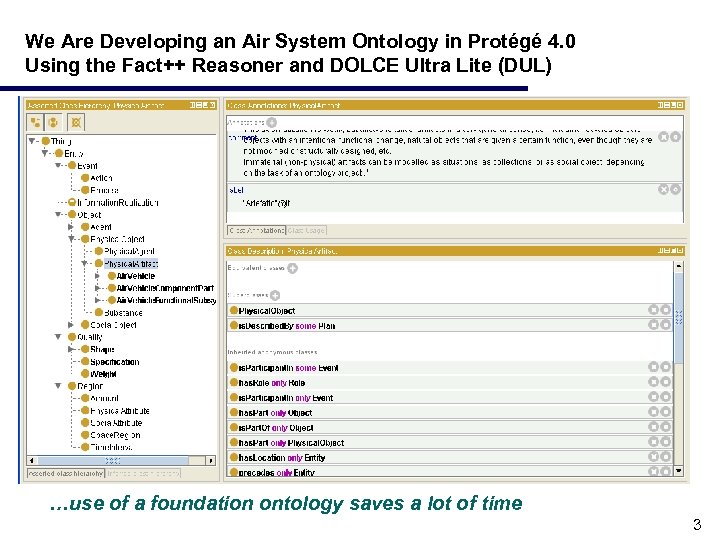 We Are Developing an Air System Ontology in Protégé 4. 0 Using the Fact++ Reasoner and DOLCE Ultra Lite (DUL) …use of a foundation ontology saves a lot of time 3
 Achievements Used class constructors to define (requirements) classes of physical objects with structural and measurable properties n n Resulting ontology has about 300 classes n Verified that requirements class is consistent n Defined (design) classes characterized by generic instances Gone outside the logic to database that represents results of measurement analysis & simulation to conclude additional properties of design instance n Verified that resulting extended generic design instance still satisfies requirements n 4
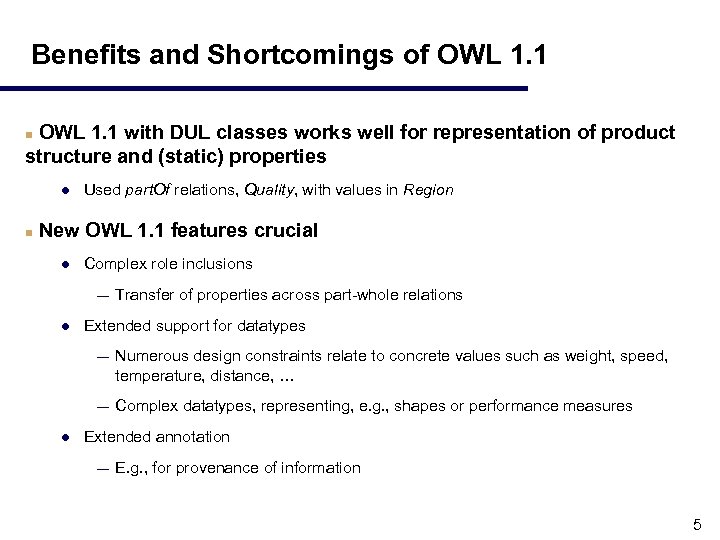 Benefits and Shortcomings of OWL 1. 1 with DUL classes works well for representation of product structure and (static) properties n l n Used part. Of relations, Quality, with values in Region New OWL 1. 1 features crucial l Complex role inclusions — l Transfer of properties across part-whole relations Extended support for datatypes — — l Numerous design constraints relate to concrete values such as weight, speed, temperature, distance, … Complex datatypes, representing, e. g. , shapes or performance measures Extended annotation — E. g. , for provenance of information 5
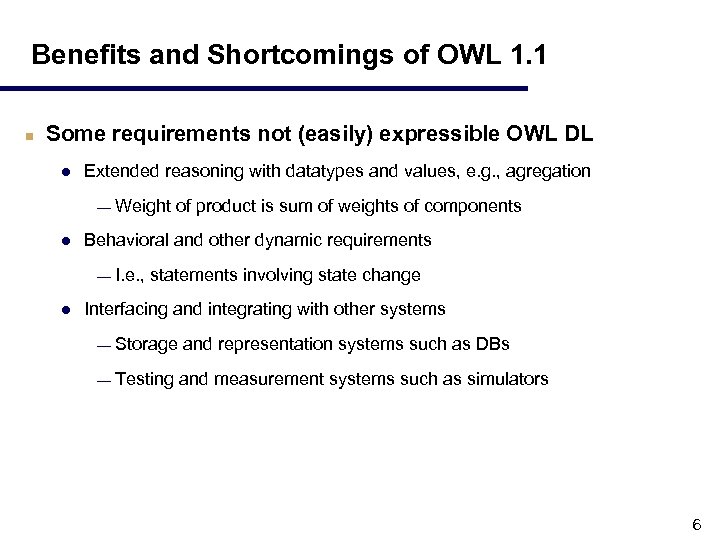 Benefits and Shortcomings of OWL 1. 1 n Some requirements not (easily) expressible OWL DL l Extended reasoning with datatypes and values, e. g. , agregation — Weight l Behavioral and other dynamic requirements — I. e. , l of product is sum of weights of components statements involving state change Interfacing and integrating with other systems — Storage and representation systems such as DBs — Testing and measurement systems such as simulators 6
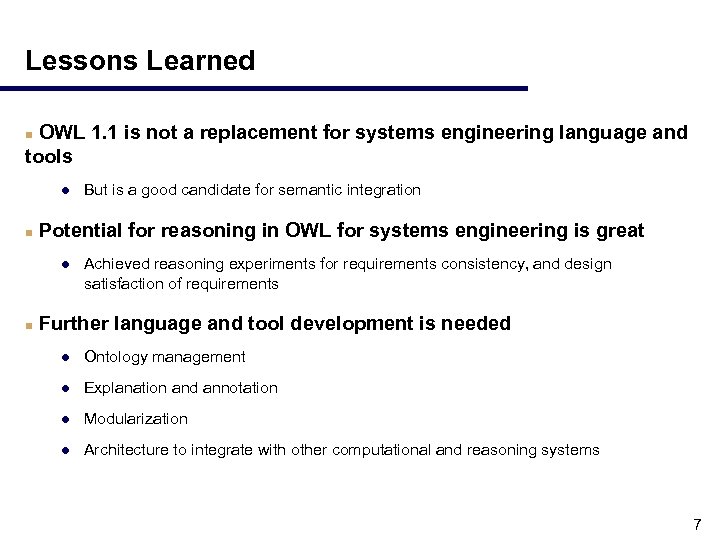 Lessons Learned OWL 1. 1 is not a replacement for systems engineering language and tools n l n Potential for reasoning in OWL for systems engineering is great l n But is a good candidate for semantic integration Achieved reasoning experiments for requirements consistency, and design satisfaction of requirements Further language and tool development is needed l Ontology management l Explanation and annotation l Modularization l Architecture to integrate with other computational and reasoning systems 7