


 Скачать презентацию APPLICATION OF OES-AD SOFTWARE PACKAGE FOR DEVELOPING AUTOMATED
42ab0efe7da9b8ff0aefc7f801a807e8.ppt
- Количество слайдов: 18
 APPLICATION OF OES-AD SOFTWARE PACKAGE FOR DEVELOPING AUTOMATED TECHNIQUES E. V. Shabanova 1, I. E. Vasilyeva 1, and I. L. Vasiliev 2 1 Vinogradov Institute of Geochemistry SB RAS, Favorsky Str. , 1 a, 664033, Irkutsk, Russia e-mail: shev@igc. irk. ru 2 Institute of System Dynamics and Control Theory SB RAS, Lermontov Str. , 134, 664033, Irkutsk, Russia
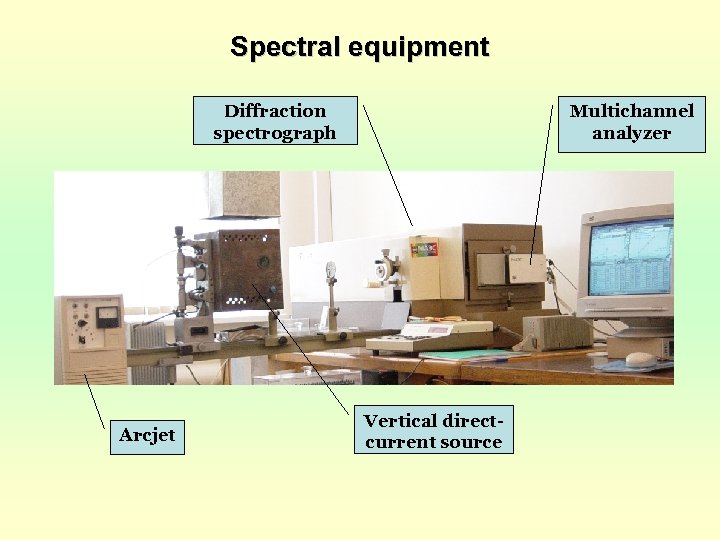 Spectral equipment Diffraction spectrograph Arcjet Multichannel analyzer Vertical directcurrent source
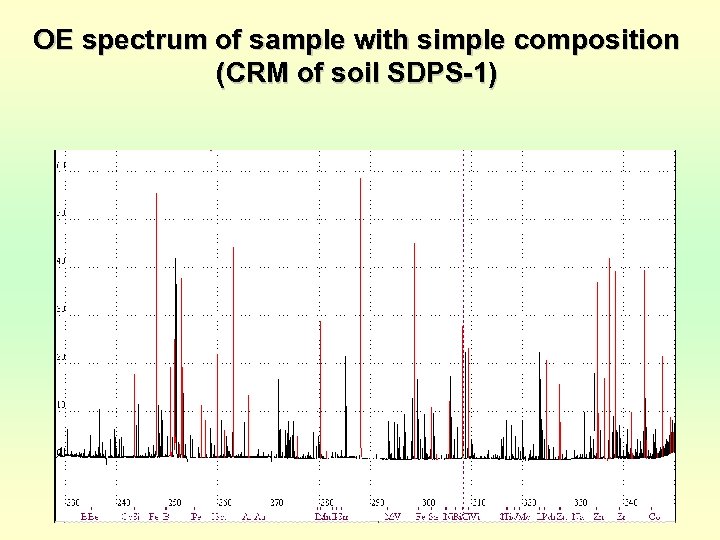 OE spectrum of sample with simple composition (CRM of soil SDPS-1)
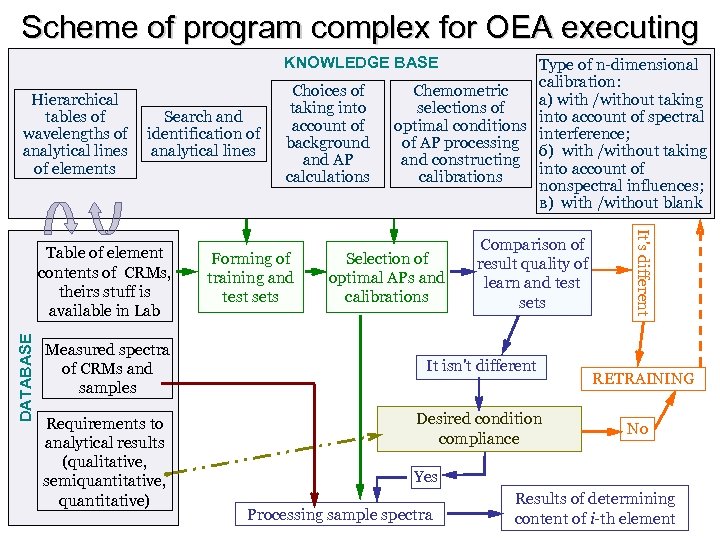 Scheme of program complex for OEA executing KNOWLEDGE BASE Hierarchical tables of Search and wavelengths of identification of analytical lines of elements DATABASE Measured spectra of CRMs and samples Requirements to analytical results (qualitative, semiquantitative, quantitative) Forming of training and test sets Selection of optimal APs and calibrations Comparison of result quality of learn and test sets It isn't different Desired condition compliance It's different Table of element contents of CRMs, theirs stuff is available in Lab Choices of taking into account of background and AP calculations Type of n-dimensional calibration: Chemometric a) with /without taking selections of into account of spectral optimal conditions interference; of AP processing б) with /without taking and constructing into account of calibrations nonspectral influences; в) with /without blank RETRAINING No Yes Processing sample spectra Results of determining content of i-th element
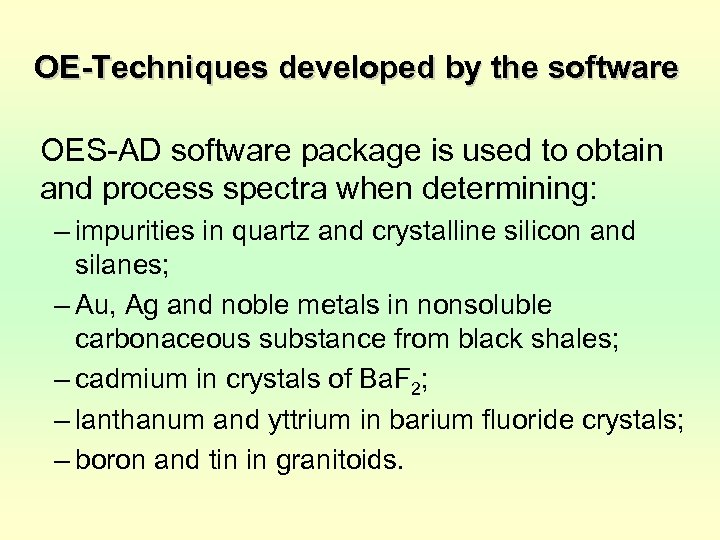 OE-Techniques developed by the software OES-AD software package is used to obtain and process spectra when determining: – impurities in quartz and crystalline silicon and silanes; – Au, Ag and noble metals in nonsoluble carbonaceous substance from black shales; – cadmium in crystals of Ba. F 2; – lanthanum and yttrium in barium fluoride crystals; – boron and tin in granitoids.
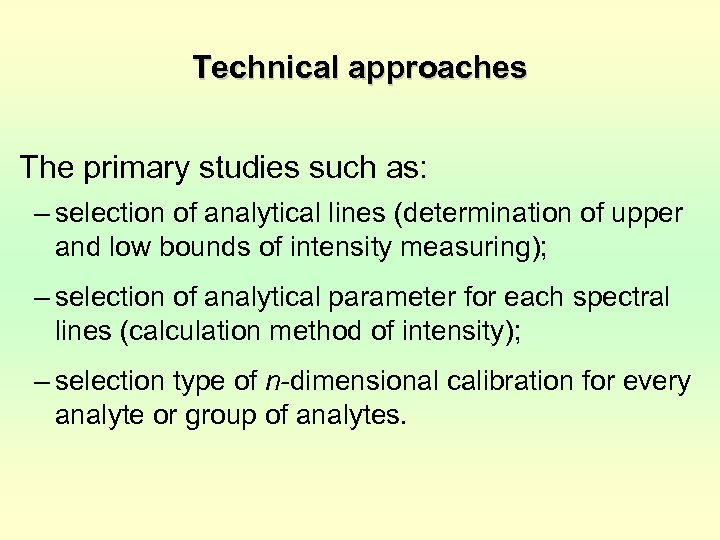 Technical approaches The primary studies such as: – selection of analytical lines (determination of upper and low bounds of intensity measuring); – selection of analytical parameter for each spectral lines (calculation method of intensity); – selection type of n-dimensional calibration for every analyte or group of analytes.
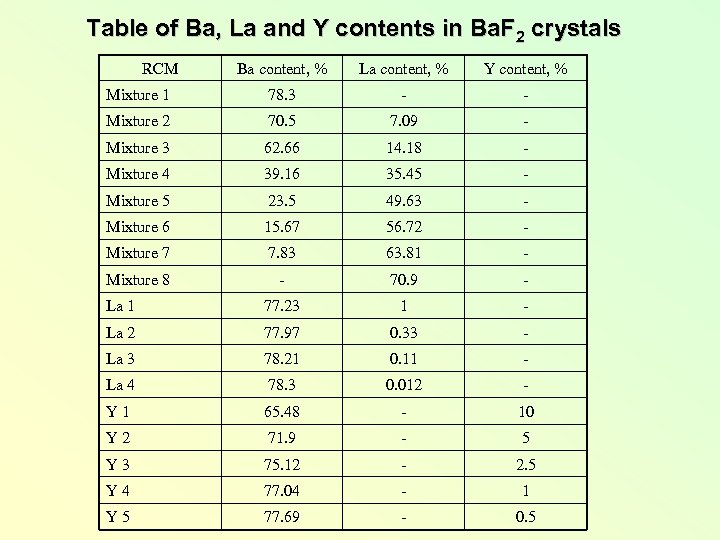 Table of Ba, La and Y contents in Ba. F 2 crystals RCM Ba content, % La content, % Y content, % Mixture 1 78. 3 - - Mixture 2 70. 5 7. 09 - Mixture 3 62. 66 14. 18 - Mixture 4 39. 16 35. 45 - Mixture 5 23. 5 49. 63 - Mixture 6 15. 67 56. 72 - Mixture 7 7. 83 63. 81 - Mixture 8 - 70. 9 - La 1 77. 23 1 - La 2 77. 97 0. 33 - La 3 78. 21 0. 11 - La 4 78. 3 0. 012 - Y 1 65. 48 - 10 Y 2 71. 9 - 5 Y 3 75. 12 - 2. 5 Y 4 77. 04 - 1 Y 5 77. 69 - 0. 5
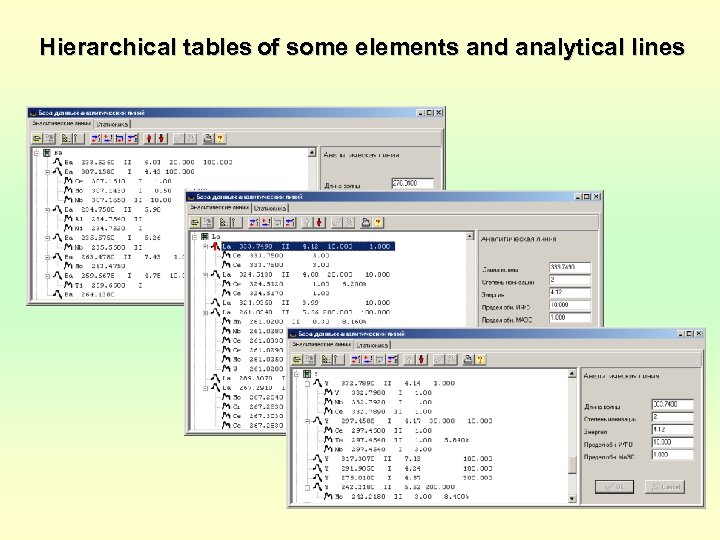 Hierarchical tables of some elements and analytical lines
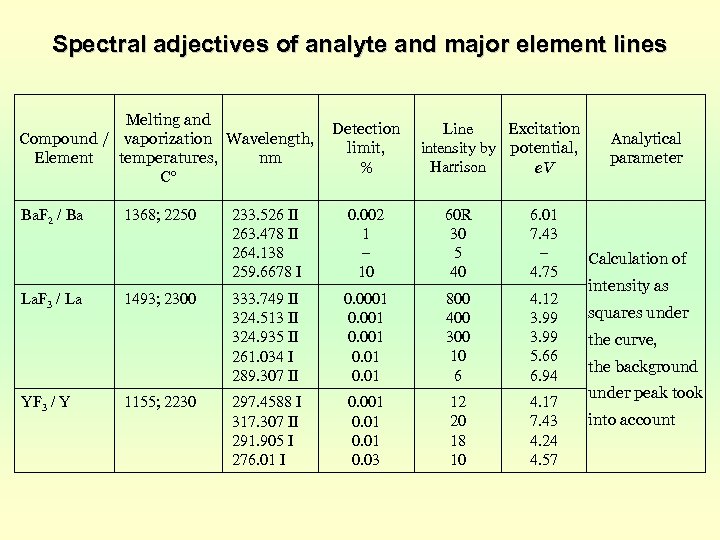 Spectral adjectives of analyte and major element lines Melting and Detection Compound / vaporization Wavelength, limit, Element temperatures, nm % С Ba. F 2 / Ba La. F 3 / La YF 3 / Y 1368; 2250 1493; 2300 1155; 2230 Line Excitation intensity by potential, Harrison e. V 233. 526 II 263. 478 II 264. 138 259. 6678 I 0. 002 1 – 10 60 R 30 5 40 6. 01 7. 43 – 4. 75 333. 749 II 324. 513 II 324. 935 II 261. 034 I 289. 307 II 0. 0001 0. 01 800 400 300 10 6 4. 12 3. 99 5. 66 6. 94 297. 4588 I 317. 307 II 291. 905 I 276. 01 I 0. 001 0. 03 12 20 18 10 4. 17 7. 43 4. 24 4. 57 Analytical parameter Calculation of intensity as squares under the curve, the background under peak took into account
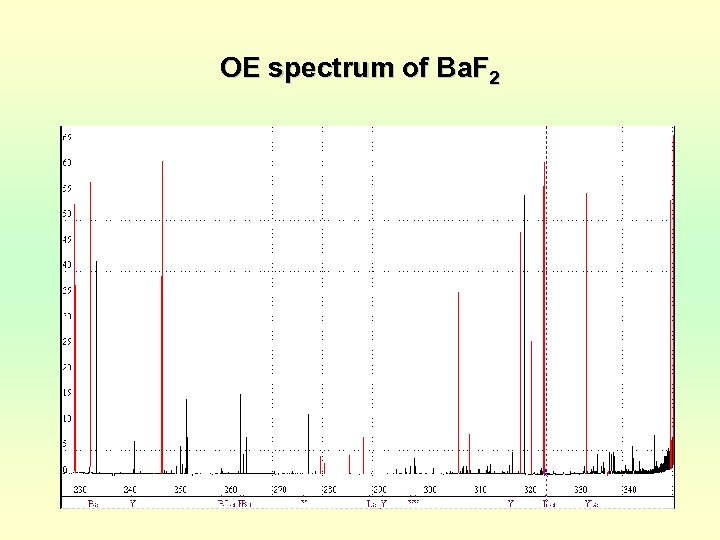 OE spectrum of Ba. F 2
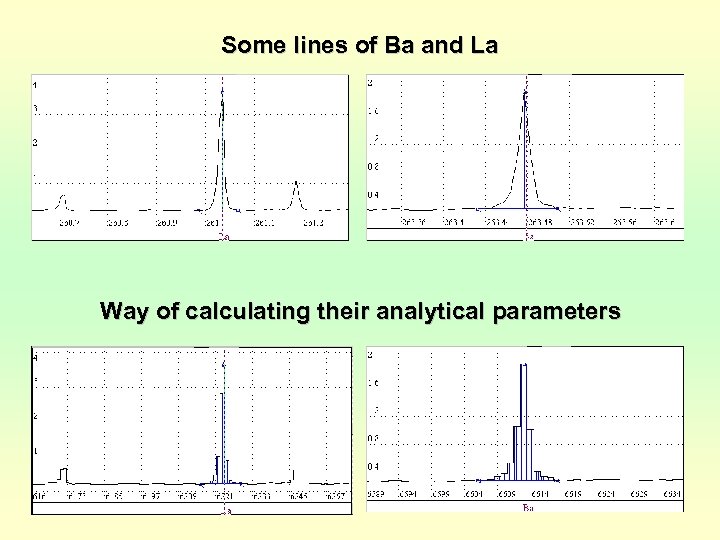 Some lines of Ba and La Way of calculating their analytical parameters
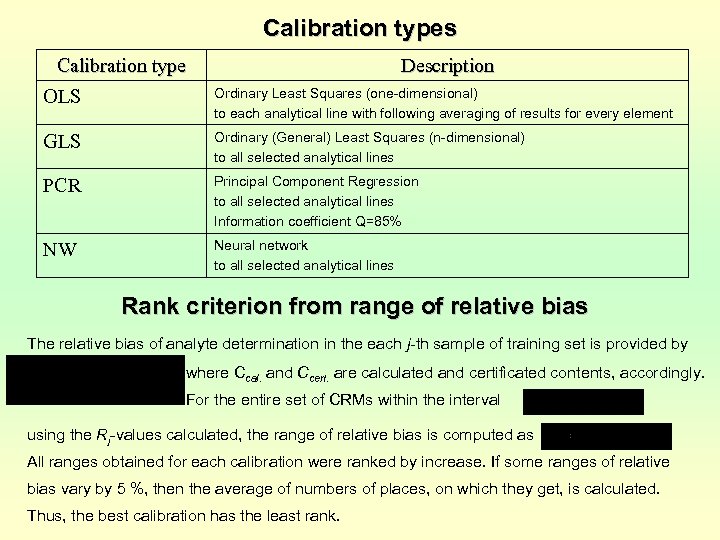 Calibration types Calibration type Description OLS Ordinary Least Squares (one-dimensional) to each analytical line with following averaging of results for every element GLS Ordinary (General) Least Squares (n-dimensional) to all selected analytical lines PCR Principal Component Regression to all selected analytical lines Information coefficient Q=85% NW Neural network to all selected analytical lines Rank criterion from range of relative bias The relative bias of analyte determination in the each j-th sample of training set is provided by where Ccal. and Ccert. are calculated and certificated contents, accordingly. For the entire set of CRMs within the interval using the Rj-values calculated, the range of relative bias is computed as All ranges obtained for each calibration were ranked by increase. If some ranges of relative bias vary by 5 %, then the average of numbers of places, on which they get, is calculated. Thus, the best calibration has the least rank.
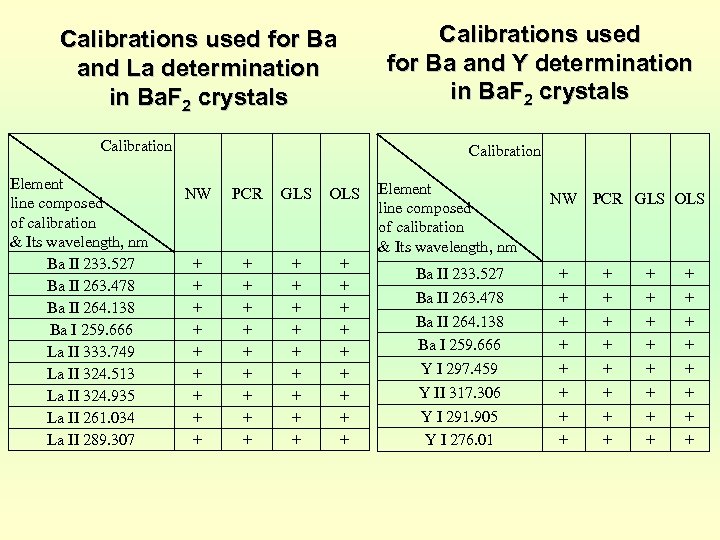 Calibrations used for Ba and Y determination in Ba. F 2 crystals Calibrations used for Ba and La determination in Ba. F 2 crystals Calibration Element line composed of calibration & Its wavelength, nm Ba II 233. 527 Ba II 263. 478 Ba II 264. 138 Ba I 259. 666 La II 333. 749 La II 324. 513 La II 324. 935 La II 261. 034 La II 289. 307 Calibration NW PCR GLS OLS + + + + + + + + + Element line composed of calibration & Its wavelength, nm Ba II 233. 527 Ba II 263. 478 Ba II 264. 138 Ba I 259. 666 Y I 297. 459 Y II 317. 306 Y I 291. 905 Y I 276. 01 NW PCR GLS OLS + + + + + + + +
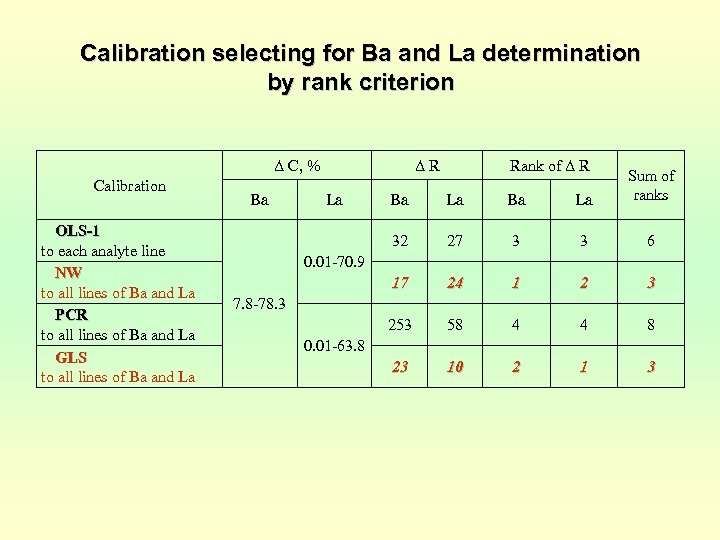 Calibration selecting for Ba and La determination by rank criterion Δ C, % Calibration OLS-1 to each analyte line NW to all lines of Ba and La PCR to all lines of Ba and La GLS to all lines of Ba and La Δ R Rank of Δ R La Ba La 27 3 3 6 17 24 1 2 3 253 La Ba 32 Ba Sum of ranks 58 4 4 8 23 10 2 1 3 0. 01 -70. 9 7. 8 -78. 3 0. 01 -63. 8
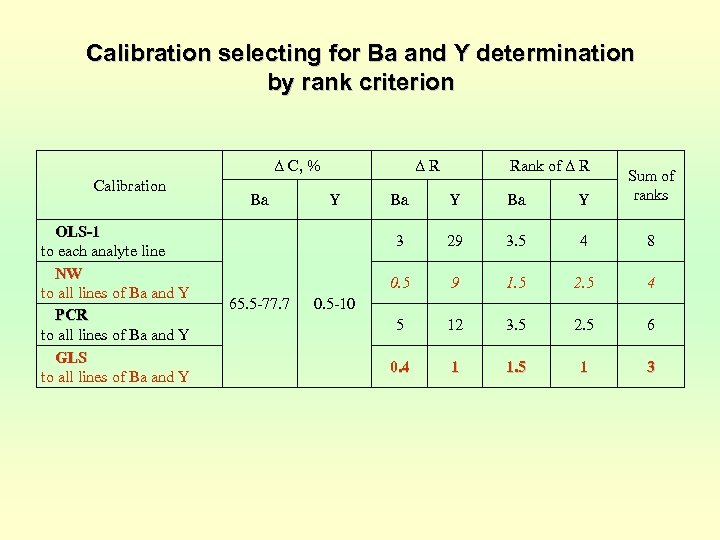 Calibration selecting for Ba and Y determination by rank criterion Δ C, % Calibration OLS-1 to each analyte line NW to all lines of Ba and Y PCR to all lines of Ba and Y GLS to all lines of Ba and Y Δ R Rank of Δ R 65. 5 -77. 7 Y Ba Y 29 3. 5 4 8 0. 5 Y Ba 3 Ba Sum of ranks 9 1. 5 2. 5 4 5 12 3. 5 2. 5 6 0. 4 1 1. 5 1 3 0. 5 -10
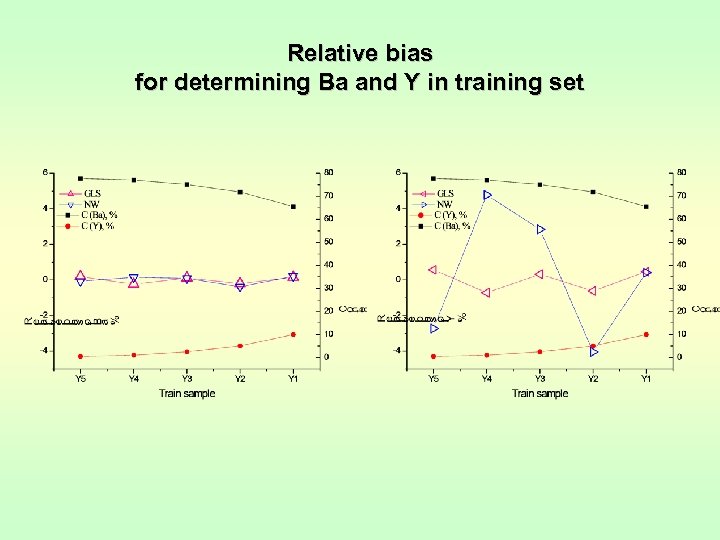 Relative bias for determining Ba and Y in training set
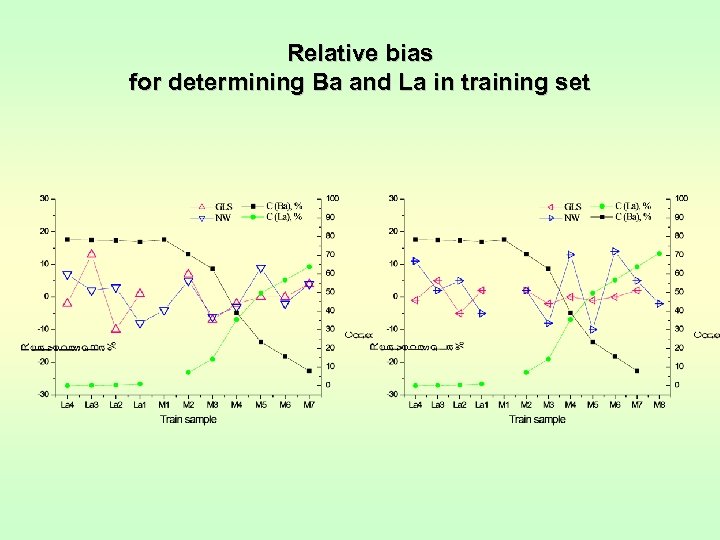 Relative bias for determining Ba and La in training set
 Technique of determination of La, Y and Ba in Ba. F 2 • The spectral equipment: diffraction spectrograph DFS 458, arcjet "Vesuvius", and multichannel analyzer MAES • 5 mg of sample and 5 mg of buffer (graphite powder) is completely evaporated with the direct current is 15 A • La content area is 0. 01 -63 % while Ba content changes 8 -78 % • Y content area is 0. 5 -10 % while Ba content changes 66 -78 % • Reproducibility of La, Y and Ba measurements, sr , are 0. 08 -0. 12; 0. 10 -0. 15; and 0. 05 -0. 07, accordingly