


 Скачать презентацию Application of MARS 15 code system to radiation
f55c424f9f39a5171fcc63b8c6cad666.ppt
- Количество слайдов: 18
 Application of MARS 15 code system to radiation safety design of LCLS electron dump -Multi-step approach and LCLST. Sanami Stanford Linear Accelerator Center / High energy accelerator Organization (KEK) N. Nakao Fermi National Accelerator Laboratory X. S. Mao and S. Rokni Stanford Linear Accelerator Center May 24, 2007 MARS 15 course @ FNAL, May 24 2007 Toshiya SANAMI sanami@slac. stanford. edu toshiya. sanami@kek. jp
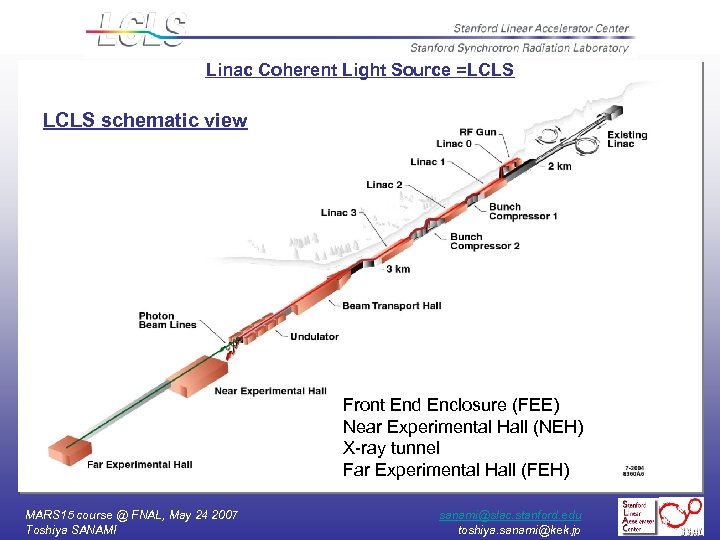 Linac Coherent Light Source =LCLS schematic view Front End Enclosure (FEE) Near Experimental Hall (NEH) X-ray tunnel Far Experimental Hall (FEH) MARS 15 course @ FNAL, May 24 2007 Toshiya SANAMI sanami@slac. stanford. edu toshiya. sanami@kek. jp
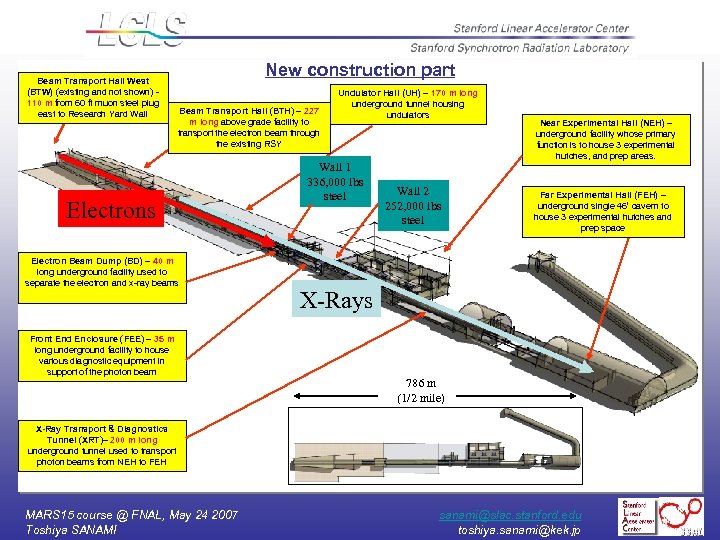 Beam Transport Hall West (BTW) (existing and not shown) - 110 m from 60 ft muon steel plug east to Research Yard Wall New construction part Beam Transport Hall (BTH) – 227 m long above grade facility to transport the electron beam through the existing RSY Electrons Electron Beam Dump (BD) – 40 m long underground facility used to separate the electron and x-ray beams Front End Enclosure (FEE) – 35 m long underground facility to house various diagnostic equipment in support of the photon beam Undulator Hall (UH) – 170 m long underground tunnel housing undulators Wall 1 336, 000 lbs steel Wall 2 252, 000 lbs steel Near Experimental Hall (NEH) – underground facility whose primary function is to house 3 experimental hutches, and prep areas. Far Experimental Hall (FEH) – underground single 46’ cavern to house 3 experimental hutches and prep space X-Rays 786 m (1/2 mile) X-Ray Transport & Diagnostics Tunnel (XRT)– 200 m long underground tunnel used to transport photon beams from NEH to FEH MARS 15 course @ FNAL, May 24 2007 Toshiya SANAMI sanami@slac. stanford. edu toshiya. sanami@kek. jp
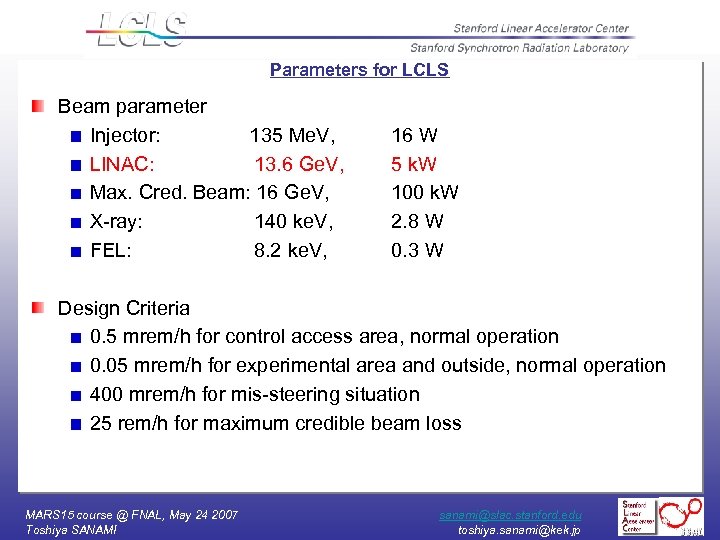 Parameters for LCLS Beam parameter Injector: 135 Me. V, LINAC: 13. 6 Ge. V, Max. Cred. Beam: 16 Ge. V, X-ray: 140 ke. V, FEL: 8. 2 ke. V, 16 W 5 k. W 100 k. W 2. 8 W 0. 3 W Design Criteria 0. 5 mrem/h for control access area, normal operation 0. 05 mrem/h for experimental area and outside, normal operation 400 mrem/h for mis-steering situation 25 rem/h for maximum credible beam loss MARS 15 course @ FNAL, May 24 2007 Toshiya SANAMI sanami@slac. stanford. edu toshiya. sanami@kek. jp
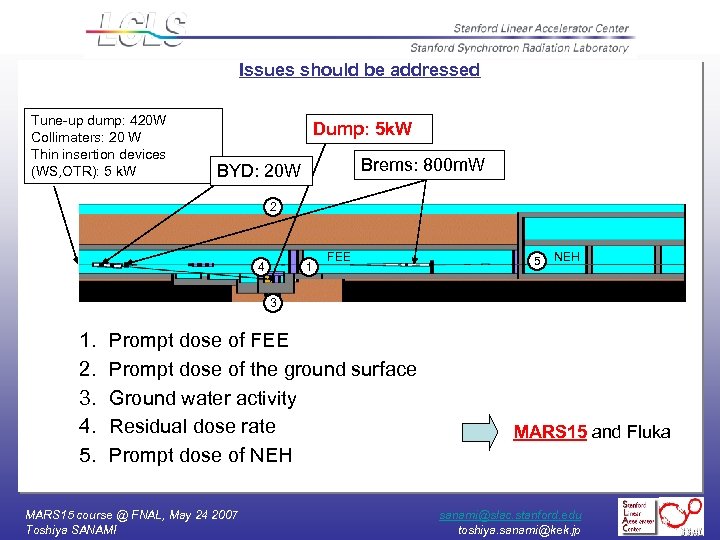 Issues should be addressed Tune-up dump: 420 W Collimaters: 20 W Thin insertion devices (WS, OTR): 5 k. W Dump: 5 k. W Brems: 800 m. W BYD: 20 W 2 4 1 FEE 5 NEH 3 1. 2. 3. 4. 5. Prompt dose of FEE Prompt dose of the ground surface Ground water activity Residual dose rate Prompt dose of NEH MARS 15 course @ FNAL, May 24 2007 Toshiya SANAMI MARS 15 and Fluka sanami@slac. stanford. edu toshiya. sanami@kek. jp
 Difficulties Complex geometry and thick shield Attenuation of up to 6 m thick concrete and soil 0 degree dose rate estimation → Subsection calculation Several beam losses and operation modes Check the contribution form each beam loss Sum-up the contribution for each mode → Use same XYZHIS. INP which allows sum up later Estimate 3 T activity close to the detection limit in ground water Residual dose rate MARS 15 course @ FNAL, May 24 2007 Toshiya SANAMI sanami@slac. stanford. edu toshiya. sanami@kek. jp
 Methodology Geometry description Produce GEOM. INP from fortran code Easy to describe relationship between devices and materials Change material for specified region Activities and average dose rate Zmin and Zmax Take out unnecessary area Subsection calculation Reduce computation time Usage of Multi-CPU MARS 15 course @ FNAL, May 24 2007 Toshiya SANAMI sanami@slac. stanford. edu toshiya. sanami@kek. jp
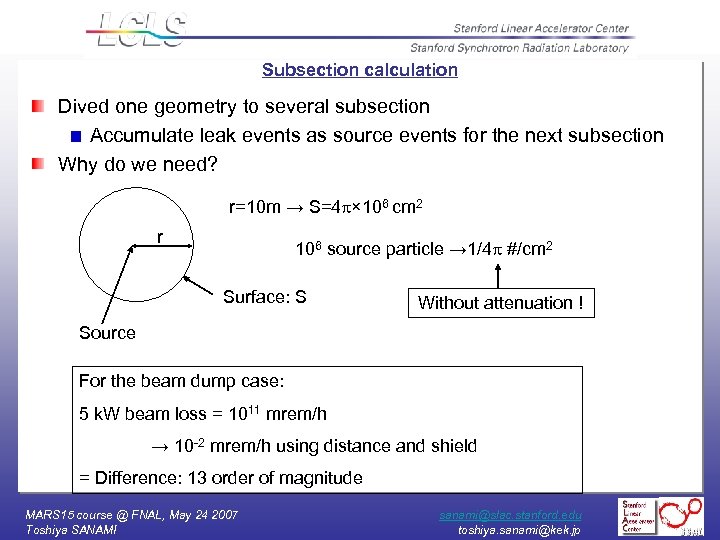 Subsection calculation Dived one geometry to several subsection Accumulate leak events as source events for the next subsection Why do we need? r=10 m → S=4 p× 106 cm 2 r 106 source particle → 1/4 p #/cm 2 Surface: S Without attenuation ! Source For the beam dump case: 5 k. W beam loss = 1011 mrem/h → 10 -2 mrem/h using distance and shield = Difference: 13 order of magnitude MARS 15 course @ FNAL, May 24 2007 Toshiya SANAMI sanami@slac. stanford. edu toshiya. sanami@kek. jp
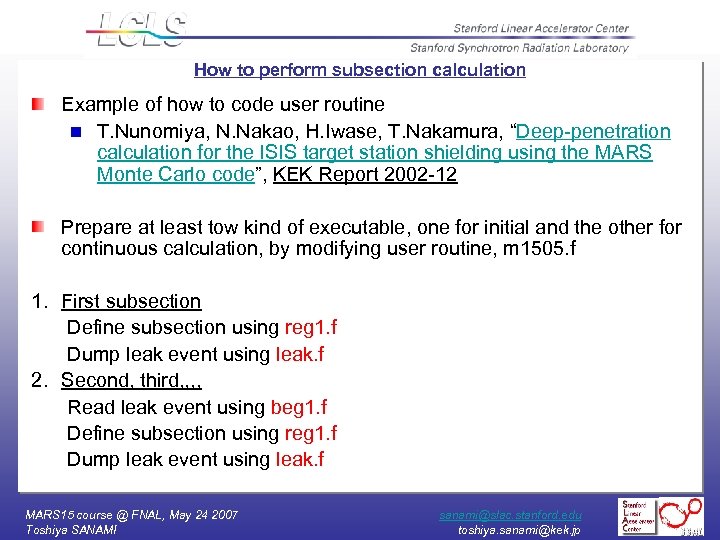 How to perform subsection calculation Example of how to code user routine T. Nunomiya, N. Nakao, H. Iwase, T. Nakamura, “Deep-penetration calculation for the ISIS target station shielding using the MARS Monte Carlo code”, KEK Report 2002 -12 Prepare at least tow kind of executable, one for initial and the other for continuous calculation, by modifying user routine, m 1505. f 1. First subsection Define subsection using reg 1. f Dump leak event using leak. f 2. Second, third, , Read leak event using beg 1. f Define subsection using reg 1. f Dump leak event using leak. f MARS 15 course @ FNAL, May 24 2007 Toshiya SANAMI sanami@slac. stanford. edu toshiya. sanami@kek. jp
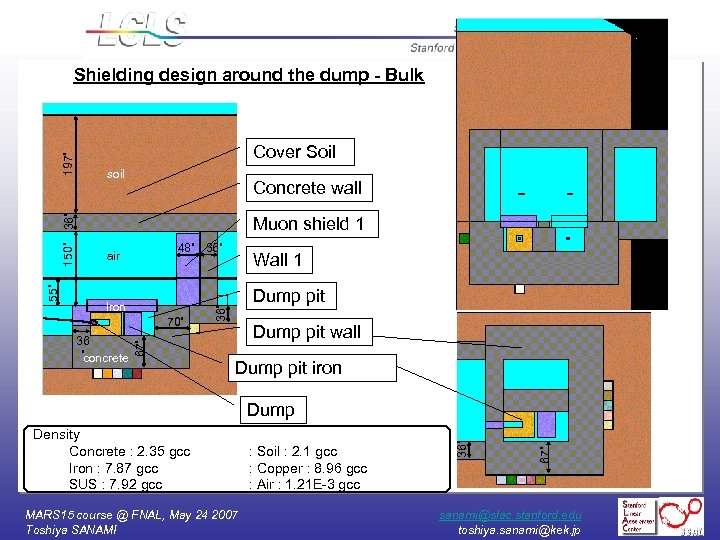 Cover Soil soil Concrete wall Muon shield 1 48” 36” air Iron 36 ”concrete Dump pit wall 67” 70” Wall 1 36” 55” 150” 36” 197” Shielding design around the dump - Bulk Dump pit iron MARS 15 course @ FNAL, May 24 2007 Toshiya SANAMI : Soil : 2. 1 gcc : Copper : 8. 96 gcc : Air : 1. 21 E-3 gcc 67” Density Concrete : 2. 35 gcc Iron : 7. 87 gcc SUS : 7. 92 gcc 36” Dump sanami@slac. stanford. edu toshiya. sanami@kek. jp
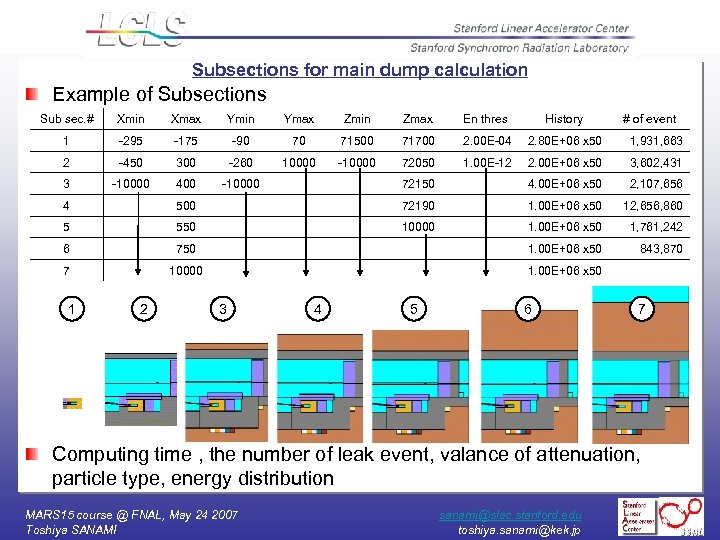 Subsections for main dump calculation Example of Subsections Sub sec. # Xmin Xmax Ymin Ymax Zmin Zmax En thres History 1 -295 -175 -90 70 71500 71700 2. 00 E-04 2. 80 E+06 x 50 1, 931, 663 2 -450 300 -260 10000 -10000 72050 1. 00 E-12 2. 00 E+06 x 50 3, 602, 431 3 -10000 400 -10000 4. 00 E+06 x 50 2, 107, 656 4 500 1. 00 E+06 x 50 12, 656, 860 1. 00 E+06 x 50 1, 761, 242 1. 00 E+06 x 50 843, 870 5 6 550 72190 10000 2 10000 750 7 1 72150 # of event 1. 00 E+06 x 50 3 4 5 6 7 Computing time , the number of leak event, valance of attenuation, particle type, energy distribution MARS 15 course @ FNAL, May 24 2007 Toshiya SANAMI sanami@slac. stanford. edu toshiya. sanami@kek. jp
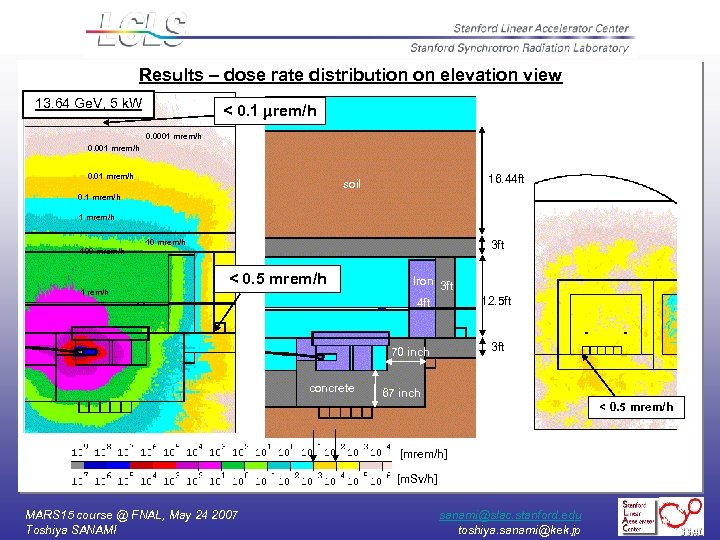 Results – dose rate distribution on elevation view 13. 64 Ge. V, 5 k. W < 0. 1 mrem/h 0. 0001 mrem/h 0. 01 mrem/h 16. 44 ft soil 0. 1 mrem/h 100 mrem/h 10 mrem/h 3 ft air 1 rem/h < 0. 5 mrem/h Iron 3 ft 4 ft 3 ft 70 inch concrete 12. 5 ft 67 inch < 0. 5 mrem/h [mrem/h] [m. Sv/h] MARS 15 course @ FNAL, May 24 2007 Toshiya SANAMI sanami@slac. stanford. edu toshiya. sanami@kek. jp
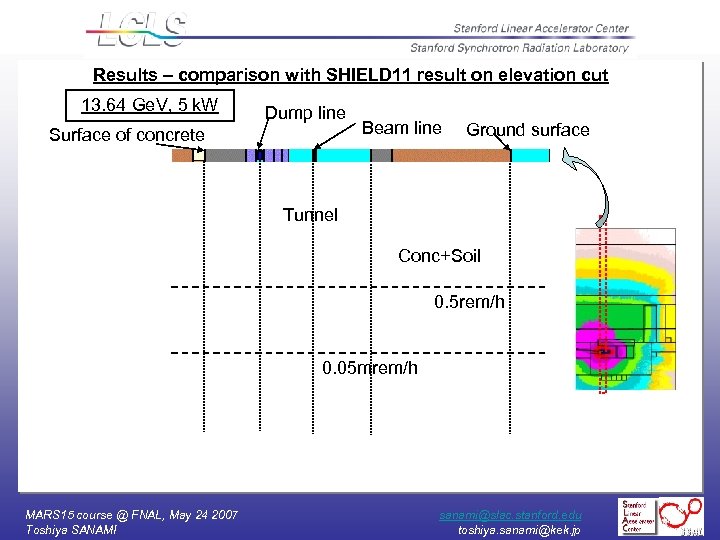 Results – comparison with SHIELD 11 result on elevation cut 13. 64 Ge. V, 5 k. W Dump line Surface of concrete Beam line Ground surface Tunnel Conc+Soil 0. 5 rem/h 0. 05 mrem/h MARS 15 course @ FNAL, May 24 2007 Toshiya SANAMI sanami@slac. stanford. edu toshiya. sanami@kek. jp
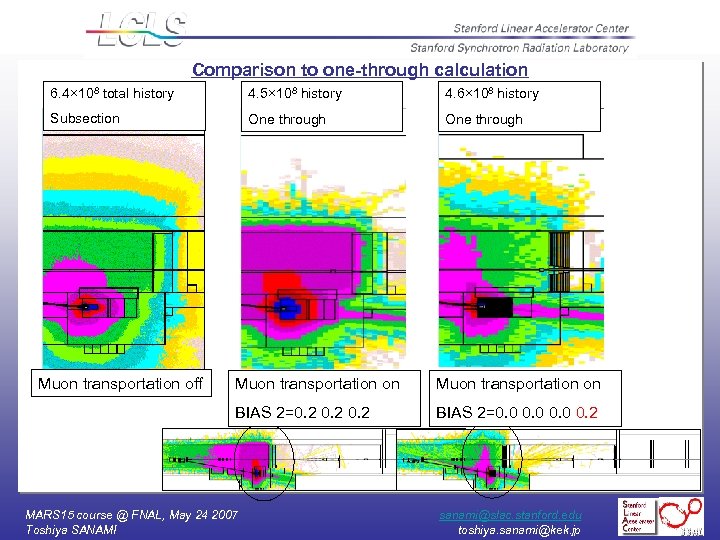 Comparison to one-through calculation 6. 4× 10⁸ total history 4. 5× 10⁸ history 4. 6× 10⁸ history Subsection One through Muon transportation off Muon transportation on BIAS 2=0. 2 BIAS 2=0. 0 0. 2 MARS 15 course @ FNAL, May 24 2007 Toshiya SANAMI sanami@slac. stanford. edu toshiya. sanami@kek. jp
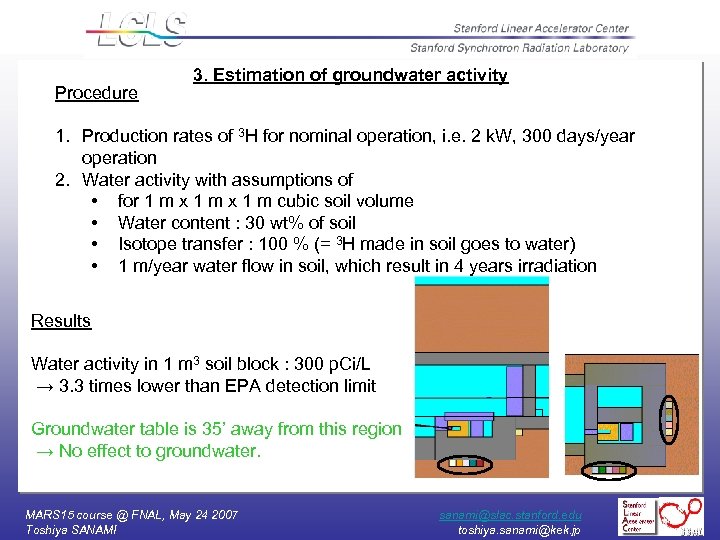 Procedure 3. Estimation of groundwater activity 1. Production rates of 3 H for nominal operation, i. e. 2 k. W, 300 days/year operation 2. Water activity with assumptions of • for 1 m x 1 m cubic soil volume • Water content : 30 wt% of soil • Isotope transfer : 100 % (= 3 H made in soil goes to water) • 1 m/year water flow in soil, which result in 4 years irradiation Results Water activity in 1 m 3 soil block : 300 p. Ci/L → 3. 3 times lower than EPA detection limit Groundwater table is 35’ away from this region → No effect to groundwater. MARS 15 course @ FNAL, May 24 2007 Toshiya SANAMI sanami@slac. stanford. edu toshiya. sanami@kek. jp
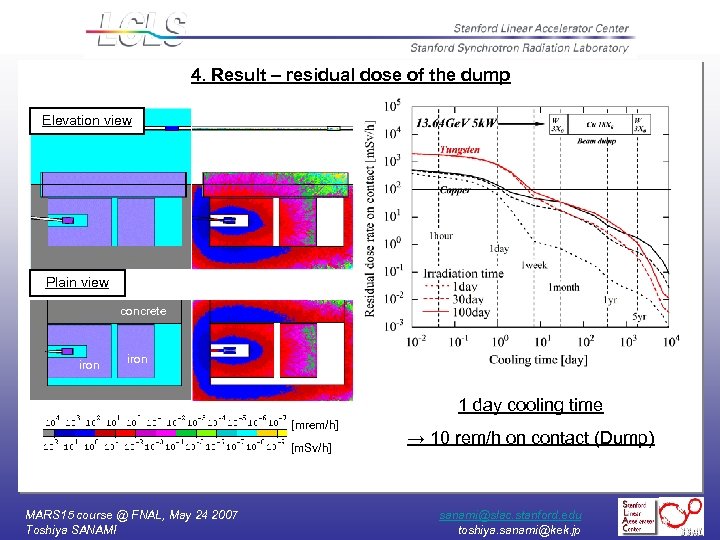 4. Result – residual dose of the dump Elevation view Plain view iron concrete iron 1 day cooling time [mrem/h] [m. Sv/h] MARS 15 course @ FNAL, May 24 2007 Toshiya SANAMI → 10 rem/h on contact (Dump) sanami@slac. stanford. edu toshiya. sanami@kek. jp
 Conclusion MARS 15 code is employed for radiation safety design of LCLS 13. 64 Ge. V, 5 k. W, electron dump Subsection technique Prompt dose Ground water activity Residual dose MARS 15 course @ FNAL, May 24 2007 Toshiya SANAMI sanami@slac. stanford. edu toshiya. sanami@kek. jp
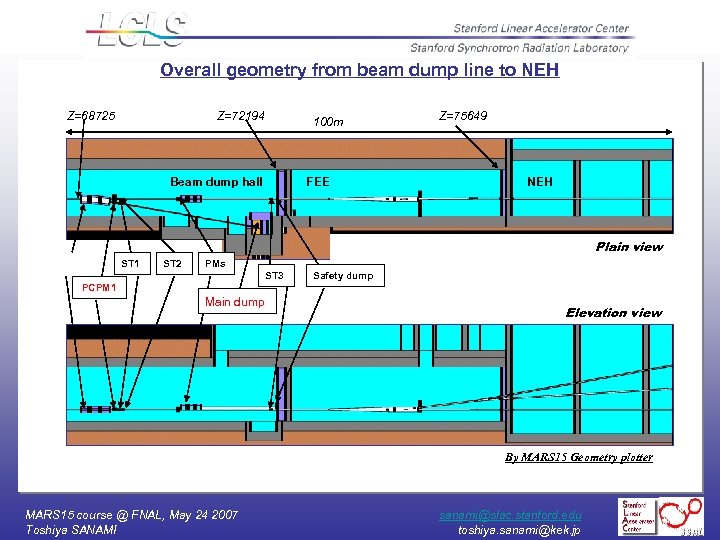 Overall geometry from beam dump line to NEH Z=68725 Z=72194 100 m Beam dump hall FEE Z=75649 NEH Plain view ST 1 ST 2 PMs ST 3 Safety dump PCPM 1 Main dump Elevation view By MARS 15 Geometry plotter MARS 15 course @ FNAL, May 24 2007 Toshiya SANAMI sanami@slac. stanford. edu toshiya. sanami@kek. jp