


 Скачать презентацию APPLICATION OF IMAGE PROCESSING TECHNIQUES TO AUTOMATICALLY ESTIMATE
61a545423d5bef47a7c7b83f701e4f3c.ppt
- Количество слайдов: 1
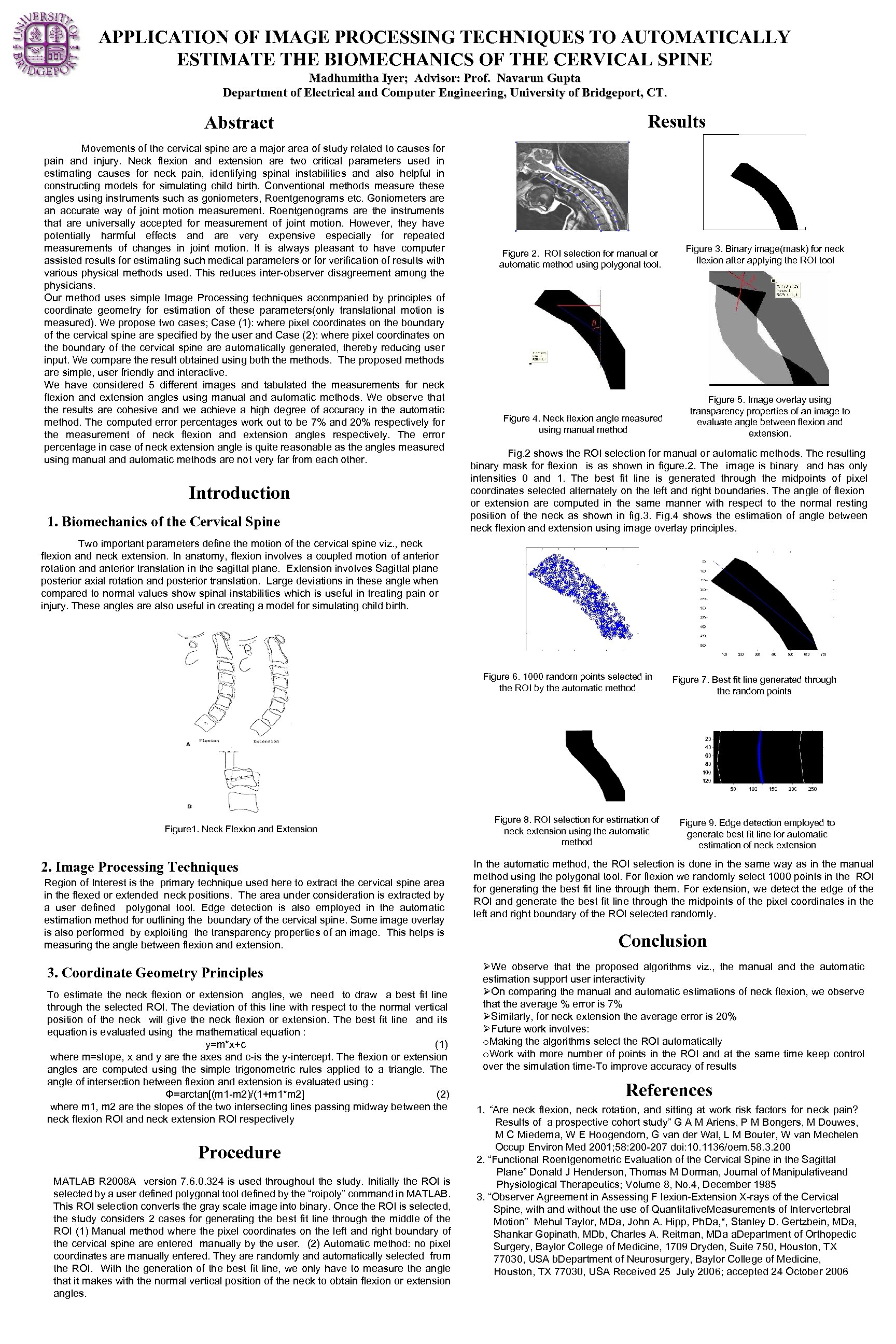 APPLICATION OF IMAGE PROCESSING TECHNIQUES TO AUTOMATICALLY ESTIMATE THE BIOMECHANICS OF THE CERVICAL SPINE Madhumitha Iyer; Advisor: Prof. Navarun Gupta Department of Electrical and Computer Engineering, University of Bridgeport, CT. Abstract Movements of the cervical spine are a major area of study related to causes for pain and injury. Neck flexion and extension are two critical parameters used in estimating causes for neck pain, identifying spinal instabilities and also helpful in constructing models for simulating child birth. Conventional methods measure these angles using instruments such as goniometers, Roentgenograms etc. Goniometers are an accurate way of joint motion measurement. Roentgenograms are the instruments that are universally accepted for measurement of joint motion. However, they have potentially harmful effects and are very expensive especially for repeated measurements of changes in joint motion. It is always pleasant to have computer assisted results for estimating such medical parameters or for verification of results with various physical methods used. This reduces inter-observer disagreement among the physicians. Our method uses simple Image Processing techniques accompanied by principles of coordinate geometry for estimation of these parameters(only translational motion is measured). We propose two cases; Case (1): where pixel coordinates on the boundary of the cervical spine are specified by the user and Case (2): where pixel coordinates on the boundary of the cervical spine are automatically generated, thereby reducing user input. We compare the result obtained using both the methods. The proposed methods are simple, user friendly and interactive. We have considered 5 different images and tabulated the measurements for neck flexion and extension angles using manual and automatic methods. We observe that the results are cohesive and we achieve a high degree of accuracy in the automatic method. The computed error percentages work out to be 7% and 20% respectively for the measurement of neck flexion and extension angles respectively. The error percentage in case of neck extension angle is quite reasonable as the angles measured using manual and automatic methods are not very far from each other. Introduction 1. Biomechanics of the Cervical Spine Results Figure 2. ROI selection for manual or automatic method using polygonal tool. Figure 4. Neck flexion angle measured using manual method Figure 3. Binary image(mask) for neck flexion after applying the ROI tool Figure 5. Image overlay using transparency properties of an image to evaluate angle between flexion and extension. Fig. 2 shows the ROI selection for manual or automatic methods. The resulting binary mask for flexion is as shown in figure. 2. The image is binary and has only intensities 0 and 1. The best fit line is generated through the midpoints of pixel coordinates selected alternately on the left and right boundaries. The angle of flexion or extension are computed in the same manner with respect to the normal resting position of the neck as shown in fig. 3. Fig. 4 shows the estimation of angle between neck flexion and extension using image overlay principles. Two important parameters define the motion of the cervical spine viz. , neck flexion and neck extension. In anatomy, flexion involves a coupled motion of anterior rotation and anterior translation in the sagittal plane. Extension involves Sagittal plane posterior axial rotation and posterior translation. Large deviations in these angle when compared to normal values show spinal instabilities which is useful in treating pain or injury. These angles are also useful in creating a model for simulating child birth. Figure 6. 1000 random points selected in the ROI by the automatic method Figure 1. Neck Flexion and Extension 2. Image Processing Techniques Region of Interest is the primary technique used here to extract the cervical spine area in the flexed or extended neck positions. The area under consideration is extracted by a user defined polygonal tool. Edge detection is also employed in the automatic estimation method for outlining the boundary of the cervical spine. Some image overlay is also performed by exploiting the transparency properties of an image. This helps is measuring the angle between flexion and extension. 3. Coordinate Geometry Principles To estimate the neck flexion or extension angles, we need to draw a best fit line through the selected ROI. The deviation of this line with respect to the normal vertical position of the neck will give the neck flexion or extension. The best fit line and its equation is evaluated using the mathematical equation : y=m*x+c (1) where m=slope, x and y are the axes and c-is the y-intercept. The flexion or extension angles are computed using the simple trigonometric rules applied to a triangle. The angle of intersection between flexion and extension is evaluated using : Φ=arctan[(m 1 -m 2)/(1+m 1*m 2] (2) where m 1, m 2 are the slopes of the two intersecting lines passing midway between the neck flexion ROI and neck extension ROI respectively Procedure MATLAB R 2008 A version 7. 6. 0. 324 is used throughout the study. Initially the ROI is selected by a user defined polygonal tool defined by the “roipoly” command in MATLAB. This ROI selection converts the gray scale image into binary. Once the ROI is selected, the study considers 2 cases for generating the best fit line through the middle of the ROI (1) Manual method where the pixel coordinates on the left and right boundary of the cervical spine are entered manually by the user. (2) Automatic method: no pixel coordinates are manually entered. They are randomly and automatically selected from the ROI. With the generation of the best fit line, we only have to measure the angle that it makes with the normal vertical position of the neck to obtain flexion or extension angles. Figure 8. ROI selection for estimation of neck extension using the automatic method Figure 7. Best fit line generated through the random points Figure 9. Edge detection employed to generate best fit line for automatic estimation of neck extension In the automatic method, the ROI selection is done in the same way as in the manual method using the polygonal tool. For flexion we randomly select 1000 points in the ROI for generating the best fit line through them. For extension, we detect the edge of the ROI and generate the best fit line through the midpoints of the pixel coordinates in the left and right boundary of the ROI selected randomly. Conclusion ØWe observe that the proposed algorithms viz. , the manual and the automatic estimation support user interactivity ØOn comparing the manual and automatic estimations of neck flexion, we observe that the average % error is 7% ØSimilarly, for neck extension the average error is 20% ØFuture work involves: o. Making the algorithms select the ROI automatically o. Work with more number of points in the ROI and at the same time keep control over the simulation time-To improve accuracy of results References 1. “Are neck flexion, neck rotation, and sitting at work risk factors for neck pain? Results of a prospective cohort study” G A M Ariens, P M Bongers, M Douwes, M C Miedema, W E Hoogendorn, G van der Wal, L M Bouter, W van Mechelen Occup Environ Med 2001; 58: 200 -207 doi: 10. 1136/oem. 58. 3. 200 2. “Functional Roentgenometric Evaluation of the Cervical Spine in the Sagittal Plane” Donald J Henderson, Thomas M Dorman, Journal of Manipulativeand Physiological Therapeutics; Volume 8, No. 4, December 1985 3. “Observer Agreement in Assessing F lexion-Extension X-rays of the Cervical Spine, with and without the use of Quantitative. Measurements of Intervertebral Motion” Mehul Taylor, MDa, John A. Hipp, Ph. Da, *, Stanley D. Gertzbein, MDa, Shankar Gopinath, MDb, Charles A. Reitman, MDa a. Department of Orthopedic Surgery, Baylor College of Medicine, 1709 Dryden, Suite 750, Houston, TX 77030, USA b. Department of Neurosurgery, Baylor College of Medicine, Houston, TX 77030, USA Received 25 July 2006; accepted 24 October 2006