


 Скачать презентацию Application of AERMOD to Native American Human Health
2ca41dd163424bbe67fa21cb52f27f72.ppt
- Количество слайдов: 36
 Application of AERMOD to Native American Human Health Risks from Chemical Weapons Incineration at the Umatilla Chemical Depot Rodney Skeen May 2013
 Presentation Overview n n n n Background on CTUIR and UMCD Human health risk assessment basics Site specific data Human health risk results Process modification to reduce risk AERMOD and Transportation Risk Summary 2
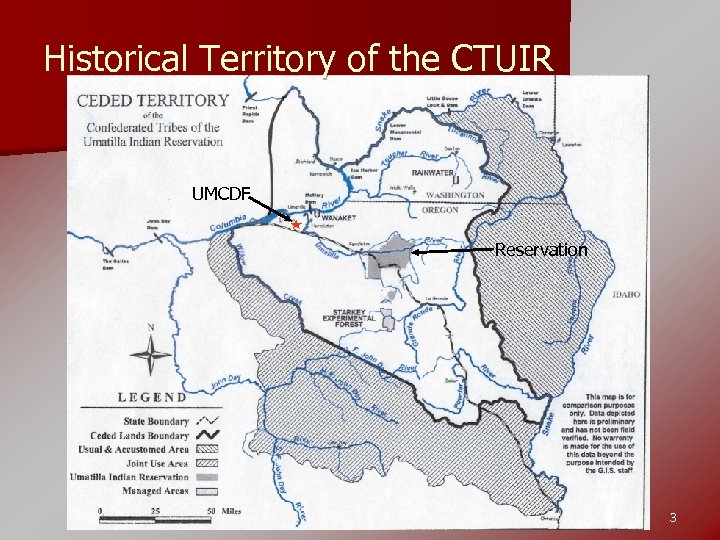 Historical Territory of the CTUIR UMCDF Reservation 3
 Umatilla Depot (UMCD) Army granted 14, 000 acres in 1941 for munitions depot (expanded to over 19, 000) n Chemical munitions have been stored since 1962 n Site stored 12% of the original U. S. stockpile of chemical agents n – – Nerve agents GB (sarin) and VX Blister agent HD On-site incinerator destroying munitions n Incinerator started in 2004, operated until 2012, full closure complete in 2014. n 4
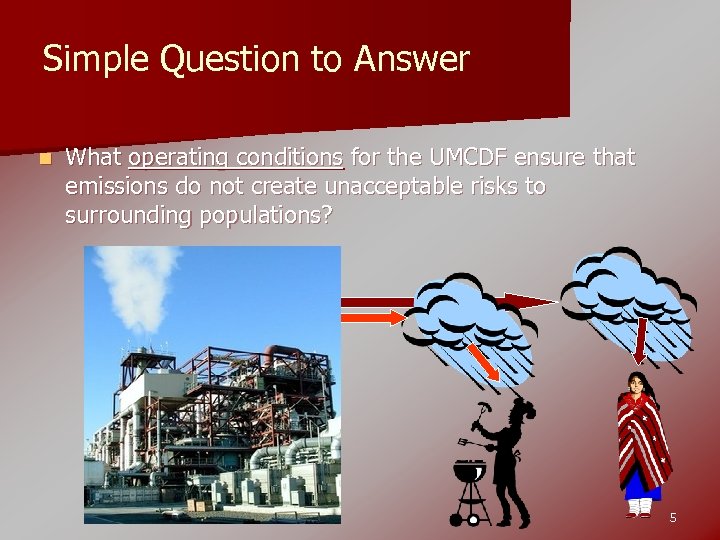 Simple Question to Answer n What operating conditions for the UMCDF ensure that emissions do not create unacceptable risks to surrounding populations? 5
 Acceptable Limits n 2004 HHRA Work Plan established the following limits: – – – No individual Cancer Risks above 1 E-6 Total Cancer Risk below 1 E-5 Individual Hazard Quotient below 0. 25 Total HI for specific effect and organ below 0. 25 Acute Inhalation HQ for individual compounds below 1. 0 – Ecological Screening Quotients below 1. 0 6
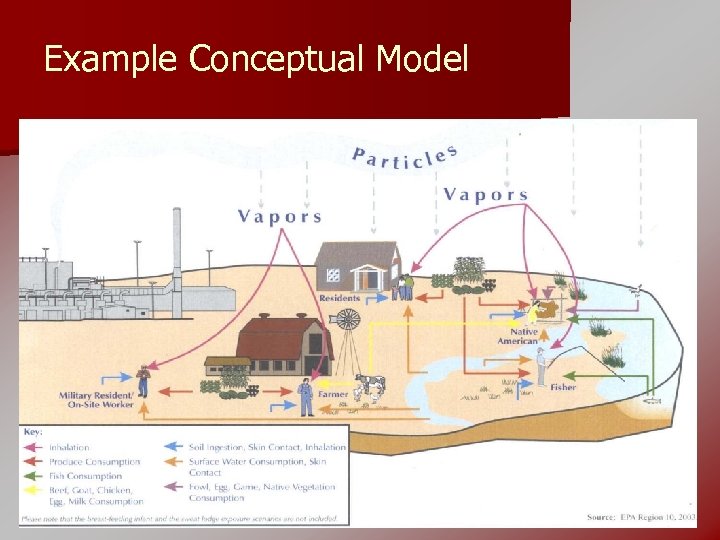 Example Conceptual Model 7
 Steps to Risk Assessment Identify emissions characteristics (flow rate, particulates, composition, temperature, etc) n Model contaminant transport and deposition through the air n Estimate exposure mechanisms n – Exposure routs (inhalation, dermal contact, ingestion) – Lifestyle Estimate toxicity of each compound n Compute dose and risk n 8
 Modeling Transport and Deposition – Data Requirements n n n n Meteorological data Topography data Land use Building geometric data Source geometry data Source emission data Risk data } Air Modeling 9
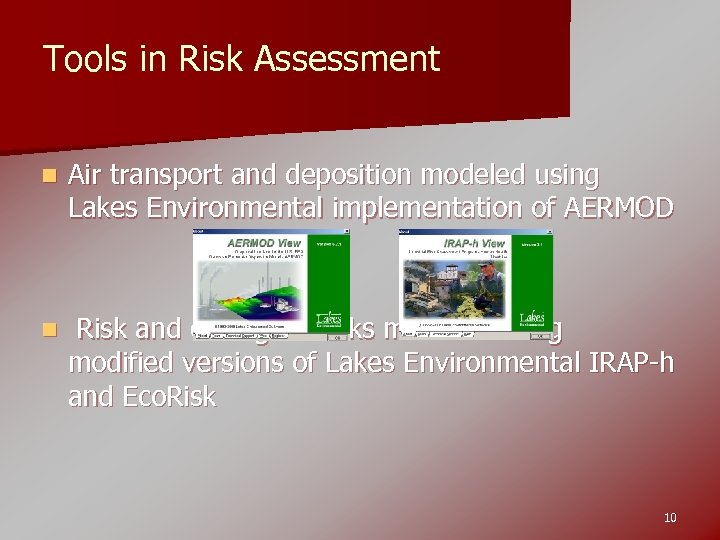 Tools in Risk Assessment n Air transport and deposition modeled using Lakes Environmental implementation of AERMOD n Risk and ecological risks modeled using modified versions of Lakes Environmental IRAP-h and Eco. Risk 10
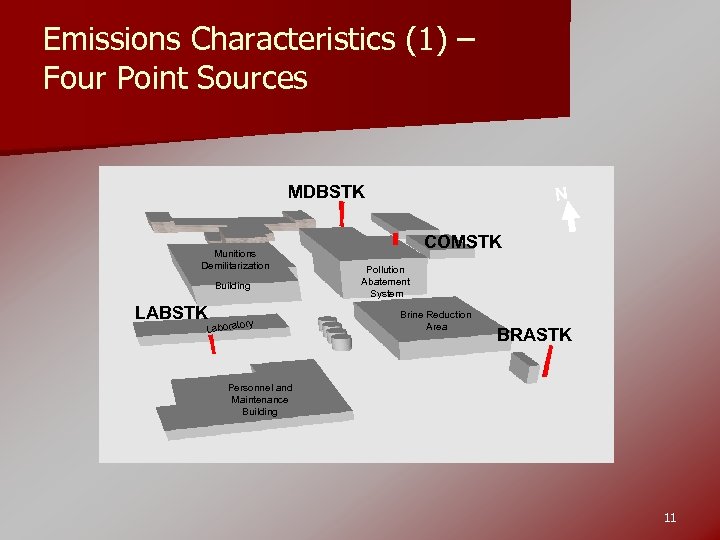 Emissions Characteristics (1) – Four Point Sources MDBSTK Munitions Demilitarization Building LABSTK ry Laborato N COMSTK Pollution Abatement System Brine Reduction Area BRASTK Personnel and Maintenance Building 11
 Emission Characteristics (2) – Common Stack n n Common stack receives emissions from four very different furnaces (Liquid incinerators 1&2, Deactivation Furnace, Metal Parts Furnace) Use of each furnace varies by type of munitions begin processed Time weighted scaling methodology was developed to estimate a single emissions rate for evaluating chronic risks Upset for each furnace evaluated separately for estimating acute risks 12
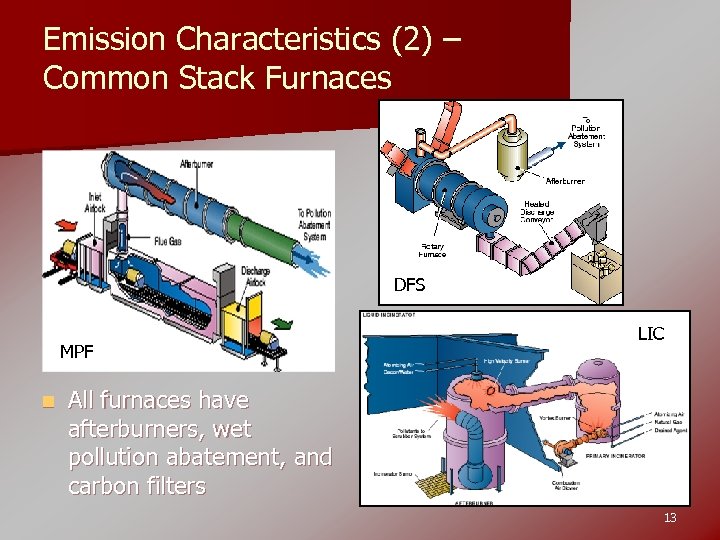 Emission Characteristics (2) – Common Stack Furnaces DFS MPF n LIC All furnaces have afterburners, wet pollution abatement, and carbon filters 13
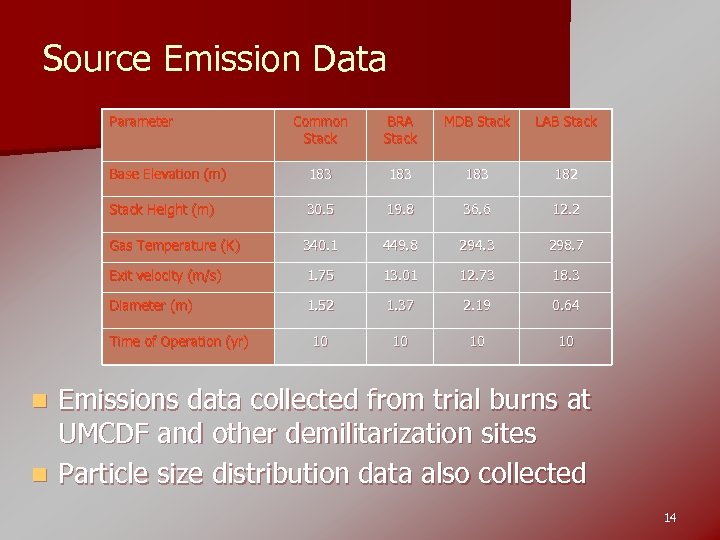 Source Emission Data Parameter Common Stack BRA Stack MDB Stack LAB Stack Base Elevation (m) 183 183 182 Stack Height (m) 30. 5 19. 8 36. 6 12. 2 Gas Temperature (K) 340. 1 449. 8 294. 3 298. 7 Exit velocity (m/s) 1. 75 13. 01 12. 73 18. 3 Diameter (m) 1. 52 1. 37 2. 19 0. 64 10 10 Time of Operation (yr) Emissions data collected from trial burns at UMCDF and other demilitarization sites n Particle size distribution data also collected n 14
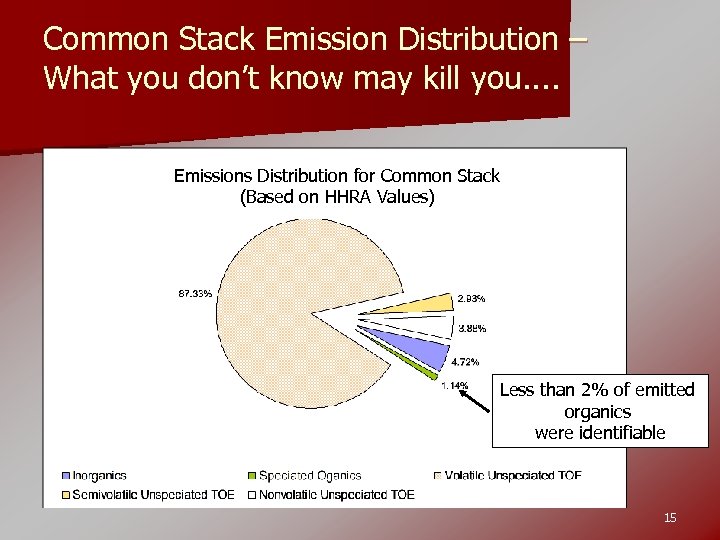 Common Stack Emission Distribution – What you don’t know may kill you. . Emissions Distribution for Common Stack (Based on HHRA Values) Less than 2% of emitted organics were identifiable 15
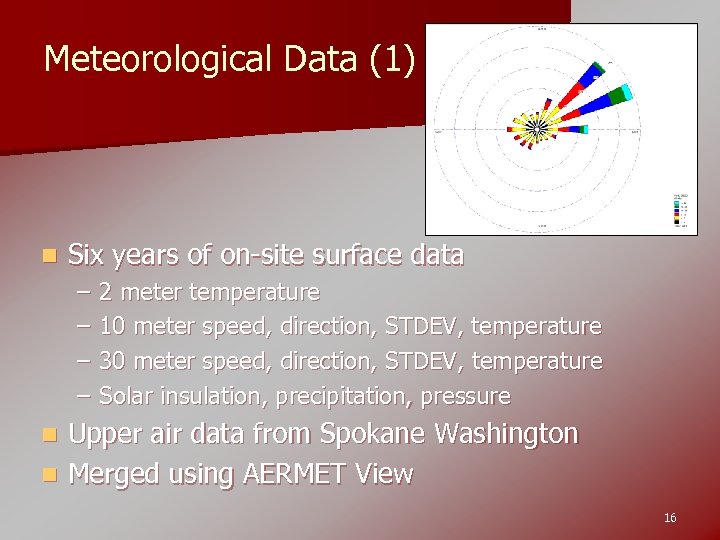 Meteorological Data (1) n Six years of on-site surface data – – 2 meter temperature 10 meter speed, direction, STDEV, temperature 30 meter speed, direction, STDEV, temperature Solar insulation, precipitation, pressure Upper air data from Spokane Washington n Merged using AERMET View n 16
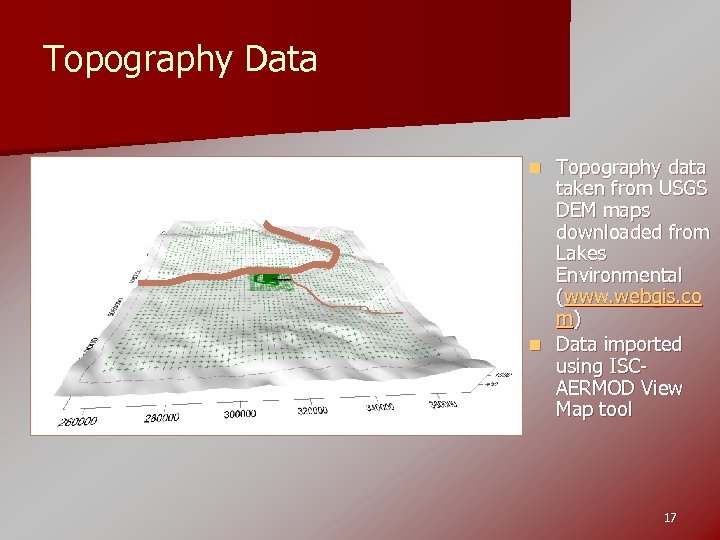 Topography Data Topography data taken from USGS DEM maps downloaded from Lakes Environmental (www. webgis. co m) n Data imported using ISCAERMOD View Map tool n Columbia River Umatilla River 17
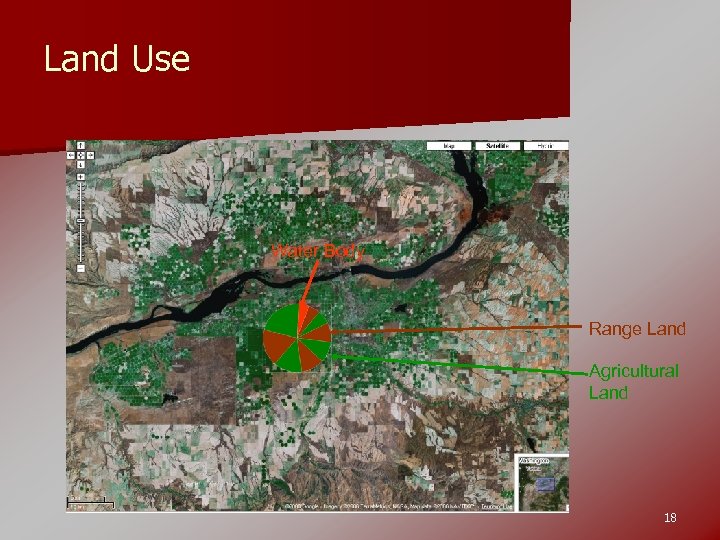 Land Use Water Body Range Land Agricultural Land 18
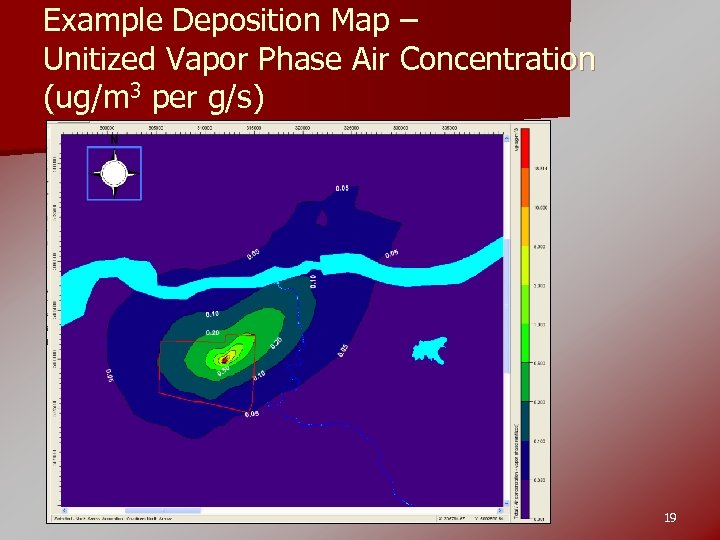 Example Deposition Map – Unitized Vapor Phase Air Concentration (ug/m 3 per g/s) 19
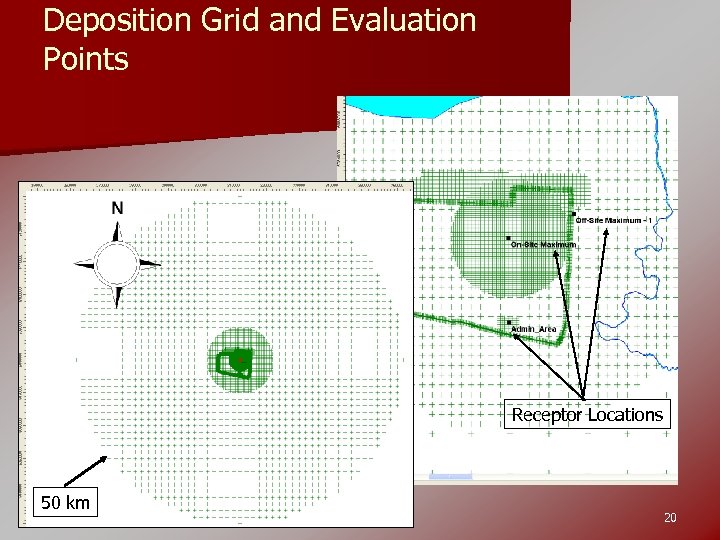 Deposition Grid and Evaluation Points Receptor Locations 50 km 20
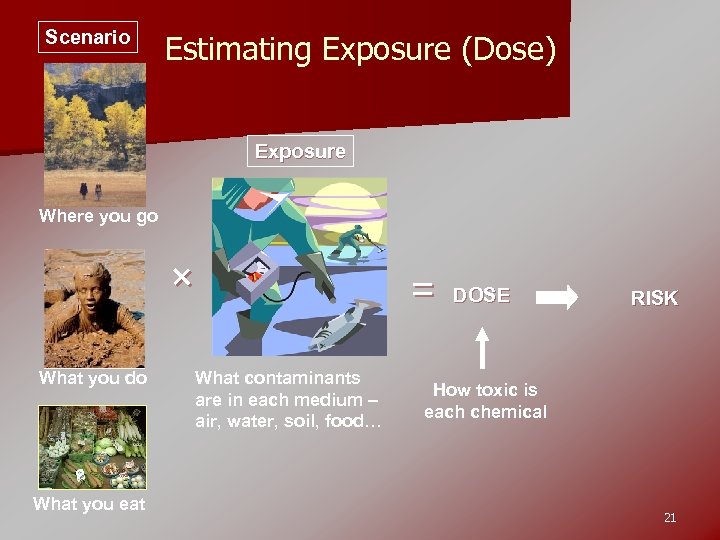 Scenario Estimating Exposure (Dose) Exposure Where you go × What you do What you eat = What contaminants are in each medium – air, water, soil, food… DOSE RISK How toxic is each chemical 21
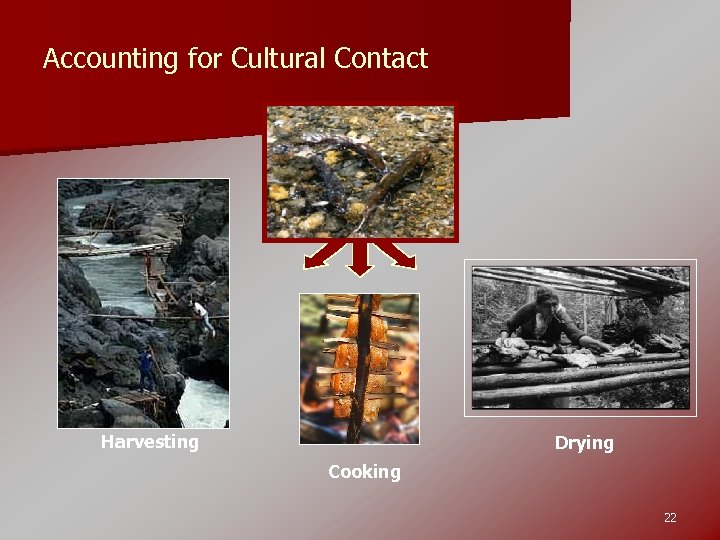 Accounting for Cultural Contact Harvesting Drying Cooking 22
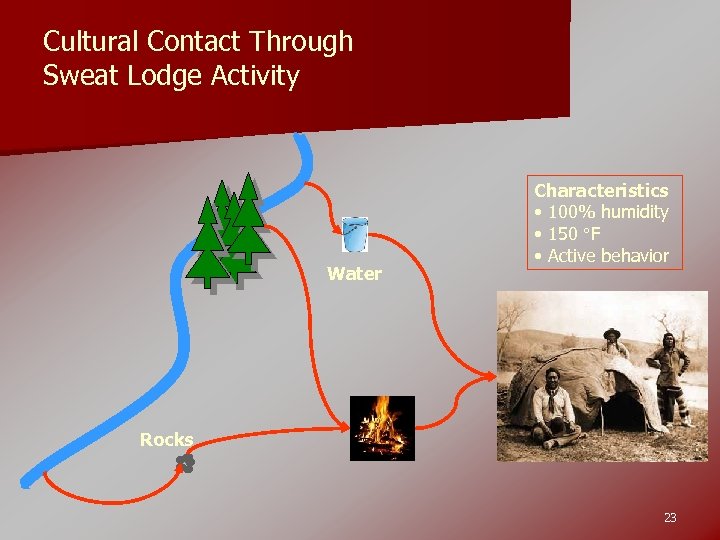 Cultural Contact Through Sweat Lodge Activity Water Characteristics • 100% humidity • 150 F • Active behavior Rocks 23
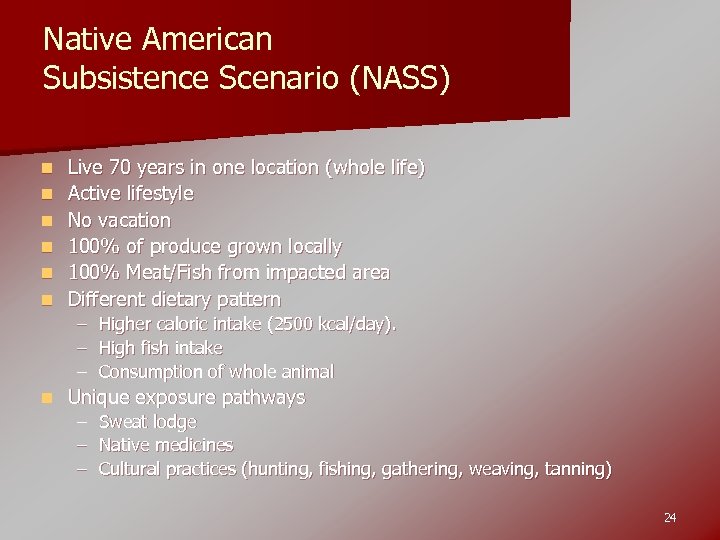 Native American Subsistence Scenario (NASS) n n n Live 70 years in one location (whole life) Active lifestyle No vacation 100% of produce grown locally 100% Meat/Fish from impacted area Different dietary pattern – Higher caloric intake (2500 kcal/day). – High fish intake – Consumption of whole animal n Unique exposure pathways – – – Sweat lodge Native medicines Cultural practices (hunting, fishing, gathering, weaving, tanning) 24
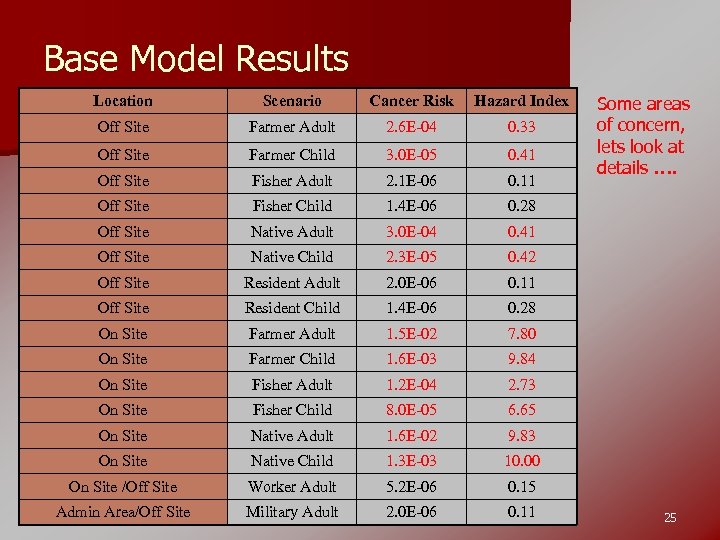 Base Model Results Location Scenario Cancer Risk Hazard Index Off Site Farmer Adult 2. 6 E-04 0. 33 Off Site Farmer Child 3. 0 E-05 0. 41 Off Site Fisher Adult 2. 1 E-06 0. 11 Off Site Fisher Child 1. 4 E-06 0. 28 Off Site Native Adult 3. 0 E-04 0. 41 Off Site Native Child 2. 3 E-05 0. 42 Off Site Resident Adult 2. 0 E-06 0. 11 Off Site Resident Child 1. 4 E-06 0. 28 On Site Farmer Adult 1. 5 E-02 7. 80 On Site Farmer Child 1. 6 E-03 9. 84 On Site Fisher Adult 1. 2 E-04 2. 73 On Site Fisher Child 8. 0 E-05 6. 65 On Site Native Adult 1. 6 E-02 9. 83 On Site Native Child 1. 3 E-03 10. 00 On Site /Off Site Worker Adult 5. 2 E-06 0. 15 Admin Area/Off Site Military Adult 2. 0 E-06 0. 11 Some areas of concern, lets look at details …. 25
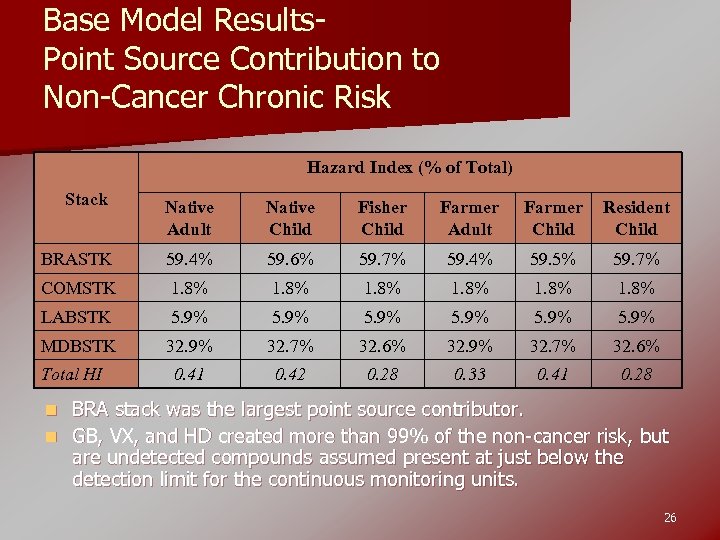 Base Model Results. Point Source Contribution to Non-Cancer Chronic Risk Hazard Index (% of Total) Stack Native Adult Native Child Fisher Child Farmer Adult Farmer Child Resident Child BRASTK 59. 4% 59. 6% 59. 7% 59. 4% 59. 5% 59. 7% COMSTK 1. 8% LABSTK 5. 9% MDBSTK 32. 9% 32. 7% 32. 6% 0. 41 0. 42 0. 28 0. 33 0. 41 0. 28 Total HI BRA stack was the largest point source contributor. n GB, VX, and HD created more than 99% of the non-cancer risk, but are undetected compounds assumed present at just below the detection limit for the continuous monitoring units. n 26
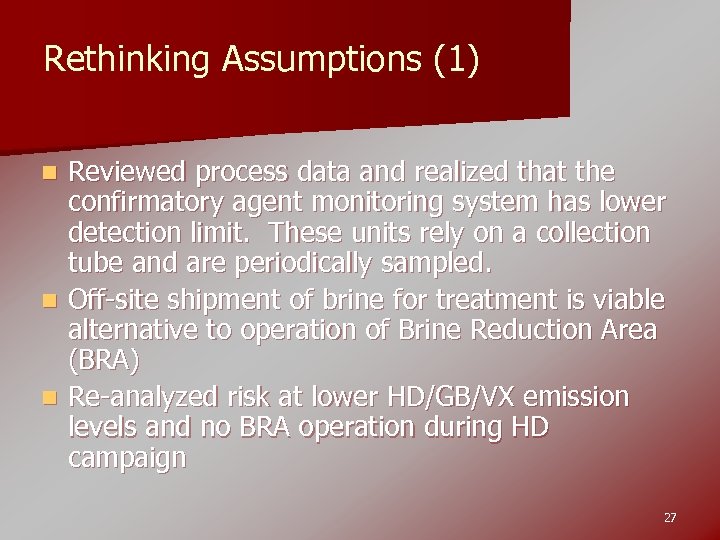 Rethinking Assumptions (1) Reviewed process data and realized that the confirmatory agent monitoring system has lower detection limit. These units rely on a collection tube and are periodically sampled. n Off-site shipment of brine for treatment is viable alternative to operation of Brine Reduction Area (BRA) n Re-analyzed risk at lower HD/GB/VX emission levels and no BRA operation during HD campaign n 27
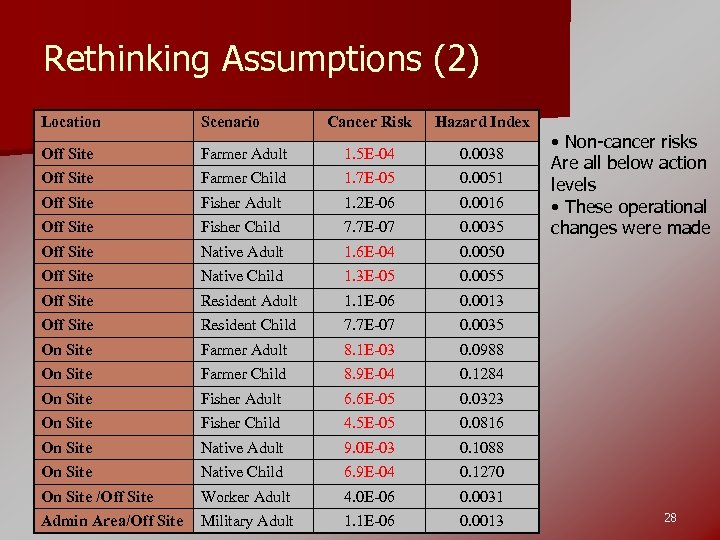 Rethinking Assumptions (2) Location Scenario Cancer Risk Hazard Index Off Site Farmer Adult 1. 5 E-04 0. 0038 Off Site Farmer Child 1. 7 E-05 0. 0051 Off Site Fisher Adult 1. 2 E-06 0. 0016 Off Site Fisher Child 7. 7 E-07 0. 0035 Off Site Native Adult 1. 6 E-04 0. 0050 Off Site Native Child 1. 3 E-05 0. 0055 Off Site Resident Adult 1. 1 E-06 0. 0013 Off Site Resident Child 7. 7 E-07 0. 0035 On Site Farmer Adult 8. 1 E-03 0. 0988 On Site Farmer Child 8. 9 E-04 0. 1284 On Site Fisher Adult 6. 6 E-05 0. 0323 On Site Fisher Child 4. 5 E-05 0. 0816 On Site Native Adult 9. 0 E-03 0. 1088 On Site Native Child 6. 9 E-04 0. 1270 On Site /Off Site Worker Adult 4. 0 E-06 0. 0031 Admin Area/Off Site Military Adult 1. 1 E-06 0. 0013 • Non-cancer risks Are all below action levels • These operational changes were made 28
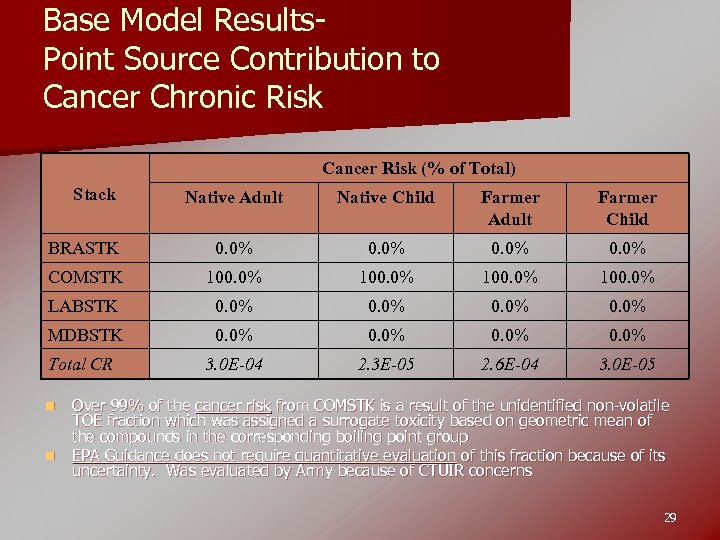 Base Model Results. Point Source Contribution to Cancer Chronic Risk Cancer Risk (% of Total) Stack Native Adult Native Child Farmer Adult Farmer Child BRASTK 0. 0% COMSTK 100. 0% LABSTK 0. 0% MDBSTK 0. 0% Total CR 3. 0 E-04 2. 3 E-05 2. 6 E-04 3. 0 E-05 n n Over 99% of the cancer risk from COMSTK is a result of the unidentified non-volatile TOE fraction which was assigned a surrogate toxicity based on geometric mean of the compounds in the corresponding boiling point group EPA Guidance does not require quantitative evaluation of this fraction because of its uncertainty. Was evaluated by Army because of CTUIR concerns 29
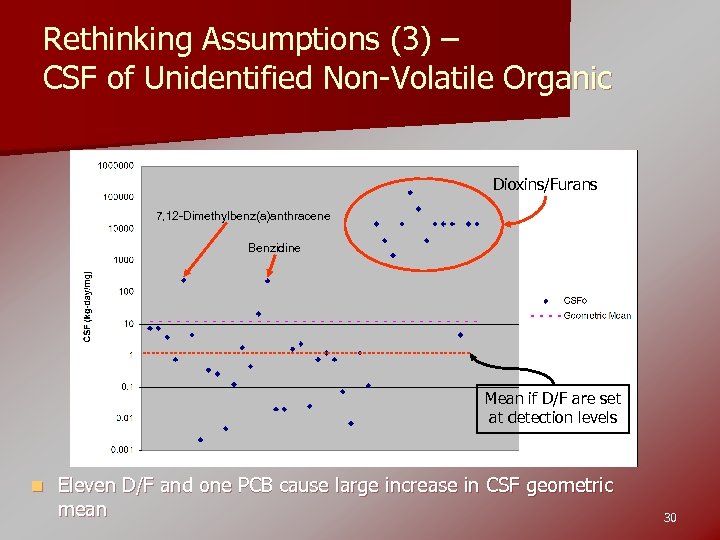 Rethinking Assumptions (3) – CSF of Unidentified Non-Volatile Organic Dioxins/Furans 7, 12 -Dimethylbenz(a)anthracene Benzidine Mean if D/F are set at detection levels n Eleven D/F and one PCB cause large increase in CSF geometric mean 30
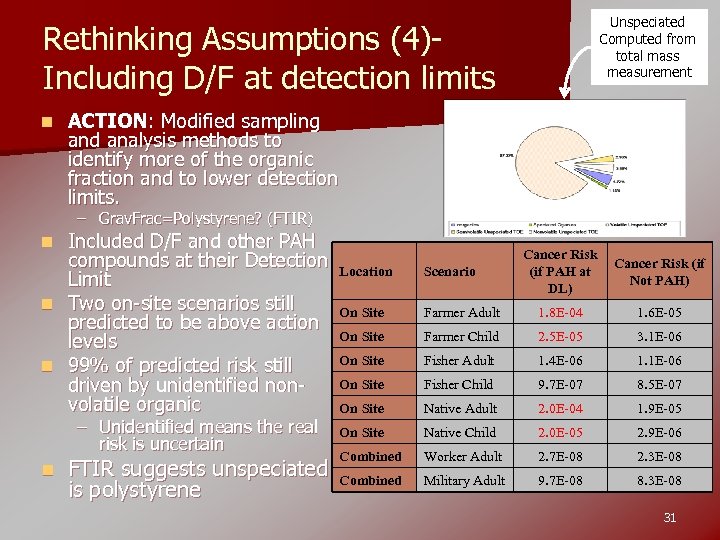 Unspeciated Computed from total mass measurement Rethinking Assumptions (4)Including D/F at detection limits n ACTION: Modified sampling and analysis methods to identify more of the organic fraction and to lower detection limits. – Grav. Frac=Polystyrene? (FTIR) Included D/F and other PAH compounds at their Detection Limit n Two on-site scenarios still predicted to be above action levels n 99% of predicted risk still driven by unidentified nonvolatile organic n – Unidentified means the real risk is uncertain n FTIR suggests unspeciated is polystyrene Cancer Risk (if PAH at DL) Cancer Risk (if Not PAH) Location Scenario On Site Farmer Adult 1. 8 E-04 1. 6 E-05 On Site Farmer Child 2. 5 E-05 3. 1 E-06 On Site Fisher Adult 1. 4 E-06 1. 1 E-06 On Site Fisher Child 9. 7 E-07 8. 5 E-07 On Site Native Adult 2. 0 E-04 1. 9 E-05 On Site Native Child 2. 0 E-05 2. 9 E-06 Combined Worker Adult 2. 7 E-08 2. 3 E-08 Combined Military Adult 9. 7 E-08 8. 3 E-08 31
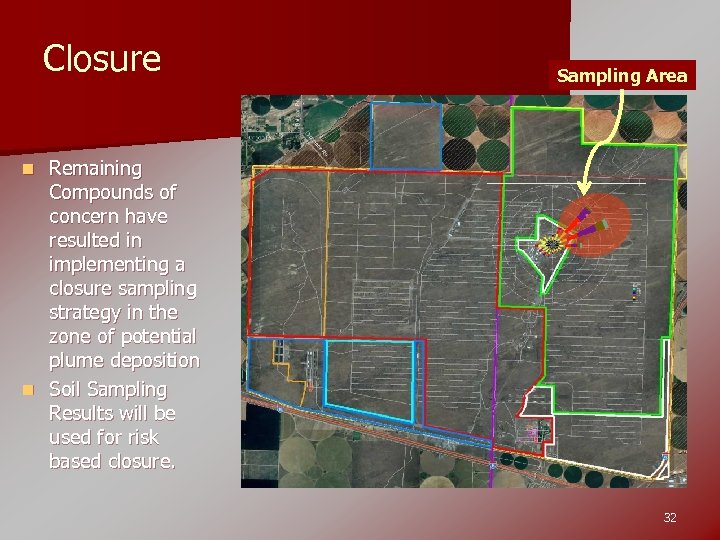 Closure Sampling Area Remaining Compounds of concern have resulted in implementing a closure sampling strategy in the zone of potential plume deposition n Soil Sampling Results will be used for risk based closure. n 32
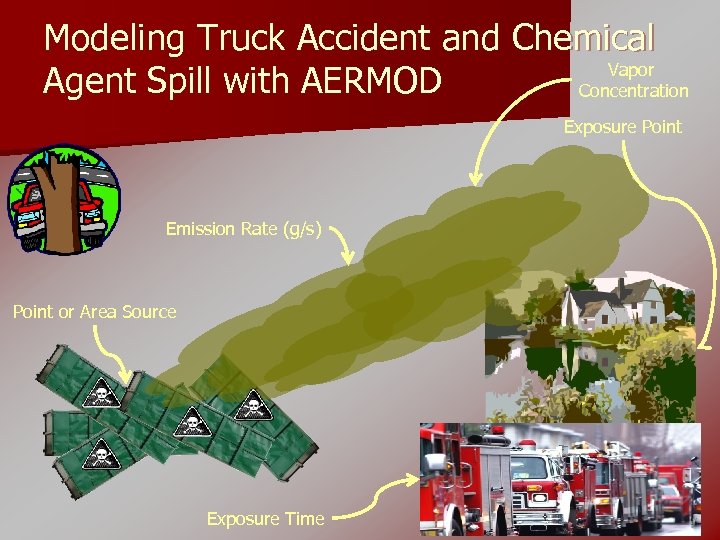 Modeling Truck Accident and Chemical Vapor Agent Spill with AERMOD Concentration Exposure Point Emission Rate (g/s) Point or Area Source Exposure Time 33
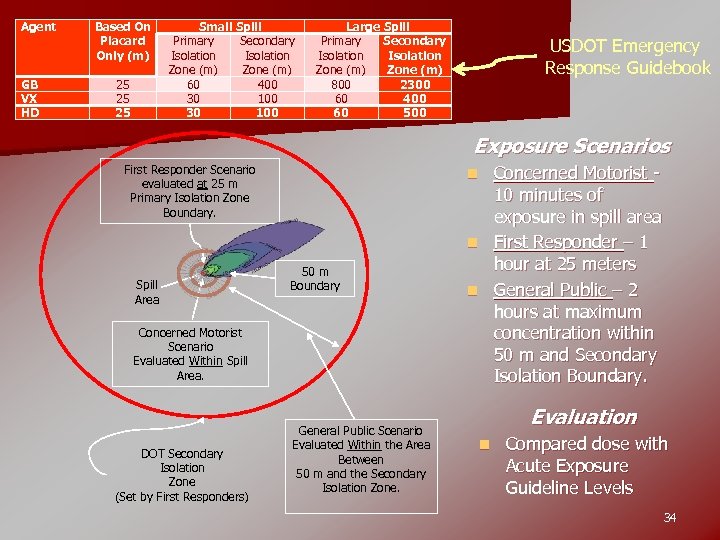 Agent GB VX HD Based On Placard Only (m) 25 25 25 Small Spill Primary Secondary Isolation Zone (m) 60 400 30 100 Large Spill Primary Secondary Isolation Zone (m) 800 2300 60 400 60 500 USDOT Emergency Response Guidebook Exposure Scenarios First Responder Scenario evaluated at 25 m Primary Isolation Zone Boundary. Spill Area 50 m Boundary Concerned Motorist Scenario Evaluated Within Spill Area. DOT Secondary Isolation Zone (Set by First Responders) Concerned Motorist 10 minutes of exposure in spill area n First Responder – 1 hour at 25 meters n General Public – 2 hours at maximum concentration within 50 m and Secondary Isolation Boundary. n General Public Scenario Evaluated Within the Area Between 50 m and the Secondary Isolation Zone. Evaluation n Compared dose with Acute Exposure Guideline Levels 34
 Conclusions AERMOD used to model emission from a chemical munitions incinerator at Umatilla, Oregon n Emissions use to evaluate future health risks to Native Americans using the impacted lands. n Risk results led to operation changes and modified closure strategy. n AERMOD also applied modeling plume development n 35
 Contact Information Rod Skeen, Ph. D. , P. E. Division Leader (541) 429 -7420 rodskeen@ctuir. org Barbara Harper, Ph. D. Division Leader (541) 429 -7950 Barbaraharper@ctuir. org 36