 Скачать презентацию Application-Level Fault Tolerance for Embedded Real-Time Systems Israel
fd7f36acfd23c8769ea85d9b1652d36a.ppt
- Количество слайдов: 42



Application-Level Fault Tolerance for Embedded Real-Time Systems Israel Koren Department of Electrical & Computer Engineering University of Massachusetts Amherst, MA, 01003 Supported in part by DARPA, NASA/JPL and NSF 1
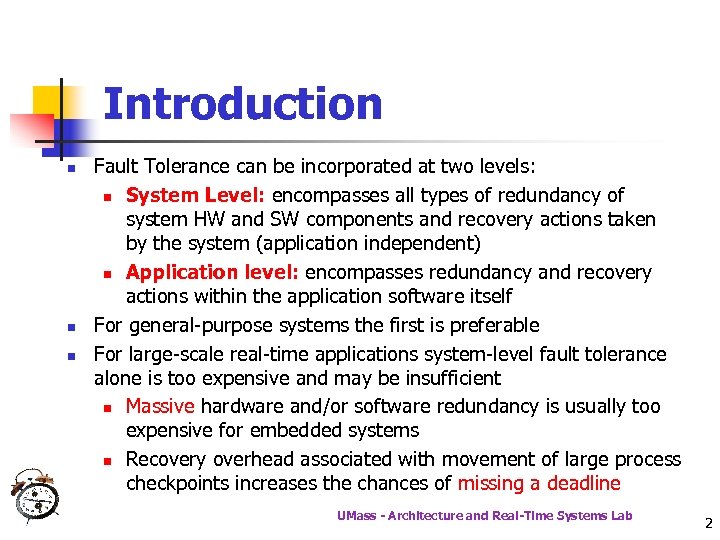
Introduction n Fault Tolerance can be incorporated at two levels: n System Level: encompasses all types of redundancy of system HW and SW components and recovery actions taken by the system (application independent) n Application level: encompasses redundancy and recovery actions within the application software itself For general-purpose systems the first is preferable For large-scale real-time applications system-level fault tolerance alone is too expensive and may be insufficient n Massive hardware and/or software redundancy is usually too expensive for embedded systems n Recovery overhead associated with movement of large process checkpoints increases the chances of missing a deadline UMass - Architecture and Real-Time Systems Lab 2
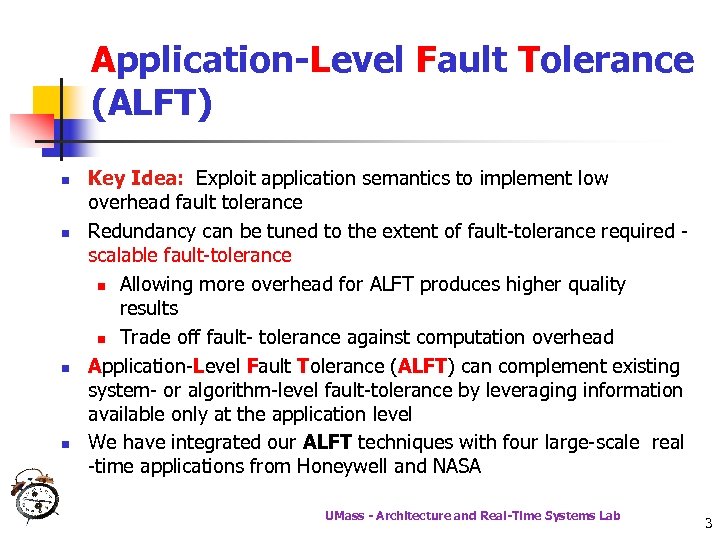
Application-Level Fault Tolerance (ALFT) n n Key Idea: Exploit application semantics to implement low overhead fault tolerance Redundancy can be tuned to the extent of fault-tolerance required scalable fault-tolerance n Allowing more overhead for ALFT produces higher quality results n Trade off fault- tolerance against computation overhead Application-Level Fault Tolerance (ALFT) can complement existing system- or algorithm-level fault-tolerance by leveraging information available only at the application level We have integrated our ALFT techniques with four large-scale real -time applications from Honeywell and NASA UMass - Architecture and Real-Time Systems Lab 3
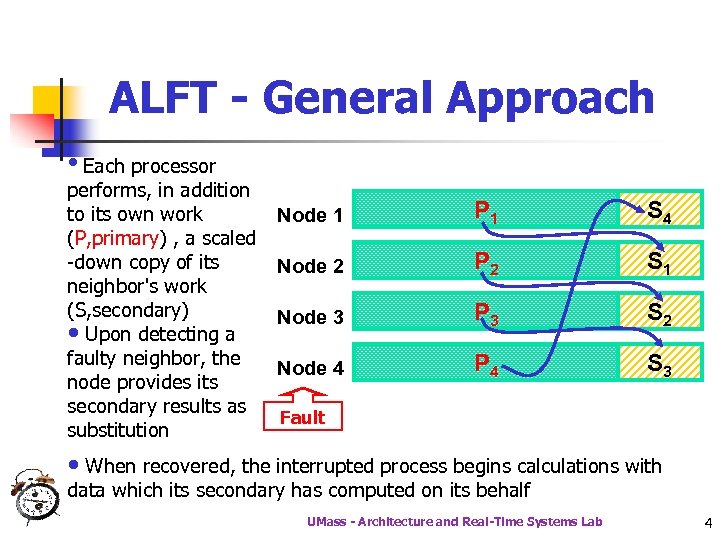
ALFT - General Approach • Each processor performs, in addition to its own work (P, primary) , a scaled -down copy of its neighbor's work (S, secondary) • Upon detecting a faulty neighbor, the node provides its secondary results as substitution Node 1 P 1 S 4 Node 2 P 2 S 1 Node 3 P 3 S 2 Node 4 P 4 S 3 Fault • When recovered, the interrupted process begins calculations with data which its secondary has computed on its behalf UMass - Architecture and Real-Time Systems Lab 4
Issues to be resolved n n n How to scale down the secondary? n Precision vs. overhead Should we always run the secondaries? The answers are application dependent UMass - Architecture and Real-Time Systems Lab 5
Benchmark Applications n n n Real-Time applications used for benchmarking: Applications from Honeywell n RTHT (real-time hypothesis tracking) n ABF (adaptive beam forming) Applications from NASA’s REE suite n OTIS (orbital thermal imaging spectrometer) n NGST (next generation space telescope) UMass - Architecture and Real-Time Systems Lab 6
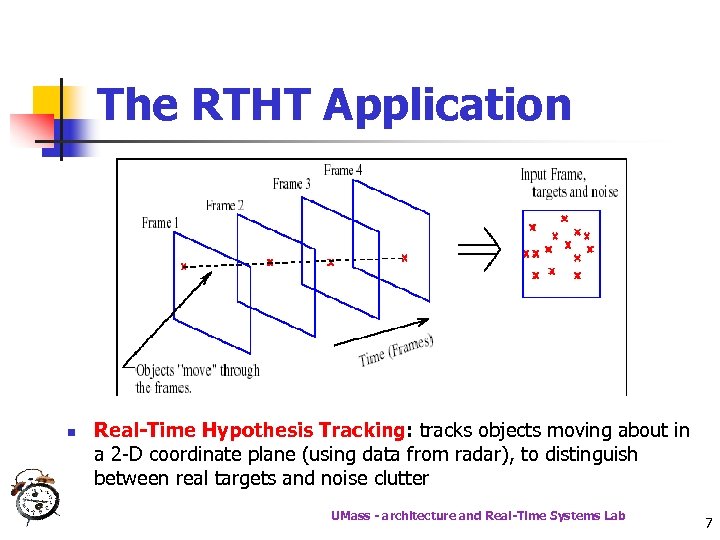
The RTHT Application n Real-Time Hypothesis Tracking: tracks objects moving about in a 2 -D coordinate plane (using data from radar), to distinguish between real targets and noise clutter UMass - architecture and Real-Time Systems Lab 7
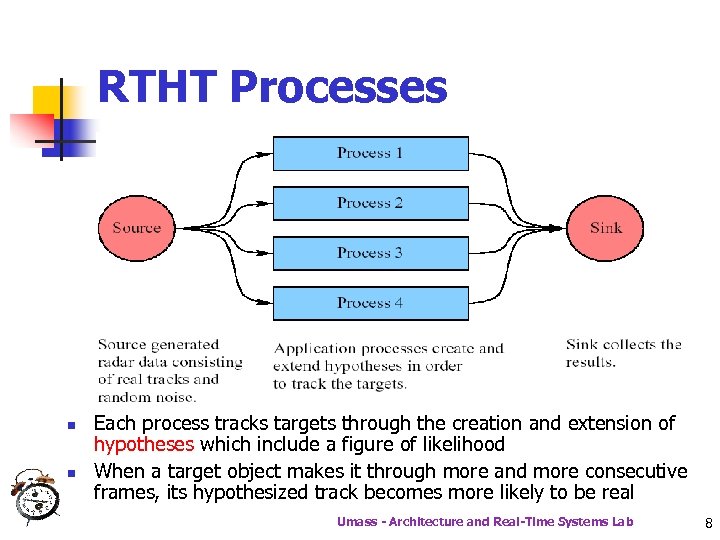
RTHT Processes n n Each process tracks targets through the creation and extension of hypotheses which include a figure of likelihood When a target object makes it through more and more consecutive frames, its hypothesized track becomes more likely to be real Umass - Architecture and Real-Time Systems Lab 8
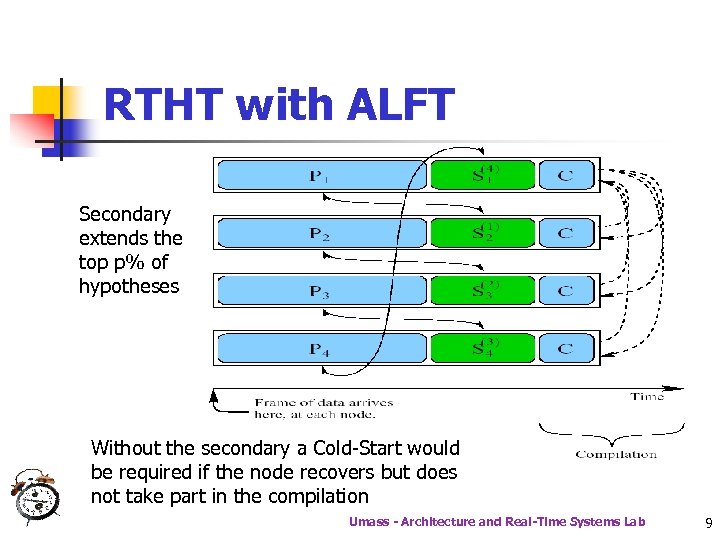
RTHT with ALFT Secondary extends the top p% of hypotheses Without the secondary a Cold-Start would be required if the node recovers but does not take part in the compilation Umass - Architecture and Real-Time Systems Lab 9
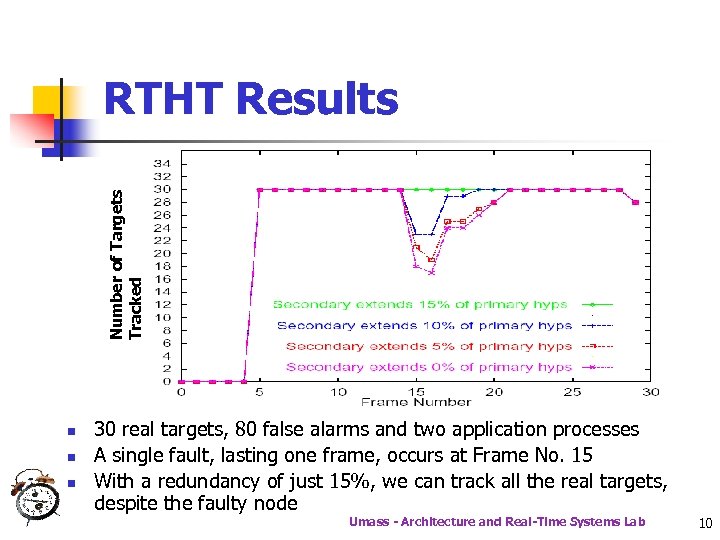
Number of Targets Tracked RTHT Results n n n 30 real targets, 80 false alarms and two application processes A single fault, lasting one frame, occurs at Frame No. 15 With a redundancy of just 15%, we can track all the real targets, despite the faulty node Umass - Architecture and Real-Time Systems Lab 10
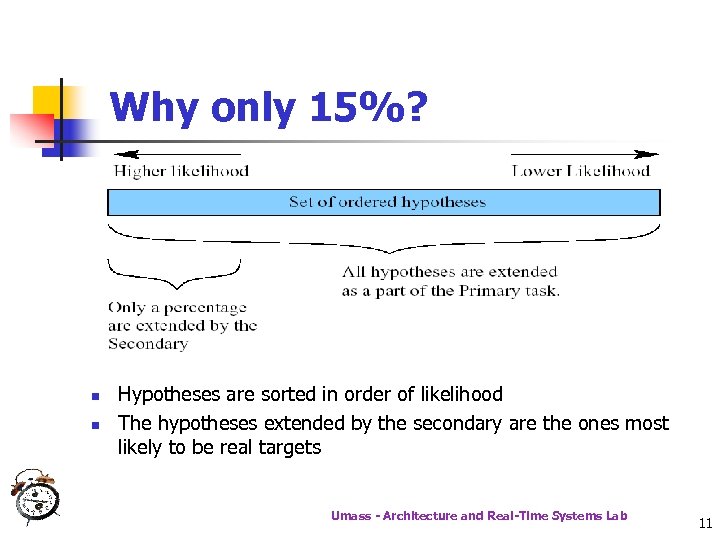
Why only 15%? n n Hypotheses are sorted in order of likelihood The hypotheses extended by the secondary are the ones most likely to be real targets Umass - Architecture and Real-Time Systems Lab 11
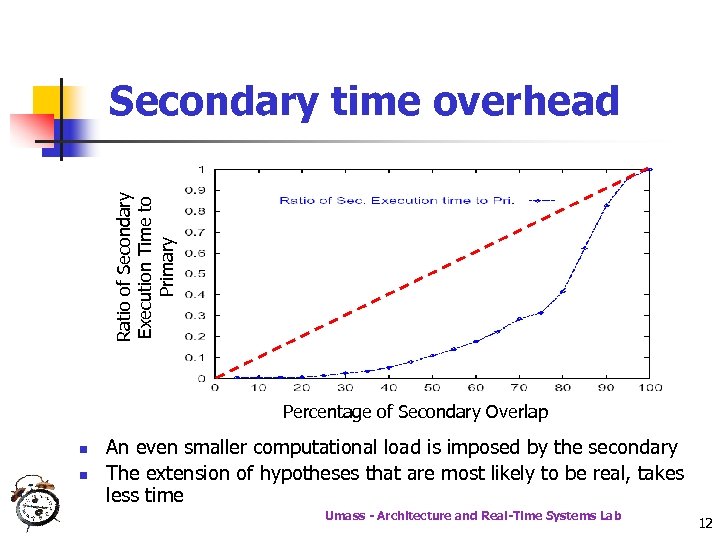
Ratio of Secondary Execution Time to Primary Secondary time overhead Percentage of Secondary Overlap n n An even smaller computational load is imposed by the secondary The extension of hypotheses that are most likely to be real, takes less time Umass - Architecture and Real-Time Systems Lab 12
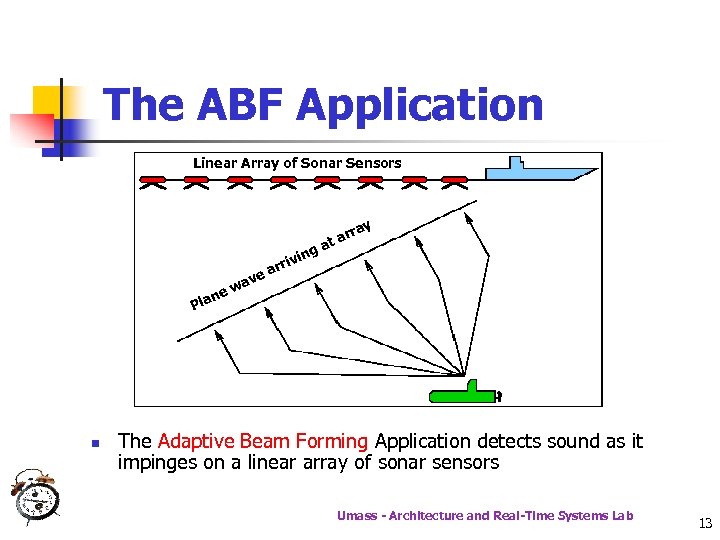
The ABF Application Linear Array of Sonar Sensors arr at g ay in ve wa e iv arr n Pla n The Adaptive Beam Forming Application detects sound as it impinges on a linear array of sonar sensors Umass - Architecture and Real-Time Systems Lab 13
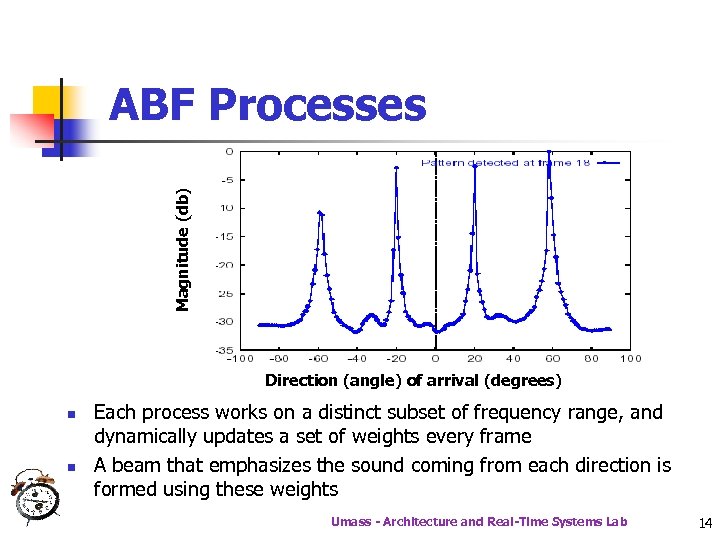
Magnitude (db) ABF Processes Direction (angle) of arrival (degrees) n n Each process works on a distinct subset of frequency range, and dynamically updates a set of weights every frame A beam that emphasizes the sound coming from each direction is formed using these weights Umass - Architecture and Real-Time Systems Lab 14
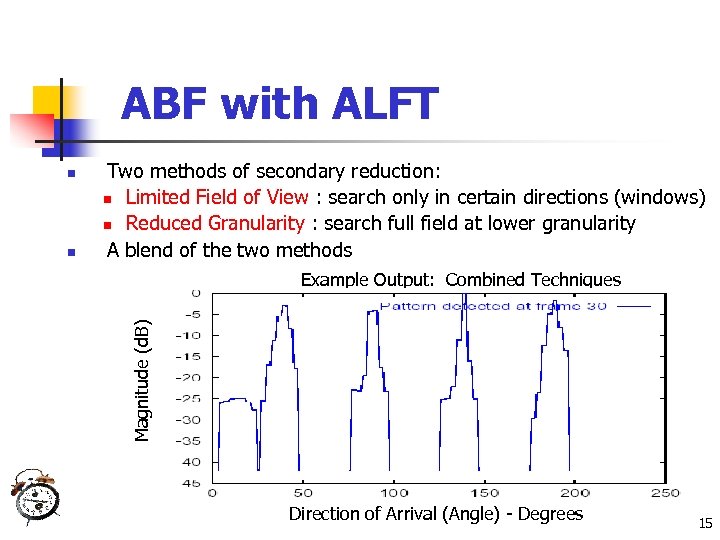
ABF with ALFT n Two methods of secondary reduction: n Limited Field of View : search only in certain directions (windows) n Reduced Granularity : search full field at lower granularity A blend of the two methods Example Output: Combined Techniques Magnitude (d. B) n Direction of Arrival (Angle) - Degrees 15
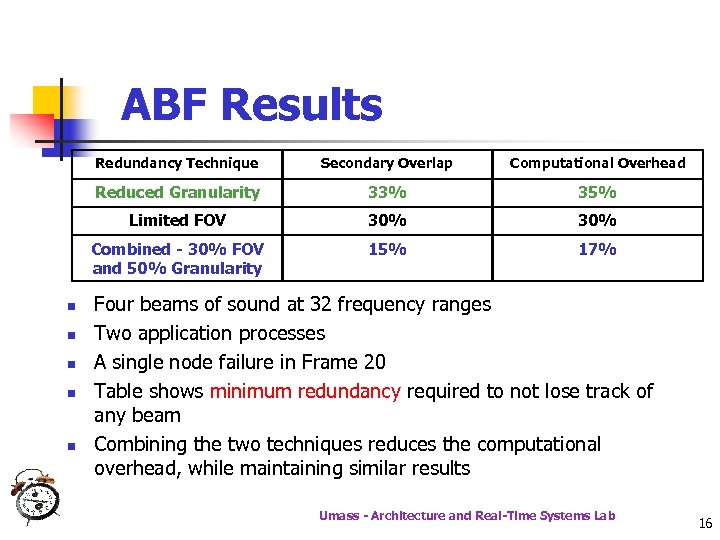
ABF Results Redundancy Technique n n 35% 30% Combined - 30% FOV and 50% Granularity n 33% Limited FOV n Computational Overhead Reduced Granularity n Secondary Overlap 15% 17% Four beams of sound at 32 frequency ranges Two application processes A single node failure in Frame 20 Table shows minimum redundancy required to not lose track of any beam Combining the two techniques reduces the computational overhead, while maintaining similar results Umass - Architecture and Real-Time Systems Lab 16
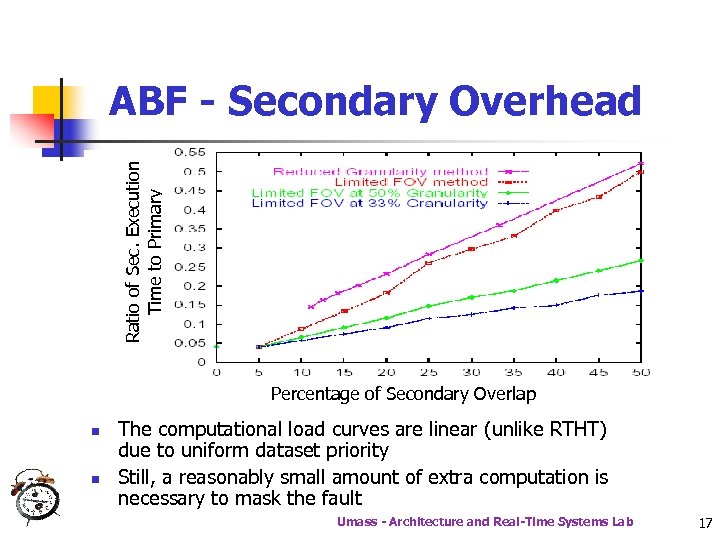
Ratio of Sec. Execution Time to Primary ABF - Secondary Overhead Percentage of Secondary Overlap n n The computational load curves are linear (unlike RTHT) due to uniform dataset priority Still, a reasonably small amount of extra computation is necessary to mask the fault Umass - Architecture and Real-Time Systems Lab 17
Adding Fault Detection n n Faults do not always completely disable a node n Malformed and corrupted data are more likely Hardware-disabling faults are easy to detect with watchdog hardware and “I am alive” messages n Faulty data is difficult to detect without application syntax Fault detection is a necessary condition for ALFT to schedule which secondary tasks to run Adding fault detection: employ acceptance filters to validate the primary’s output Secondary tasks can provide verification for ambiguous (possibly faulty) data Umass - Architecture and Real-Time Systems Lab 18
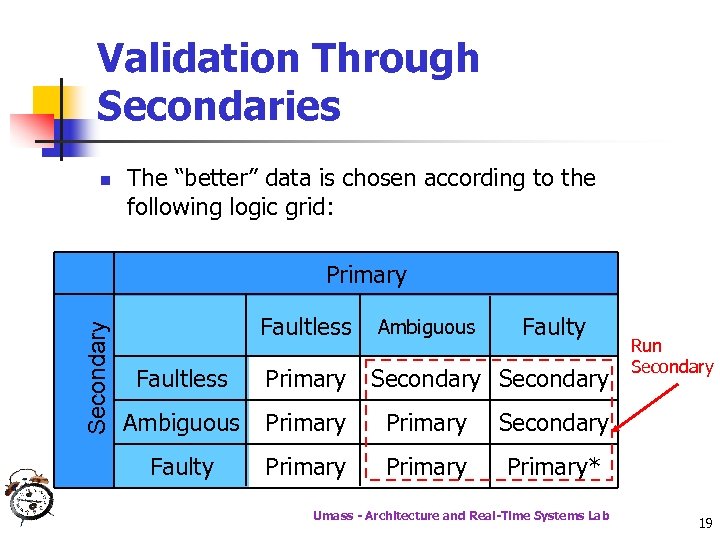
Validation Through Secondaries n The “better” data is chosen according to the following logic grid: Secondary Primary Faultless Ambiguous Faulty Faultless Primary Secondary Ambiguous Primary Secondary Faulty Primary Run Secondary Primary* Umass - Architecture and Real-Time Systems Lab 19
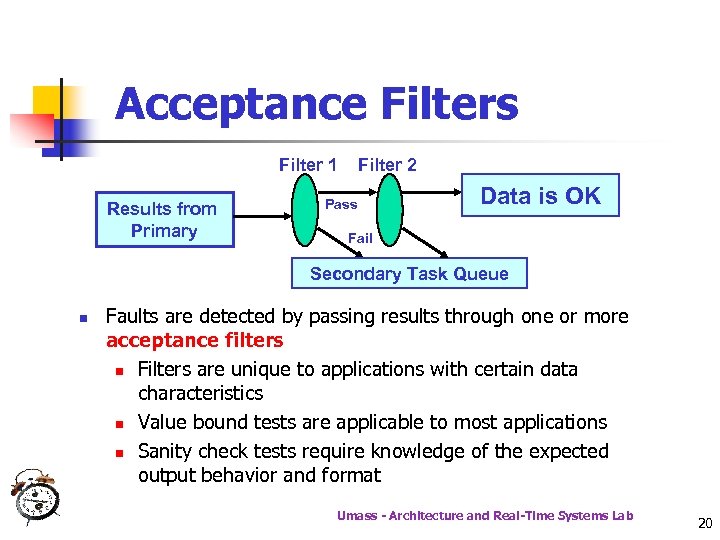
Acceptance Filters Filter 1 Results from Primary Filter 2 Pass Data is OK Fail Secondary Task Queue n Faults are detected by passing results through one or more acceptance filters n Filters are unique to applications with certain data characteristics n Value bound tests are applicable to most applications n Sanity check tests require knowledge of the expected output behavior and format Umass - Architecture and Real-Time Systems Lab 20
OTIS Characteristics n n ALFTD was applied to OTIS (Orbital Thermal Imaging Spectrometer) - part of the REE suite n OTIS reads radiation values from various bands and calculates temperature data Useful characteristics of OTIS’ output (temperature) n Local Correlation: Data changes gradually over an area n Absolute Bounds: Data falls within some expected realistic range UMass - Architecture and Real-Time Systems Lab 21
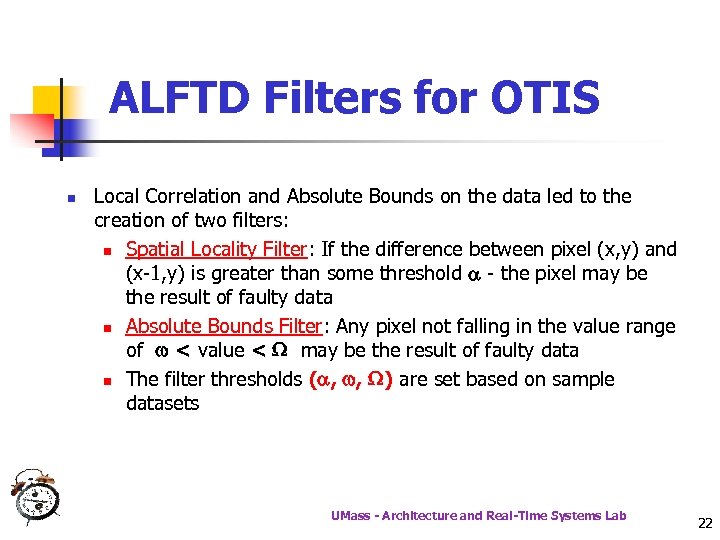
ALFTD Filters for OTIS n Local Correlation and Absolute Bounds on the data led to the creation of two filters: n Spatial Locality Filter: If the difference between pixel (x, y) and (x-1, y) is greater than some threshold - the pixel may be the result of faulty data n Absolute Bounds Filter: Any pixel not falling in the value range of < value < may be the result of faulty data n The filter thresholds ( , , ) are set based on sample datasets UMass - Architecture and Real-Time Systems Lab 22
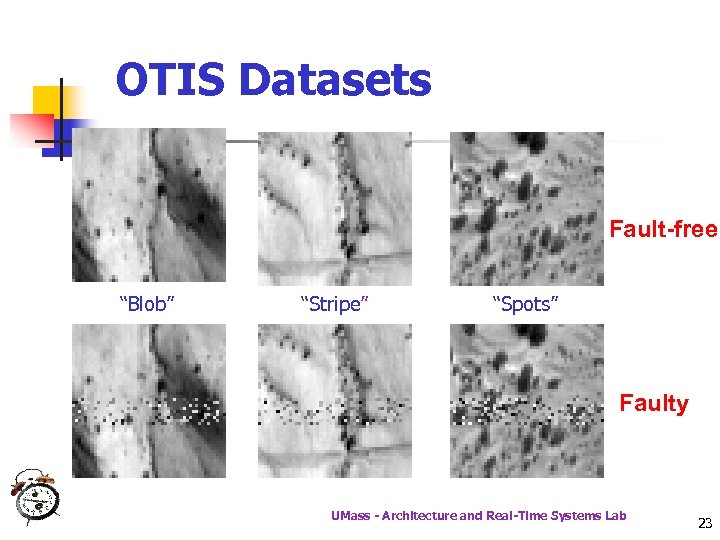
OTIS Datasets Fault-free “Blob” “Stripe” “Spots” Faulty UMass - Architecture and Real-Time Systems Lab 23
Filter Calibration n n ALFTD filters require calibration n Higher detection probability with low rate of false alarms can be achieved with well-tuned filters Calibration should be based on characteristics of the most frequent data UMass - Architecture and Real-Time Systems Lab 24
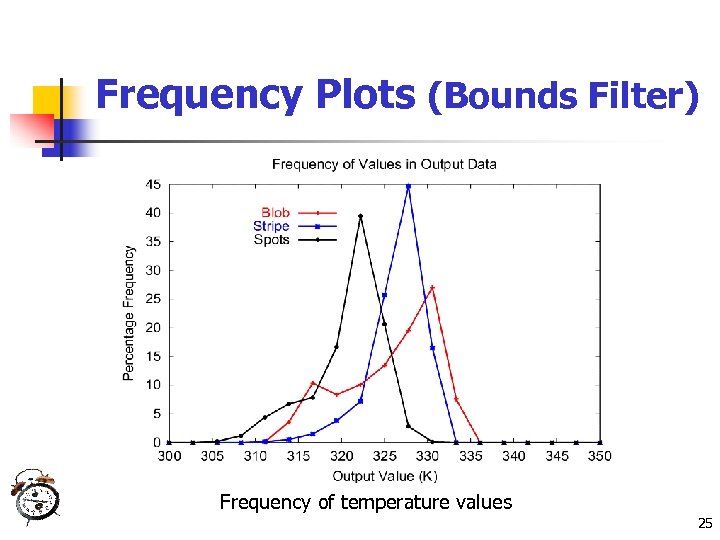
Frequency Plots (Bounds Filter) Frequency of temperature values 25
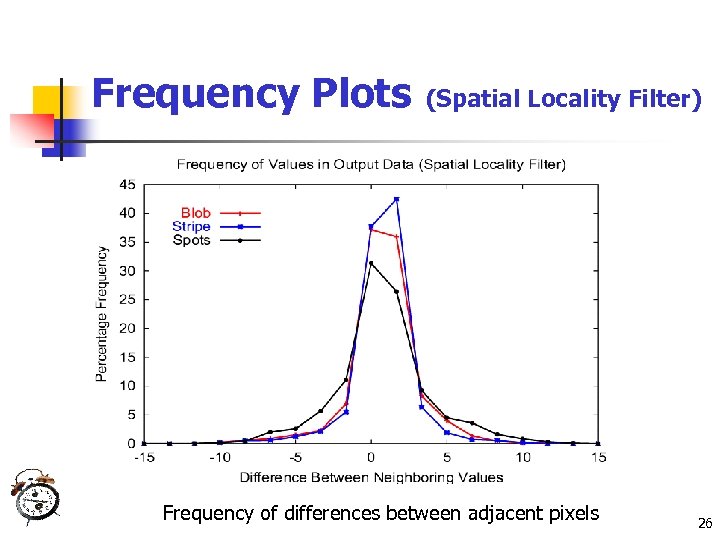
Frequency Plots (Spatial Locality Filter) Frequency of differences between adjacent pixels 26
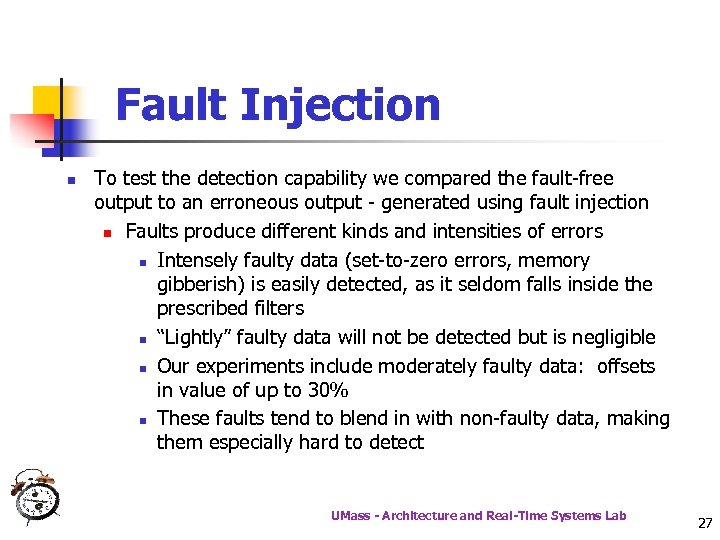
Fault Injection n To test the detection capability we compared the fault-free output to an erroneous output - generated using fault injection n Faults produce different kinds and intensities of errors n Intensely faulty data (set-to-zero errors, memory gibberish) is easily detected, as it seldom falls inside the prescribed filters n “Lightly” faulty data will not be detected but is negligible n Our experiments include moderately faulty data: offsets in value of up to 30% n These faults tend to blend in with non-faulty data, making them especially hard to detect UMass - Architecture and Real-Time Systems Lab 27
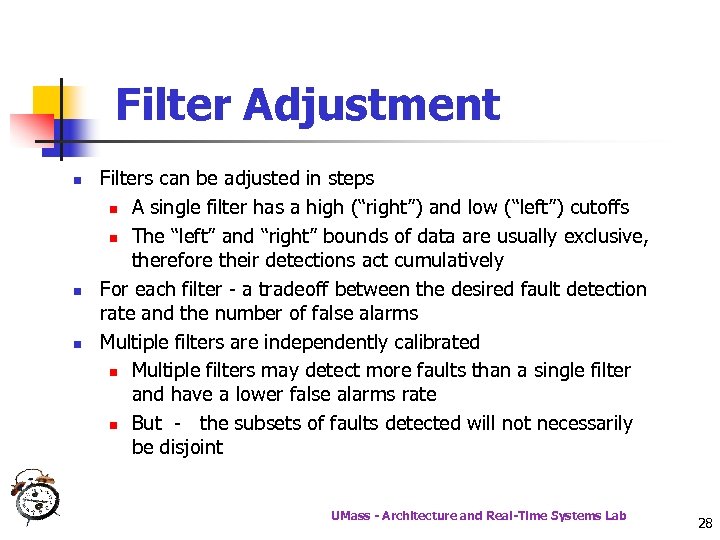
Filter Adjustment n n n Filters can be adjusted in steps n A single filter has a high (“right”) and low (“left”) cutoffs n The “left” and “right” bounds of data are usually exclusive, therefore their detections act cumulatively For each filter - a tradeoff between the desired fault detection rate and the number of false alarms Multiple filters are independently calibrated n Multiple filters may detect more faults than a single filter and have a lower false alarms rate n But the subsets of faults detected will not necessarily be disjoint UMass - Architecture and Real-Time Systems Lab 28
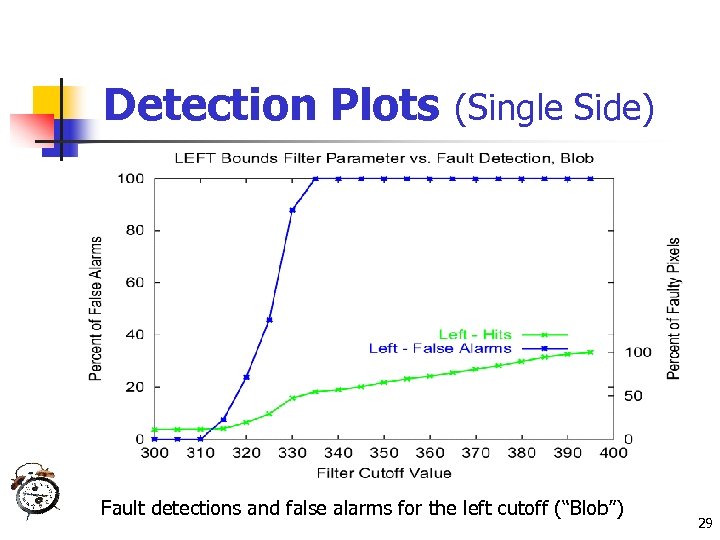
Detection Plots (Single Side) Fault detections and false alarms for the left cutoff (“Blob”) 29
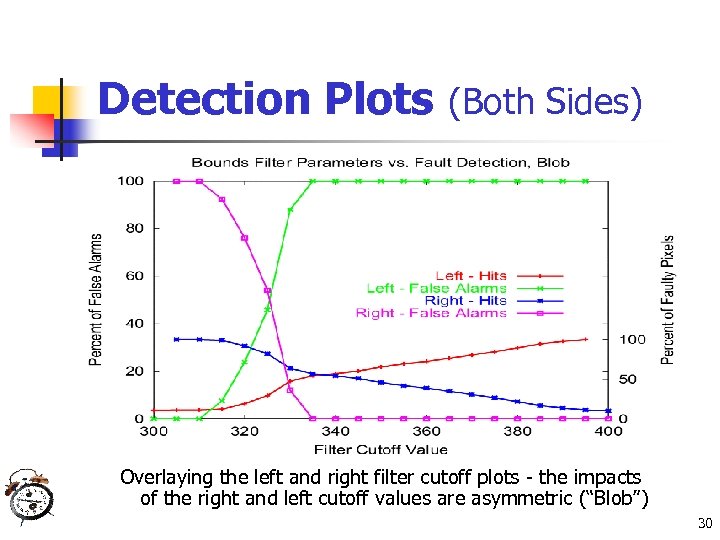
Detection Plots (Both Sides) Overlaying the left and right filter cutoff plots - the impacts of the right and left cutoff values are asymmetric (“Blob”) 30
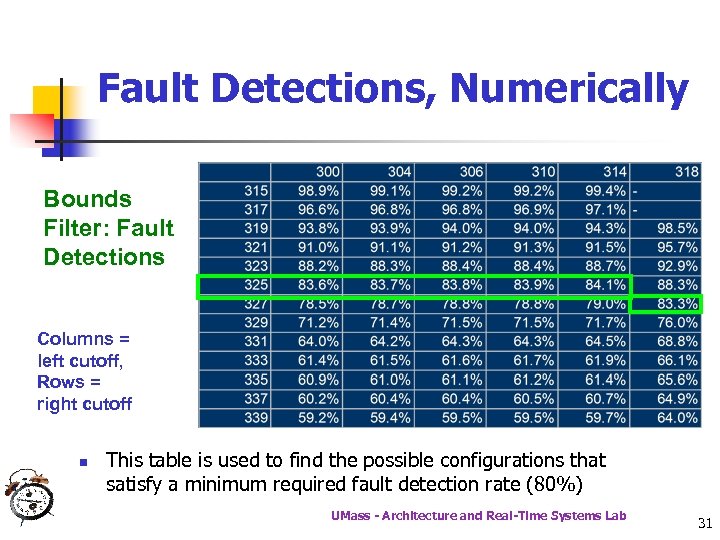
Fault Detections, Numerically Bounds Filter: Fault Detections Columns = left cutoff, Rows = right cutoff n This table is used to find the possible configurations that satisfy a minimum required fault detection rate (80%) UMass - Architecture and Real-Time Systems Lab 31
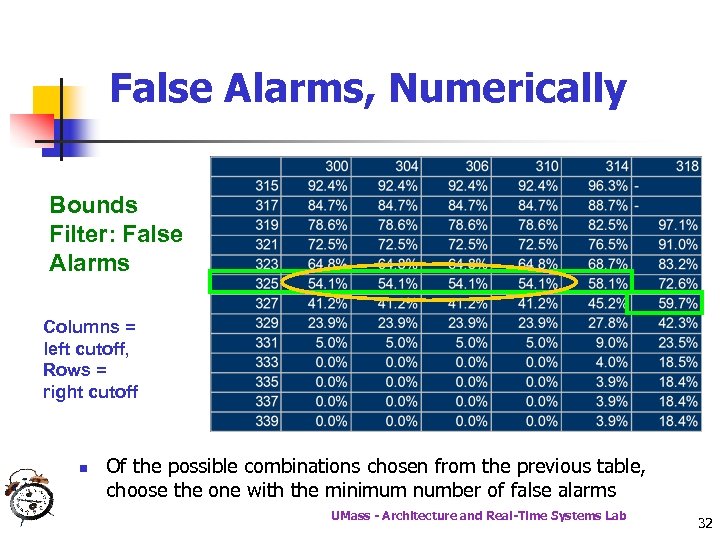
False Alarms, Numerically Bounds Filter: False Alarms Columns = left cutoff, Rows = right cutoff n Of the possible combinations chosen from the previous table, choose the one with the minimum number of false alarms UMass - Architecture and Real-Time Systems Lab 32
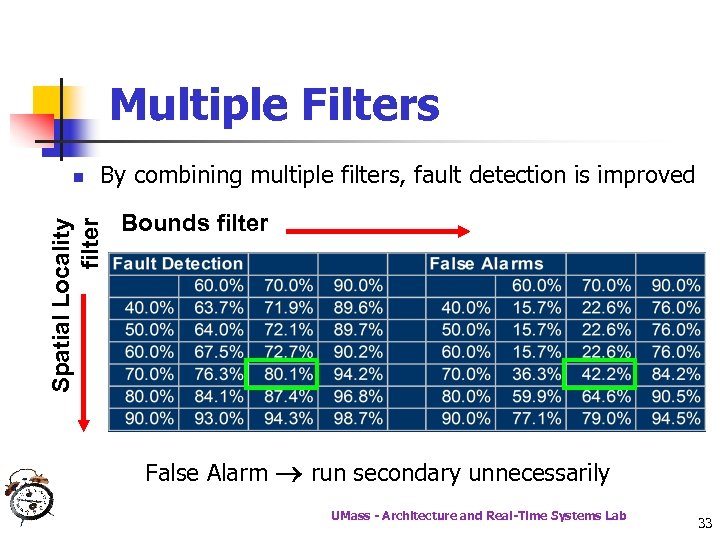
Multiple Filters By combining multiple filters, fault detection is improved Spatial Locality filter n Bounds filter False Alarm run secondary unnecessarily UMass - Architecture and Real-Time Systems Lab 33
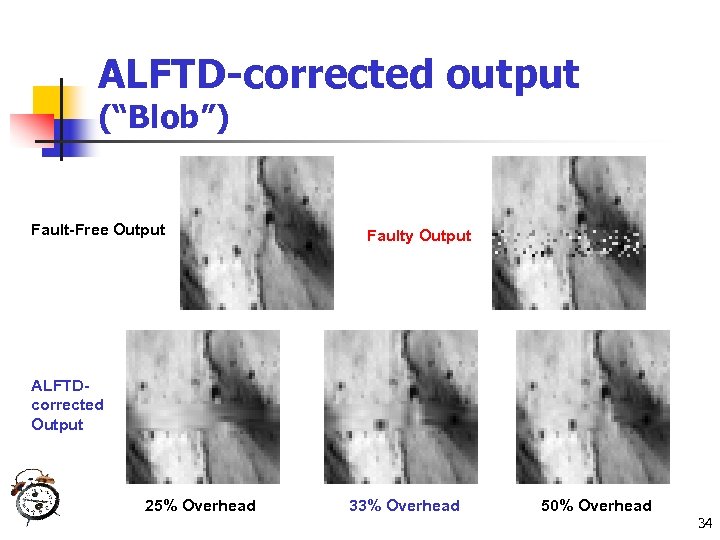
ALFTD-corrected output (“Blob”) Fault-Free Output Faulty Output ALFTDcorrected Output 25% Overhead 33% Overhead 50% Overhead 34
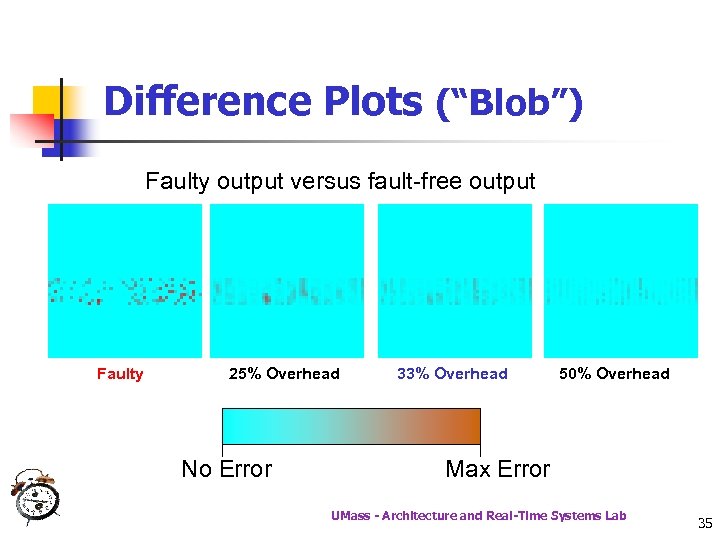
Difference Plots (“Blob”) Faulty output versus fault-free output Faulty 25% Overhead No Error 33% Overhead 50% Overhead Max Error UMass - Architecture and Real-Time Systems Lab 35
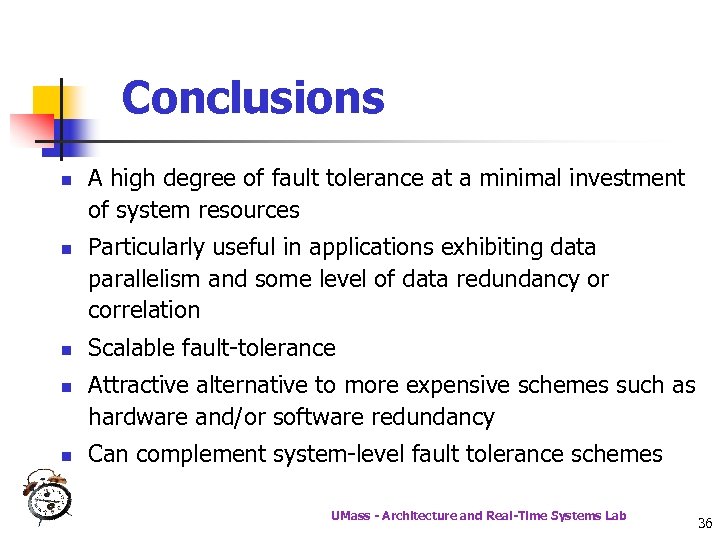
Conclusions n n n A high degree of fault tolerance at a minimal investment of system resources Particularly useful in applications exhibiting data parallelism and some level of data redundancy or correlation Scalable fault-tolerance Attractive alternative to more expensive schemes such as hardware and/or software redundancy Can complement system-level fault tolerance schemes UMass - Architecture and Real-Time Systems Lab 36
References n J. Haines, V. R. Lakamraju, I. Koren and C. M. Krishna, “Development of Application-Level Fault Tolerance in a Real-Time Benchmark, " Proc. of EFTS'98, IEEE Workshop On Embedded Fault-Tolerant Systems, May 1998. n n J. Haines, V. R. Lakamraju, I. Koren and C. M. Krishna, “Application. Level Fault Tolerance as a Complement to System-Level Fault Tolerance, " The Journal of Supercomputing, Special Issue on “Embedded Fault-Tolerant Computing Systems, ” Vol. 16, pp. 53 -68, Kluwer Academic Publishers, MA, 2000. E. Ciocca, I. Koren, C. M. Krishna, “Determining Acceptance Tests for Application-Level Fault Detection, ” Proc. of the 2 nd ASPLOS Workshop on Evaluating and Architecting System Dependability, pp. 47 -53, Oct. 2002. UMass - Architecture and Real-Time Systems Lab 37
Thank You! C. M. Krishna Vijay Lakamraju Josh Haines Eric Ciocca 38
Further Extension n n (Input Errors) Real-time applications exposed to extreme environments can be affected by charged particles like alpha/cosmic rays n High likelihood of input data faults manifesting as bit flips Re-running the process or its secondary is useless as the input remains the same Input data should be preprocessed to detect input errors and attempt to correct them We have integrated preprocessing of input data in two NASA applications - OTIS and NGST UMass - Architecture and Real-Time Systems Lab 39
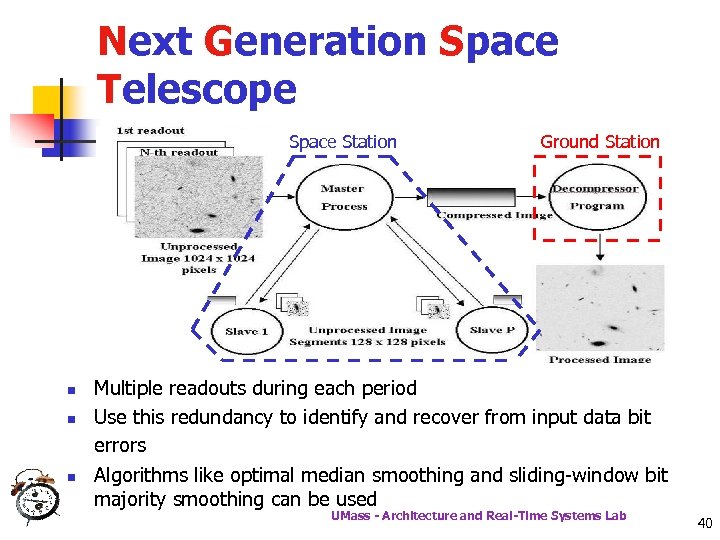
Next Generation Space Telescope Space Station n Ground Station Multiple readouts during each period Use this redundancy to identify and recover from input data bit errors Algorithms like optimal median smoothing and sliding-window bit majority smoothing can be used UMass - Architecture and Real-Time Systems Lab 40
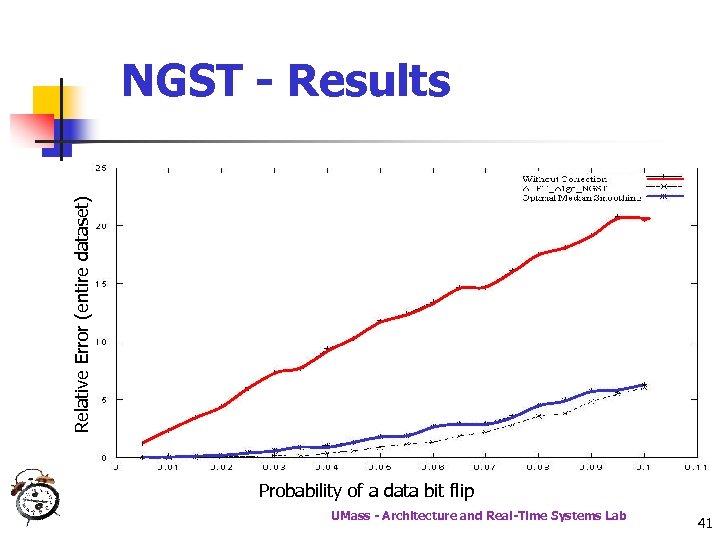
Relative Error (entire dataset) NGST - Results Probability of a data bit flip UMass - Architecture and Real-Time Systems Lab 41
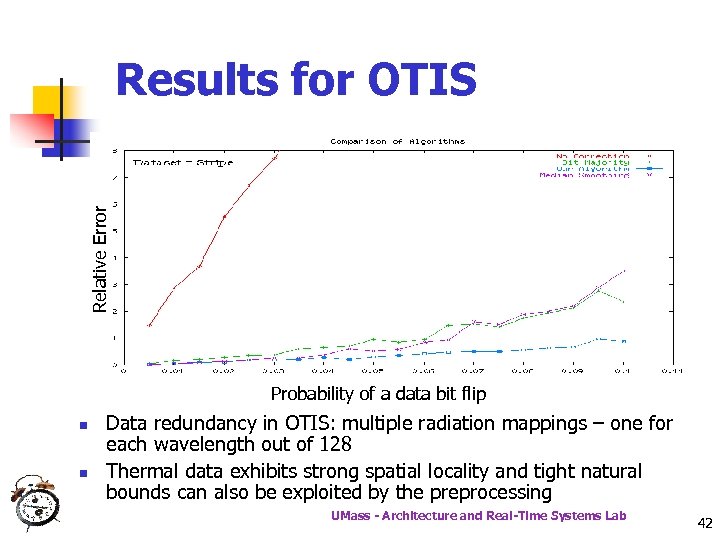
Relative Error Results for OTIS Probability of a data bit flip n n Data redundancy in OTIS: multiple radiation mappings – one for each wavelength out of 128 Thermal data exhibits strong spatial locality and tight natural bounds can also be exploited by the preprocessing UMass - Architecture and Real-Time Systems Lab 42
Скачать презентацию Application-Level Fault Tolerance for Embedded Real-Time Systems Israel
fd7f36acfd23c8769ea85d9b1652d36a.ppt