


 Скачать презентацию Application-Level Checkpoint-restart CPR for MPI Programs Keshav Pingali
de1088e55738654e86addce2ce996fb7.ppt
- Количество слайдов: 38
 Application-Level Checkpoint-restart (CPR) for MPI Programs Keshav Pingali Joint work with Dan Marques, Greg Bronevetsky, Paul Stodghill, Rohit Fernandes
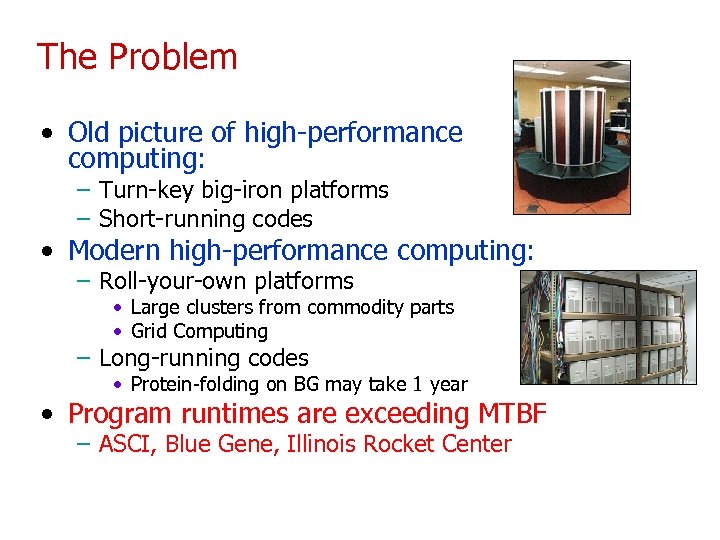 The Problem • Old picture of high-performance computing: – Turn-key big-iron platforms – Short-running codes • Modern high-performance computing: – Roll-your-own platforms • Large clusters from commodity parts • Grid Computing – Long-running codes • Protein-folding on BG may take 1 year • Program runtimes are exceeding MTBF – ASCI, Blue Gene, Illinois Rocket Center
 Software view of hardware failures • Two classes of faults – Fail-stop: a failed processor ceases all operation and does not further corrupt system state – Byzantine: arbitrary failures • Nothing to do with adversaries • Our focus: – Fail-Stop Faults
![Solution Space for Fail-stop Faults • Checkpoint-restart (CPR) [Our Choice] – Save application state](https://present5.com/presentation/de1088e55738654e86addce2ce996fb7/image-4.jpg "Solution Space for Fail-stop Faults • Checkpoint-restart (CPR) [Our Choice] – Save application state") Solution Space for Fail-stop Faults • Checkpoint-restart (CPR) [Our Choice] – Save application state periodically – When a process fails, all processes go back to last consistent saved state. • Message Logging – Processes save outgoing messages – If a process goes down it restarts and neighbors resend it old messages – Checkpointing used to trim message log – In principle, only failed processes need to be restarted – Popular in the distributed system community – Our experience: not practical for scientific programs because of communication volume
Solution Space for Fail-stop Faults • Checkpoint-restart (CPR) [Our Choice] – Save application state periodically – When a process fails, all processes go back to last consistent saved state. • Message Logging – Processes save outgoing messages – If a process goes down it restarts and neighbors resend it old messages – Checkpointing used to trim message log – In principle, only failed processes need to be restarted – Popular in the distributed system community – Our experience: not practical for scientific programs because of communication volume
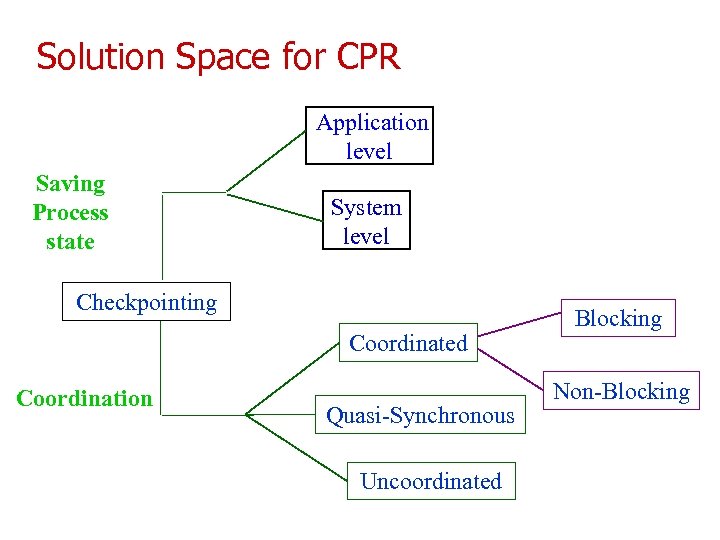 Solution Space for CPR Application level Saving Process state System level Checkpointing Coordinated Coordination Quasi-Synchronous Uncoordinated Blocking Non-Blocking
 Saving process state • System-level (SLC) – save all bits of machine – program must be restarted on same platform • Application-level (ALC) [Our Choice] – programmer chooses certain points in program to save minimal state – programmer or compiler generate save/restore code – amount of saved data can be much less than in system-level CPR (e. g. , n-body codes) – in principle, program can be restarted on a totally different platform • Practice at National Labs – demand vendor provide SLC – but use hand-rolled ALC in practice!
 Coordinating checkpoints • Uncoordinated – Dependency-tracking, time-coordinated, … – Suffer from exponential rollback • Coordinated [Our Choice] – Blocking • Global snapshot at a Barrier • Used in current ALC implementations – Non-blocking • Chandy-Lamport
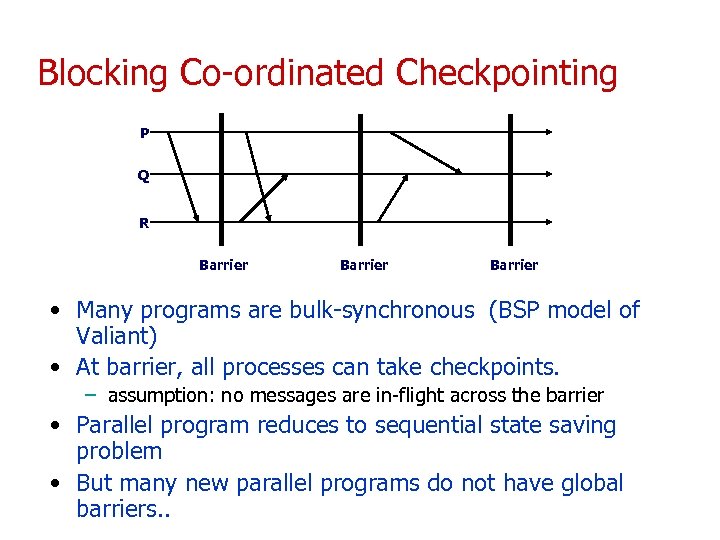 Blocking Co-ordinated Checkpointing P Q R Barrier • Many programs are bulk-synchronous (BSP model of Valiant) • At barrier, all processes can take checkpoints. – assumption: no messages are in-flight across the barrier • Parallel program reduces to sequential state saving problem • But many new parallel programs do not have global barriers. .
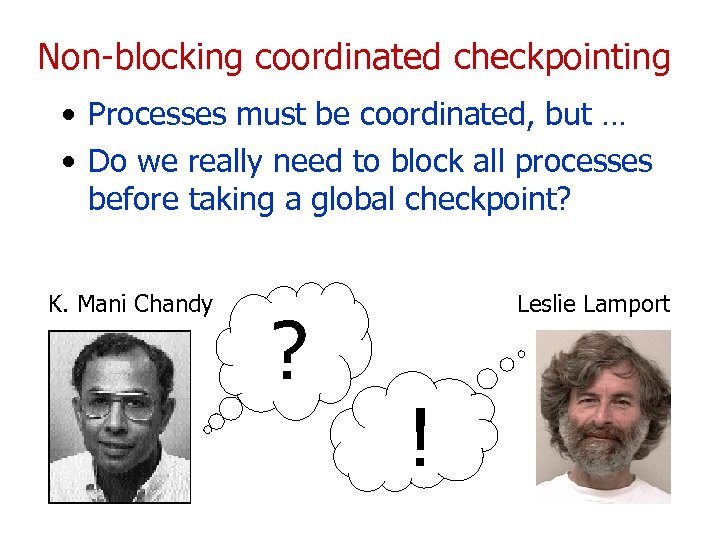 Non-blocking coordinated checkpointing • Processes must be coordinated, but … • Do we really need to block all processes before taking a global checkpoint? K. Mani Chandy ? Leslie Lamport !
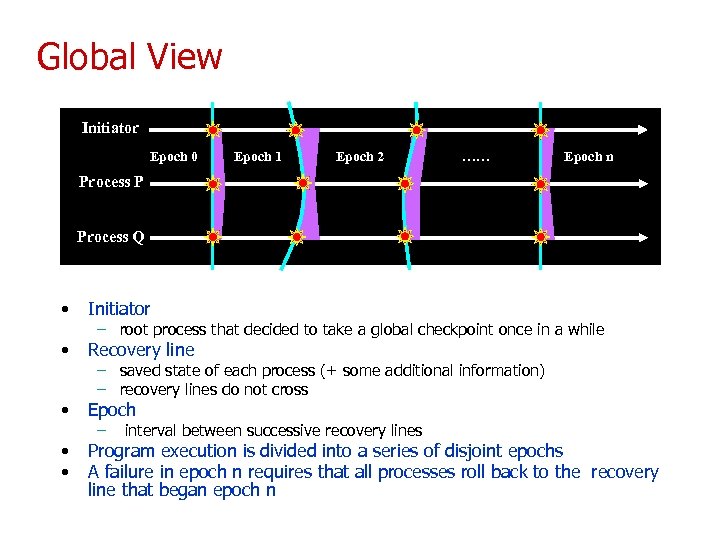 Global View Initiator Epoch 0 Epoch 1 Epoch 2 …… Epoch n Process P Process Q • Initiator • Recovery line • Epoch • • Program execution is divided into a series of disjoint epochs A failure in epoch n requires that all processes roll back to the recovery line that began epoch n – root process that decided to take a global checkpoint once in a while – saved state of each process (+ some additional information) – recovery lines do not cross – interval between successive recovery lines
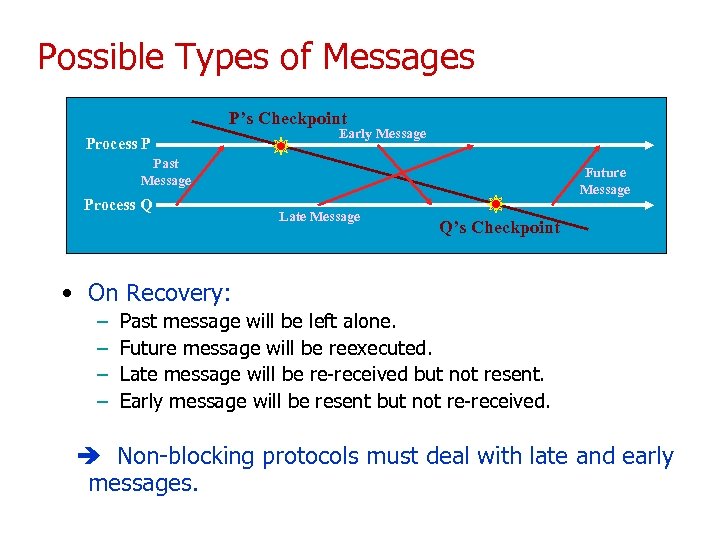 Possible Types of Messages P’s Checkpoint Process P Early Message Past Message Process Q Future Message Late Message Q’s Checkpoint • On Recovery: – – Past message will be left alone. Future message will be reexecuted. Late message will be re-received but not resent. Early message will be resent but not re-received. Non-blocking protocols must deal with late and early messages.
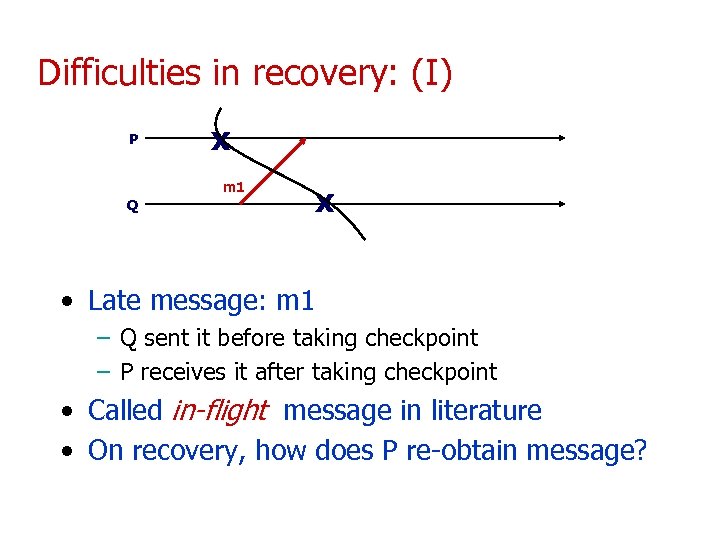 Difficulties in recovery: (I) P x m 1 Q x • Late message: m 1 – Q sent it before taking checkpoint – P receives it after taking checkpoint • Called in-flight message in literature • On recovery, how does P re-obtain message?
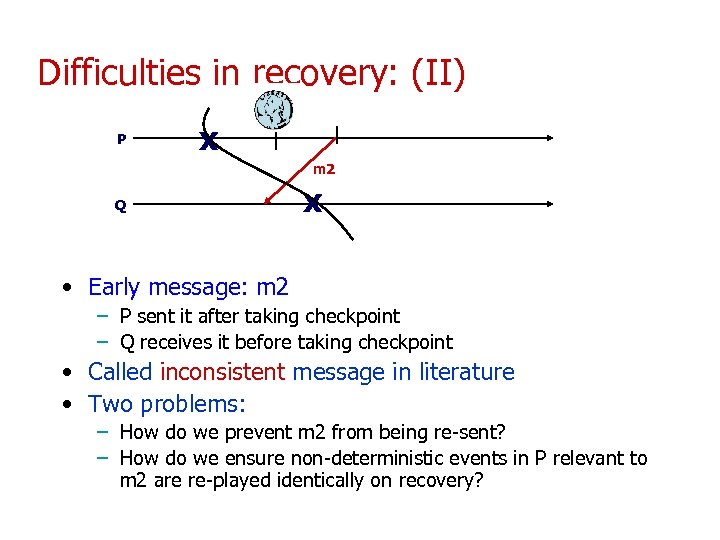 Difficulties in recovery: (II) P x m 2 Q x • Early message: m 2 – P sent it after taking checkpoint – Q receives it before taking checkpoint • Called inconsistent message in literature • Two problems: – How do we prevent m 2 from being re-sent? – How do we ensure non-deterministic events in P relevant to m 2 are re-played identically on recovery?
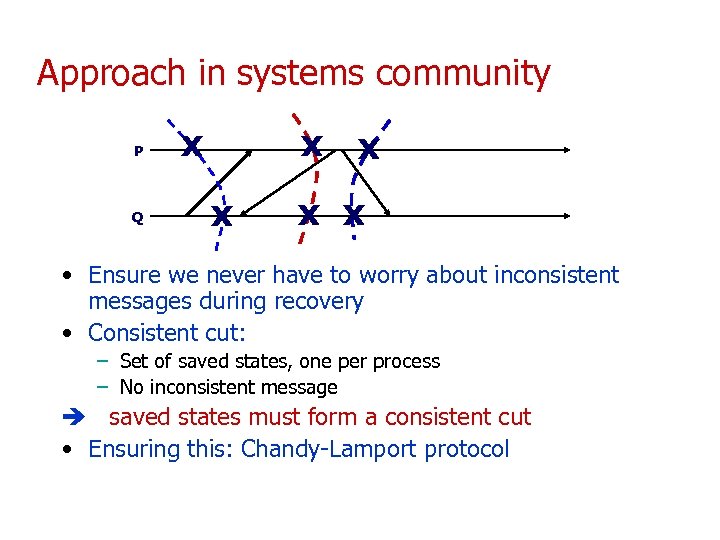 Approach in systems community P Q x x x • Ensure we never have to worry about inconsistent messages during recovery • Consistent cut: – Set of saved states, one per process – No inconsistent message saved states must form a consistent cut • Ensuring this: Chandy-Lamport protocol
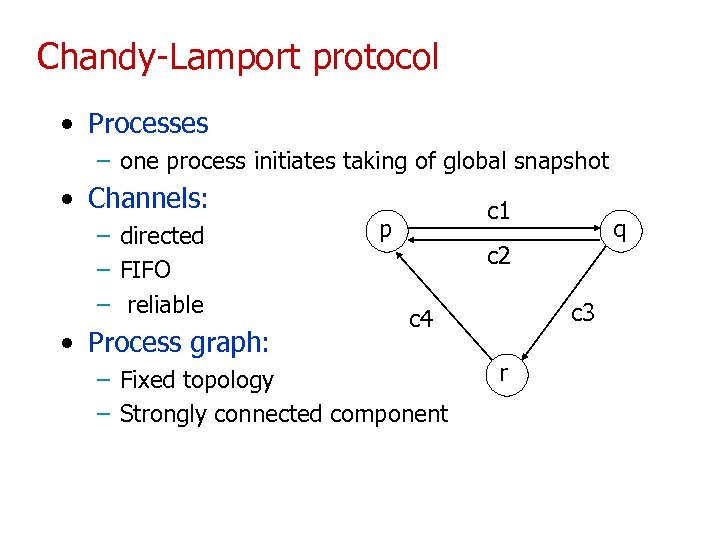 Chandy-Lamport protocol • Processes – one process initiates taking of global snapshot • Channels: – directed – FIFO – reliable • Process graph: c 1 p q c 2 c 3 c 4 – Fixed topology – Strongly connected component r
 Algorithm explanation 1. Coordinating process state-saving – How do we avoid inconsistent messages? 2. Saving in-flight messages 3. Termination Next: Model of Distributed System
 Step 1: co-ordinating process state-saving • Initiator: – Save its local state – Send a marker token on each outgoing edge • Out-of-band (non-application) message • All other processes: – On receiving a marker on an incoming edge for the first time • save state immediately • propagate markers on all outgoing edges • resume execution. – Further markers will be eaten up. Next: Example
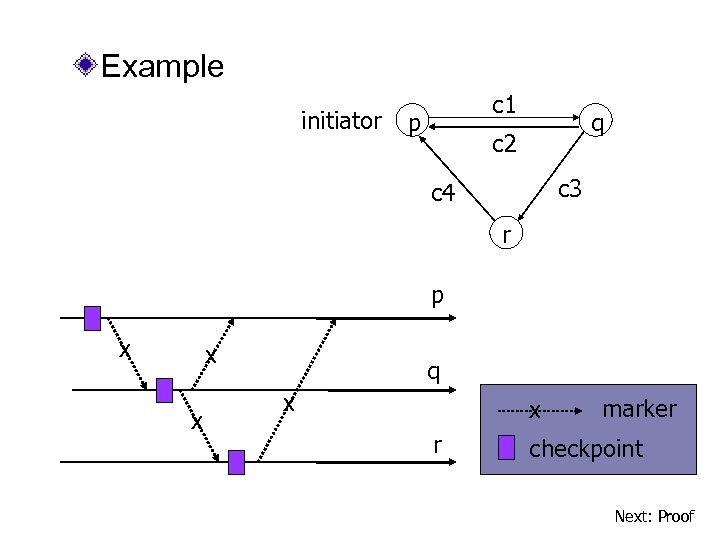 Example initiator c 1 p q c 2 c 3 c 4 r p x x x q x x r marker checkpoint Next: Proof
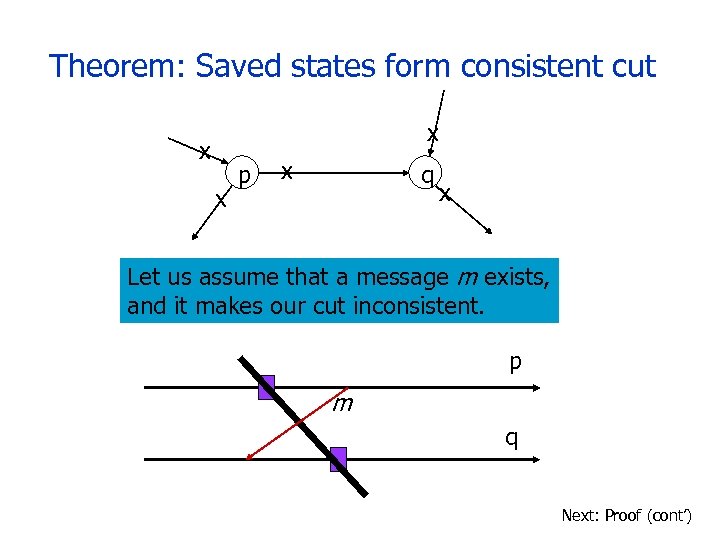 Theorem: Saved states form consistent cut x x x p x q x Let us assume that a message m exists, and it makes our cut inconsistent. p m q Next: Proof (cont’)
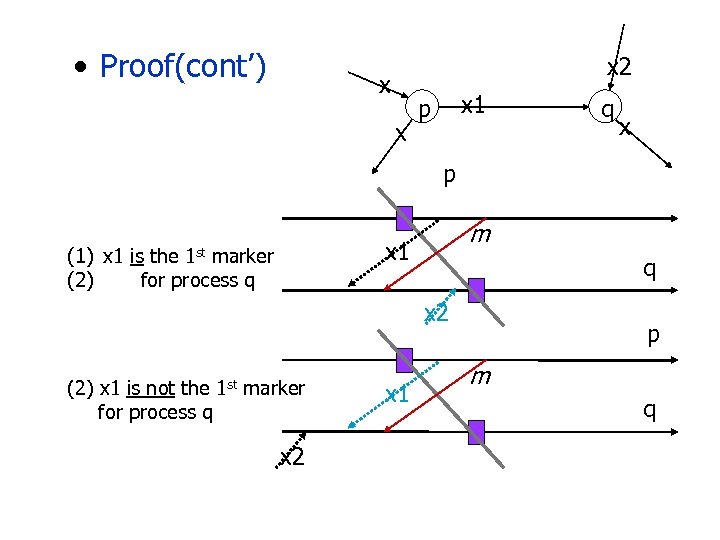 • Proof(cont’) x 2 x x x 1 p q x p m x 1 (1) x 1 is the 1 st marker (2) for process q q x 2 (2) x 1 is not the 1 st marker for process q x 2 x 1 p m q
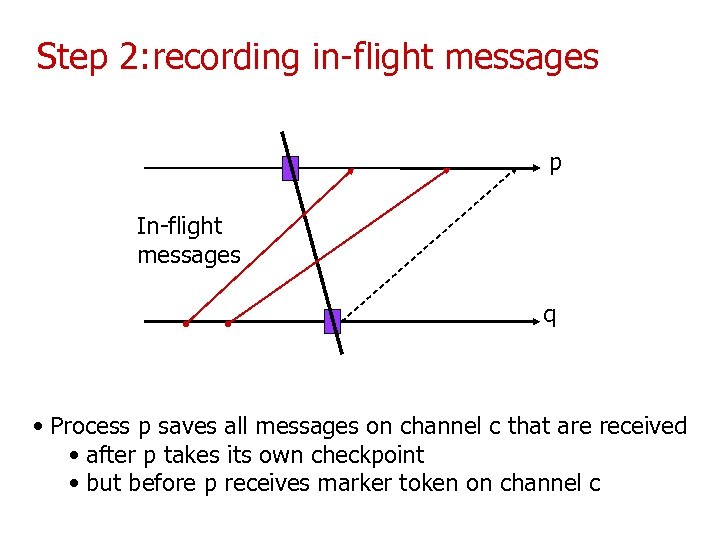 Step 2: recording in-flight messages p In-flight messages q • Process p saves all messages on channel c that are received • after p takes its own checkpoint • but before p receives marker token on channel c
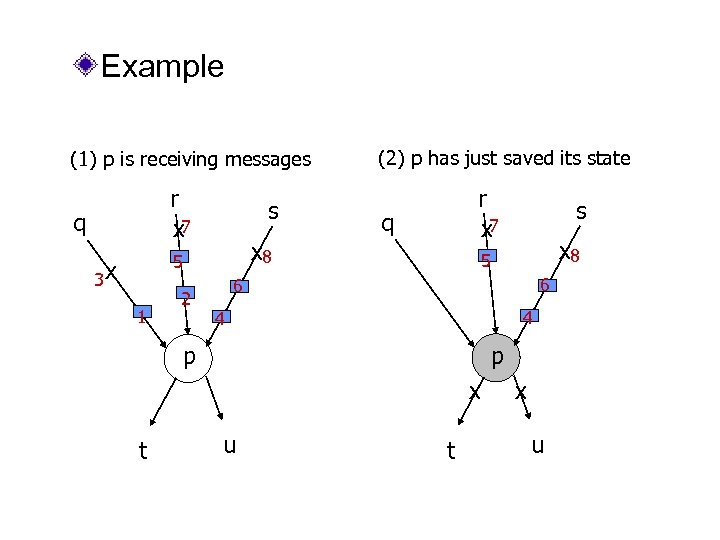 Example (1) p is receiving messages r x 7 q s 1 2 r x 7 q x 8 5 3 x (2) p has just saved its state x 8 5 6 6 4 4 p p x t s u t x u
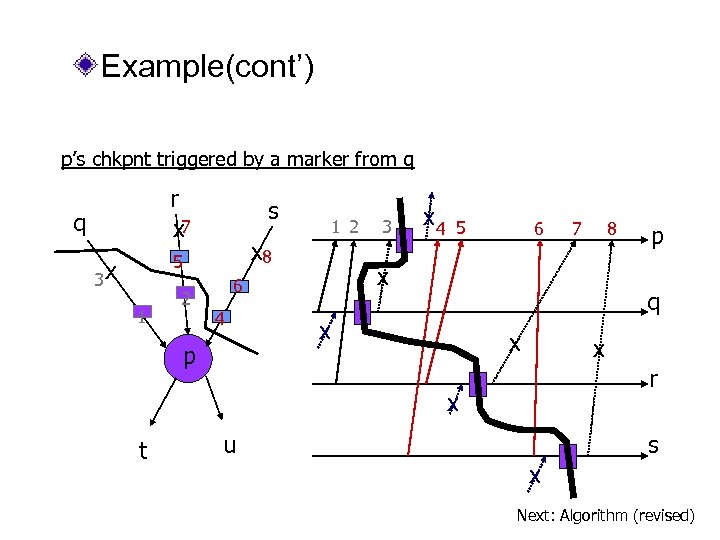 Example(cont’) p’s chkpnt triggered by a marker from q r x 7 q s x 8 5 3 x 1 2 p x 4 5 6 8 p q x x x r x t 7 x 6 4 3 u s x Next: Algorithm (revised)
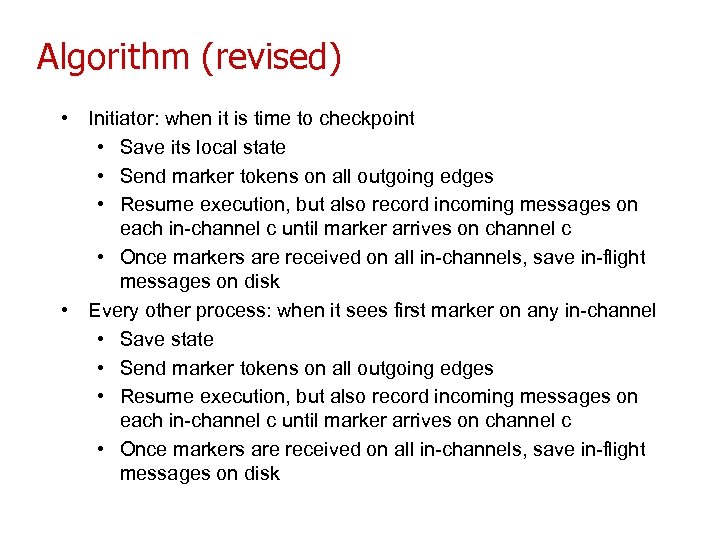 Algorithm (revised) • Initiator: when it is time to checkpoint • Save its local state • Send marker tokens on all outgoing edges • Resume execution, but also record incoming messages on each in-channel c until marker arrives on channel c • Once markers are received on all in-channels, save in-flight messages on disk • Every other process: when it sees first marker on any in-channel • Save state • Send marker tokens on all outgoing edges • Resume execution, but also record incoming messages on each in-channel c until marker arrives on channel c • Once markers are received on all in-channels, save in-flight messages on disk
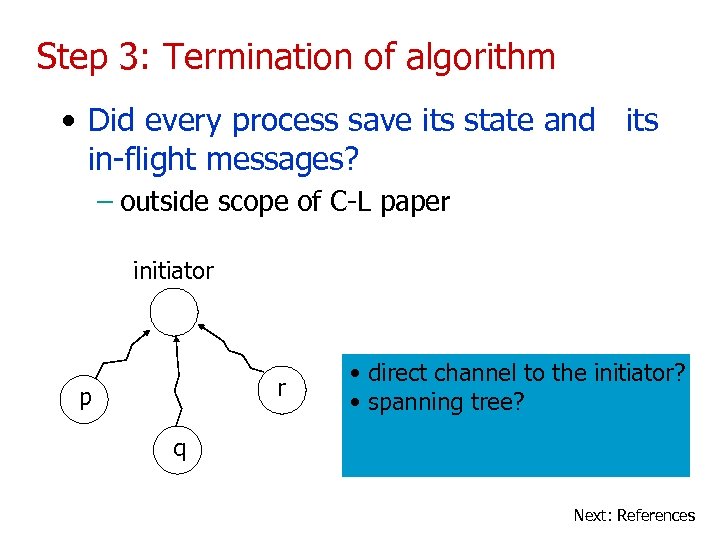 Step 3: Termination of algorithm • Did every process save its state and its in-flight messages? – outside scope of C-L paper initiator r p • direct channel to the initiator? • spanning tree? q Next: References
 Comments on C-L protocol • Relied critically on some assumptions: – Process can take checkpoint at any time during execution • get first marker save state – FIFO communication – Fixed communication topology – Point-to-point communication: no group communication primitives like bcast • None of these assumptions are valid for application-level checkpointing of MPI programs
 Application-Level Checkpointing (ALC) • At special points in application the programmer (or automated tool) places calls to a take_checkpoint() function. • Checkpoints may be taken at such spots. • State-saving: – Programmer writes code – Preprocessor transforms program into a version that saves its own state during calls to take_checkpoint().
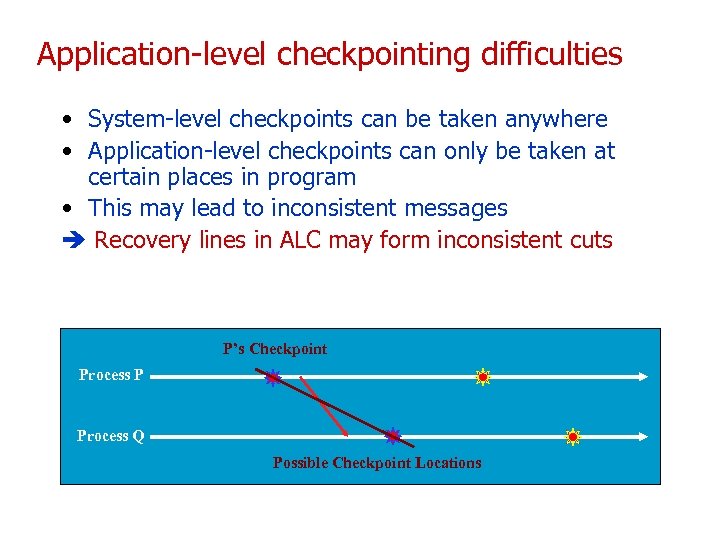 Application-level checkpointing difficulties • System-level checkpoints can be taken anywhere • Application-level checkpoints can only be taken at certain places in program • This may lead to inconsistent messages Recovery lines in ALC may form inconsistent cuts Process P P’s Checkpoint Process P Process Q Possible Checkpoint Locations
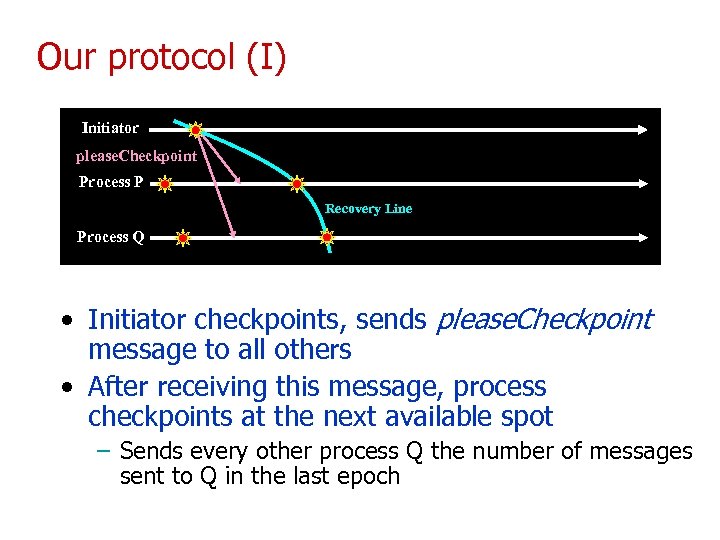 Our protocol (I) Initiator please. Checkpoint Process P Recovery Line Process Q • Initiator checkpoints, sends please. Checkpoint message to all others • After receiving this message, process checkpoints at the next available spot – Sends every other process Q the number of messages sent to Q in the last epoch
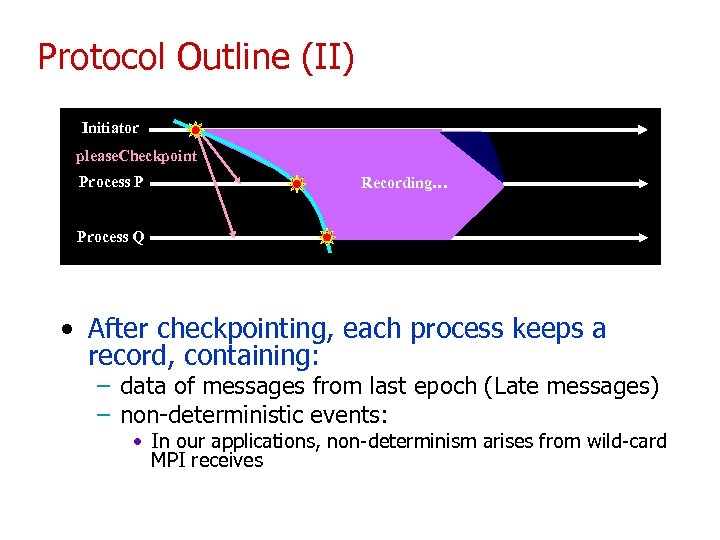 Protocol Outline (II) Initiator please. Checkpoint Process P Recording… Process Q • After checkpointing, each process keeps a record, containing: – data of messages from last epoch (Late messages) – non-deterministic events: • In our applications, non-determinism arises from wild-card MPI receives
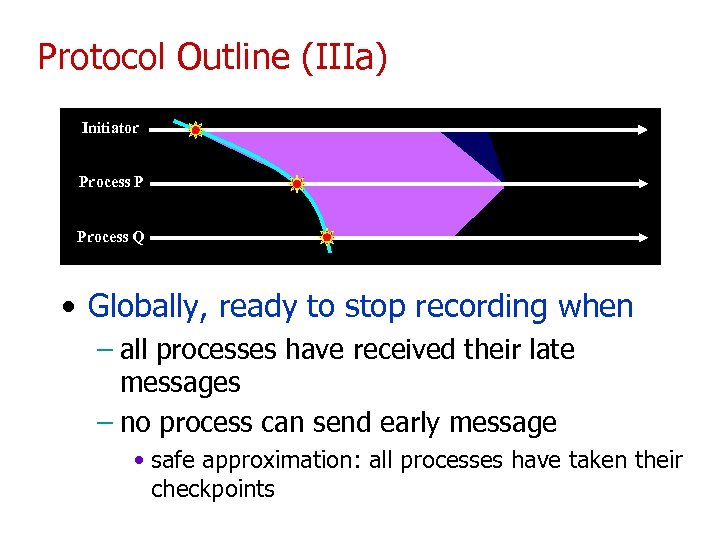 Protocol Outline (IIIa) Initiator Process P Process Q • Globally, ready to stop recording when – all processes have received their late messages – no process can send early message • safe approximation: all processes have taken their checkpoints
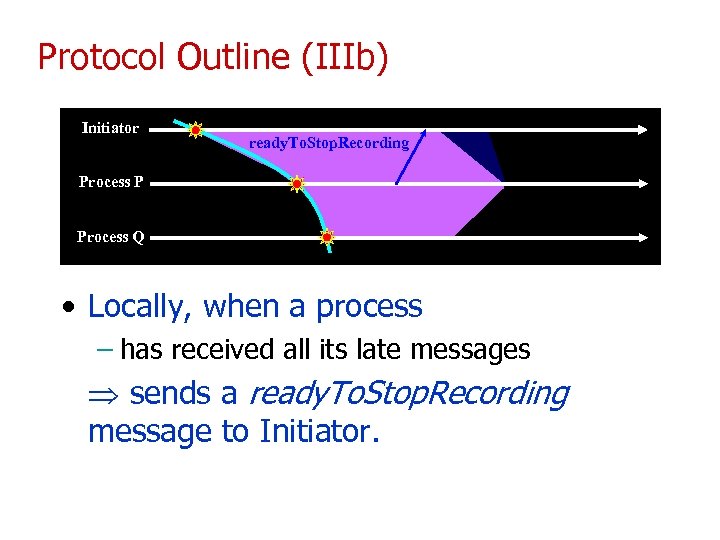 Protocol Outline (IIIb) Initiator ready. To. Stop. Recording Process P Process Q • Locally, when a process – has received all its late messages sends a ready. To. Stop. Recording message to Initiator.
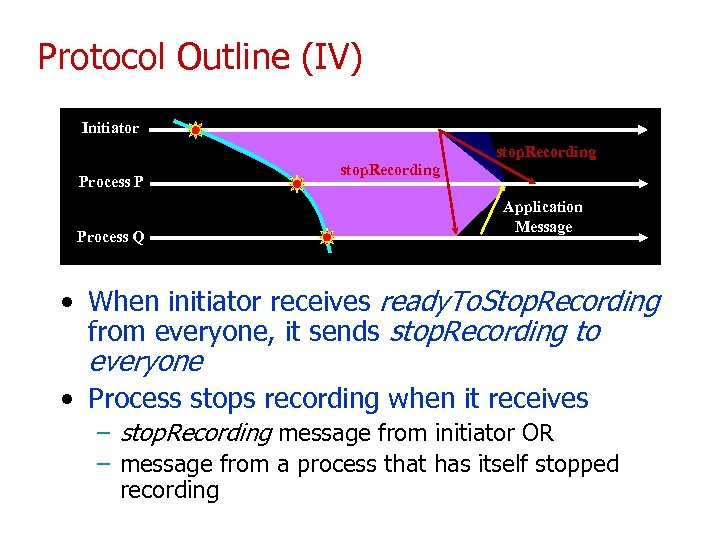 Protocol Outline (IV) Initiator stop. Recording Process P Process Q stop. Recording Application Message • When initiator receives ready. To. Stop. Recording from everyone, it sends stop. Recording to everyone • Process stops recording when it receives – stop. Recording message from initiator OR – message from a process that has itself stopped recording
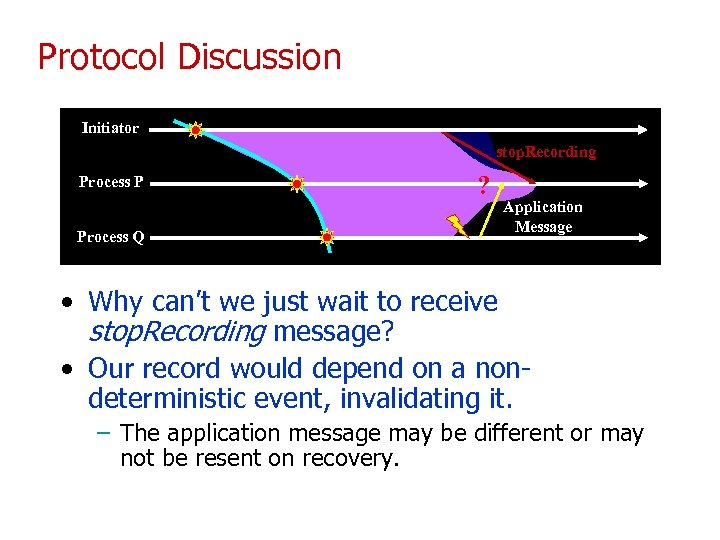 Protocol Discussion Initiator stop. Recording Process P Process Q ? Application Message • Why can’t we just wait to receive stop. Recording message? • Our record would depend on a nondeterministic event, invalidating it. – The application message may be different or may not be resent on recovery.
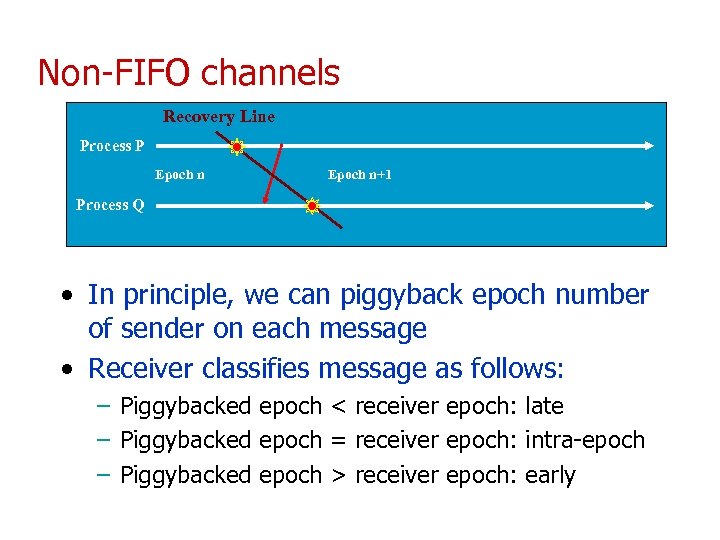 Non-FIFO channels Recovery Line Process P Epoch n+1 Process Q • In principle, we can piggyback epoch number of sender on each message • Receiver classifies message as follows: – Piggybacked epoch < receiver epoch: late – Piggybacked epoch = receiver epoch: intra-epoch – Piggybacked epoch > receiver epoch: early
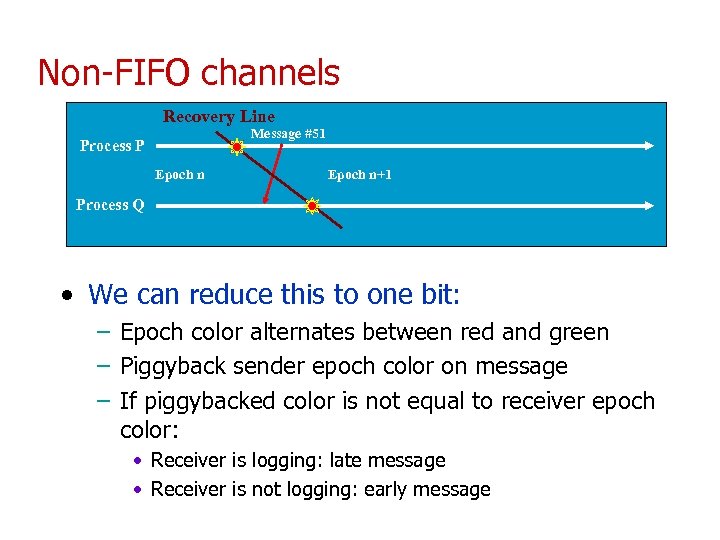 Non-FIFO channels Recovery Line Message #51 Process P Epoch n+1 Process Q • We can reduce this to one bit: – Epoch color alternates between red and green – Piggyback sender epoch color on message – If piggybacked color is not equal to receiver epoch color: • Receiver is logging: late message • Receiver is not logging: early message
 Implementation details • Out-of-band messages – Whenever application program does a send or receive, our thin layer also looks to see if any outof-band messages have arrived – May cause a problem if a process does not exchange messages for a long time but this is not a serious concern in practice • MPI features – non-blocking communication – Collective communication • Save internal state of MPI library • Write global checkpoint out to stable storage
 Research issue • Protocol is sufficiently complex that it is easy to make errors • Shared-memory protocol – even more subtle because shared-memory programs have race conditions • Is there a framework for proving these kinds of protocols correct?