


 Скачать презентацию Application and Controls Software Project List for ATF
95fc9ced316772743c3cfb87e73d1906.ppt
- Количество слайдов: 28
 Application and Controls Software Project List for ATF 2 EXT and FFS Tuning Goals Glen White ATF 2 Software Workshop LAL, June 2008 EXT tuning and feedback FFS tuning and feedback Online optics manipulations EPICS IOC development FS software development New hardware controls in FS
 Some General Comments Two main categories of project Lower-level controls software (hardware drivers, EPICS DB, EPICS-level interfaces). Higher-level apps (through FS) (tuning algorithms) Project list slides shown here just brief overview for discussion Only EXT/FFS related projects shown here Responsible person should be found for each project and first task should be construction of a more detailed task list. Priorities shown are a subjective view on the urgency of the tasks as relates to the primary goal of ATF 2. For simulation development- need agreed centrally maintained list of error sources for comparison purposes. Need to agree procedure to sign-off on projects to declare them as production versions (agree chosen techniques to be used, quality of code etc. . . ) Overlap between many tasks listed here and those for the EXT emittance study group- this is not duplicate work, just consolidating all task descriptions here.
 Generic Project Deliverables For all software application projects: Test algorithms and make choice based on simulation performance Migrate code to control environment (FS & ATF computer). Make graphical interface to run on main control system Also have easy to use functional interface to be called by other apps with well defined input/outputs etc this is the “manual” interface to run this one tuning task in isolation. This can form part of a larger automated tuning system Documentation Main functions should contain instructions for use Graphical interfaces should contain step-by-step detailed useage instructions Also put full documentation for application, together with project information, work still to do etc on wiki EPICS – control software projects: EPICS DB's written and tested including simulation mode Documentation in wiki (including project details, work to do and a detailed description of all PV's) Test graphical interfaces Archiving + restore list
 Coupling Measurement and Correction in EXT Priority: V. High Work Done: Experience at ATF with wirescanner system Developed strategy for ATF 2 with simulations (including integrated) MW / GW / CR / JB / MA Study of startup conditions (only 2 skew Quad's) Methods Iterative scanning of wirescanners Faster, single step 4 -d calculation and correction? Simulation work required Performance estimation with realistic errors Ability to correct expected coupling sources- from ring (from ring simulation inputs), and from QM 7. . . FS/controls integration Need wirescanner interface to automate procedure Writing and testing of FS code
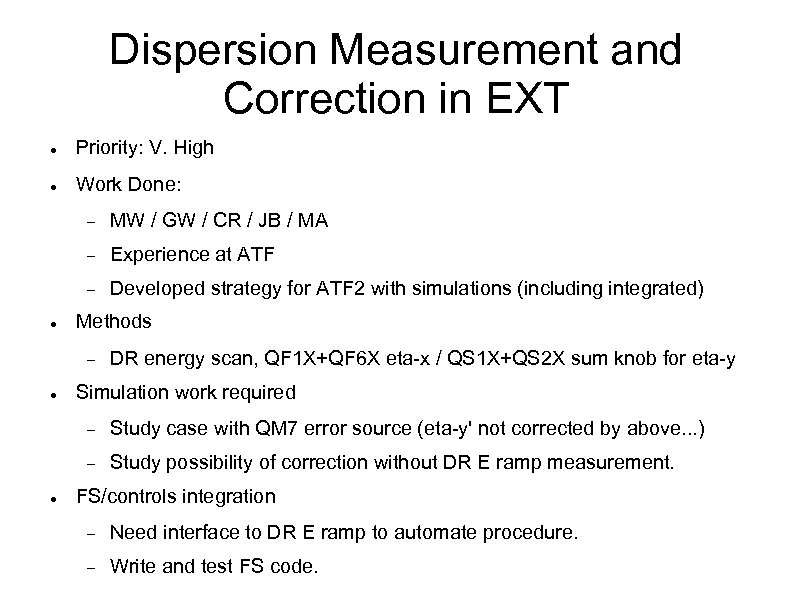 Dispersion Measurement and Correction in EXT Priority: V. High Work Done: Experience at ATF MW / GW / CR / JB / MA Developed strategy for ATF 2 with simulations (including integrated) Methods DR energy scan, QF 1 X+QF 6 X eta-x / QS 1 X+QS 2 X sum knob for eta-y Simulation work required Study case with QM 7 error source (eta-y' not corrected by above. . . ) Study possibility of correction without DR E ramp measurement. FS/controls integration Need interface to DR E ramp to automate procedure. Write and test FS code.
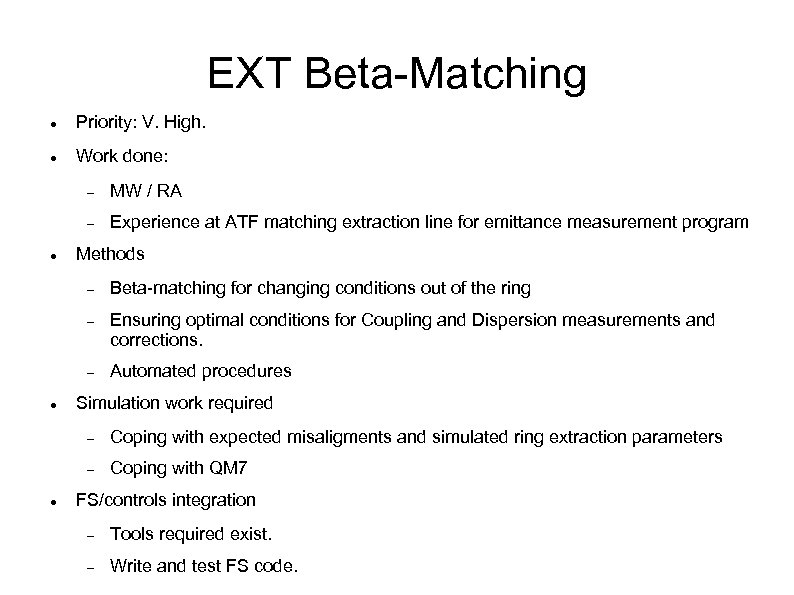 EXT Beta-Matching Priority: V. High. Work done: MW / RA Experience at ATF matching extraction line for emittance measurement program Methods Ensuring optimal conditions for Coupling and Dispersion measurements and corrections. Beta-matching for changing conditions out of the ring Automated procedures Simulation work required Coping with expected misaligments and simulated ring extraction parameters Coping with QM 7 FS/controls integration Tools required exist. Write and test FS code.
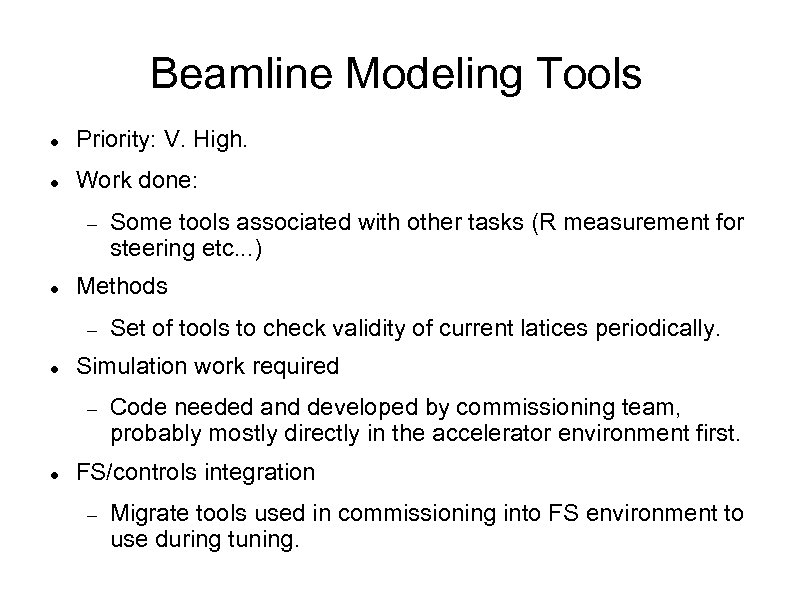 Beamline Modeling Tools Priority: V. High. Work done: Methods Set of tools to check validity of current latices periodically. Simulation work required Some tools associated with other tasks (R measurement for steering etc. . . ) Code needed and developed by commissioning team, probably mostly directly in the accelerator environment first. FS/controls integration Migrate tools used in commissioning into FS environment to use during tuning.
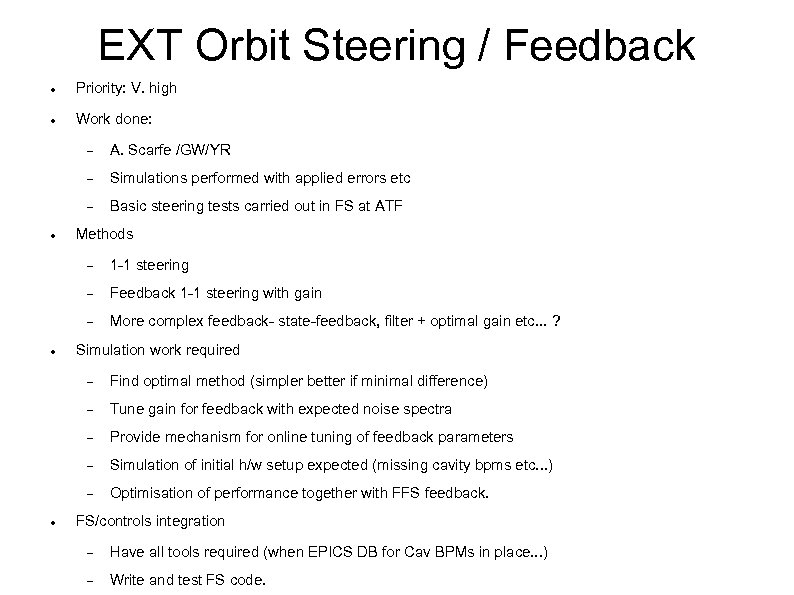 EXT Orbit Steering / Feedback Priority: V. high Work done: Simulations performed with applied errors etc A. Scarfe /GW/YR Basic steering tests carried out in FS at ATF Methods Feedback 1 -1 steering with gain 1 -1 steering More complex feedback- state-feedback, filter + optimal gain etc. . . ? Simulation work required Tune gain for feedback with expected noise spectra Provide mechanism for online tuning of feedback parameters Simulation of initial h/w setup expected (missing cavity bpms etc. . . ) Find optimal method (simpler better if minimal difference) Optimisation of performance together with FFS feedback. FS/controls integration Have all tools required (when EPICS DB for Cav BPMs in place. . . ) Write and test FS code.
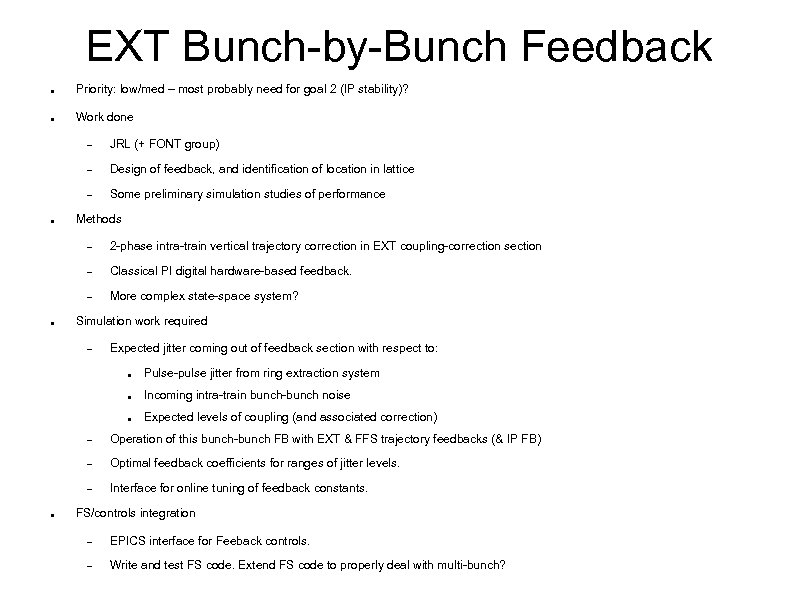 EXT Bunch-by-Bunch Feedback Priority: low/med – most probably need for goal 2 (IP stability)? Work done Design of feedback, and identification of location in lattice JRL (+ FONT group) Some preliminary simulation studies of performance Methods Classical PI digital hardware-based feedback. 2 -phase intra-train vertical trajectory correction in EXT coupling-correction section More complex state-space system? Simulation work required Expected jitter coming out of feedback section with respect to: Pulse-pulse jitter from ring extraction system Incoming intra-train bunch-bunch noise Expected levels of coupling (and associated correction) Optimal feedback coefficients for ranges of jitter levels. Operation of this bunch-bunch FB with EXT & FFS trajectory feedbacks (& IP FB) Interface for online tuning of feedback constants. FS/controls integration EPICS interface for Feeback controls. Write and test FS code. Extend FS code to properly deal with multi-bunch?
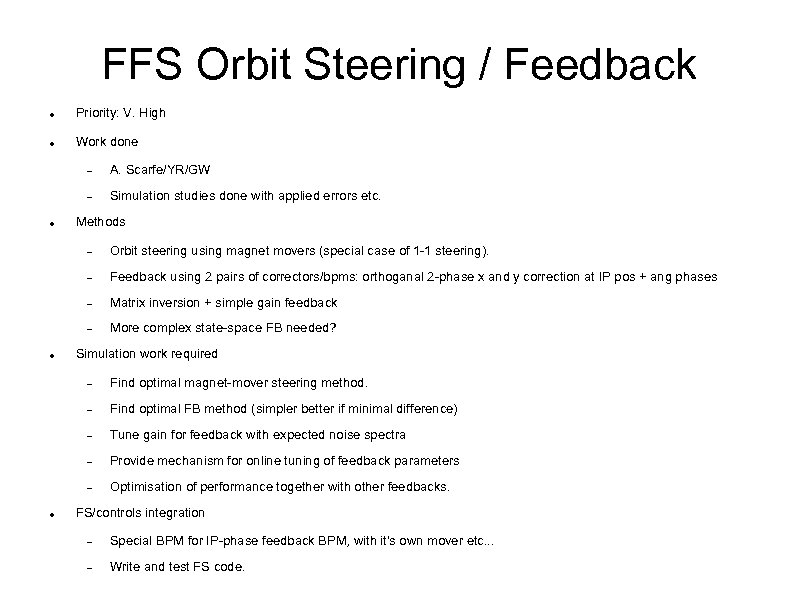 FFS Orbit Steering / Feedback Priority: V. High Work done A. Scarfe/YR/GW Simulation studies done with applied errors etc. Methods Feedback using 2 pairs of correctors/bpms: orthoganal 2 -phase x and y correction at IP pos + ang phases Matrix inversion + simple gain feedback Orbit steering using magnet movers (special case of 1 -1 steering). More complex state-space FB needed? Simulation work required Find optimal FB method (simpler better if minimal difference) Tune gain for feedback with expected noise spectra Provide mechanism for online tuning of feedback parameters Find optimal magnet-mover steering method. Optimisation of performance together with other feedbacks. FS/controls integration Special BPM for IP-phase feedback BPM, with it's own mover etc. . . Write and test FS code.
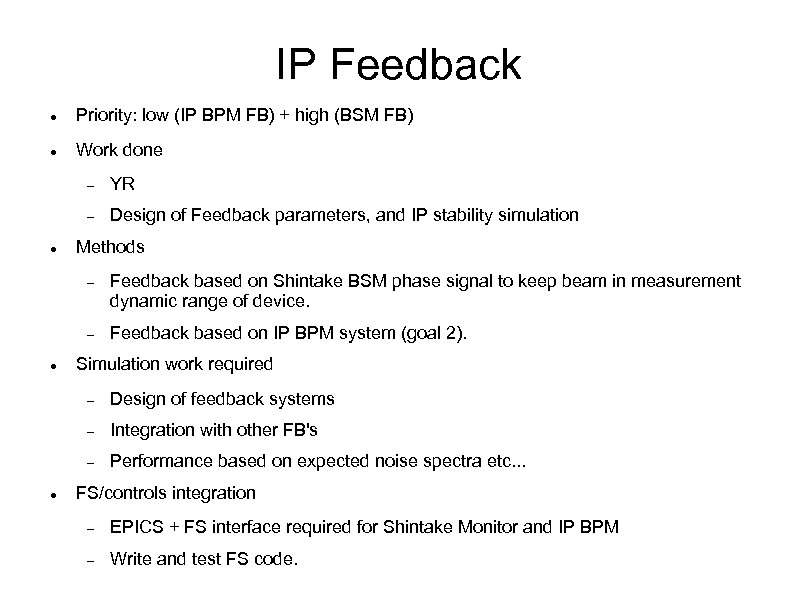 IP Feedback Priority: low (IP BPM FB) + high (BSM FB) Work done YR Design of Feedback parameters, and IP stability simulation Methods Feedback based on Shintake BSM phase signal to keep beam in measurement dynamic range of device. Feedback based on IP BPM system (goal 2). Simulation work required Integration with other FB's Design of feedback systems Performance based on expected noise spectra etc. . . FS/controls integration EPICS + FS interface required for Shintake Monitor and IP BPM Write and test FS code.
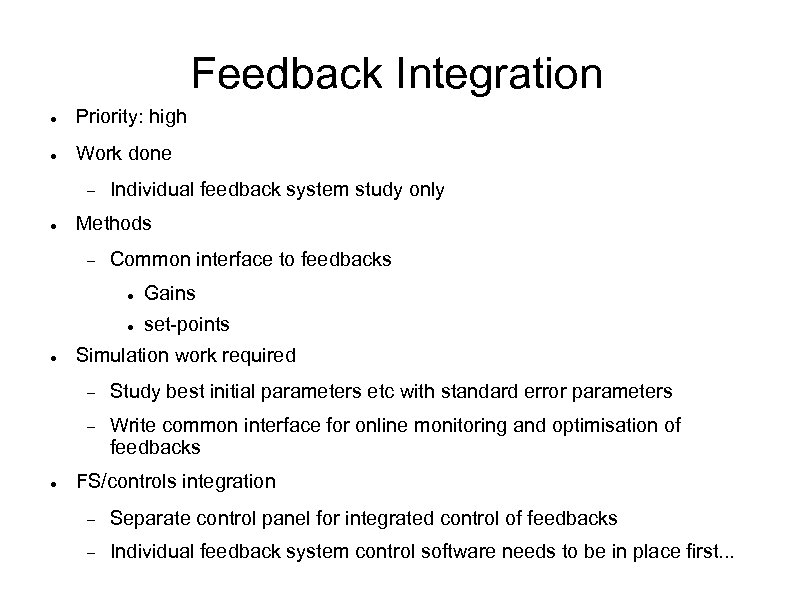 Feedback Integration Priority: high Work done Individual feedback system study only Methods Common interface to feedbacks Gains set-points Simulation work required Study best initial parameters etc with standard error parameters Write common interface for online monitoring and optimisation of feedbacks FS/controls integration Separate control panel for integrated control of feedbacks Individual feedback system control software needs to be in place first. . .
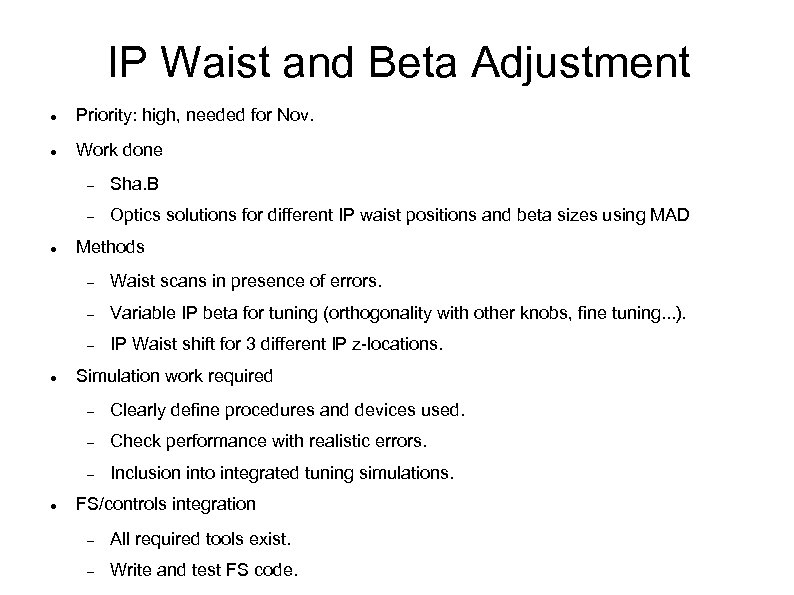 IP Waist and Beta Adjustment Priority: high, needed for Nov. Work done Sha. B Optics solutions for different IP waist positions and beta sizes using MAD Methods Variable IP beta for tuning (orthogonality with other knobs, fine tuning. . . ). Waist scans in presence of errors. IP Waist shift for 3 different IP z-locations. Simulation work required Check performance with realistic errors. Clearly define procedures and devices used. Inclusion into integrated tuning simulations. FS/controls integration All required tools exist. Write and test FS code.
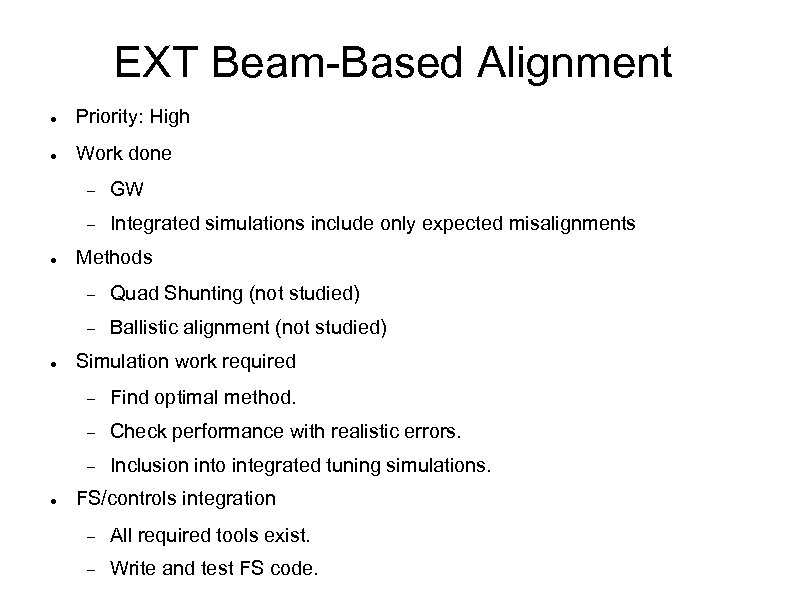 EXT Beam-Based Alignment Priority: High Work done GW Integrated simulations include only expected misalignments Methods Quad Shunting (not studied) Ballistic alignment (not studied) Simulation work required Check performance with realistic errors. Find optimal method. Inclusion into integrated tuning simulations. FS/controls integration All required tools exist. Write and test FS code.
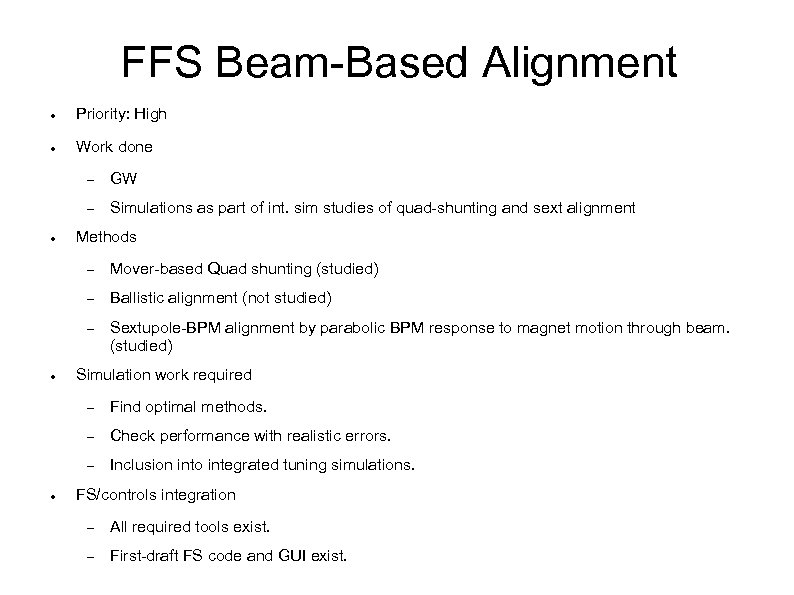 FFS Beam-Based Alignment Priority: High Work done GW Simulations as part of int. sim studies of quad-shunting and sext alignment Methods Ballistic alignment (not studied) Mover-based Quad shunting (studied) Sextupole-BPM alignment by parabolic BPM response to magnet motion through beam. (studied) Simulation work required Check performance with realistic errors. Find optimal methods. Inclusion into integrated tuning simulations. FS/controls integration All required tools exist. First-draft FS code and GUI exist.
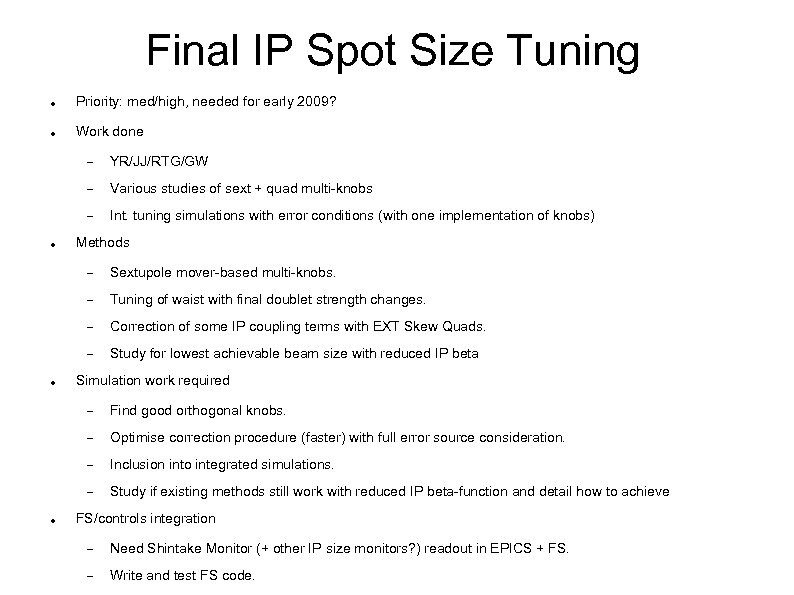 Final IP Spot Size Tuning Priority: med/high, needed for early 2009? Work done Various studies of sext + quad multi-knobs YR/JJ/RTG/GW Int. tuning simulations with error conditions (with one implementation of knobs) Methods Tuning of waist with final doublet strength changes. Correction of some IP coupling terms with EXT Skew Quads. Sextupole mover-based multi-knobs. Study for lowest achievable beam size with reduced IP beta Simulation work required Optimise correction procedure (faster) with full error source consideration. Inclusion into integrated simulations. Find good orthogonal knobs. Study if existing methods still work with reduced IP beta-function and detail how to achieve FS/controls integration Need Shintake Monitor (+ other IP size monitors? ) readout in EPICS + FS. Write and test FS code.
 Integrated Automated Tuning Priority: low Work done GW/SM Integrated tuning studies, with many error conditions, checks for magnet mover range deviations etc. . . Methods Combine all tuning steps with rigorous automated checking to generate an automated tuning program Ability to test effect w. r. t. probabilistic beam size achievable / tuning time of changes to tuning procedures Simulation work required Extend integrated simulation work to include many simulated error conditions and as much “reality” as possible to design automated system. FS/controls integration No additional requirements over those for individual tuning steps Final implementation depends upon successful automation of individual tasks outlined earlier.
 Bunch-Bunch IP Feedback Priority: Med Work done If Shintake BSM needs ~<30 nm stability w. r. t. IP vertical beam waist, simulations suggest not possible without further IP stabilisation? Some feasibility studies by Honda-san. . . Methods Work required Beam-based feedback with IP cavity BPM and fast corrector close to IP Detailed h/w design and simulation FS/controls integration
 Magnet Mover IOC Development Priority: med/high Work done JN/GW Drivers and EPICS DB + test EDM interface tested at SLAC, now in place at ATF 2 Aims Produce a good simulation at the IOC driver level of the response of the magnet movers to a move command. Work required Need something rudimentary initially- just have mover IOC report requested move in sim mode. With more data, can have better simulation: Simulate time to move based on requested move Simulate available move phase-space Simulate trimming behaviour.
 Power Supply IOC Development Priority: low Work done GW h/w drivers and EPICS DB written, Matlab-based graphical interface for testing exists, tested at SLAC, now in operation at ATF 2 Aims Produce a good simulation at the IOC driver level of the response of the power supplies. Work required Simulation within the High-Availability PS IOC (for FFS magnets) already present- the power supplies report being set to the value required. HAPS very accurate- 20 bit, not an important source of error for ATF 2 tuning. Other magnets have lower resolution PS's – maybe better to simulate this behaviour at FS software level though?
 Automated Emittance Measurement with SLAC OTR Priority: med Work done Experience using manual setup at ATF Aims Single shot measurements provide 4 -d phase space from fits to measured beam ellipse Use the SLAC OTR together with a quad scan technique to automatically and periodically measure the EXT emittance. Should be fast, one shot measurement- allows emittance to be displayed as a parameter to tune on for other tasks. Work required Use existing OTR equipment installed in ATF 2 beamline at a location convenient for quad scans. Upgrade mover control systems such that they can be controlled through EPICS. Develop automated software interface to read 2 -d image from OTR camera, fit 2 -d ellipse and present to control system/FS. Develop automated quad scan procedure, be able to track beam position shifts automatically with mover system and 2 -d image readback (within FS environment? )
 Main EXT + FFS Cavity BPM IOC Development Priority: High Work done SB et. al. Drivers and analysis code exist for BPM system (turning waveforms into position readings) at a low-level. Aims Create an EPICS IOC for cavity BPMs Software integration with mover system for calibration Work required EPICS DB required with simulation mode for use away from ATF ( not try to read hardware and allows FS to set position values and read them back (FS does all “BPM simulation” with tracking tools)). Decide at what level to implement calibration stuff with links to mover code etc.
 EPICS Readout of Fiber-PLIC beam loss monitor Priority: low Work done DM Analogue interface at ATF (look at scope waveforms) Aims Digitise beam loss signal and write to EPICS database Work required ?
 FFS IP-phase Vertical Feedback BPM Mover System Priority: high Work done Aims BPM requires ~< 100 nm resolution, means CBPM operating with high gain and low dynamic range. Need to keep BPM centre within ~10 um of beam? Work required Using spare standard magnet mover. Write controls software to have BPM track beam, periodically self-calibrate etc. . .
 Flight Simulator Core Software Development Priority: med (ongoing. . . ) Work done GW/YR Software developed and tested in simulation and in production at ATF Wish list Improve speed and reliability of software (socket code development). Handle additional transfer protocols other than just ascii. Error handling and reporting Additional functionality Handle multiple clients Parallel processing Additional interfaces (SAD, MAD, LOCO, AT. . . ) More documentation Software repository management (migration to KEK)
 EPICS Interface for Wirescanners Priority: med/high Work done Aims Write an EPICS database which interfaces with the driver code for the wirescanner software. Be able to automate the wirescanner beamsize taking process from the FS. Work required Understand existing wirescanner interface and write a softwarebased EPICS driver based on this. Write the EPICS database once driver developed. Interface this in FS.
 EPICS Interface for IP BSM (Shintake Monitor) Priority: med/high Work done Aims Write an EPICS database which interfaces with the driver code for the BSM software (readout IP beamsize into EPICS record when it is taken). Work required Provide a mechanism where BSM can automatically write beam size data to an EPICS record when it is processed. Preferably access to the 90 raw intensity data points per scan so different analysis techniques can be tried. Simulation of BSM for FS. Import this data into the FS.
 EPICS Infrastructure Development Priority: med (ongoing. . . ) Work done Installation of db archiving software on atfsad SB, GW ATF <-> EPICS IOC Aims Timestamping / synchronising with V-system issues etc. . . Alarm handling etc- what needs doing in EPICS, what can be left to ATF control system through VSYSTEM? Db archiving/restore functionality Developing ATF (VSYSTEM) <-> EPICS 'soft' IOC Work needed Testing of systems with full IOC load Synchronous acquisition across systems? Only 1. 56 Hz- accurate timestamps enough? Utilise local ntpd. . . Change ATF IOC to deal with ATF 2 systems