 Скачать презентацию APPENDIX E THE SUB-REGIONAL WORKSHOP PRESENTATIONS 1
b689e77ae5e1f413068061cc303b1119.ppt
- Количество слайдов: 41



APPENDIX E THE SUB-REGIONAL WORKSHOP PRESENTATIONS 1
South West Regional Collaborative Workshop Housing with Care and Support with Dan Short/ Rob Griffiths from CSED 2
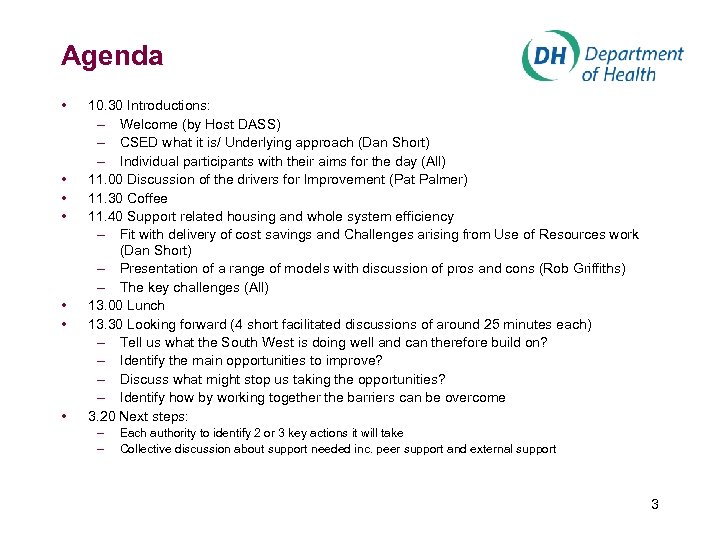
Agenda • • 10. 30 Introductions: – Welcome (by Host DASS) – CSED what it is/ Underlying approach (Dan Short) – Individual participants with their aims for the day (All) 11. 00 Discussion of the drivers for Improvement (Pat Palmer) 11. 30 Coffee 11. 40 Support related housing and whole system efficiency – Fit with delivery of cost savings and Challenges arising from Use of Resources work (Dan Short) – Presentation of a range of models with discussion of pros and cons (Rob Griffiths) – The key challenges (All) 13. 00 Lunch 13. 30 Looking forward (4 short facilitated discussions of around 25 minutes each) – Tell us what the South West is doing well and can therefore build on? – Identify the main opportunities to improve? – Discuss what might stop us taking the opportunities? – Identify how by working together the barriers can be overcome 3. 20 Next steps: – – Each authority to identify 2 or 3 key actions it will take Collective discussion about support needed inc. peer support and external support 3
Welcome by Jane Smith 4
CSED – Introduction and underlying approach • Programme within DH Social Care, Local Government and Care Partnerships Directorate established in 2004 following Gershon • Supporting adult social care achieve necessary 3% savings p. a. • Team of independent consultants • Reports to Shaun Gallagher Director of Social Care and Policy in the DH Social Care policy and Innovation Division • CSR 07 Programme launched April 2008 – Tim O’Connor Programme Director – c. 35 staff supporting 150 CSSRs and advising on efficiency in other DH programmes Care Services Efficiency Delivery: supporting sustainable transformation 5
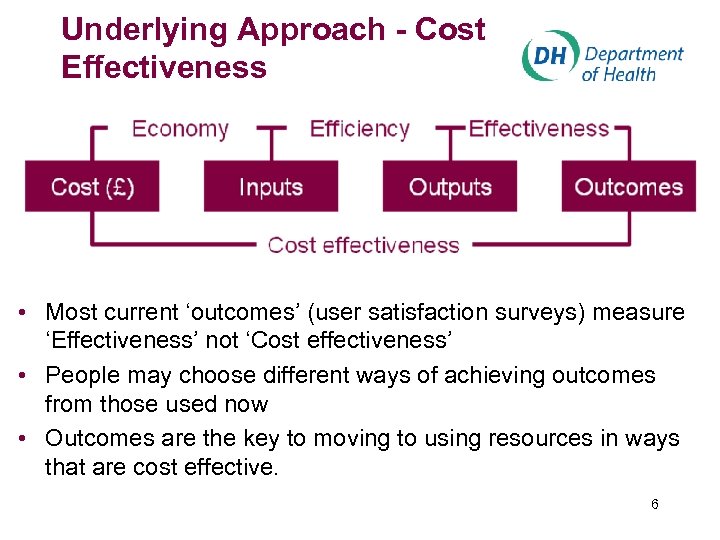
Underlying Approach - Cost Effectiveness • Most current ‘outcomes’ (user satisfaction surveys) measure ‘Effectiveness’ not ‘Cost effectiveness’ • People may choose different ways of achieving outcomes from those used now • Outcomes are the key to moving to using resources in ways that are cost effective. 6
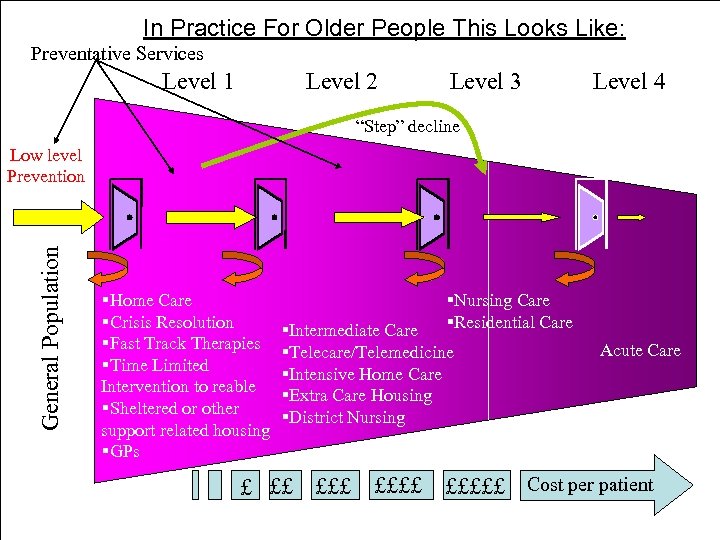
In Practice For Older People This Looks Like: Preventative Services Level 1 Level 2 Level 3 Level 4 “Step” decline General Population Low level Prevention §Home Care §Crisis Resolution §Fast Track Therapies §Time Limited Intervention to reable §Sheltered or other support related housing §GPs §Nursing Care §Residential Care §Intermediate Care §Telecare/Telemedicine §Intensive Home Care §Extra Care Housing §District Nursing Acute Care £ ££ £££££ Cost per patient 7 Slide 7
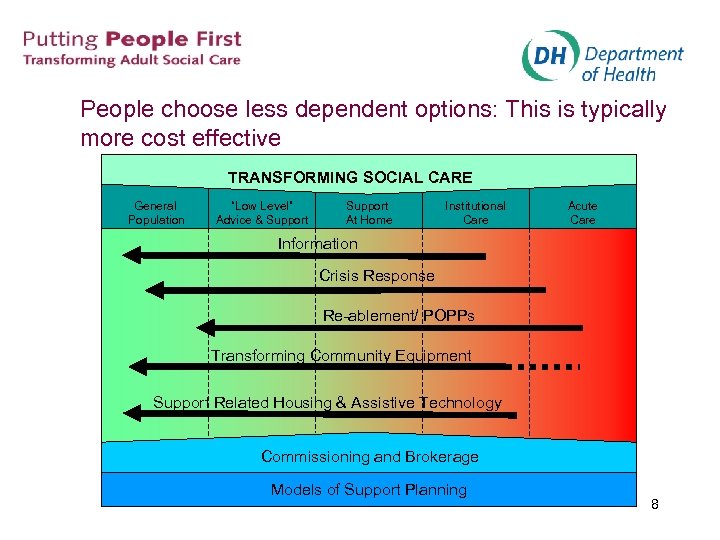
People choose less dependent options: This is typically more cost effective TRANSFORMING SOCIAL CARE General Population “Low Level” Advice & Support At Home Institutional Care Acute Care Information Crisis Response Re-ablement/ POPPs Transforming Community Equipment Support Related Housing & Assistive Technology Commissioning and Brokerage Models of Support Planning 8
Individual objectives for the day 9
Housing Support Unit (South West) ‘Working towards the delivery of better housing options for older people in the SW’ Pat Palmer South West Housing LIN & South West HSU Lead 10
Drivers for Change • Startling demographics • Cost efficiencies – ‘John Bolton challenge’ • Rising aspirations – a consumer generation • Personalisation agenda 11
The Challenges • The need for a clear strategic vision • Partnership working – means ‘buy in’ and commitment - joint strategies • Dwindling resources – effective Use of Resources is the key tool for communicating the need for change • Capacity issues and time to think ‘strategically’ -we need to work collaboratively • The need for effective models for the South West 12
Identify solutions • The importance of understanding the market – Demand – Provision – Aspirations • Models that deliver the desired outcomes 13
Refreshments 14
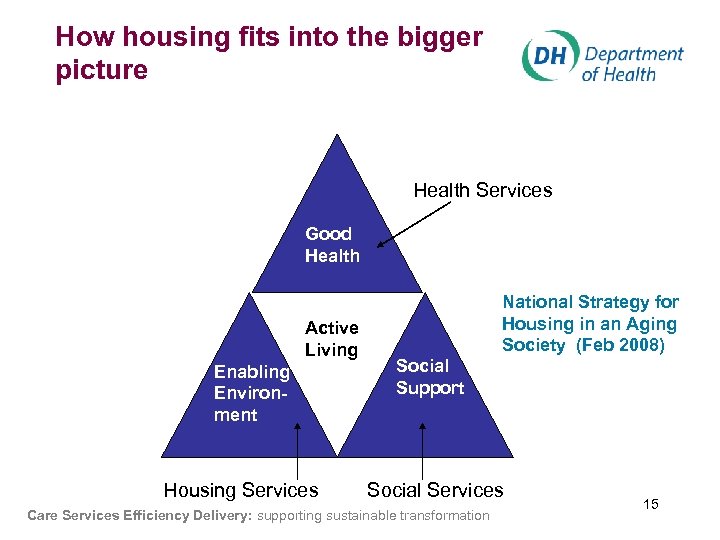
How housing fits into the bigger picture Health Services Good Health Active Living Enabling Environment Housing Services National Strategy for Housing in an Aging Society (Feb 2008) Social Support Social Services Care Services Efficiency Delivery: supporting sustainable transformation 15
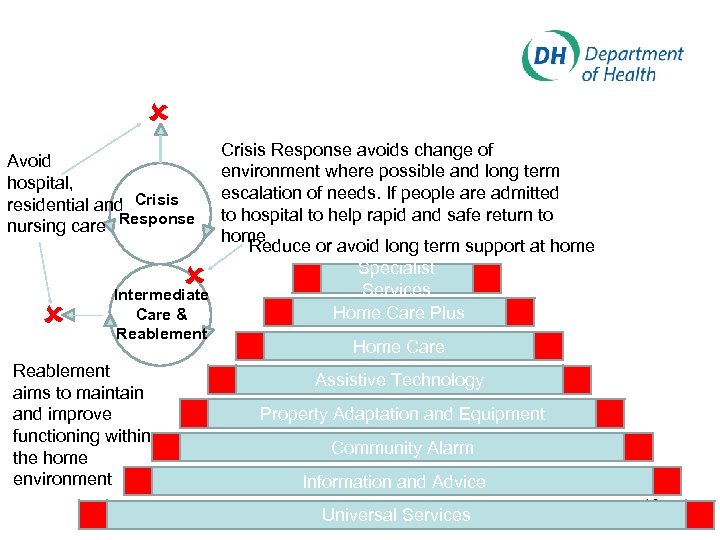
Crisis Response avoids change of environment where possible and long term escalation of needs. If people are admitted to hospital to help rapid and safe return to home Reduce or avoid long term support at home Specialist Services Intermediate Home Care Plus Care & Avoid hospital, residential and Crisis nursing care Response Reablement aims to maintain and improve functioning within the home environment Home Care Assistive Technology Property Adaptation and Equipment Community Alarm Information and Advice Universal Services 16
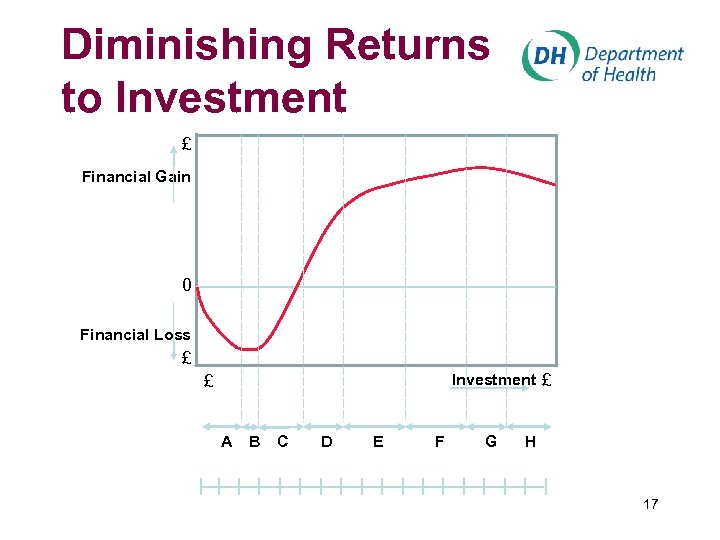
Diminishing Returns to Investment £ Financial Gain 0 Financial Loss £ Investment £ £ A B C D E F G H 17
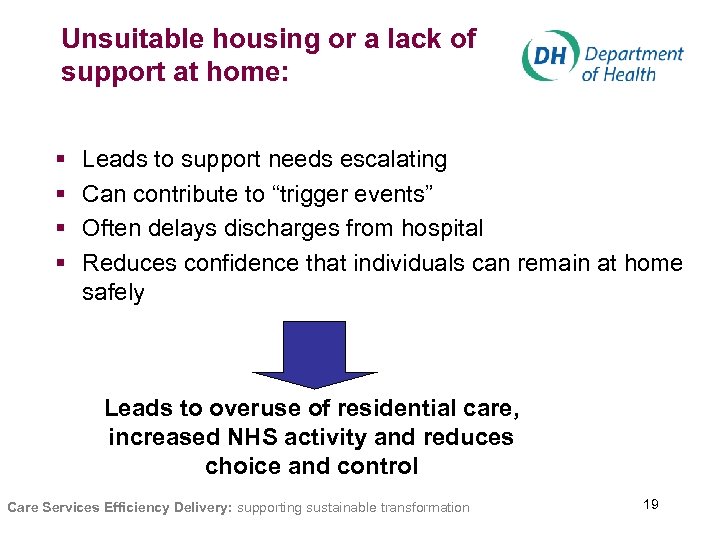
Unsuitable housing or a lack of support at home: § § Leads to support needs escalating Can contribute to “trigger events” Often delays discharges from hospital Reduces confidence that individuals can remain at home safely Leads to overuse of residential care, increased NHS activity and reduces choice and control Care Services Efficiency Delivery: supporting sustainable transformation 19
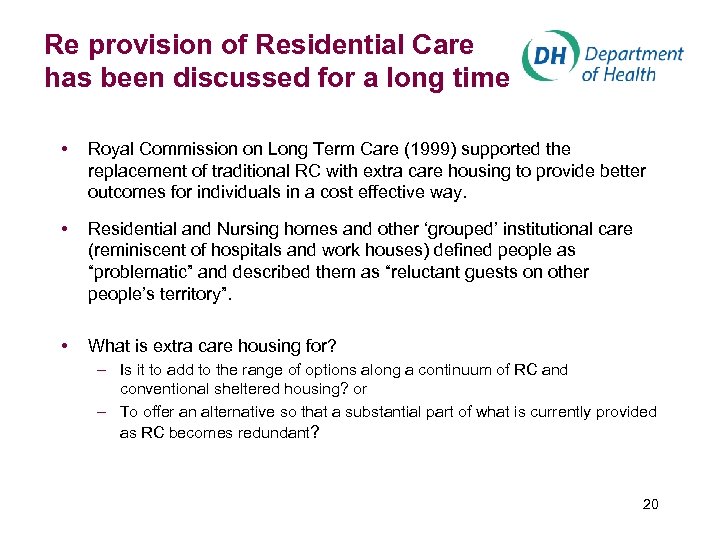
Re provision of Residential Care has been discussed for a long time • Royal Commission on Long Term Care (1999) supported the replacement of traditional RC with extra care housing to provide better outcomes for individuals in a cost effective way. • Residential and Nursing homes and other ‘grouped’ institutional care (reminiscent of hospitals and work houses) defined people as “problematic” and described them as “reluctant guests on other people’s territory”. • What is extra care housing for? – Is it to add to the range of options along a continuum of RC and conventional sheltered housing? or – To offer an alternative so that a substantial part of what is currently provided as RC becomes redundant? 20
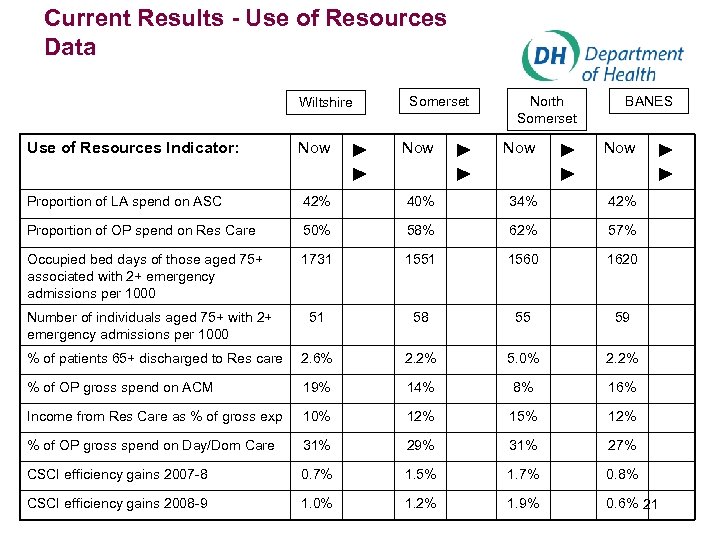
Current Results - Use of Resources Data Wiltshire Use of Resources Indicator: Now ► ► Somerset Now ► ► North Somerset Now ► ► BANES Now ► ► Proportion of LA spend on ASC 42% 40% 34% 42% Proportion of OP spend on Res Care 50% 58% 62% 57% Occupied bed days of those aged 75+ associated with 2+ emergency admissions per 1000 1731 1551 1560 1620 51 58 55 59 % of patients 65+ discharged to Res care 2. 6% 2. 2% 5. 0% 2. 2% % of OP gross spend on ACM 19% 14% 8% 16% Income from Res Care as % of gross exp 10% 12% 15% 12% % of OP gross spend on Day/Dom Care 31% 29% 31% 27% CSCI efficiency gains 2007 -8 0. 7% 1. 5% 1. 7% 0. 8% CSCI efficiency gains 2008 -9 1. 0% 1. 2% 1. 9% 0. 6% 21 Number of individuals aged 75+ with 2+ emergency admissions per 1000
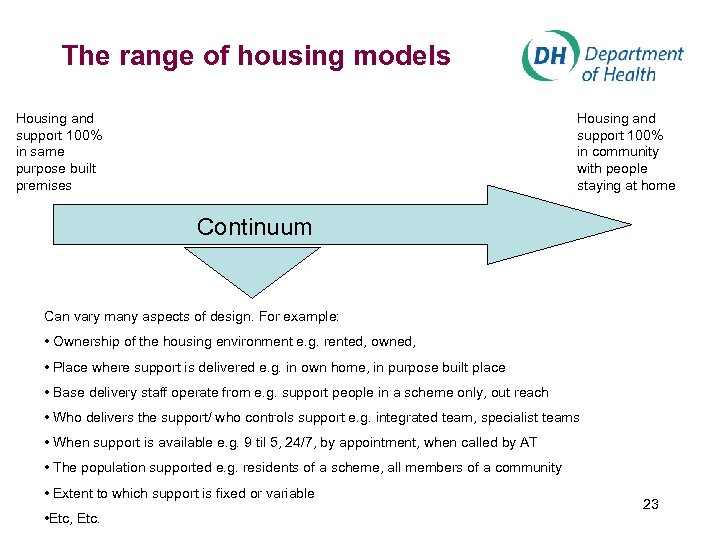
The range of housing models Housing and support 100% in same purpose built premises Housing and support 100% in community with people staying at home Continuum Can vary many aspects of design. For example: • Ownership of the housing environment e. g. rented, owned, • Place where support is delivered e. g. in own home, in purpose built place • Base delivery staff operate from e. g. support people in a scheme only, out reach • Who delivers the support/ who controls support e. g. integrated team, specialist teams • When support is available e. g. 9 til 5, 24/7, by appointment, when called by AT • The population supported e. g. residents of a scheme, all members of a community • Extent to which support is fixed or variable • Etc, Etc. 23
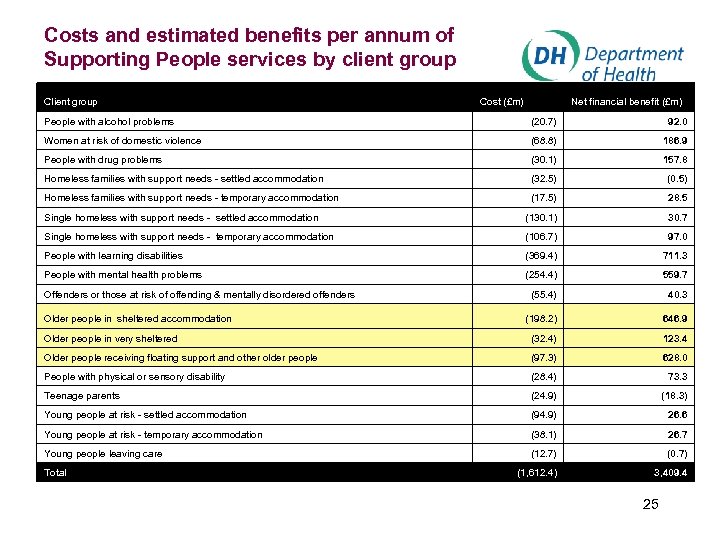
Costs and estimated benefits per annum of Supporting People services by client group Cost (£m) Net financial benefit (£m) People with alcohol problems (20. 7) 92. 0 Women at risk of domestic violence (68. 8) 186. 9 People with drug problems (30. 1) 157. 8 Homeless families with support needs - settled accommodation (32. 5) (0. 5) Homeless families with support needs - temporary accommodation (17. 5) 28. 5 Single homeless with support needs - settled accommodation (130. 1) 30. 7 Single homeless with support needs - temporary accommodation (106. 7) 97. 0 People with learning disabilities (369. 4) 711. 3 People with mental health problems (254. 4) 559. 7 (55. 4) 40. 3 (198. 2) 646. 9 Older people in very sheltered (32. 4) 123. 4 Older people receiving floating support and other older people (97. 3) 628. 0 People with physical or sensory disability (28. 4) 73. 3 Teenage parents (24. 9) (18. 3) Young people at risk - settled accommodation (94. 9) 26. 6 Young people at risk - temporary accommodation (38. 1) 26. 7 Young people leaving care (12. 7) (0. 7) (1, 612. 4) 3, 409. 4 Offenders or those at risk of offending & mentally disordered offenders Older people in sheltered accommodation Total 25
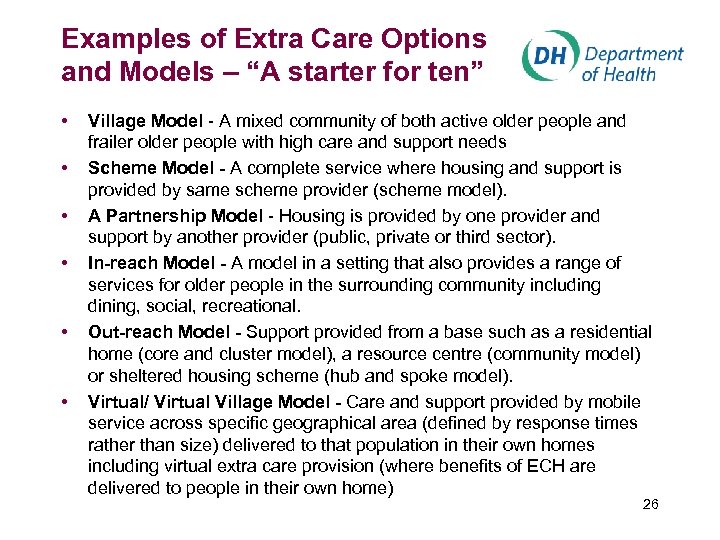
Examples of Extra Care Options and Models – “A starter for ten” • • • Village Model - A mixed community of both active older people and frailer older people with high care and support needs Scheme Model - A complete service where housing and support is provided by same scheme provider (scheme model). A Partnership Model - Housing is provided by one provider and support by another provider (public, private or third sector). In-reach Model - A model in a setting that also provides a range of services for older people in the surrounding community including dining, social, recreational. Out-reach Model - Support provided from a base such as a residential home (core and cluster model), a resource centre (community model) or sheltered housing scheme (hub and spoke model). Virtual/ Virtual Village Model - Care and support provided by mobile service across specific geographical area (defined by response times rather than size) delivered to that population in their own homes including virtual extra care provision (where benefits of ECH are delivered to people in their own home) 26
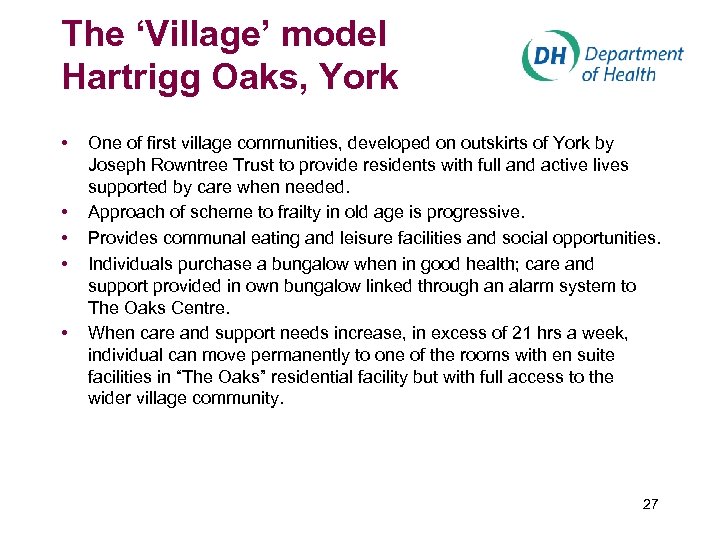
The ‘Village’ model Hartrigg Oaks, York • • • One of first village communities, developed on outskirts of York by Joseph Rowntree Trust to provide residents with full and active lives supported by care when needed. Approach of scheme to frailty in old age is progressive. Provides communal eating and leisure facilities and social opportunities. Individuals purchase a bungalow when in good health; care and support provided in own bungalow linked through an alarm system to The Oaks Centre. When care and support needs increase, in excess of 21 hrs a week, individual can move permanently to one of the rooms with en suite facilities in “The Oaks” residential facility but with full access to the wider village community. 27
Extracare Charitable Trust model – Scheme model with “In Reach” • • • Extra. Care Charitable Trust formed in 1988 and operates 30 supported housing schemes and retirement villages throughout the Midlands area and the North (8 in Wolverhampton) Trust’s roots are in the reprovision of NHS long stay units for older people providing substantial experience of higher end dependency. Emphasis on lifestyle and opportunities for learning and growth in old age alongside flexible approach to care provision. Very sheltered model is partnership between registered social landlord, care provider and local authority who retain 100% nomination rights if free land given. Each scheme consists of typically 40 -50 self contained flats held on assured tenancy agreements that give a legal right of occupation and offers: Ø Social club with social, learning and healthy living activities plus Cafe/restaurant. for people in scheme and for the local community ( in reach). Ø 24/7 dedicated on site care team, to provide flexible response to tenants needs (average package = 10 -12 hrs per week; schemes monitored by allocations team to ensure no disproportionate number of people with high level needs). Ø Preventative, rehabilitative, person centred approach. 28
Extracare Charitable Trust model Wolverhampton - Impacts • • Wolverhampton has 8 very sheltered schemes providing over 400 units. Impact on where people live: – Investment has had an impact on residential care numbers reducing over a 10 yr period from anticipated 1, 050 to 588 ( 814 people 65+ in 1997). – Indicates that 400 -500 older people were maintained at home through reconfiguration of very sheltered housing, intermediate care and respite care. • Cost effectiveness: – Broadway Gardens was initial element of LA’s total re provision of RC homes. Evaluation of 36 tenants after 2 years showed that if they had received the same level of care as prior to the scheme care costs would have been 50% higher so producing £ 123, 000 savings over the two year period. – Langley Court has shown savings of £ 93, 132 (48%) – Bridge Court has shown savings of £ 108, 888 (24%) N. B. Savings from Bridge Court would have been 33% if Supporting People funding had been excluded. – Net average cost to social care of support to older person in scheme = £ 125 pw compared with residential care net average cost of £ 250 pw or average care package of £ 190 pw (not including 24/7 support). – People with £ 16, 000 capital pay flat weekly fee (£ 105); people who receive attendance allowance pay at least 85% to scheme provider. 29
Extracare Charitable Trust ‘village’ model, Berryhill, Stokeon-Trent – Optimum Size • Developed after Broadway Gardens to offer a ‘village’ approach. • Increased conventional size of traditional sheltered schemes on the basis that: Ø A larger development allowed greater investment in high quality communal facilities for tenants and local community. Ø Enhanced the viability of activities and services that drew upon the expertise of residents. • Trust now regard 250 unit schemes as the norm i. e. it is important to think about service size from the perspective of quality and economies of scale 30
Extracare Charitable Trust ‘village’ model, Warrington –The question of tenure? • Example of larger scale developments providing units for sale for owner occupier market; 20% moving towards 50%. • Success of schemes depend on volunteers among residents to sustain them mixing a relatively high proportion of people with little or no current care needs with smaller numbers with medium to high needs so developing social capital within each community and offering valuable peer support. • Evidence from the Trust and an evaluation from Keele University indicates that such schemes can reverse dependency for some residents and support a proportion of residents with high level service needs. 31
The ‘scheme’ model Wokingham Extra Care Sheltered Housing • Mixed dependency population; around 1/3 having care needs in excess of 18 hrs pw; 1/3 low care needs; 1/3 no current care needs. • Aggregate care needs at least 240 hrs p. w. • Manager based on site provides support and co-ordination; 24/7 on site care. Facilitated recreation, social and cultural programme. • Offers en suite 1 bedroom accommodation plus: Ø Ø Ø Restaurant, Craft rooms, IT suite, Exercise suite, Day opportunities. • Scheme design: Ø Encourages orientation, Ø Has infra structure for AT, Ø Additional storage space. 32
The ‘virtual care village’model Cumbria County Council • • • Care and support provided by mobile service through block contracts across a specific geographical area defined by response times rather than size delivered to that population in their own homes including extra care provision. Alarm provider uses telecare database to provide vital information to care workers via mobile phones 24/7; telehealth used to monitor LTC. Extra care schemes provide on site waking night service and a base for mobile night time care team. Developments include housing visitor, housing warden and floating support. Drivers include making existing extra care housing more efficient and better management of risk in communities given demographic pressures and rural locations. Potential to develop shared information systems and client data base, development of co-ordinated handyperson service and 3 rd sector support services e. g. Alzeimer’s Society Family Support, Carers Assoc. 34
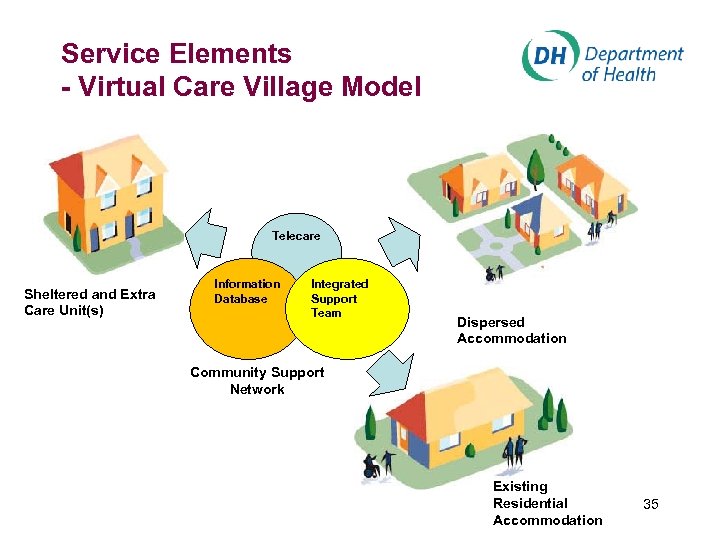
Service Elements - Virtual Care Village Model Telecare Sheltered and Extra Care Unit(s) Information Database Integrated Support Team Dispersed Accommodation Community Support Network Existing Residential Accommodation 35
Virtual Extra Care/ Enhanced Domiciliary Care - North Warwickshire • • Existing daytime home care service + new night time home care workers operating on short term contracts from a Residential Care Home, Bracebridge Court, offering 24/7 cover to a defined rural community within a 14 mile radius. Under home care regs. Eligibility to cover those assessed as needing Residential Care or respite, or temporary social care needs e. g. hospital discharge, reablement etc. Bracebridge offers respite and telecare familiarity for short stays and as a local community resource. Service linked with housing management staff, community nurses, 3 rd sector and locality commissioners for continuous review. Unit costs based on estimated 20 service users = £ 7, 950 pa. or £ 150 p. w. If scheme extended to additional users, unit costs will decrease. Scheme offers an extra care cheaper alternative to residential care and benefits for users at being able to stay in their own home and community. Possibility of linking to ‘virtual wards’ in future. 36
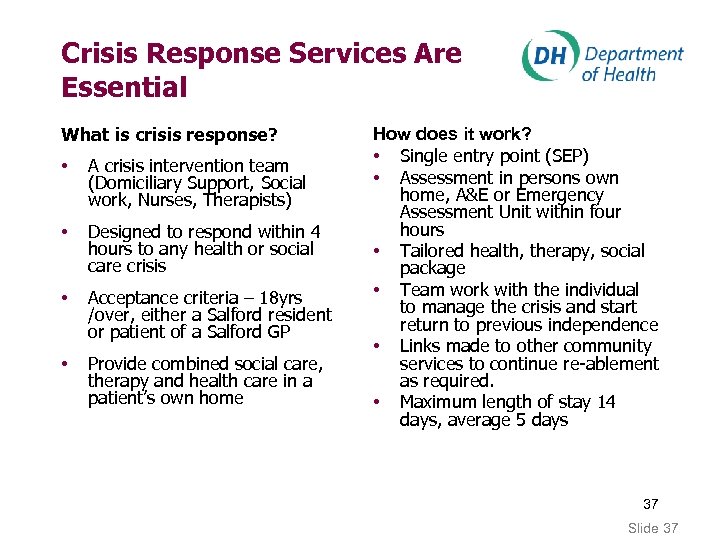
Crisis Response Services Are Essential What is crisis response? • A crisis intervention team (Domiciliary Support, Social work, Nurses, Therapists) • Designed to respond within 4 hours to any health or social care crisis • Acceptance criteria – 18 yrs /over, either a Salford resident or patient of a Salford GP • Provide combined social care, therapy and health care in a patient’s own home How does it work? • Single entry point (SEP) • Assessment in persons own home, A&E or Emergency Assessment Unit within four hours • Tailored health, therapy, social package • Team work with the individual to manage the crisis and start return to previous independence • Links made to other community services to continue re-ablement as required. • Maximum length of stay 14 days, average 5 days 37 Slide 37
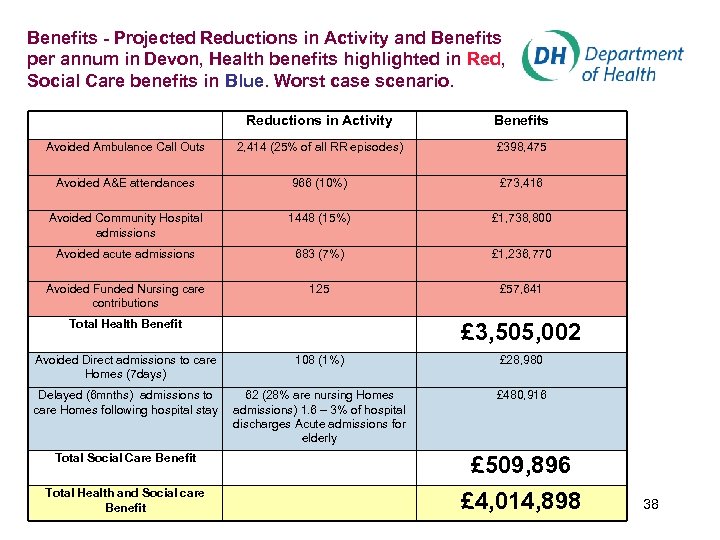
Benefits - Projected Reductions in Activity and Benefits per annum in Devon, Health benefits highlighted in Red, Social Care benefits in Blue. Worst case scenario. Reductions in Activity Benefits Avoided Ambulance Call Outs 2, 414 (25% of all RR episodes) £ 398, 475 Avoided A&E attendances 966 (10%) £ 73, 416 Avoided Community Hospital admissions 1448 (15%) £ 1, 738, 800 Avoided acute admissions 683 (7%) £ 1, 236, 770 Avoided Funded Nursing care contributions 125 £ 57, 641 Total Health Benefit £ 3, 505, 002 Avoided Direct admissions to care Homes (7 days) 108 (1%) £ 28, 980 Delayed (6 mnths) admissions to care Homes following hospital stay 62 (28% are nursing Homes admissions) 1. 6 – 3% of hospital discharges Acute admissions for elderly £ 480, 916 Total Social Care Benefit Total Health and Social care Benefit £ 509, 896 £ 4, 014, 898 38
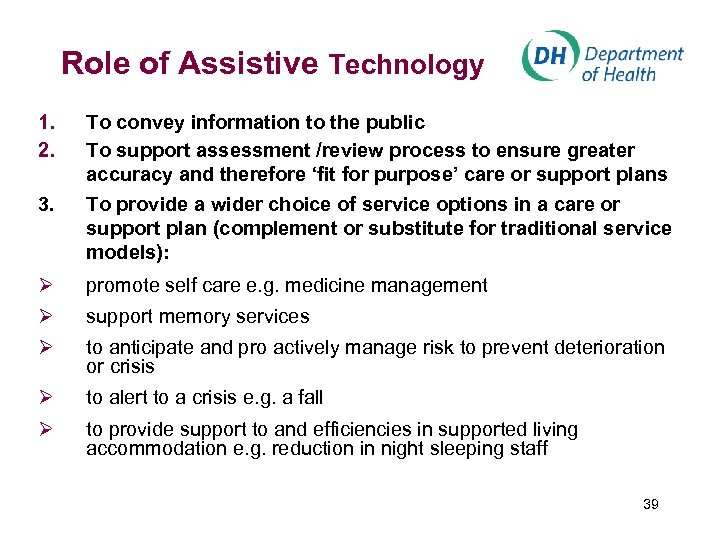
Role of Assistive Technology 1. 2. 3. To convey information to the public To support assessment /review process to ensure greater accuracy and therefore ‘fit for purpose’ care or support plans To provide a wider choice of service options in a care or support plan (complement or substitute for traditional service models): Ø promote self care e. g. medicine management Ø support memory services Ø to anticipate and pro actively manage risk to prevent deterioration or crisis Ø to alert to a crisis e. g. a fall Ø to provide support to and efficiencies in supported living accommodation e. g. reduction in night sleeping staff 39
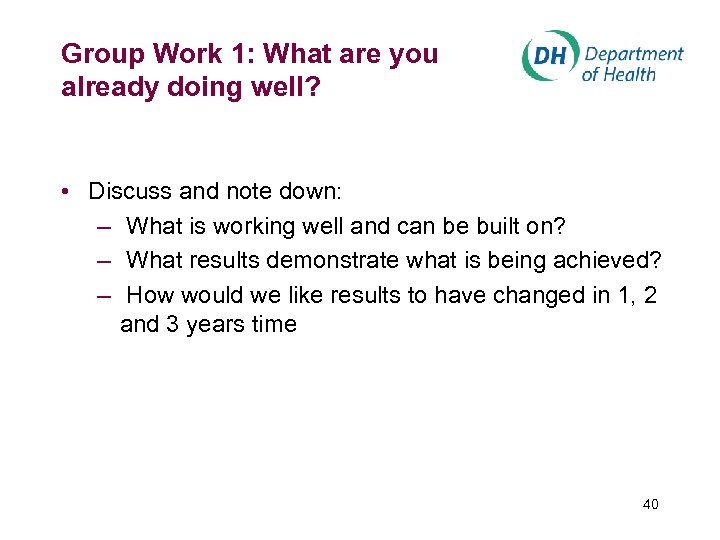
Group Work 1: What are you already doing well? • Discuss and note down: – What is working well and can be built on? – What results demonstrate what is being achieved? – How would we like results to have changed in 1, 2 and 3 years time 40
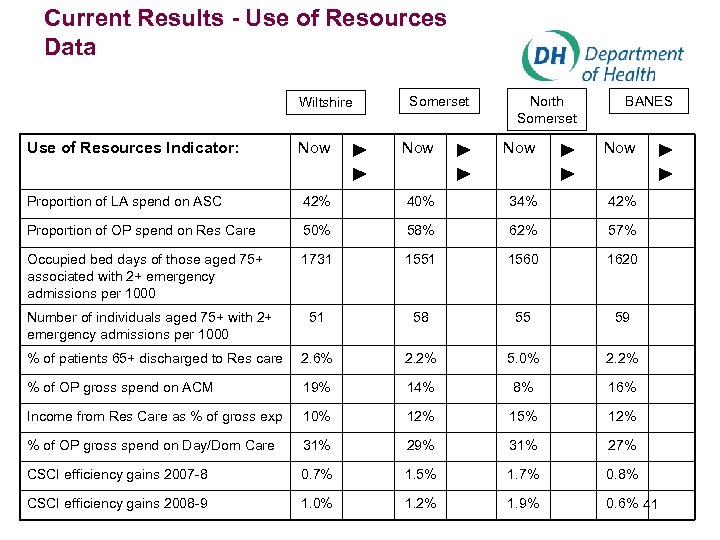
Current Results - Use of Resources Data Wiltshire Use of Resources Indicator: Now ► ► Somerset Now ► ► North Somerset Now ► ► BANES Now ► ► Proportion of LA spend on ASC 42% 40% 34% 42% Proportion of OP spend on Res Care 50% 58% 62% 57% Occupied bed days of those aged 75+ associated with 2+ emergency admissions per 1000 1731 1551 1560 1620 51 58 55 59 % of patients 65+ discharged to Res care 2. 6% 2. 2% 5. 0% 2. 2% % of OP gross spend on ACM 19% 14% 8% 16% Income from Res Care as % of gross exp 10% 12% 15% 12% % of OP gross spend on Day/Dom Care 31% 29% 31% 27% CSCI efficiency gains 2007 -8 0. 7% 1. 5% 1. 7% 0. 8% CSCI efficiency gains 2008 -9 1. 0% 1. 2% 1. 9% 0. 6% 41 Number of individuals aged 75+ with 2+ emergency admissions per 1000
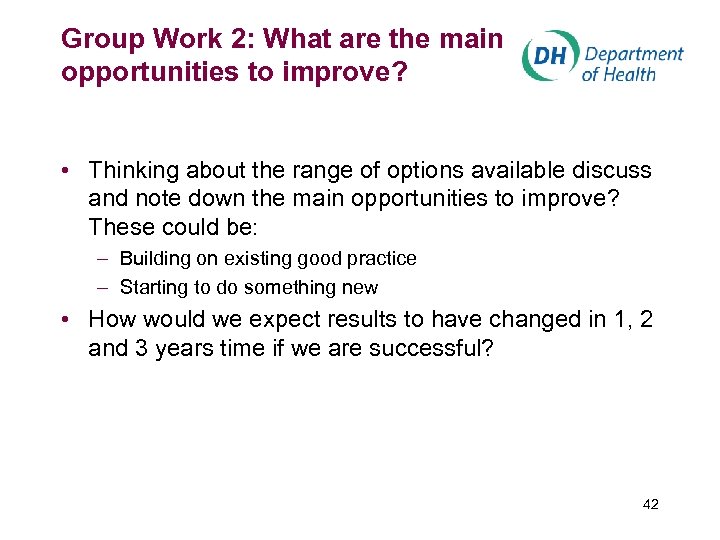
Group Work 2: What are the main opportunities to improve? • Thinking about the range of options available discuss and note down the main opportunities to improve? These could be: – Building on existing good practice – Starting to do something new • How would we expect results to have changed in 1, 2 and 3 years time if we are successful? 42
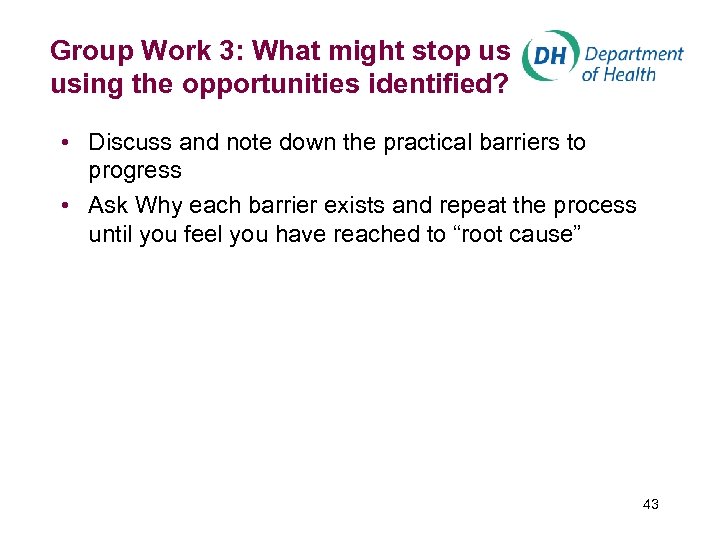
Group Work 3: What might stop us using the opportunities identified? • Discuss and note down the practical barriers to progress • Ask Why each barrier exists and repeat the process until you feel you have reached to “root cause” 43
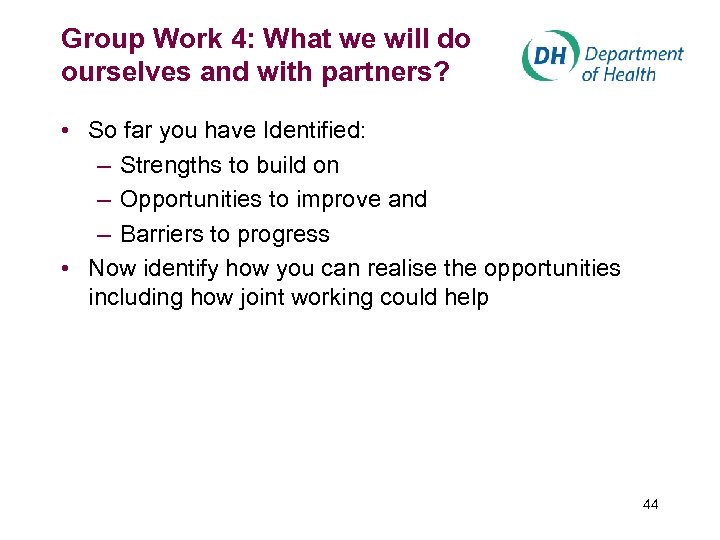
Group Work 4: What we will do ourselves and with partners? • So far you have Identified: – Strengths to build on – Opportunities to improve and – Barriers to progress • Now identify how you can realise the opportunities including how joint working could help 44
Next steps • Please identify the first 2 or 3 things you will do to start taking advantage of the opportunities identified • Discuss what support (external and by peers) would be helpful in the future 45
Скачать презентацию APPENDIX E THE SUB-REGIONAL WORKSHOP PRESENTATIONS 1
b689e77ae5e1f413068061cc303b1119.ppt