 Скачать презентацию Appendix 1 Debate Basics By Ruth Sunda
debate1_bosshart copy.ppt
- Количество слайдов: 14



Appendix 1 Debate Basics By Ruth Sunda
1. Basic terms Debate: a competition in which two opposing teams make speeches to support their arguments and disagree with those of the other team Resolution: the opinion about which two teams argue. Affirmative team: agrees with the resolution. Negative team: disagrees with the resolution. Rebuttal: explains why one team disagrees with the other team.
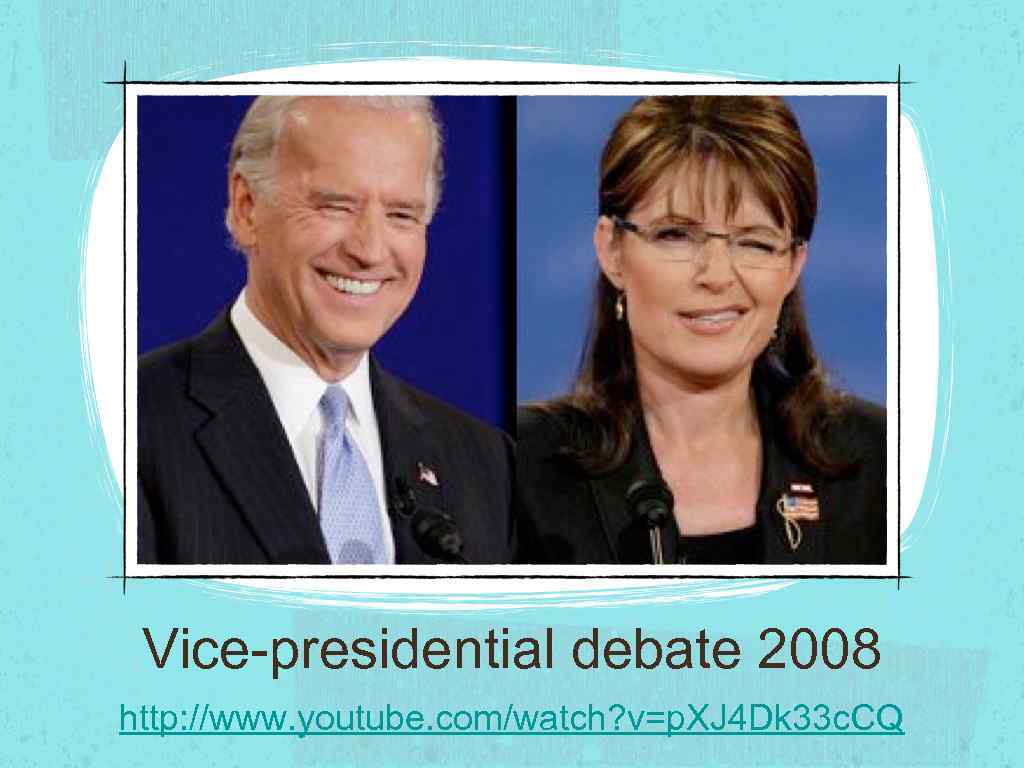
Vice-presidential debate 2008 http: //www. youtube. com/watch? v=p. XJ 4 Dk 33 c. CQ
From the transcript: BIDEN: Yes, well, you know, until two weeks ago -- it was two Mondays ago John Mc. Cain said at 9 o'clock in the morning that the fundamentals of the economy were strong. Two weeks before that, he said George -- we've made great economic progress under George Bush's policies. Nine o'clock, the economy was strong. Eleven o'clock that same day, two Mondays ago, John Mc. Cain said that we have an economic crisis. That doesn't make John Mc. Cain a bad guy, but it does point out he's out of touch. Those folks on the sidelines knew that two months ago. IFILL: Gov. Palin, you may respond. PALIN: John Mc. Cain, in referring to the fundamental of our economy being strong, he was talking to and he was talking about the American workforce. And the American workforce is the greatest in this world, with the ingenuity and the work ethic that is just entrenched in our workforce. That's a positive. That's encouragement. And that's what John Mc. Cain meant.
Now, what I've done as a governor and as a mayor is (inaudible) I've had that track record of reform. And I've joined this team that is a team of mavericks with John Mc. Cain, also, with his track record of reform, where we're known for putting partisan politics aside to just get the job done. Now, Barack Obama, of course, he's pretty much only voted along his party lines. In fact, 96 percent of his votes have been solely along party line, not having that proof for the American people to know that his commitment, too, is, you know, put the partisanship, put the special interests aside, and get down to getting business done for the people of America. We're tired of the old politics as usual. And that's why, with all due respect, I do respect your years in the U. S. Senate, but I think Americans are craving something new and different and that new energy and that new commitment that's going to come with reform. I think that's why we need to send the maverick from the Senate and put him in the White House, and I'm happy to join him there. IFILL: Governor, Senator, neither of you really answered that last question about what you would do as vice president. I'm going to come back to that. . . http: //edition. cnn. com/2008/POLITICS/10/02/debate. transcript/index. html
2. Giving support for your reasons Support consists of evidence. The four kinds of evidence: Example: from your own experience or from what you heard or read Common sense: things that you believe are common knowledge Expert opinion: the opinions of experts -- this comes from research. Statistics: numbers -- this also comes from research
Topic: Smoking should be banned in all public places Example: For example / for instance / let me give an example “Whenever I got to a restaurant or bar and there are people smoking near me, I feel that I am breathing their smoke. This makes me a smoker even though I don’t want to be. ”
Common sense: Everyone knows / if. . . then / it’s common knowledge that “Secondhand smoke is very unhealthy for nonsmokers. ”
Statistics: “Secondhand smoke causes about 250, 000 respiratory infections in infants and children every year, resulting in about 15, 000 hospitalizations each year. ”
Expert opinion: According to. . . / to quote. . . / the book _____ says. . . “According to the Environmental Protection Agency, “secondhand smoke causes about 3, 000 lung cancer deaths in nonsmokers each year. ”
Opinions, preferences: I think. . . , In my opinion. . . , I’d like to. . . , I’d rather. . . I’d prefer. . . , The way I see it. . . , As far as I’m concerned. . . , If it were up to me. . . , I suppose. . . , I suspect that. . . , I’m pretty sure that. . . , It is fairly certain that. . . , I’m convinced that. . . , I honestly feel that, I strongly believe that. . . , Without a doubt. . . ,
Disagreeing: I don’t think that. . . , Don’t you think it would be better. . . , I don’t agree, I’d prefer. . . , Shouldn’t we consider. . . , But what about. . . , I’m afraid I don’t agree. . . , Frankly, I doubt it. . . , Let’s face it, the truth is. . . , The problem with your point of view is that. . .
Giving reasons and offering explanation: To start with, The reason why. . . , That’s why. . . , For this reason. . . , That’s the reason why. . . , Many people think. . . , Considering. . . , Allowing for the fact that. . . , When you consider that. . .
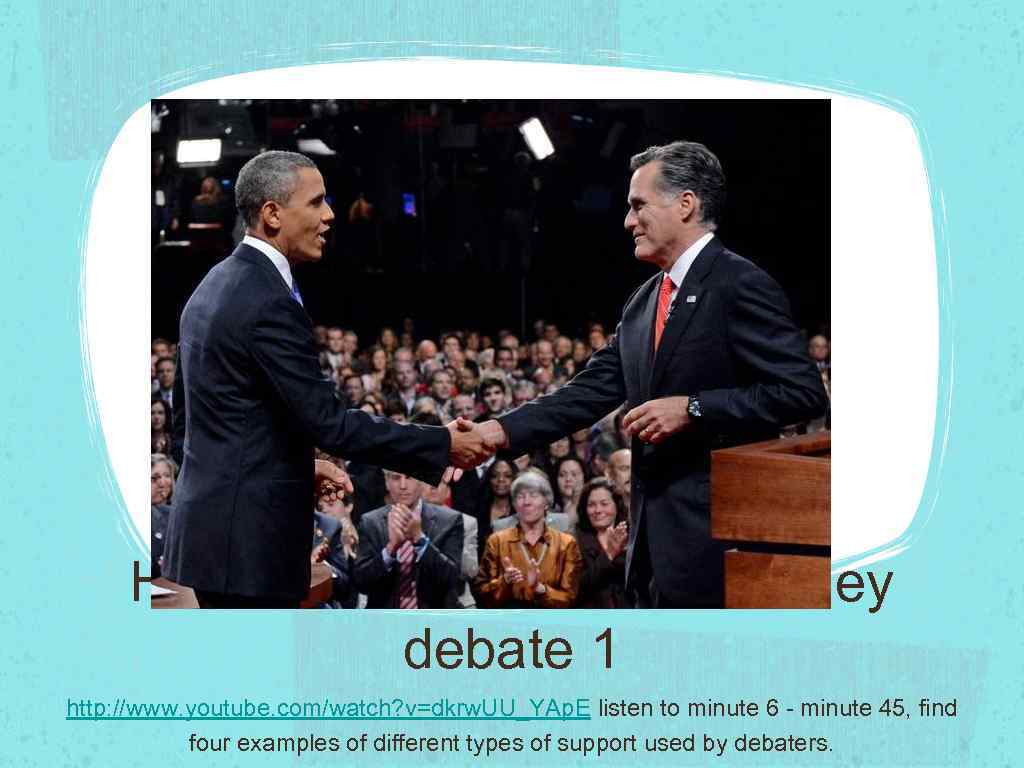
Homework: Obama v. Romney debate 1 http: //www. youtube. com/watch? v=dkrw. UU_YAp. E listen to minute 6 - minute 45, find four examples of different types of support used by debaters.
Скачать презентацию Appendix 1 Debate Basics By Ruth Sunda
debate1_bosshart copy.ppt