


 Скачать презентацию Appendiceal Neuroendocrine Neoplasms ANENs Krystallenia Alexandraki Endocrinologist Endocrine
91c6bd10443e11e11d0af1a4c2a21a4d.ppt
- Количество слайдов: 21
 Appendiceal Neuroendocrine Neoplasms (ANENs) Krystallenia Alexandraki Endocrinologist Endocrine Department, Pathophysiology Clinic, “Laikon” Hospital, National and Kapodistrian University of Athens
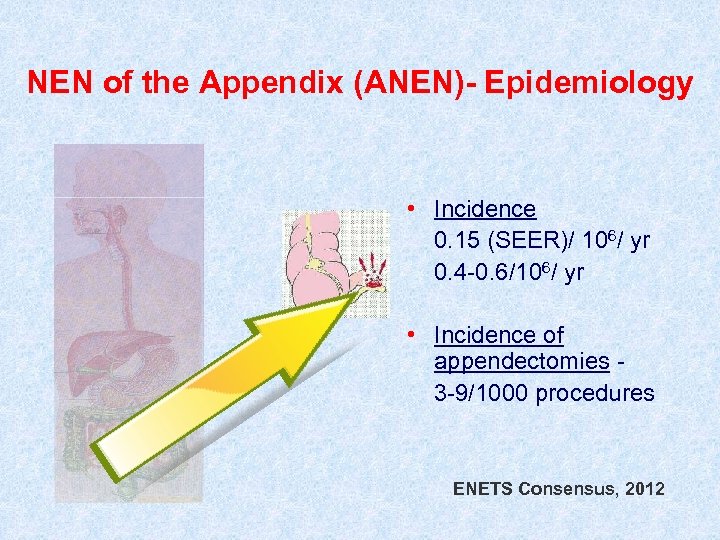 NEN of the Appendix (ANEN)- Epidemiology • Incidence 0. 15 (SEER)/ 106/ yr 0. 4 -0. 6/106/ yr • Incidence of appendectomies 3 -9/1000 procedures ENETS Consensus, 2012
 Patient 1, A. K. • 27 year-old woman, previously in good health • 2/2004 - abdominal pain • Appendicectomy: Small tumor noted at base of appendix
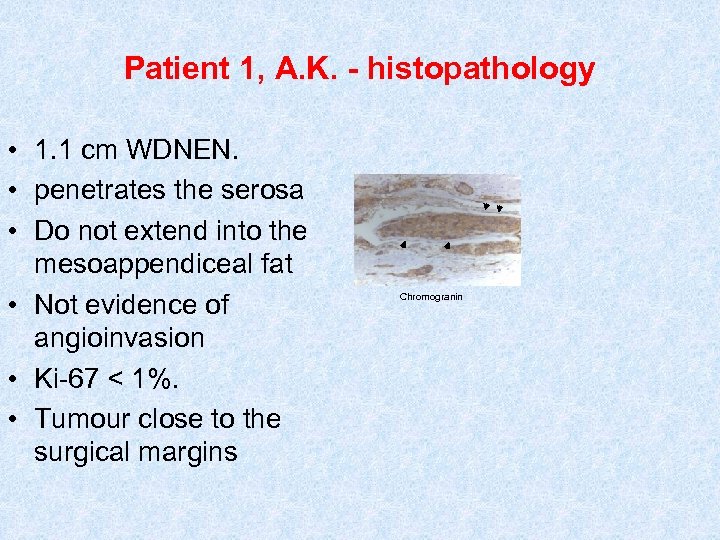 Patient 1, A. K. - histopathology • 1. 1 cm WDNEN. • penetrates the serosa • Do not extend into the mesoappendiceal fat • Not evidence of angioinvasion • Ki-67 < 1%. • Tumour close to the surgical margins Chromogranin
 Patient 2, F. S. • 25 year-old woman, previously in good health. • 7/05 - abdominal pain • Appendicectomy: Small tumor noted at tip of appendix
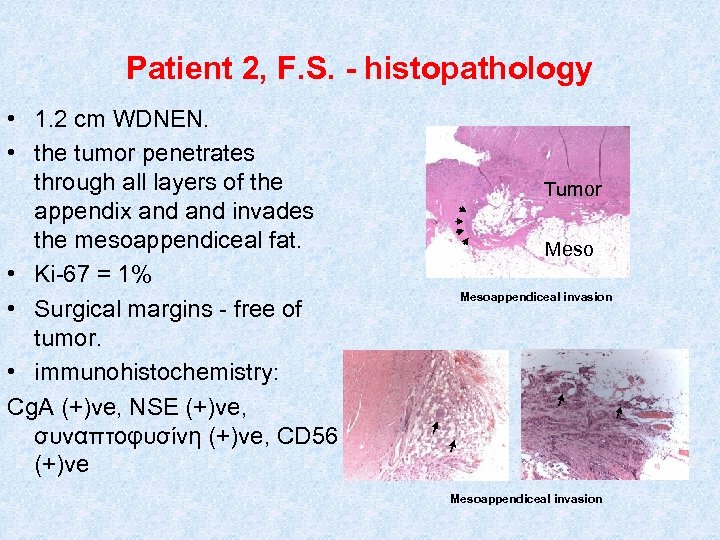 Patient 2, F. S. - histopathology • 1. 2 cm WDNEN. • the tumor penetrates through all layers of the appendix and invades the mesoappendiceal fat. • Ki-67 = 1% • Surgical margins - free of tumor. • immunohistochemistry: Cg. A (+)ve, NSE (+)ve, συναπτοφυσίνη (+)ve, CD 56 (+)ve Tumor Mesoappendiceal invasion
 Patient 3, K. T. • 19 year-old woman, previously in good health. • 7/06 - chronic abdominal pain • Appendicectomy: Small tumor noted at the base of appendix and close to the surgical margins
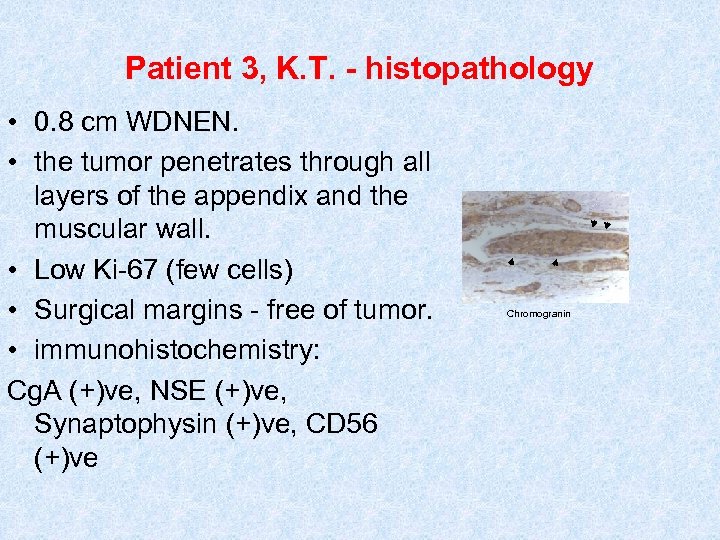 Patient 3, K. T. - histopathology • 0. 8 cm WDNEN. • the tumor penetrates through all layers of the appendix and the muscular wall. • Low Ki-67 (few cells) • Surgical margins - free of tumor. • immunohistochemistry: Cg. A (+)ve, NSE (+)ve, Synaptophysin (+)ve, CD 56 (+)ve Chromogranin
 Patients A. K. - F. S. K. T. : What next? • Nothing? • Right hemicolectomy?
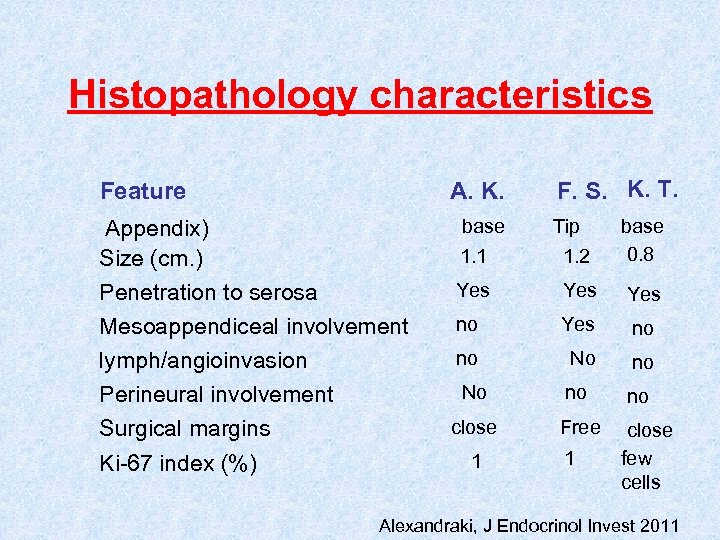 Histopathology characteristics Feature A. K. Appendix) Size (cm. ) Penetration to serosa Mesoappendiceal involvement lymph/angioinvasion Perineural involvement Surgical margins Ki-67 index (%) base F. S. K. T. 1. 1 1. 2 base 0. 8 Yes Yes no no No no no close Free close few cells 1 Tip 1 Alexandraki, J Endocrinol Invest 2011
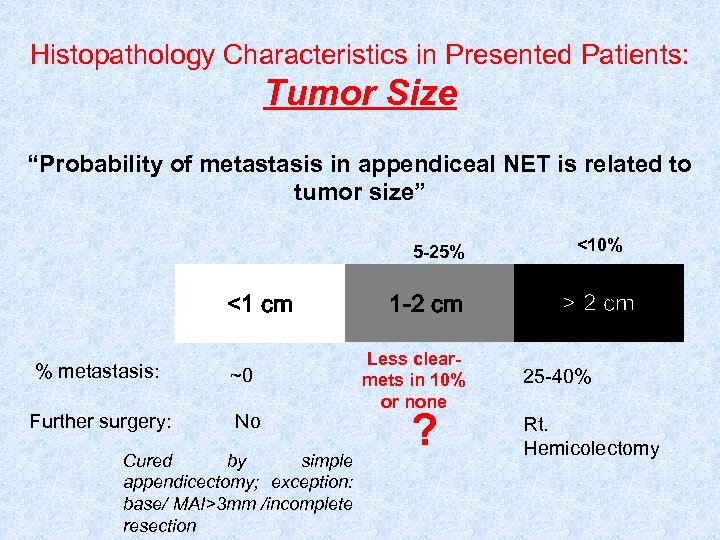 Histopathology Characteristics in Presented Patients: Tumor Size “Probability of metastasis in appendiceal NET is related to tumor size” 5 -25% <1 cm % metastasis: ~0 Further surgery: No Cured by simple appendicectomy; exception: base/ MAI>3 mm /incomplete resection 1 -2 cm Less clearmets in 10% or none ? <10% > 2 cm 25 -40% Rt. Hemicolectomy
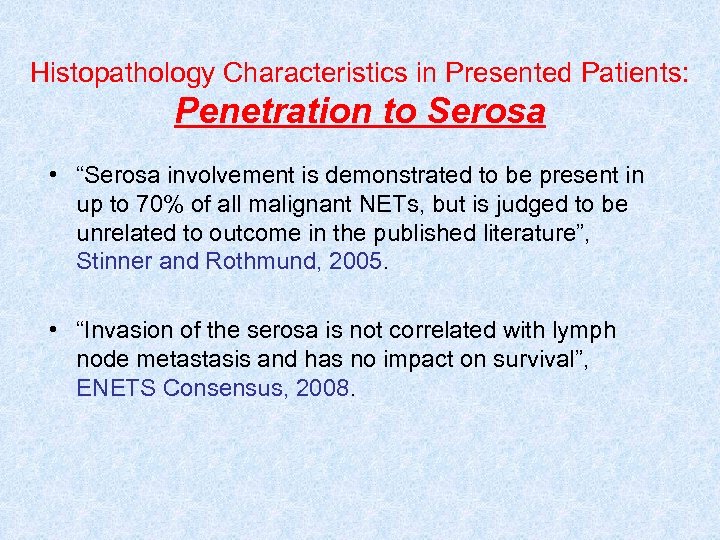 Histopathology Characteristics in Presented Patients: Penetration to Serosa • “Serosa involvement is demonstrated to be present in up to 70% of all malignant NETs, but is judged to be unrelated to outcome in the published literature”, Stinner and Rothmund, 2005. • “Invasion of the serosa is not correlated with lymph node metastasis and has no impact on survival”, ENETS Consensus, 2008.
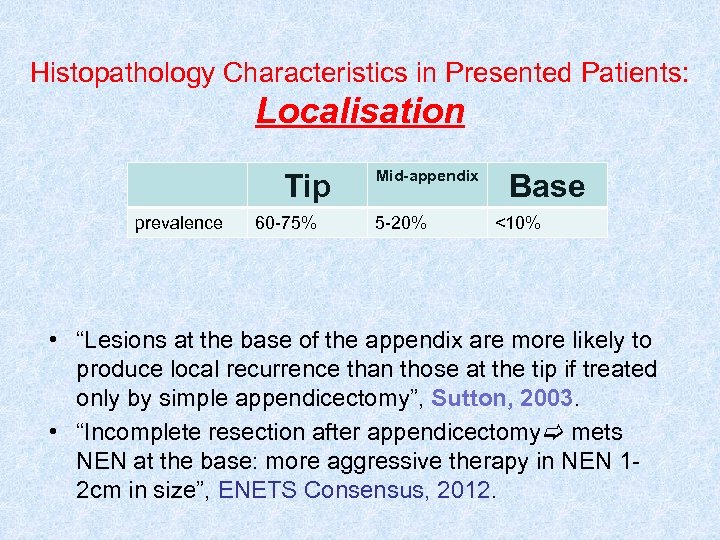 Histopathology Characteristics in Presented Patients: Localisation Tip prevalence 60 -75% Mid-appendix 5 -20% Base <10% • “Lesions at the base of the appendix are more likely to produce local recurrence than those at the tip if treated only by simple appendicectomy”, Sutton, 2003. • “Incomplete resection after appendicectomy mets NEN at the base: more aggressive therapy in NEN 12 cm in size”, ENETS Consensus, 2012.
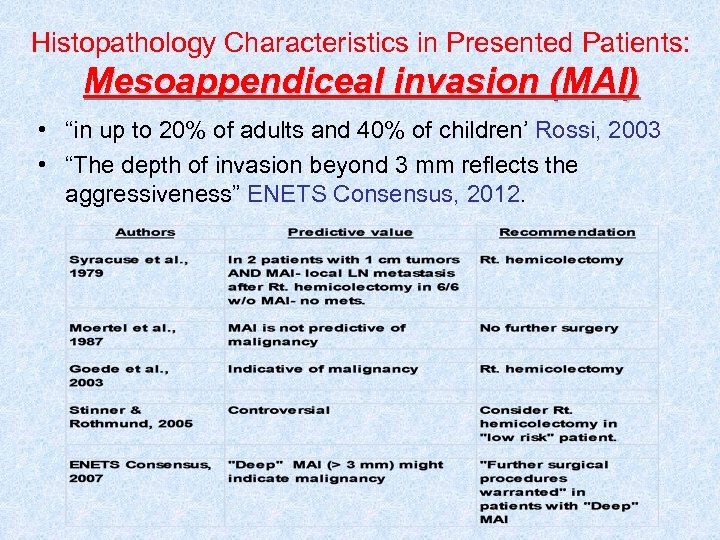 Histopathology Characteristics in Presented Patients: Mesoappendiceal invasion (MAI) • “in up to 20% of adults and 40% of children’ Rossi, 2003 • “The depth of invasion beyond 3 mm reflects the aggressiveness” ENETS Consensus, 2012.
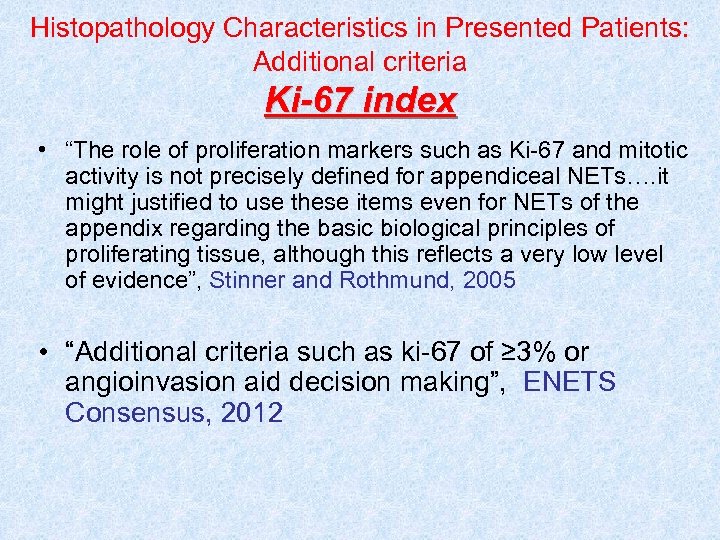 Histopathology Characteristics in Presented Patients: Additional criteria Ki-67 index • “The role of proliferation markers such as Ki-67 and mitotic activity is not precisely defined for appendiceal NETs…. it might justified to use these items even for NETs of the appendix regarding the basic biological principles of proliferating tissue, although this reflects a very low level of evidence”, Stinner and Rothmund, 2005 • “Additional criteria such as ki-67 of ≥ 3% or angioinvasion aid decision making”, ENETS Consensus, 2012
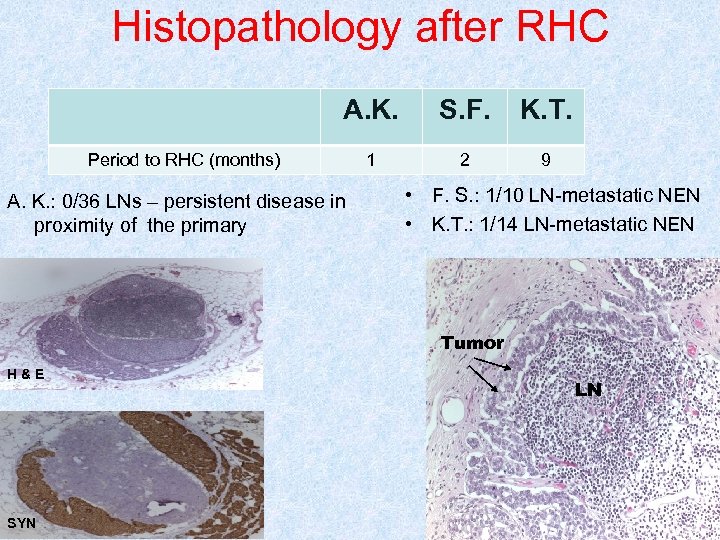 Histopathology after RHC A. K. S. F. K. T. 1 2 9 Period to RHC (months) A. K. : 0/36 LNs – persistent disease in proximity of the primary • F. S. : 1/10 LN-metastatic NEN • K. T. : 1/14 LN-metastatic NEN Tumor H & E SYN LN
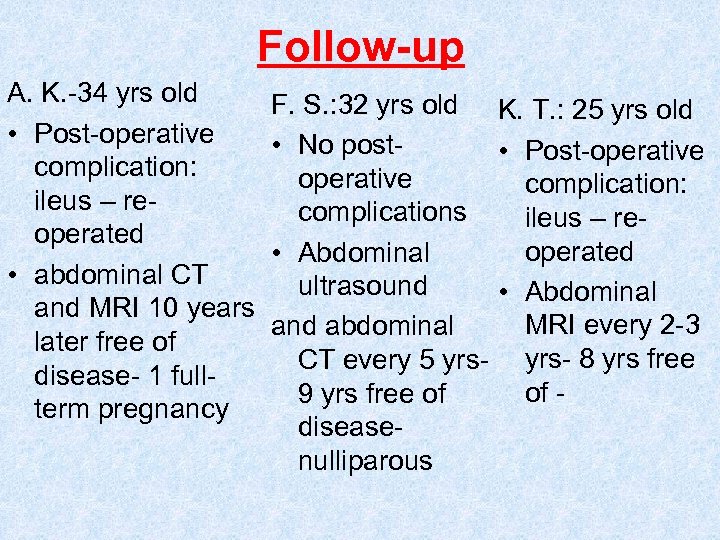 Follow-up A. K. -34 yrs old • Post-operative complication: ileus – reoperated • abdominal CT and MRI 10 years later free of disease- 1 fullterm pregnancy F. S. : 32 yrs old K. T. : 25 yrs old • No post • Post-operative complication: complications ileus – reoperated • Abdominal ultrasound • Abdominal MRI every 2 -3 and abdominal CT every 5 yrs- 8 yrs free of 9 yrs free of diseasenulliparous
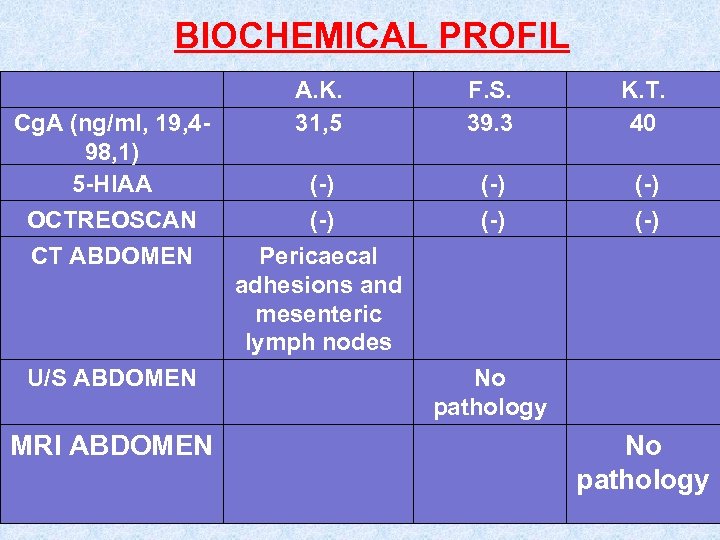 BIOCHEMICAL PROFIL Cg. A (ng/ml, 19, 498, 1) 5 -ΗΙΑΑ OCTREOSCAN CT ABDOMEN U/S ABDOMEN MRI ABDOMEN Α. Κ. 31, 5 F. S. 39. 3 K. T. 40 (-) Pericaecal adhesions and mesenteric lymph nodes (-) (-) No pathology
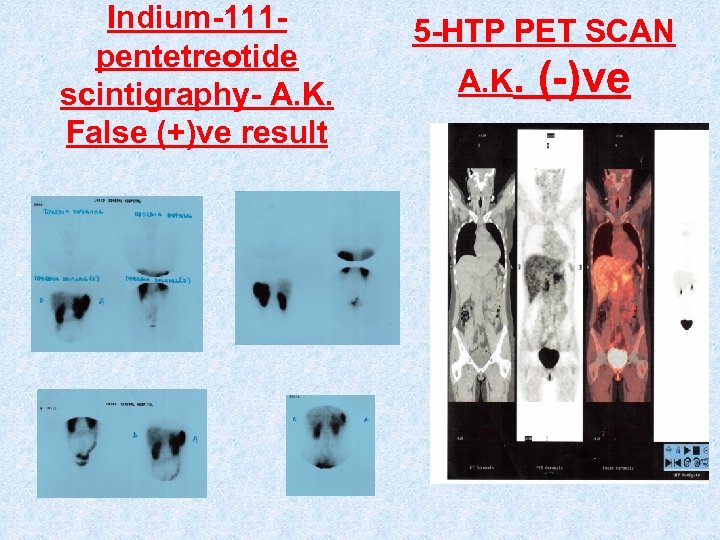 Indium-111 pentetreotide scintigraphy- A. K. False (+)ve result 5 -HTP PET SCAN A. K. (-)ve
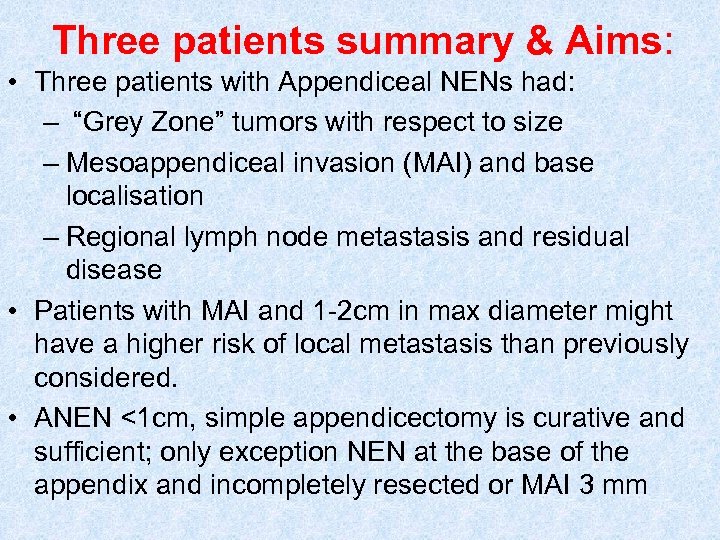 Three patients summary & Aims: • Three patients with Appendiceal NENs had: – “Grey Zone” tumors with respect to size – Mesoappendiceal invasion (MAI) and base localisation – Regional lymph node metastasis and residual disease • Patients with MAI and 1 -2 cm in max diameter might have a higher risk of local metastasis than previously considered. • ANEN <1 cm, simple appendicectomy is curative and sufficient; only exception NEN at the base of the appendix and incompletely resected or MAI 3 mm
 Thank you Neuroendocrine Tumor Unit Team, Endocrinology & Metabolism Service, Department of Medicine, Hadassah-Hebrew University Medical Center, Jerusalem, Israel Acknowledgments Department of Surgery, Shaare Zedek Medical Center, Jerusalem, Israel Prof. D. J. Gross Dr S. Grozinsky-Glasberg Mrs. D. Barak Prof. P. Reissman