


 Скачать презентацию APPEASEMENT AND THE SPIRAL MODEL Topics 17 -18
0696163204e57da081e4dde832578ad4.ppt
- Количество слайдов: 20
 APPEASEMENT AND THE SPIRAL MODEL Topics #17 -18
 Two Theories of War & Peace • There are, roughly speaking, two distinct theories as to why wars break out, despite their often devastating effects on both sides. – Both theories pertain primarily to the nature of the international system, • i. e. , both are primarily “third image” theories in the sense of Waltz, Man, the State, and War. • The two theories are: – The Appeasement / Deterrence Failure Theory of War , • which proposes essentially that international relations is a big Game of Chicken – The Spiral Model Theory of War(“Security Dilemma” plus “Excitation”) • which proposes essentially that international relations is a big Prisoner’s Dilemma Game.
 Appeasement • For nation D to (try to) appease nation A in order to avoid armed conflict may be a sensible strategy, – if the value of the prize to D is relatively small, and (especially) – if giving A the prize will actually appease A. • Domestic democratic politics is in large measure the politics of appeasement – of interest groups, voting blocs, etc. • But even here there is an argument against “appeasement. ” – A strategic analysis of the proverb: “The squeaky wheel gets the grease. ” • In a game against nature, the proverb provides good advise. • But in a game against rational self-interested players, – greasing squeaky wheels may cause more wheels to squeak, – so maybe you shouldn’t grease squeaky wheels in the first place. • Or disciplining a five-year old child?
 Appeasement (cont. ) • In Britain in the mid-1930 s, “appeasement” (of Hitler’s Germany) was widely (though not universally) regarded as a high-minded, praiseworthy, and peace-preserving policy. • “Appeasement” of Germany was widely discredited only after Hitler violated the Munich agreement in March 1939, – when it became reasonably clear that he could not be appeased. • Of course, the earlier appeasement of Hitler may have made him less appeasable later.
 The Appeasement Theory of War • The risk of war arises when – an aggressor nation A (that wants to change the status quo) believes that – status quo nation D is weak in • military capability or (especially) • willingness to use that capability. – A tests D’s resolve with respect to some minor prize. – If D gives in, • especially if D threatens to fight to deny the prize to A but does not carry out its deterrent threat when it fails, • D loses not only the prize but reputation and future credibility, • which encourages A to press other claims against D (and perhaps other nations) even more boldly. – At some point, D recognizes this pattern and resolves to stand firm the next time. • • But D’s threat is no longer credible to A, so A attacks once again, so A may be surprised when D actually carries out its threat and war breaks out as a result of deterrence failure. – The implication is that D should have carried out its deterrent threat in the first instance.
 The Appeasement Theory of War (cont. ) • The story of the origins of WWII in Europe is pretty much a poster-child for the appeasement theory of war. • The US (and its allies) have experienced several more recent instances of costly deterrence failure. – Would North Korea invaded have invaded South Korea (or been permitted to do by the SU and/or China) in 1950 if the US had made a specific threat to respond in the way it actually did respond? • Secretary of State Dean Acheson’s speech regarding the US’s “defense perimeter” in East Asia. – Would Iraq have invaded Kuwait in 1990 if the US had made a credible deterrent threat to respond in the way that it actually did respond?
 The “Security Dilemma” • The “Spiral Model” theory begins with the “security dilemma” (John Herz, International Politics in the Atomic Age). • There are two nations A and B, – of roughly equal military and economic strength. • Neither has aggressive intentions against the other, but – each has a prudent regard for its own national security. – Each nation undertakes some defensive measures, – because neither can be sure about the peaceful intentions of the other, • Some of defensive measures are pretty clearly not threatening to the other nation, • e. g. , fortifications and other static defenses, • Other defensive measures may be (inadvertently) threatening to the other country, • in that they can be used for offensive as well as defensive (“dual use”) purposes, • e. g. , building up the size of an army. – Such measures undertaken by each side generates some fear on the other side, • prompting a further military build-up on each side.
 “Security Dilemma” (cont. ) • In general, as each nation tries to enhance its national security, it also tends inadvertantly to threaten the national security of the other nation. • So we get – something of an arms race between A and B – rising tensions between A and B, and – the possibility of actual war breaking out between A and B. • This results, not from aggressive intentions on either side, but from a reasonable regard for national security in an anarchic international system. • The severity of a security dilemma between A and B depends on: – the degree of equality (of potential military capacity) between A and B; – the state of technology, which determines • the balance between offensive capabilities • the degree to which offensive and defensive capabilities are distinguishable, and – the geographical proximity of the two nations.
 “Security Dilemma” (cont. ) – The US was fortunate to be hardly confronted by a security dilemma throughout much of its history, – due to its geographical isolation (before bombers and missiles) from other great powers. – [Canada and Mexico are not great powers] • European powers, jammed close together in a small continent, have historically faced severe security dilemmas; – that is, their military capabilities posed threats to each other even if they were defensively motivated. • Israel, about ten miles wide at its narrowest and most densely populated area, faces an exceptionally severe security dilemma, that is – military preparations that may truly be defensive nevertheless threaten Israel’s neighbors, because – Israel wants to assure that, if fighting comes, it will occur outside rather than inside Israel.
 The Spiral Model • The Spiral Model starts with the Security Dilemma and carries the story forward to actual or imminently threatened general war between A and B. • This typically entails another relationship between A and B commonly referred to as • the incentive to pre-empt, or • the reciprocal fear of surprise attack (T. Schelling, The Strategy of Conflict), or • the dynamics of mutual alarm (T. Schelling, Arms and Influence, Chapter 6), – that results when a great or even decisive advantage in actual fighting goes to whichever side gets in the first blow, • The severity of the incentive to pre-empt, as of the spiral model itself, depends largely on military technology and geographical proximity.
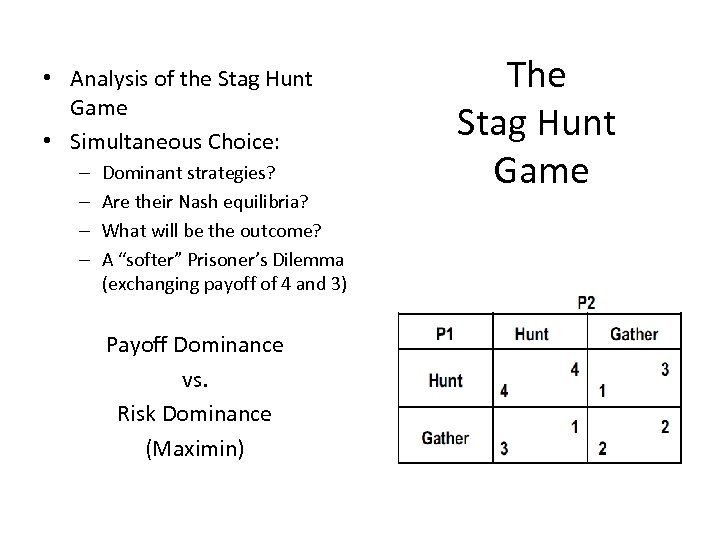 • Analysis of the Stag Hunt Game • Simultaneous Choice: – – Dominant strategies? Are their Nash equilibria? What will be the outcome? A “softer” Prisoner’s Dilemma (exchanging payoff of 4 and 3) Payoff Dominance vs. Risk Dominance (Maximin) The Stag Hunt Game
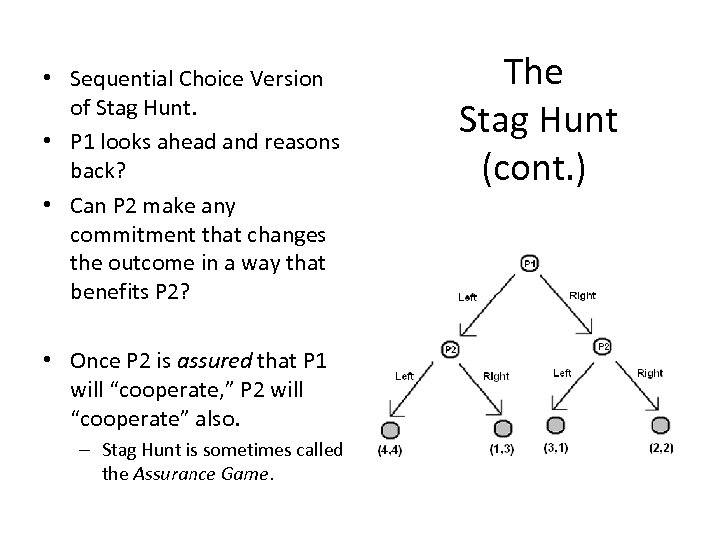 • Sequential Choice Version of Stag Hunt. • P 1 looks ahead and reasons back? • Can P 2 make any commitment that changes the outcome in a way that benefits P 2? • Once P 2 is assured that P 1 will “cooperate, ” P 2 will “cooperate” also. – Stag Hunt is sometimes called the Assurance Game. The Stag Hunt (cont. )
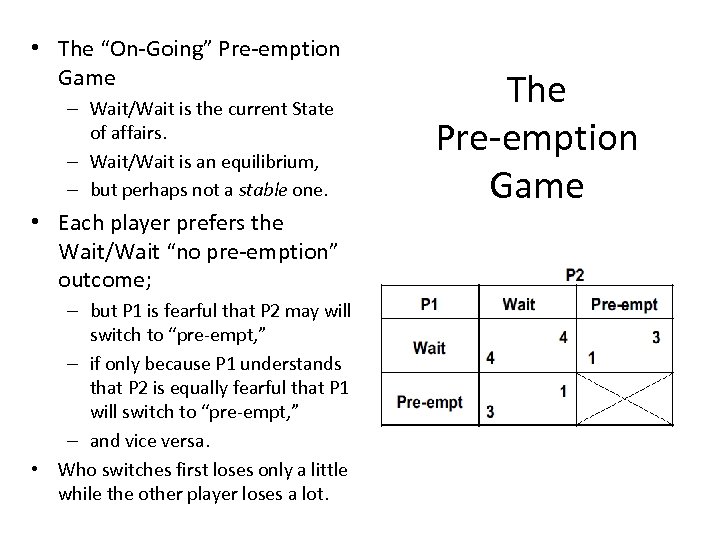 • The “On-Going” Pre-emption Game – Wait/Wait is the current State of affairs. – Wait/Wait is an equilibrium, – but perhaps not a stable one. • Each player prefers the Wait/Wait “no pre-emption” outcome; – but P 1 is fearful that P 2 may will switch to “pre-empt, ” – if only because P 1 understands that P 2 is equally fearful that P 1 will switch to “pre-empt, ” – and vice versa. • Who switches first loses only a little while the other player loses a lot. The Pre-emption Game
 The Spiral Model and Pre-emptive War • The story of the origins of WWI in Europe is pretty much a poster-child for the spiral model theory of war. – European powers had many interlocking security alliances. – They had large armies that were costly to mobilize and difficult to demobilize. – The widely held view that there was a great advantage to mobilizing first constituted an incentive to pre-empt. • The Six Day War: Israel’s pre-emptive attack against the Egyptian Air Force. • There was an “incentive to pre-empt” at various points in the evolution of the nuclear balance between the US and SU in the Cold War. • The Bush Doctrine: pre-empting terrorist attacks. – However, such attempts would really be in large measure preventive, rather than pre-emptive.
 Preventive vs. Pre-emptive War • The incentives for pre-emptive war are reciprocal and reinforcing. • The incentives for preventive war are unilateral, i. e. , – at most only one side has the incentive to launch a preventive war, • while the other side has an incentive to conciliate. • A has an incentive to wage preventive war against B if A believes that – the balance of military capabilities between them is at present fairly favorable to A, – but it will become much less favorable to A in the not too distant future. • Examples: – Some people (famously including the British philosopher Bertrand Russell) advocated a US preventive war (probably preceded by an attempted compellent threat) against the SU in the late 1940 s (while the US held its “nuclear monopoly”). – Some people advocated preventive war against (Communist) China a couple of decades later (when Chinese leaders were expressing frightening equanimity about the prospect of general nuclear war). – Compellent threat plus preventive war against Iran?
 The Origins of the Cold War • The contested diagnosis of the origins of the Cold War. • “Appeasement Theory” of the Cold War: – The SU had evident more or less aggressive intentions, • though they probably were not in a hurry to realize them, • as they believed that the laws of history were on their side. – The US/West acted on the basis of the appeasement theory of war (so painfully learned in the run-up to WWII), • and by acting in accord with its prescriptions – successfully deterred and “contained” the SU and – maintained a “cold peace” – until it evolved into a less aggressive nation. – Of course, a “mirror image” narrative was provided by the SU • and by some “strongly revision” (Western) historians.
 The Origins of the Cold War (cont. ) • “Security Dilemma”/ “Spiral Model” Theory of the Cold War: – A Security Dilemma existed between East and West, • created by the new technology of nuclear weapons and long range delivery vehicles (bombers and missiles). – But while the SU had great ideological differences with the West, it did not have hostile or aggressive goals vis-a-vis the US/West, • but the US/West thought it did (or at least feared it might), – and it acted accordingly. • That is, the US/West acted in accordance with the appeasement theory of war, – but it should not have. • The SU likewise acted in accordance with appeasement theory, – but it should not have either. – This led to a Spiral Model effect (manifested more consistently in an arms race than in a persistent incentive to pre-empt), • so the spiral model did not led to general “hot” war.
 Appeasement vs. Spiral Model • Note that these two accounts of the origins of the Cold war are not mutually exclusive, i. e. , both could be substantially true. • Nevertheless the Appeasement Theory and Spiral Model Theory have rather contrary implication foreign policy. – Appeasement Theory: be tough, don’t give in, even on small stuff, etc. – Spiral Model Theory: be conciliatory, especially on small stuff, take care not to do things that look threatening to the other side, etc. • Which approach to follow? – Really depends on the assessment of the intentions of the other nation, • which often are extremely difficult to assess. – Moreover its intentions may change over time, • and do so in response to one’s own behavior.
 Origins of Cold War • No doubt a full account of the origins and persistence of the Cold War includes some mix of both theories. • But 45 years onward, we got something of an empirical test. • According to Spiral Model, ideological differences (or similarities) between nations don’t matter. • So the collapse of the Communist regime in the Soviet Union 20 years ago per se should not make a difference, – as whatever security dilemma previously existed would persist. • But Cold War pretty much ended with that collapse? – Clearly there were other factors at work, • particularly the evolving Soviet/Russian economic weakness.
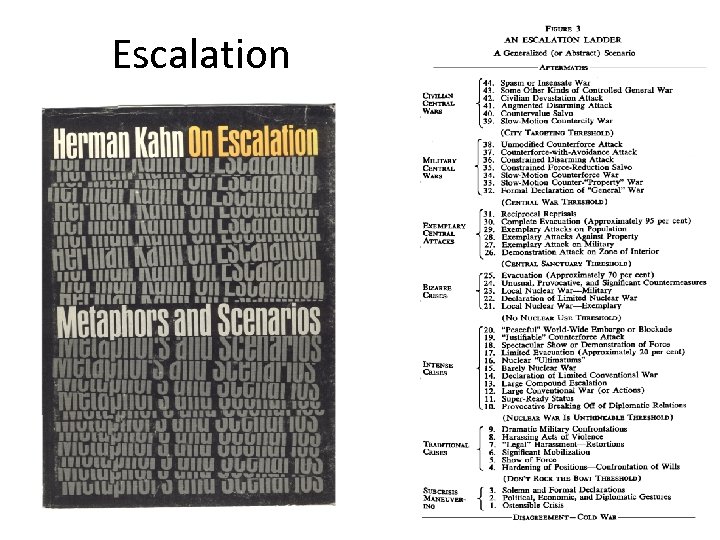 Escalation