 Скачать презентацию Appeals before CIT Appeals under Income Tax Act
f0522fed1b3949cdd3a3cc8c15ecceb8.ppt
- Количество слайдов: 41



Appeals before CIT (Appeals) under Income Tax Act Presented By CA. S. K. Bansal B. Com, FCA, DISA For Faridabad Income Tax Bar Association
Contents for Coverage: § § § § § An Overview Appellate Forums Who can file the Appealable Orders Non-Appealable Orders Appeals which cannot be filed with CIT(A) Time Limit for filing of Appeal Mode of filing an Appeal Fee Admission of Appeal Documents to be filed with the Appeal Procedure in Appeal Powers of CIT (Appeals) Production of additional evidence (Rule 46 A) Death of an Assessee Withdrawal of Appeal Drafting of Appeal before the CIT (A) Presentation before the CIT(A)
An Overview: § Appeal - a remedy for redressal of grievances against unjust, erroneous, undesirable or invalid Orders passed by an Authority. § No inherent right to appeal but conferred by the Statute. § This right is conferred by the statute, hence subject to the terms and conditions specified therein. § Provisions relating to First Appeal under the Income Tax Act are contained in Section 246 A to 251. § The right to First appeal is available to the tax payer only.
Two remedies are available against the order of the Assessing Officer: Appeal to Commissioner of Income Tax (Appeal): § First Appeal in all cases shall lie with CIT (A). Revision by Commissioner of Income Tax U/S 264 on an application by the assessee: § The option for revision may be preferred if the appeal is not filed or it has become time barred for filing.
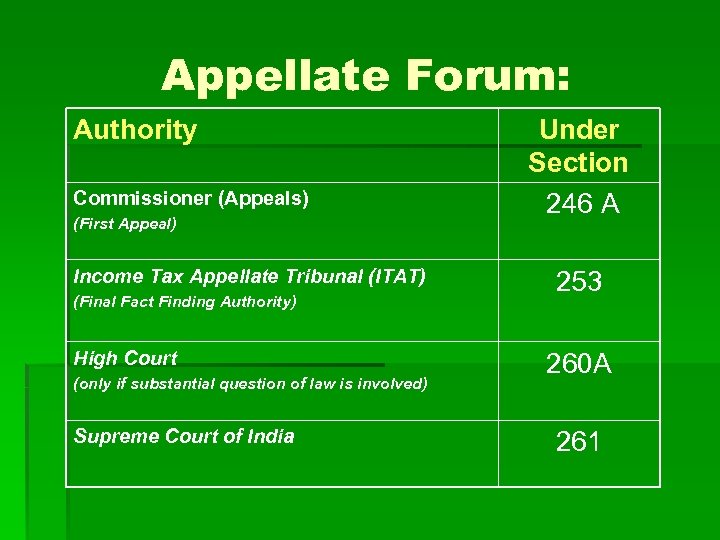
Appellate Forum: Authority Commissioner (Appeals) (First Appeal) Income Tax Appellate Tribunal (ITAT) (Final Fact Finding Authority) High Court (only if substantial question of law is involved) Supreme Court of India Under Section 246 A 253 260 A 261
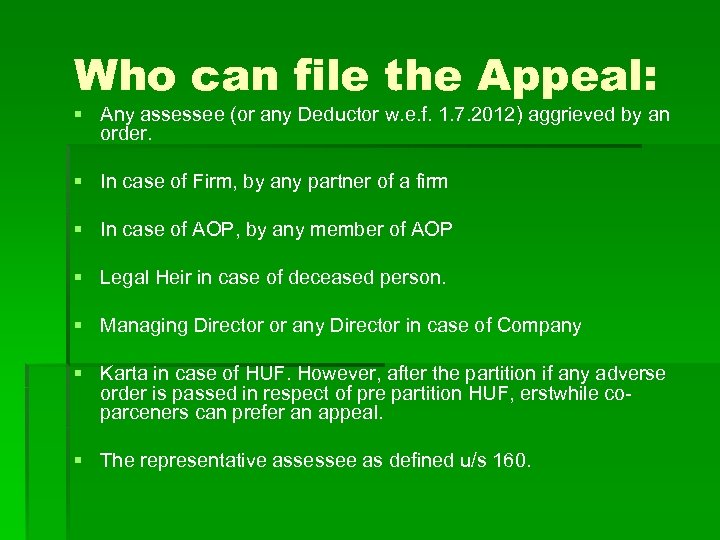
Who can file the Appeal: § Any assessee (or any Deductor w. e. f. 1. 7. 2012) aggrieved by an order. § In case of Firm, by any partner of a firm § In case of AOP, by any member of AOP § Legal Heir in case of deceased person. § Managing Director or any Director in case of Company § Karta in case of HUF. However, after the partition if any adverse order is passed in respect of pre partition HUF, erstwhile coparceners can prefer an appeal. § The representative assessee as defined u/s 160.
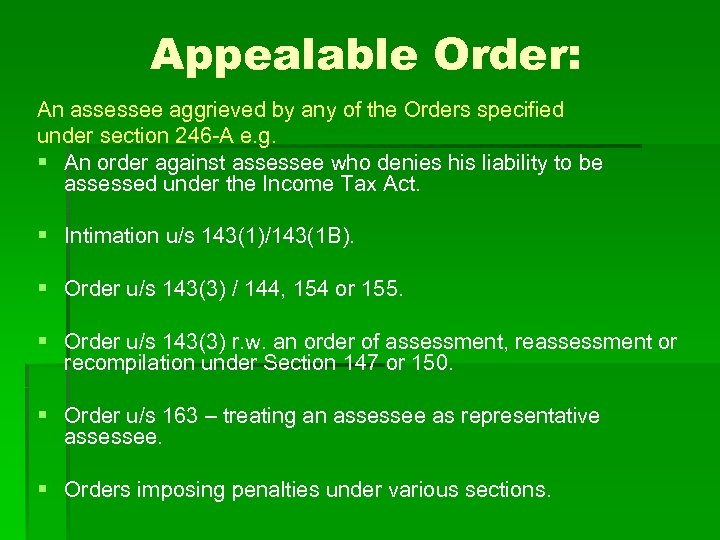
Appealable Order: An assessee aggrieved by any of the Orders specified under section 246 -A e. g. § An order against assessee who denies his liability to be assessed under the Income Tax Act. § Intimation u/s 143(1)/143(1 B). § Order u/s 143(3) / 144, 154 or 155. § Order u/s 143(3) r. w. an order of assessment, reassessment or recompilation under Section 147 or 150. § Order u/s 163 – treating an assessee as representative assessee. § Orders imposing penalties under various sections.
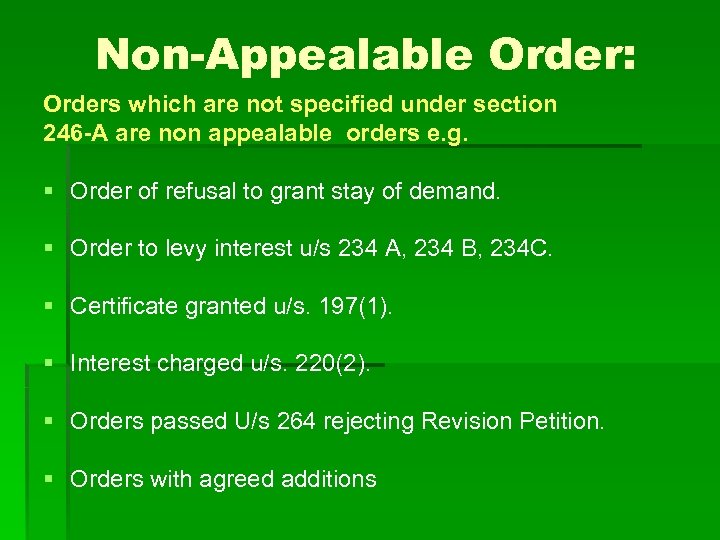
Non-Appealable Order: Orders which are not specified under section 246 -A are non appealable orders e. g. § Order of refusal to grant stay of demand. § Order to levy interest u/s 234 A, 234 B, 234 C. § Certificate granted u/s. 197(1). § Interest charged u/s. 220(2). § Orders passed U/s 264 rejecting Revision Petition. § Orders with agreed additions
Appeals which cannot be filed with CIT (A): Appeals can be filed only with the Authorities superior to those passing the Order. As such, appeals in the following cases can be filed only with the ITAT: § An Order passed by the CIT u/s 12 AA, or 80 G (5) (vi) § An Order passed by the CIT u/s 263, 271 or order passed by him u/s 154 amending his order u/s 263. § Order passed by Chief Commissioner or Director General or a Director u/s 272 A

Time Limit for filing of Appeal: The appeal shall be presented within 30 days of the following date, that is to say: § Where the appeal relates to any TDS U/S 195(1), “from the date of payment of tax. ” § Where the appeal relates to any assessment or penalty; “the date of service of the notice of demand. ” § In other cases; “the date on which such intimation of the order is served. ”
Contd…, Condonation of delay § Application for condonation of delay must be made specifying that there was a Sufficient Cause for delay. § The CIT(A) can condone delay in filing of appeal under section 249(3) if satisfied that delay was due to“sufficient cause”. § The CIT has discretionary powers of condonation which should be exercised judiciously. § The CIT should have a pragmatic and liberal approach. [Collector Land Acquisition Vs Mst. Katiji 167 ITR 471 SC]
Other decisions: Contd…, § The Supreme Court in N. Balkrishnan vs. M. Krishnamurthy (1998) 7 SCC 123 had condoned a delay of 833 days. It was observed that condonation of delay is a matter of discretion of the Court and the only criterion is the acceptability of explanation irrespective of the length of delay. § A subsequent decision of the Supreme Court/High Court was considered as sufficient cause for condoning delay in filing the appeal. [State of Andhra Pradesh vs. Venkataramana Chudava & Muramura Merchant (1986) 159 ITR 59 (AP)] § The Courts have also held that the mistake of an Advocate or Chartered Accountant is a reasonable cause for delay in filing an appeal. [Rafiq C. Munshilal AIR 1981 SC 1400 (1401), Mahavir Prasad Jain vs. CIT (1988) 172 ITR 331 (MP), Concord of India Insurance Co. Ltd. vs. Smt. Nirmaladevi & Sons (1979) 118 ITR 507 (SC). Punam Singh vs. ITO (2002) 257 ITR 38 (Chennai) ( Trib). Shakti Clearing Agency P. Ltd. vs. ITO (127 Taxman 49 (Mag) (Raj. )].
Contd……, Exclusion of time taken for copy (Section 268) § The day on which the Order appealed against was served is to be excluded § If the assessee was not furnished with a copy of the order, the requisite time for obtaining a copy of such order shall be excluded.
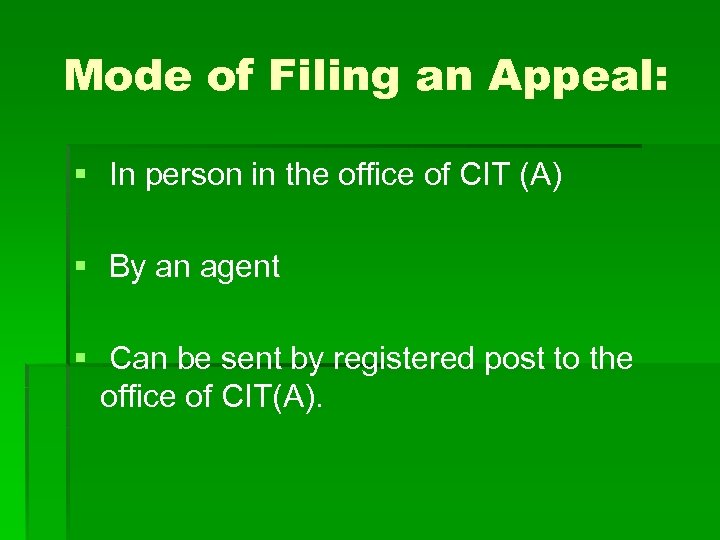
Mode of Filing an Appeal: § In person in the office of CIT (A) § By an agent § Can be sent by registered post to the office of CIT(A).
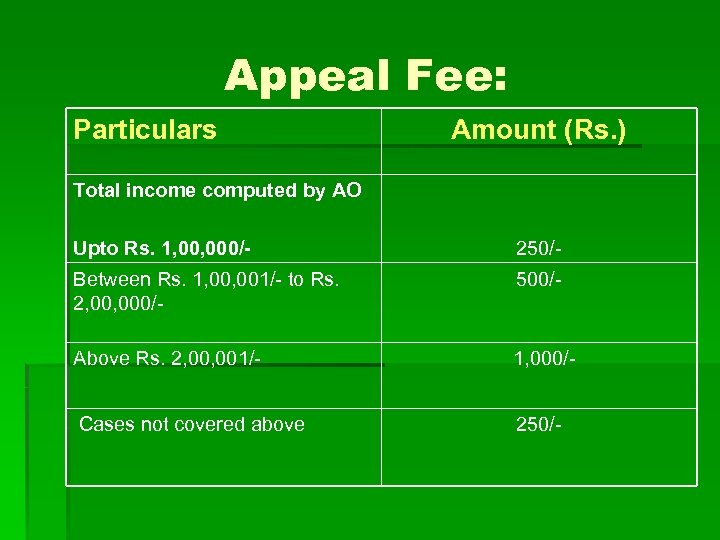
Appeal Fee: Particulars Amount (Rs. ) Total income computed by AO Upto Rs. 1, 000/- 250/- Between Rs. 1, 001/- to Rs. 2, 000/- 500/- Above Rs. 2, 001/- 1, 000/- Cases not covered above 250/-
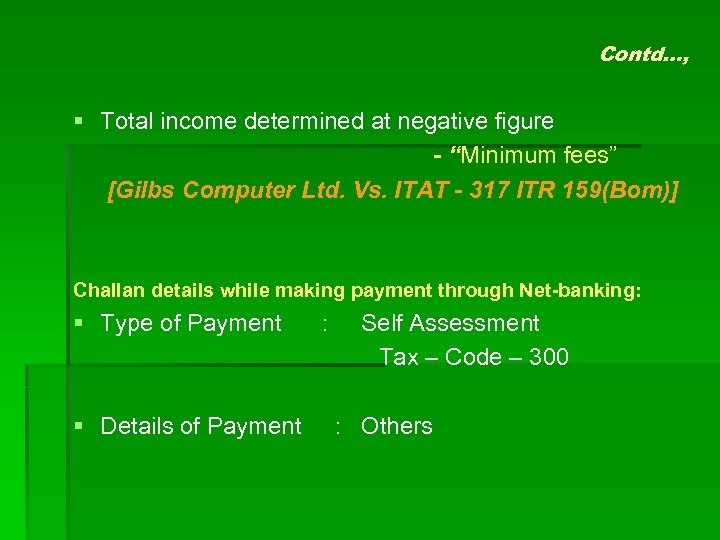
Contd…, § Total income determined at negative figure - “Minimum fees” [Gilbs Computer Ltd. Vs. ITAT - 317 ITR 159(Bom)] Challan details while making payment through Net-banking: § Type of Payment § Details of Payment : Self Assessment Tax – Code – 300 : Others
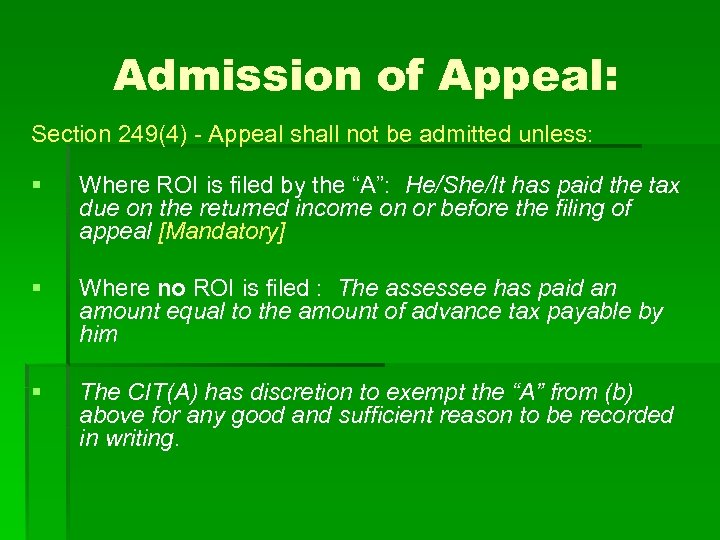
Admission of Appeal: Section 249(4) - Appeal shall not be admitted unless: § Where ROI is filed by the “A”: He/She/It has paid the tax due on the returned income on or before the filing of appeal [Mandatory] § Where no ROI is filed : The assessee has paid an amount equal to the amount of advance tax payable by him § The CIT(A) has discretion to exempt the “A” from (b) above for any good and sufficient reason to be recorded in writing.
Contd…, § Even payment of tax as per ROI before filing the appeal or hearing of the appeal will not mar the appeal [S. Alagarswamy Vs. ITO - 296 ITR 43 (Mad)] [CIT Vs. Smt. G. A. Samanthakamani - 259 ITR 245 (Mad)] § Tax does not include interest; CIT Vs. Manojkumar Beriwal - 217 CTR 407 (Bom).
Documents to be filed with the Appeal: The Memorandum of appeal should be filed alongwith the following documents: § Form – 35 (In duplicate) § Statement of Facts (In duplicate) § Grounds of Appeal (In duplicate) § Copy of order agst which appeal is preferred (In duplicate) § Original notice of demand (u/s 156) § Copy of challan for payment of fees § Power of Attorney § Court fees stamp. (50 paisa on Form No 35 and 65 paisa on Copy of Assessment Order) Refer Circular No 36 (XL-52) dated 19 -11 -1958. § Covering letter addressed to the CIT (A)
Contd…. . , § Non enclosure of notice of demand – technical irregularities but not fatal: [Chelamala Setti Adeyya Vs. CIT - 54 ITR 339(AP)] § The form of verification shall be signed by a person in accordance with the provisions of Rule 45(2) i. e. by the person who is authorized to sign the ROI u/s. 140 of the Act, as applicable to the assessee.
Procedure in Appeal— Section 250: § Notice to AO and Assessee fixing a day and place of hearing. § Following shall have right to be heard: a) the appellant in person or through his AR b) the AO or his AR. § CIT (A) has powers to adjourn the hearing from time to time. § Before disposing of the appeal, the CIT (A) has power to make further inquiry or may direct the AO to further inquire and report i. e. remand report. § Additional ground may be allowed, at the time hearing of an appeal, if satisfied that the omission was not willful or unreasonable.
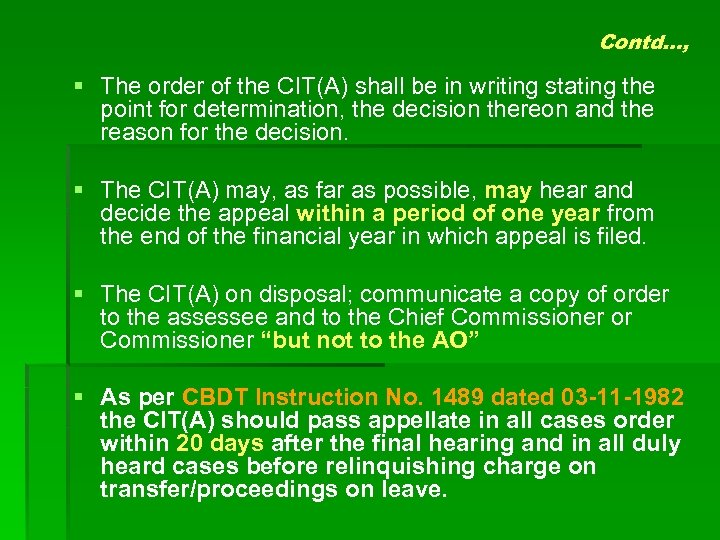
Contd…, § The order of the CIT(A) shall be in writing stating the point for determination, the decision thereon and the reason for the decision. § The CIT(A) may, as far as possible, may hear and decide the appeal within a period of one year from the end of the financial year in which appeal is filed. § The CIT(A) on disposal; communicate a copy of order to the assessee and to the Chief Commissioner or Commissioner “but not to the AO” § As per CBDT Instruction No. 1489 dated 03 -11 -1982 the CIT(A) should pass appellate in all cases order within 20 days after the final hearing and in all duly heard cases before relinquishing charge on transfer/proceedings on leave.
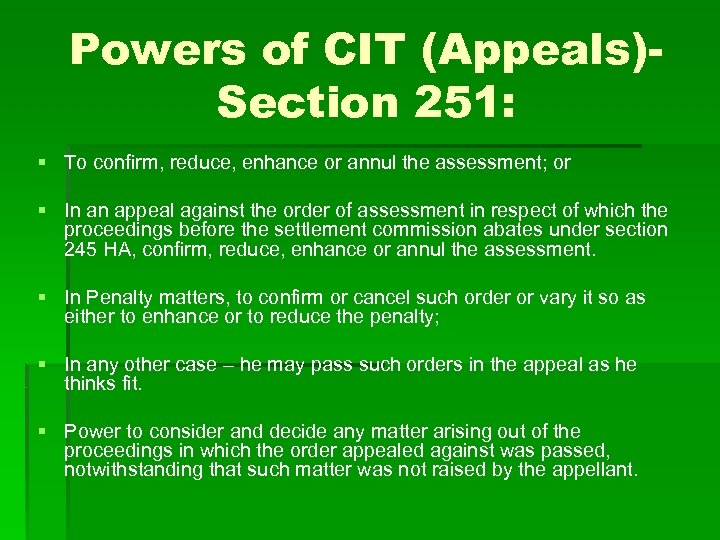
Powers of CIT (Appeals)Section 251: § To confirm, reduce, enhance or annul the assessment; or § In an appeal against the order of assessment in respect of which the proceedings before the settlement commission abates under section 245 HA, confirm, reduce, enhance or annul the assessment. § In Penalty matters, to confirm or cancel such order or vary it so as either to enhance or to reduce the penalty; § In any other case – he may pass such orders in the appeal as he thinks fit. § Power to consider and decide any matter arising out of the proceedings in which the order appealed against was passed, notwithstanding that such matter was not raised by the appellant.
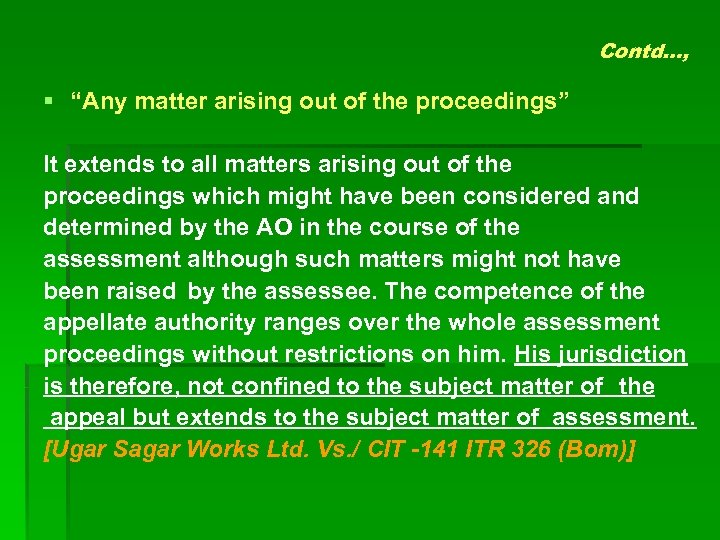
Contd…, § “Any matter arising out of the proceedings” It extends to all matters arising out of the proceedings which might have been considered and determined by the AO in the course of the assessment although such matters might not have been raised by the assessee. The competence of the appellate authority ranges over the whole assessment proceedings without restrictions on him. His jurisdiction is therefore, not confined to the subject matter of the appeal but extends to the subject matter of assessment. [Ugar Sagar Works Ltd. Vs. / CIT -141 ITR 326 (Bom)]
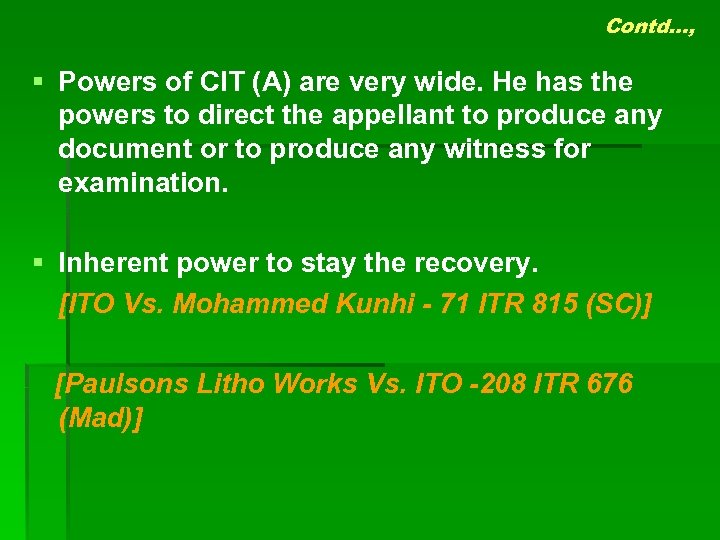
Contd…, § Powers of CIT (A) are very wide. He has the powers to direct the appellant to produce any document or to produce any witness for examination. § Inherent power to stay the recovery. [ITO Vs. Mohammed Kunhi - 71 ITR 815 (SC)] [Paulsons Litho Works Vs. ITO -208 ITR 676 (Mad)]
Limitations § No power to review except power of rectification u/s. 154. § No power to consider validity of Act or Rules [CIT Vs. Straw Products Ltd. 60 ITR 156 (SC)] § Commissioner (Appeals) has no power to set aside an order and refer the case back to AO for fresh assessment [w. e. f 01 -06 -2001] § Commissioner (Appeals) cannot award costs to parties.
Production of additional evidence (Rule 46 A): Appellant is not entitled to produce additional evidence except in the following 4 circumstances: § Where the AO refused to admit the said evidence which ought to have been admitted. § Where appellant was prevented by sufficient cause from producing evidence called upon by the AO. § Where the appellant was prevented by sufficient cause from producing before the AO any evidence which is relevant to any ground of appeal. § Where AO passed the impugned order without giving sufficient opportunity to appellant to adduce evidence relevant to any ground of appeal.
Contd…, § The CIT (A) must record in writing the reasons for admission of additional evidence. § Before considering the additional evidence, the CIT(A) must : § Allow the AO a reasonable opportunity to examine the evidence or document or to cross examine the witness produced by the appellant, or § To produce any evidence or document or any witness in rebuttal of the additional evidence produced by the appellant.
Death of an assessee: § Where an assessee to an appeal dies or is adjudicated insolvent or in the case of the company wound up, the appeal will not abate and will continue against the executor, administrator or other legal representatives of the assessee or by or against the assignee, receiver or liquidator as the case may be. § In case of a death of assessee, the legal heirs of the assessee must file copy of death certificate and an affidavit of they being the legal heirs. § A fresh memorandum of appeal signed by the legal heirs must be filed before the Commissioner (Appeals) or the Tribunal as the case may be where the assessee is the appellant so that the legal heirs are brought on record.
Withdrawal of Appeal: § Appeal once filed cannot be withdrawn by the appellant. § However the appellate authority in its discretion may allow withdrawal of appeal and dismiss the same as not pressed. § In CIT v. Rai Bahadur Hardutroy Motilal Chamaria (1967) 66 ITR 443 (SC) it has been held that: “It is also wellestablished that an assessee having once filed an appeal cannot withdraw it. In other words, the assessee having filed an appeal and brought the machinery of the Act into working cannot prevent the AAC from ascertaining and settling the real sum to be assessed, by intimation of his withdrawal of the appeal. Even if the assessee refuses to appear at the hearing, the Appellate Assistant Commissioner can proceed with the enquiry and if he finds that there has been an under-assessment, he can enhance the assessment”
Contd…, § Although the assessee has no power to withdraw the appeal filed before the CIT(A) as per 66 ITR 443(SC) (supra) but the CIT(A) or Appellate Authority is satisfied that there will be no prejudice to revenue may allow to withdraw. [Bhartia Steel & Engineering Co. P. Ltd. Vs. ITO 97 ITR 154(Cal)]
Appeal Order and appeal effect: § After conclusion of hearing the CIT (A) will issue a order of the appeal. § If it is in favour of the “A”, either in full or partial, he has to file a request with AO for appeal effect. § In case of against the “A”, he has to decide to file second appeal file an appeal before jurisdictional ITAT within 60 days.
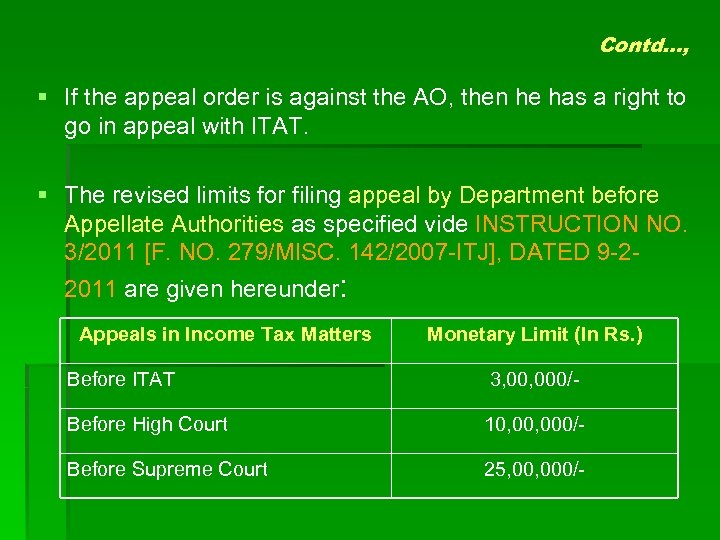
Contd…, § If the appeal order is against the AO, then he has a right to go in appeal with ITAT. § The revised limits for filing appeal by Department before Appellate Authorities as specified vide INSTRUCTION NO. 3/2011 [F. NO. 279/MISC. 142/2007 -ITJ], DATED 9 -22011 are given hereunder: Appeals in Income Tax Matters Monetary Limit (In Rs. ) Before ITAT 3, 000/- Before High Court 10, 000/- Before Supreme Court 25, 000/-
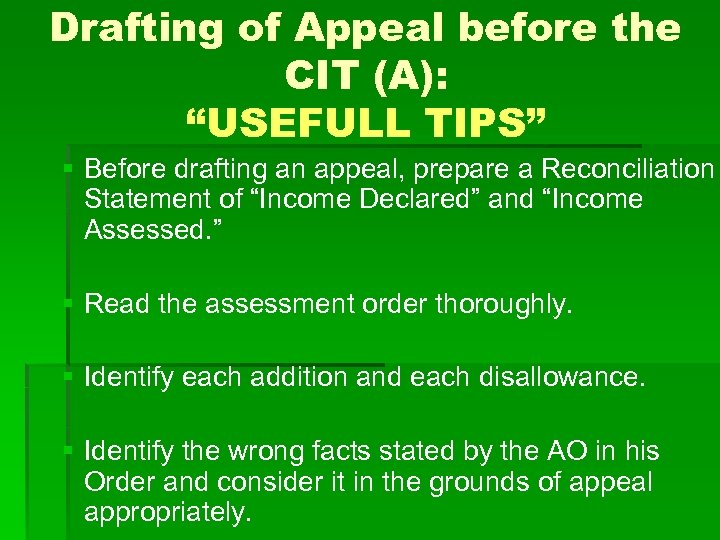
Drafting of Appeal before the CIT (A): “USEFULL TIPS” § Before drafting an appeal, prepare a Reconciliation Statement of “Income Declared” and “Income Assessed. ” § Read the assessment order thoroughly. § Identify each addition and each disallowance. § Identify the wrong facts stated by the AO in his Order and consider it in the grounds of appeal appropriately.
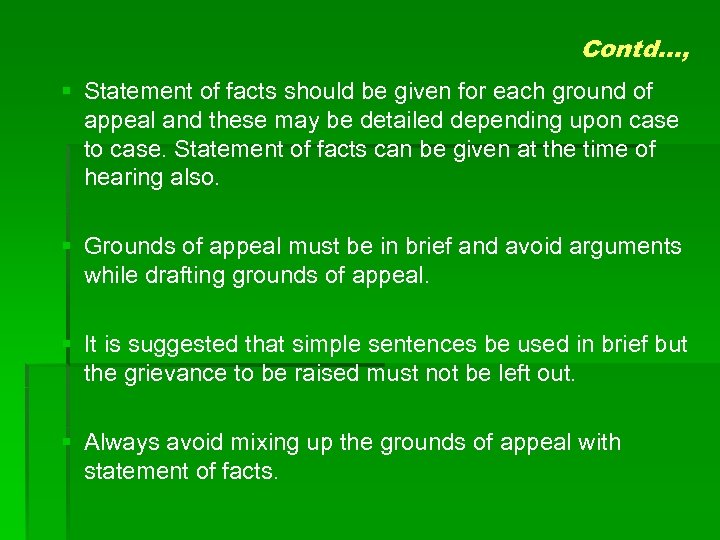
Contd…, § Statement of facts should be given for each ground of appeal and these may be detailed depending upon case to case. Statement of facts can be given at the time of hearing also. § Grounds of appeal must be in brief and avoid arguments while drafting grounds of appeal. § It is suggested that simple sentences be used in brief but the grievance to be raised must not be left out. § Always avoid mixing up the grounds of appeal with statement of facts.
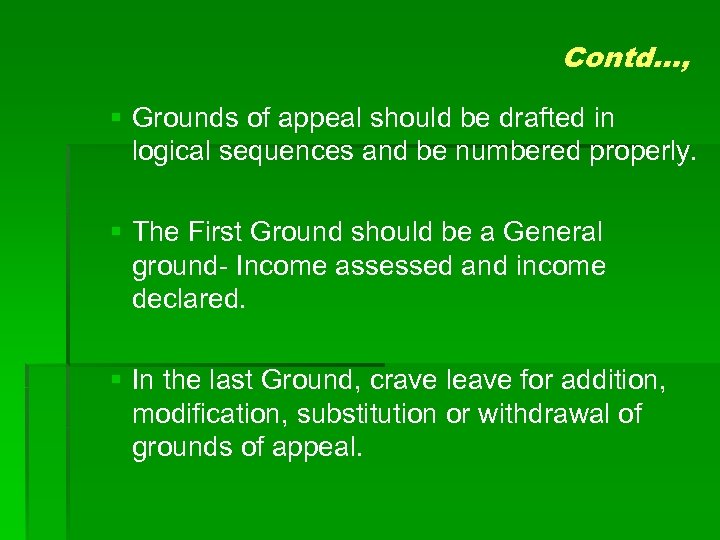
Contd…, § Grounds of appeal should be drafted in logical sequences and be numbered properly. § The First Ground should be a General ground- Income assessed and income declared. § In the last Ground, crave leave for addition, modification, substitution or withdrawal of grounds of appeal.
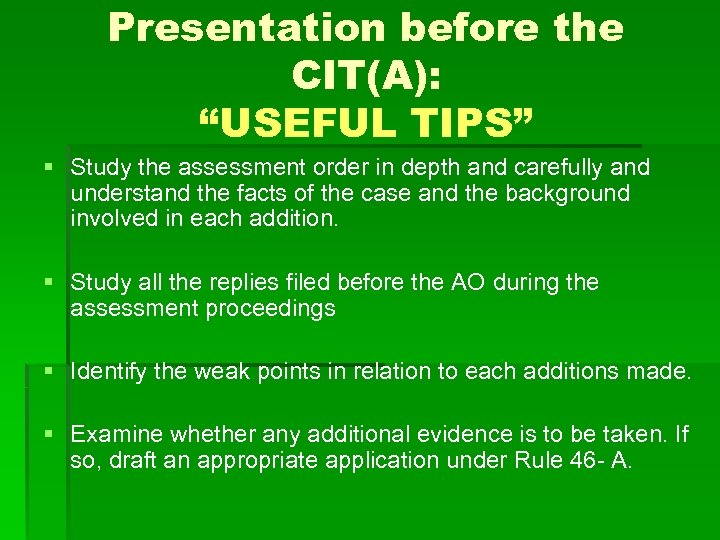
Presentation before the CIT(A): “USEFUL TIPS” § Study the assessment order in depth and carefully and understand the facts of the case and the background involved in each addition. § Study all the replies filed before the AO during the assessment proceedings § Identify the weak points in relation to each additions made. § Examine whether any additional evidence is to be taken. If so, draft an appropriate application under Rule 46 - A.
Contd…. , § File the application under Rule 46 -A alongwith documentary evidence in support of your claim as far as possible. § Prepare paper book with index containing all written submissions filed, evidences in support of assertions made in the written submissions. § Prepare exhaustive written submissions relevant to each ground of appeal. Highlight the important submissions in bold or italics. § Make special efforts in emphasizing as to how and why the AO was wrong based on actual facts and legal issues. Controvert the stand taken by the AO duly supported by documentary evidences, legal position and decided cases by the courts.
Contd…. , § Reliance be placed on the decisions of the Apex Courts, Jurisdiction High Court and ITAT. § Revenue authorities have to follow decision of jurisdictional High Court. [CIT Vs. G. M. Mittal Stainless Steel (P) Ltd. (2003) 130 Tax man 67 / 263 ITR 255 (SC)] § Care need to be taken while placing reliance on case laws. Examine the cases for and against. As far as possible, distinction be made between the cases which are against. § Distinguish the cases relied upon by the AO.
Contd…. , § Maintain calm and be peaceful and confident. § Have proper knowledge of all facts of the case. Reply to the queries raised by the CIT (A) be offered promptly and to the point. § Do not get provoked with the seemingly irrelevant queries by the CIT(A). § Avoid unnecessary arguments and altercations in case if the CIT(A) is not satisfied with your arguments.

“THANKS”
Скачать презентацию Appeals before CIT Appeals under Income Tax Act
f0522fed1b3949cdd3a3cc8c15ecceb8.ppt