


 Скачать презентацию APHEIS 2 Air Pollution and Health A European
5dbe75152fc65e6ddfe6defd044d3fbc.ppt
- Количество слайдов: 43
 APHEIS 2 Air Pollution and Health: A European Information System A Health Impact Assessment of Air Pollution In 26 European Cities Emilia Maria Niciu 1, Anna Paldy 2, Eszter Erdei 2, Michal Krzyzanowski 3 Sylvia Medina 4, Antonio Placencia 5, on behalf of the Apheis network 1 - Institutul de Sanatate Publica (Institute of Public Health), Bucharest, Romania 2 - Jozsef Fodor National Center for Public Health, National Institute of Environmental Health), Budapest, Hungary 3 - WHO European Centre for Environment and Health, Bonn Office, Germany 4 - Institut de Veille Sanitaire, Saint-Maurice, France 5 - Institut Municipal de Salut Pública (Municipal Institute of Public Health), Barcelona, Spain ISEE Chapter , Balaton, Hungary, 4 -6 October 2003
 Who funds Apheis Co-funded by: * Pollution-Related Diseases Programme of Health and Consumer Protection DG of the European Commission, contract Nos. : • SI 2. 131174 [99 CVF 2 -604] • SI 2. 297300 [2000 CVG 2 -607] • SI 2. 326507 [2001 CVG 2 -602] * Participating institutions in 12 European countries
 What methods did we use Network * Network of environmental and public-health professionals * 16 centres totalling 26 cities in 12 European countries centres cities * Each centre part of a city, regional or national institution active in the field of environmental health
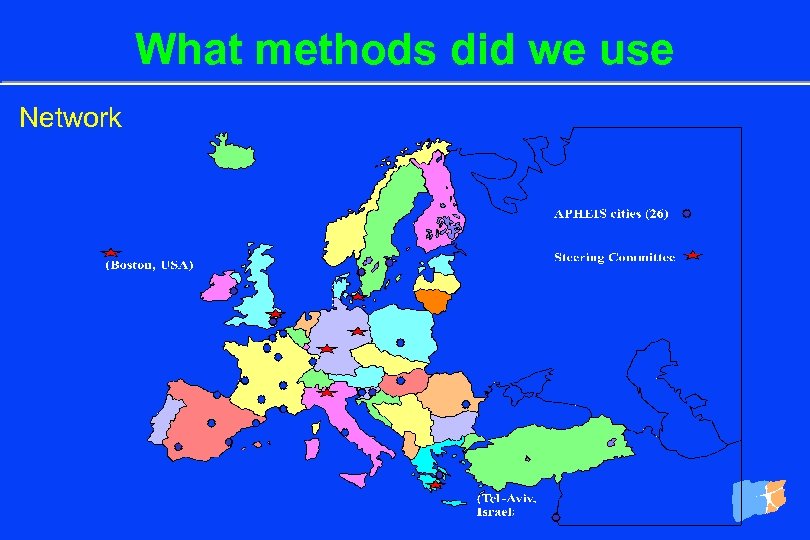 What methods did we use Network
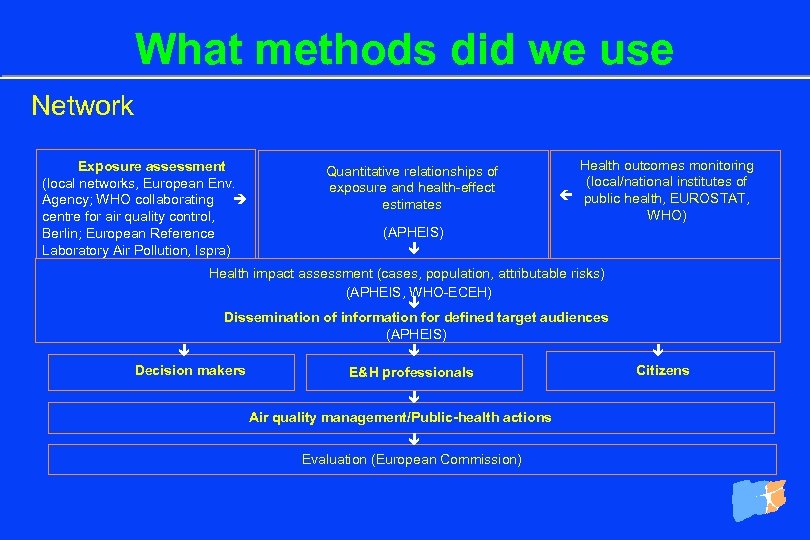 What methods did we use Network Exposure assessment (local networks, European Env. Agency; WHO collaborating centre for air quality control, Berlin; European Reference Laboratory Air Pollution, Ispra) Quantitative relationships of exposure and health-effect estimates Health outcomes monitoring (local/national institutes of public health, EUROSTAT, WHO) (APHEIS) Health impact assessment (cases, population, attributable risks) (APHEIS, WHO-ECEH) Dissemination of information for defined target audiences (APHEIS) Decision makers E&H professionals Air quality management/Public-health actions Evaluation (European Commission) Citizens
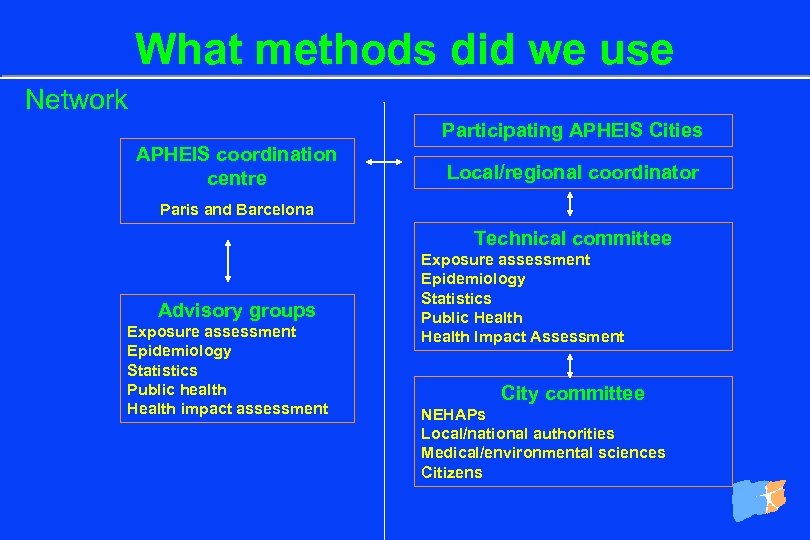 What methods did we use Network Participating APHEIS Cities APHEIS coordination centre Local/regional coordinator Paris and Barcelona Technical committee Advisory groups Exposure assessment Epidemiology Statistics Public health Health impact assessment Exposure assessment Epidemiology Statistics Public Health Impact Assessment City committee NEHAPs Local/national authorities Medical/environmental sciences Citizens
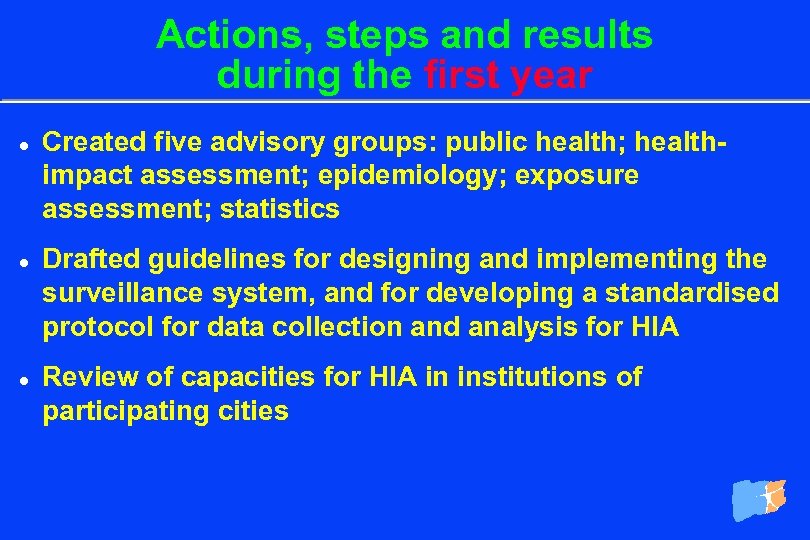 Actions, steps and results during the first year l l l Created five advisory groups: public health; healthimpact assessment; epidemiology; exposure assessment; statistics Drafted guidelines for designing and implementing the surveillance system, and for developing a standardised protocol for data collection and analysis for HIA Review of capacities for HIA in institutions of participating cities
 Actions, steps and results during the second year l Implement or adapt organisational models designed during first year l Collect and analyse data for health-impact assessment l Prepare different health-impact scenarios l Prepare HIA report in standardised format (HIA in 26 cities)
 Five main steps in HIA 1. Specify exposure * PM 10, BS * Urban background stations
 Five main steps in HIA 2. Define the appropriate health outcomes * Acute effects - Premature mortality excluding accidents and violent deaths - Hospital admissions for respiratory diseases 65+ age group - Hospital admissions for cardiac diseases all ages * Chronic effects - Premature mortality
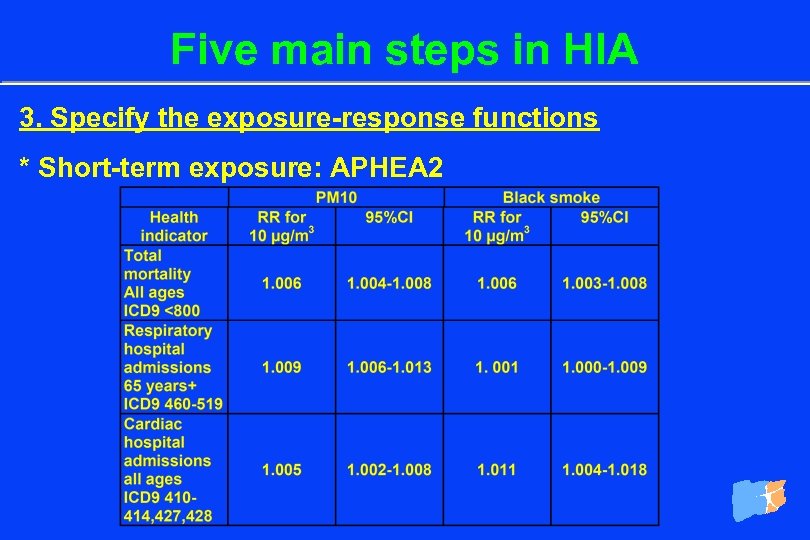 Five main steps in HIA 3. Specify the exposure-response functions * Short-term exposure: APHEA 2
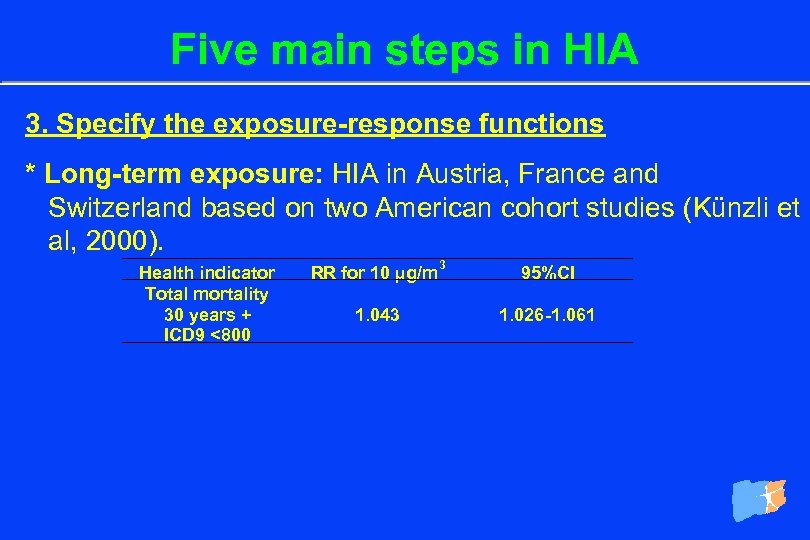 Five main steps in HIA 3. Specify the exposure-response functions * Long-term exposure: HIA in Austria, France and Switzerland based on two American cohort studies (Künzli et al, 2000). Health indicator Total mortality 30 years + ICD 9 <800 3 RR for 10 µg/m 95%CI 1. 043 1. 026 -1. 061
 Five main steps in HIA 4. Derive population baseline frequency measures for health outcomes 5. Calculate number of attributable cases in target population
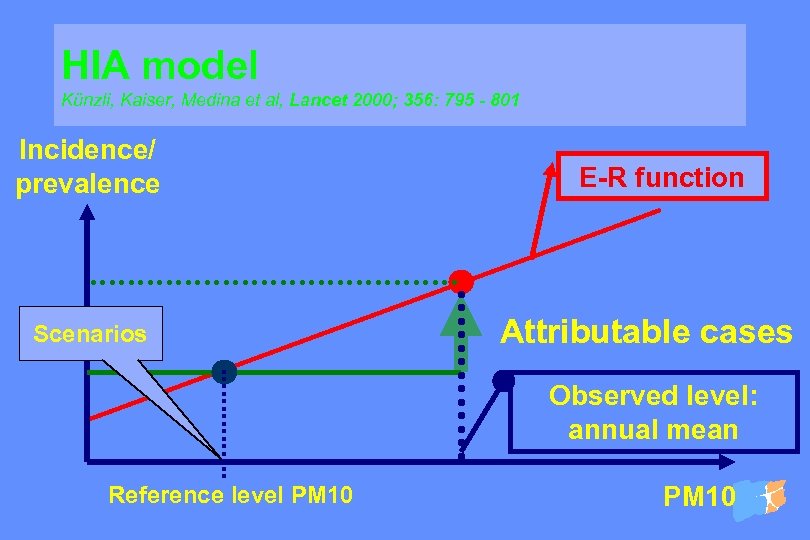 HIA model Künzli, Kaiser, Medina et al, Lancet 2000; 356: 795 - 801 Incidence/ prevalence Scenarios E-R function Attributable cases Observed level: annual mean Reference level PM 10
 Descriptive findings Demographic characteristics * Nearly 39 million inhabitants in Western and Eastern million Europe ( 34 mil. in 21 WE cities 5 mil. in 5 CEE cities) mil. 21 WE mil CEE * Proportion of people over 65 years: 15%, with highest proportion in Barcelona and lowest in London
 Descriptive findings Air pollution levels * PM 10 - measurements provided by 19 cities: Bordeaux, Bucharest, Budapest, Celje, Cracow, Gothenburg, Lille, Ljubljana, London, Lyon, Madrid, Marseille, Paris, Rome, Seville, Stockholm, Strasbourg, Tel Aviv and Toulouse * Black Smoke - measurements provided by 15 cities: Smoke Athens, Barcelona, Bilbao, Bordeaux, Celje, Cracow, Dublin, Le Havre, Lille, Ljubljana, London, Marseille, Paris, Rouen and Valencia
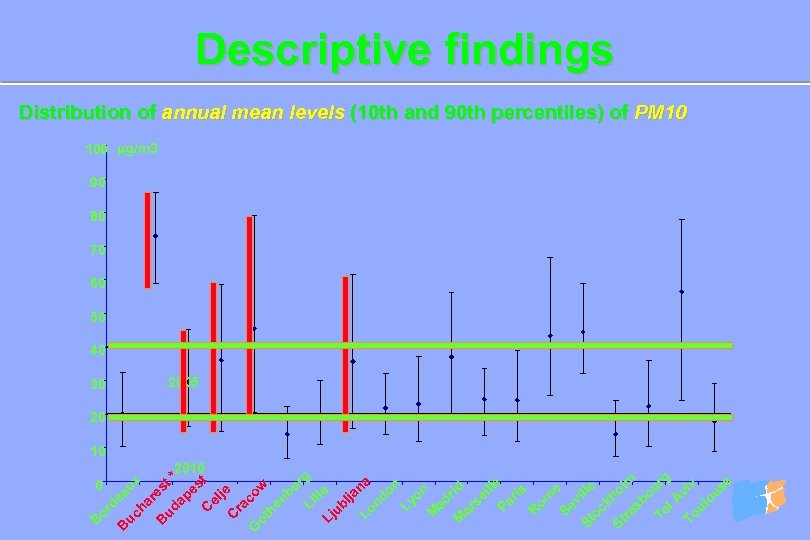 x au 2010 B re ud st * ap es t C el je C ra G co w ot he nb ur Li g ll Lj e ub lja Lo na nd on Ly on M ad rid M ar se ill e Pa ris R om e Se v St ille oc k St ho lm ra sb o Te urg l A To viv ul ou se ha uc de 0 B or B Descriptive findings Distribution of annual mean levels (10 th and 90 th percentiles) of PM 10 100 µg/m 3 90 80 70 60 50 40 30 2005 20 10
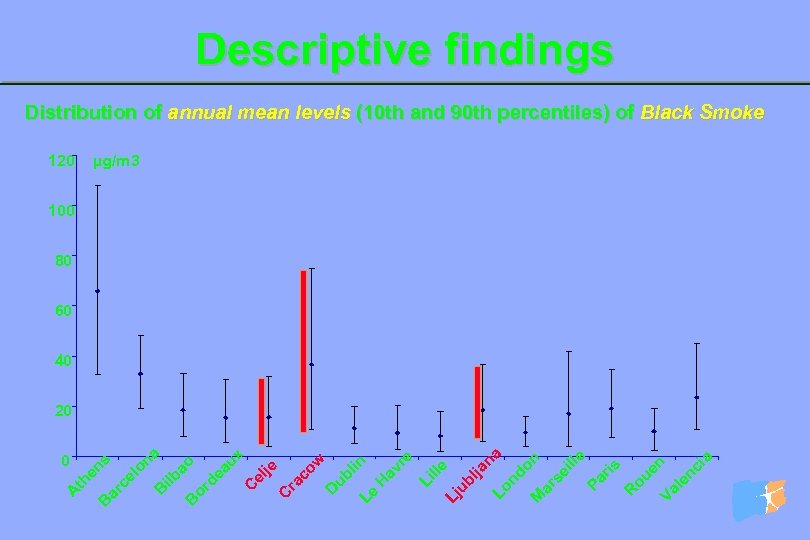 Descriptive findings Distribution of annual mean levels (10 th and 90 th percentiles) of Black Smoke 120 µg/m 3 100 80 60 40 li Le n H av re Li lle Lj ub lja na Lo nd on M ar se ill e Pa ris R ou e Va n le nc ia ub D co w ra C el je x C au de or B B ilb ao on s ar ce l en B A th 0 a 20
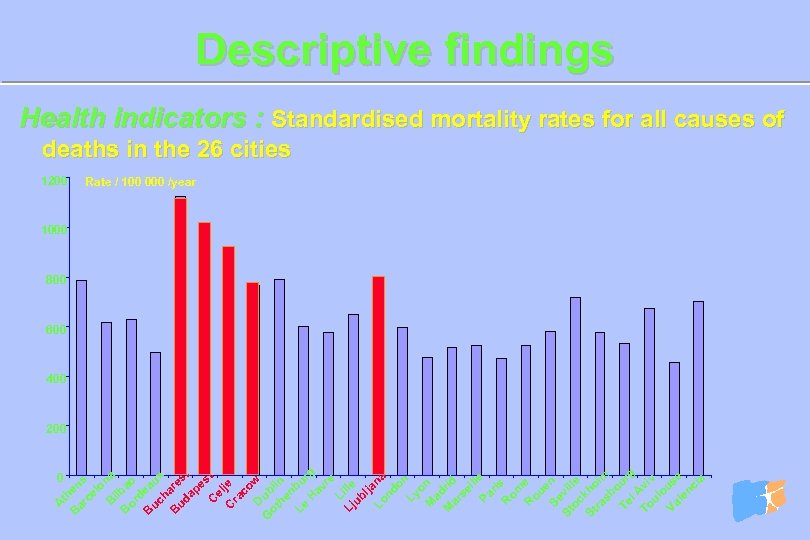 ar en th 0 ce s lo B na il B ba or o d B ea uc ux h B are ud s ap t es t C el C je ra co D w G ub ot li he n n Le bu H rg av re Li Lj lle ub lja Lo na nd on Ly o M n ad M rid ar se ill Pa e ris R om R e ou e Se n St vil oc le St kho ra lm sb o Te ur l A g To vi ul v o Va us le e nc ia B A Descriptive findings Health indicators : Standardised mortality rates for all causes of deaths in the 26 cities 1200 Rate / 100 000 /year 1000 800 600 400 200
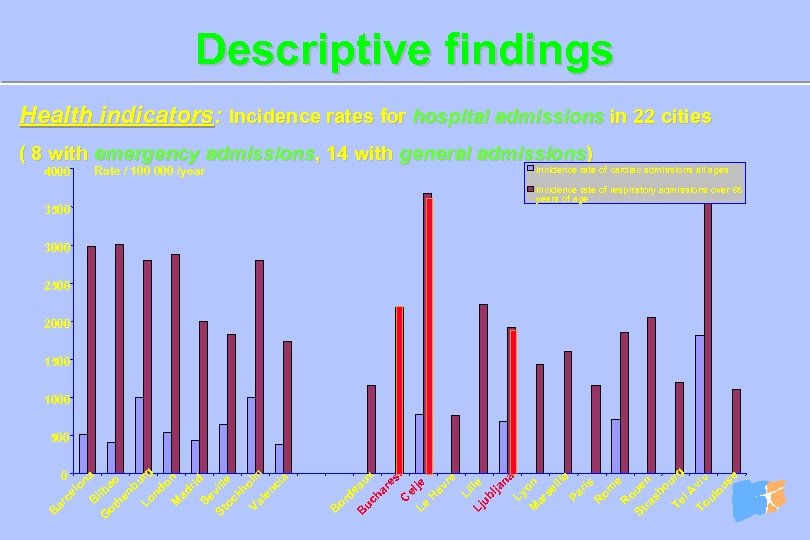 Descriptive findings Health indicators: Incidence rates for hospital admissions in 22 cities ( 8 with emergency admissions, 14 with general admissions) Rate / 100 000 /year 4000 incidence rate of cardiac admissions all ages incidence rate of respiratory admissions over 65 years of age 3500 3000 2500 2000 1500 1000 e Le lje H av re Li Lj lle ub lja na Ly M on ar se ill e Pa ris R om e R ou St ra en sb ou rg Te l A To viv ul ou se st C re ha au x uc de or B ot B a he o nb u Lo rg nd o M n ad rid Se St vill oc e kh Va olm le nc ia ilb on B G B ar ce l 0 a 500
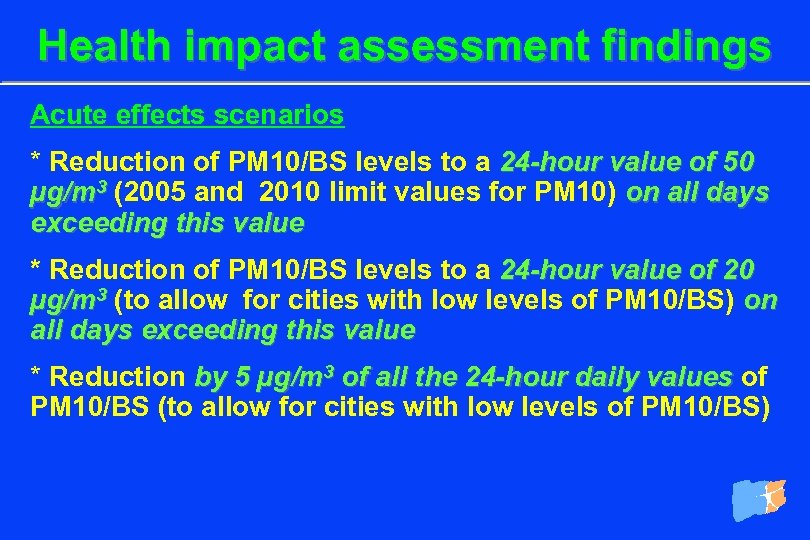 Health impact assessment findings Acute effects scenarios * Reduction of PM 10/BS levels to a 24 -hour value of 50 µg/m 3 (2005 and 2010 limit values for PM 10) on all days exceeding this value * Reduction of PM 10/BS levels to a 24 -hour value of 20 µg/m 3 (to allow for cities with low levels of PM 10/BS) on all days exceeding this value * Reduction by 5 µg/m 3 of all the 24 -hour daily values of values PM 10/BS (to allow for cities with low levels of PM 10/BS)
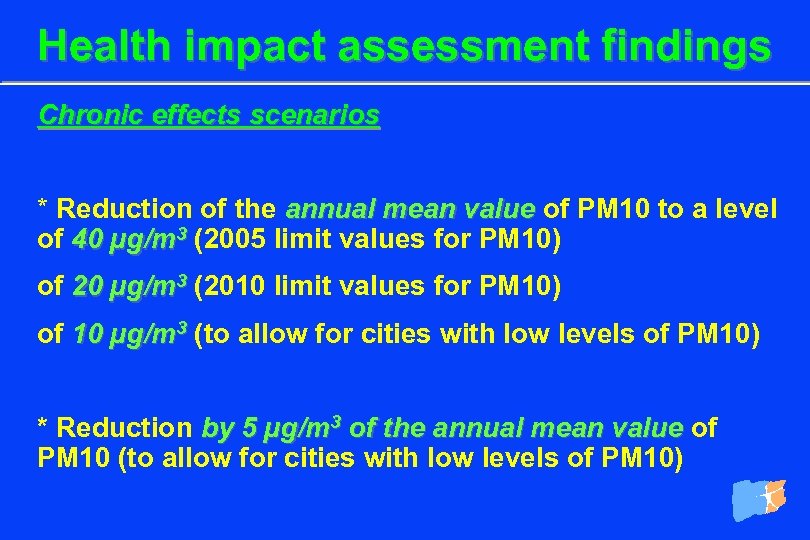 Health impact assessment findings Chronic effects scenarios * Reduction of the annual mean value of PM 10 to a level value of 40 µg/m 3 (2005 limit values for PM 10) of 20 µg/m 3 (2010 limit values for PM 10) of 10 µg/m 3 (to allow for cities with low levels of PM 10) * Reduction by 5 µg/m 3 of the annual mean value of value PM 10 (to allow for cities with low levels of PM 10)
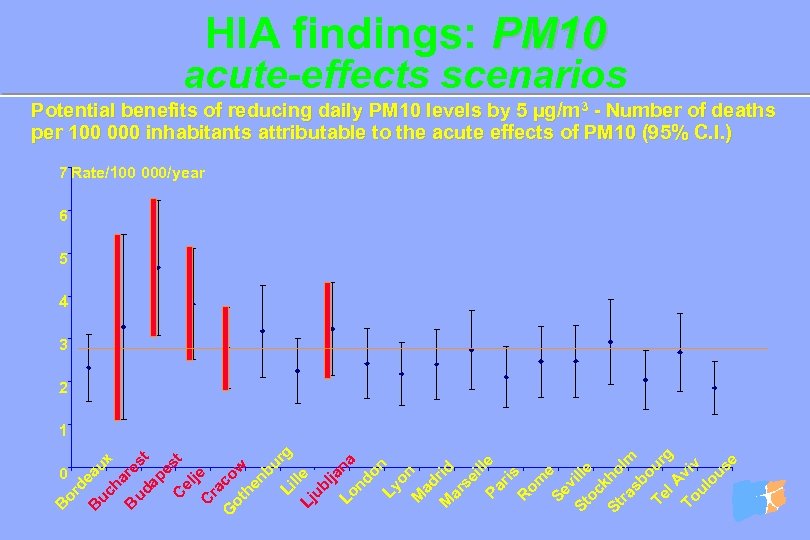 HIA findings: PM 10 acute-effects scenarios Potential benefits of reducing daily PM 10 levels by 5 µg/m 3 - Number of deaths per 100 000 inhabitants attributable to the acute effects of PM 10 (95% C. I. ) 7 Rate/100 000/year 6 5 4 3 2 de a uc ux ha r B ud est ap e C st el j C e ra G co ot w he nb u Li rg l Lj le ub lja Lo na nd on Ly on M ad M rid ar se ill Pa e ris R om e Se v St ille oc k St ho ra lm sb o Te ur l A g To viv ul ou se 1 B or 0 B
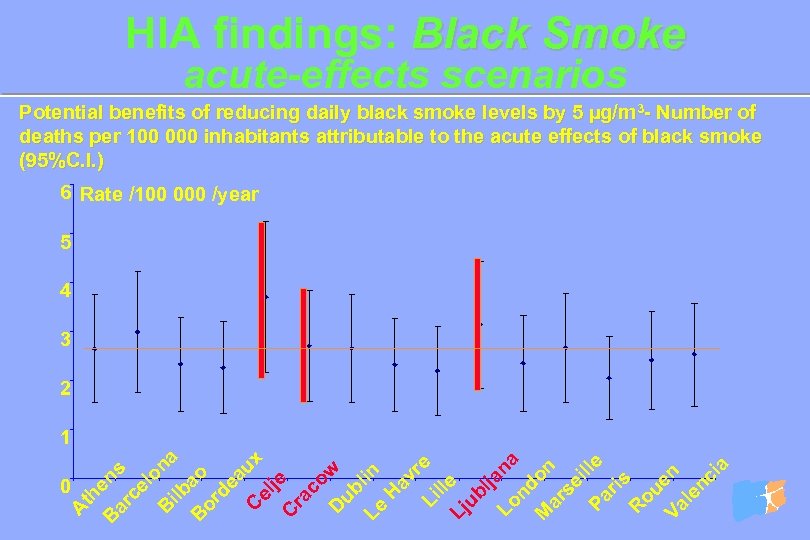 HIA findings: Black Smoke acute-effects scenarios Potential benefits of reducing daily black smoke levels by 5 µg/m 3 - Number of deaths per 100 000 inhabitants attributable to the acute effects of black smoke (95%C. I. ) 6 Rate /100 000 /year 5 4 3 2 ilb a B ao or de au C el x j C e ra co D w ub Le lin H av r Li e lle Lj ub lja Lo na nd M on ar se ill Pa e ris R ou Va en le nc ia B lo n ce ar en B A th 0 s 1
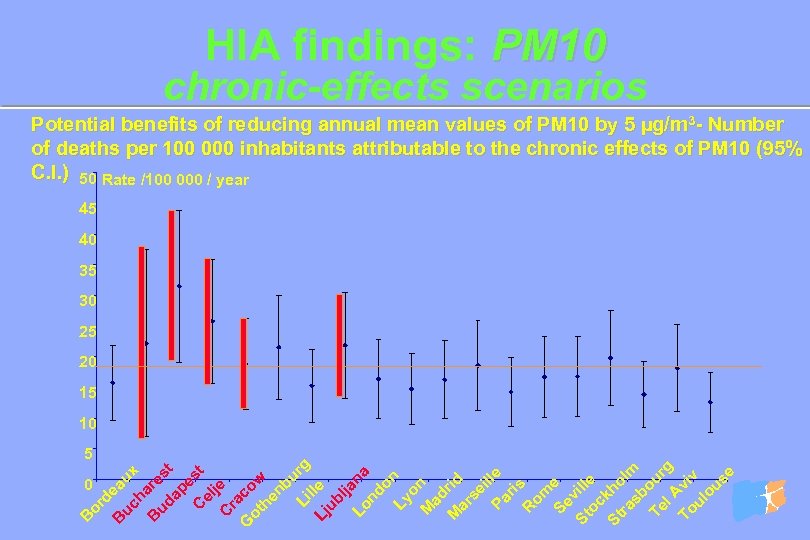 HIA findings: PM 10 chronic-effects scenarios Potential benefits of reducing annual mean values of PM 10 by 5 µg/m 3 - Number of deaths per 100 000 inhabitants attributable to the chronic effects of PM 10 (95% C. I. ) 50 Rate /100 000 / year C. I. ) 45 40 35 30 25 20 15 10 B B or de 0 uc aux h B are ud s ap t e C st el j C e ra G co ot w he nb u Li rg l Lj le ub lj Lo ana nd o Ly n o M n ad M rid ar se il Pa le ris R om Se e St ville oc St kho ra lm sb Te our l A g To viv ul ou se 5
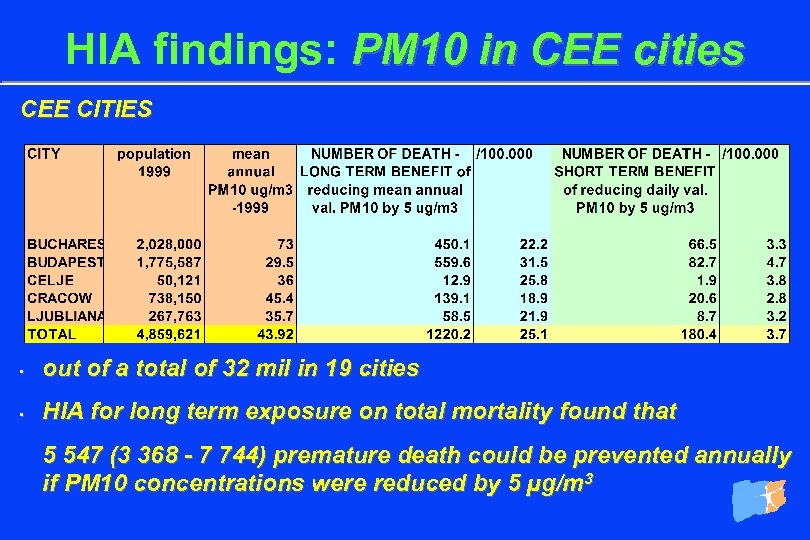 HIA findings: PM 10 in CEE cities CEE CITIES • out of a total of 32 mil in 19 cities • HIA for long term exposure on total mortality found that 5 547 (3 368 - 7 744) premature death could be prevented annually if PM 10 concentrations were reduced by 5 µg/m 3
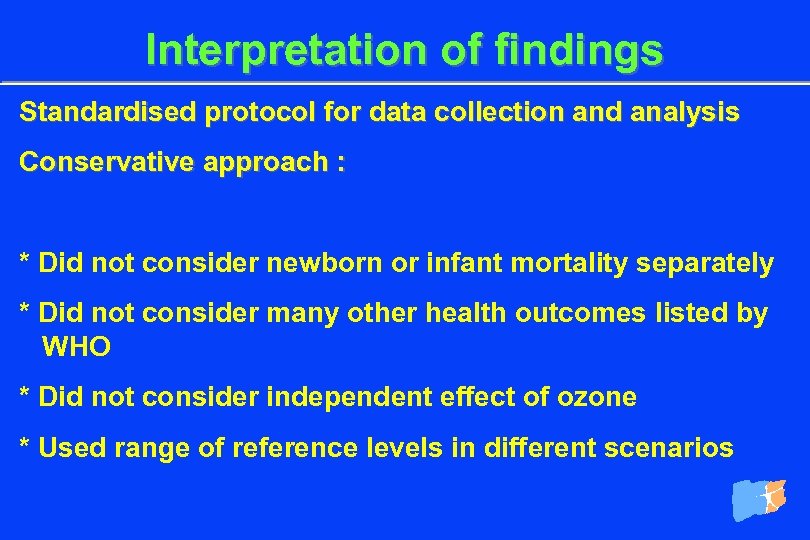 Interpretation of findings Standardised protocol for data collection and analysis Conservative approach : * Did not consider newborn or infant mortality separately * Did not consider many other health outcomes listed by WHO * Did not consider independent effect of ozone * Used range of reference levels in different scenarios
 Interpretation of findings Transferability of Exposure-Response (E-R) functions: * Short-term exposure: Question avoided by using E-R functions developed by APHEA 2 * Long-term exposure: Open question - used U. S. E-R functions
 Interpretation of findings Conclusions * Our HIA provides a conservative but accurate and detailed picture of the impact of air pollution on health in 26 European cities, and shows that air pollution continues to threaten public health in Europe. * Even very small and achievable reductions in air pollution levels have an impact on public health * This impact justifies taking preventive measures even in cities with low levels of air pollution
 Apheis 2002 -2003
 Actions, steps and results during the third year (2002 -03) l To keep our HIA as accurate and up-to-date as possible: - Produce new exposure-response functions on short-term effects of AP - Calculate years of life lost or reduction in life expectancy, in addition to the attributable number of deaths based on longterm effects
 Actions, steps and results during the third year To fulfill our mission of making our learnings available to the broadest possible audiences, and to evaluate the usefulness of our work on HIA among those who need to know: l - Explore and understand how best to meet the information needs of policy makers concerned with the impact of air pollution on public health and - Understand how to meet those needs in terms of content and form
 The broad view l l l Apheis is a multiyear, multiphase proactive public-health programme Each phase builds on learnings of previous phase First broad-based European HIA of air pollution on both the city and European levels simultaneously Consistent with other HIAs on air pollution worldwide Translates epidemiological findings into decision-making tool One more brick in the wall of evidence that air pollution continues to threaten public health
 The future
 Epheis Environmental Pollution and Health: A European Information System
 Background § Call for proposals DGSANCO 2003 -2008 ENHIS Environment and Health Information System (WHO- ECEH Bonn) Six modules: 1. Identification of relevant policies/corresponding needs 2. Development of Indicators 3. Methods for data retrieval/processing 4. Creation of NCC, networking 5. Integrate HIA (Epheis) 6. Database development and maintenance Coordination WHO-Bonn Steering Committee Length first year : 1 Feb 2004 -30 Jan 2005 §
 Objective Comparative risk assessment (CRA) of different environmental risk factors in Europe o Selected environmental risk factors o Method based on HIA and CRA
 For further information please visit: www. apheis. org
 Who are our partners 1. University of Athens, Greece 2. Institut Municipal de Salut Pública (Municipal Institute of Public Health), Barcelona, Spain 3. Departamento de Sanidad, Gobierno Vasco, Vitoria-Gasteiz, Spain 4. Institutul de Sanatate Publica (Institute of Public Health), Bucharest, Romania 5. Jozsef Fodor National Center for Public Health, National Institute of Environmental Health), Budapest, Hungary 6. National Institute of Hygiene, Warsaw, Poland 7. Saint James Hospital, Dublin, Ireland 8. Institut de Veille Sanitaire, Saint-Maurice, France 9. Inštitut za Varovanje Zdravja RS, (Institute of Public Health), Ljubljana, Republic of Slovenia
 Who are our partners 10. Saint George’s Hospital Medical School, London, UK 11. Dirección General de Salud Pública, Consejeria de Sanidad, Comunidad de Madrid (Department of Public Health, Regional Ministry of Health, Madrid Regional Government), Madrid, Spain 12. ASL RM/E Local Health Authority Roma E, Rome, Italy 13. Escuela Andaluza de Salud Pública (Andalusia School of Public Health), Granada, Spain 14. Umeå University, Department of Public Health and Clinical Medicine, Umeå, Sweden 15. Tel Aviv University, Tel Aviv, Israel 16. Escuela Valenciana de Estudios para la Salud (Valencia School of Health Studies), Valencia, Spain
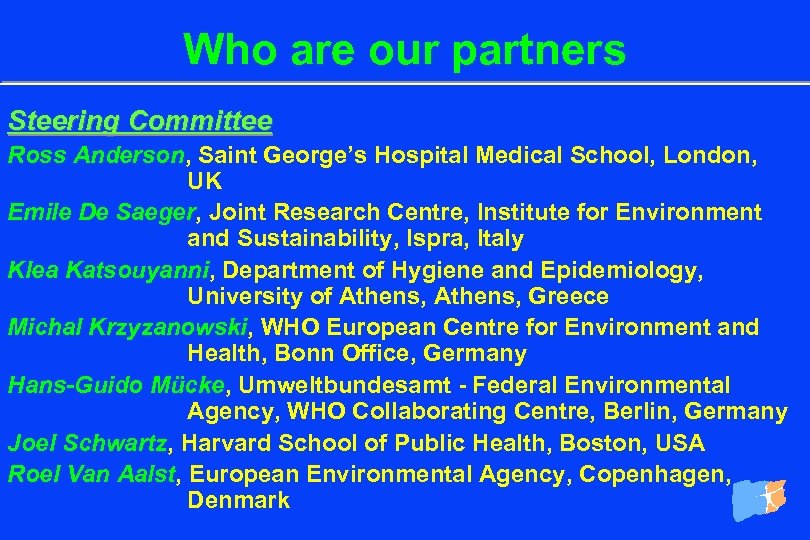 Who are our partners Steering Committee Ross Anderson, Saint George’s Hospital Medical School, London, UK Emile De Saeger, Joint Research Centre, Institute for Environment and Sustainability, Ispra, Italy Klea Katsouyanni, Department of Hygiene and Epidemiology, University of Athens, Greece Michal Krzyzanowski, WHO European Centre for Environment and Health, Bonn Office, Germany Hans-Guido Mücke, Umweltbundesamt - Federal Environmental Agency, WHO Collaborating Centre, Berlin, Germany Joel Schwartz, Harvard School of Public Health, Boston, USA Roel Van Aalst, European Environmental Agency, Copenhagen, Denmark
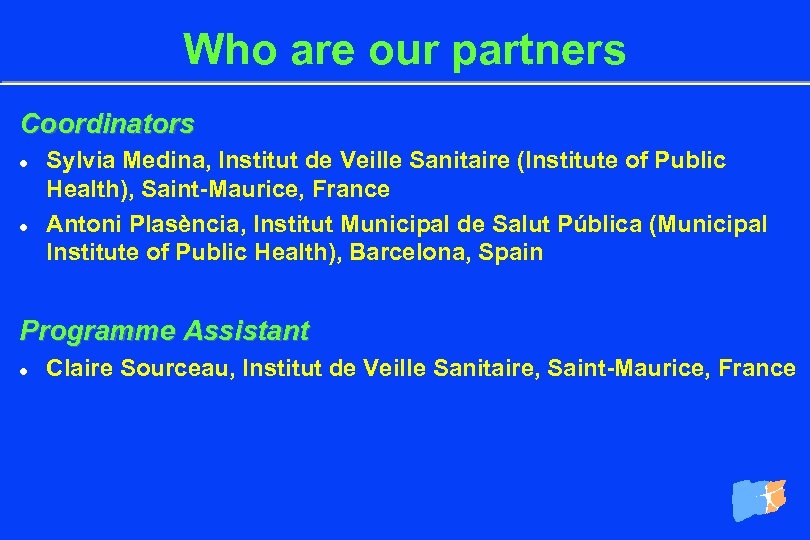 Who are our partners Coordinators l l Sylvia Medina, Institut de Veille Sanitaire (Institute of Public Health), Saint-Maurice, France Antoni Plasència, Institut Municipal de Salut Pública (Municipal Institute of Public Health), Barcelona, Spain Programme Assistant l Claire Sourceau, Institut de Veille Sanitaire, Saint-Maurice, France