


 Скачать презентацию Aphasiology Historical Overview William F Katz Ph
6bcc2fef64eec5bf62615ddd23637a24.ppt
- Количество слайдов: 83
 Aphasiology: Historical Overview • William F. Katz, Ph. D. COMD 7302
 Early History • Egypt • Hebrews • Greece • Rome
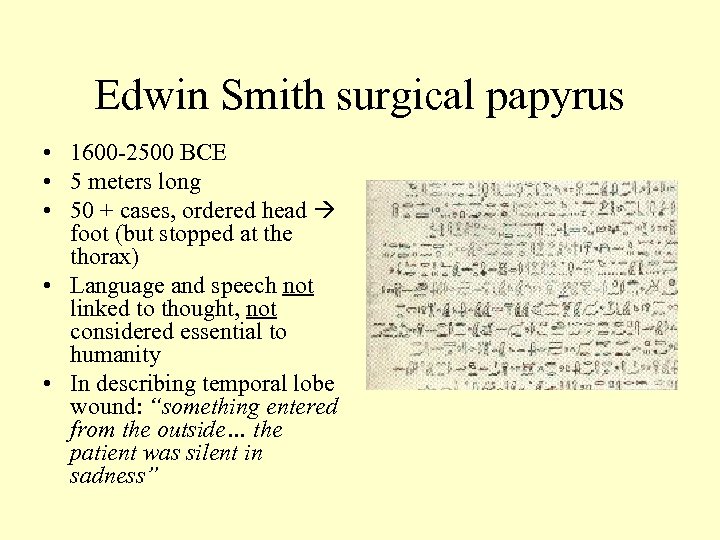 Edwin Smith surgical papyrus • 1600 -2500 BCE • 5 meters long • 50 + cases, ordered head foot (but stopped at the thorax) • Language and speech not linked to thought, not considered essential to humanity • In describing temporal lobe wound: “something entered from the outside… the patient was silent in sadness”
 Hebrew writings • Loss of speech does not imply loss of soul • Soul located in heart • Unity of the soul: Mental faculties are not fractional
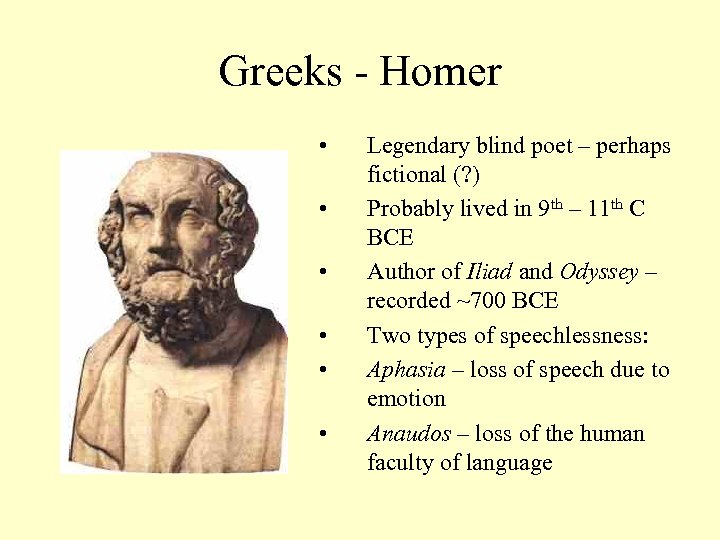 Greeks - Homer • • • Legendary blind poet – perhaps fictional (? ) Probably lived in 9 th – 11 th C BCE Author of Iliad and Odyssey – recorded ~700 BCE Two types of speechlessness: Aphasia – loss of speech due to emotion Anaudos – loss of the human faculty of language
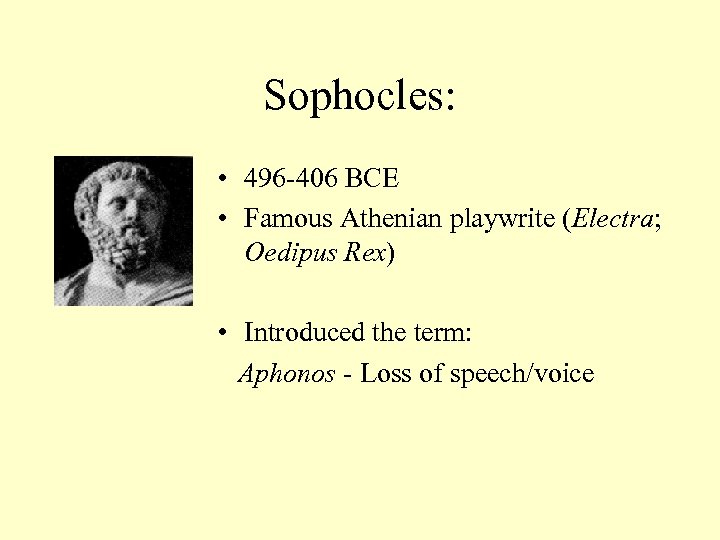 Sophocles: • 496 -406 BCE • Famous Athenian playwrite (Electra; Oedipus Rex) • Introduced the term: Aphonos - Loss of speech/voice
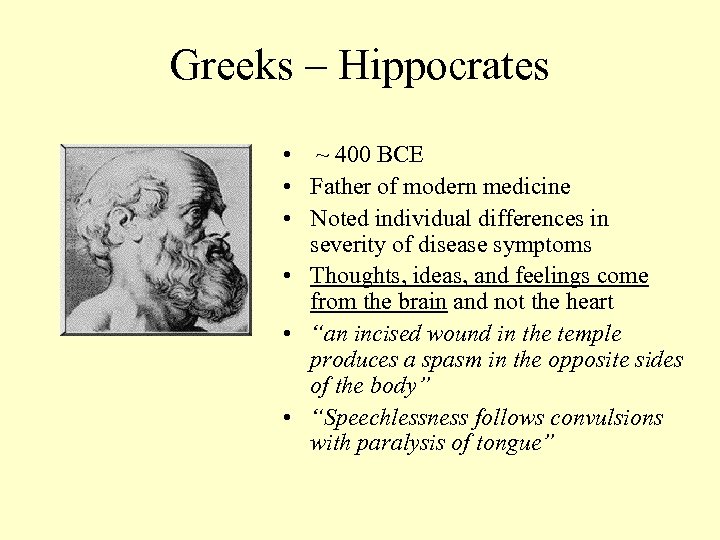 Greeks – Hippocrates • ~ 400 BCE • Father of modern medicine • Noted individual differences in severity of disease symptoms • Thoughts, ideas, and feelings come from the brain and not the heart • “an incised wound in the temple produces a spasm in the opposite sides of the body” • “Speechlessness follows convulsions with paralysis of tongue”
 Hippocrates • Aphonos attributed to “excessive repletions of blood vessels” (i. e. , stroke) • Head injury as source of speech loss • Correlation between paralysis and speech loss
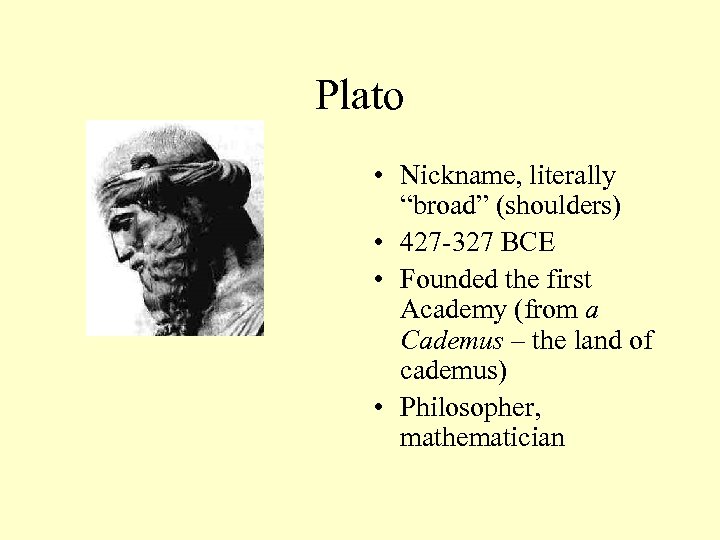 Plato • Nickname, literally “broad” (shoulders) • 427 -327 BCE • Founded the first Academy (from a Cademus – the land of cademus) • Philosopher, mathematician
 Plato • Thought = “Inner speech”
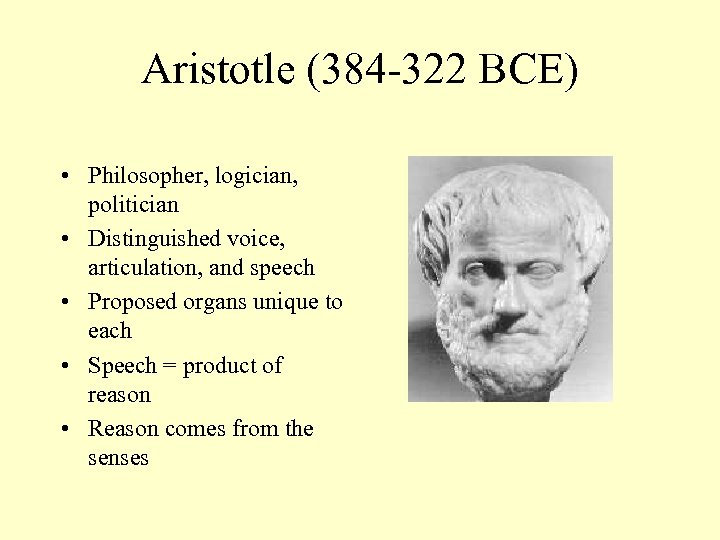 Aristotle (384 -322 BCE) • Philosopher, logician, politician • Distinguished voice, articulation, and speech • Proposed organs unique to each • Speech = product of reason • Reason comes from the senses
 Aristotle • Political origins of language
 Romans • • 30 CE Valerius Maximus 1 rst case of traumatic alexia Early localization of brain functions assigned to ventricles
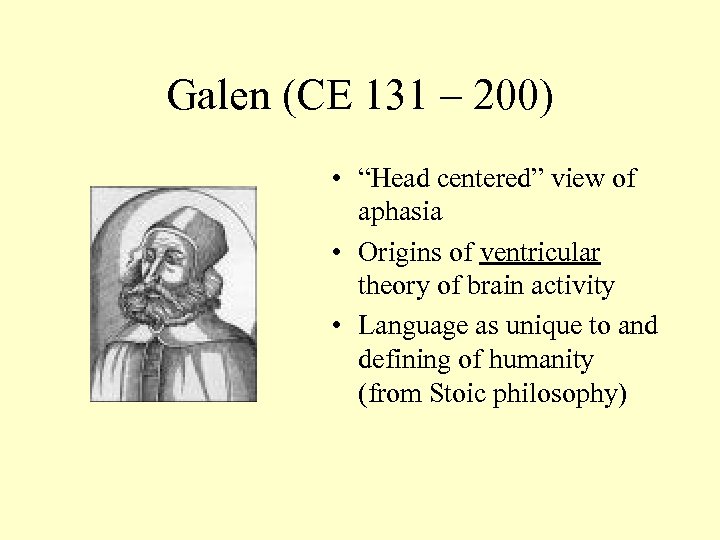 Galen (CE 131 – 200) • “Head centered” view of aphasia • Origins of ventricular theory of brain activity • Language as unique to and defining of humanity (from Stoic philosophy)
 From Rome to the middle ages • Justinian code (539 CE): • Speech as a requisite for Roman citizenship • Christian middle ages: • Speech is a property of the soul • Not a topic of scientific inquiry
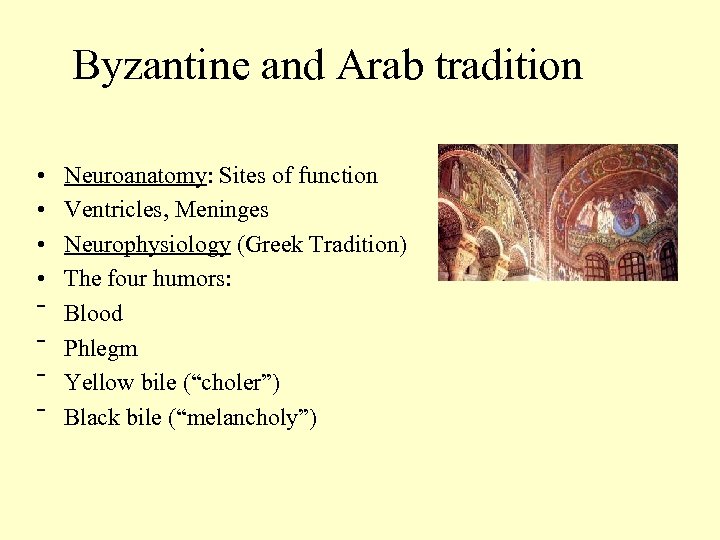 Byzantine and Arab tradition • • ˉ ˉ Neuroanatomy: Sites of function Ventricles, Meninges Neurophysiology (Greek Tradition) The four humors: Blood Phlegm Yellow bile (“choler”) Black bile (“melancholy”)
 Medieval Renaissance • • • Return of medical science Clinical observation and translation Emergence of Universities Dissections permitted at Bologna (1326) Role of the great plagues
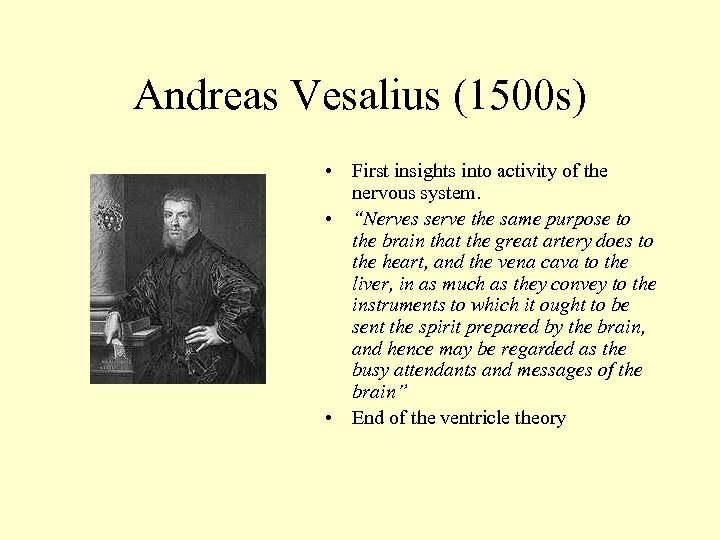 Andreas Vesalius (1500 s) • First insights into activity of the nervous system. • “Nerves serve the same purpose to the brain that the great artery does to the heart, and the vena cava to the liver, in as much as they convey to the instruments to which it ought to be sent the spirit prepared by the brain, and hence may be regarded as the busy attendants and messages of the brain” • End of the ventricle theory
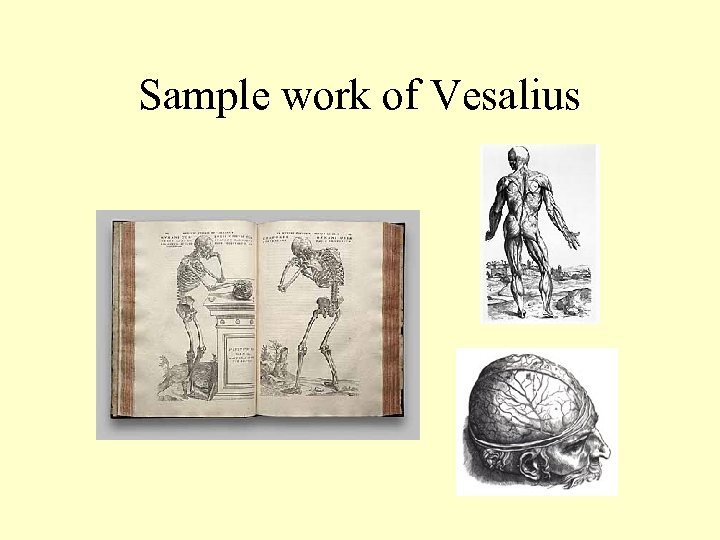 Sample work of Vesalius
 Modern history of aphasia • Post-enlightenment • Strong European contributions
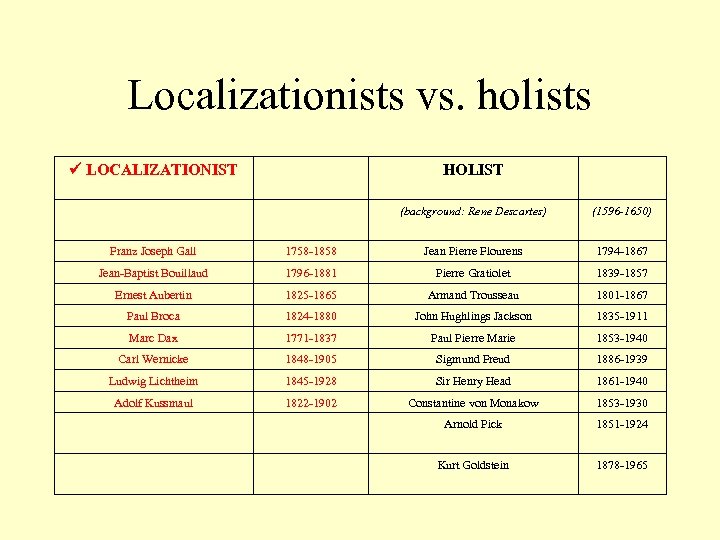 Localizationists vs. holists LOCALIZATIONIST HOLIST (background: Rene Descartes) (1596 -1650) Franz Joseph Gall 1758 -1858 Jean Pierre Flourens 1794 -1867 Jean-Baptist Bouillaud 1796 -1881 Pierre Gratiolet 1839 -1857 Ernest Aubertin 1825 -1865 Armand Trousseau 1801 -1867 Paul Broca 1824 -1880 John Hughlings Jackson 1835 -1911 Marc Dax 1771 -1837 Paul Pierre Marie 1853 -1940 Carl Wernicke 1848 -1905 Sigmund Freud 1886 -1939 Ludwig Lichtheim 1845 -1928 Sir Henry Head 1861 -1940 Adolf Kussmaul 1822 -1902 Constantine von Monakow 1853 -1930 Arnold Pick 1851 -1924 Kurt Goldstein 1878 -1965
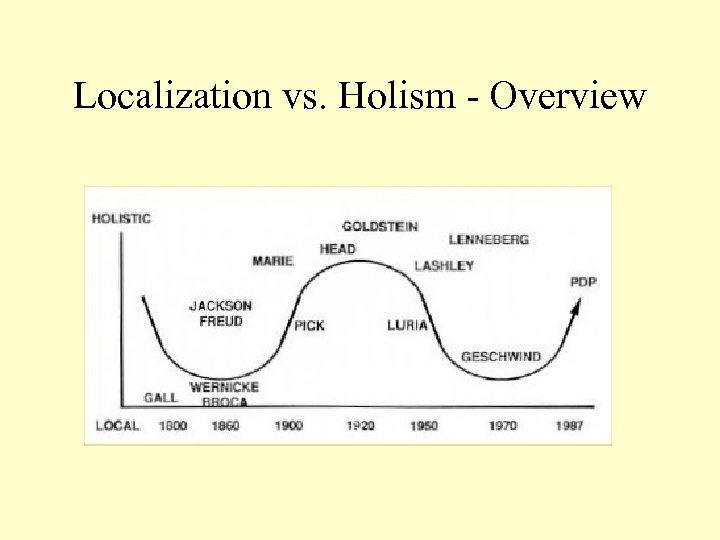 Localization vs. Holism - Overview
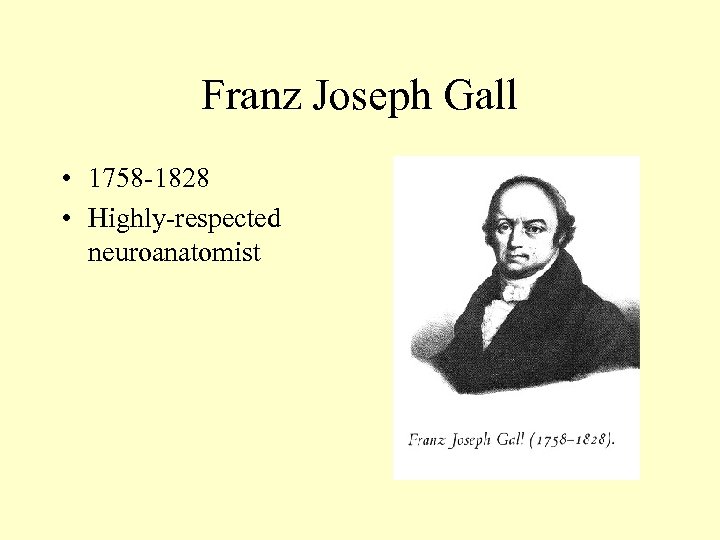 Franz Joseph Gall • 1758 -1828 • Highly-respected neuroanatomist
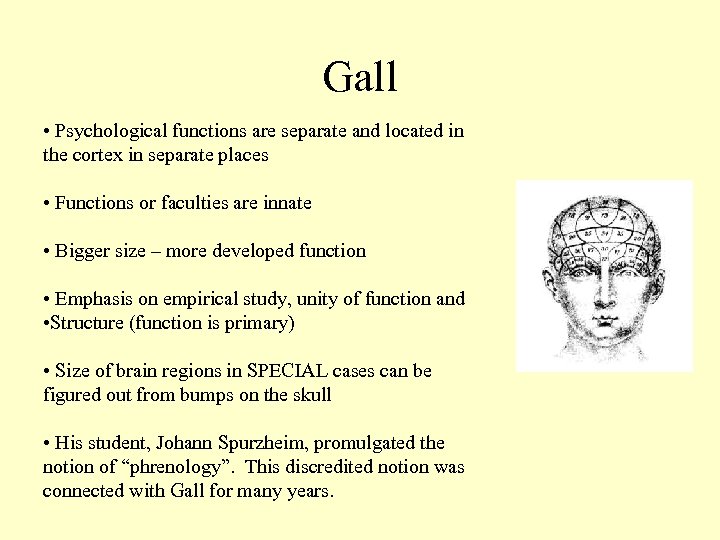 Gall • Psychological functions are separate and located in the cortex in separate places • Functions or faculties are innate • Bigger size – more developed function • Emphasis on empirical study, unity of function and • Structure (function is primary) • Size of brain regions in SPECIAL cases can be figured out from bumps on the skull • His student, Johann Spurzheim, promulgated the notion of “phrenology”. This discredited notion was connected with Gall for many years.
 Gall – main insights • Contralateral organization of neural control over bodily functions • Distinction between grey and white matter • Origins of cerebral convolutions in the growth and folding of the developing brain • Nerves do not all descend from a single brain
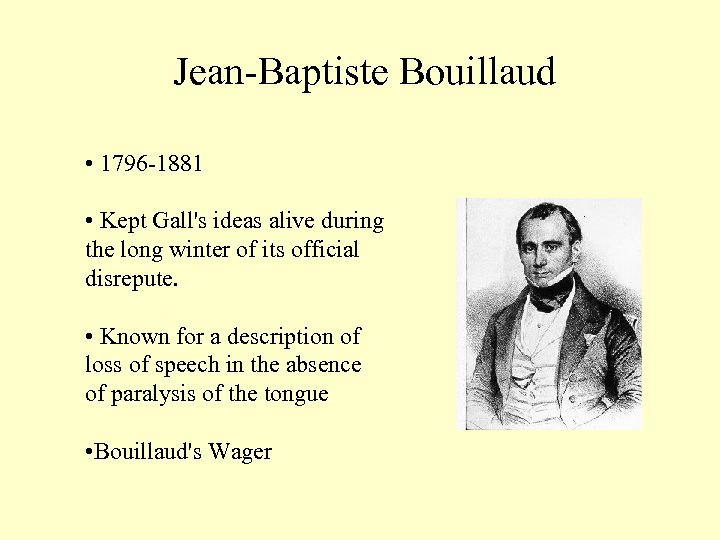 Jean-Baptiste Bouillaud • 1796 -1881 • Kept Gall's ideas alive during the long winter of its official disrepute. • Known for a description of loss of speech in the absence of paralysis of the tongue • Bouillaud's Wager
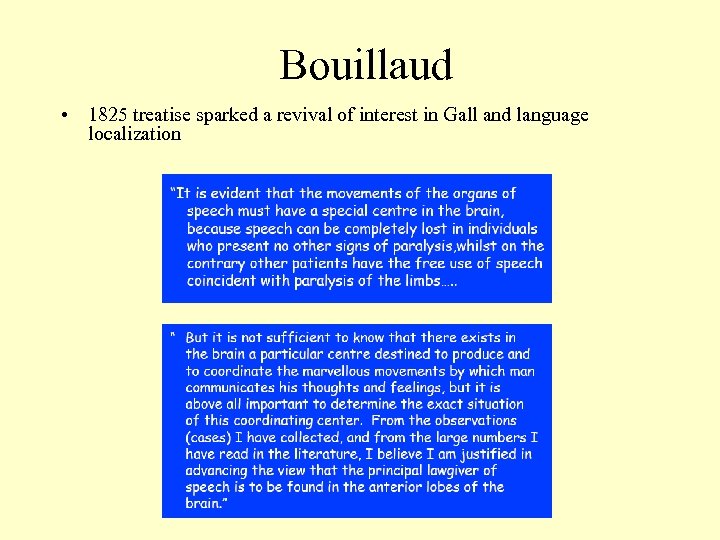 Bouillaud • 1825 treatise sparked a revival of interest in Gall and language localization
 Ernest Aubertin • Son-in-law of Bouillaud • 1861 mentioned a patient with traumatic frontal cranial deficit. When he applied light pressure while the patient was speaking he would stop in midword. • Worked with Broca at Bicetre • Contributed to Broca’s famous case of Leborgne • Specified the connection between anterior brain damage and loss of speech
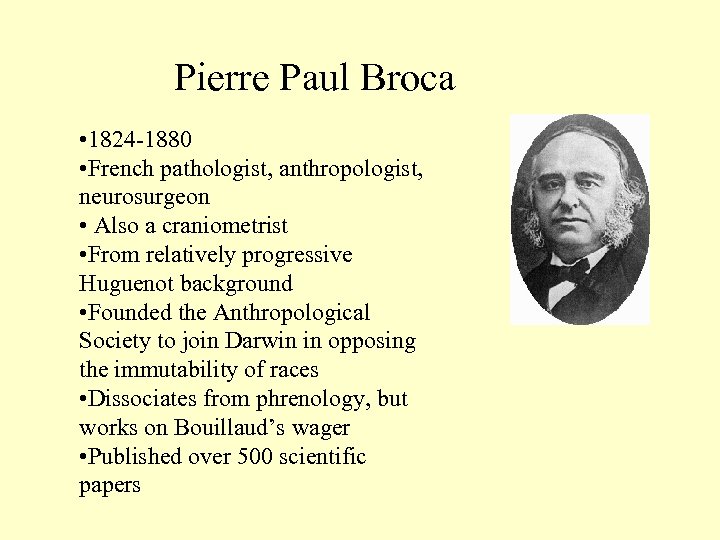 Pierre Paul Broca • 1824 -1880 • French pathologist, anthropologist, neurosurgeon • Also a craniometrist • From relatively progressive Huguenot background • Founded the Anthropological Society to join Darwin in opposing the immutability of races • Dissociates from phrenology, but works on Bouillaud’s wager • Published over 500 scientific papers
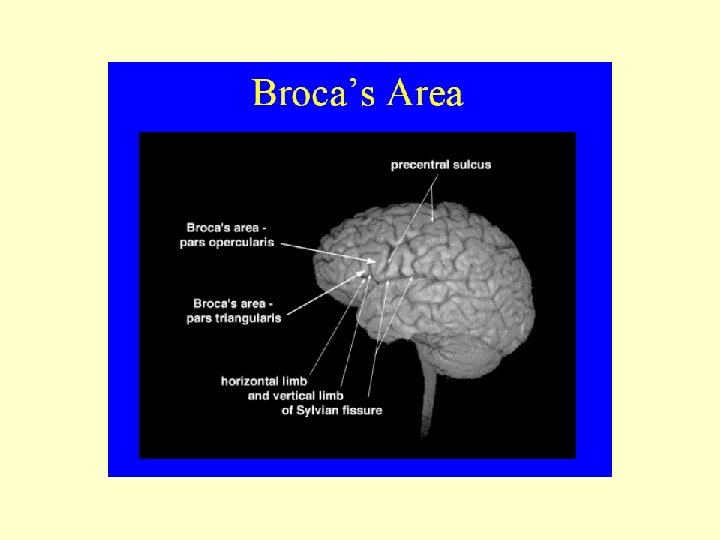
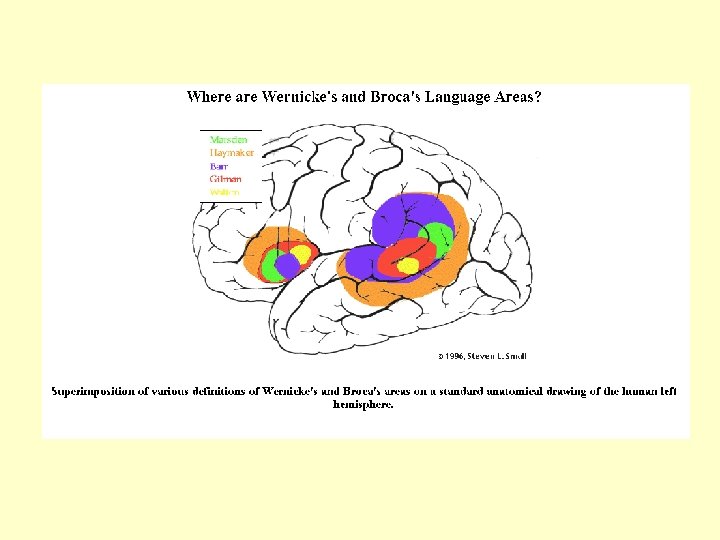
 Broca • Localizes faculty of articulate speech in third frontal convolution “aphemia” • Makes key contributions on laterality “we speak with the left hemisphere” • Important links between laterality and handedness
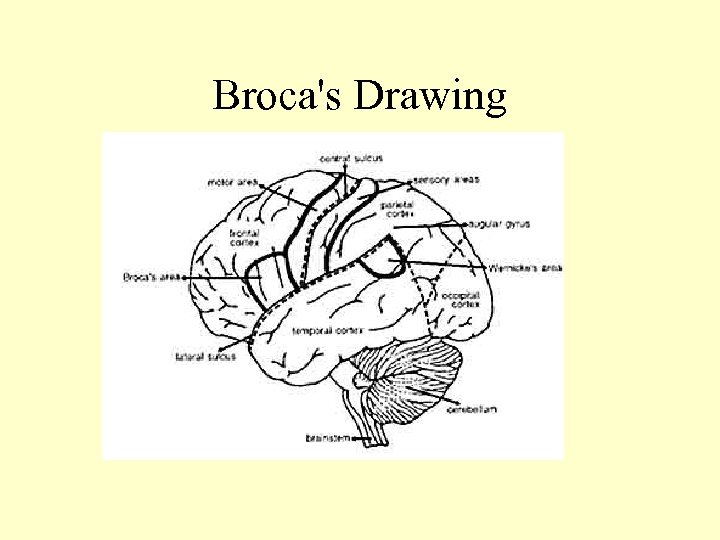 Broca's Drawing
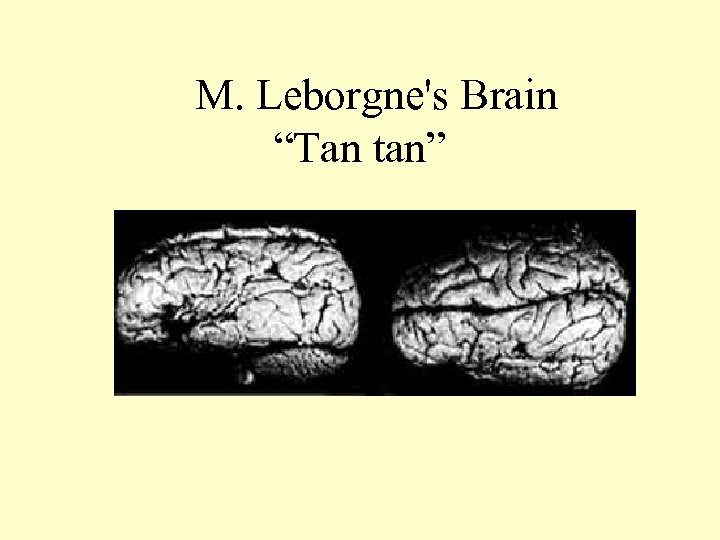 M. Leborgne's Brain “Tan tan”
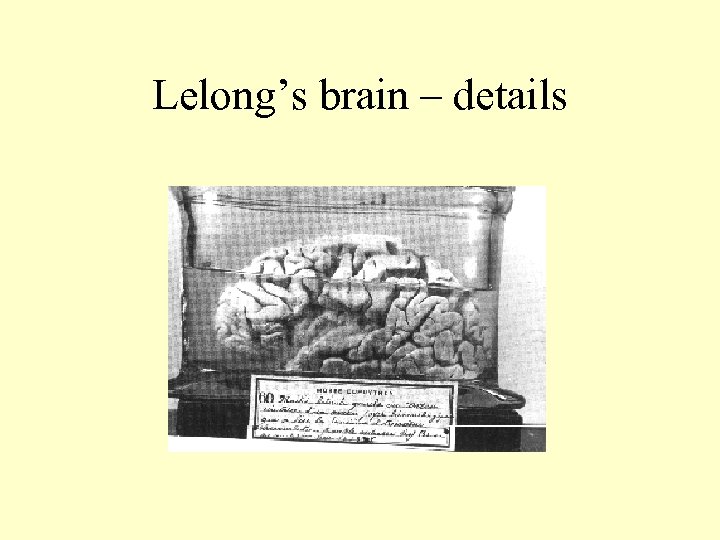 Lelong’s brain – details
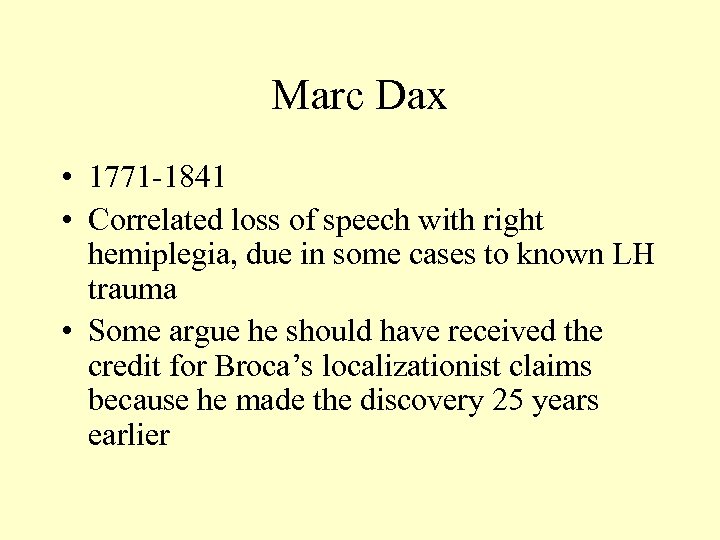 Marc Dax • 1771 -1841 • Correlated loss of speech with right hemiplegia, due in some cases to known LH trauma • Some argue he should have received the credit for Broca’s localizationist claims because he made the discovery 25 years earlier
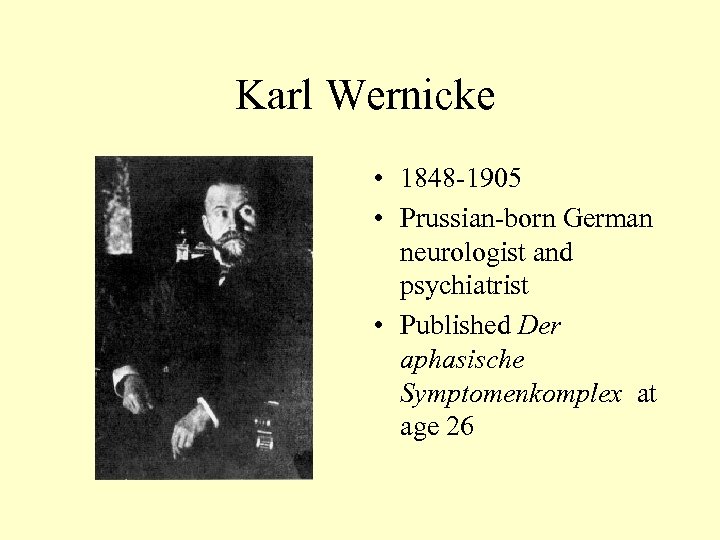 Karl Wernicke • 1848 -1905 • Prussian-born German neurologist and psychiatrist • Published Der aphasische Symptomenkomplex at age 26
 Wernicke • Introduced important concept of reflex arc and physiological vocabulary • Careful description of functional disturbances as well as pathological detail • Model has predictive value • Birth of information processing models
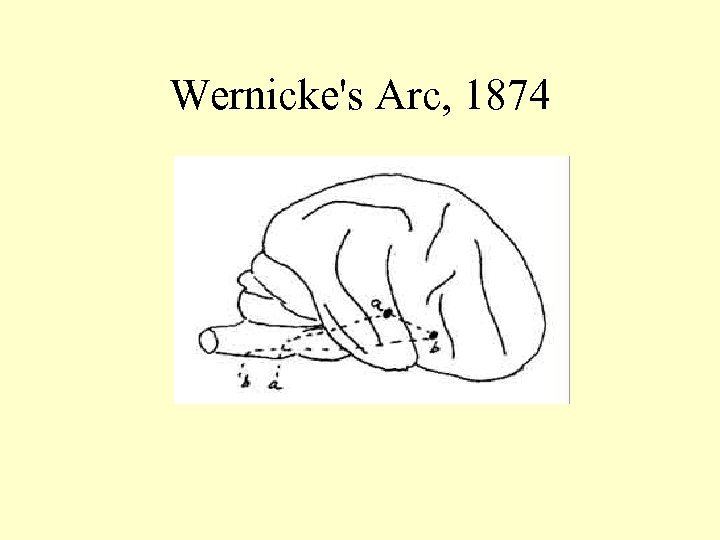 Wernicke's Arc, 1874
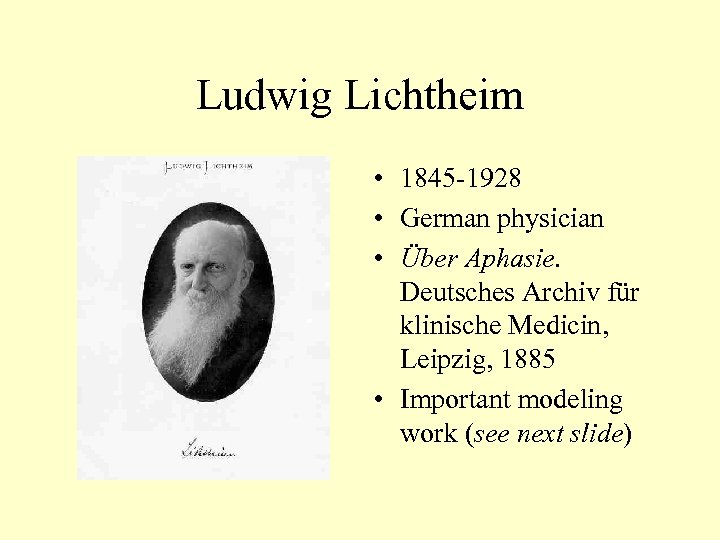 Ludwig Lichtheim • 1845 -1928 • German physician • Über Aphasie. Deutsches Archiv für klinische Medicin, Leipzig, 1885 • Important modeling work (see next slide)
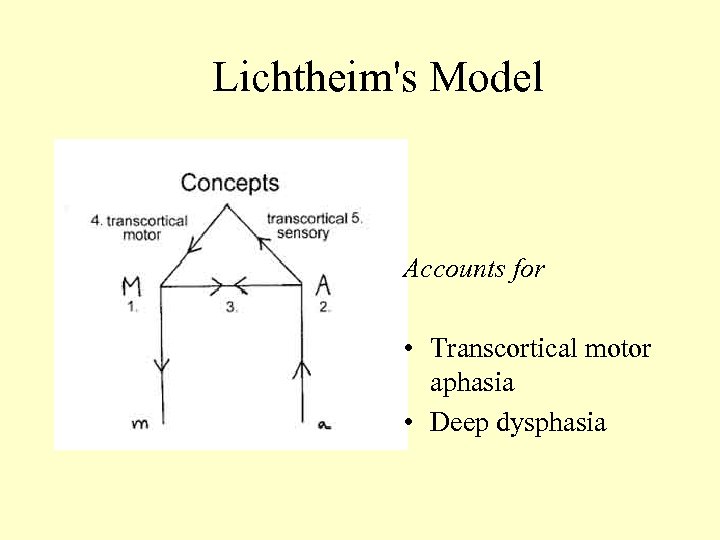 Lichtheim's Model Accounts for • Transcortical motor aphasia • Deep dysphasia
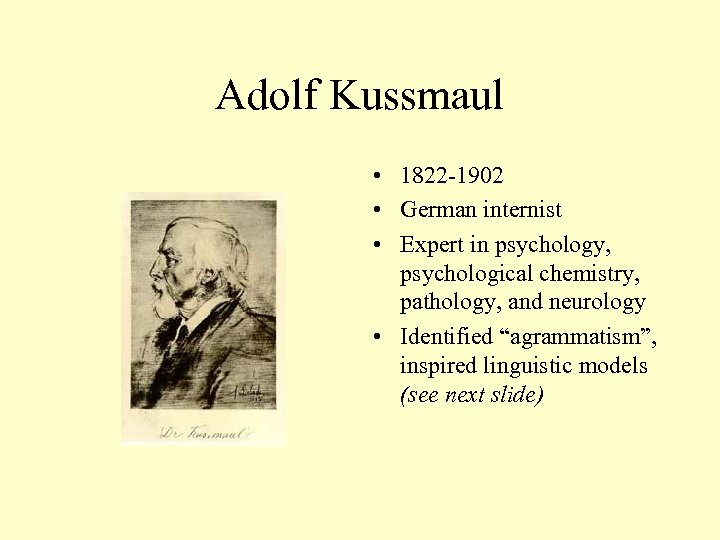 Adolf Kussmaul • 1822 -1902 • German internist • Expert in psychology, psychological chemistry, pathology, and neurology • Identified “agrammatism”, inspired linguistic models (see next slide)
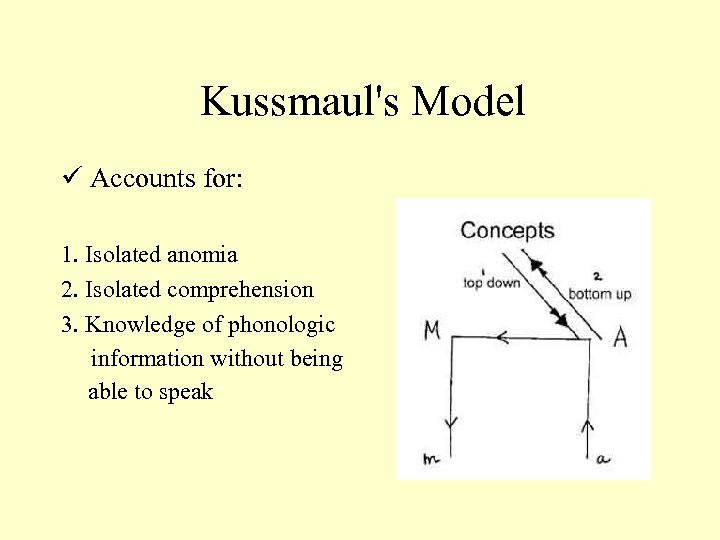 Kussmaul's Model Accounts for: 1. Isolated anomia 2. Isolated comprehension 3. Knowledge of phonologic information without being able to speak
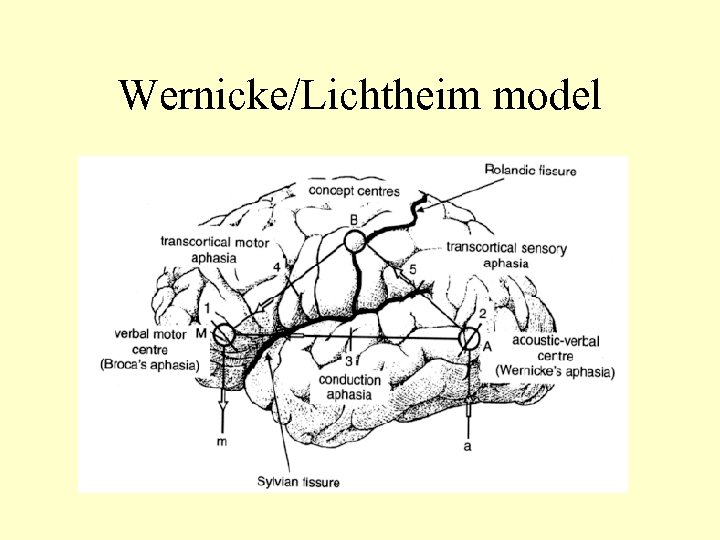 Wernicke/Lichtheim model
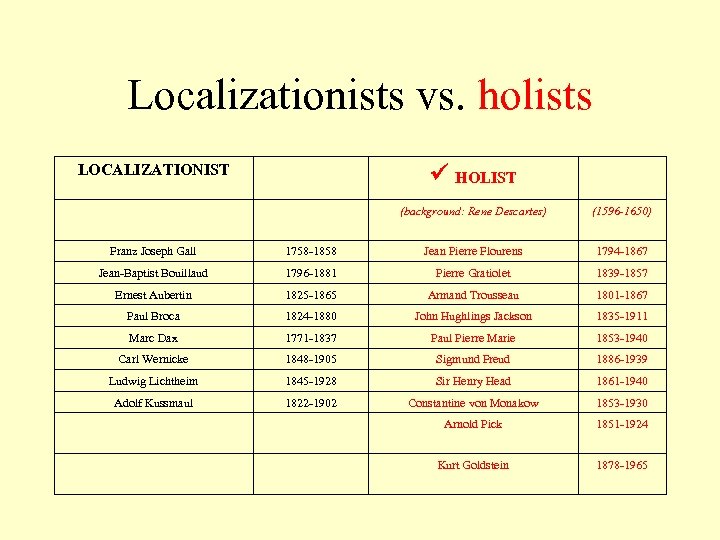 Localizationists vs. holists LOCALIZATIONIST HOLIST (background: Rene Descartes) (1596 -1650) Franz Joseph Gall 1758 -1858 Jean Pierre Flourens 1794 -1867 Jean-Baptist Bouillaud 1796 -1881 Pierre Gratiolet 1839 -1857 Ernest Aubertin 1825 -1865 Armand Trousseau 1801 -1867 Paul Broca 1824 -1880 John Hughlings Jackson 1835 -1911 Marc Dax 1771 -1837 Paul Pierre Marie 1853 -1940 Carl Wernicke 1848 -1905 Sigmund Freud 1886 -1939 Ludwig Lichtheim 1845 -1928 Sir Henry Head 1861 -1940 Adolf Kussmaul 1822 -1902 Constantine von Monakow 1853 -1930 Arnold Pick 1851 -1924 Kurt Goldstein 1878 -1965
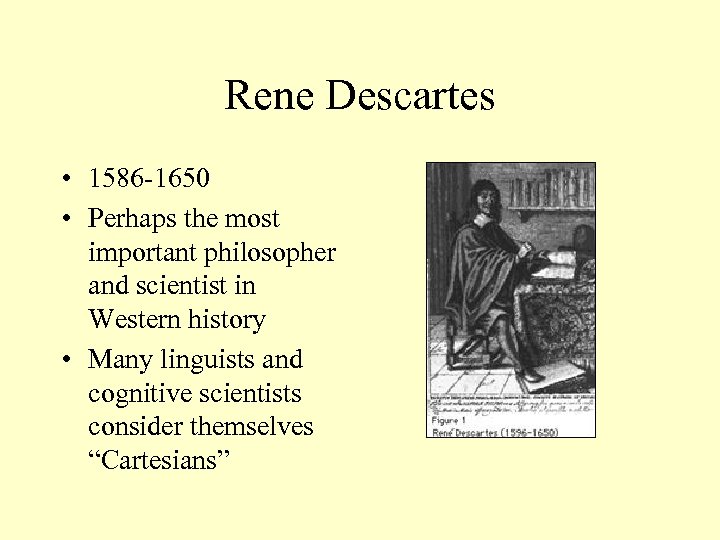 Rene Descartes • 1586 -1650 • Perhaps the most important philosopher and scientist in Western history • Many linguists and cognitive scientists consider themselves “Cartesians”
 Cogito Ergo Sum • The only certainty Descartes felt was that he could doubt • But, through doubting: Doubting was thinking Thinking required a thinker Therefore he did, in fact, exist • Hence: I think, therefore I am
 Innate Ideas • Innate ideas were natural components of the mind • Some ideas were so clear and distinctive they had to be true, even without personal experience • Descartes had ideas that were perfect, even if he wasn’t • Descartes could not have had these ideas on his own • Therefore GOD put those ideas into a person’s head • Some Innate Ideas: Unity/Infinity/Perfection
 Descartes’ Contributions • Mechanistic views on behavior • These views influenced: - Behaviorism - Stimulus – Response Psychology - Comparative Psychology - Physiological Psychology • Re-focused Conflict - Animal vs. Human - Rational vs. Irrational • Notion of “Mind” Permitted study of consciousness
 Descartes • His dualistic model of mind and body (“substance dualism”) denied the mind any materializability or localizability. • Therefore, his legacy tended to work against the localizationist concept.
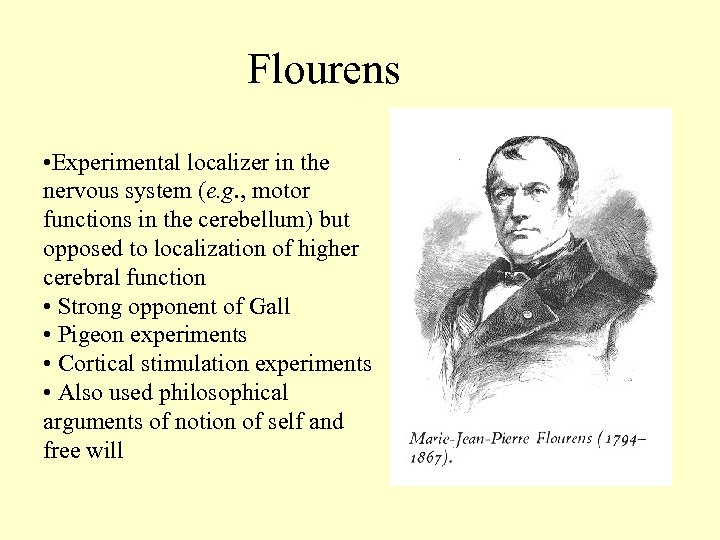 Flourens • Experimental localizer in the nervous system (e. g. , motor functions in the cerebellum) but opposed to localization of higher cerebral function • Strong opponent of Gall • Pigeon experiments • Cortical stimulation experiments • Also used philosophical arguments of notion of self and free will
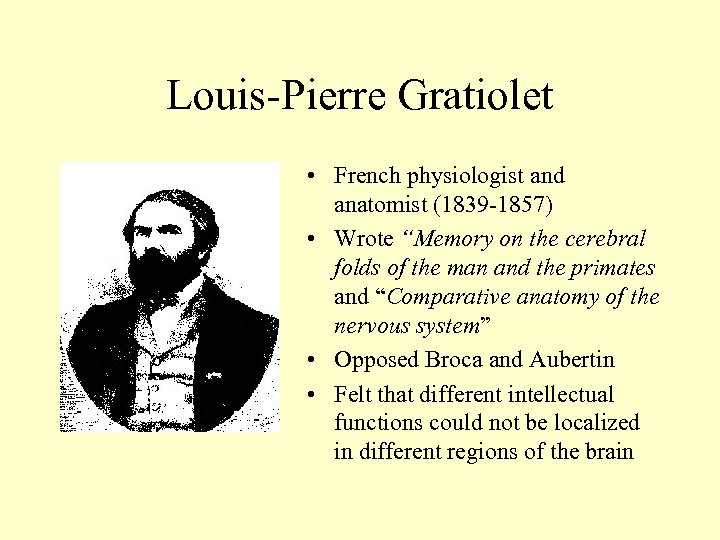 Louis-Pierre Gratiolet • French physiologist and anatomist (1839 -1857) • Wrote “Memory on the cerebral folds of the man and the primates and “Comparative anatomy of the nervous system” • Opposed Broca and Aubertin • Felt that different intellectual functions could not be localized in different regions of the brain
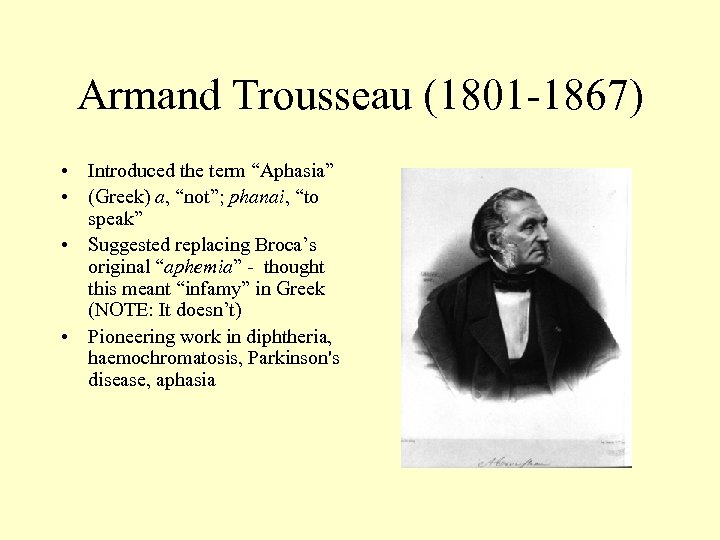 Armand Trousseau (1801 -1867) • Introduced the term “Aphasia” • (Greek) a, “not”; phanai, “to speak” • Suggested replacing Broca’s original “aphemia” - thought this meant “infamy” in Greek (NOTE: It doesn’t) • Pioneering work in diphtheria, haemochromatosis, Parkinson's disease, aphasia
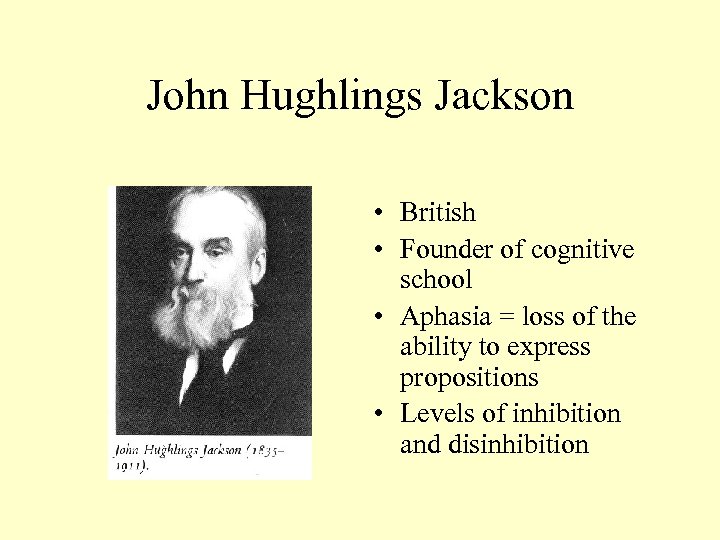 John Hughlings Jackson • British • Founder of cognitive school • Aphasia = loss of the ability to express propositions • Levels of inhibition and disinhibition
 Jackson • “To locate the lesion which destroys speech and to locate speech are two different things” • Demanded empirical evidence • His work presaged later concepts of automatic vs. controlled processing
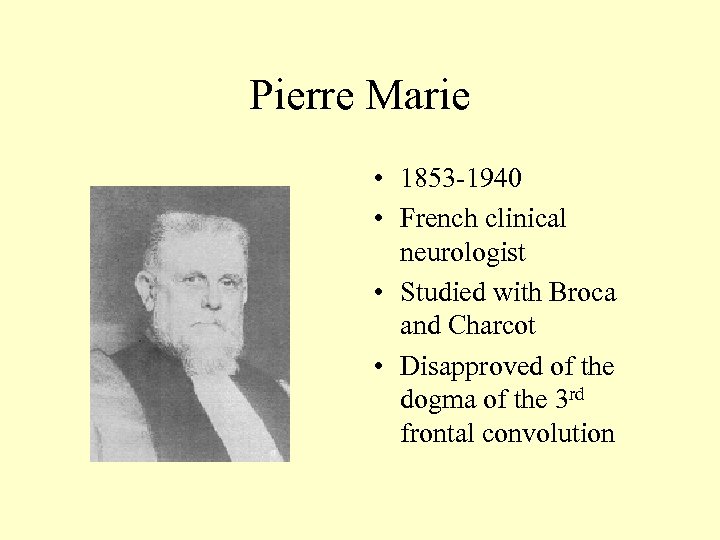 Pierre Marie • 1853 -1940 • French clinical neurologist • Studied with Broca and Charcot • Disapproved of the dogma of the 3 rd frontal convolution
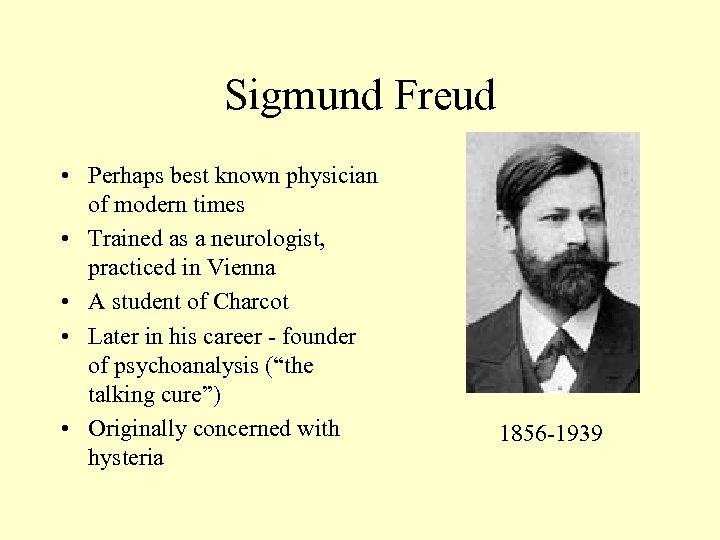 Sigmund Freud • Perhaps best known physician of modern times • Trained as a neurologist, practiced in Vienna • A student of Charcot • Later in his career - founder of psychoanalysis (“the talking cure”) • Originally concerned with hysteria 1856 -1939
 Freud • • Zur Auffassung der Aphasien (1891) Influenced by Jackson Hierarchy, preconscious Criticizes Lichtheim's model on its own predictions: internally inconsistent
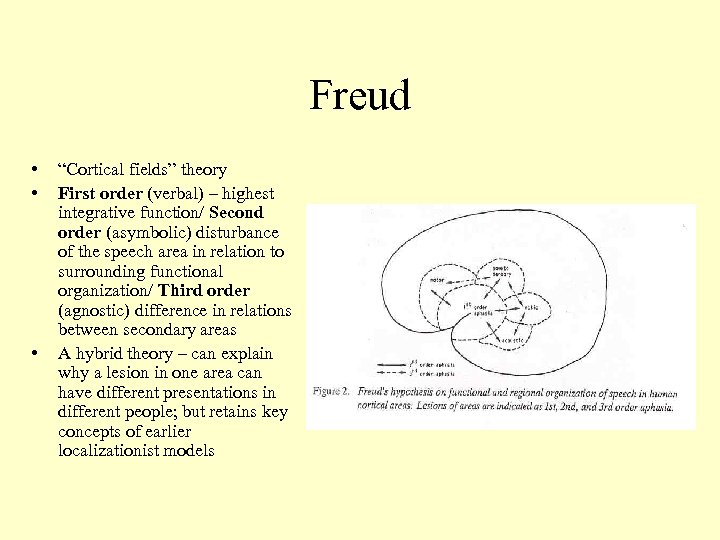 Freud • • • “Cortical fields” theory First order (verbal) – highest integrative function/ Second order (asymbolic) disturbance of the speech area in relation to surrounding functional organization/ Third order (agnostic) difference in relations between secondary areas A hybrid theory – can explain why a lesion in one area can have different presentations in different people; but retains key concepts of earlier localizationist models
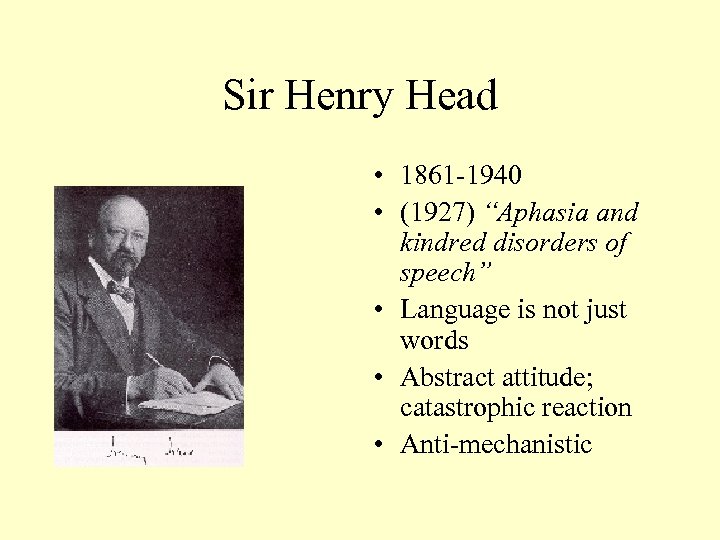 Sir Henry Head • 1861 -1940 • (1927) “Aphasia and kindred disorders of speech” • Language is not just words • Abstract attitude; catastrophic reaction • Anti-mechanistic
 Head • • Extensive study of injuries from WWI Ridiculed the “diagram makers” Stressed the symbolic nature of language Stop conceiving of language as words
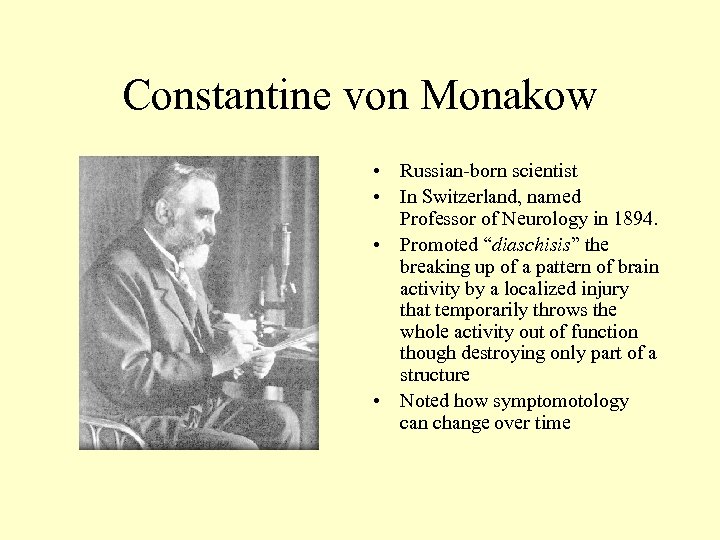 Constantine von Monakow • Russian-born scientist • In Switzerland, named Professor of Neurology in 1894. • Promoted “diaschisis” the breaking up of a pattern of brain activity by a localized injury that temporarily throws the whole activity out of function though destroying only part of a structure • Noted how symptomotology can change over time
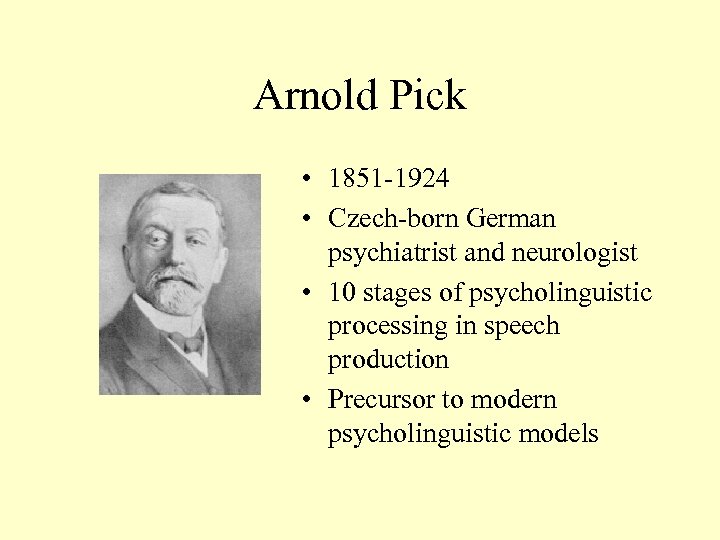 Arnold Pick • 1851 -1924 • Czech-born German psychiatrist and neurologist • 10 stages of psycholinguistic processing in speech production • Precursor to modern psycholinguistic models
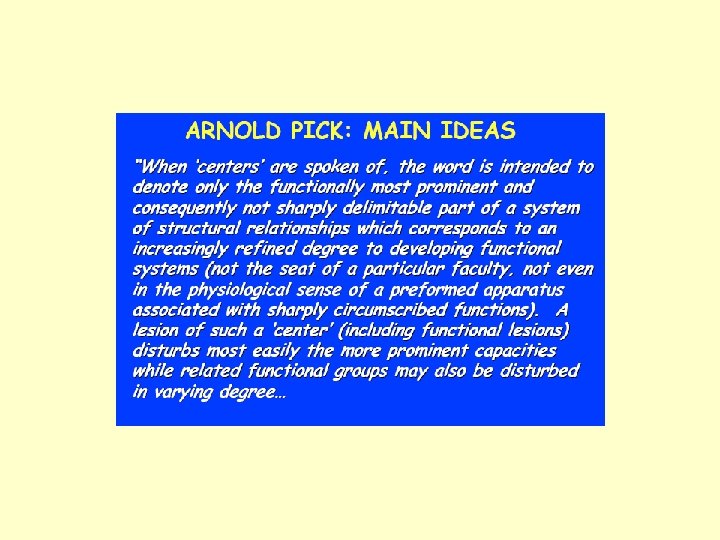
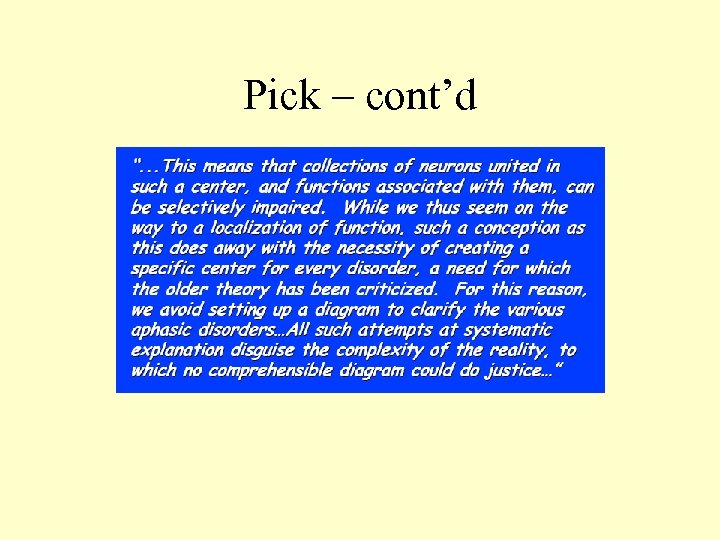 Pick – cont’d
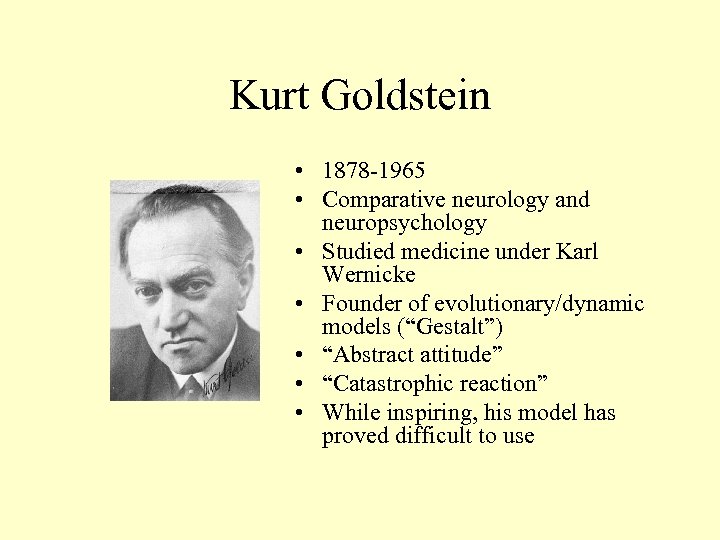 Kurt Goldstein • 1878 -1965 • Comparative neurology and neuropsychology • Studied medicine under Karl Wernicke • Founder of evolutionary/dynamic models (“Gestalt”) • “Abstract attitude” • “Catastrophic reaction” • While inspiring, his model has proved difficult to use
 Hiatus in Aphasiology 1920 -1960 1. Behaviorism and black box models 2. Increased focus on reductionist sciences (e. g. , biochemistry) 3. Psychoanalytic dominance 4. Legacy of holists; information processing models forgotten
 Weisenberg & Mc. Bride (1935) • Re-examined Head’s clinical tests and found them lacking • Important advances in methodology (control groups, standardized scores, etc. ) • Proposed an intuitive classification scheme: Receptive/expressive/ expressive-receptive/amnsesic
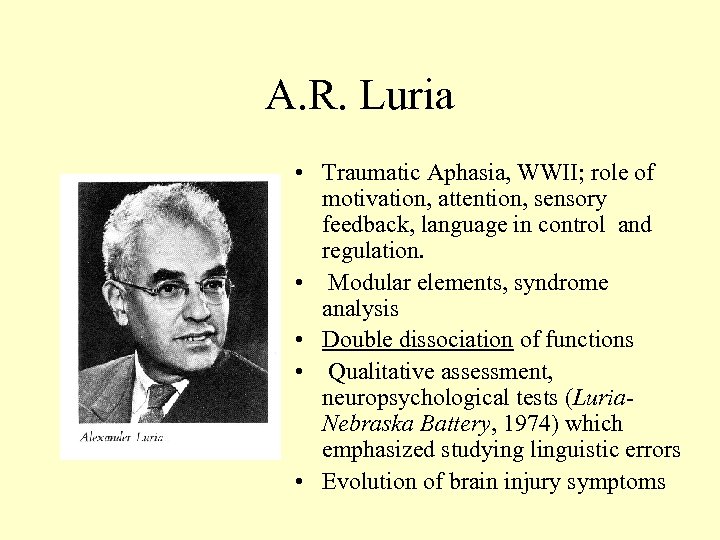 A. R. Luria • Traumatic Aphasia, WWII; role of motivation, attention, sensory feedback, language in control and regulation. • Modular elements, syndrome analysis • Double dissociation of functions • Qualitative assessment, neuropsychological tests (Luria. Nebraska Battery, 1974) which emphasized studying linguistic errors • Evolution of brain injury symptoms
 Luria • Influenced by Pavlov’s second signal system • “Constellation of cerebral zones” model (psychological functions are not localized in a single location in the brain, but are distributed across a system of different modular subcomponents) • Efferent and afferent motor aphasia
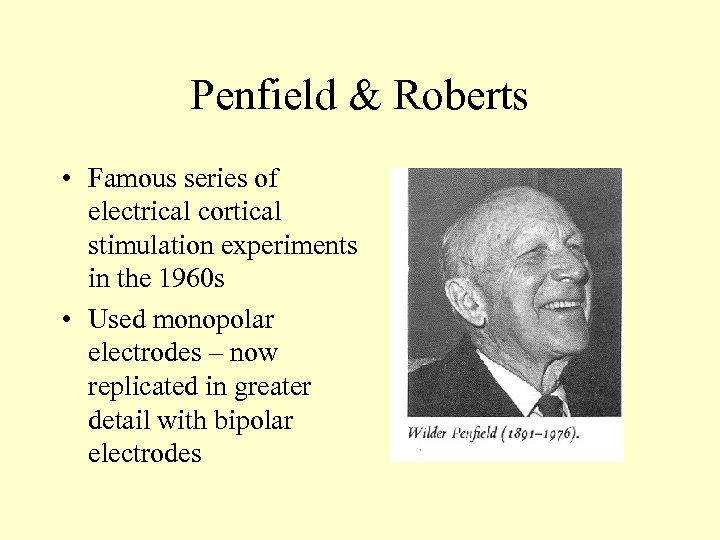 Penfield & Roberts • Famous series of electrical cortical stimulation experiments in the 1960 s • Used monopolar electrodes – now replicated in greater detail with bipolar electrodes
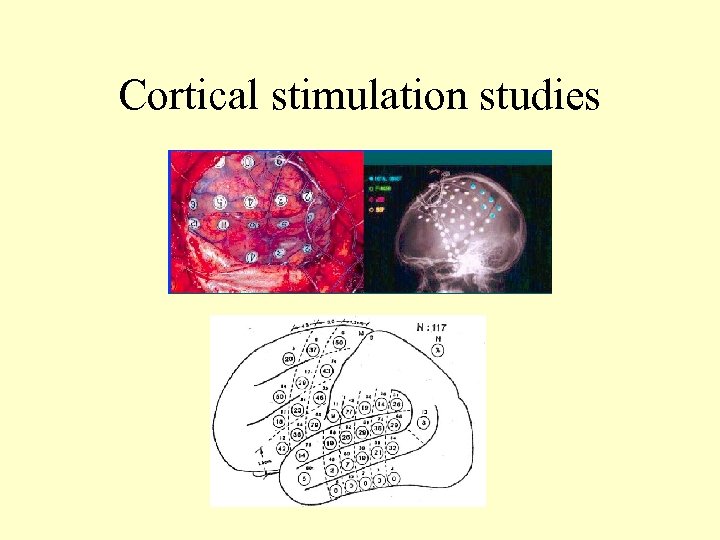 Cortical stimulation studies
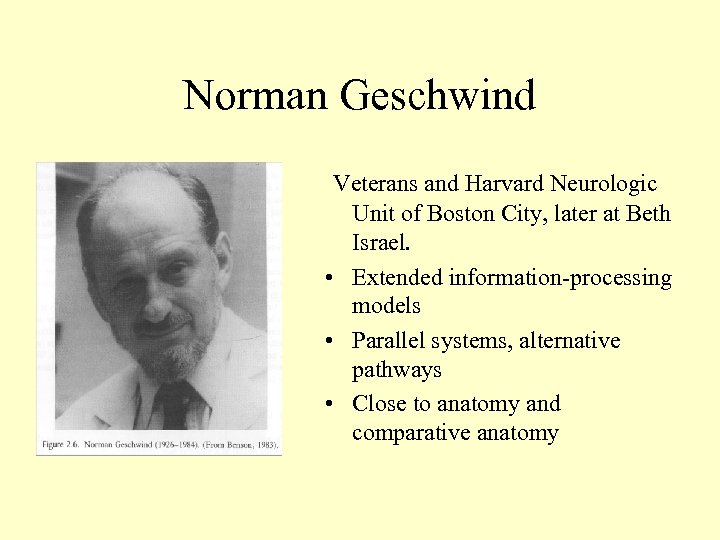 Norman Geschwind Veterans and Harvard Neurologic Unit of Boston City, later at Beth Israel. • Extended information-processing models • Parallel systems, alternative pathways • Close to anatomy and comparative anatomy
 Hildred Schuell • Key aphasia educator and clinician of the 1970 s • Compassionate therapy – avoiding “catastrophic reaction” • However, key concepts were overly simple and not tested empirically…
 Eric Lenneberg • 1921 -1975 • “The biological foundations of language” (1967) • Motor correlates of language development • Plasticity in the face of early brain injury - Equipotentiality - Lateralization is an outcome of language learning • Limits on plasticity provide evidence for critical periods in language development
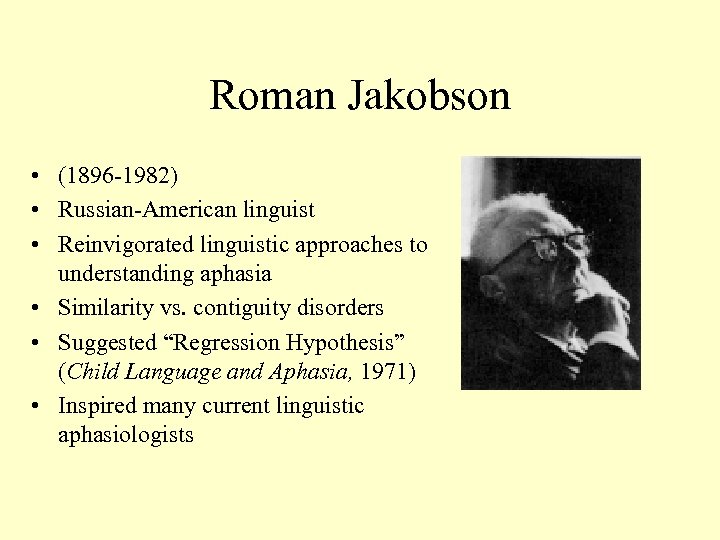 Roman Jakobson • (1896 -1982) • Russian-American linguist • Reinvigorated linguistic approaches to understanding aphasia • Similarity vs. contiguity disorders • Suggested “Regression Hypothesis” (Child Language and Aphasia, 1971) • Inspired many current linguistic aphasiologists
![Jakobson • “The varieties of aphasia [severe language disorder] are numerous and diverse, but](https://present5.com/presentation/6bcc2fef64eec5bf62615ddd23637a24/image-77.jpg "Jakobson • “The varieties of aphasia [severe language disorder] are numerous and diverse, but") Jakobson • “The varieties of aphasia [severe language disorder] are numerous and diverse, but all of them lie between the two polar types just described. Every form of aphasic disturbance consists in some impairment, more or less severe, either of the faculty for selection and substitution or for combination and contexture. The former affliction involves a deterioration of metalinguistic operations, while the latter damages the capacity for maintaining the hierarchy of linguistic units. The relation of similarity is suppressed in the former, the relation of contiguity in the latter type of aphasia. Metaphor is alien to the similarity disorder, and metonymy to the contiguity disorder. ”
Jakobson • “The varieties of aphasia [severe language disorder] are numerous and diverse, but all of them lie between the two polar types just described. Every form of aphasic disturbance consists in some impairment, more or less severe, either of the faculty for selection and substitution or for combination and contexture. The former affliction involves a deterioration of metalinguistic operations, while the latter damages the capacity for maintaining the hierarchy of linguistic units. The relation of similarity is suppressed in the former, the relation of contiguity in the latter type of aphasia. Metaphor is alien to the similarity disorder, and metonymy to the contiguity disorder. ”
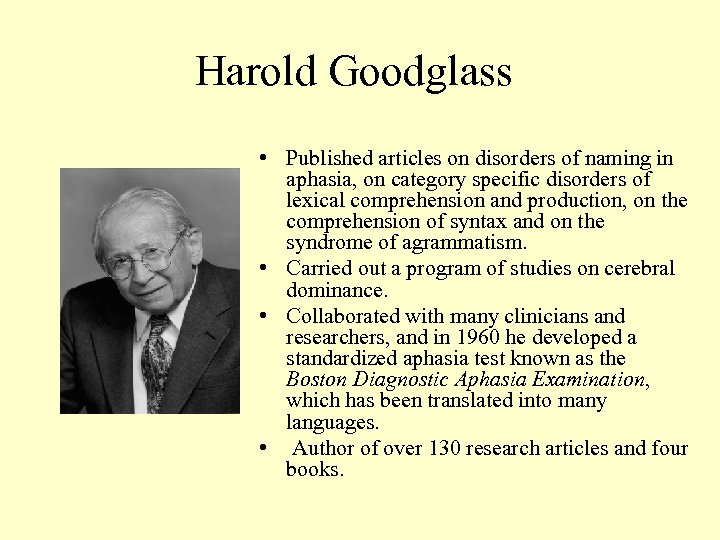 Harold Goodglass • Published articles on disorders of naming in aphasia, on category specific disorders of lexical comprehension and production, on the comprehension of syntax and on the syndrome of agrammatism. • Carried out a program of studies on cerebral dominance. • Collaborated with many clinicians and researchers, and in 1960 he developed a standardized aphasia test known as the Boston Diagnostic Aphasia Examination, which has been translated into many languages. • Author of over 130 research articles and four books.
 Other modern contributors • • • Jerry Fodor Noam Chomsky Roger Sperry, Michael Gazzaniga George Ojemann Herman Kolk, Klaus Heeschen PDP school: Jeffrey Elman, Gary Dell, Elizabeth Bates, Myrna Schwartz • Boston School: Harold Goodglass, Edith Kaplan, Sheila Blumstein, Alfonso Caramazza, Howard Gardner, Edgar Zurif
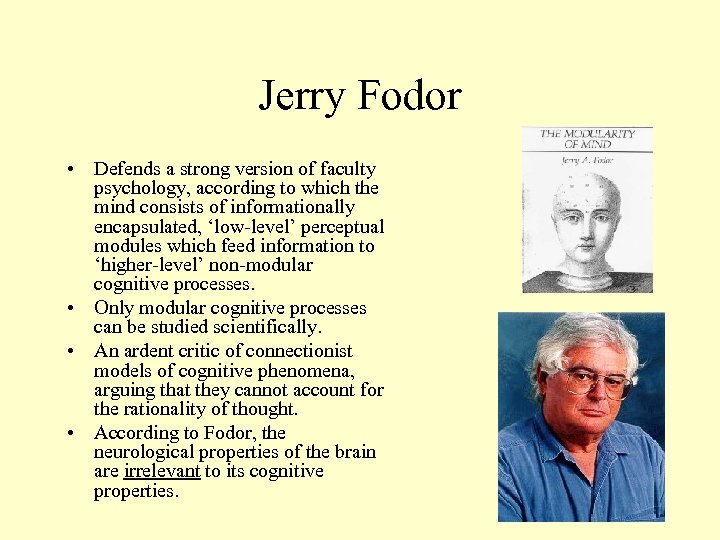 Jerry Fodor • Defends a strong version of faculty psychology, according to which the mind consists of informationally encapsulated, ‘low-level’ perceptual modules which feed information to ‘higher-level’ non-modular cognitive processes. • Only modular cognitive processes can be studied scientifically. • An ardent critic of connectionist models of cognitive phenomena, arguing that they cannot account for the rationality of thought. • According to Fodor, the neurological properties of the brain are irrelevant to its cognitive properties.
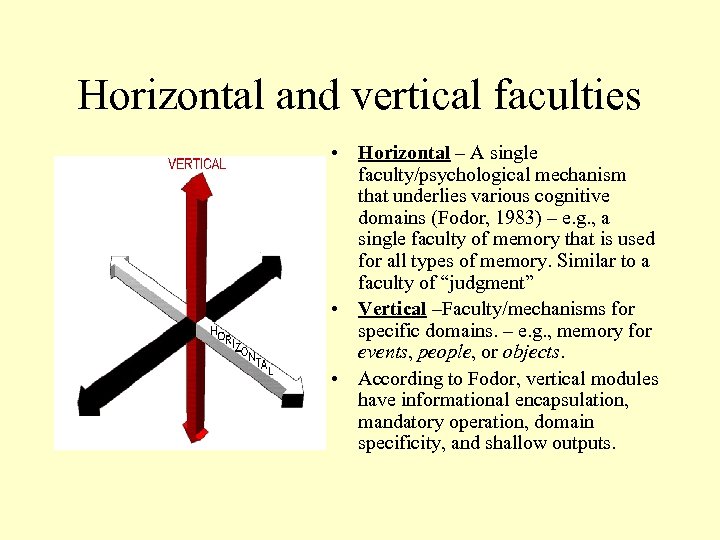 Horizontal and vertical faculties • Horizontal – A single faculty/psychological mechanism that underlies various cognitive domains (Fodor, 1983) – e. g. , a single faculty of memory that is used for all types of memory. Similar to a faculty of “judgment” • Vertical –Faculty/mechanisms for specific domains. – e. g. , memory for events, people, or objects. • According to Fodor, vertical modules have informational encapsulation, mandatory operation, domain specificity, and shallow outputs.
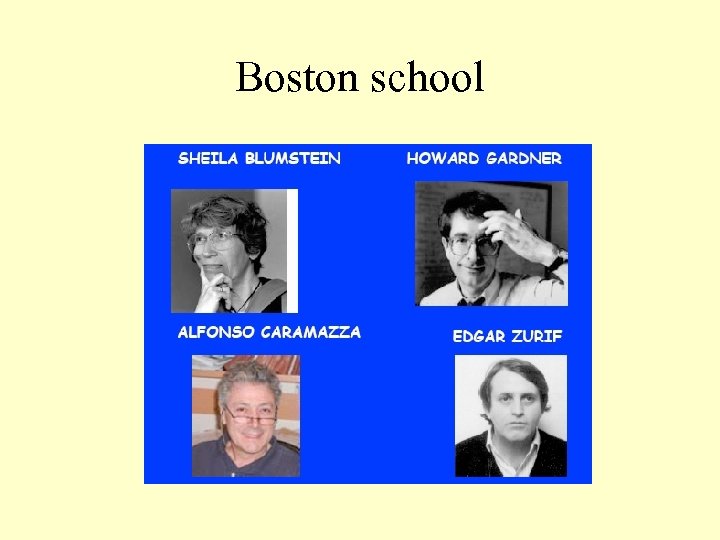 Boston school
 The end