


 Скачать презентацию APEC Integration model Zhirkova Sargylana Kagermazova Diana IFF
79 APEC.ppt
- Количество слайдов: 19
 APEC Integration model Zhirkova Sargylana Kagermazova Diana IFF 2 -3
 Asia-Pacific Economic Cooperation • is a forum that seeks to promote free trade and economic cooperation throughout the Asia-Pacific region. It was established in 1989 in response to the growing interdependence of Asia-Pacific economies and the advent of regional trade blocs in other parts of the world.
 Asia-Pacific Economic Cooperation • APEC currently has 21 members, including most countries with a coastline on the Pacific Ocean. However, the criterion for membership is that the member is a separate economy, rather than a state. As a result, APEC uses the term member economies rather than member countries to refer to its members.
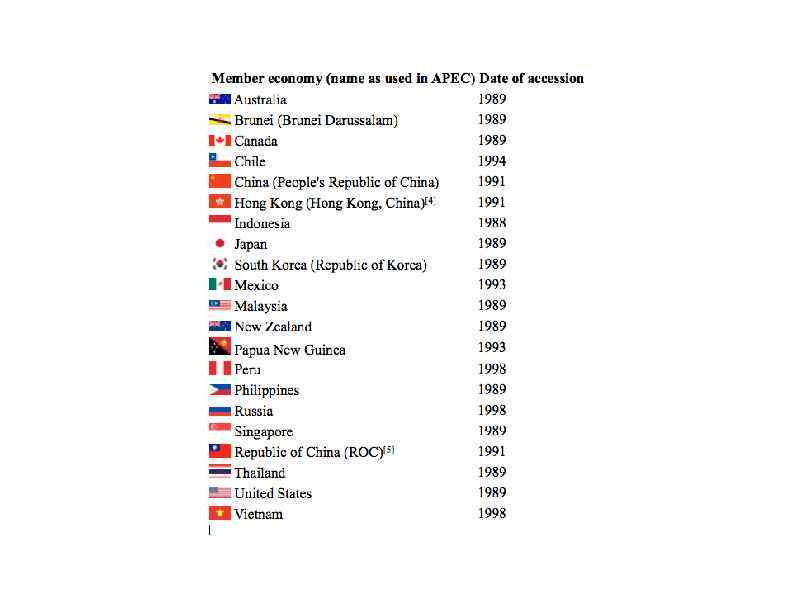
 History • The idea of APEC was firstly publicly broached by former Prime Minister of Australia, Mr Bob Hawke, during a speech in Seoul, Korea in January 1989. Later that year, 12 Asia-Pacific economies met in Canberra, Australia to establish APEC. The founding members were: Australia, Brunei Darussalam, Canada, Indonesia, Japan, Korea, Malaysia, New Zealand, the Philippines, Singapore, Thailand the United States.
 Host Economy • Every year one of the 21 APEC Member Economies plays host to APEC meetings and serves as the APEC Chair. The APEC host economy is responsible for chairing the annual Economic Leaders' Meeting, selected Ministerial Meetings, Senior Officials Meetings, the APEC Business Advisory Council and the APEC Study Centres Consortium. Until 2009, the host has also filled the Executive Director position at the APEC Secretariat. From 2010, the appointment will be made on a fixed-term basis (3 yrs) and will be open to candidates from all Member Economies.
 Funding • • • Projects generally Relate to the priorities of APEC Economic Leaders and APEC Ministers Cover the interest of at least several APEC Member Economies Build capacity Improve economic efficiency, and Encourage the participation of the business sector, non-governmental institutions and women.
 • Known as APEC's 'Three Pillars', APEC focuses on three key areas: • • • Trade and Investment Liberalisation Business Facilitation Economic and Technical Cooperation
 Trade and Investment Liberalisation • Trade and Investment Liberalisation reduces and eventually eliminates tariff and non-tariff barriers to trade and investment. Protectionism is expensive because it raises prices for goods and services.
 Business Facilitation • Business Facilitation focuses on reducing the costs of business transactions, improving access to trade information and aligning policy and business strategies to facilitate growth, and free and open trade.
 Economic and Technical Cooperation • ECOTECH is dedicated to providing training and cooperation to build capacities in all APEC Member Economies to take advantage of global trade. This area builds capacity at the institutional and personal level to assist APEC Member Economies and its people gain the necessary skills to meet their economic potential.
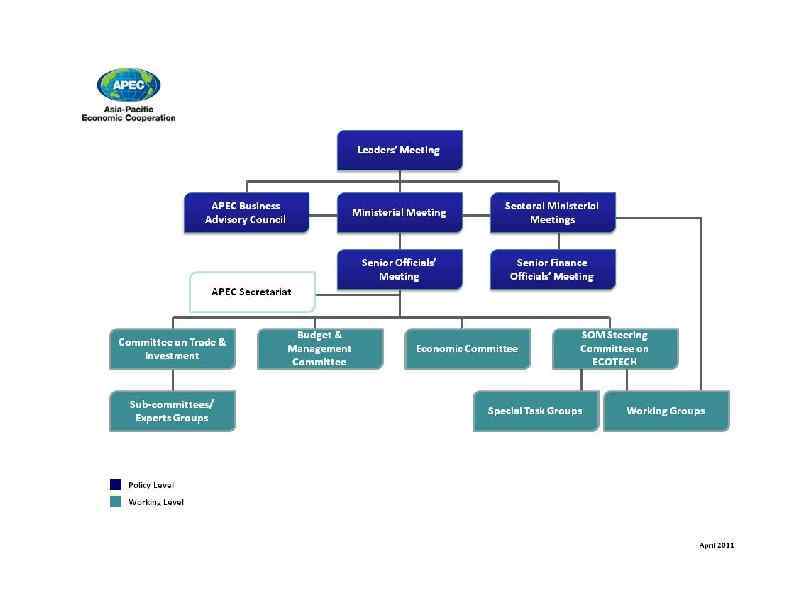
 • Policy Development • APEC Economic Leaders' Meeting • APEC Ministerial Meeting • Sectoral Ministerial Meetings
 APEC Business Advisory Council • ABAC provides APEC Economic Leaders with a business perspective on APEC issues through an annual meeting and a formal report. The annual report contains recommendations to improve the business and investment environment in the APEC region. ABAC also meets four times per year and a representative attends Ministerial Meetings.
 • APEC's working level activities and projects are guided by APEC Senior Officials from the 21 APEC member economies. These activities and projects are carried out by four high level committees: 1. Committee on Trade and Investment 2. Senior Officials' Meeting Committee on Economic and Technical Cooperation 3. Economic Committee 4. Budget and Management Committee • Sub-Committees, Experts' Groups, Working Groups and Task Forces all support the activities and projects led by these four high level committees.
 • • Senior Officials' Meeting (SOM) Working under direction from APEC Ministers, Senior Officials guide the activities of the Committees, Working Groups and Task Forces. Senior Officials develop recommendations for APEC Ministers and APEC Economic Leaders. Senior Officials' Meetings are held three to four times a year with the chair from the host economy. Committees, Working Groups, SOM Task Groups A brief description of the Committees, Working Groups and SOM Task Groups is given below. Additional information on the groups can be accessed via the APEC Groups link on this page.
 • • Committee on Trade and Investment (CTI) The Committee on Trade and Investment coordinates APEC's work on the liberalization and facilitation of trade and investment. The Committee on Trade and Investment also works to reduce impediments to business activity through its Sub-Committees and Experts' Groups. SOM Committee on Economic and Technical Cooperation The SOM Committee on Economic and Technical Cooperation assists APEC Senior Officials in coordinating and managing APEC's economic and technical cooperation agenda, as well as identifying initiatives for cooperative action by member economies.
 • • Economic Committee (EC) The Economic Committee (EC) has a mandate to promote structural reform within APEC by undertaking policy analysis and action-oriented work. The EC progresses this mandate in close coordination with other relevant APEC groups; for instance, the Competition Policy and Law Group (CPDG) and the Finance Ministers' Process (FMP) Budget and Management Committee (BMC) The Budget and Management Committee advises the SOM on budgetary, administrative and managerial issues. It also monitors and evaluates project management aspects of the operations of Committees and Working Groups and makes recommendations to SOM for improved efficiency and effectiveness.
 • • Working Groups carry out APEC's work in specific sectors as directed by APEC Economic Leaders, APEC Ministers, APEC Sectoral Ministers and Senior Officials. SOM Special Task Groups/Ad-hoc Groups Senior Officials set Special Task Groups to identify issues and make recommendations about important areas for APEC's consideration. Ad-hoc Groups have also been established in APEC to provide topical and relevant information or to fulfill important tasks not being covered by other groups.