 Скачать презентацию APB SAR and Nunn-Mc Curdy Status DAMIR Conference
1295177a816d11b64c4f5e7dc8a4034f.ppt
- Количество слайдов: 29



APB, SAR, and Nunn-Mc. Curdy Status DAMIR Conference October 30 -31, 2007 Larry Axtell & Wendell Irby OUSD(AT&L) 1
APB, SAR, and Nunn-Mc. Curdy Status Acquisition Program Baseline (APB) Status 2
Acquisition Program Baseline (APB) Purpose • Contract between the Program Manager (PM) and the Milestone Decision Authority (MDA) documenting program performance, schedule, and cost goals (objectives) • Provides reference point for measuring program status • Establishes the PM’s trade space: – How is the system supposed to perform? – When are critical events to occur? – How much will it cost? • Defines the deviation limits (thresholds) beyond which the PM may not exceed without authorization from the MDA 3
Acquisition Program Baseline (APB) Background • Defense Acquisition Improvement Act of 1986 implemented Packard Commission recommendation that Do. D “fully institutionalize baselining to improve program stability. ” • Required by Title 10, United States Code, Section 2435 (10 USC 2435) for Major Defense Acquisition Programs (MDAPs) • Do. D Instruction 5000. 2 and the Defense Acquisition Guidebook, dated November 2004, provide policies and procedures for APBs and reporting APB breaches for all ACAT IC&ID and ACAT IAM&IAC programs 4
Acquisition Program Baseline (APB) Statutory Requirements • All MDAPs (ACAT IC/D programs) must have APBs • No funds may be obligated after Milestone B for MDAPs without approved APB (unless waived by USD(AT&L)) • APB must be prepared before “system development and demonstration, production and deployment, and full rate production” • Sec. Def must prescribe regulations governing: – – Baseline contents Submission of reports of baseline deviations Procedures to review deviations Procedures for submission of revised baselines • For purposes of 10 USC 2433 (Nunn-Mc. Curdy), there are Original and Current Baselines 5
Acquisition Program Baseline (APB) Original Baseline • First APB prepared just before a program enters SDD (Milestone B) or program initiation, whichever occurs later • For programs designated as MDAPs after Milestone B or program initiation, the Original APB is the first APB approved as an MDAP • Serves as the current baseline description until a revised APB is prepared at a major milestone, full rate production, or deviation (breach) • The cost estimate parameter may be revised under 10 U. S. C. 2435 only if a breach occurs that exceeds a critical cost growth threshold for the program under 10 U. S. C. 2433 6
Acquisition Program Baseline (APB) Current Baseline • Shall be revised at major milestone decisions and at full rate production • Revisions to cost or other APB parameters are not automatically authorized if there is a change to cost, schedule, or performance parameters • May be revised only: – as a result of a major program restructure that is fully funded and approved by the MDA – as a result of a program deviation (breach), if the MDA determines that the breach is primarily beyond control of the PM • Multiple revisions may not be authorized, and in no event will a revision be authorized if proposed merely to avoid a reportable breach • MDA determines whether to revise the APB 7
Acquisition Program Baseline (APB) Default Thresholds • Performance: No default. (However, if no threshold provided, threshold same as objective values and vice versa) • Schedule: 6 months after the objective date • Cost: 10% above objective values (BY$) Note: Non-default thresholds can be used if justified and approved by the MDA 8
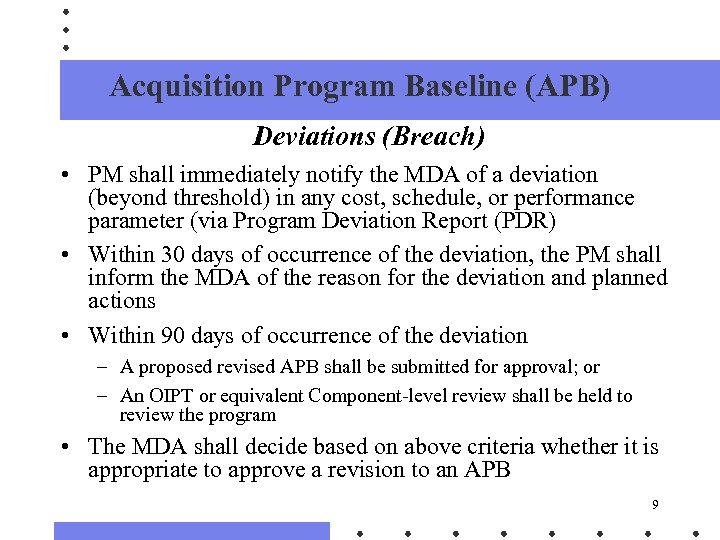
Acquisition Program Baseline (APB) Deviations (Breach) • PM shall immediately notify the MDA of a deviation (beyond threshold) in any cost, schedule, or performance parameter (via Program Deviation Report (PDR) • Within 30 days of occurrence of the deviation, the PM shall inform the MDA of the reason for the deviation and planned actions • Within 90 days of occurrence of the deviation – A proposed revised APB shall be submitted for approval; or – An OIPT or equivalent Component-level review shall be held to review the program • The MDA shall decide based on above criteria whether it is appropriate to approve a revision to an APB 9
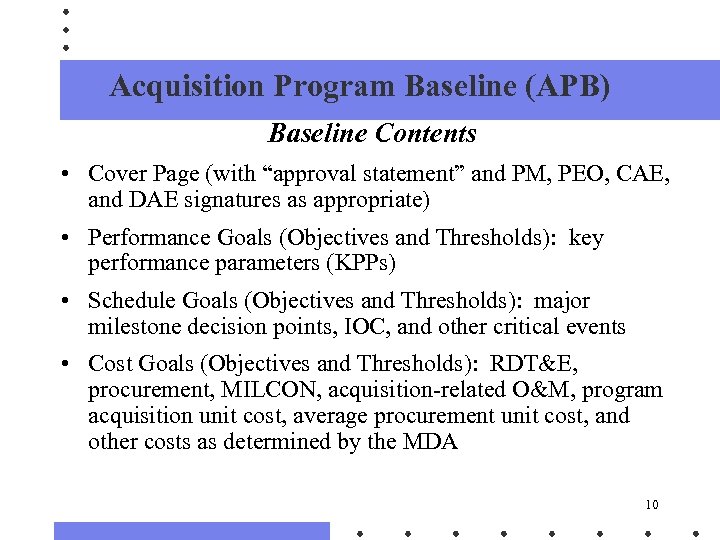
Acquisition Program Baseline (APB) Baseline Contents • Cover Page (with “approval statement” and PM, PEO, CAE, and DAE signatures as appropriate) • Performance Goals (Objectives and Thresholds): key performance parameters (KPPs) • Schedule Goals (Objectives and Thresholds): major milestone decision points, IOC, and other critical events • Cost Goals (Objectives and Thresholds): RDT&E, procurement, MILCON, acquisition-related O&M, program acquisition unit cost, average procurement unit cost, and other costs as determined by the MDA 10
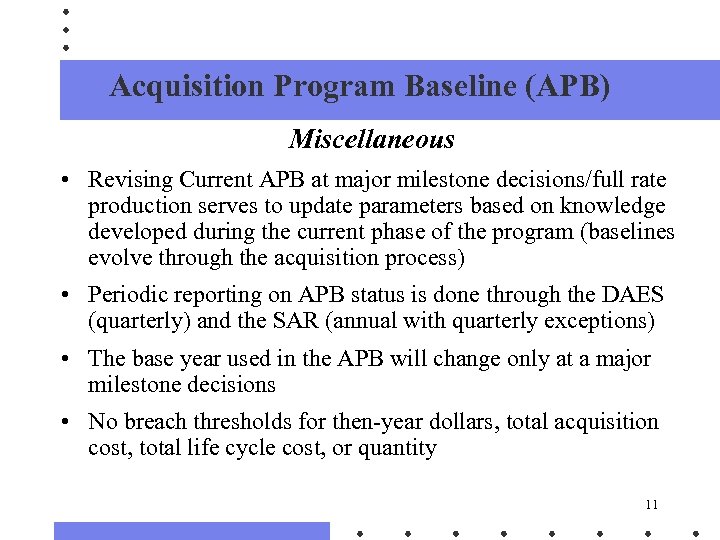
Acquisition Program Baseline (APB) Miscellaneous • Revising Current APB at major milestone decisions/full rate production serves to update parameters based on knowledge developed during the current phase of the program (baselines evolve through the acquisition process) • Periodic reporting on APB status is done through the DAES (quarterly) and the SAR (annual with quarterly exceptions) • The base year used in the APB will change only at a major milestone decisions • No breach thresholds for then-year dollars, total acquisition cost, total life cycle cost, or quantity 11
APB, SAR, and Nunn-Mc. Curdy Status Selected Acquisition Report (SAR) Status 12
Selected Acquisition Report (SAR) Status • Cost, schedule, and performance status on MDAPs required pursuant to 10 USC 2432 • On June 7, 2007, Do. D submitted Section 803 report to Congress with recommended changes to SAR format and content: – Add percent change to Threshold Breach section – Revise Unit Cost Information section (PAUC and APUC table, delete unit cost report and unit cost history sections) – Delete contractor estimated price at completion, “planned” deliveries, and O&S cost element breakout • Implementation of Section 803 changes planned for June 2008 13
Selected Acquisition Report (SAR) Status • December 2007 SAR will be generated using the DAMIR SAR Web Application (classified and unclassified versions)* – Current SAR Baselines (PEs/DEs/Pd. Es) must be broken out into year-by-year flyaway and support components (difficult task) – Current estimate from most recent SAR must be broken out into year-by-year flyaway and support components (some of this information already available) * APB Web Application will be implemented at the same time 14
APB, SAR, and Nunn-Mc. Curdy Status Nunn-Mc. Curdy Unit Cost Reporting Status 15
Nunn-Mc. Curdy Unit Cost Reporting • • Background/Purpose To provide Congressional unit cost reporting for Major Defense Acquisition Programs (MDAPs) Drafted by Senator Nunn in 1982 (Representative Mc. Curdy co-sponsored) Title 10, United States Code, Section 2433 (Unit Cost Reports) and Section 2435 (Baseline Description) Largely unchanged until FY 06 National Defense Authorization Act (NDAA) in January 2006 16
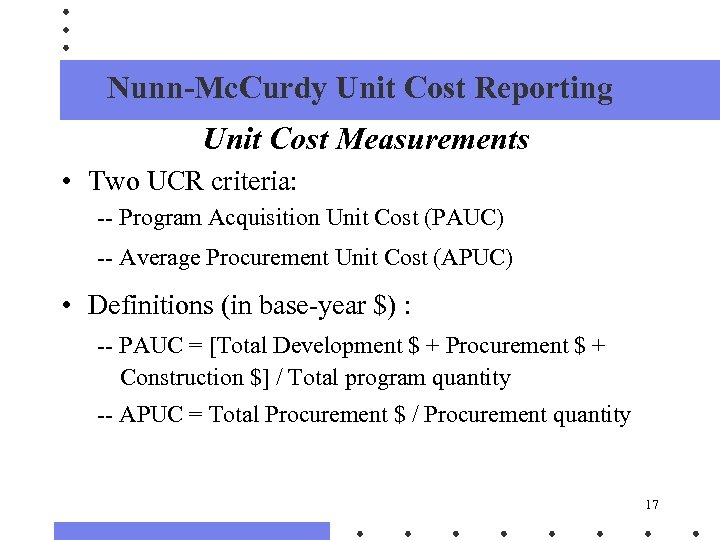
Nunn-Mc. Curdy Unit Cost Reporting Unit Cost Measurements • Two UCR criteria: -- Program Acquisition Unit Cost (PAUC) -- Average Procurement Unit Cost (APUC) • Definitions (in base-year $) : -- PAUC = [Total Development $ + Procurement $ + Construction $] / Total program quantity -- APUC = Total Procurement $ / Procurement quantity 17
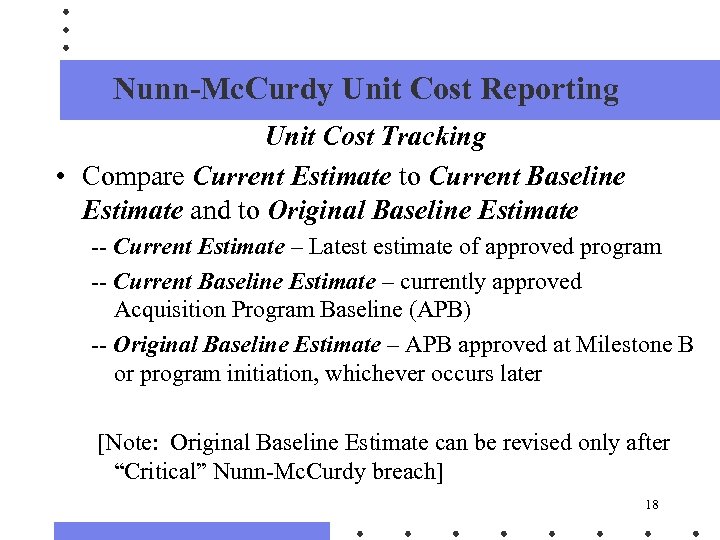
Nunn-Mc. Curdy Unit Cost Reporting Unit Cost Tracking • Compare Current Estimate to Current Baseline Estimate and to Original Baseline Estimate -- Current Estimate – Latest estimate of approved program -- Current Baseline Estimate – currently approved Acquisition Program Baseline (APB) -- Original Baseline Estimate – APB approved at Milestone B or program initiation, whichever occurs later [Note: Original Baseline Estimate can be revised only after “Critical” Nunn-Mc. Curdy breach] 18
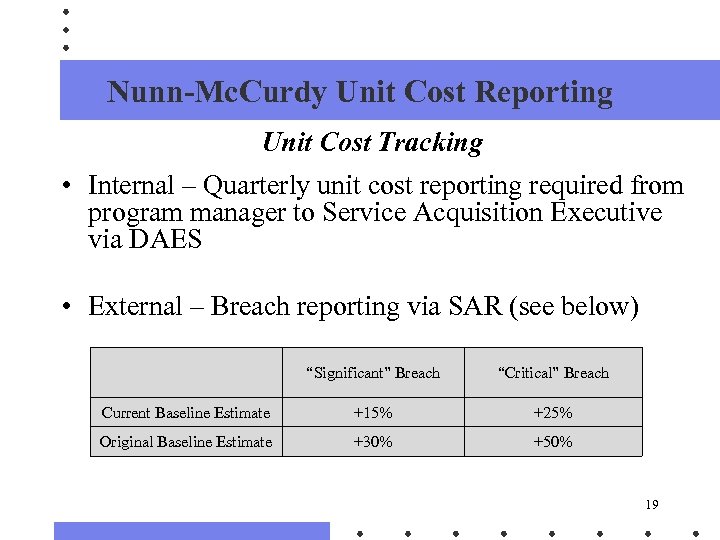
Nunn-Mc. Curdy Unit Cost Reporting Unit Cost Tracking • Internal – Quarterly unit cost reporting required from program manager to Service Acquisition Executive via DAES • External – Breach reporting via SAR (see below) “Significant” Breach “Critical” Breach Current Baseline Estimate +15% +25% Original Baseline Estimate +30% +50% 19
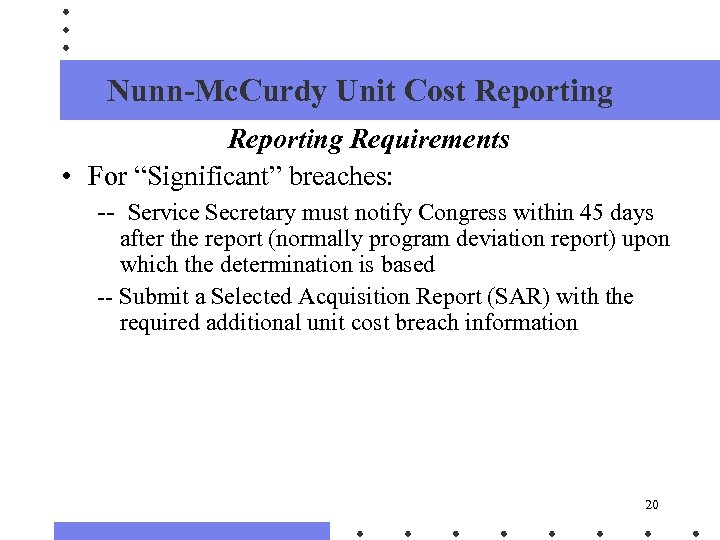
Nunn-Mc. Curdy Unit Cost Reporting Requirements • For “Significant” breaches: -- Service Secretary must notify Congress within 45 days after the report (normally program deviation report) upon which the determination is based -- Submit a Selected Acquisition Report (SAR) with the required additional unit cost breach information 20
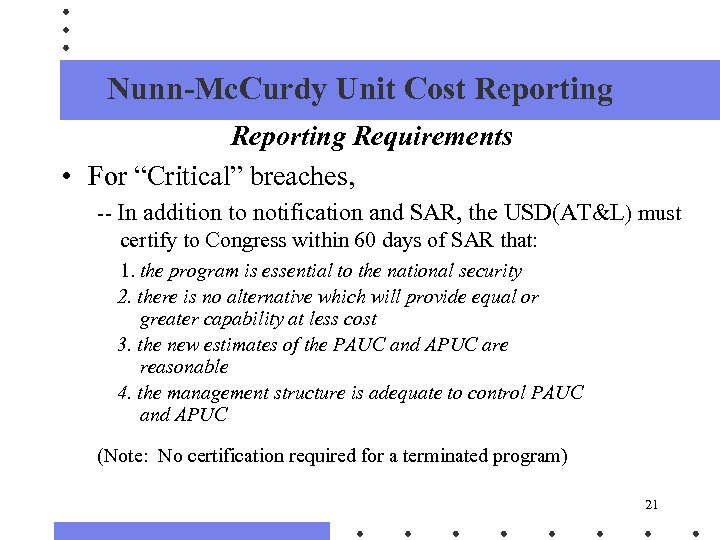
Nunn-Mc. Curdy Unit Cost Reporting Requirements • For “Critical” breaches, -- In addition to notification and SAR, the USD(AT&L) must certify to Congress within 60 days of SAR that: 1. the program is essential to the national security 2. there is no alternative which will provide equal or greater capability at less cost 3. the new estimates of the PAUC and APUC are reasonable 4. the management structure is adequate to control PAUC and APUC (Note: No certification required for a terminated program) 21
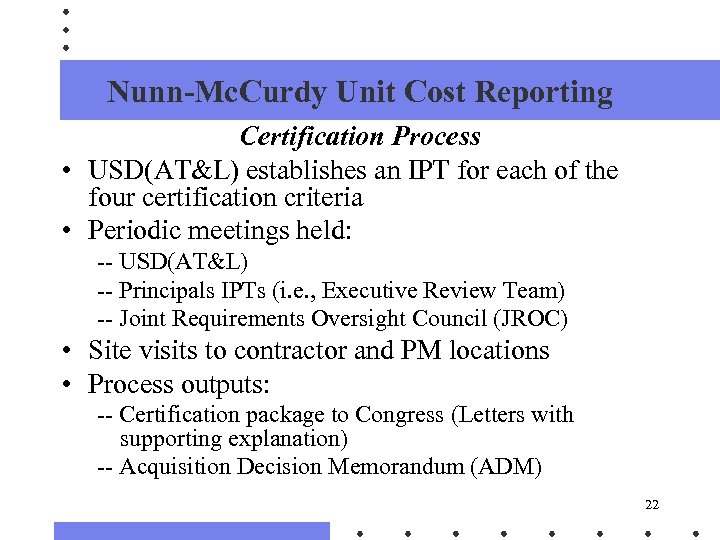
Nunn-Mc. Curdy Unit Cost Reporting Certification Process • USD(AT&L) establishes an IPT for each of the four certification criteria • Periodic meetings held: -- USD(AT&L) -- Principals IPTs (i. e. , Executive Review Team) -- Joint Requirements Oversight Council (JROC) • Site visits to contractor and PM locations • Process outputs: -- Certification package to Congress (Letters with supporting explanation) -- Acquisition Decision Memorandum (ADM) 22
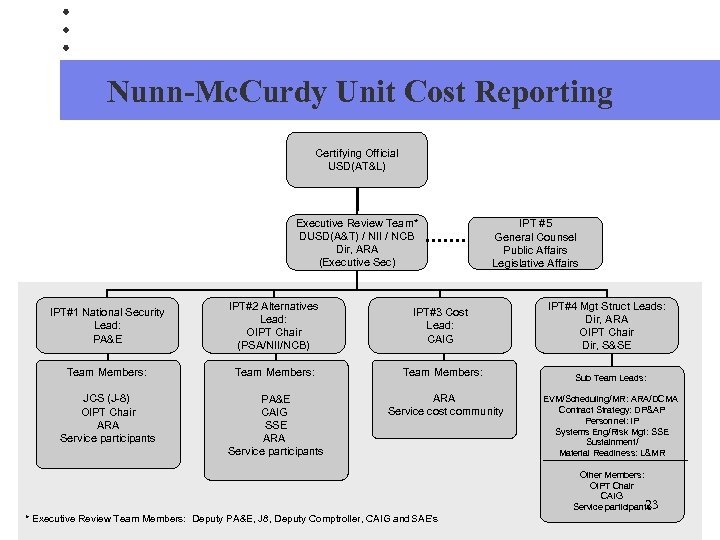
Nunn-Mc. Curdy Unit Cost Reporting Certifying Official USD(AT&L) Executive Review Team* DUSD(A&T) / NII / NCB Dir, ARA (Executive Sec) IPT #5 General Counsel Public Affairs Legislative Affairs IPT#1 National Security Lead: PA&E IPT#2 Alternatives Lead: OIPT Chair (PSA/NII/NCB) IPT#3 Cost Lead: CAIG Team Members: JCS (J-8) OIPT Chair ARA Service participants PA&E CAIG SSE ARA Service participants ARA Service cost community IPT#4 Mgt Struct Leads: Dir, ARA OIPT Chair Dir, S&SE Sub Team Leads: EVM/Scheduling/MR: ARA/DCMA Contract Strategy: DP&AP Personnel: IP Systems Eng/Risk Mgt: SSE Sustainment/ Material Readiness: L&MR Other Members: OIPT Chair CAIG 23 Service participants * Executive Review Team Members: Deputy PA&E, J 8, Deputy Comptroller, CAIG and SAE's
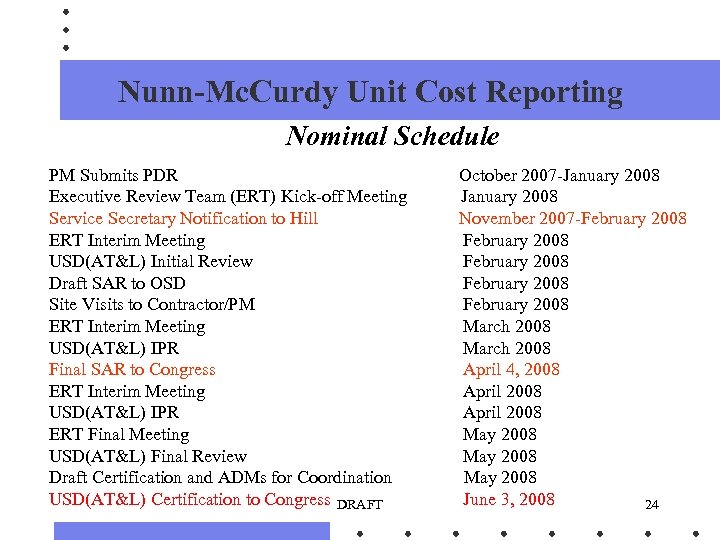
Nunn-Mc. Curdy Unit Cost Reporting Nominal Schedule PM Submits PDR Executive Review Team (ERT) Kick-off Meeting Service Secretary Notification to Hill ERT Interim Meeting USD(AT&L) Initial Review Draft SAR to OSD Site Visits to Contractor/PM ERT Interim Meeting USD(AT&L) IPR Final SAR to Congress ERT Interim Meeting USD(AT&L) IPR ERT Final Meeting USD(AT&L) Final Review Draft Certification and ADMs for Coordination USD(AT&L) Certification to Congress DRAFT October 2007 -January 2008 November 2007 -February 2008 February 2008 March 2008 April 4, 2008 April 2008 May 2008 June 3, 2008 24
Nunn-Mc. Curdy Unit Cost Reporting Penalties • Suspension of Obligations -- If either SAR or certification are not submitted on time, obligational authority suspended on all major contracts -- Suspension shall cease to apply after 30 days of continuous session of Congress (starting from the date of receipt of SAR/certification) 25
Nunn-Mc. Curdy Unit Cost Reporting Anatomy of a Breach • Breaches can occur only to the Current APB or only to the Original APB, but most occur to both • Normally, there are several contributing factors that cause programs to breach: -- Significant reduction in quantity -- Change in requirements since baseline -- Development or production stretchouts -- Technical or performance/reliability issues -- Inadequate estimate at baseline • Most (not all) programs with “Critical” breaches are certified by the USD(AT&L), but the certified program represents a restructuring of the “program of record” 26
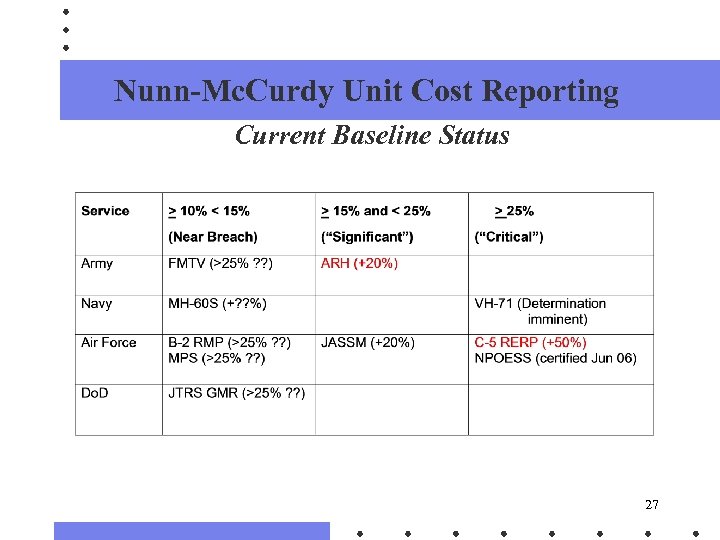
Nunn-Mc. Curdy Unit Cost Reporting Current Baseline Status 27
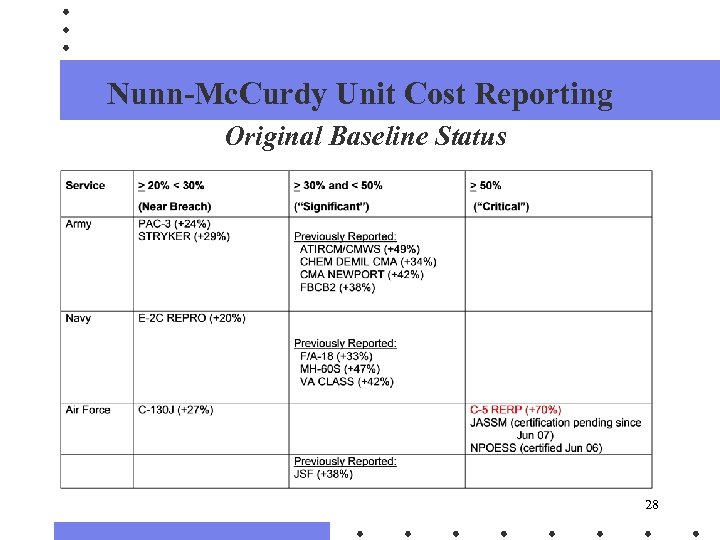
Nunn-Mc. Curdy Unit Cost Reporting Original Baseline Status 28
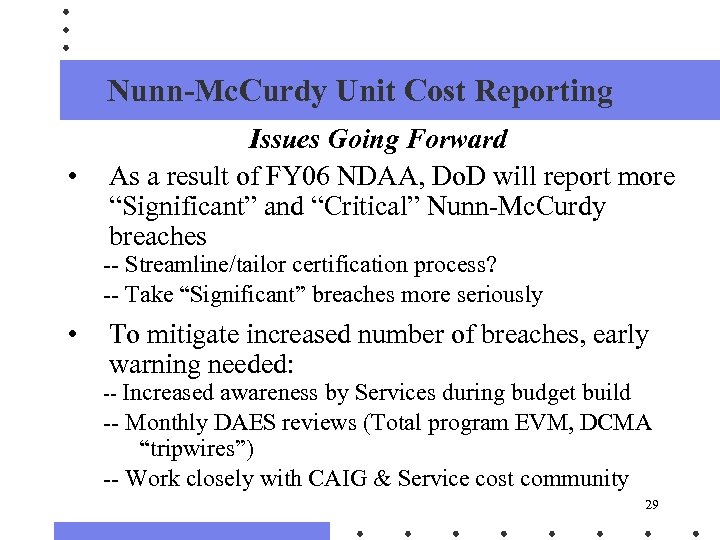
Nunn-Mc. Curdy Unit Cost Reporting • Issues Going Forward As a result of FY 06 NDAA, Do. D will report more “Significant” and “Critical” Nunn-Mc. Curdy breaches -- Streamline/tailor certification process? -- Take “Significant” breaches more seriously • To mitigate increased number of breaches, early warning needed: -- Increased awareness by Services during budget build -- Monthly DAES reviews (Total program EVM, DCMA “tripwires”) -- Work closely with CAIG & Service cost community 29
Скачать презентацию APB SAR and Nunn-Mc Curdy Status DAMIR Conference
1295177a816d11b64c4f5e7dc8a4034f.ppt