 Скачать презентацию APAC National Grid and Trying to be all
34d0e11ddc638f22efc91ac65958b4e0.ppt
- Количество слайдов: 15



APAC National Grid and Trying to be all Things to all Users … Lindsay Hood Australian Partnership for Advanced Computing www. apac. edu. au lindsay. hood@apac. edu. au
Australian Partnership for Advanced Computing “providing national advanced computing, data management and grid services for e. Research” Partners: • Australian Centre for Advanced Computing and Communications (ac 3) in NSW • CSIRO • i. VEC, The Hub of Advanced Computing in Western Australia • Queensland Cyber Infrastructure Foundation (QCIF) • South Australian Partnership for Advanced Computing (SAPAC) • The Australian National University (ANU) • The University of Tasmania (TPAC) • Victorian Partnership for Advanced Computing (VPAC) 4500 CPUs, 3 PB storage
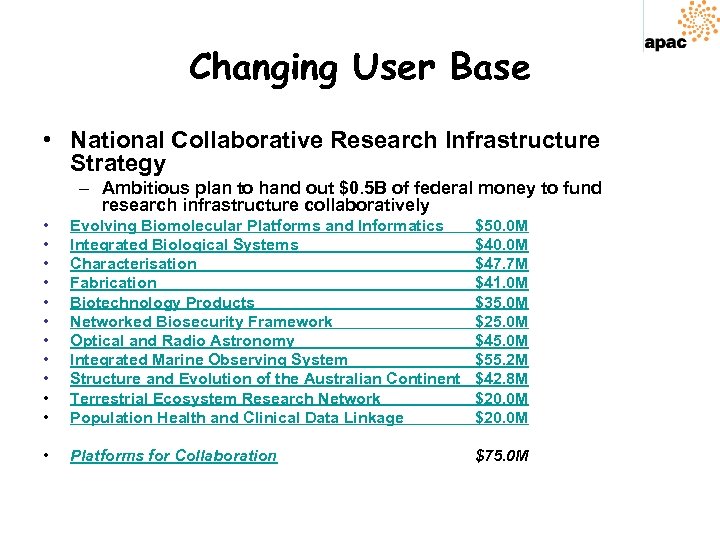
Changing User Base • National Collaborative Research Infrastructure Strategy – Ambitious plan to hand out $0. 5 B of federal money to fund research infrastructure collaboratively • • • Evolving Biomolecular Platforms and Informatics Integrated Biological Systems Characterisation Fabrication Biotechnology Products Networked Biosecurity Framework Optical and Radio Astronomy Integrated Marine Observing System Structure and Evolution of the Australian Continent Terrestrial Ecosystem Research Network Population Health and Clinical Data Linkage $50. 0 M $47. 7 M $41. 0 M $35. 0 M $25. 0 M $45. 0 M $55. 2 M $42. 8 M $20. 0 M • Platforms for Collaboration $75. 0 M
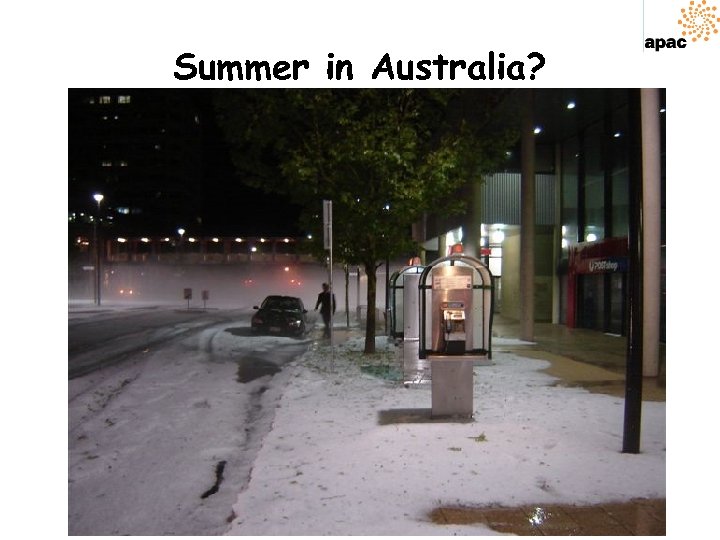
Summer in Australia?
Recent Review APAC in the future must be regarded not just as the National Facility, but as the sum of its component parts comprising: […] The National Grid […] That the APAC National Grid must be the pre-eminent grid in Australia and continue extending its coverage to include capabilities wherever they exist or develop. It must also nurture and support scientific research teams, NCRIS infrastructure and international partnerships
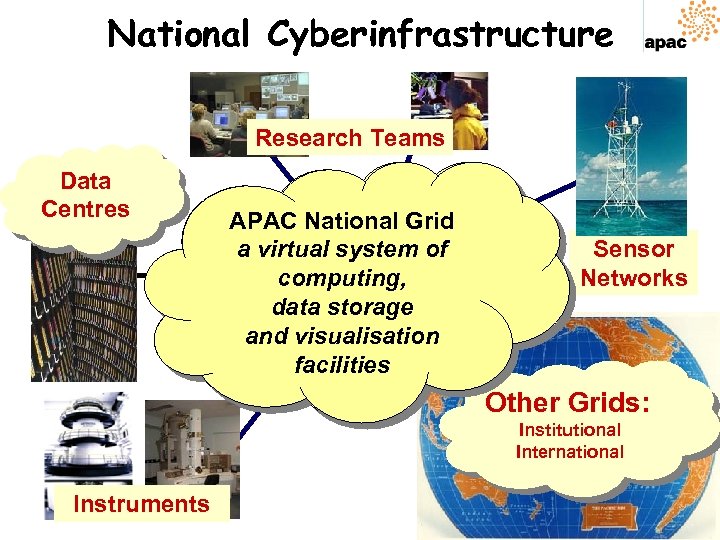
National Cyberinfrastructure Research Teams Data Centres QPSF IVEC APAC National ac 3 Grid a virtual system of APAC ANU NATIONAL SAPAC computing, data FACILITY storage and visualisation CSIRO TPAC facilities VPAC Sensor Networks Other Grids: Institutional International Instruments
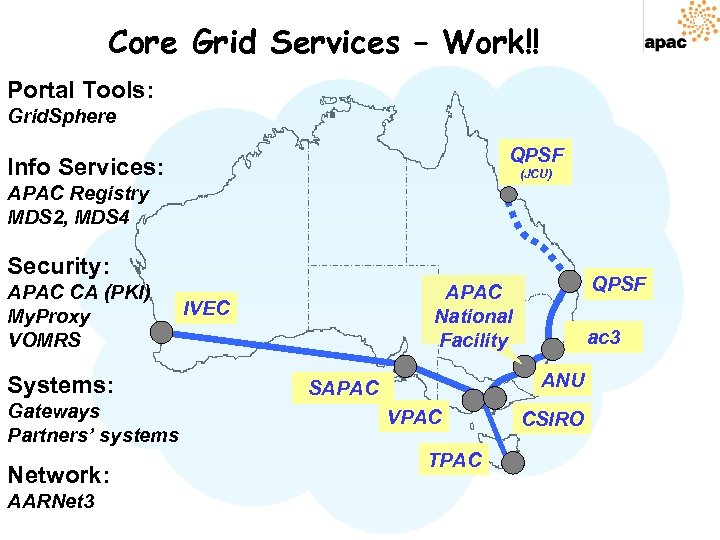
Core Grid Services – Work!! Portal Tools: Grid. Sphere QPSF Info Services: (JCU) APAC Registry MDS 2, MDS 4 Security: APAC CA (PKI) My. Proxy VOMRS Systems: Gateways Partners’ systems Network: AARNet 3 QPSF APAC National Facility IVEC ac 3 ANU SAPAC VPAC TPAC CSIRO
Gateways • Rapid churn in the middleware – You need lots of test machines • Different communities want different middleware – GT 2, GT 4, Gridsphere, SRB … • Minimises interaction with non griddedicated production systems • Virtualisation is well understood technology • Xen has a nice price
Middleware Stack • We’re using VDT – For both GT 2 and GT 4 – Inclusion of VOMS/VOMRS/GUMS is nice • Actively doing QA, and finding and reporting several bugs • Add portal and data components to core VDT for other gateways – SRB, Grid. Sphere • Java tool Grix for simplified certificate management by users – APAC has IGTF-audited CA
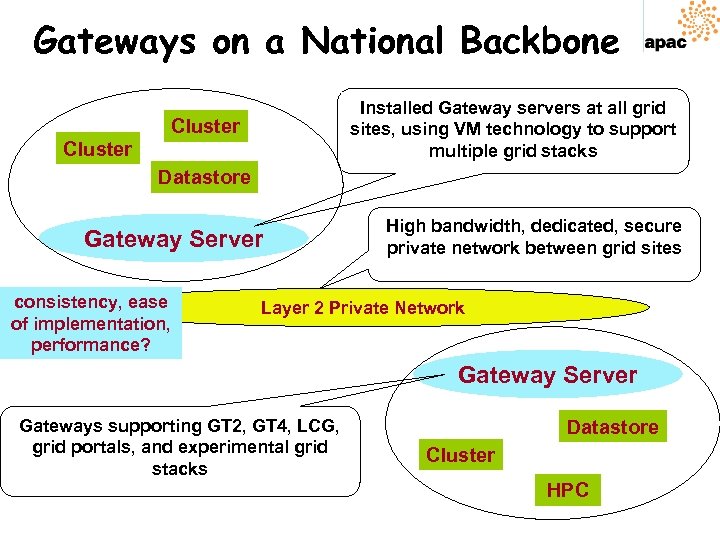
Gateways on a National Backbone Installed Gateway servers at all grid sites, using VM technology to support multiple grid stacks Cluster Datastore Gateway Server consistency, ease of implementation, performance? High bandwidth, dedicated, secure private network between grid sites Layer 2 Private Network Gateway Server Gateways supporting GT 2, GT 4, LCG, grid portals, and experimental grid stacks Datastore Cluster HPC
Data services • Data is hard – Different communities have different needs – Complex access controls • We have gridftp between sites – Network consistency is interesting … • SRB today; i. RODS later this year • Dcache, SRM, Gfarm as communities require • Credible use cases for a global file system?
Registry services • MDS 2, MDS 4 running • Deployed Modular Information Provider to present site and aggregated information more easily • Using GLUE schema, but it’s far from satisfactory for describing real-world production HPC resources
Improved AAA Services • NCRIS will require e-research services to a much wider community than traditional HPC – PKI doesn’t scale and is conceptually difficult for non computer weenies • Australian Access Federation funded • IAM Suite from MELCOE – Shibboleth authentication plus appropriate attributes generates short lived certificate – Tools for users to easily create shared workspaces and manage attribute release • Only a few people will need real certificates • But a year or two before being ready for prime time
Future Strategies • Expand the user base – NCRIS, Merit Allocation Scheme, Partners – Open access to core grid services • Expand the services – Workflow engines and tools – Kepler, Taverna – Data management: metadata support, collections registry • Expand the facilities – Include major data centres • data from instruments, government agencies – Include institutional systems and repositories • Resulting changes: – – Policies: acceptable service provision Organisation: coordinated user support Architecture: scaling gateways Technologies: Attribute-based authorisation
Скачать презентацию APAC National Grid and Trying to be all
34d0e11ddc638f22efc91ac65958b4e0.ppt