


 Скачать презентацию AP US History Students of History —
60be8aa939120cbc3cd0b9061cba1358.ppt
- Количество слайдов: 27
 AP US History © Students of History - http: //www. teacherspayteachers. com/Store/Students-Of-History
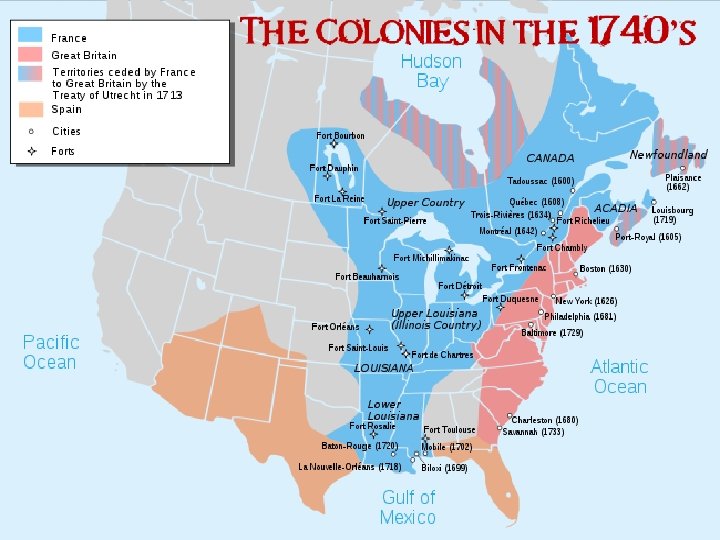
 Colonial Clashes The Ohio Valley became the main bone of contention between the British and French Critical area into which the westward- pushing British colonists would inevitably penetrate George Washington and other speculators secured legal “rights” to some 500, 000 acres in the Ohio Valley region At the same time, the French were constructing forts along the Ohio River Summer of 1754 To secure Virginia’s claims, Washington was sent to the Ohio country Clashes at the French Fort Duquesne and Washington’s Fort Necessity lukerosa@gmail. com
 French and Indian War The colonial version of the Seven Years’ War in Europe (1756 -1763) & first major “World War” Started by Washington in the Ohio Valley British and Iroquois vs. French and Algonquians British Gen. Braddock commands troops and sets out for Ft. Duquesne Moved slowly with its heavy artillery Had to hack out a path through the dense woods Braddock was defeated French/Indian victory led to Indian attacks against the frontier (from Pennsylvania to North Carolina)
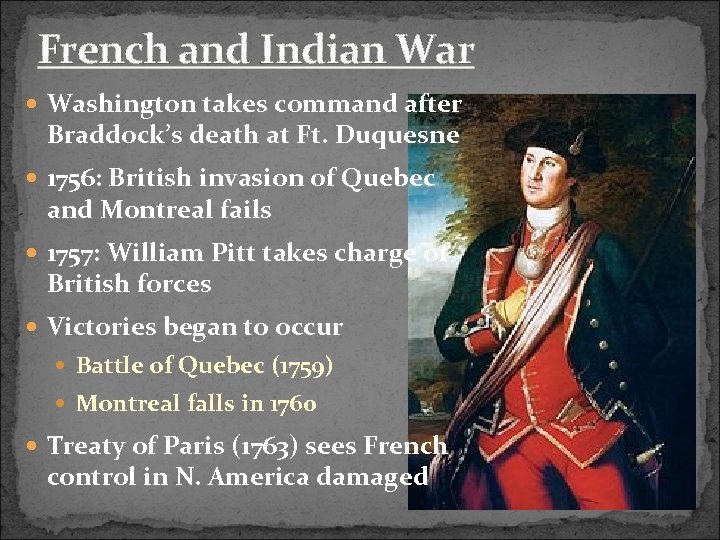 French and Indian War Washington takes command after Braddock’s death at Ft. Duquesne 1756: British invasion of Quebec and Montreal fails 1757: William Pitt takes charge of British forces Victories began to occur Battle of Quebec (1759) Montreal falls in 1760 Treaty of Paris (1763) sees French control in N. America damaged
 Post French-Indian War For the first time in 50 years, England was at peace Yet they had accumulated a massive amount of debt fighting all of these wars Increased taxation of the colonies was seen as justified After all, the British felt, many of these wars had been fought in the interest of protecting the colonies
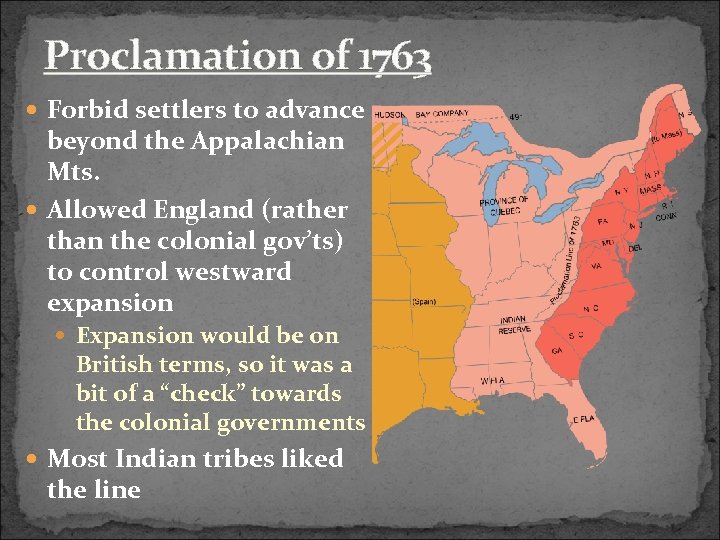 Proclamation of 1763 Forbid settlers to advance beyond the Appalachian Mts. Allowed England (rather than the colonial gov’ts) to control westward expansion Expansion would be on British terms, so it was a bit of a “check” towards the colonial governments Most Indian tribes liked the line
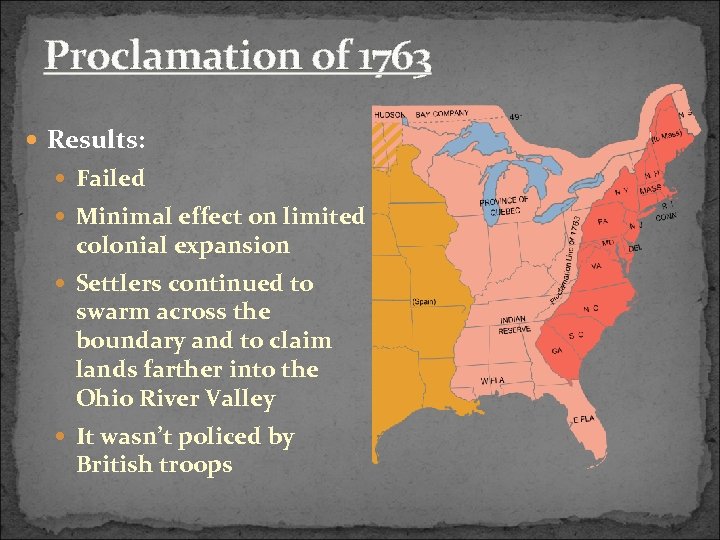 Proclamation of 1763 Results: Failed Minimal effect on limited colonial expansion Settlers continued to swarm across the boundary and to claim lands farther into the Ohio River Valley It wasn’t policed by British troops
 Sugar Act (1764) Designed to eliminate the illegal sugar trade between the colonists and the French/Spanish West Indies Strengthened enforcement on sugar, while lowering the duty on molasses, damaging the sugar grown in the colonies try smugglers lukerosa@gmail. com Established courts in America to
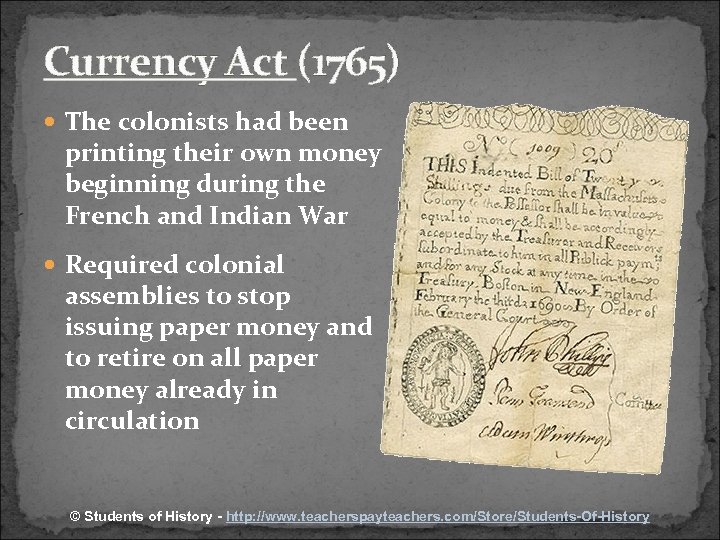 Currency Act (1765) The colonists had been printing their own money beginning during the French and Indian War Required colonial assemblies to stop issuing paper money and to retire on all paper money already in circulation © Students of History - http: //www. teacherspayteachers. com/Store/Students-Of-History
 Colonial Response to Acts Resented the new imperial regulations But, they continued to be at odds with one another, as well Tensions between the established societies of the Atlantic coast and the “backcountry” Paxton Boys: descended on Philadelphia with demands for tax relief; threatened bloodshed Regulator Movement: North Carolina; farmers of the Carolina upcountry who were opposed to higher taxes 2, 000 regulators took on the governor’s forces in a virtual civil war
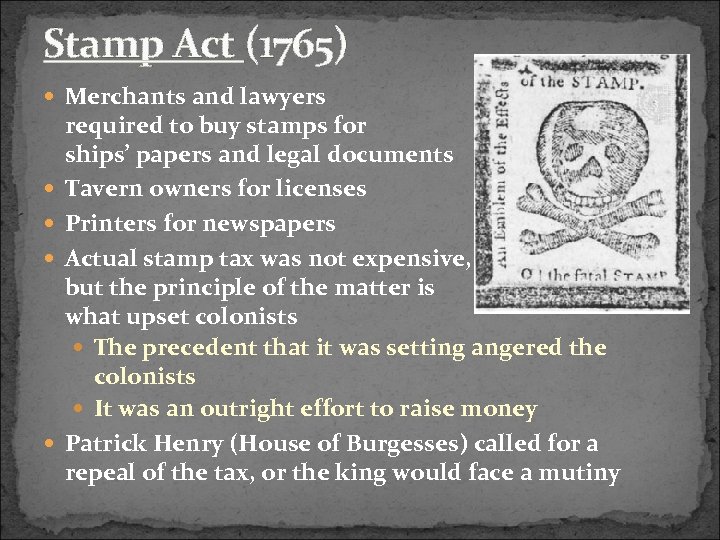 Stamp Act (1765) Merchants and lawyers required to buy stamps for ships’ papers and legal documents Tavern owners for licenses Printers for newspapers Actual stamp tax was not expensive, but the principle of the matter is what upset colonists The precedent that it was setting angered the colonists It was an outright effort to raise money Patrick Henry (House of Burgesses) called for a repeal of the tax, or the king would face a mutiny
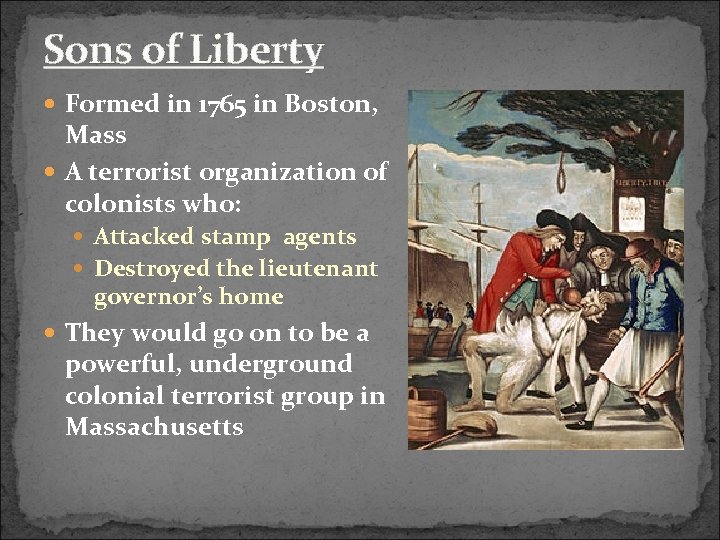 Sons of Liberty Formed in 1765 in Boston, Mass A terrorist organization of colonists who: Attacked stamp agents Destroyed the lieutenant governor’s home They would go on to be a powerful, underground colonial terrorist group in Massachusetts
 Townshend Acts Charles Townshend was the new exchequer (British treasury secretary) Enacted: Quartering (Mutiny) Act of 1765 Required colonists to provide quarters and supplies for British troops in America It was the providing of supplies, not the quartering, that angered colonists the most Townshend Duties Taxes on imports from GBR (lead, paint, paper, tea) Townshend called them “external taxes” Call them what you want, they had the same effect as a direct tax
 Response to the Townshend Acts/Duties In 1767, the Massachusetts Assembly circulates a letter of opposition Has little effect until the British circulate a letter denouncing those who support the Assembly’s idea to stand up against every tax Now people were taking notice of the Assembly’s letter! Assembly votes 92 -17 affirming their letter Boycotts in Boston, New York, and Philadelphia against British goods subject to the Townshend duties Townshend dies suddenly; his replacement repeals the duties
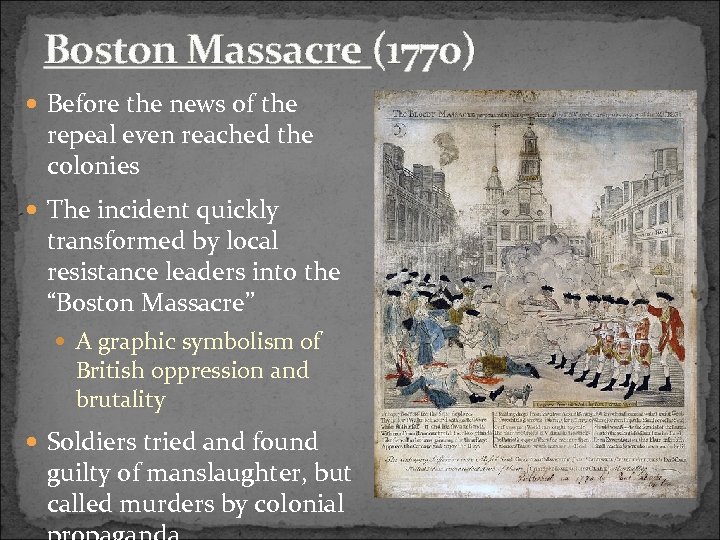 Boston Massacre (1770) Before the news of the repeal even reached the colonies The incident quickly transformed by local resistance leaders into the “Boston Massacre” A graphic symbolism of British oppression and brutality Soldiers tried and found guilty of manslaughter, but called murders by colonial
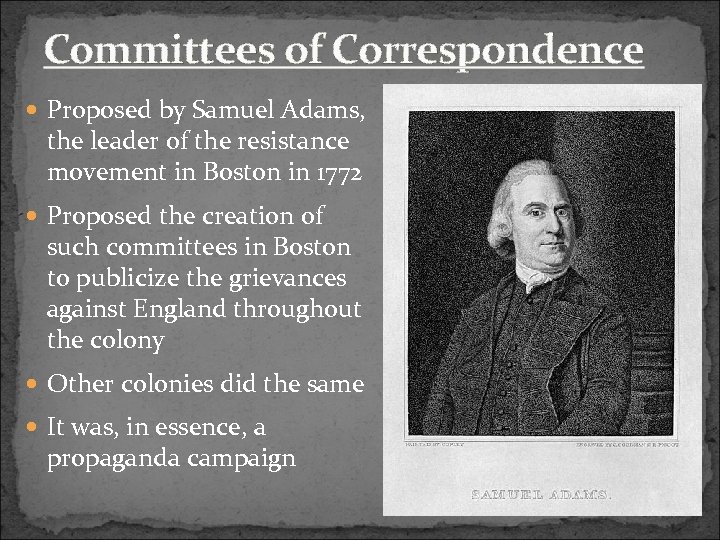 Committees of Correspondence Proposed by Samuel Adams, the leader of the resistance movement in Boston in 1772 Proposed the creation of such committees in Boston to publicize the grievances against England throughout the colony Other colonies did the same It was, in essence, a propaganda campaign
 The Psychology of Revolt Gradually, a revolutionary outlook had gained a following Where did the ideas for revolution come from? Religious: Puritans had left England; this provided inspiration to separate from England Foreign: English Whigs stood up against the Tories in England Political: Enlightenment ideas; a new concept of what gov’t should be Such arguments found little sympathy in the English
 The Psychology of Revolt No taxation without representation Virtual (vs) Actual Representation Where does ultimate power lay? Colonists argued: Parliament can legislate for England for the empire as a whole, but colonial assemblies could legislate for individual colonies English argued: In any system of gov’t, there must be an ultimate authority Since the empire is a single, undivided unit, there could be only one authority within it~ the King and Parliament
 Tea Act (1773) The early 1770 s was pretty quiet, though it disguised growing resentment Customs commissioners were increasingly intrusive Pamphlets, leaflets, and books kept revolutionary sentiment alive As of 1773, the British East India Company was on the verge of bankruptcy The Tea Act was an attempt to save the company Gave the company the right to export tea directly to the colonies without paying any of the navigation taxes that were imposed on colonial merchants With this, the British company would be underselling the American companies in effect
 Tea Act (1773) The British had assumed the colonists would like the act, as it would lower the cost of tea But resistance leaders argued that it was another example of the results of an unconstitutional tax boycott of tea by many The boycott was quite effective as a mobilizing revolutionary force It linked colonies together through a common experience Colonial women (as the principal consumers) were now leaders in the effort of the boycott
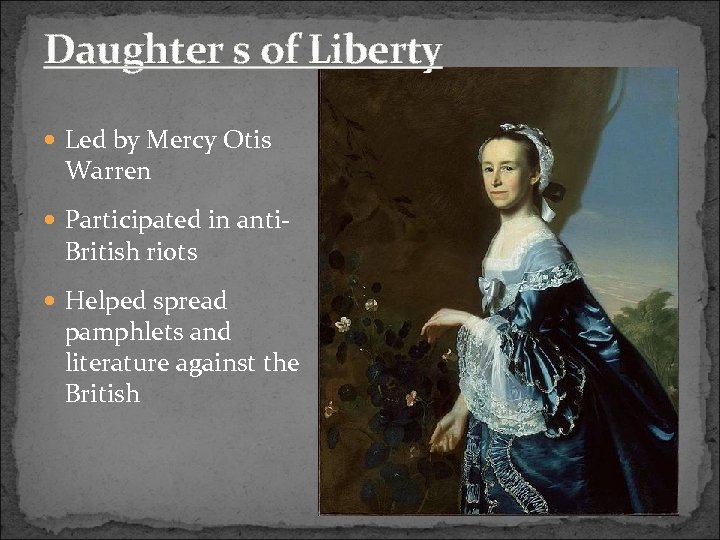 Daughter s of Liberty Led by Mercy Otis Warren Participated in anti- British riots Helped spread pamphlets and literature against the British
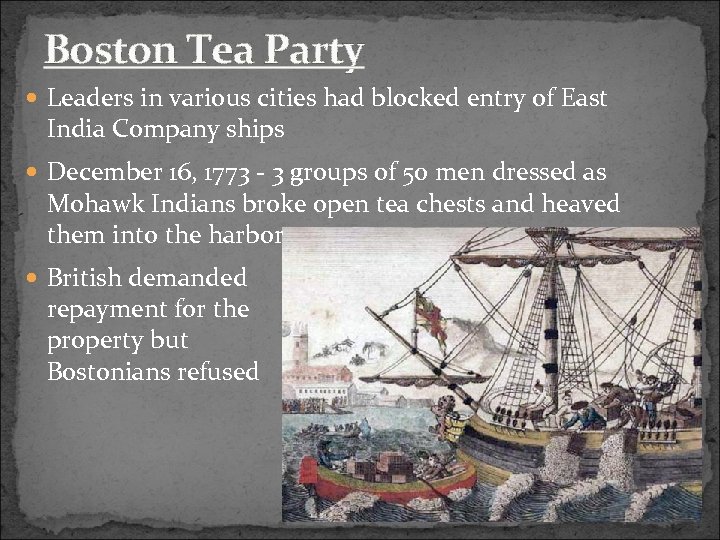 Boston Tea Party Leaders in various cities had blocked entry of East India Company ships December 16, 1773 - 3 groups of 50 men dressed as Mohawk Indians broke open tea chests and heaved them into the harbor British demanded repayment for the property but Bostonians refused
 Intolerable (Coercive) Acts In response to the Boston Tea Party The acts: 1. 2. 3. 4. Closed the port of Boston Reduced their self-government autonomy Those accused of crimes now had to be tried in England Must quarter troops These acts made the inhabitants of Massachusetts a martyr to the other colonies Sparked new resistance throughout the colonies
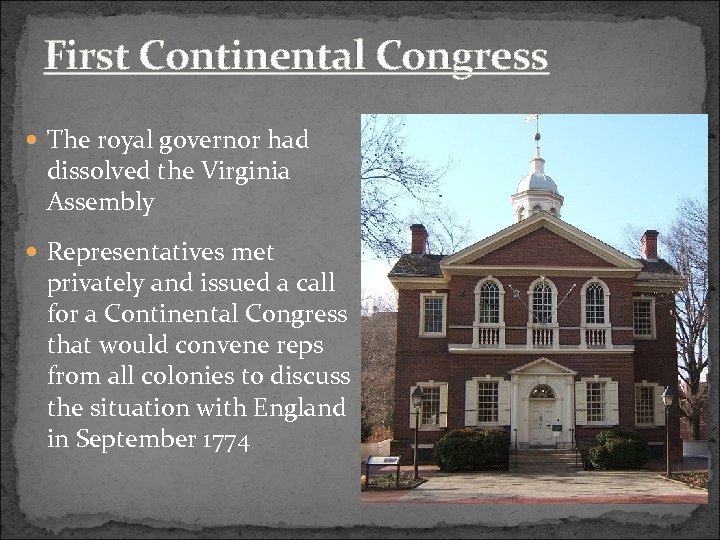 First Continental Congress The royal governor had dissolved the Virginia Assembly Representatives met privately and issued a call for a Continental Congress that would convene reps from all colonies to discuss the situation with England in September 1774
 First Continental Congress Representatives from all colonies (except Georgia) convened in Philadelphia Made 4 major decisions 1. 2. 3. 4. Rejected a plan for a colonial union under British authority Endorsed a statement of grievances reflecting the conflicts among the delegates Resolutions recommending that the colonists make military preparations for defense against an attack by the British Agreed to non-importation, non-exportation, and non -consumptions as a means of stopping all trade with England
 First Continental Congress Through their reps, the colonies had reaffirmed their autonomous status within the empire and declared something close to economic war © Students of History - http: //www. teacherspayteachers. com/Store/Students-Of-History