


 Скачать презентацию AP Physics Part I Mechanics A Kinematics in
aaab2a75d54f48c1608d3c7bc76df340.ppt
- Количество слайдов: 38
 AP Physics Part I: Mechanics A. Kinematics in One Dimension
 Mechanics – how & why objects move Kinematics: the description of how objects move
 Position, Distance, & Displacement a. b. Distance: total length of travel Displacement: change in position Let’s say a runner jogs a lap around a 100 -meter track. He returns back to where he started in 4 minutes. a. What distance did he travel? b. What was his displacement?
 b. Displacement Our Very First Formula! Isn’t this exciting? Displacement: Δx = xf – xi , Where Δx = change in position, or displacement, xf = final position, and xi = initial position *Displacement is directionally dependent! You CAN have negative displacement!
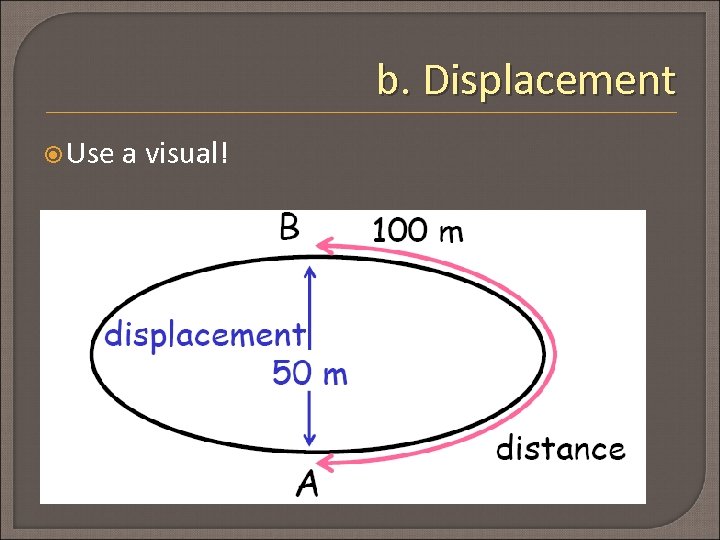 b. Displacement Use a visual!
 Practice Does the odometer in your car measure distance or displacement? Can you think of a situation where it would measure both?
 More Practice A particle moves from x = 1. 0 m to x = -1. 0 m. What is the distance? Displacement?
 Last One You are driving around a circular track with a diameter of 40 m. You drive around 2 ½ times. How far have you driven? What is your displacement?
 1 -D Kinematics Speed & Velocity
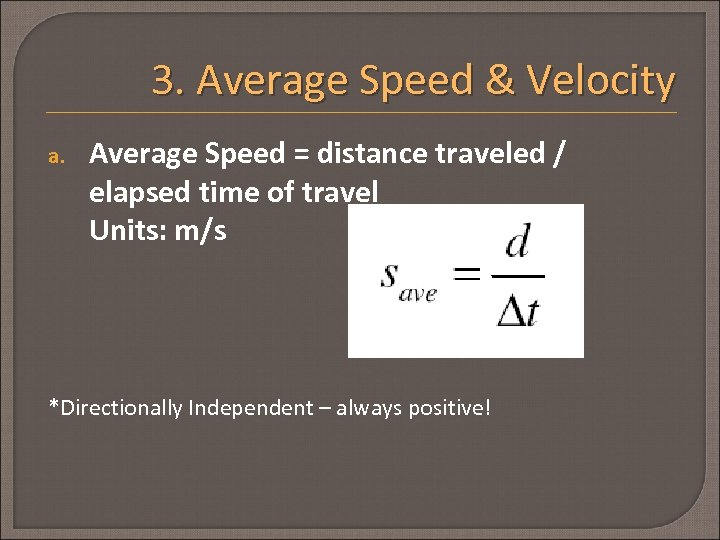 3. Average Speed & Velocity a. Average Speed = distance traveled / elapsed time of travel Units: m/s *Directionally Independent – always positive!
 Average Speed You nose out another runner to win the 100. 000 m dash. If your total time for the race was 11. 800 s and you aced out the other runner by 0. 001 s, by how many meters did you win?
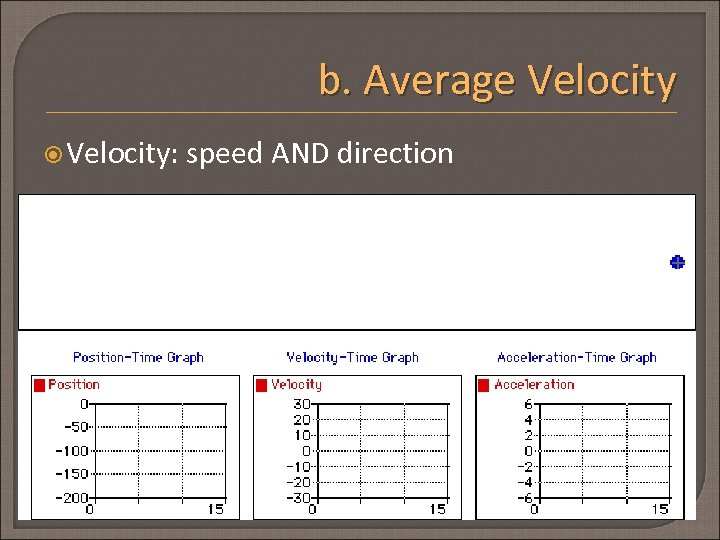 b. Average Velocity: speed AND direction
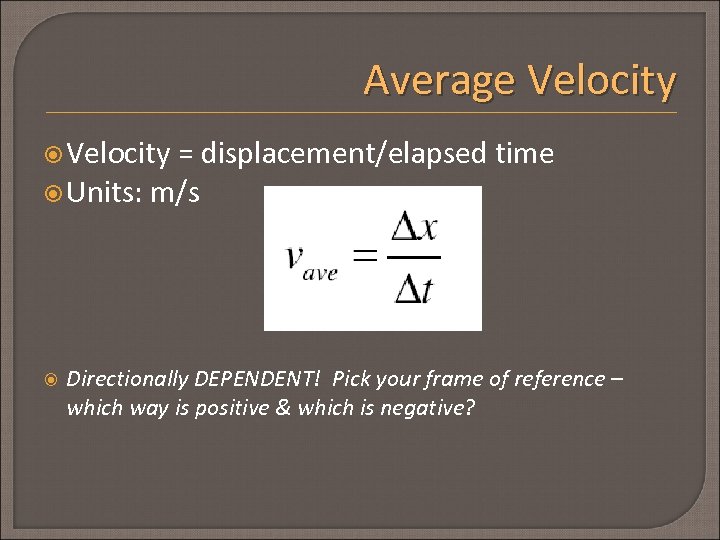 Average Velocity = displacement/elapsed time Units: m/s Directionally DEPENDENT! Pick your frame of reference – which way is positive & which is negative?
 Average Velocity Your friend Marsha lives 0. 55 km east of your house. The nearest grocery store is 0. 82 km west of your house. You walk from your house to the grocery store for some soda. It takes you 17 minutes to get there, and you spend 3 minutes in the store. Then, in 12 minutes, you walk from the grocery store over to Marsha’s house. Find the distance you traveled, your displacement, your average speed, and your average velocity.
 c. Graphing Position vs. Time Graph position vs. time for your trip to the grocery store & Marsha’s house. The slope of the line along each interval shows your velocity!
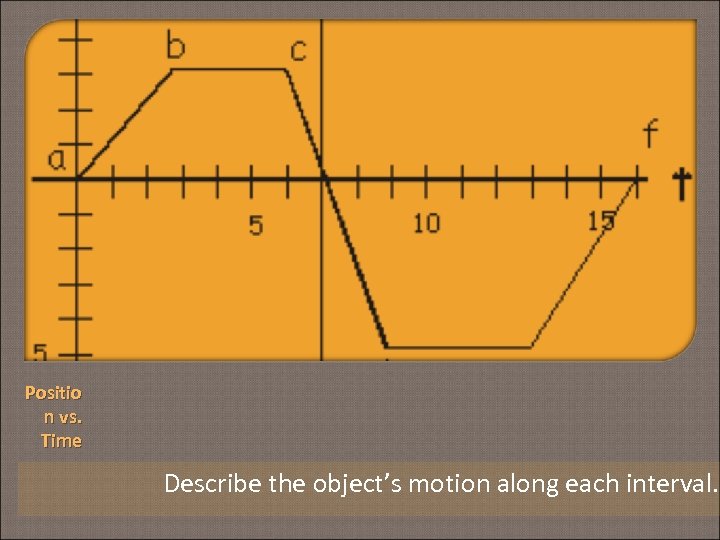 Positio n vs. Time Describe the object’s motion along each interval.
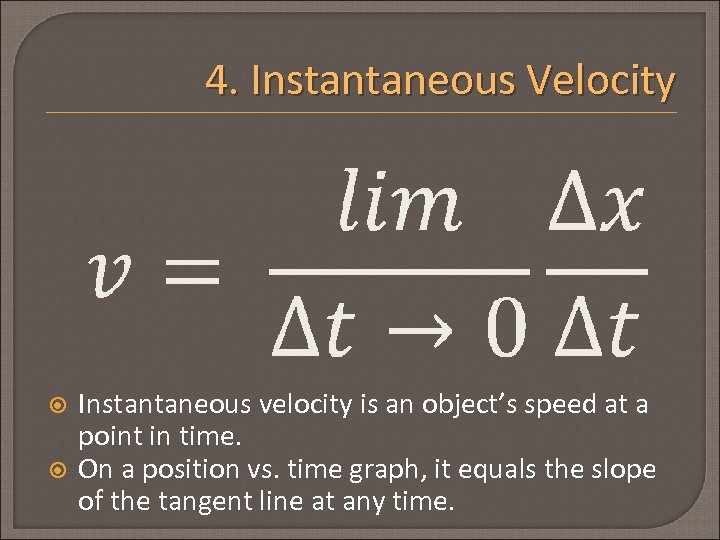 4. Instantaneous Velocity Instantaneous velocity is an object’s speed at a point in time. On a position vs. time graph, it equals the slope of the tangent line at any time.
 Graphing Position and Velocity
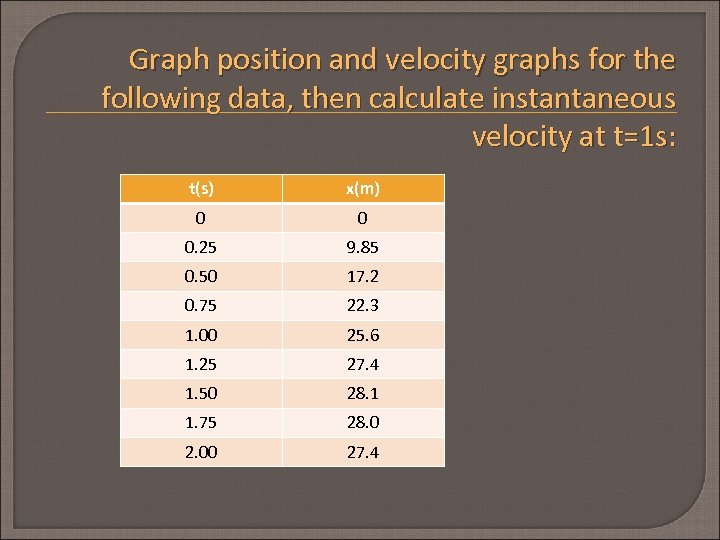 Graph position and velocity graphs for the following data, then calculate instantaneous velocity at t=1 s: t(s) x(m) 0 0 0. 25 9. 85 0. 50 17. 2 0. 75 22. 3 1. 00 25. 6 1. 25 27. 4 1. 50 28. 1 1. 75 28. 0 2. 00 27. 4
 1 -D Kinematics Acceleration
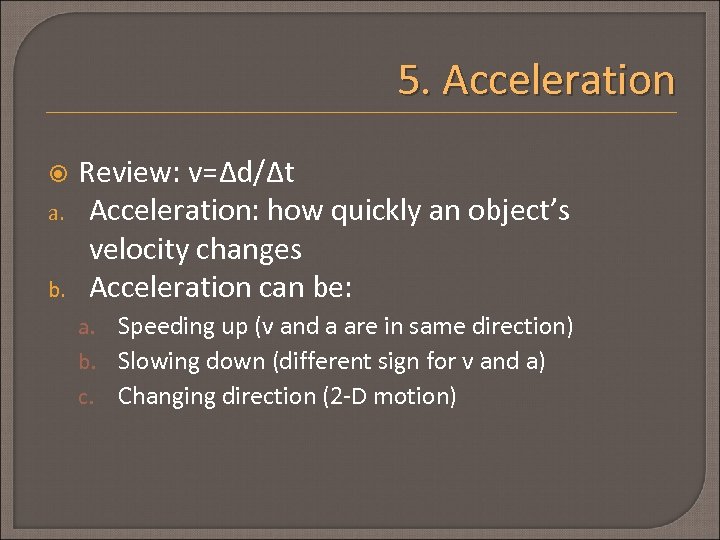 5. Acceleration a. b. Review: v=Δd/Δt Acceleration: how quickly an object’s velocity changes Acceleration can be: a. Speeding up (v and a are in same direction) b. Slowing down (different sign for v and a) c. Changing direction (2 -D motion)
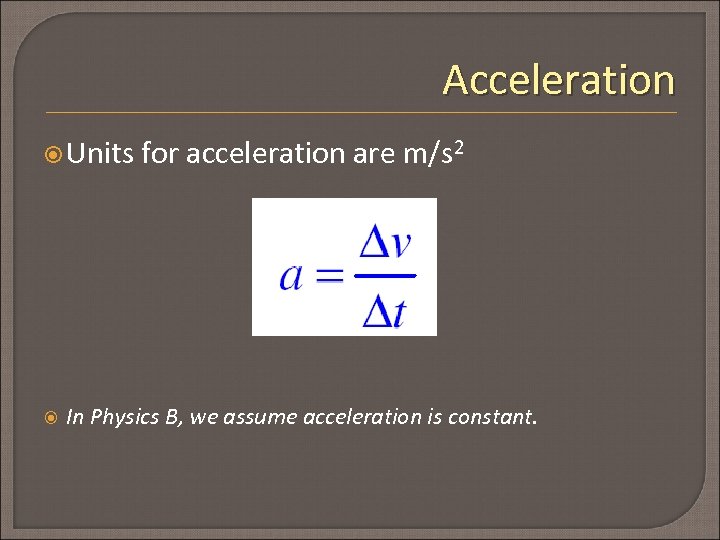 Acceleration Units for acceleration are m/s 2 In Physics B, we assume acceleration is constant.
 Acceleration Saab advertises a car that goes from 0 to 60. 0 mi/h in 6. 2 s. What is the average acceleration of this car? An airplane has an average acceleration of 5. 6 m/s 2 during takeoff. How long does it take for the plane to reach a speed of 150 mi/h?
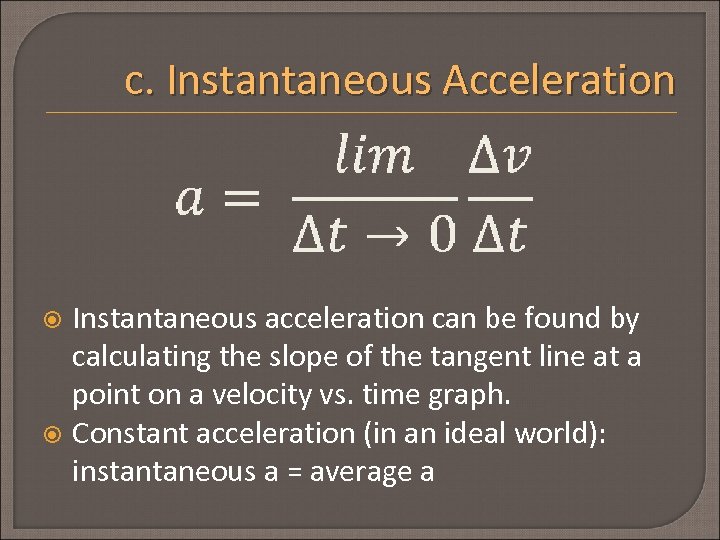 c. Instantaneous Acceleration Instantaneous acceleration can be found by calculating the slope of the tangent line at a point on a velocity vs. time graph. Constant acceleration (in an ideal world): instantaneous a = average a
 Kinematics Kinematic Equations
 Kinematic Equations
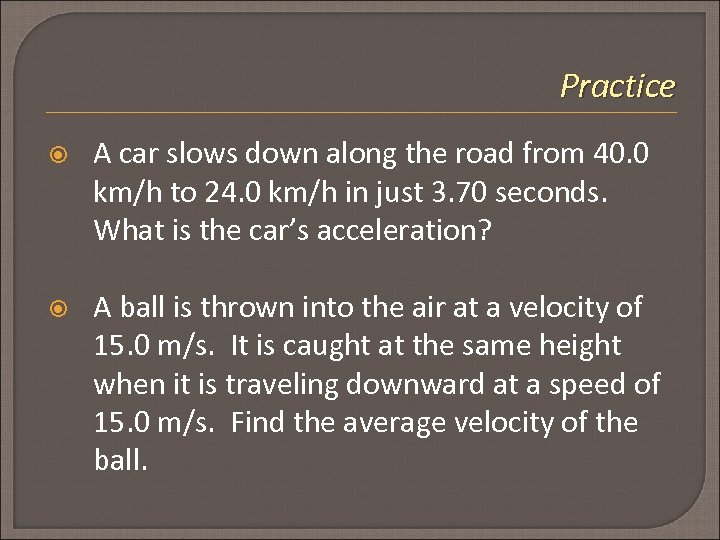 Practice A car slows down along the road from 40. 0 km/h to 24. 0 km/h in just 3. 70 seconds. What is the car’s acceleration? A ball is thrown into the air at a velocity of 15. 0 m/s. It is caught at the same height when it is traveling downward at a speed of 15. 0 m/s. Find the average velocity of the ball.
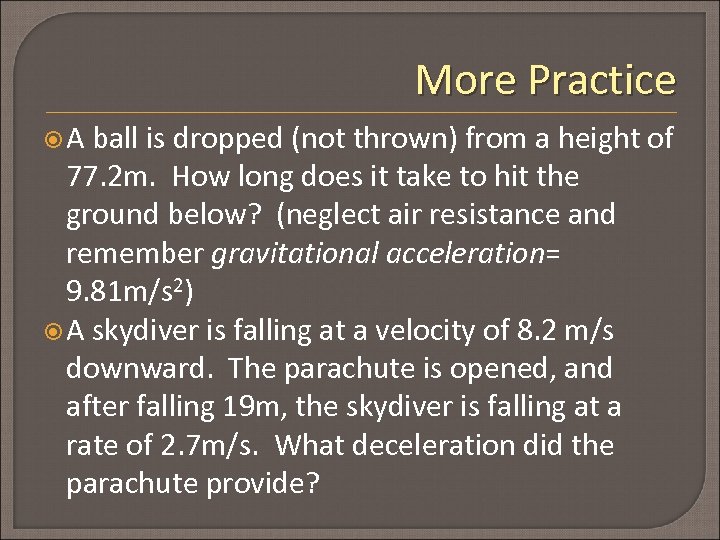 More Practice A ball is dropped (not thrown) from a height of 77. 2 m. How long does it take to hit the ground below? (neglect air resistance and remember gravitational acceleration= 9. 81 m/s 2) A skydiver is falling at a velocity of 8. 2 m/s downward. The parachute is opened, and after falling 19 m, the skydiver is falling at a rate of 2. 7 m/s. What deceleration did the parachute provide?
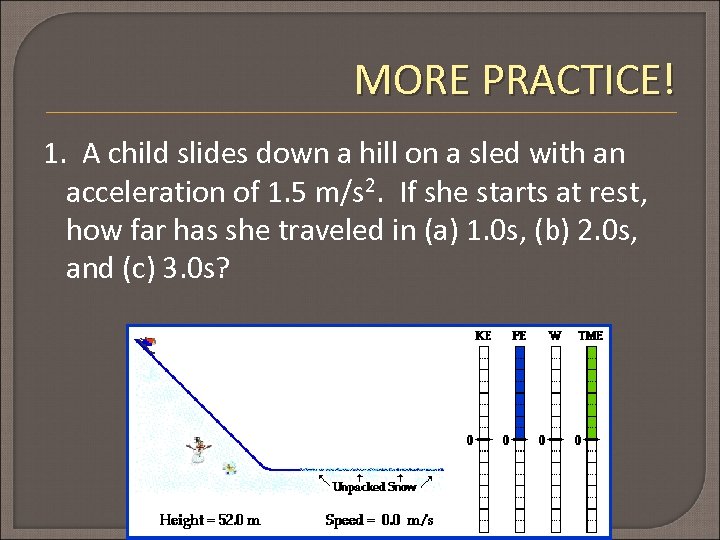 MORE PRACTICE! 1. A child slides down a hill on a sled with an acceleration of 1. 5 m/s 2. If she starts at rest, how far has she traveled in (a) 1. 0 s, (b) 2. 0 s, and (c) 3. 0 s?
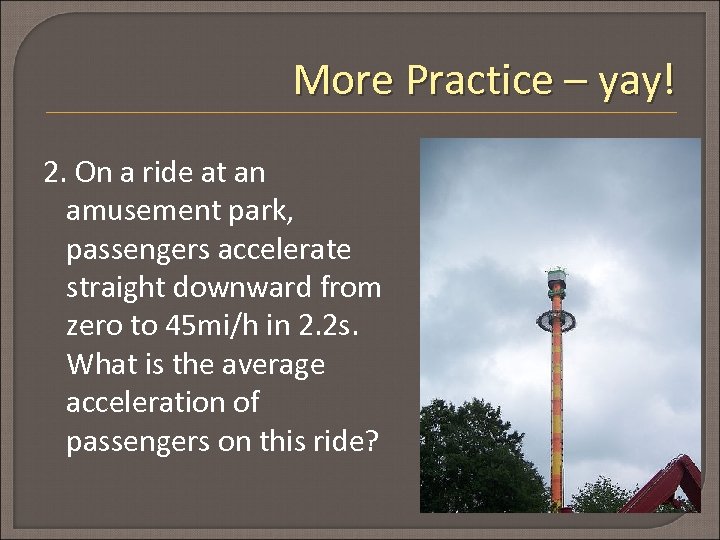 More Practice – yay! 2. On a ride at an amusement park, passengers accelerate straight downward from zero to 45 mi/h in 2. 2 s. What is the average acceleration of passengers on this ride?
 Even MORE Physics Practice 4. Two cars drive on a straight highway. At time t=0, car 1 passes mile marker 0 traveling due east with a speed of 20. 0 m/s. At the same time, car 2 is 1. 0 km east of mile marker 0 traveling at 30. 0 m/s due west. Car 1 is speeding up with an acceleration of magnitude 2. 5 m/s 2, and car 2 is slowing down with an acceleration of magnitude 3. 2 m/s 2. Write xversus-t equations of motion for both cars.
 And some more practice… 5. You’re driving around town at 12. 0 m/s when a kid runs out in front of your car. You brake – your car decelerates at 3. 5 m/s/s. (a) How far do you travel before stopping? (b) When you have traveled half that distance, what is your speed? (c) How much time does it take to stop? (d) After braking half that time, what is your speed?
 7. Free Fall

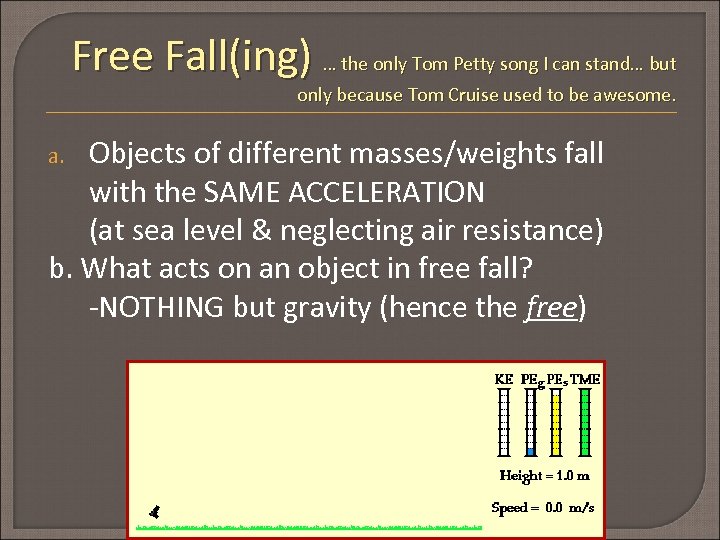 Free Fall(ing) … the only Tom Petty song I can stand… but only because Tom Cruise used to be awesome. Objects of different masses/weights fall with the SAME ACCELERATION (at sea level & neglecting air resistance) b. What acts on an object in free fall? -NOTHING but gravity (hence the free) a.
 Free Fall c. Objects in free fall can move down, OR up! d. g = 9. 81 m/s/s ← g is always positive 9. 81 m/s/s. If your frame of reference says down is negative, use –g. *If down is positive and x 0=0, then x=1/2 gt 2 (derived from that super-important eqn)
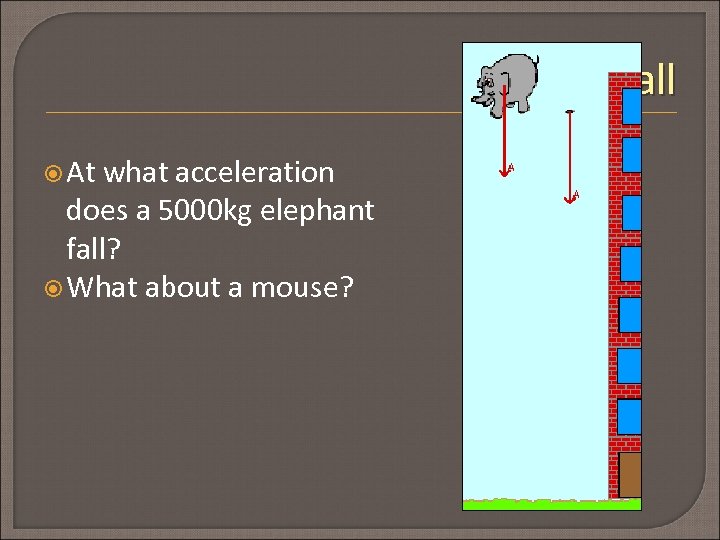 Free Fall At what acceleration does a 5000 kg elephant fall? What about a mouse?
 Practice You drop a ball from a 120 -m high cliff • How long is it in the air? • What is its speed just before it hits the ground? (at x=0 m) • Sketch x vs t, v vs t, and a vs t graphs for this