


 Скачать презентацию AP MACRO ECONOMCS UNIT 5 THE FINANCIAL SECTOR
42a63dc7ce743738aff97e174648bc21.ppt
- Количество слайдов: 67
 AP MACRO ECONOMCS UNIT 5 THE FINANCIAL SECTOR MODULES 22 -29
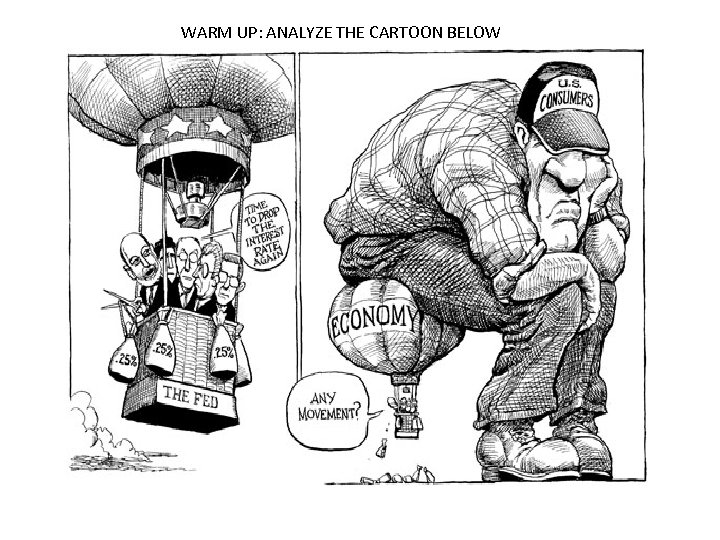 WARM UP: ANALYZE THE CARTOON BELOW
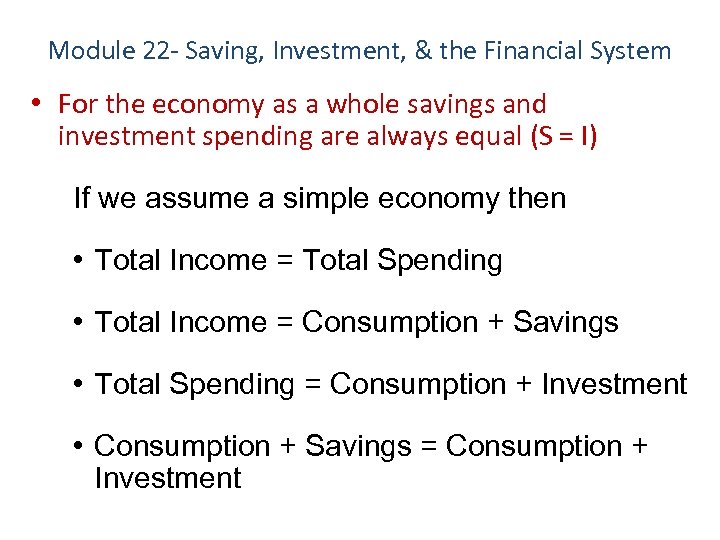 Module 22 - Saving, Investment, & the Financial System • For the economy as a whole savings and investment spending are always equal (S = I) If we assume a simple economy then • Total Income = Total Spending • Total Income = Consumption + Savings • Total Spending = Consumption + Investment • Consumption + Savings = Consumption + Investment
 KEY TERMS TO KNOW • Budget Surplus • Budget Deficit and Budget Debt • Budget Balance • National Savings v. Private Savings • Capital inflow
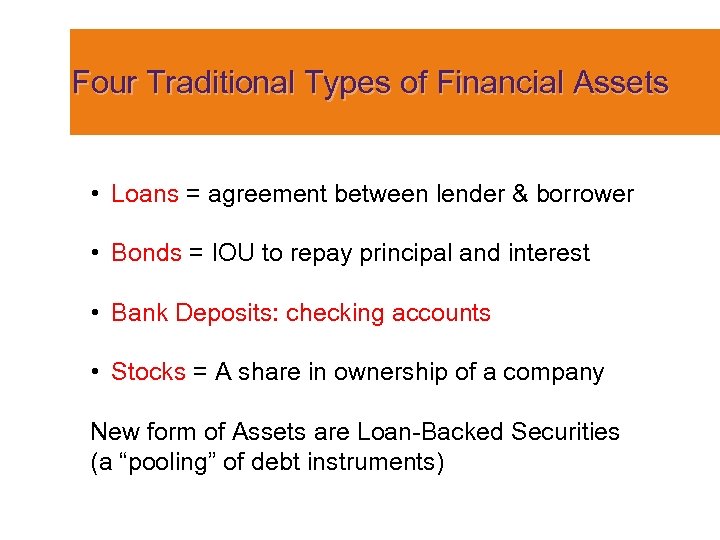 Four Traditional Types of Financial Assets • Loans = agreement between lender & borrower • Bonds = IOU to repay principal and interest • Bank Deposits: checking accounts • Stocks = A share in ownership of a company New form of Assets are Loan-Backed Securities (a “pooling” of debt instruments)
 The Equity Markets: Stocks and Bonds
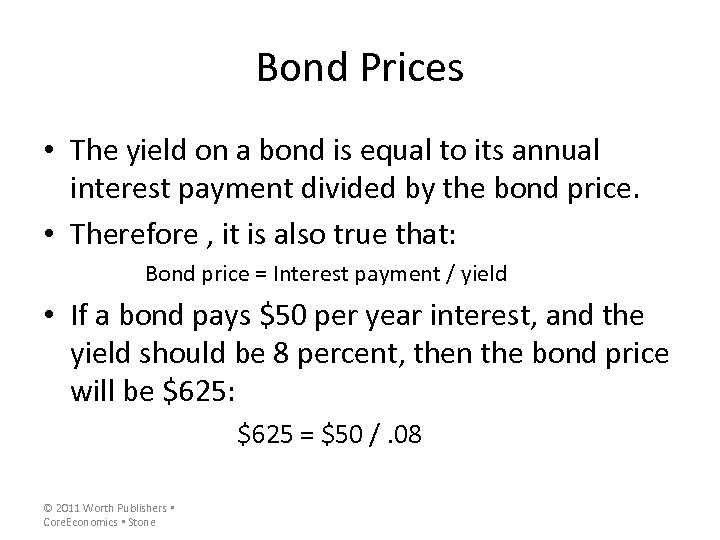 Bond Prices • The yield on a bond is equal to its annual interest payment divided by the bond price. • Therefore , it is also true that: Bond price = Interest payment / yield • If a bond pays $50 per year interest, and the yield should be 8 percent, then the bond price will be $625: $625 = $50 /. 08 © 2011 Worth Publishers ▪ Core. Economics ▪ Stone
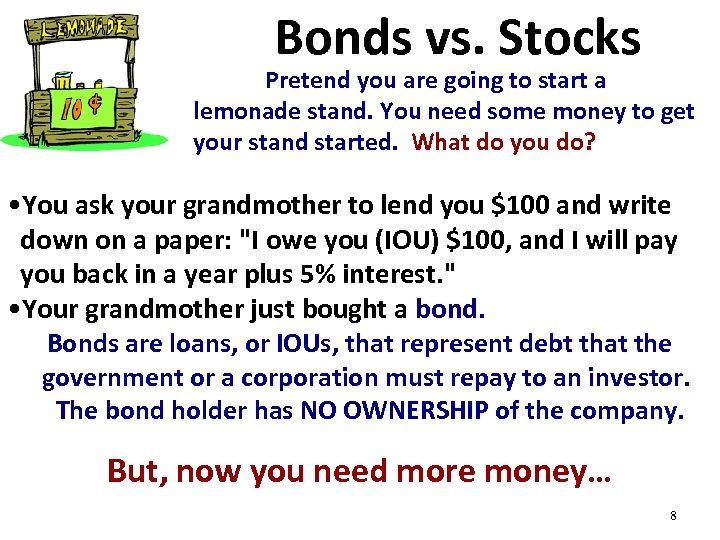 Bonds vs. Stocks Pretend you are going to start a lemonade stand. You need some money to get your stand started. What do you do? • You ask your grandmother to lend you $100 and write down on a paper: "I owe you (IOU) $100, and I will pay you back in a year plus 5% interest. " • Your grandmother just bought a bond. Bonds are loans, or IOUs, that represent debt that the government or a corporation must repay to an investor. The bond holder has NO OWNERSHIP of the company. But, now you need more money… 8
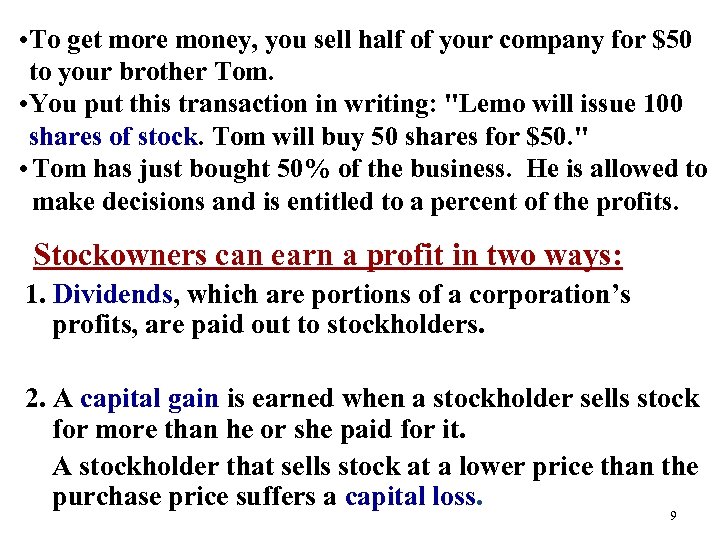 • To get more money, you sell half of your company for $50 to your brother Tom. • You put this transaction in writing: "Lemo will issue 100 shares of stock. Tom will buy 50 shares for $50. " • Tom has just bought 50% of the business. He is allowed to make decisions and is entitled to a percent of the profits. Stockowners can earn a profit in two ways: 1. Dividends, which are portions of a corporation’s profits, are paid out to stockholders. 2. A capital gain is earned when a stockholder sells stock for more than he or she paid for it. A stockholder that sells stock at a lower price than the purchase price suffers a capital loss. 9
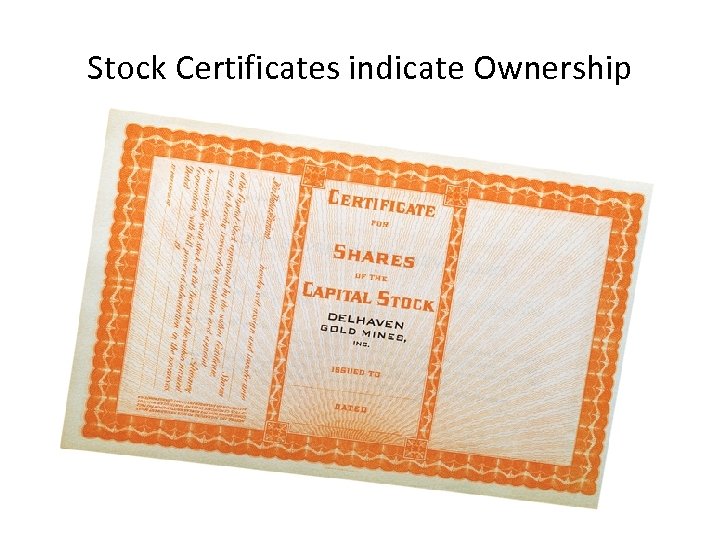 Stock Certificates indicate Ownership
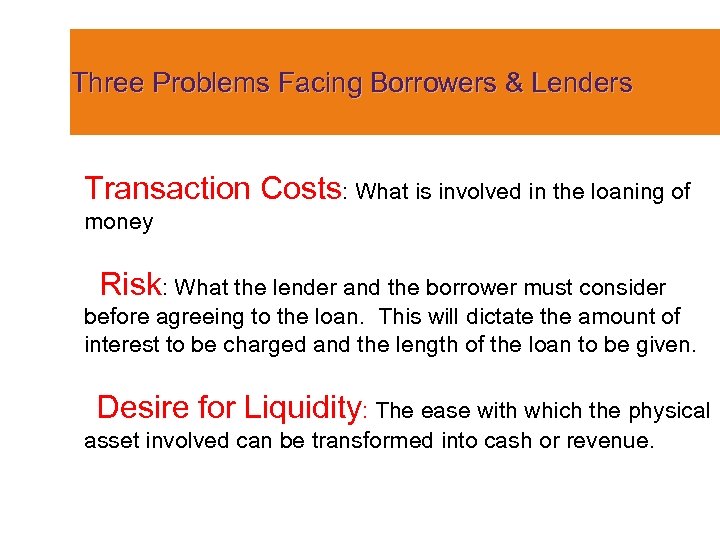 Three Problems Facing Borrowers & Lenders Transaction Costs: What is involved in the loaning of money Risk: What the lender and the borrower must consider before agreeing to the loan. This will dictate the amount of interest to be charged and the length of the loan to be given. Desire for Liquidity: The ease with which the physical asset involved can be transformed into cash or revenue.
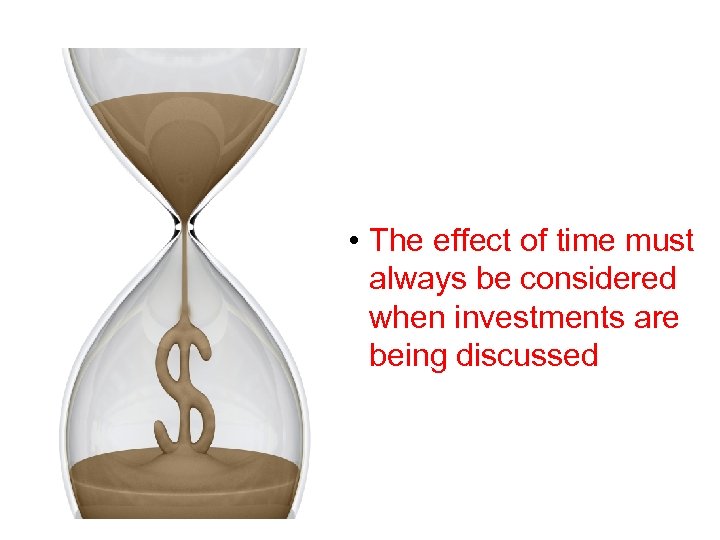 • The effect of time must always be considered when investments are being discussed
 Financial Intermediaries transform funds from many different individuals into financial assets • Mutual Funds : Largest fund Company is Fidelity • Pension Funds • Life Insurance Companies • Banks • Fractional reserve banking: system where banks lend to borrowers from the deposits of customers. • http: //www. learningmarkets. com/understanding-the-fractional-reservebanking-system/
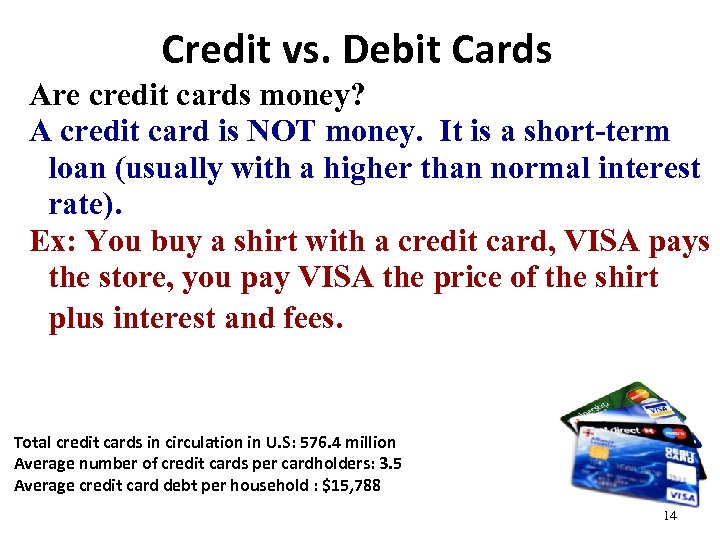 Credit vs. Debit Cards Are credit cards money? A credit card is NOT money. It is a short-term loan (usually with a higher than normal interest rate). Ex: You buy a shirt with a credit card, VISA pays the store, you pay VISA the price of the shirt plus interest and fees. Total credit cards in circulation in U. S: 576. 4 million Average number of credit cards per cardholders: 3. 5 Average credit card debt per household : $15, 788 14
 Module 23: What is Money? Money is anything that is generally accepted in payment for goods and services Commodity Money- Something that performs the function of money and has alternative uses. – Examples: Gold, silver, cigarettes, etc. Fiat Money- Something that serves as money but has no other important uses. – Examples: Paper Money, Coins 15
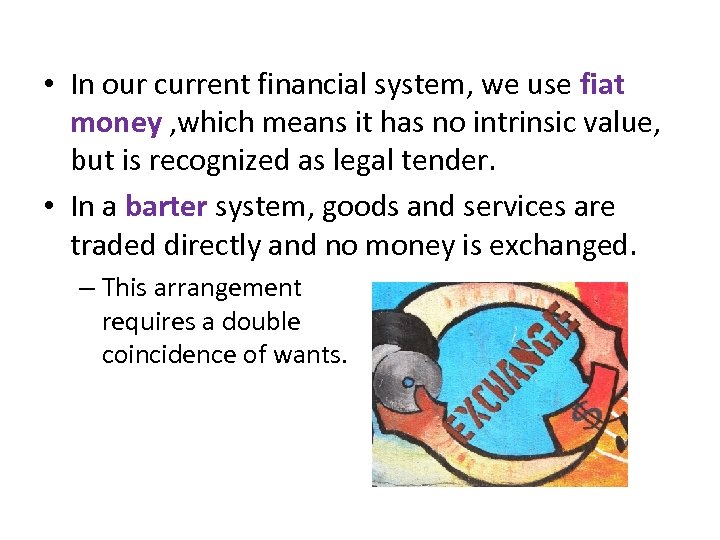 • In our current financial system, we use fiat money , which means it has no intrinsic value, but is recognized as legal tender. • In a barter system, goods and services are traded directly and no money is exchanged. – This arrangement requires a double coincidence of wants.
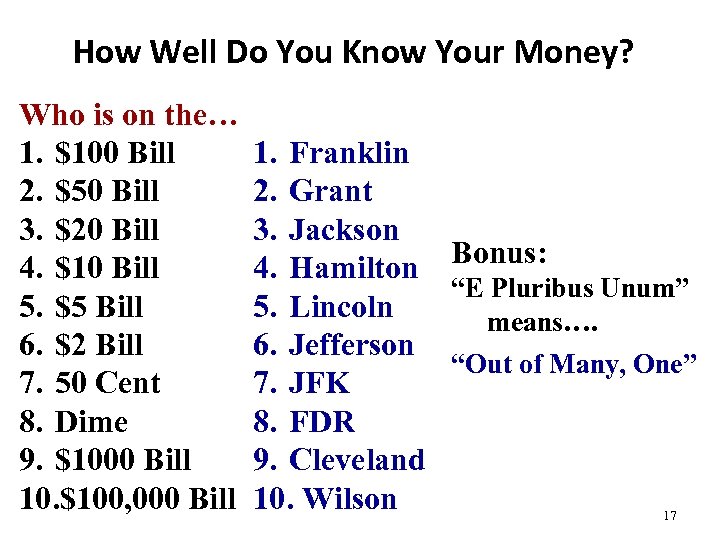 How Well Do You Know Your Money? Who is on the… 1. $100 Bill 2. $50 Bill 3. $20 Bill 4. $10 Bill 5. $5 Bill 6. $2 Bill 7. 50 Cent 8. Dime 9. $1000 Bill 10. $100, 000 Bill 1. Franklin 2. Grant 3. Jackson Bonus: 4. Hamilton “E Pluribus Unum” 5. Lincoln means…. 6. Jefferson “Out of Many, One” 7. JFK 8. FDR 9. Cleveland 10. Wilson 17
 What would happen if we didn’t have money? Problems: 1. Before trade could occur, each trader had to have something the other wanted. 2. Some goods cannot be split. If 1 goat is worth five chickens, how do you make an exchange if you only want 1 chicken? Example: A heart surgeon might accept only certain goods but not others because he doesn’t like them (ex: broccoli) To get the surgery, a pineapple grower must find a broccoli farmer that likes pineapples. 18
 3 Functions of Money 1. A Medium of Exchange • Money can easily be used to buy goods and services with no complications of barter system. 2. A Unit of Account • Money measures the value of all goods and services. Money acts as a measurement of value. • 1 goat = $50 = 5 chickens OR 1 chicken = $10 3. A Store of Value • Money allows you to store purchasing power for the future. • Money doesn’t die or spoil. 19
 Types of Money Liquidity- ease with which an asset can be accessed and converted into cash (liquidized) M 1 (High Liquidity) - Cash, Traveler’s Checks and Checkable Deposits. In general, this is known as the MONEY SUPPLY M 2 (Medium Liquidity) - M 1 plus other “near money” such as savings accounts (CD’s) and mutual funds M 3 (Low Liquidity) – No longer used 20
 Functions of Money • Money is often used as a store of wealth because it has such a high level of liquidity. – The liquidity of an asset is determined by how fast, easily, and reliably it can be converted into cash. – Money is the most liquid asset because, as the medium of exchange, it requires no conversion.
 Answer the Following Question • M 1 consists of – A) Currency plus savings accounts – B) Currency plus excess reserves held by banks – C) Currency plus travelers checks plus checkable deposits – D) Demand deposits plus savings deposits plus travelers checks
 Answer • M 1 consists of – A) Currency plus savings accounts – B) Currency plus excess reserves held by banks – C) Currency plus travelers checks plus checkable deposits. Correct! – D) Demand deposits plus savings deposits plus travelers checks
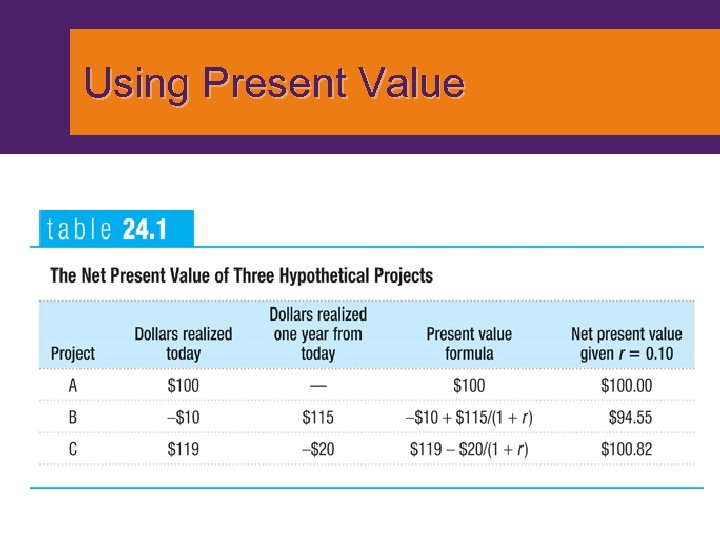
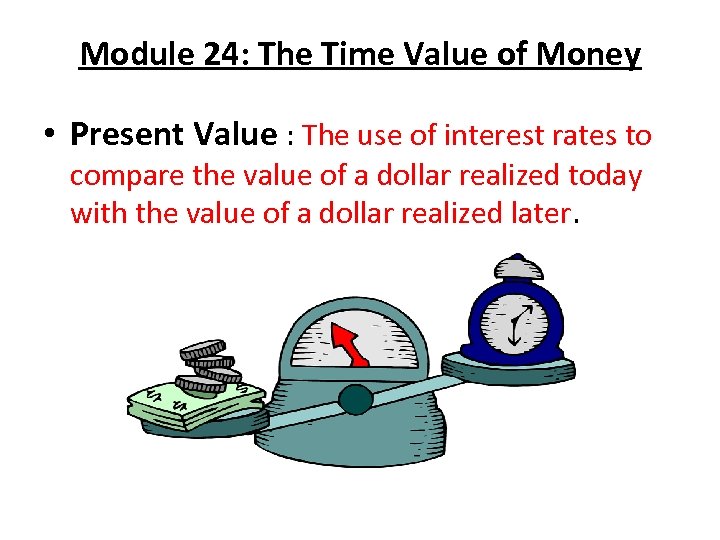 Module 24: The Time Value of Money • Present Value : The use of interest rates to compare the value of a dollar realized today with the value of a dollar realized later.
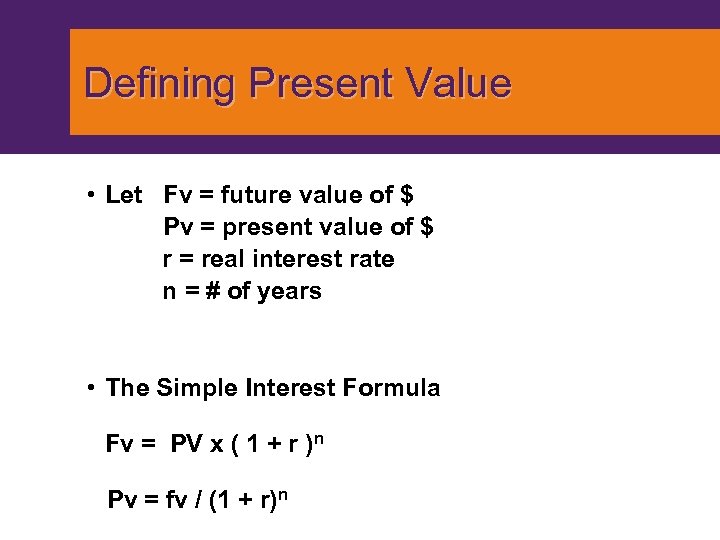 Defining Present Value • Let Fv = future value of $ Pv = present value of $ r = real interest rate n = # of years • The Simple Interest Formula Fv = PV x ( 1 + r )n Pv = fv / (1 + r)n
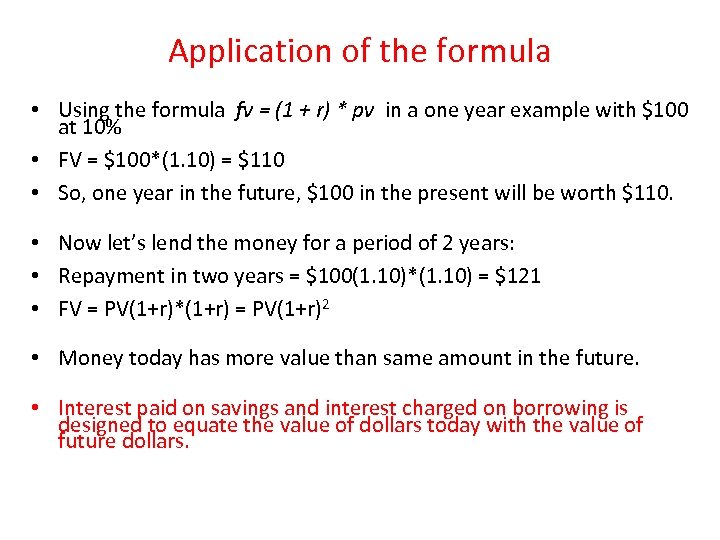 Application of the formula • • • • Using the formula fv = (1 + r) * pv in a one year example with $100 at 10% FV = $100*(1. 10) = $110 So, one year in the future, $100 in the present will be worth $110. Now let’s lend the money for a period of 2 years: Repayment in two years = $100(1. 10)*(1. 10) = $121 FV = PV(1+r)*(1+r) = PV(1+r)2 Money today has more value than same amount in the future. • Interest paid on savings and interest charged on borrowing is designed to equate the value of dollars today with the value of future dollars.
 Using Present Value
 • Remember what we learned in module 22. The effect of time must always be considered when investments are being discussed
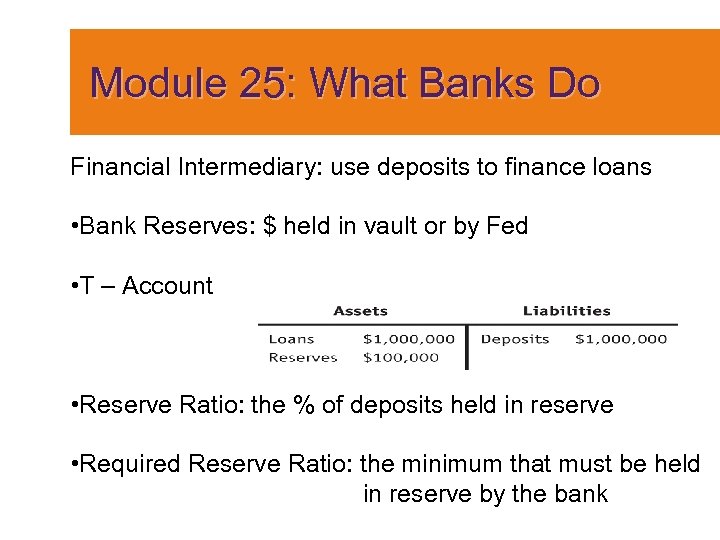 Module 25: What Banks Do Financial Intermediary: use deposits to finance loans • Bank Reserves: $ held in vault or by Fed • T – Account • Reserve Ratio: the % of deposits held in reserve • Required Reserve Ratio: the minimum that must be held in reserve by the bank
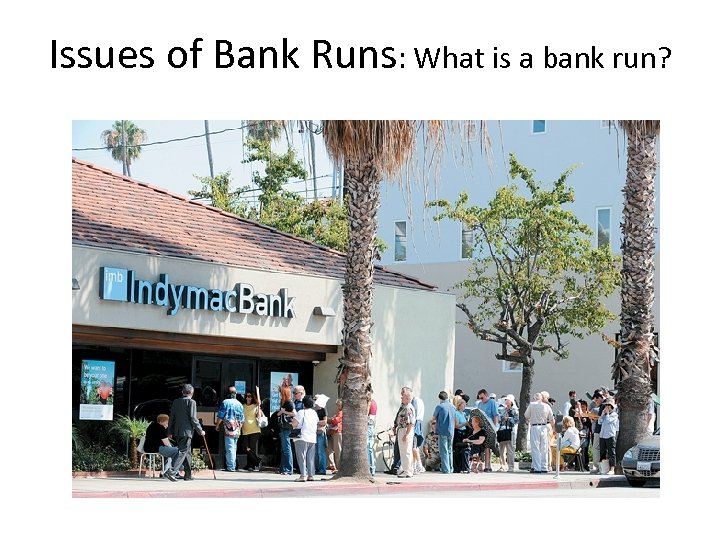 Issues of Bank Runs: What is a bank run?
 To Protect Against Bank Runs the Following Regulations are in effect • FDIC : Insured to $250 K • Capital Requirements: Owners must hold more assets then the value of the deposits (usually at least 7% more) • Reserve Requirements: Reserve ratio is presently 10% of all checkable deposits • Discount Window: Ability to borrow from the Fed to avoid having to sell assets at below market prices
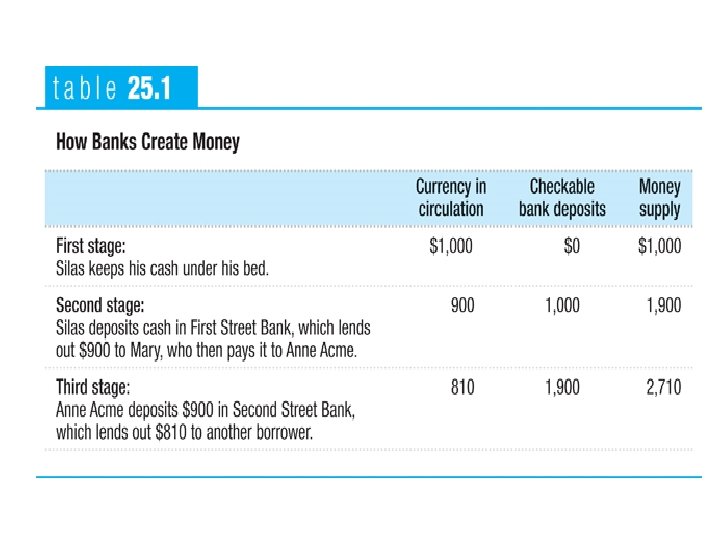
 Money Creation is similar to the Multiplier Effect of Fiscal Policy The money multiplier measures the potential or maximum amount the money supply can increase when new deposits enter the system but some money will “leak out” of the banking system and reduce the multiplier • The money multiplier is defined as: Money Multiplier = 1/Reserve Requirement So if Fed adds $100 to monetary base (increased reserves) the money supply will increase by $1000. 1/. 01=10 and 10 x 100 = 1000
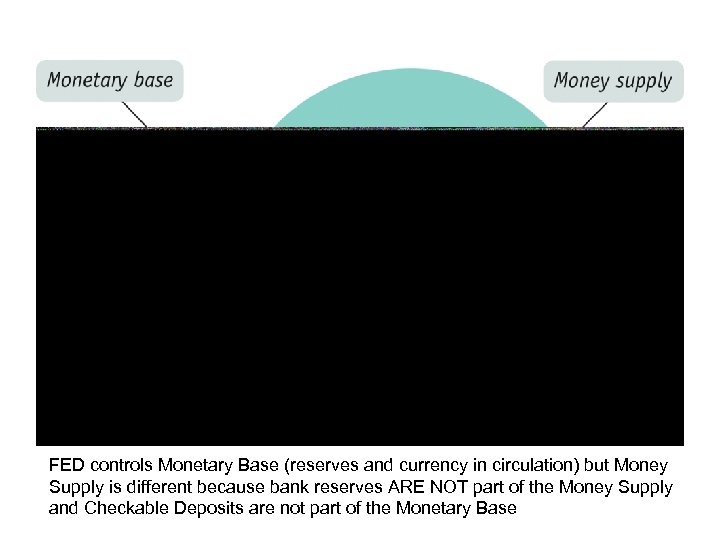 FED controls Monetary Base (reserves and currency in circulation) but Money Supply is different because bank reserves ARE NOT part of the Money Supply and Checkable Deposits are not part of the Monetary Base
 Modules 26 & 27 The Federal Reserve System
 36
36
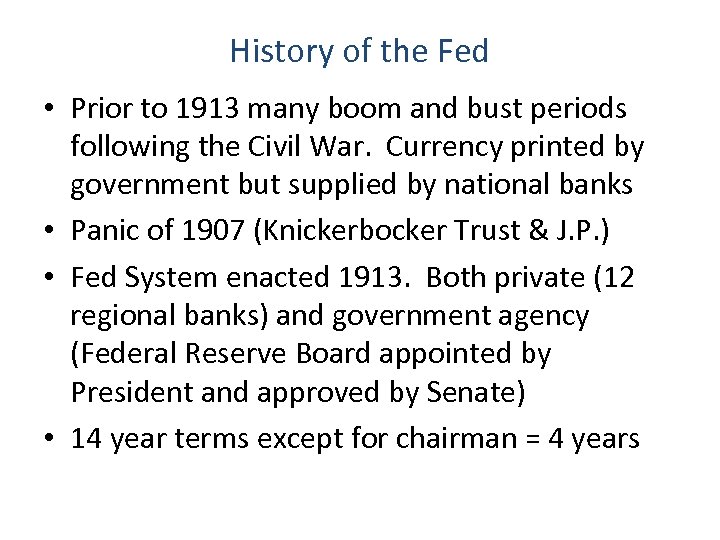 History of the Fed • Prior to 1913 many boom and bust periods following the Civil War. Currency printed by government but supplied by national banks • Panic of 1907 (Knickerbocker Trust & J. P. ) • Fed System enacted 1913. Both private (12 regional banks) and government agency (Federal Reserve Board appointed by President and approved by Senate) • 14 year terms except for chairman = 4 years
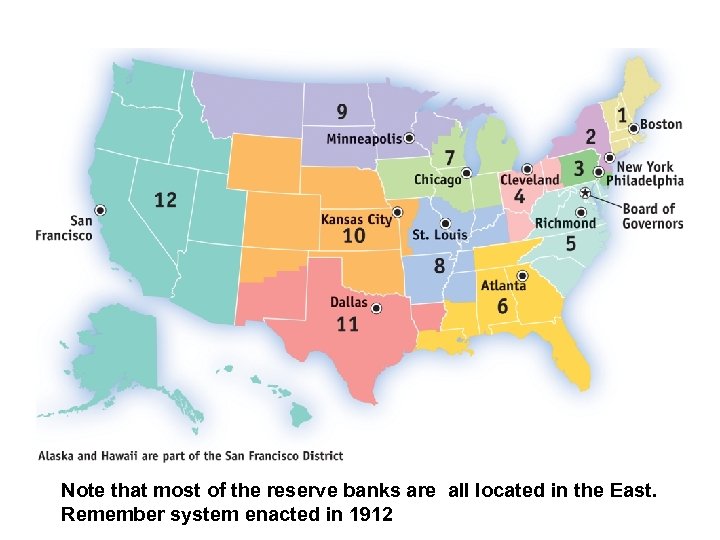 Note that most of the reserve banks are all located in the East. Remember system enacted in 1912
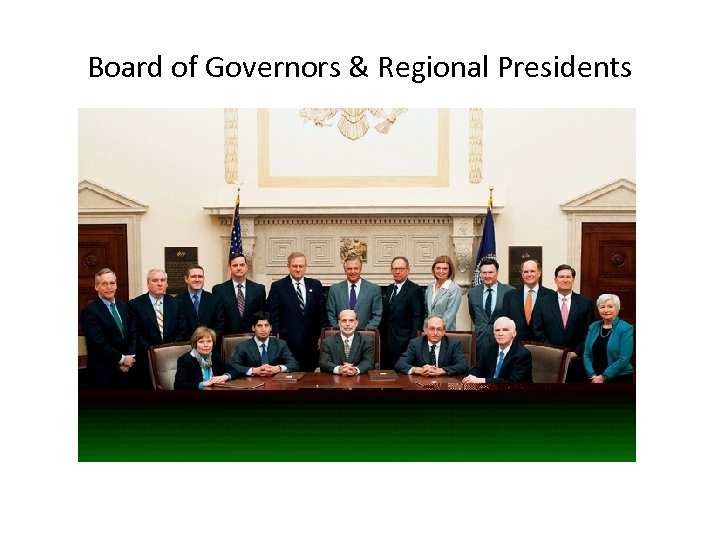 Board of Governors & Regional Presidents
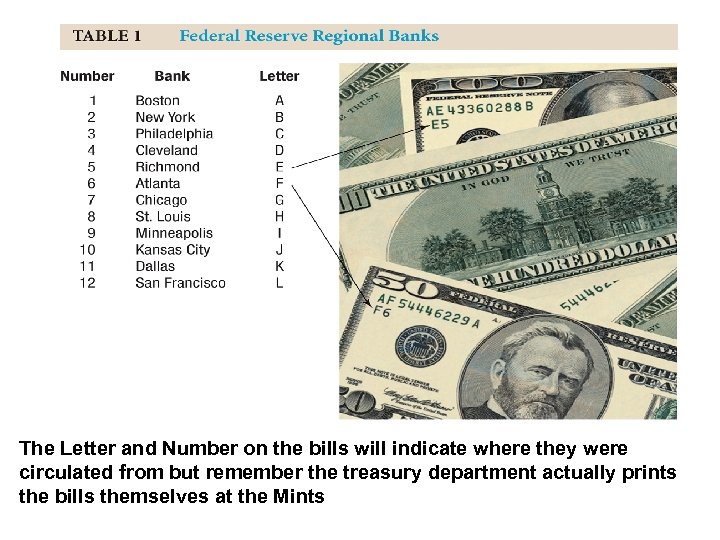 The Letter and Number on the bills will indicate where they were circulated from but remember the treasury department actually prints the bills themselves at the Mints
 • Most important Reserve Bank is the NY Fed which is in charge of “open market operations”. • Depression brought about a number of reforms to the banking system including Glass-Steagall Act and the FDIC. • Savings and Loans (S&L’s aka Thrifts) were less regulated then banks because main purpose was to provide home mortgages from deposits. • Distinction between commercial and investment banks has been reduced recently
 The Financial Crisis of 2008 • LTCM (1994) shows Hedge Funds can fail • Subprime Lending and the Housing Bubble • securitization • TED Spread: Difference between overnight rate and interest on 3 month T-Bills
 Poster Creation Requirement Problem: The Fed wants to increase the money supply. Decision: How should you accomplish this? What tools did you choose? Why? Create a poster to advertise for the Fed’s choice (your choice) on how to increase the monetary policy and include three arguments why people should be accepting of this choice Include a nonlinguistic representation and an overview of who “the Fed” is
 Module 28: The Money Market (Supply and Demand for Money) 44
 Demand for money has an inverse relationship between nominal interest rates and the quantity of money demanded 1. What happens to the quantity demanded of money when interest rates increase? Quantity demanded falls because individuals would prefer to have interest earning assets instead of borrowed liabilities 2. What happens to the quantity demanded when interest rates decrease? Quantity demanded increases. There is no incentive to convert cash into interest earning assets 45
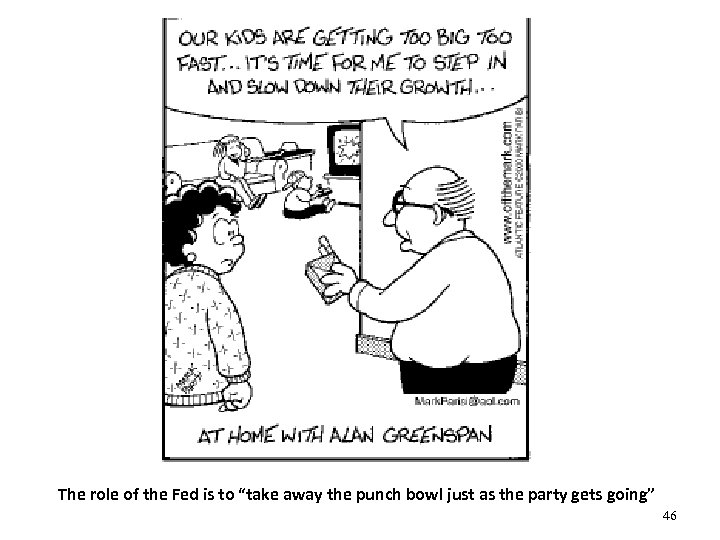 The role of the Fed is to “take away the punch bowl just as the party gets going” 46
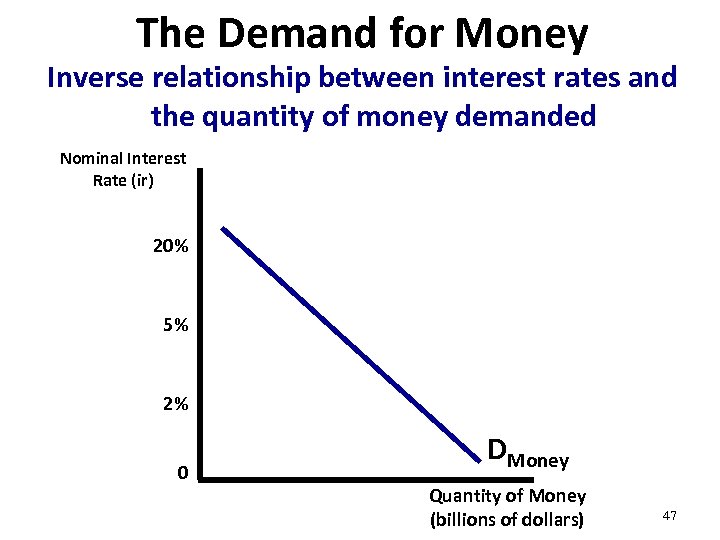 The Demand for Money Inverse relationship between interest rates and the quantity of money demanded Nominal Interest Rate (ir) 20% 5% 2% 0 DMoney Quantity of Money (billions of dollars) 47
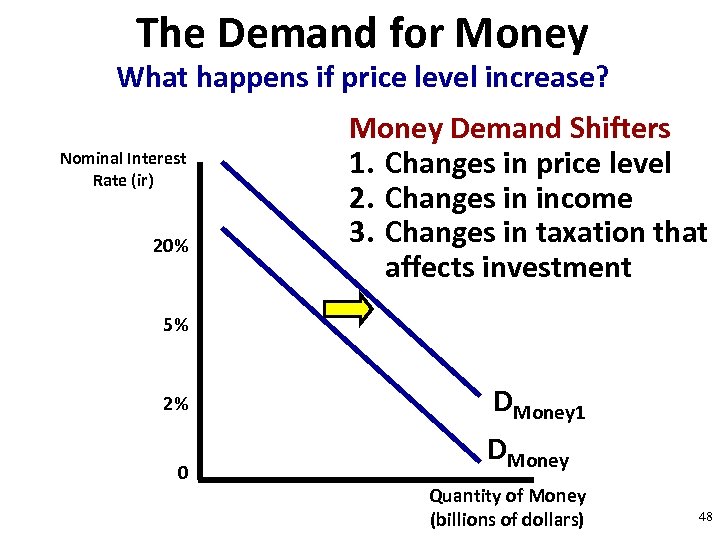 The Demand for Money What happens if price level increase? Nominal Interest Rate (ir) 20% Money Demand Shifters 1. Changes in price level 2. Changes in income 3. Changes in taxation that affects investment 5% 2% 0 DMoney 1 DMoney Quantity of Money (billions of dollars) 48
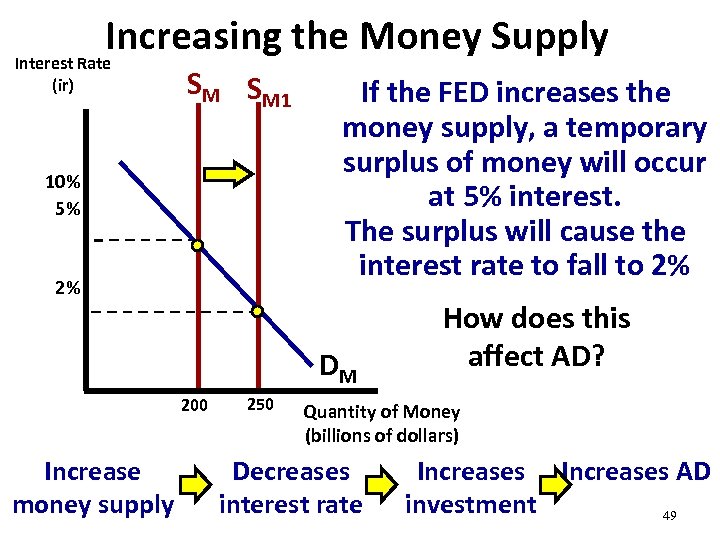 Increasing the Money Supply Interest Rate (ir) SM SM 1 10% 5% 2% If the FED increases the money supply, a temporary surplus of money will occur at 5% interest. The surplus will cause the interest rate to fall to 2% DM 200 Increase money supply 250 How does this affect AD? Quantity of Money (billions of dollars) Decreases interest rate Increases AD investment 49
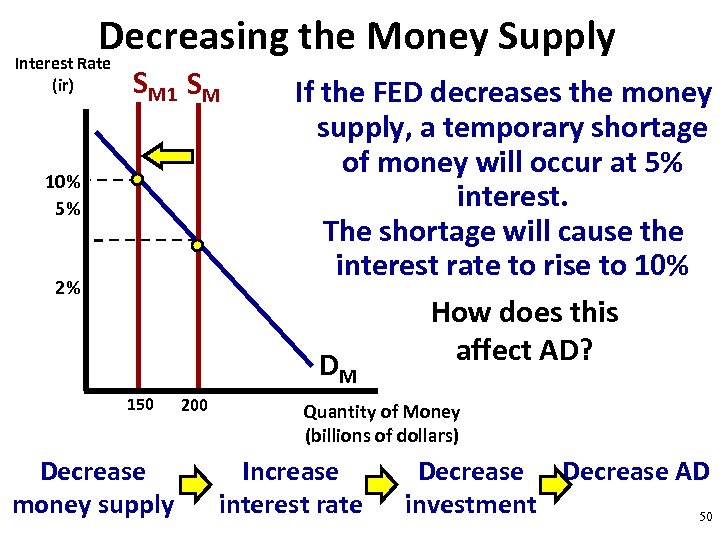 Decreasing the Money Supply Interest Rate (ir) SM 10% 5% 2% If the FED decreases the money supply, a temporary shortage of money will occur at 5% interest. The shortage will cause the interest rate to rise to 10% How does this affect AD? D M 150 Decrease money supply 200 Quantity of Money (billions of dollars) Increase interest rate Decrease AD investment 50
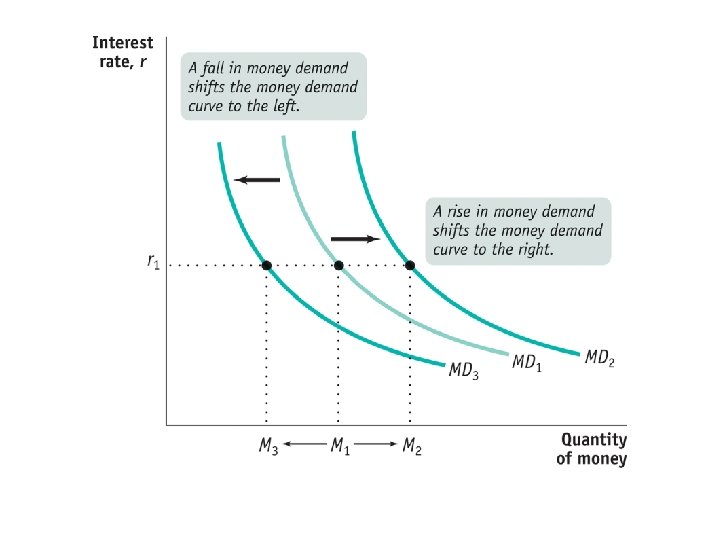
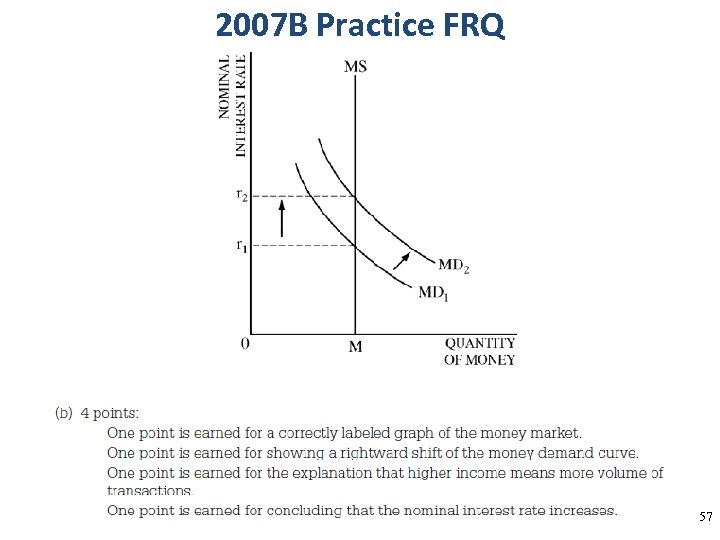
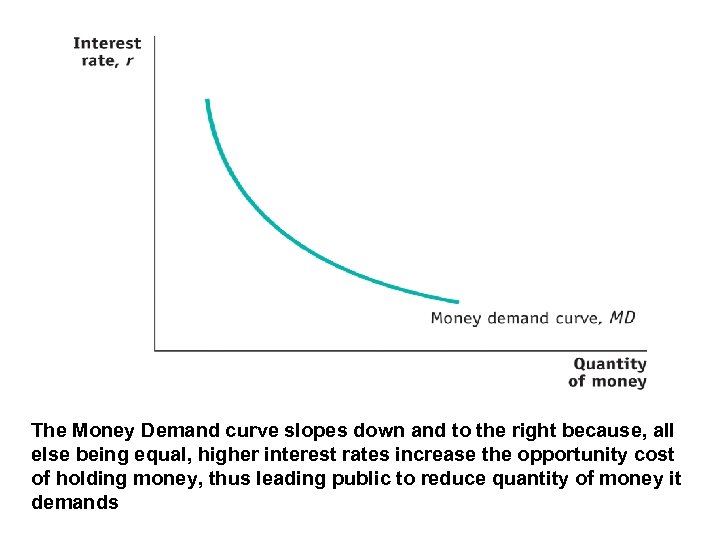 The Money Demand curve slopes down and to the right because, all else being equal, higher interest rates increase the opportunity cost of holding money, thus leading public to reduce quantity of money it demands
 Factors that can cause the MD Curve to shift • Changes in Aggregate Prices • Changes in Real GDP • Changes in banking technology (ex: ATM’s) • Changes in Banking Institution Regulations
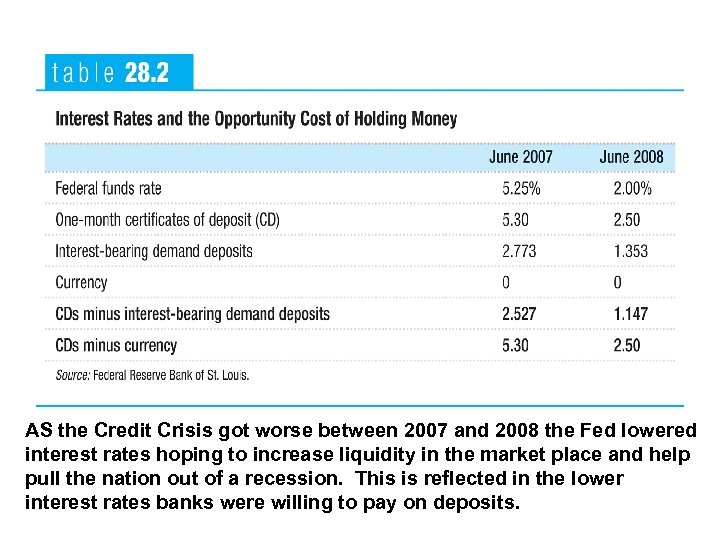 AS the Credit Crisis got worse between 2007 and 2008 the Fed lowered interest rates hoping to increase liquidity in the market place and help pull the nation out of a recession. This is reflected in the lower interest rates banks were willing to pay on deposits.
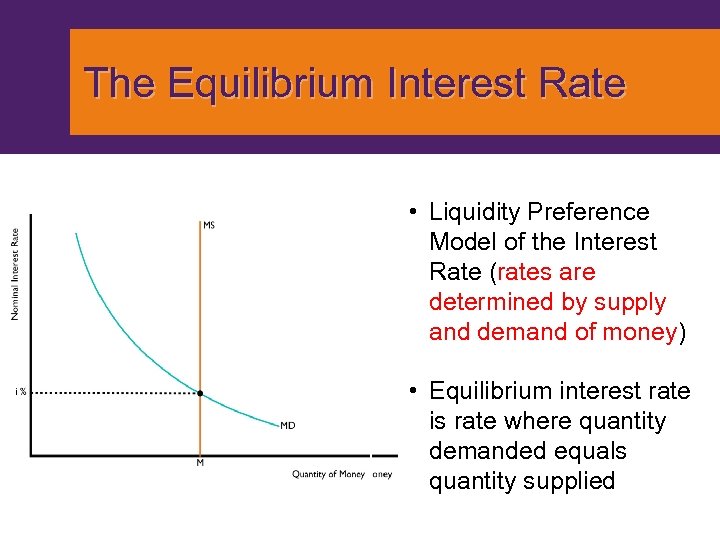 The Equilibrium Interest Rate • Liquidity Preference Model of the Interest Rate (rates are determined by supply and demand of money) • Equilibrium interest rate is rate where quantity demanded equals quantity supplied
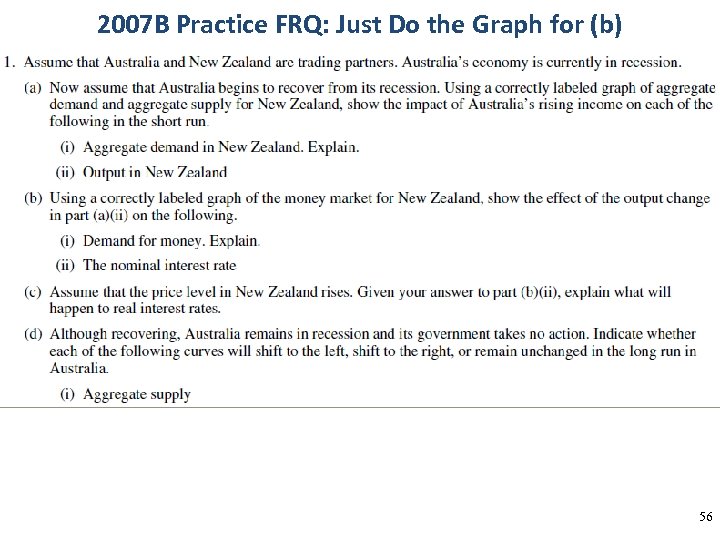 2007 B Practice FRQ: Just Do the Graph for (b) 56
 2007 B Practice FRQ 57
 Module 29: Loanable Funds Market 58
 Is an interest rate of 50% good or bad? Bad for borrowers but good for lenders The loanable funds market brings together those who wish to borrow with those who want to lend Demand- Inverse relationship between real interest rate and quantity loans demanded Supply- Direct relationship between real interest rate and quantity loans supplied This is NOT the same as the money market. (supply is not vertical) 59
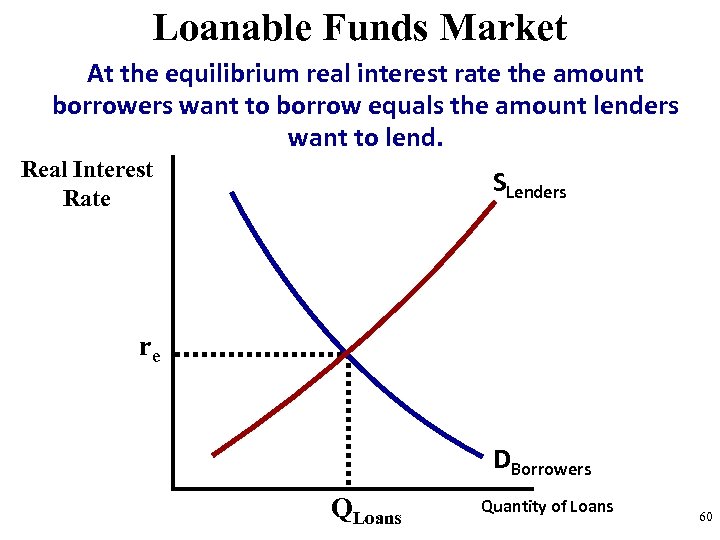 Loanable Funds Market At the equilibrium real interest rate the amount borrowers want to borrow equals the amount lenders want to lend. Real Interest Rate SLenders re DBorrowers QLoans Quantity of Loans 60
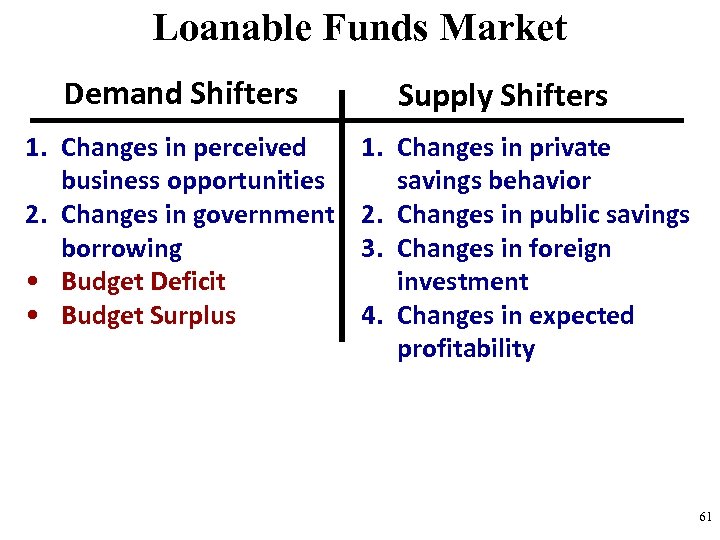 Loanable Funds Market Demand Shifters 1. Changes in perceived business opportunities 2. Changes in government borrowing • Budget Deficit • Budget Surplus Supply Shifters 1. Changes in private savings behavior 2. Changes in public savings 3. Changes in foreign investment 4. Changes in expected profitability 61
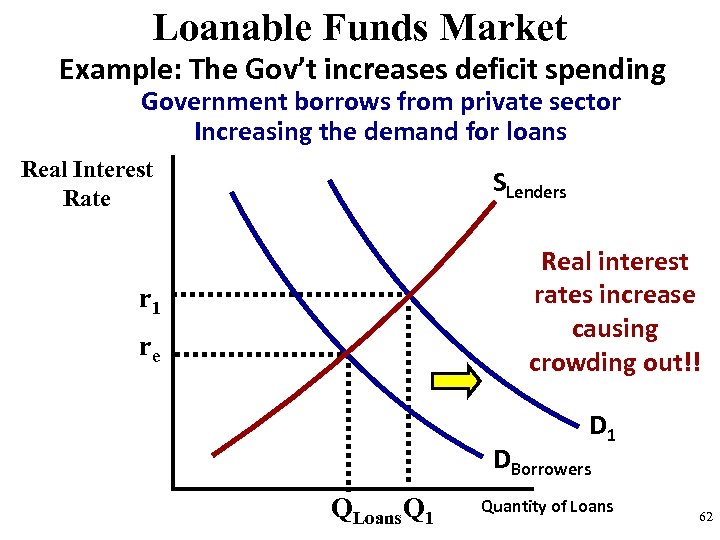 Loanable Funds Market Example: The Gov’t increases deficit spending Government borrows from private sector Increasing the demand for loans Real Interest Rate SLenders Real interest rates increase causing crowding out!! r 1 re D 1 DBorrowers QLoans Q 1 Quantity of Loans 62
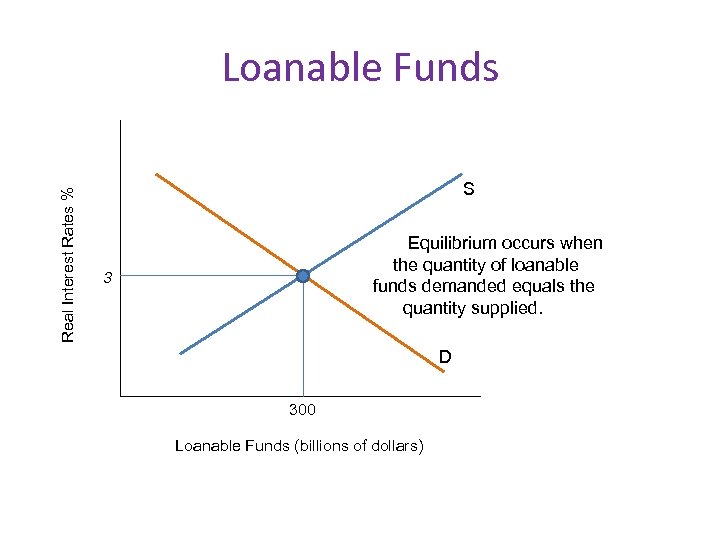 Real Interest Rates % Loanable Funds S Equilibrium occurs when the quantity of loanable funds demanded equals the quantity supplied. 3 D 300 Loanable Funds (billions of dollars)
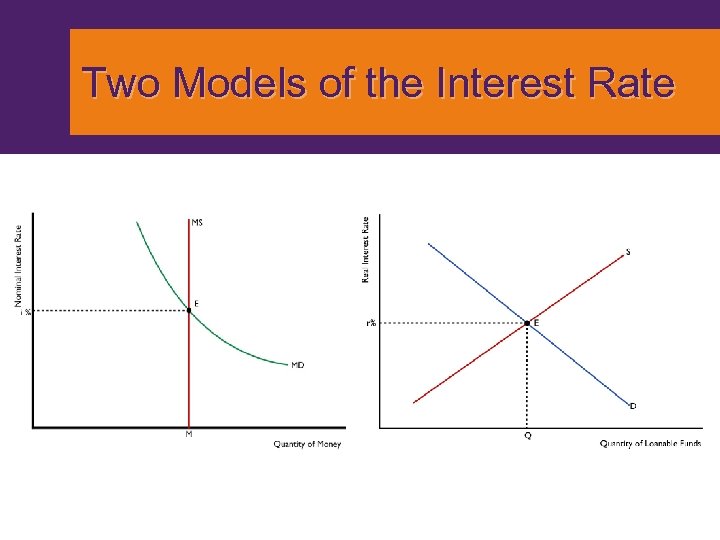 Two Models of the Interest Rate
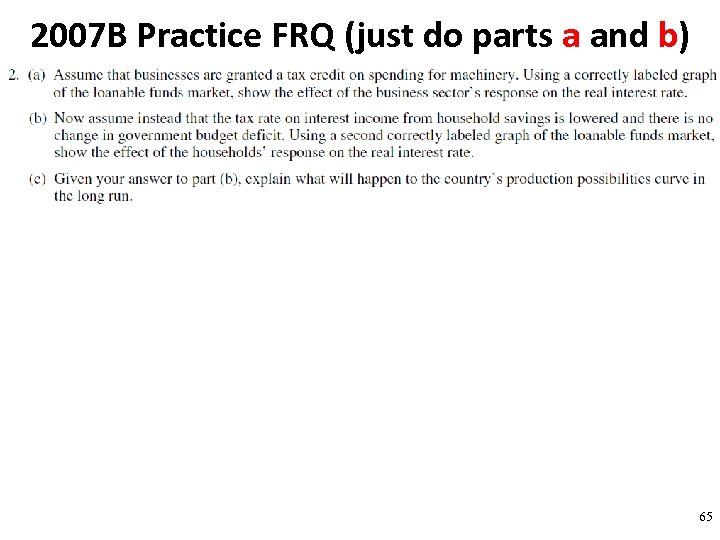 2007 B Practice FRQ (just do parts a and b) 65
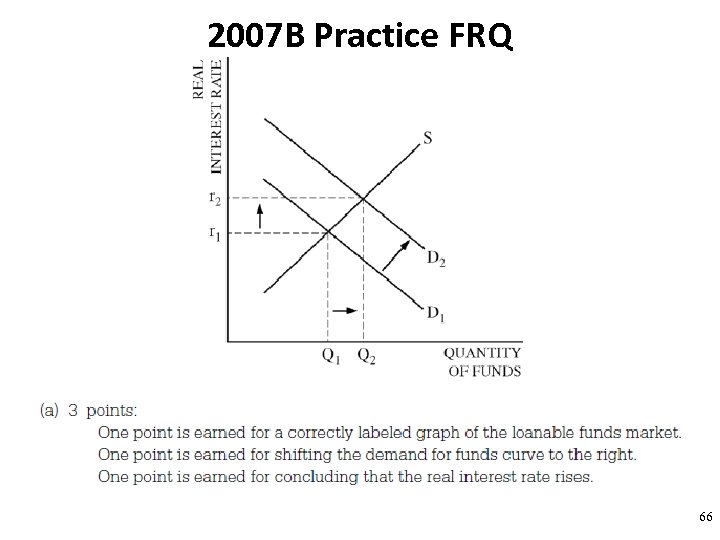 2007 B Practice FRQ 66
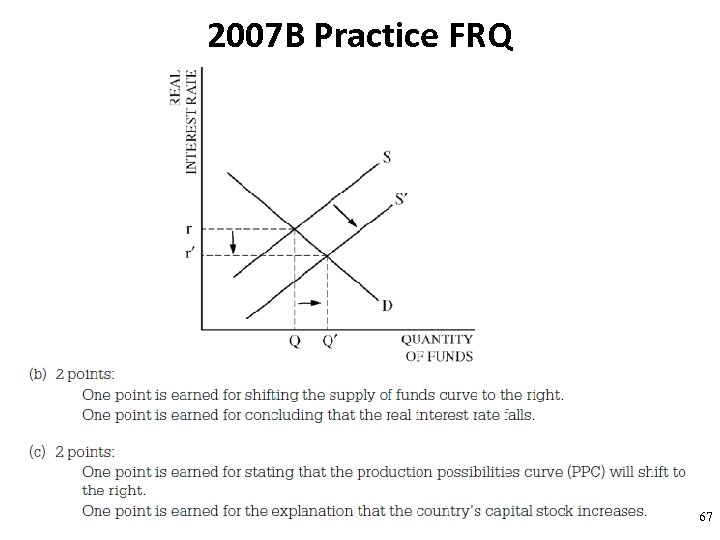 2007 B Practice FRQ 67