


 Скачать презентацию ap Ch 13 er t Cross Cultural Consumer
4f0a63b5d9d71d7a75104485fa25dcac.ppt
- Количество слайдов: 34
 ap Ch 13 er t Cross –Cultural Consumer Behavior Copyright © 2015 Pearson Education
 Chapter 13 Learning Objectives 13. 1 To understand how to study the values and customs of different cultures in order to develop effective marketing strategies. 13. 2 To understand how to decide whether to customize products for global markets or to sell standardized ones. 13. 3 To understand how to identify global marketing opportunities. 13. 4 To understand how to apply psychographics to segmenting multinational markets. Copyright © 2015 Pearson Education Slide 2 of 32
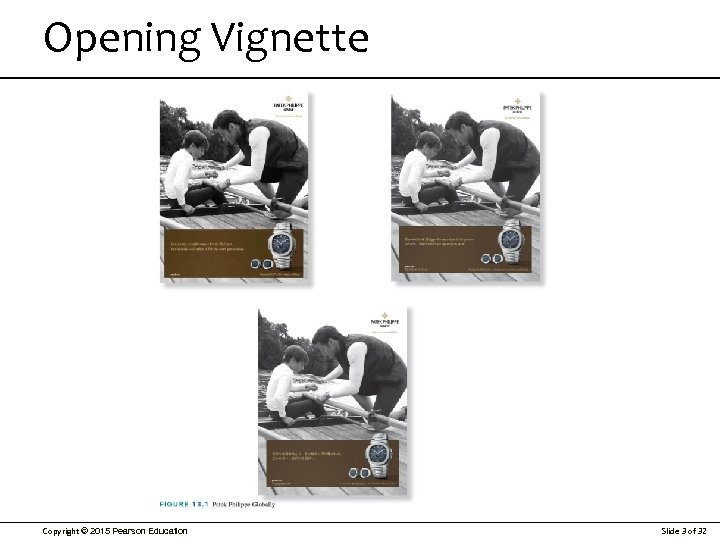 Opening Vignette Copyright © 2015 Pearson Education Slide 3 of 32
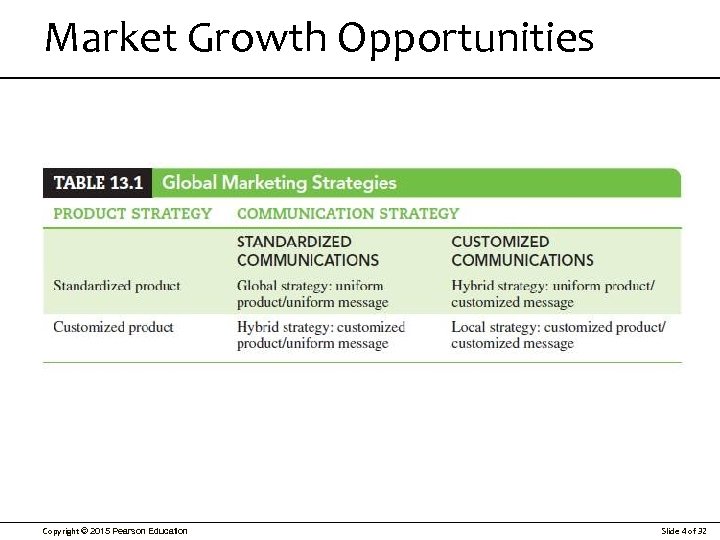 Market Growth Opportunities Copyright © 2015 Pearson Education Slide 4 of 32
 Learning Objective 13. 1 To understand how to study the values and customs of different cultures in order to develop effective marketing strategies. Copyright © 2015 Pearson Education Slide 5 of 32
 e D ed fin Cross-cultural Analysis that determines the extent to which the consumers of two or more nations are similar or different Copyright © 2015 Pearson Education Slide 6 of 32
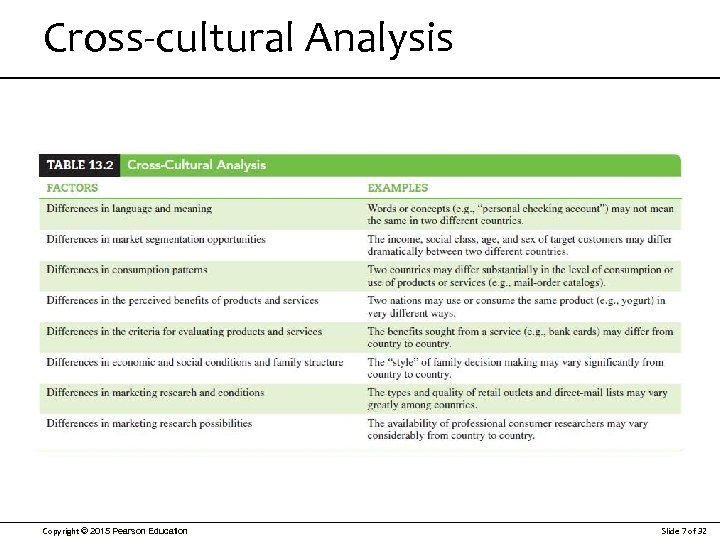 Cross-cultural Analysis Copyright © 2015 Pearson Education Slide 7 of 32
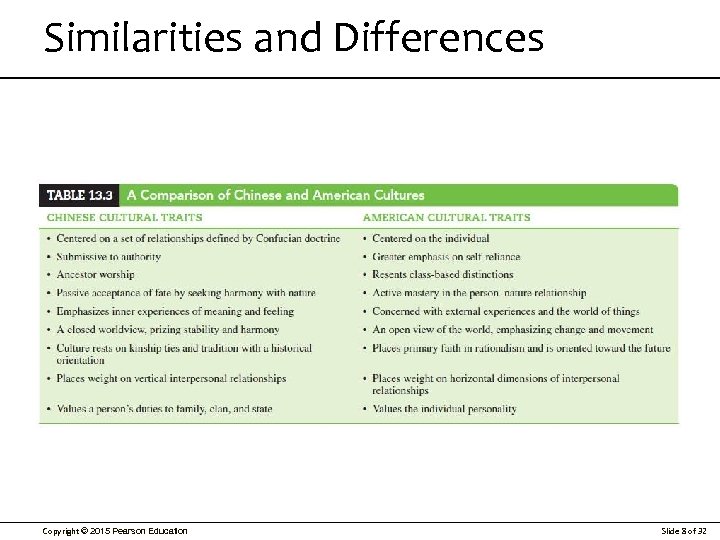 Similarities and Differences Copyright © 2015 Pearson Education Slide 8 of 32
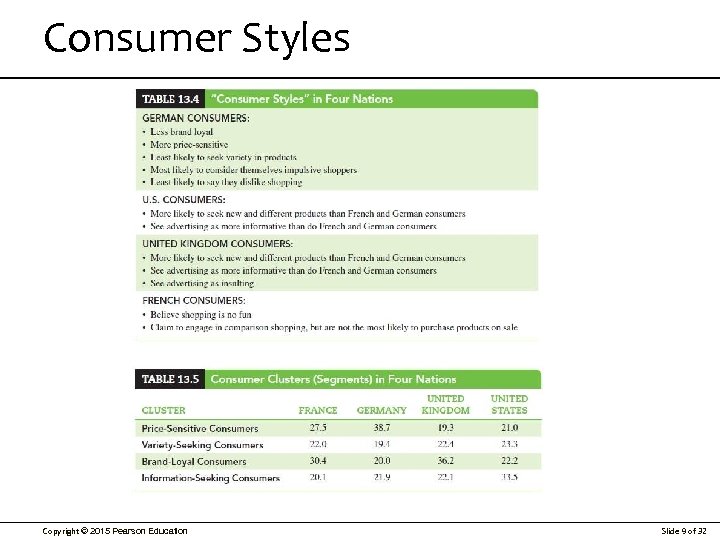 Consumer Styles Copyright © 2015 Pearson Education Slide 9 of 32
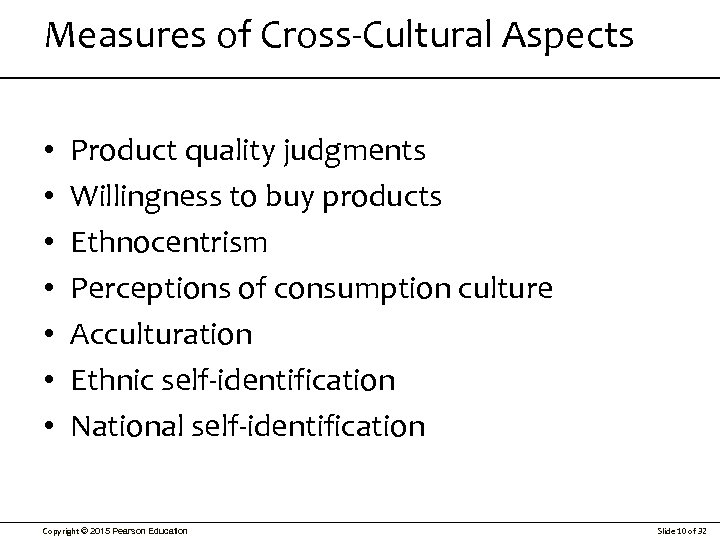 Measures of Cross-Cultural Aspects • • Product quality judgments Willingness to buy products Ethnocentrism Perceptions of consumption culture Acculturation Ethnic self-identification National self-identification Copyright © 2015 Pearson Education Slide 10 of 32
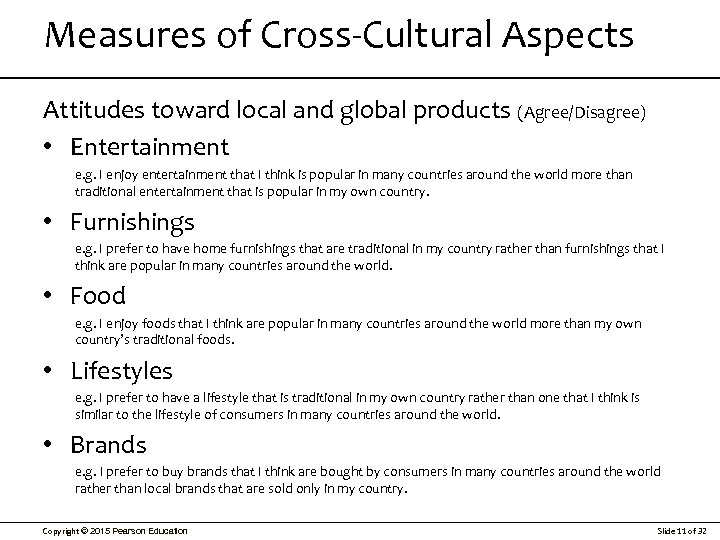 Measures of Cross-Cultural Aspects Attitudes toward local and global products (Agree/Disagree) • Entertainment e. g. I enjoy entertainment that I think is popular in many countries around the world more than traditional entertainment that is popular in my own country. • Furnishings e. g. I prefer to have home furnishings that are traditional in my country rather than furnishings that I think are popular in many countries around the world. • Food e. g. I enjoy foods that I think are popular in many countries around the world more than my own country’s traditional foods. • Lifestyles e. g. I prefer to have a lifestyle that is traditional in my own country rather than one that I think is similar to the lifestyle of consumers in many countries around the world. • Brands e. g. I prefer to buy brands that I think are bought by consumers in many countries around the world rather than local brands that are sold only in my country. Copyright © 2015 Pearson Education Slide 11 of 32
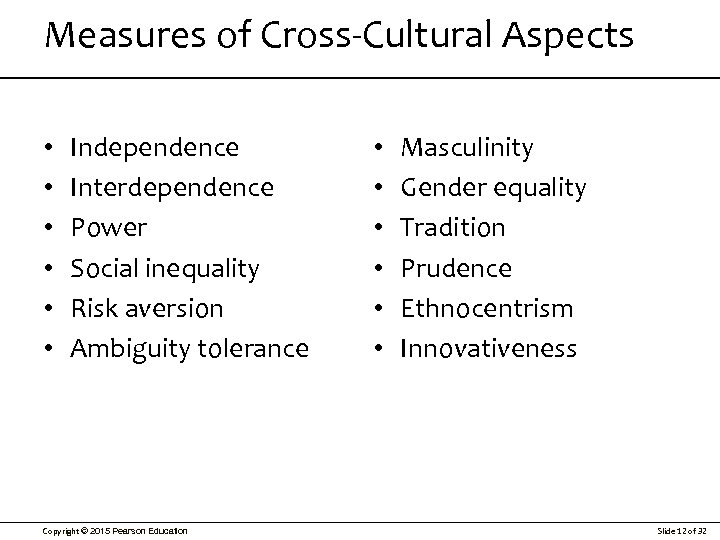 Measures of Cross-Cultural Aspects • • • Independence Interdependence Power Social inequality Risk aversion Ambiguity tolerance Copyright © 2015 Pearson Education • • • Masculinity Gender equality Tradition Prudence Ethnocentrism Innovativeness Slide 12 of 32
 e D ed fin Acculturation The process by which marketers learn —via cross-cultural analysis—about the values, beliefs, and customs of other cultures and then apply this knowledge to marketing products internationally Copyright © 2015 Pearson Education Slide 13 of 32
 Acculturation: Dual Learning Process 1. Marketers learn everything relevant about the product/product category in the chosen market 2. Marketers must persuade/teach members of the chosen market to change traditional ways of doing things and adopt the new product Copyright © 2015 Pearson Education Slide 14 of 32
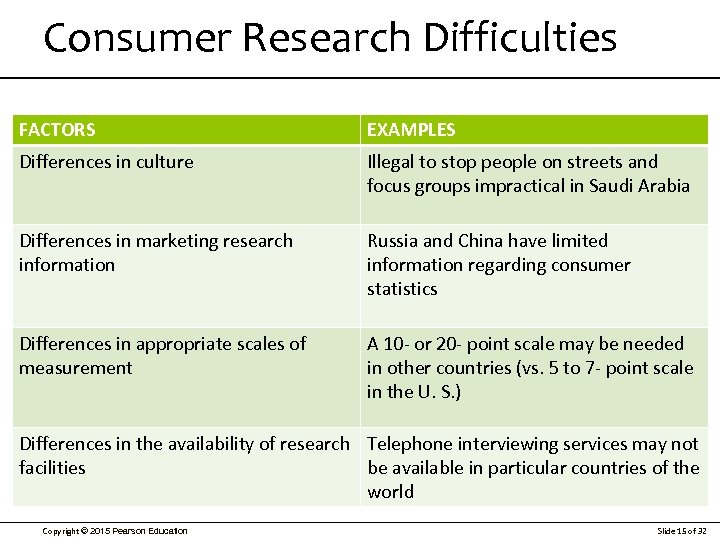 Consumer Research Difficulties FACTORS EXAMPLES Differences in culture Illegal to stop people on streets and focus groups impractical in Saudi Arabia Differences in marketing research information Russia and China have limited information regarding consumer statistics Differences in appropriate scales of measurement A 10 - or 20 - point scale may be needed in other countries (vs. 5 to 7 - point scale in the U. S. ) Differences in the availability of research Telephone interviewing services may not facilities be available in particular countries of the world Copyright © 2015 Pearson Education Slide 15 of 32
 Learning Objective 13. 2 To understand how to decide whether to customize products for global markets or to sell standardized ones. Copyright © 2015 Pearson Education Slide 16 of 32
 Customization Examples • Mc. Donald’s – Japan: Donald Mc. Donald vs. Ronald Mc. Donald – Japan: Corn soup and green tea milkshakes – Sweden: Softer design and woodcut packaging – France: Mc. Baguette – Philippines: Rice and spaghetti as side dishes • Pizza Hut Casual Dining in China • Starbucks coffee in Europe • Sunglasses for Chinese people Copyright © 2015 Pearson Education Slide 17 of 32
 Linguistic Barriers • General Motors – Chevy Runs Deep Find New Roads – Nova “No Go” (Spanish) Caribe • Parker Pens (Mexico): “It won’t leak in your pocket and make you pregnant” • Vicks cough drops (Germany): sexual penetration • Pepsi (Taiwan): bring ancestors back from the dead • Coc-Cola (China): Ke-kou-ke-la = bite the wax tadpole or female horse stuffed with wax Kokou-ko-le = happiness in the mouth Copyright © 2015 Pearson Education Slide 18 of 32
 Chinese Names: Examples • Cadillac (Ka di la ke) and Hilton (Xi er dun) = phonetic translations; mean nothing • Snickers’ (Shi Li Jia) = “honorary powerful support” • Tide (Tai Zi) = “gets rid of dirt” • Colgate (Gao Lu Jie) = “revealing superior cleanliness” • Citibank (Hua Qi Yihang) = “star-spangled banner bank” Copyright © 2015 Pearson Education Slide 19 of 32
 Promotional Appeals • Humorous advertising: UK vs. Greece • Sexual appeals: – Western country vs. Muslim or Buddhist countries – South Asian cultures vs. the U. S. • Collectivist vs. individualistic ad appeals • Comparative advertising – Self-construal – Need for cognition Copyright © 2015 Pearson Education Slide 20 of 32
 Global Brands • Characteristics – Quality Signal – Global Myth – Social Responsibility • Intracountry consumer segments – Global Citizens – Global Dreamers – Antiglobals – Global Agnostics Copyright © 2015 Pearson Education Slide 21 of 32
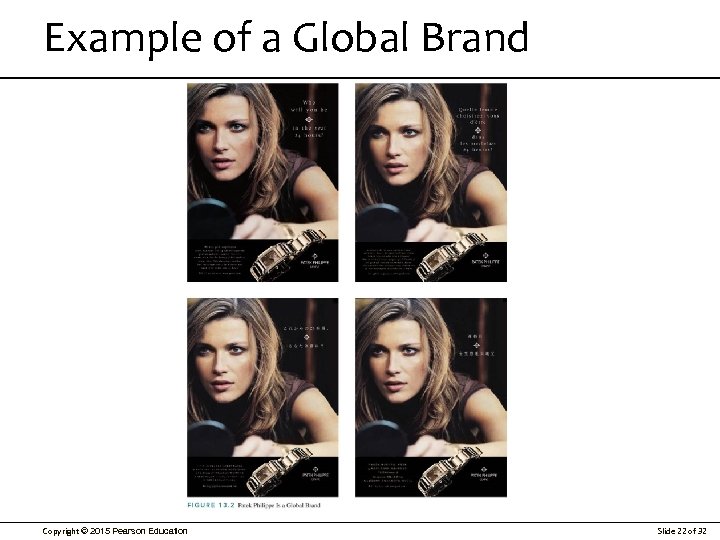 Example of a Global Brand Copyright © 2015 Pearson Education Slide 22 of 32
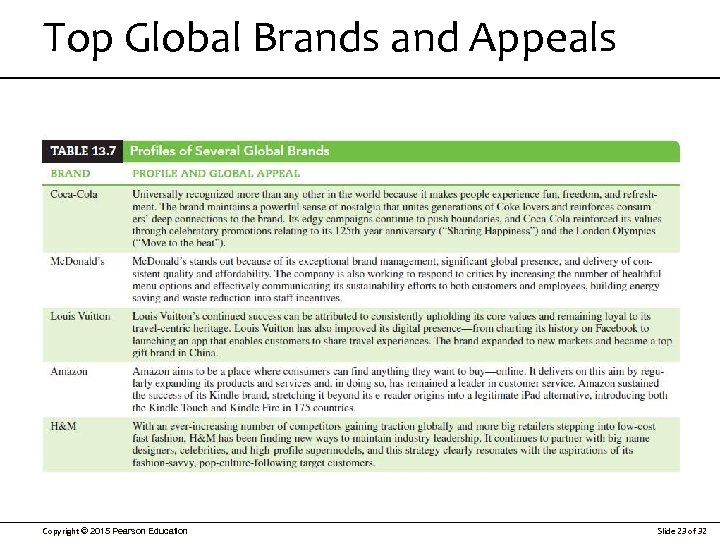 Top Global Brands and Appeals Copyright © 2015 Pearson Education Slide 23 of 32
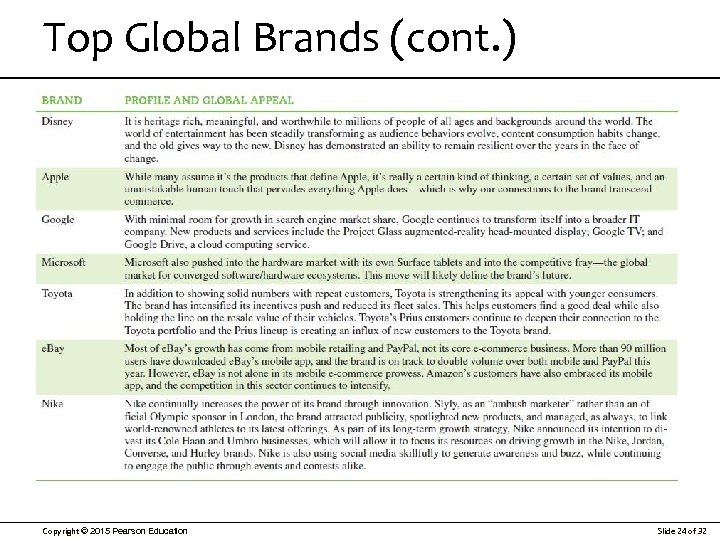 Top Global Brands (cont. ) Copyright © 2015 Pearson Education Slide 24 of 32
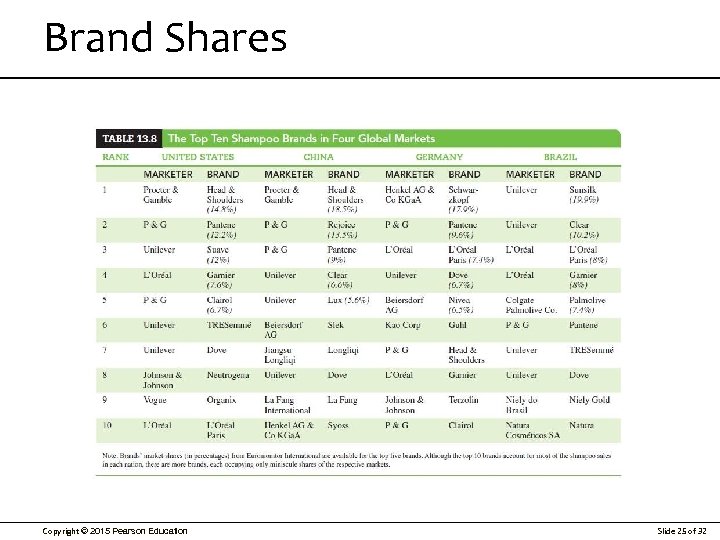 Brand Shares Copyright © 2015 Pearson Education Slide 25 of 32
 Learning Objective 13. 3 To understand how to identify global marketing opportunities. Copyright © 2015 Pearson Education Slide 26 of 32
 Reasons to Pursue Global Markets • Multinational fever – attractive multinational markets, products, or services • Overseas markets offer future growth when home markets mature • Consumers around the globe eager to try “foreign” products Copyright © 2015 Pearson Education Slide 27 of 32
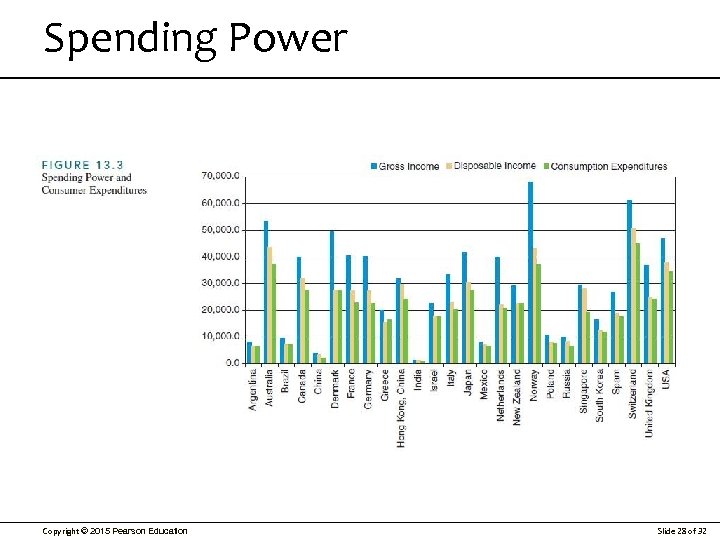 Spending Power Copyright © 2015 Pearson Education Slide 28 of 32
 Middle Class & Teen Market • Middle Class growth – By 2020, the middle class will grow from 30% to 52% of the world’s population. – By 2025, China will have the world’s largest middle class – By 2025, India’s middle class will be 10 times larger than it currently is • Global Teen Market – similar interests, desires and consumption behavior Copyright © 2015 Pearson Education Slide 29 of 32
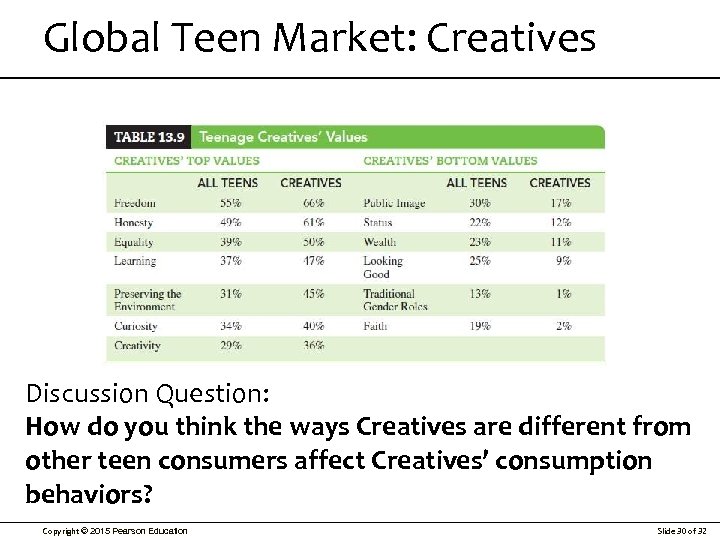 Global Teen Market: Creatives Discussion Question: How do you think the ways Creatives are different from other teen consumers affect Creatives’ consumption behaviors? Copyright © 2015 Pearson Education Slide 30 of 32
 Learning Objective 13. 4 To understand how to apply psychographics to segmenting multinational markets. Copyright © 2015 Pearson Education Slide 31 of 32
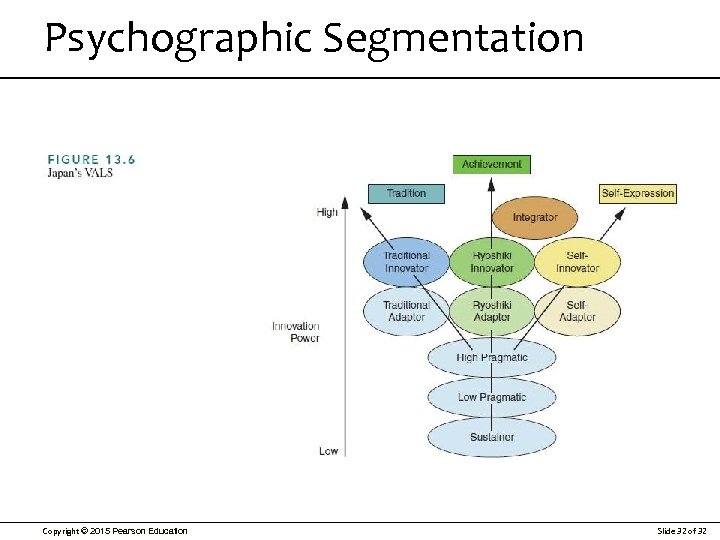 Psychographic Segmentation Copyright © 2015 Pearson Education Slide 32 of 32
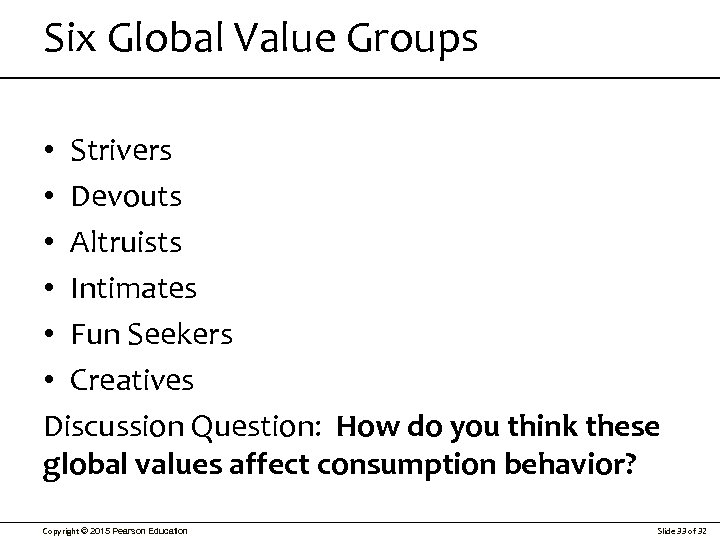 Six Global Value Groups • Strivers • Devouts • Altruists • Intimates • Fun Seekers • Creatives Discussion Question: How do you think these global values affect consumption behavior? Copyright © 2015 Pearson Education Slide 33 of 32
 All rights reserved. No part of this publication may be reproduced, stored in a retrieval system, or transmitted, in any form or by any means, electronic, mechanical, photocopying, recording, or otherwise, without the prior written permission of the publisher. Printed in the United States of America. Copyright © 2015 Pearson Education Slide 34 of 32