


 Скачать презентацию Anyone NOT on this list see me after
6291dc904f9de552d6dce8f629c3f4c8.ppt
- Количество слайдов: 67
 Anyone NOT on this list see me after class! Ki Yung Ahn Nish Aravamudan David Archer Yujing He Joel Hoffman Christopher Holm Ralf Juengling Karthika Kothapally Daniel Lake Jin Li Adam Lowry Shane Matthews Ninad Palsule Nick Rayner Vincent Rayappa Phillip Sitbon Tiffany Takahara Indraneel Takkilapati Shuping Tien Zhifei Wang Candy Yiu Paper assignments will be posted soon! CS 533 - Concepts of Operating Systems 1
 CS 533 Concepts of Operating Systems Class 2 Overview of Threads and Concurrency CS 533 - Concepts of Operating Systems 2
 Questions q q q Why study threads and concurrent programming in an OS class? What is a thread? Is multi-threaded programming easy? o If not, why not? CS 533 - Concepts of Operating Systems 3
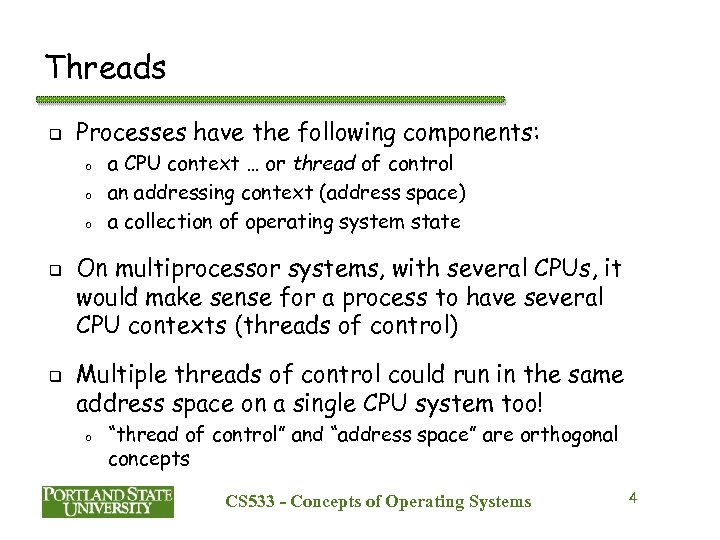 Threads q Processes have the following components: o o o q q a CPU context … or thread of control an addressing context (address space) a collection of operating system state On multiprocessor systems, with several CPUs, it would make sense for a process to have several CPU contexts (threads of control) Multiple threads of control could run in the same address space on a single CPU system too! o “thread of control” and “address space” are orthogonal concepts CS 533 - Concepts of Operating Systems 4
 Threads q Threads share an address space with zero or more other threads o q Threads have their own o o q PC, SP, register state etc (CPU state) Stack (memory) Why do these need to be private to each thread? o q could be the kernel’s address space or that of a user level process what other OS state should be private to threads? A traditional process can be viewed as an address space with a single thread CS 533 - Concepts of Operating Systems 5
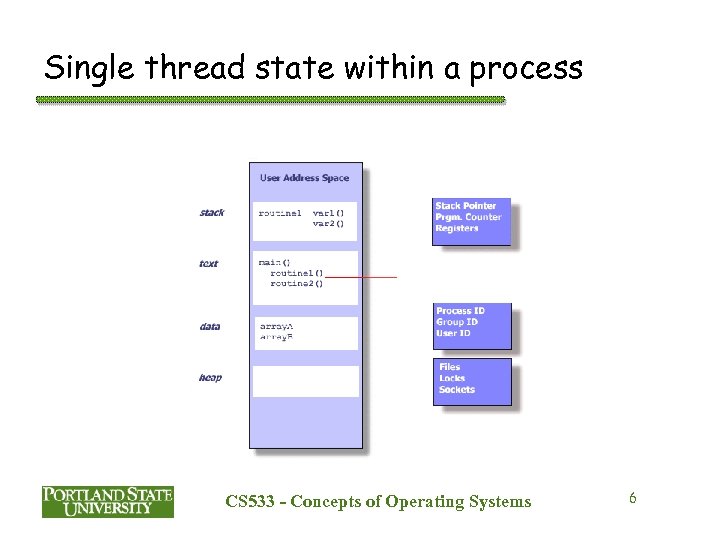 Single thread state within a process CS 533 - Concepts of Operating Systems 6
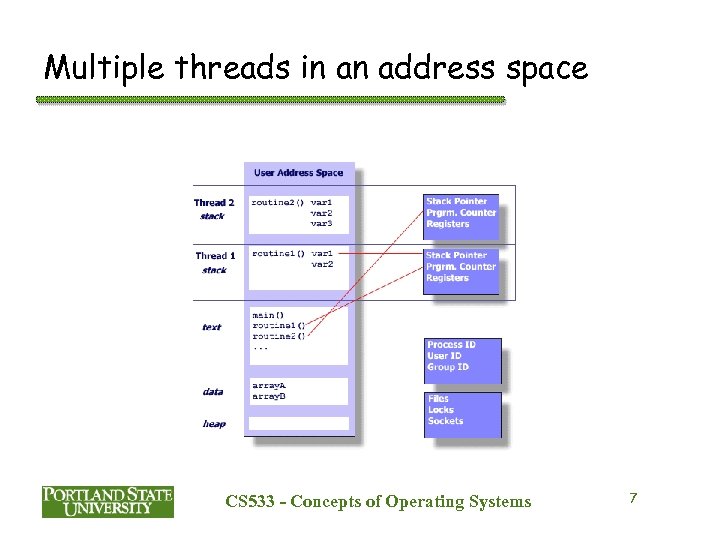 Multiple threads in an address space CS 533 - Concepts of Operating Systems 7
 Shared state among related threads q q q Open files, sockets, locks User ID, group ID, process/task ID Address space o o o q Text Data (off-stack global variables) Heap (dynamic data) Changes made to shared state by one thread will be visible to the others! o Reading & writing shared memory requires synchronization! CS 533 - Concepts of Operating Systems 8
 Why program using threads? q q q Utilize multiple CPU’s concurrently Low cost communication via shared memory Overlap computation and blocking on a single CPU o o q Blocking due to I/O Computation and communication Handle asynchronous events CS 533 - Concepts of Operating Systems 9
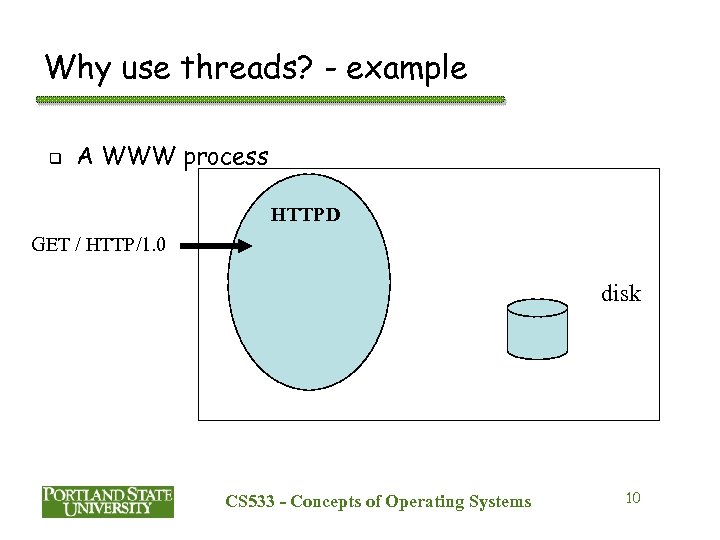 Why use threads? - example q A WWW process HTTPD GET / HTTP/1. 0 disk CS 533 - Concepts of Operating Systems 10
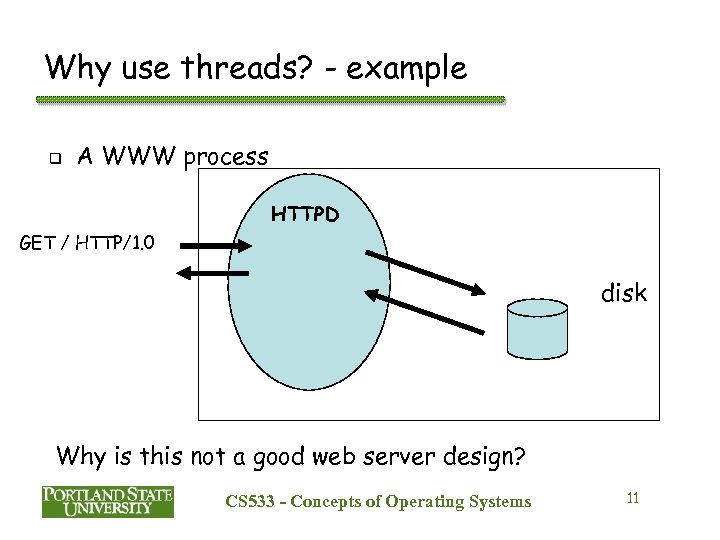 Why use threads? - example q A WWW process HTTPD GET / HTTP/1. 0 disk Why is this not a good web server design? CS 533 - Concepts of Operating Systems 11
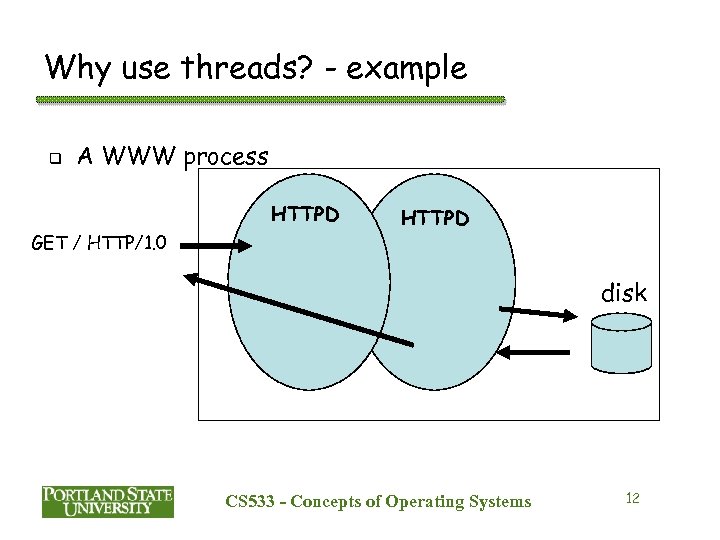 Why use threads? - example q A WWW process HTTPD GET / HTTP/1. 0 HTTPD disk CS 533 - Concepts of Operating Systems 12
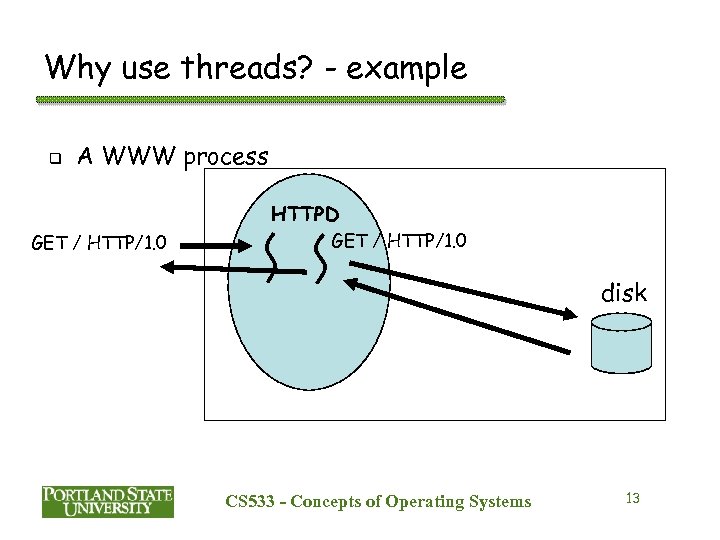 Why use threads? - example q A WWW process HTTPD GET / HTTP/1. 0 disk CS 533 - Concepts of Operating Systems 13
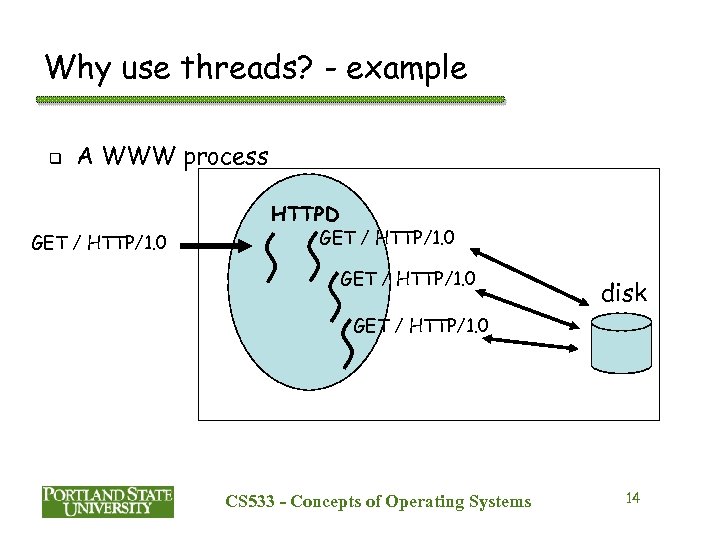 Why use threads? - example q A WWW process HTTPD GET / HTTP/1. 0 disk GET / HTTP/1. 0 CS 533 - Concepts of Operating Systems 14
 What does a typical thread API look like? q q q POSIX standard threads (Pthreads) First thread exists in main(), typically creates the others pthread_create (thread, attr, start_routine, arg) o o o Returns new thread ID in “thread” Executes routine specified by “start_routine” with argument specified by “arg” Exits on return from routine or when told explicitly CS 533 - Concepts of Operating Systems 15
 Thread API (continued) q pthread_exit (status) o q pthread_join (threadid, status) o o o q Terminates the thread and returns “status” to any joining thread Blocks the calling thread until thread specified by “threadid” terminates Return status from pthread_exit is passed in “status” One way of synchronizing between threads pthread_yield () o Thread gives up the CPU and enters the run queue CS 533 - Concepts of Operating Systems 16
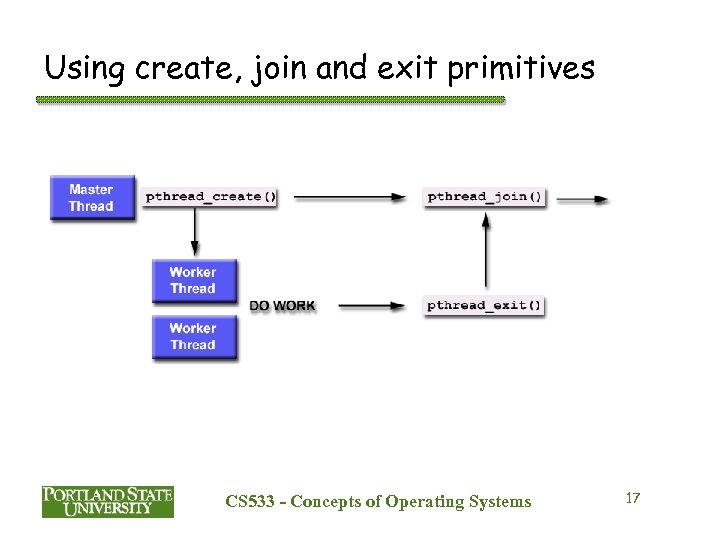 Using create, join and exit primitives CS 533 - Concepts of Operating Systems 17
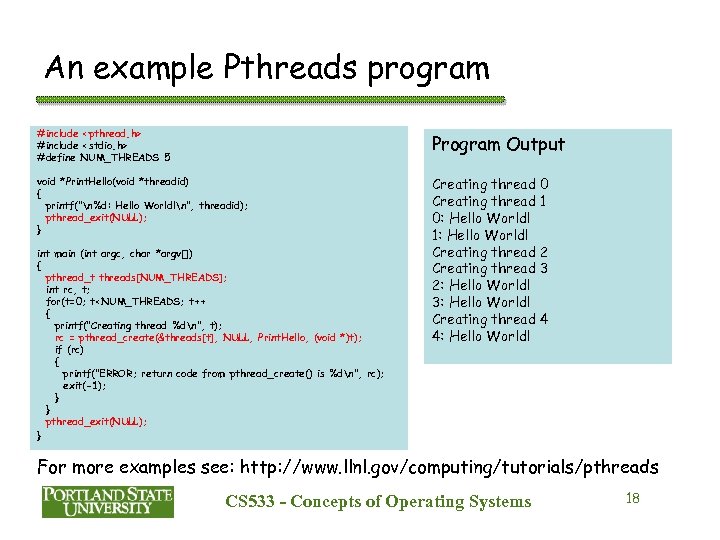 An example Pthreads program #include
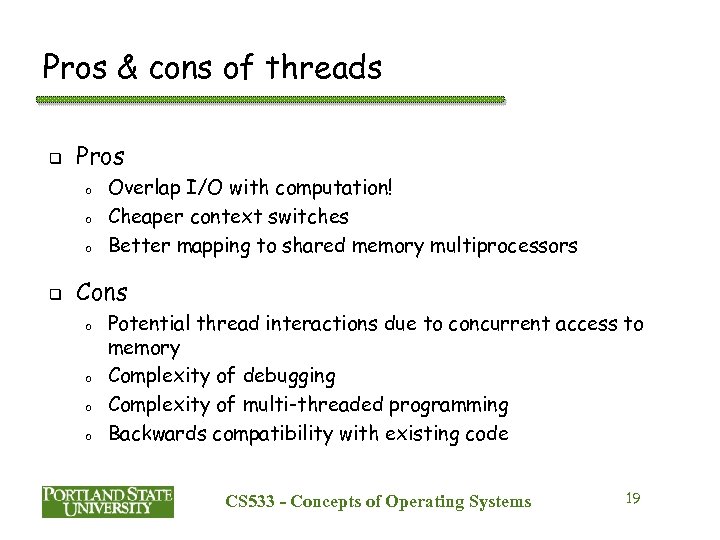 Pros & cons of threads q Pros o o o q Overlap I/O with computation! Cheaper context switches Better mapping to shared memory multiprocessors Cons o o Potential thread interactions due to concurrent access to memory Complexity of debugging Complexity of multi-threaded programming Backwards compatibility with existing code CS 533 - Concepts of Operating Systems 19
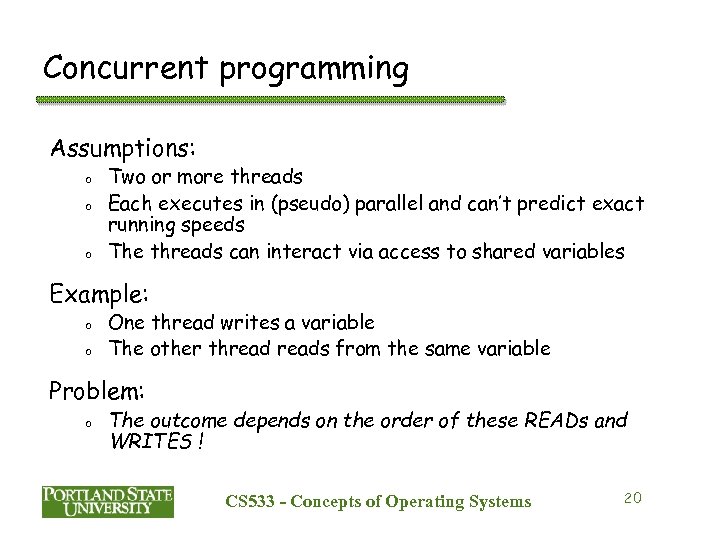 Concurrent programming Assumptions: o o o Two or more threads Each executes in (pseudo) parallel and can’t predict exact running speeds The threads can interact via access to shared variables Example: o o One thread writes a variable The other threads from the same variable Problem: o The outcome depends on the order of these READs and WRITES ! CS 533 - Concepts of Operating Systems 20
 Race conditions q What is a race condition? CS 533 - Concepts of Operating Systems 21
 Race conditions q What is a race condition? o q two or more threads have an inconsistent view of a shared memory region (I. e. , a variable) Why do race conditions occur? CS 533 - Concepts of Operating Systems 22
 Race conditions q What is a race condition? o q two or more threads have an inconsistent view of a shared memory region (I. e. , a variable) Why do race conditions occur? o o o values of memory locations are replicated in registers during execution context switches occur at arbitrary times during execution (or program runs on a multiprocessor) threads can see “stale” memory values in registers CS 533 - Concepts of Operating Systems 23
 Race Conditions q q Race condition: whenever the output depends on the precise execution order of the threads ! What solutions can we apply? CS 533 - Concepts of Operating Systems 24
 Race Conditions q q Race condition: whenever the output depends on the precise execution order of the threads ! What solutions can we apply? o o prevent context switches by preventing interrupts? make threads coordinate with each other to ensure mutual exclusion in accessing critical sections of code CS 533 - Concepts of Operating Systems 25
 Synchronization by mutual exclusion q Divide thread code into critical sections o q Sections where shared data is accessed (read/written) Only allow one thread at a time in a critical section CS 533 - Concepts of Operating Systems 26
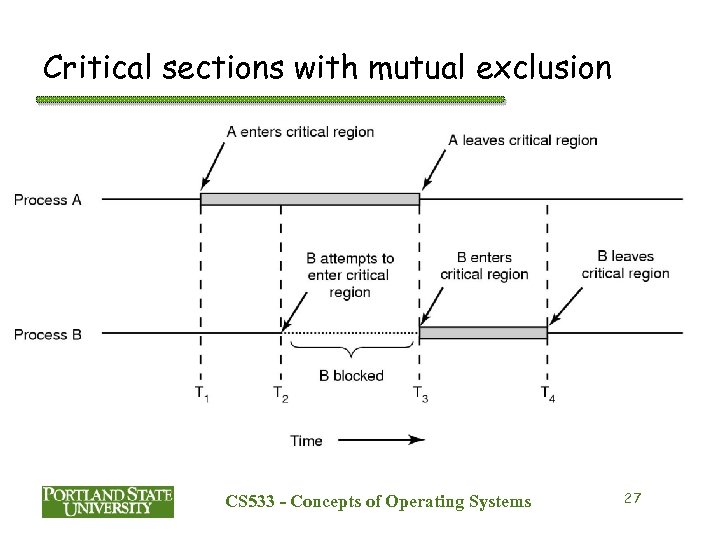 Critical sections with mutual exclusion CS 533 - Concepts of Operating Systems 27
 How can we ensure mutual exclusion? q What about using a binary “lock” variable in memory and having threads check it and set it before entry to critical regions? CS 533 - Concepts of Operating Systems 28
 Implementing locks q q A binary “lock” variable in memory does not work! Many computers have some limited hardware support for atomically testing and setting locks o o q “Atomic” Test and Set Lock instruction “Atomic” compare and swap instruction These atomic instructions can be used to implement mutual exclusion (mutex) locks CS 533 - Concepts of Operating Systems 29
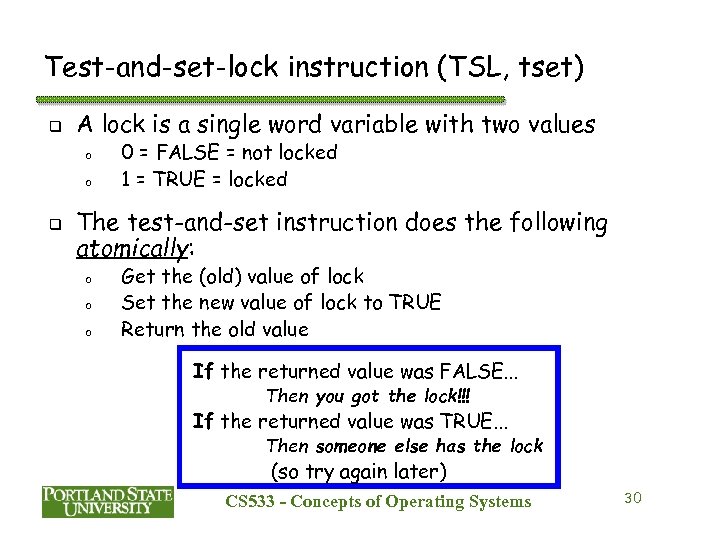 Test-and-set-lock instruction (TSL, tset) q A lock is a single word variable with two values o o q 0 = FALSE = not locked 1 = TRUE = locked The test-and-set instruction does the following atomically: o o o Get the (old) value of lock Set the new value of lock to TRUE Return the old value If the returned value was FALSE. . . Then you got the lock!!! If the returned value was TRUE. . . Then someone else has the lock (so try again later) CS 533 - Concepts of Operating Systems 30
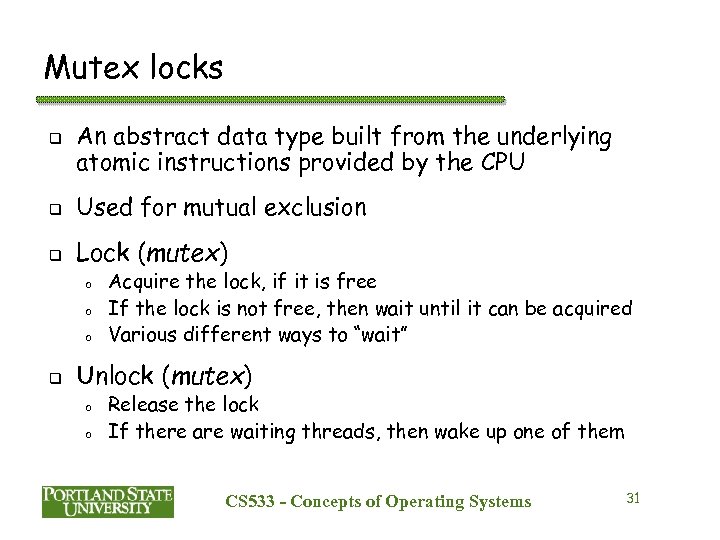 Mutex locks q An abstract data type built from the underlying atomic instructions provided by the CPU q Used for mutual exclusion q Lock (mutex) o o o q Acquire the lock, if it is free If the lock is not free, then wait until it can be acquired Various different ways to “wait” Unlock (mutex) o o Release the lock If there are waiting threads, then wake up one of them CS 533 - Concepts of Operating Systems 31
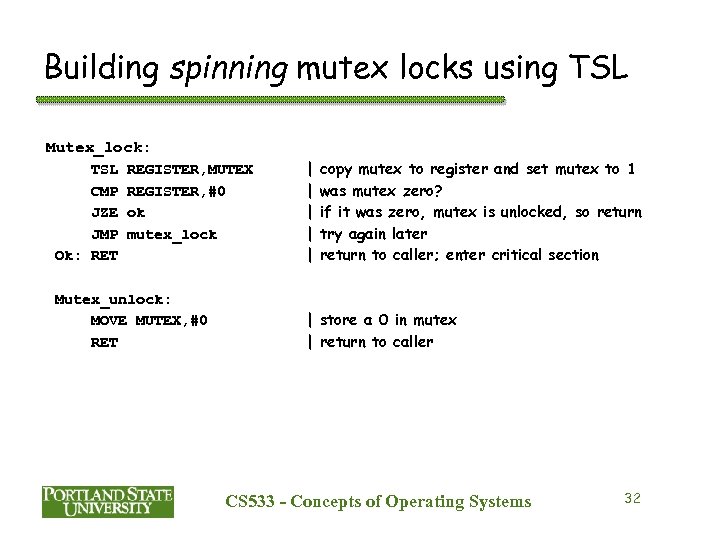 Building spinning mutex locks using TSL Mutex_lock: TSL CMP JZE JMP Ok: RET REGISTER, MUTEX REGISTER, #0 ok mutex_lock Mutex_unlock: MOVE MUTEX, #0 RET | | | copy mutex to register and set mutex to 1 was mutex zero? if it was zero, mutex is unlocked, so return try again later return to caller; enter critical section | store a 0 in mutex | return to caller CS 533 - Concepts of Operating Systems 32
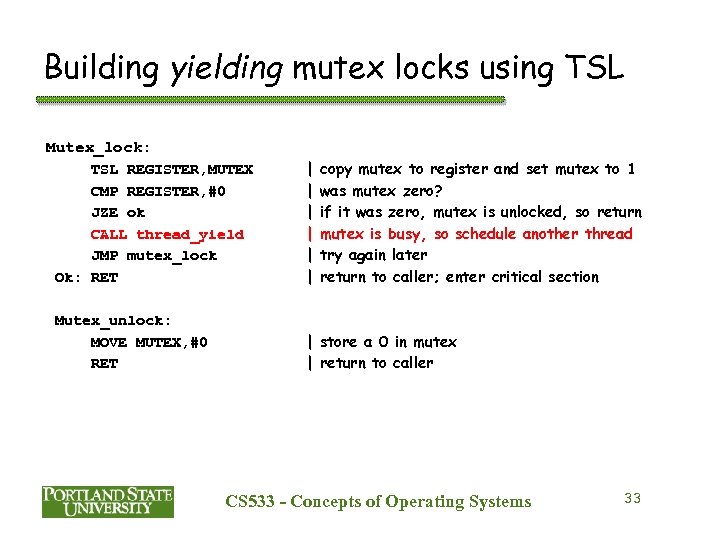 Building yielding mutex locks using TSL Mutex_lock: TSL REGISTER, MUTEX CMP REGISTER, #0 JZE ok CALL thread_yield JMP mutex_lock Ok: RET | | | copy mutex to register and set mutex to 1 was mutex zero? if it was zero, mutex is unlocked, so return mutex is busy, so schedule another thread try again later return to caller; enter critical section Mutex_unlock: MOVE MUTEX, #0 RET | store a 0 in mutex | return to caller CS 533 - Concepts of Operating Systems 33
 To yield or not to yield? q Spin-locks do busy waiting o o q Yielding locks give up the CPU o o q wastes CPU cycles on uni-processors Why? may waste CPU cycles on multi-processors Why? Yielding is not the same as blocking! CS 533 - Concepts of Operating Systems 34
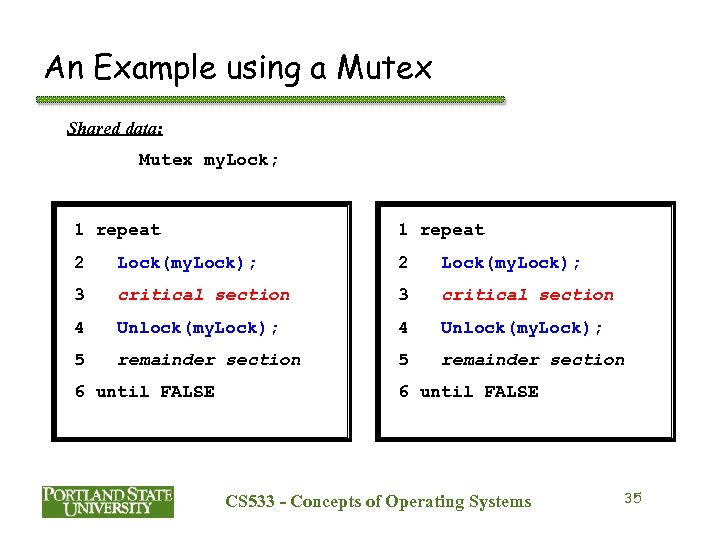 An Example using a Mutex Shared data: Mutex my. Lock; 1 repeat 2 Lock(my. Lock); 3 critical section 4 Unlock(my. Lock); 5 remainder section 6 until FALSE CS 533 - Concepts of Operating Systems 35
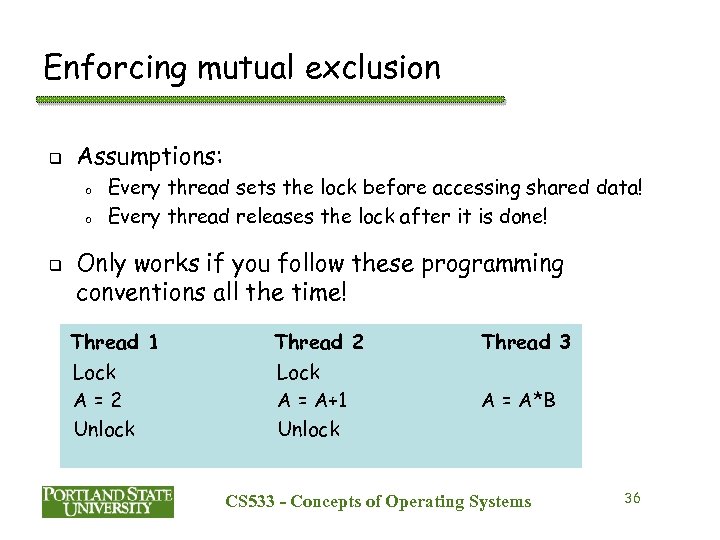 Enforcing mutual exclusion q Assumptions: o o q Every thread sets the lock before accessing shared data! Every thread releases the lock after it is done! Only works if you follow these programming conventions all the time! Thread 1 Lock A=2 Unlock Thread 2 Lock A = A+1 Unlock Thread 3 A = A*B CS 533 - Concepts of Operating Systems 36
 Using Pthread mutex variables q Pthread_mutex_lock (mutex) o q Pthread_mutex_trylock (mutex) o q Acquire the lock or block until it is acquired Acquire the lock or return with “busy” error code Pthread_mutex_unlock (mutex) o Free the lock CS 533 - Concepts of Operating Systems 37
 Invariant of a mutex q The mutex “invariant” is the condition that must be restored before: o q The mutex is released Example o Invariant A=B • o always holds outside the critical section Critical section updates A and B CS 533 - Concepts of Operating Systems 38
 What does “thread-safe” mean? CS 533 - Concepts of Operating Systems 39
 What does “thread-safe” mean? q q A piece of code (library) is “thread-safe” if it defines critical sections and uses synchronization to control access to them All entry points must be re-entrant Results not returned in shared global variables nor global statically allocated storage All calls should be synchronous CS 533 - Concepts of Operating Systems 40
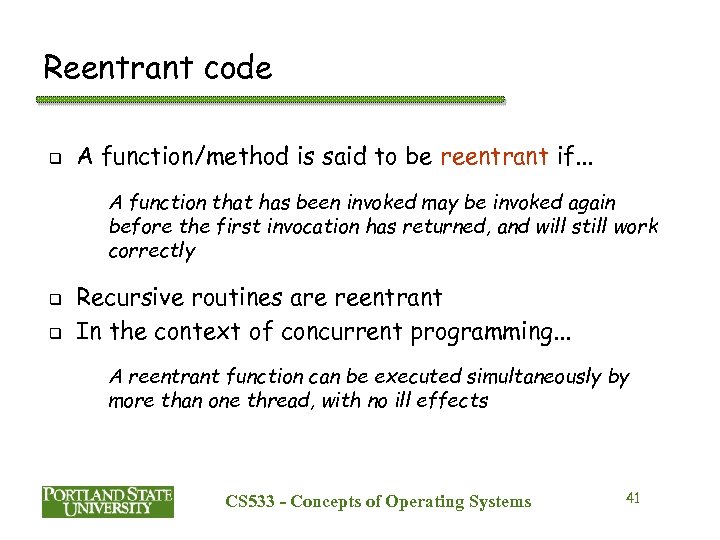 Reentrant code q A function/method is said to be reentrant if. . . A function that has been invoked may be invoked again before the first invocation has returned, and will still work correctly q q Recursive routines are reentrant In the context of concurrent programming. . . A reentrant function can be executed simultaneously by more than one thread, with no ill effects CS 533 - Concepts of Operating Systems 41
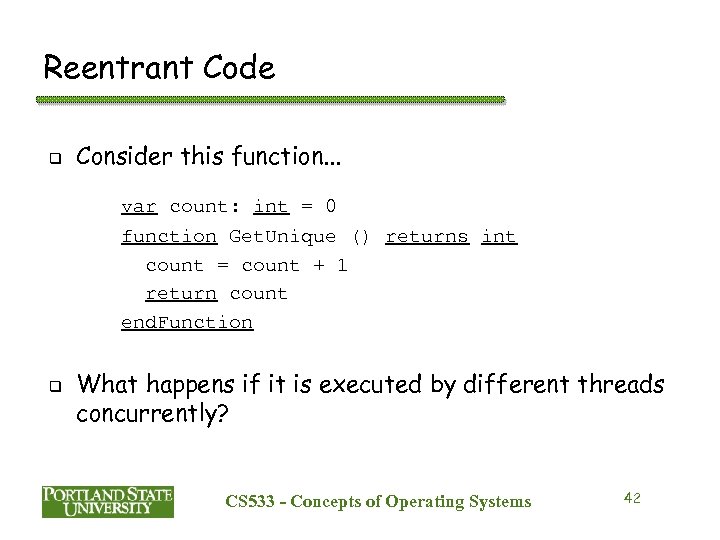 Reentrant Code q Consider this function. . . var count: int = 0 function Get. Unique () returns int count = count + 1 return count end. Function q What happens if it is executed by different threads concurrently? CS 533 - Concepts of Operating Systems 42
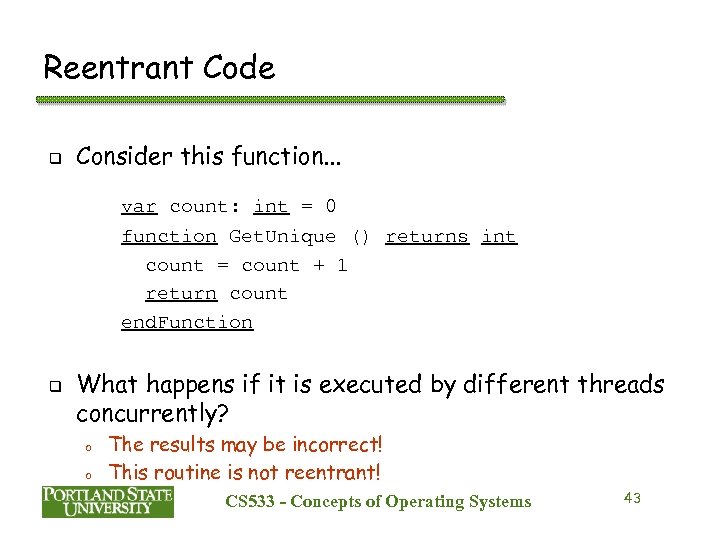 Reentrant Code q Consider this function. . . var count: int = 0 function Get. Unique () returns int count = count + 1 return count end. Function q What happens if it is executed by different threads concurrently? o o The results may be incorrect! This routine is not reentrant! CS 533 - Concepts of Operating Systems 43
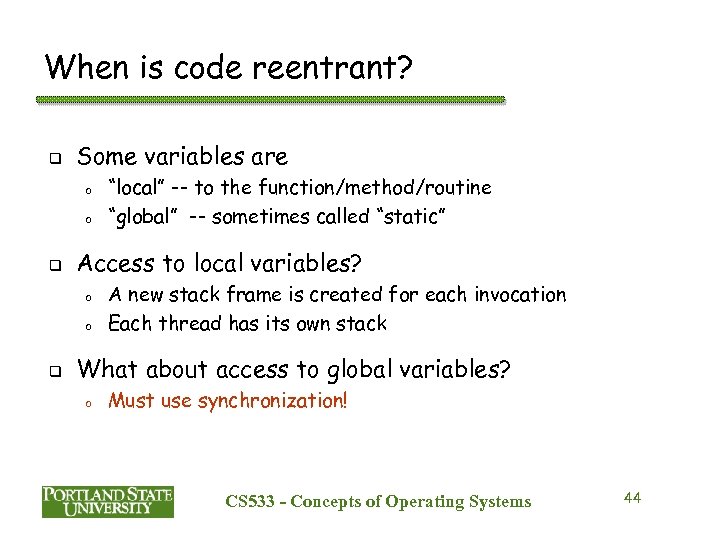 When is code reentrant? q Some variables are o o q Access to local variables? o o q “local” -- to the function/method/routine “global” -- sometimes called “static” A new stack frame is created for each invocation Each thread has its own stack What about access to global variables? o Must use synchronization! CS 533 - Concepts of Operating Systems 44
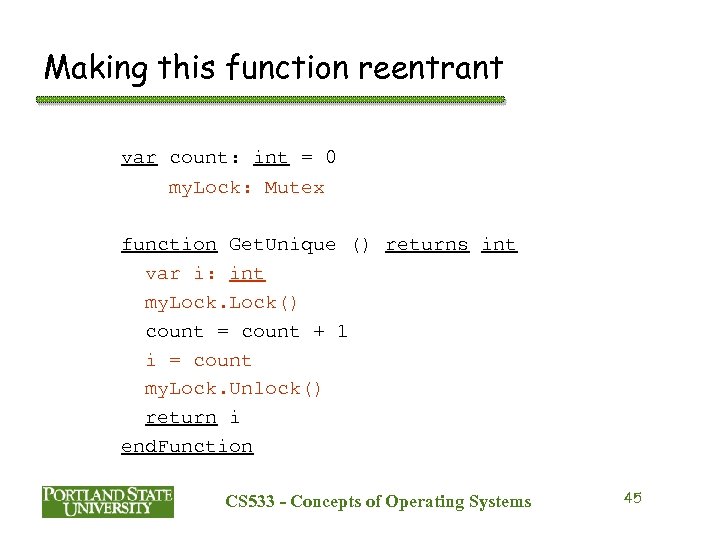 Making this function reentrant var count: int = 0 my. Lock: Mutex function Get. Unique () returns int var i: int my. Lock() count = count + 1 i = count my. Lock. Unlock() return i end. Function CS 533 - Concepts of Operating Systems 45
 Question q What is the difference between mutual exclusion and condition synchronization? CS 533 - Concepts of Operating Systems 46
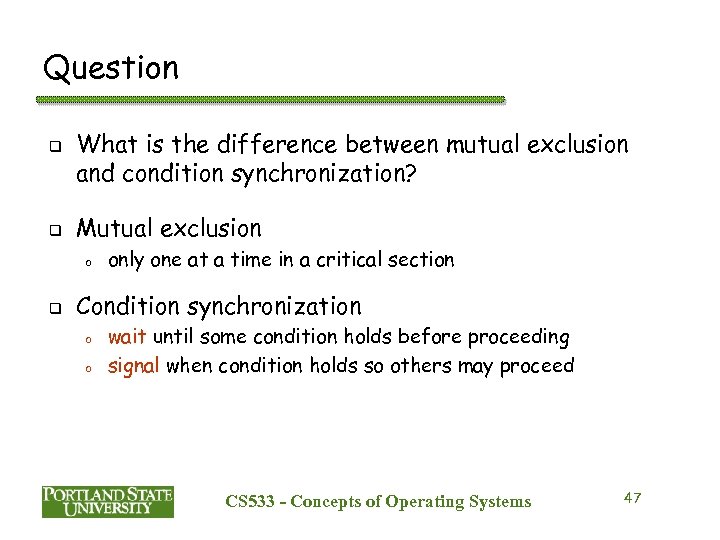 Question q q What is the difference between mutual exclusion and condition synchronization? Mutual exclusion o q only one at a time in a critical section Condition synchronization o o wait until some condition holds before proceeding signal when condition holds so others may proceed CS 533 - Concepts of Operating Systems 47
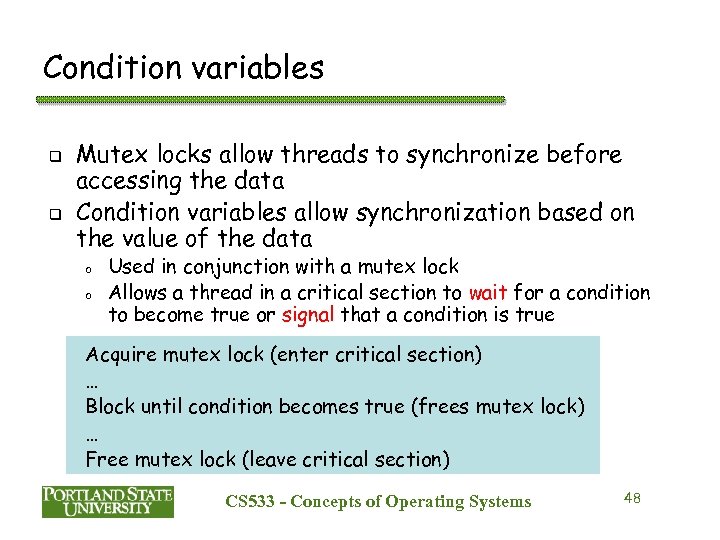 Condition variables q q Mutex locks allow threads to synchronize before accessing the data Condition variables allow synchronization based on the value of the data o o Used in conjunction with a mutex lock Allows a thread in a critical section to wait for a condition to become true or signal that a condition is true Acquire mutex lock (enter critical section) … Block until condition becomes true (frees mutex lock) … Free mutex lock (leave critical section) CS 533 - Concepts of Operating Systems 48
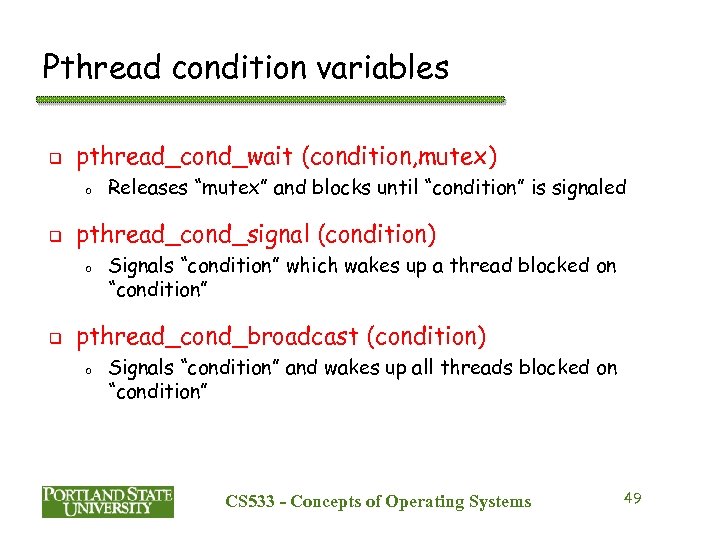 Pthread condition variables q pthread_cond_wait (condition, mutex) o q pthread_cond_signal (condition) o q Releases “mutex” and blocks until “condition” is signaled Signals “condition” which wakes up a thread blocked on “condition” pthread_cond_broadcast (condition) o Signals “condition” and wakes up all threads blocked on “condition” CS 533 - Concepts of Operating Systems 49
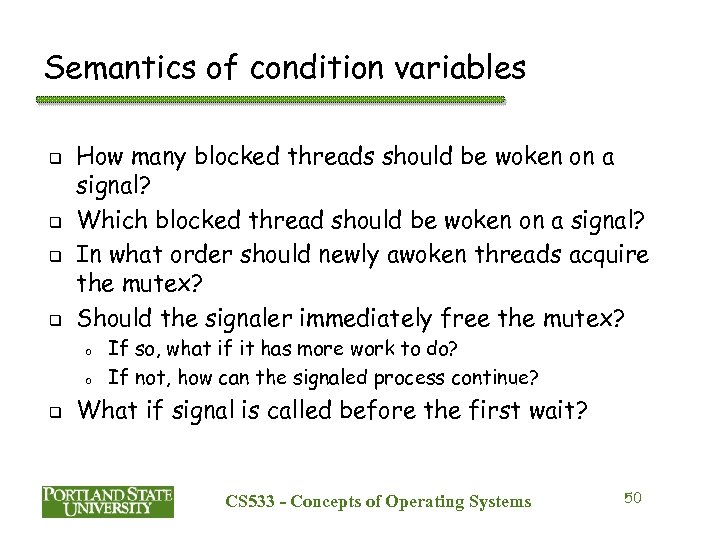 Semantics of condition variables q q How many blocked threads should be woken on a signal? Which blocked thread should be woken on a signal? In what order should newly awoken threads acquire the mutex? Should the signaler immediately free the mutex? o o q If so, what if it has more work to do? If not, how can the signaled process continue? What if signal is called before the first wait? CS 533 - Concepts of Operating Systems 50
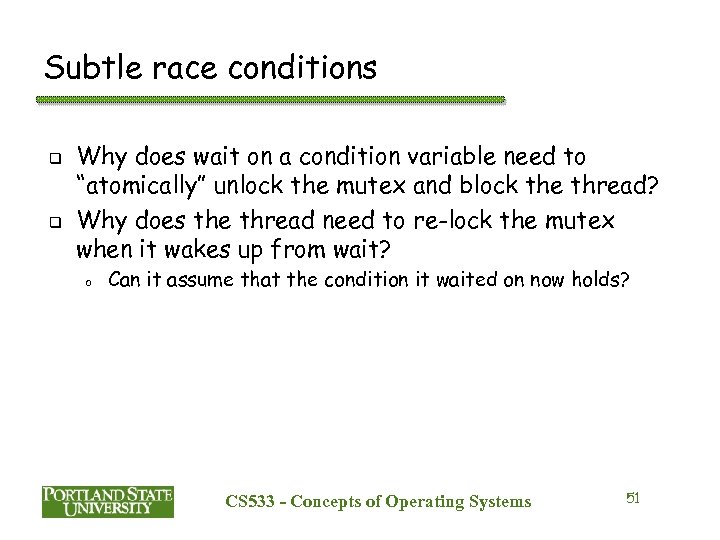 Subtle race conditions q q Why does wait on a condition variable need to “atomically” unlock the mutex and block the thread? Why does the thread need to re-lock the mutex when it wakes up from wait? o Can it assume that the condition it waited on now holds? CS 533 - Concepts of Operating Systems 51
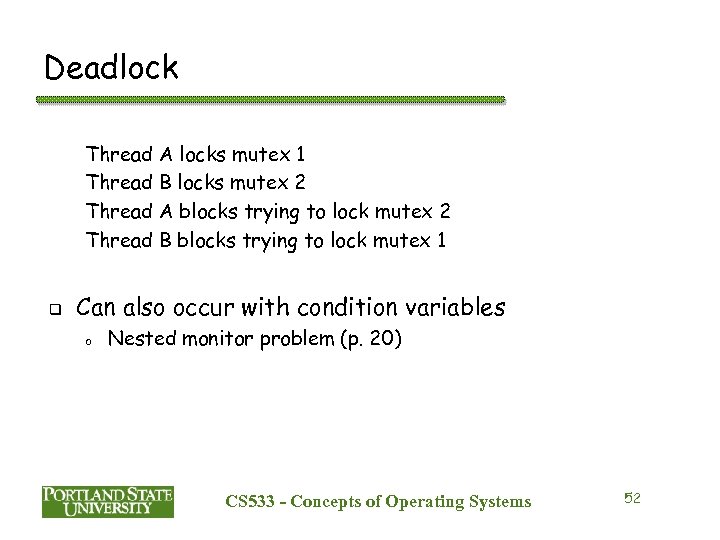 Deadlock Thread A locks mutex 1 Thread B locks mutex 2 Thread A blocks trying to lock mutex 2 Thread B blocks trying to lock mutex 1 q Can also occur with condition variables o Nested monitor problem (p. 20) CS 533 - Concepts of Operating Systems 52
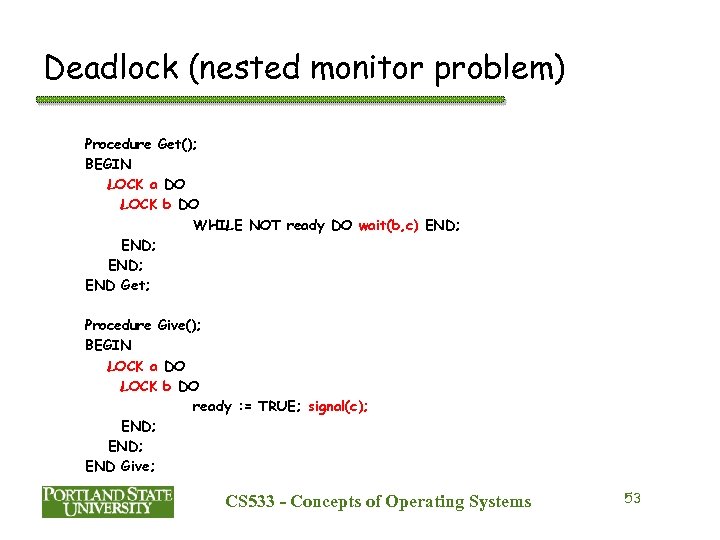 Deadlock (nested monitor problem) Procedure Get(); BEGIN LOCK a DO LOCK b DO WHILE NOT ready DO wait(b, c) END; END Get; Procedure Give(); BEGIN LOCK a DO LOCK b DO ready : = TRUE; signal(c); END; END Give; CS 533 - Concepts of Operating Systems 53
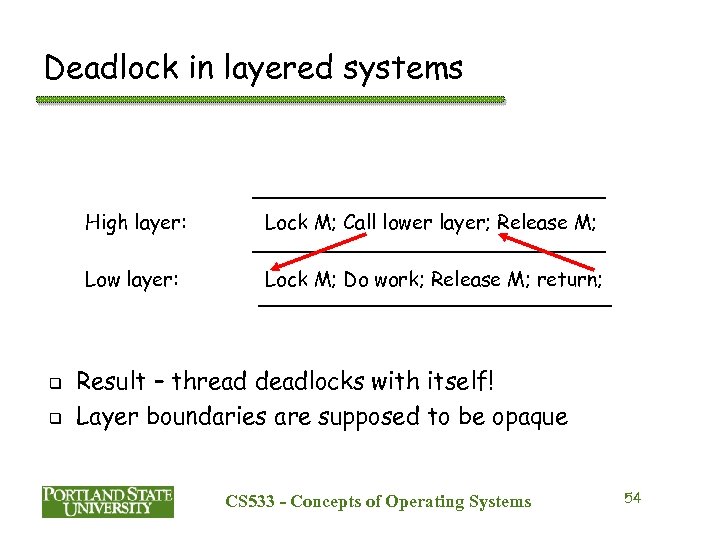 Deadlock in layered systems High layer: Low layer: q q Lock M; Call lower layer; Release M; Lock M; Do work; Release M; return; Result – thread deadlocks with itself! Layer boundaries are supposed to be opaque CS 533 - Concepts of Operating Systems 54
 Deadlock q Why is it better to have a deadlock than a race? CS 533 - Concepts of Operating Systems 55
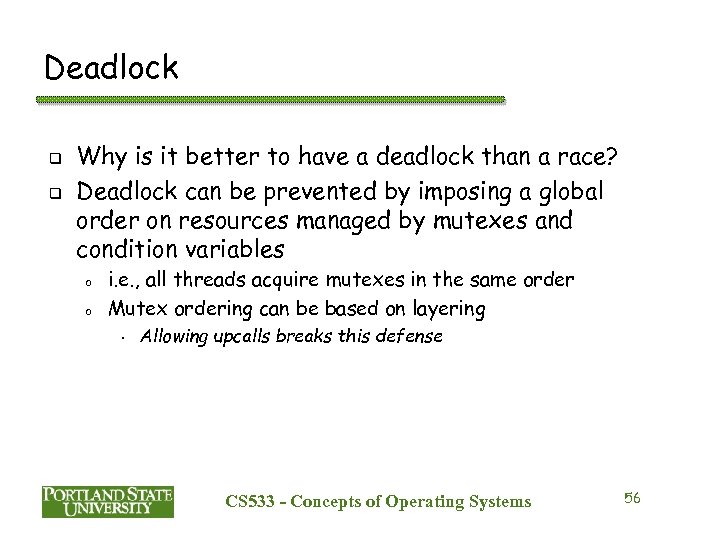 Deadlock q q Why is it better to have a deadlock than a race? Deadlock can be prevented by imposing a global order on resources managed by mutexes and condition variables o o i. e. , all threads acquire mutexes in the same order Mutex ordering can be based on layering • Allowing upcalls breaks this defense CS 533 - Concepts of Operating Systems 56
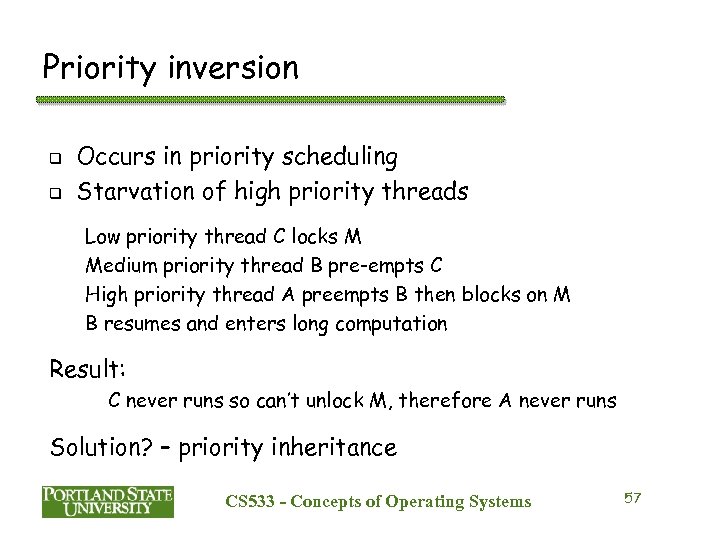 Priority inversion q q Occurs in priority scheduling Starvation of high priority threads Low priority thread C locks M Medium priority thread B pre-empts C High priority thread A preempts B then blocks on M B resumes and enters long computation Result: C never runs so can’t unlock M, therefore A never runs Solution? – priority inheritance CS 533 - Concepts of Operating Systems 57
 Dangers of blocking in a critical section q q q Blocking while holding M prevents progress of other threads that need M Blocking on another mutex may lead to deadlock Why not release the mutex before blocking? o o o Must restore the mutex invariant Must reacquire the mutex on return! Things may have changed while you were gone … CS 533 - Concepts of Operating Systems 58
 Reader/writer locking q q q Writers exclude readers and writers Readers exclude writers but not readers Example, page 15 o o q Move signal/broadcast call after release of mutex? o q Good use of broadcast in Release. Exclusive() Results in “spurious wake-ups” … and “spurious lock conflicts” How could you use signal instead? Advantages? Disadvantages? Can we avoid writer starvation? CS 533 - Concepts of Operating Systems 59
 Useful programming conventions q All access to shared data must be potected by a mutex o o q All shared variables have a lock The lock is held by the thread that accesses the variable How can this be checked? o o Statically? Dynamically? CS 533 - Concepts of Operating Systems 60
 Automated checking of conventions q Eraser o o o q A dynamic checker that uses binary re-writing techniques Gathers an “execution history” of reads, writes and lock acquisitions Evaluates consistency with rules Is it enough to simply check that some lock is held whenever a global variable is accessed? CS 533 - Concepts of Operating Systems 61
 Automated checking of conventions q q Eraser doesn’t know ahead of time which locks protect which variables It infers which locks protect which variables using a lock-set algorithm o o o Assume all locks are candidates for a variable ( C(v) is full) For each access take intersection of C(v) and locks held by thread and make these the candidate set C(v) If C(v) becomes empty, issue warning CS 533 - Concepts of Operating Systems 62
 Improving the locking discipline q q The standard approach produces many false positives that arise due to special cases: Initialization o q Read sharing o q No need to lock if no thread has a reference yet No need to lock if all threads are readers Reader/writer locking o Distinguish concurrent readers from concurrent readers and writers CS 533 - Concepts of Operating Systems 63
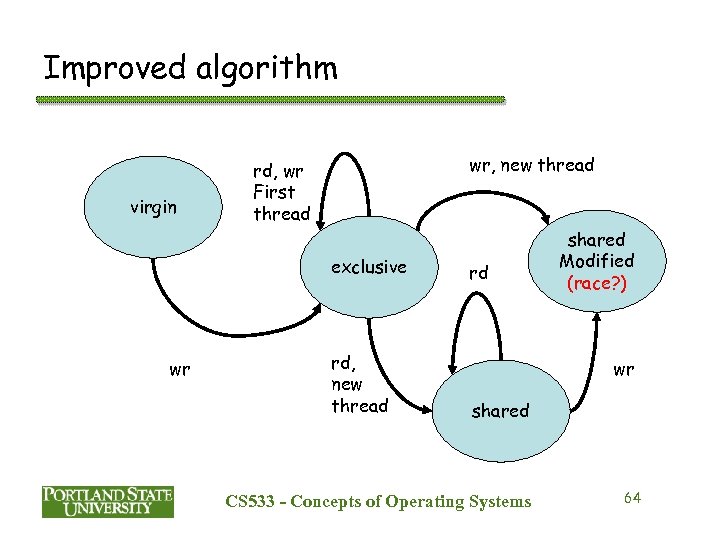 Improved algorithm virgin wr, new thread rd, wr First thread exclusive wr rd, new thread rd shared Modified (race? ) wr shared CS 533 - Concepts of Operating Systems 64
 Questions q q Why are threads “lightweight”? Why associate thread lifetime with a procedure? Why block instead of spin waiting for a mutex? If a mutex is a resource scheduling mechanism o o q q What is the resource being scheduled? What is the scheduling policy and where is it defined? Why do “alerts” result in complicated programs? What is coarse-grain locking? o o What effect does it have on program complexity? What effect does it have on performance? CS 533 - Concepts of Operating Systems 65
 Questions q What is “lock contention”? o o q Why is it worse on multiprocessors than uniprocessors? What is the solution? … and its cost? What else might cause performance to degrade when you use multiple threads? CS 533 - Concepts of Operating Systems 66
 Why is multi-threaded programming hard? q Many possible interleavings at the instruction level that make it hard to reason about correctness CS 533 - Concepts of Operating Systems 67