


 Скачать презентацию Anxiety disorders A gender test case within
d49faf26cf2aaff9c1a7035e5737273f.ppt
- Количество слайдов: 25
 Anxiety disorders: A gender test case within mental health (care) research Marrie H. J. Bekker and Janneke van Mens. Verhulst Maastricht, January 26 -27 2007 Bekker & van Mens-Verhulst. 2007
 Anxiety disorders and gender: State of the art & Future research • Prevalence/ co-morbidity • Theories • Treatment (effects) Bekker & van Mens-Verhulst. 2007
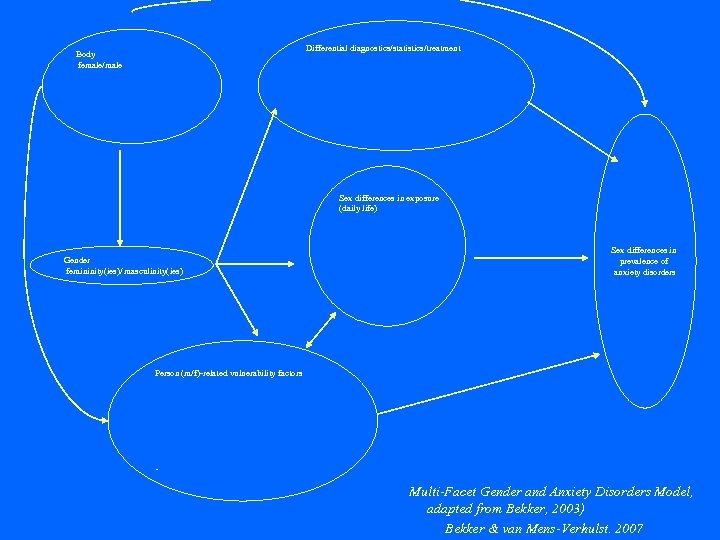 Differential diagnostics/statistics/treatment Body female/male Sex differences in exposure (daily life) Sex differences in prevalence of anxiety disorders Gender femininity(ies)/ masculinity(ies) Person (m/f)-related vulnerability factors - Multi-Facet Gender and Anxiety Disorders Model, adapted from Bekker, 2003) Bekker & van Mens-Verhulst. 2007
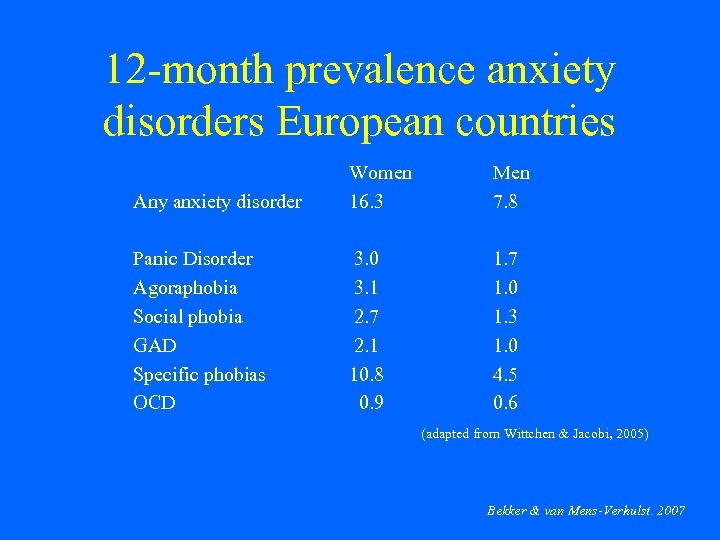 12 -month prevalence anxiety disorders European countries Any anxiety disorder Women 16. 3 Men 7. 8 Panic Disorder Agoraphobia Social phobia GAD Specific phobias OCD 3. 0 3. 1 2. 7 2. 1 10. 8 0. 9 1. 7 1. 0 1. 3 1. 0 4. 5 0. 6 (adapted from Wittchen & Jacobi, 2005) Bekker & van Mens-Verhulst. 2007
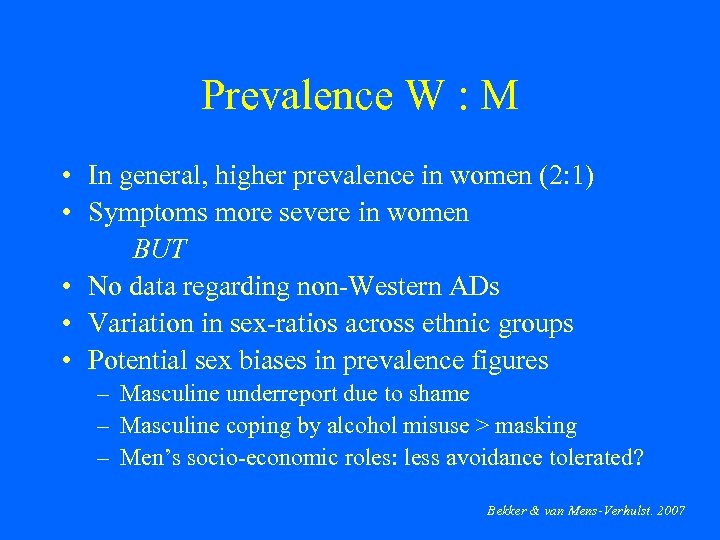 Prevalence W : M • In general, higher prevalence in women (2: 1) • Symptoms more severe in women BUT • No data regarding non-Western ADs • Variation in sex-ratios across ethnic groups • Potential sex biases in prevalence figures – Masculine underreport due to shame – Masculine coping by alcohol misuse > masking – Men’s socio-economic roles: less avoidance tolerated? Bekker & van Mens-Verhulst. 2007
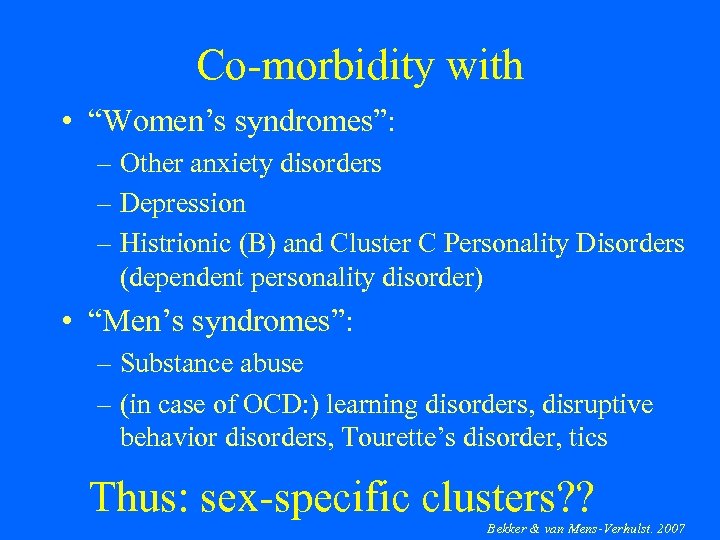 Co-morbidity with • “Women’s syndromes”: – Other anxiety disorders – Depression – Histrionic (B) and Cluster C Personality Disorders (dependent personality disorder) • “Men’s syndromes”: – Substance abuse – (in case of OCD: ) learning disorders, disruptive behavior disorders, Tourette’s disorder, tics Thus: sex-specific clusters? ? Bekker & van Mens-Verhulst. 2007
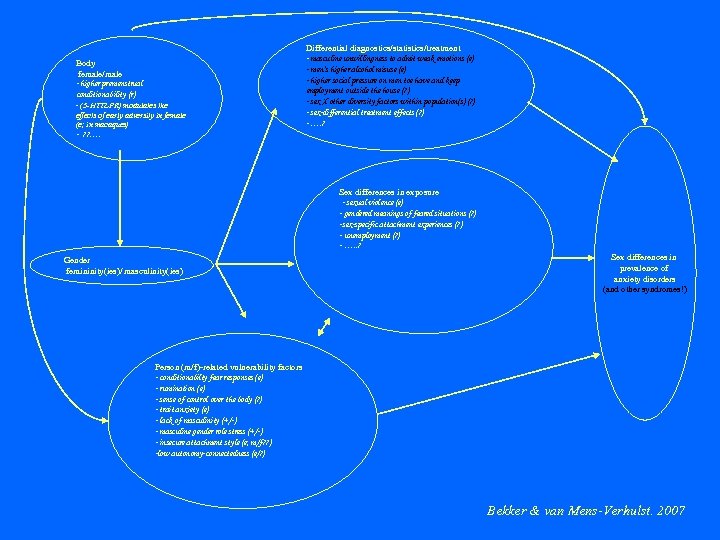 Body female/male - higher premenstrual conditionability (r) - (5 -HTTLPR) modulates the effects of early adversity in female (e; in macaques) Differential diagnostics/statistics/treatment - masculine unwillingness to admit weak emotions (e) - men’s higher alcohol misuse (e) - higher social pressure on men toe have and keep employment outside the house (? ) - sex X other diversity factors within population(s) (? ) - sex-differential treatment effects (? ) - …. ? - ? ? …. Sex differences in exposure - sexual violence (e) - gendered meanings of feared situations (? ) -sex-specific attachment experiences (? ) - unemployment (? ) - …. . ? Sex differences in prevalence of anxiety disorders (and other syndromes!) Gender femininity(ies)/ masculinity(ies) Person (m/f)-related vulnerability factors - conditionabilty fear responses (e) - rumination (e) - sense of control over the body (? ) - trait anxiety (e) - lack of masculinity (+/-) - masculine gender role stress (+/-) - insecure attachment style (e; m/f? ? ) -low autonomy-connectedness (e/? ) Bekker & van Mens-Verhulst. 2007
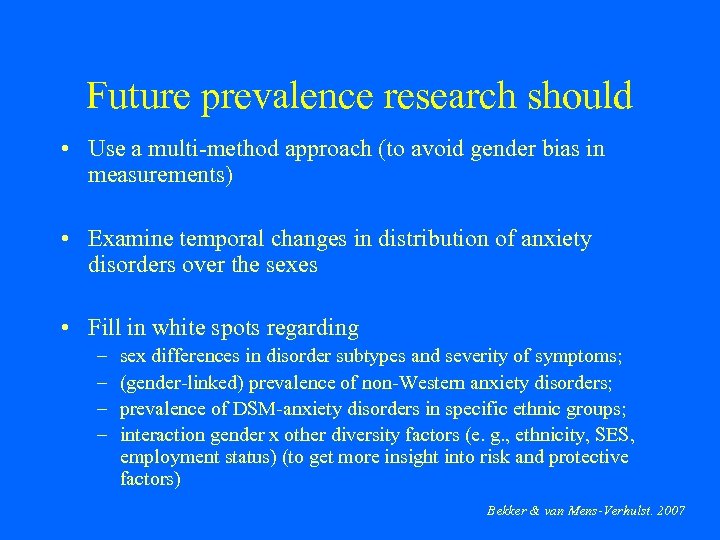 Future prevalence research should • Use a multi-method approach (to avoid gender bias in measurements) • Examine temporal changes in distribution of anxiety disorders over the sexes • Fill in white spots regarding – – sex differences in disorder subtypes and severity of symptoms; (gender-linked) prevalence of non-Western anxiety disorders; prevalence of DSM-anxiety disorders in specific ethnic groups; interaction gender x other diversity factors (e. g. , ethnicity, SES, employment status) (to get more insight into risk and protective factors) Bekker & van Mens-Verhulst. 2007
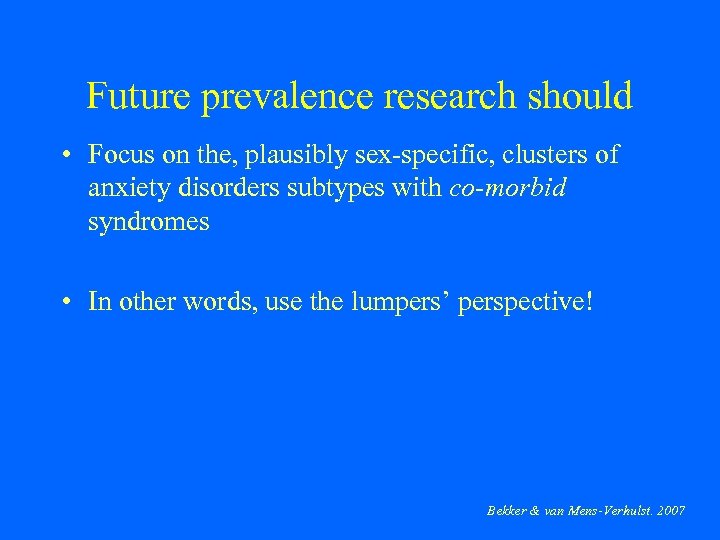 Future prevalence research should • Focus on the, plausibly sex-specific, clusters of anxiety disorders subtypes with co-morbid syndromes • In other words, use the lumpers’ perspective! Bekker & van Mens-Verhulst. 2007
 Anxiety disorders and gender: State of the art & Future research • Prevalence/ co-morbidity • Theories • Treatment (effects) Bekker & van Mens-Verhulst. 2007
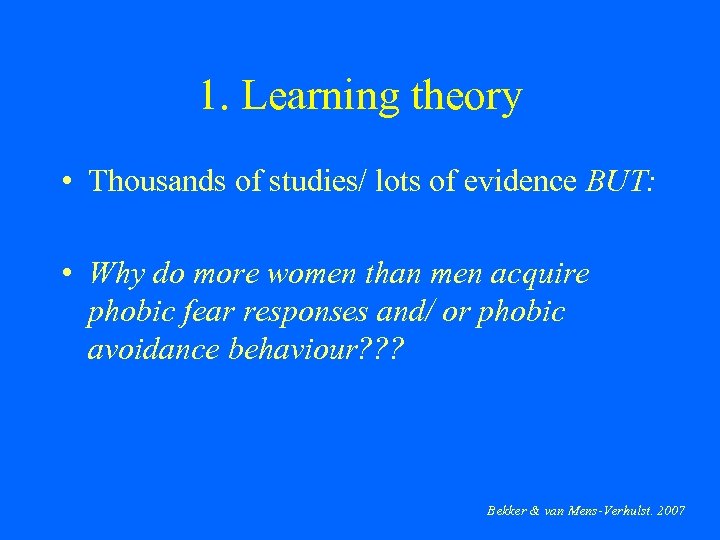 1. Learning theory • Thousands of studies/ lots of evidence BUT: • Why do more women than men acquire phobic fear responses and/ or phobic avoidance behaviour? ? ? Bekker & van Mens-Verhulst. 2007
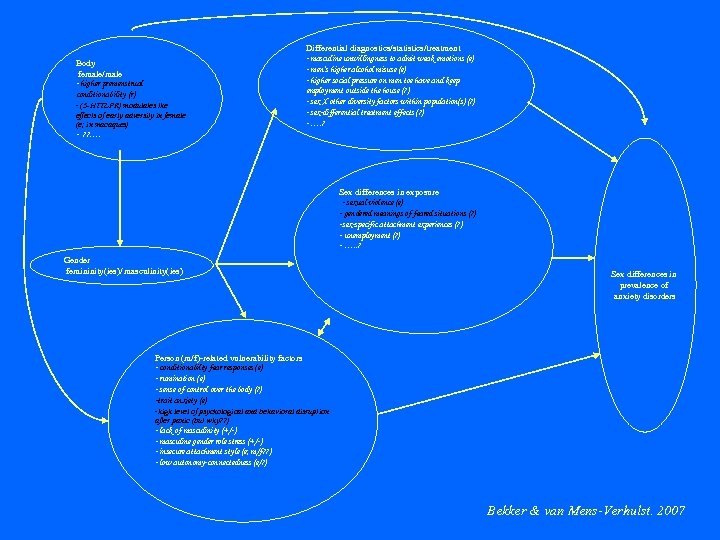 Body female/male - higher premenstrual conditionability (r) - (5 -HTTLPR) modulates the effects of early adversity in female (e; in macaques) Differential diagnostics/statistics/treatment - masculine unwillingness to admit weak emotions (e) - men’s higher alcohol misuse (e) - higher social pressure on men toe have and keep employment outside the house (? ) - sex X other diversity factors within population(s) (? ) - sex-differential treatment effects (? ) - …. ? - ? ? …. Sex differences in exposure - sexual violence (e) - gendered meanings of feared situations (? ) -sex-specific attachment experiences (? ) - unemployment (? ) - …. . ? Gender femininity(ies)/ masculinity(ies) Sex differences in prevalence of anxiety disorders Person (m/f)-related vulnerability factors - conditionabilty fear responses (e) - rumination (e) - sense of control over the body (? ) -trait anxiety (e) -high level of psychological and behavioral disruption after panic (but why? ? ) - lack of masculinity (+/-) - masculine gender role stress (+/-) - insecure attachment style (e; m/f? ? ) - low autonomy-connectedness (e/? ) Bekker & van Mens-Verhulst. 2007
 Future research within the learning perspective should clarify • Why more women than men acquire phobic fears and avoidant behaviours, and/ or • why less men than women acquire these fears and behaviours • The influence of gendered meaning of situations that are feared and avoided • The role of (sexual) violence against women • A possibly gendered pattern of reacting to one’s own bodily sensations Bekker & van Mens-Verhulst. 2007
 2. Sex role theory • Some studies: some indication of a role for (lack of) masculinity, BUT • Why do only a small minority of all women and men develop anxiety disorders? ? ? Bekker & van Mens-Verhulst. 2007
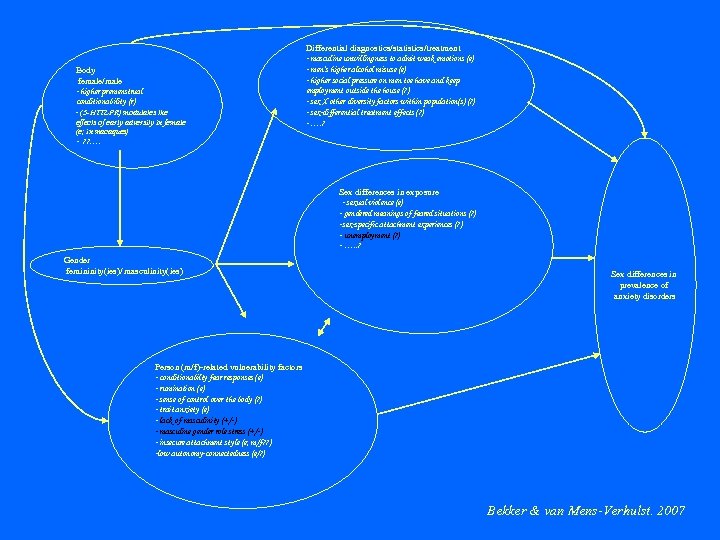 Body female/male - higher premenstrual conditionability (r) - (5 -HTTLPR) modulates the effects of early adversity in female (e; in macaques) Differential diagnostics/statistics/treatment - masculine unwillingness to admit weak emotions (e) - men’s higher alcohol misuse (e) - higher social pressure on men toe have and keep employment outside the house (? ) - sex X other diversity factors within population(s) (? ) - sex-differential treatment effects (? ) - …. ? - ? ? …. Sex differences in exposure - sexual violence (e) - gendered meanings of feared situations (? ) -sex-specific attachment experiences (? ) - unemployment (? ) - …. . ? Gender femininity(ies)/ masculinity(ies) Sex differences in prevalence of anxiety disorders Person (m/f)-related vulnerability factors - conditionabilty fear responses (e) - rumination (e) - sense of control over the body (? ) - trait anxiety (e) - lack of masculinity (+/-) - masculine gender role stress (+/-) - insecure attachment style (e; m/f? ? ) -low autonomy-connectedness (e/? ) Bekker & van Mens-Verhulst. 2007
 Future research within sex/gender role perspectives should clarify • The relations between anxiety disorders, stress anyhow, and stress resulting from gender roles • Why only a small minority of women (and men) develop anxiety disorders whereas all women and men are exposed to existing gender roles • If, how and with which results attention is paid to sex/gender roles within therapy Bekker & van Mens-Verhulst. 2007
 3. Attachment and Schema theory • Almost all studies on attachment and anxiety: No attention paid to sex differences • Clues for explaining the gender issue can be found in combining attachment theory with feminist, object-relational theory Bekker & van Mens-Verhulst. 2007
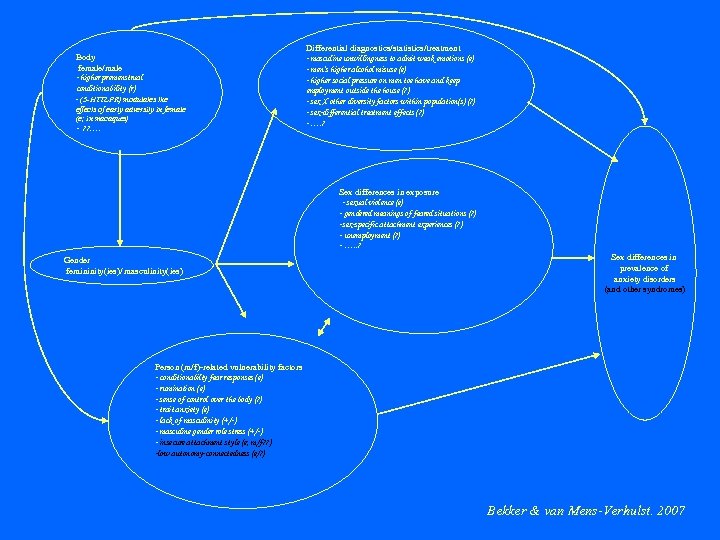 Body female/male - higher premenstrual conditionability (r) - (5 -HTTLPR) modulates the effects of early adversity in female (e; in macaques) - ? ? …. Differential diagnostics/statistics/treatment - masculine unwillingness to admit weak emotions (e) - men’s higher alcohol misuse (e) - higher social pressure on men toe have and keep employment outside the house (? ) - sex X other diversity factors within population(s) (? ) - sex-differential treatment effects (? ) - …. ? Sex differences in exposure - sexual violence (e) - gendered meanings of feared situations (? ) -sex-specific attachment experiences (? ) - unemployment (? ) - …. . ? Sex differences in prevalence of anxiety disorders (and other syndromes) Gender femininity(ies)/ masculinity(ies) Person (m/f)-related vulnerability factors - conditionabilty fear responses (e) - rumination (e) - sense of control over the body (? ) - trait anxiety (e) - lack of masculinity (+/-) - masculine gender role stress (+/-) - insecure attachment style (e; m/f? ? ) -low autonomy-connectedness (e/? ) Bekker & van Mens-Verhulst. 2007
 Future research within attachment and schema theory should clarify: • Gender aspects of autonomy-connectedness and attachment styles • Sex-specific aspects of interaction patterns between care-givers and children resulting in anxiety disorders and their sex-unequal prevalences • Predictive strength of these aspects for anxiety disorders • The processes and mechanisms in between ! Bekker & van Mens-Verhulst. 2007
 Anxiety disorders and gender: State of the art & Future research • Prevalence/ co-morbidity • Theories • Treatment (effects) Bekker & van Mens-Verhulst. 2007
 Studies on (differential) treatment effects in men and women • Are scarce! (Notice the dominance of CBT) • We did not find gender-sensitive interventions! • The scarce data do not yield much differences • Meta-analytical studies (there are many of them!): No attention/ no differences Bekker & van Mens-Verhulst. 2007
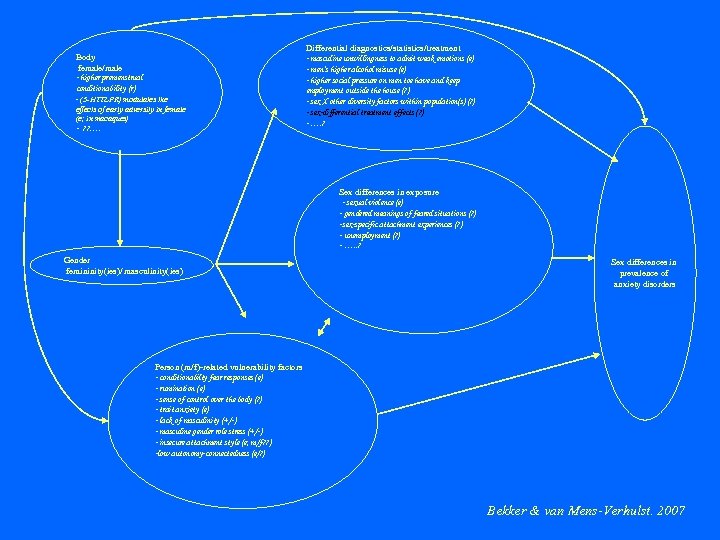 Body female/male - higher premenstrual conditionability (r) - (5 -HTTLPR) modulates the effects of early adversity in female (e; in macaques) - ? ? …. Differential diagnostics/statistics/treatment - masculine unwillingness to admit weak emotions (e) - men’s higher alcohol misuse (e) - higher social pressure on men toe have and keep employment outside the house (? ) - sex X other diversity factors within population(s) (? ) - sex-differential treatment effects (? ) - …. ? Sex differences in exposure - sexual violence (e) - gendered meanings of feared situations (? ) -sex-specific attachment experiences (? ) - unemployment (? ) - …. . ? Gender femininity(ies)/ masculinity(ies) Sex differences in prevalence of anxiety disorders Person (m/f)-related vulnerability factors - conditionabilty fear responses (e) - rumination (e) - sense of control over the body (? ) - trait anxiety (e) - lack of masculinity (+/-) - masculine gender role stress (+/-) - insecure attachment style (e; m/f? ? ) -low autonomy-connectedness (e/? ) Bekker & van Mens-Verhulst. 2007
 Future research should provide information about sex- and genderspecific effects of treatments by: • Including sex/gender-relevant aspects of therapy content and process • Sex/gender-conscious sampling • Using sex/gender sensitive measures • Applying sex-stratification before analyzing • Accounting for sex/gender in meta-analyses Bekker & van Mens-Verhulst. 2007
 General recommendations for future research on anxiety disorders (and gender): • Use sex differences as a source of knowledge! • Implement the available gender-related knowledge into treatment, and examine effects • Apply a gender-sensitive methodology! • Use a lumper’s perspective! Bekker & van Mens-Verhulst. 2007
 Thank you for your attention! Marrie H. J. Bekker and Janneke van Mens. Verhulst Maastricht, January 26 -27 2007 Bekker & van Mens-Verhulst. 2007