


 Скачать презентацию Anura L Jayewardene Ph D Drug Research Unit
19008c134f48c9154b0fc8a8cf55c453.ppt
- Количество слайдов: 1
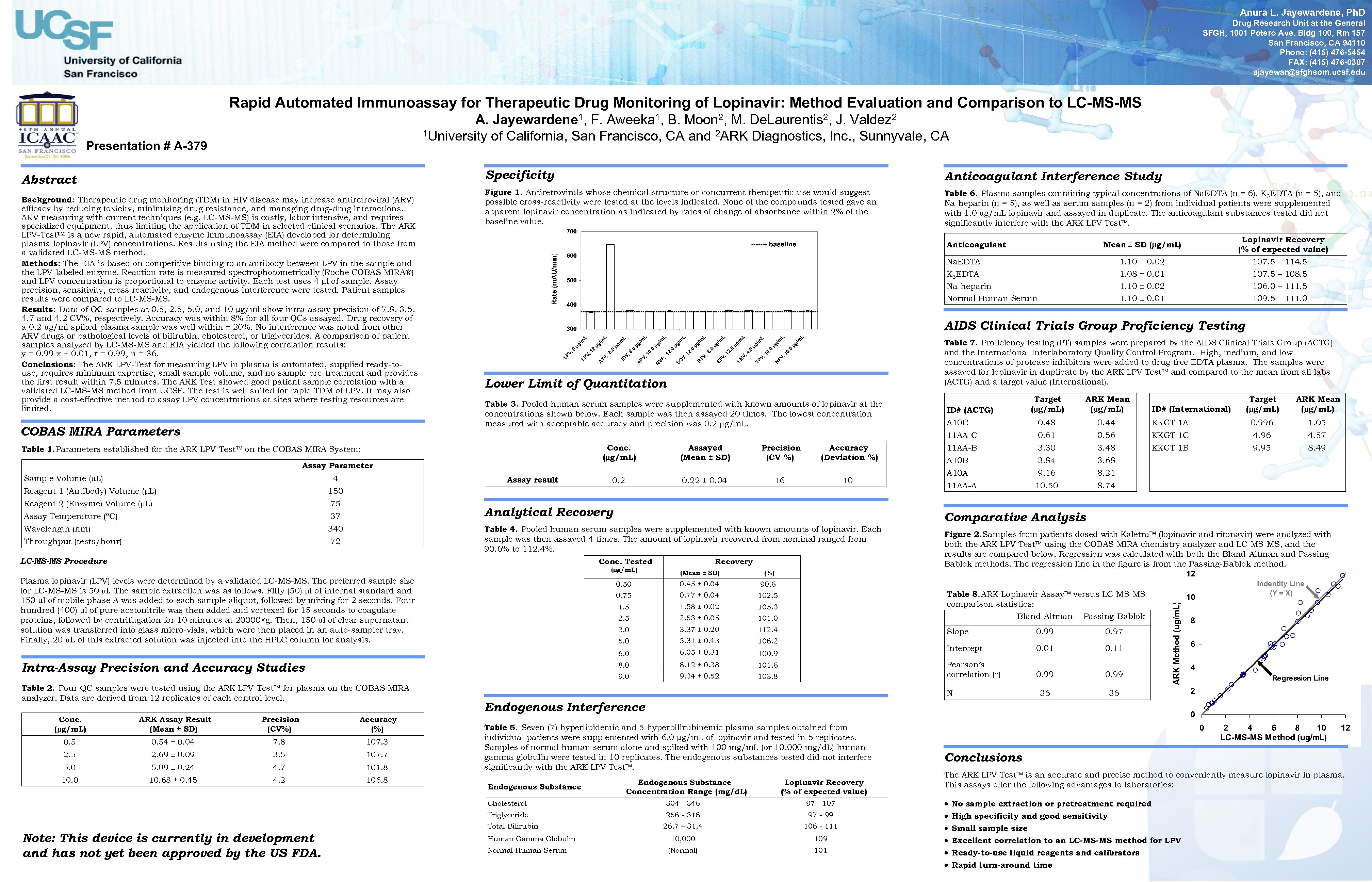 Anura L. Jayewardene, Ph. D Drug Research Unit at the General SFGH, 1001 Potero Ave. Bldg 100, Rm 157 San Francisco, CA 94110 Phone: (415) 476 -5454 FAX: (415) 476 -0307 ajayewar@sfghsom. ucsf. edu Rapid Automated Immunoassay for Therapeutic Drug Monitoring of Lopinavir: Method Evaluation and Comparison to LC-MS-MS A. Jayewardene 1, F. Aweeka 1, B. Moon 2, M. De. Laurentis 2, J. Valdez 2 1 University of California, San Francisco, CA and 2 ARK Diagnostics, Inc. , Sunnyvale, CA Presentation # A-379 Specificity Abstract Background: Therapeutic drug monitoring (TDM) in HIV disease may increase antiretroviral (ARV) efficacy by reducing toxicity, minimizing drug resistance, and managing drug-drug interactions. ARV measuring with current techniques (e. g. LC-MS-MS) is costly, labor intensive, and requires specialized equipment, thus limiting the application of TDM in selected clinical scenarios. The ARK LPV-Test™ is a new rapid, automated enzyme immunoassay (EIA) developed for determining plasma lopinavir (LPV) concentrations. Results using the EIA method were compared to those from a validated LC-MS-MS method. Methods: The EIA is based on competitive binding to an antibody between LPV in the sample and the LPV-labeled enzyme. Reaction rate is measured spectrophotometrically (Roche COBAS MIRA®) and LPV concentration is proportional to enzyme activity. Each test uses 4 µl of sample. Assay precision, sensitivity, cross reactivity, and endogenous interference were tested. Patient samples results were compared to LC-MS-MS. Results: Data of QC samples at 0. 5, 2. 5, 5. 0, and 10 µg/ml show intra-assay precision of 7. 8, 3. 5, 4. 7 and 4. 2 CV%, respectively. Accuracy was within 8% for all four QCs assayed. Drug recovery of a 0. 2 µg/ml spiked plasma sample was well within ± 20%. No interference was noted from other ARV drugs or pathological levels of bilirubin, cholesterol, or triglycerides. A comparison of patient samples analyzed by LC-MS-MS and EIA yielded the following correlation results: y = 0. 99 x + 0. 01, r = 0. 99, n = 36. Conclusions: The ARK LPV-Test for measuring LPV in plasma is automated, supplied ready-touse, requires minimum expertise, small sample volume, and no sample pre-treatment and provides the first result within 7. 5 minutes. The ARK Test showed good patient sample correlation with a validated LC-MS-MS method from UCSF. The test is well suited for rapid TDM of LPV. It may also provide a cost-effective method to assay LPV concentrations at sites where testing resources are limited. Anticoagulant Interference Study Figure 1. Antiretrovirals whose chemical structure or concurrent therapeutic use would suggest possible cross-reactivity were tested at the levels indicated. None of the compounds tested gave an apparent lopinavir concentration as indicated by rates of change of absorbance within 2% of the baseline value. Table 6. Plasma samples containing typical concentrations of Na. EDTA (n = 6), K 3 EDTA (n = 5), and Na-heparin (n = 5), as well as serum samples (n = 2) from individual patients were supplemented with 1. 0 µg/m. L lopinavir and assayed in duplicate. The anticoagulant substances tested did not significantly interfere with the ARK LPV Test. Anticoagulant Mean ± SD (µg/m. L) Na. EDTA K 3 EDTA Na-heparin Normal Human Serum 1. 10 1. 08 1. 10 Table 7. Proficiency testing (PT) samples were prepared by the AIDS Clinical Trials Group (ACTG) and the International Interlaboratory Quality Control Program. High, medium, and low concentrations of protease inhibitors were added to drug-free EDTA plasma. The samples were assayed for lopinavir in duplicate by the ARK LPV Test and compared to the mean from all labs (ACTG) and a target value (International). Lower Limit of Quantitation Table 3. Pooled human serum samples were supplemented with known amounts of lopinavir at the concentrations shown below. Each sample was then assayed 20 times. The lowest concentration measured with acceptable accuracy and precision was 0. 2 µg/m. L. Conc. (µg/m. L) Table 1. Parameters established for the ARK LPV-Test on the COBAS MIRA System: Assay Parameter Sample Volume (µL) 4 Reagent 1 (Antibody) Volume (µL) 75 Assay Temperature (ºC) Assay result 37 0. 2 Assayed (Mean ± SD) Precision (CV %) 0. 22 ± 0. 04 Accuracy (Deviation %) 16 10 150 Reagent 2 (Enzyme) Volume (µL) Wavelength (nm) Analytical Recovery Throughput (tests/hour) 72 LC-MS-MS Procedure Target (µg/m. L) ARK Mean (µg/m. L) A 10 C 0. 48 0. 44 KKGT 1 A 0. 996 1. 05 0. 61 0. 56 KKGT 1 C 4. 96 4. 57 11 AA-B 3. 30 3. 48 KKGT 1 B 9. 95 8. 49 A 10 B 3. 84 3. 68 A 10 A 9. 16 8. 21 10. 50 8. 74 ID# (ACTG) 11 AA-A Conc. Tested Recovery Figure 2. Samples from patients dosed with Kaletra (lopinavir and ritonavir) were analyzed with both the ARK LPV Test using the COBAS MIRA chemistry analyzer and LC-MS-MS, and the results are compared below. Regression was calculated with both the Bland-Altman and Passing. Bablok methods. The regression line in the figure is from the Passing-Bablok method. (µg/m. L) Precision (CV%) Accuracy (%) 0. 54 ± 0. 04 7. 8 107. 3 2. 5 2. 69 ± 0. 09 3. 5 107. 7 5. 09 ± 0. 24 4. 7 101. 8 10. 0 10. 68 ± 0. 45 4. 2 106. 8 0. 77 ± 0. 04 102. 5 1. 58 ± 0. 02 105. 3 2. 53 ± 0. 05 101. 0 Table 8. ARK Lopinavir Assay versus LC-MS-MS comparison statistics: Bland-Altman Passing-Bablok 3. 0 3. 37 ± 0. 20 112. 4 Slope 0. 99 0. 97 5. 0 5. 31 ± 0. 43 106. 2 6. 05 ± 0. 31 100. 9 Intercept 0. 01 0. 11 8. 12 ± 0. 38 101. 6 9. 0 ARK Assay Result (Mean ± SD) 90. 6 8. 0 Conc. (µg/m. L) 0. 45 ± 0. 04 6. 0 Table 2. Four QC samples were tested using the ARK LPV-Test for plasma on the COBAS MIRA analyzer. Data are derived from 12 replicates of each control level. (%) 0. 75 Intra-Assay Precision and Accuracy Studies (Mean ± SD) 0. 50 Plasma lopinavir (LPV) levels were determined by a validated LC-MS-MS. The preferred sample size for LC-MS-MS is 50 µl. The sample extraction was as follows. Fifty (50) µl of internal standard and 150 µl of mobile phase A was added to each sample aliquot, followed by mixing for 2 seconds. Four hundred (400) µl of pure acetonitrile was then added and vortexed for 15 seconds to coagulate proteins, followed by centrifugation for 10 minutes at 20000×g. Then, 150 µl of clear supernatant solution was transferred into glass micro-vials, which were then placed in an auto-sampler tray. Finally, 20 µL of this extracted solution was injected into the HPLC column for analysis. 9. 34 ± 0. 52 103. 8 Pearson’s correlation (r) 0. 99 36 36 N Endogenous Interference Table 5. Seven (7) hyperlipidemic and 5 hyperbilirubinemic plasma samples obtained from individual patients were supplemented with 6. 0 µg/m. L of lopinavir and tested in 5 replicates. Samples of normal human serum alone and spiked with 100 mg/m. L (or 10, 000 mg/d. L) human gamma globulin were tested in 10 replicates. The endogenous substances tested did not interfere significantly with the ARK LPV Test. Endogenous Substance Concentration Range (mg/d. L) Lopinavir Recovery (% of expected value) Cholesterol 304 - 346 97 - 107 Triglyceride 256 - 316 97 - 99 26. 7 – 31. 4 106 - 111 10, 000 109 (Normal) 101 Total Bilirubin Note: This device is currently in development and has not yet been approved by the US FDA. ID# (International) Comparative Analysis Table 4. Pooled human serum samples were supplemented with known amounts of lopinavir. Each sample was then assayed 4 times. The amount of lopinavir recovered from nominal ranged from 90. 6% to 112. 4%. 340 0. 02 0. 01 AIDS Clinical Trials Group Proficiency Testing 11 AA-C COBAS MIRA Parameters ± ± Lopinavir Recovery (% of expected value) 107. 5 – 114. 5 107. 5 – 108. 5 106. 0 – 111. 5 109. 5 – 111. 0 Human Gamma Globulin Normal Human Serum Conclusions The ARK LPV Test is an accurate and precise method to conveniently measure lopinavir in plasma. This assays offer the following advantages to laboratories: No sample extraction or pretreatment required High specificity and good sensitivity Small sample size Excellent correlation to an LC-MS-MS method for LPV Ready-to-use liquid reagents and calibrators Rapid turn-around time