 Скачать презентацию Antique Philosophy Boethius Anicius Manlius Severinus Boëthius
фил.pptx
- Количество слайдов: 9



Antique Philosophy Boethius
Anicius Manlius Severinus Boëthius commonly called Boethius (ca. 480– 524 or 525 AD) was a philosopher of the early 6 th century.

Boethius teaching his students (initial in a 1385 Italian manuscript of the Consolation of Philosophy. )
Boethius's best known work is the Consolation of Philosophy, which he wrote most likely while in exile under house arrest or in prison while awaiting his execution, but his lifelong project was a deliberate attempt to preserve ancient classical knowledge, particularly philosophy. This work represented an imaginary dialogue between himself and philosophy, with philosophy being personified by a woman. The book argues that despite the apparent inequality of the world, there is, in Platonic fashion, a higher power and everything else is secondary to that divine Providence.
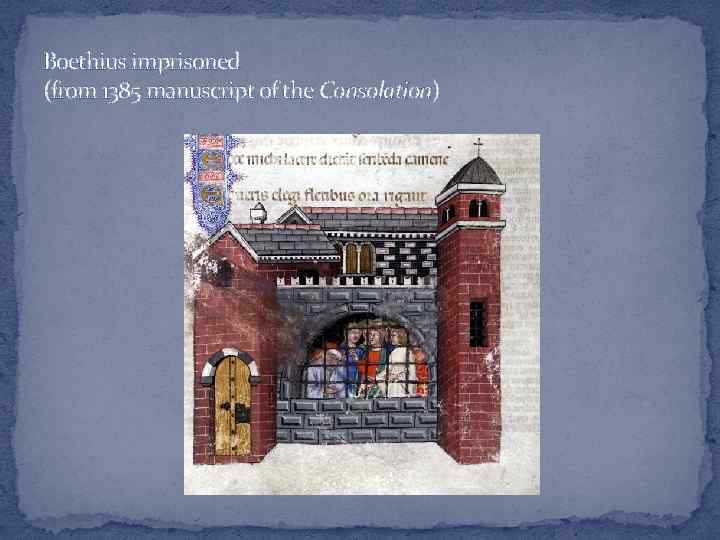
Boethius imprisoned (from 1385 manuscript of the Consolation)
Boethius wrote Christian theological treatises, which generally supported the orthodox position against Arianism and other dissident forms of Christianity. [49] These included On the Trinity, On the Catholic Faith, and a Book against Eutychius and Nestorius. [43]
Boethius is recognized as a martyr for the Catholic faith by the Roman Martyrology. His cult is held in Pavia and in the Church of Santa Maria in Portico in Rome. His feast day is October 23. He was declared a saint by the Sacred Congregation of Rites in 1883, and Pope Benedict XVI explains the relevance of Boethius to modern day Christians by linking his teachings to an understanding of Providence.
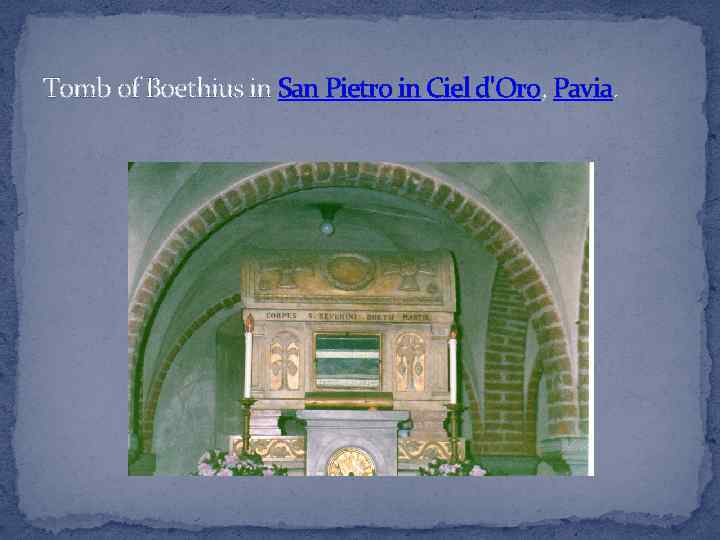
Tomb of Boethius in San Pietro in Ciel d'Oro, Pavia.
 Скачать презентацию Antique Philosophy Boethius Anicius Manlius Severinus Boëthius
фил.pptx