 Скачать презентацию Anticipatory Behavior for Object Recognition and Robot Arm
ca27cd9a9ac64aeb190a6d9e35b61bc4.ppt
- Количество слайдов: 14



Anticipatory Behavior for Object Recognition and Robot Arm Control Modular and Hierarchical Systems, & Anticipatory Behavior and Control Department of Cognitive Psychology University of Würzburg, Germany Martin V. Butz, Oliver Herbort, Joachim Hoffmann, Andrea Kiesel Mind. RACES, First Review Meeting, Lund, 11/01/2006 1
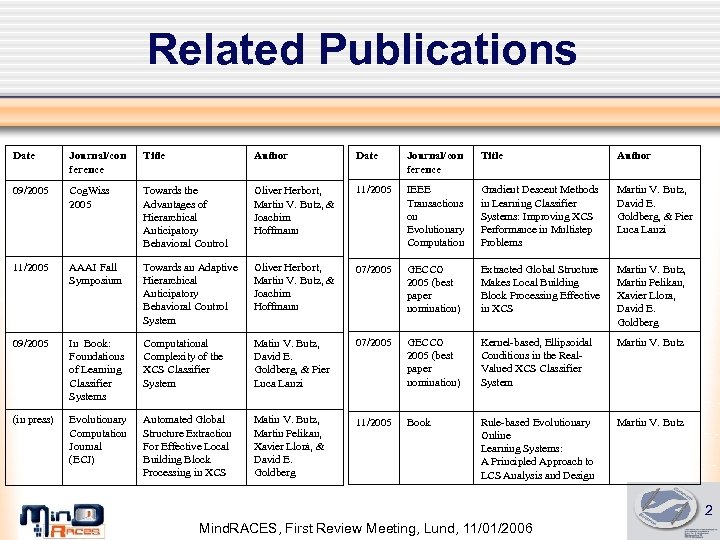
Related Publications Date Journal/con ference Title Author 09/2005 Cog. Wiss 2005 Towards the Advantages of Hierarchical Anticipatory Behavioral Control Oliver Herbort, Martin V. Butz, & Joachim Hoffmann 11/2005 IEEE Transactions on Evolutionary Computation Gradient Descent Methods in Learning Classifier Systems: Improving XCS Performance in Multistep Problems Martin V. Butz, David E. Goldberg, & Pier Luca Lanzi 11/2005 AAAI Fall Symposium Towards an Adaptive Hierarchical Anticipatory Behavioral Control System Oliver Herbort, Martin V. Butz, & Joachim Hoffmann 07/2005 GECCO 2005 (best paper nomination) Extracted Global Structure Makes Local Building Block Processing Effective in XCS Martin V. Butz, Martin Pelikan, Xavier Llora, David E. Goldberg 09/2005 In Book: Foundations of Learning Classifier Systems Computational Complexity of the XCS Classifier System Matin V. Butz, David E. Goldberg, & Pier Luca Lanzi 07/2005 GECCO 2005 (best paper nomination) Kernel-based, Ellipsoidal Conditions in the Real. Valued XCS Classifier System Martin V. Butz (in press) Evolutionary Computation Journal (ECJ) Automated Global Structure Extraction For Effective Local Building Block Processing in XCS Matin V. Butz, Martin Pelikan, Xavier Llorà, & David E. Goldberg 11/2005 Book Rule-based Evolutionary Online Learning Systems: A Principled Approach to LCS Analysis and Design Martin V. Butz 2 Mind. RACES, First Review Meeting, Lund, 11/01/2006
Overview • • Anticipatory Behavioral Control Scenario involvement Modular systems Targeted system integrations w Learning of environment dynamics w Object recognition, symbol grounding w Hierarchical anticipatory arm control 3 Mind. RACES, First Review Meeting, Lund, 11/01/2006
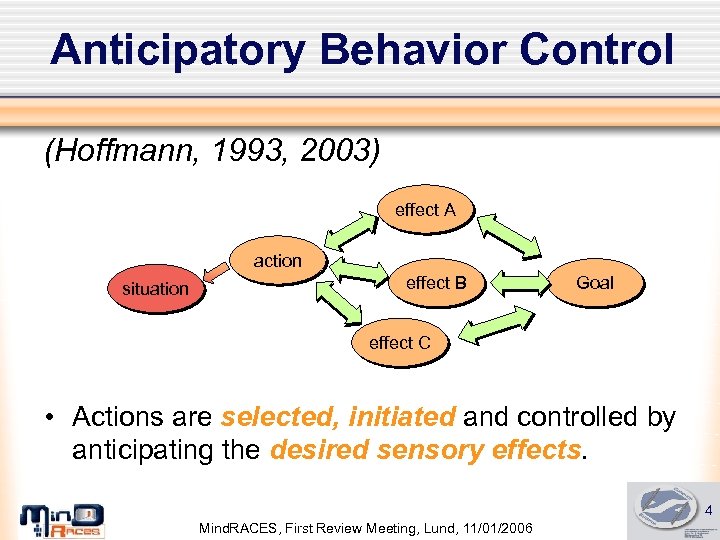
Anticipatory Behavior Control (Hoffmann, 1993, 2003) effect A action situation effect B Goal effect C • Actions are selected, initiated and controlled by anticipating the desired sensory effects. 4 Mind. RACES, First Review Meeting, Lund, 11/01/2006
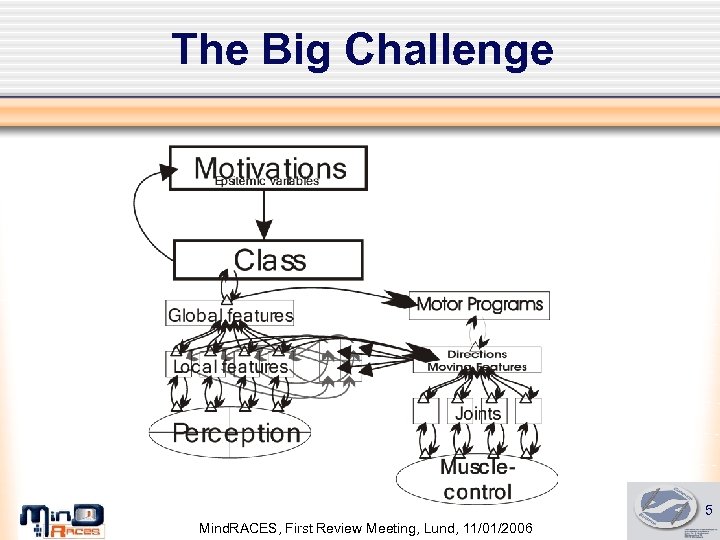
The Big Challenge 5 Mind. RACES, First Review Meeting, Lund, 11/01/2006
Scenario Involvement • Watching a scene, learning existence and behavior of objects (Scenario 2) w Continuous movement w Blocking of movement w Object permanence • Control and manipulation of objects (Scenario 1) w Cognitive, anticipatory arm control w Interactive object manipulation • Finding objects (Scenario 1) w Search of particular objects (with certain properties) w Search in room or house • Behavior triggered by motivations (and possibly emotions) (Scenario 1) 6 Mind. RACES, First Review Meeting, Lund, 11/01/2006
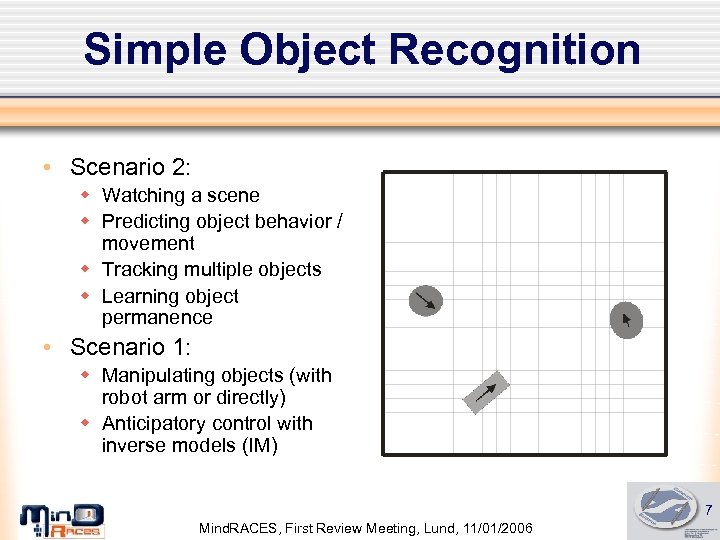
Simple Object Recognition • Scenario 2: w Watching a scene w Predicting object behavior / movement w Tracking multiple objects w Learning object permanence • Scenario 1: w Manipulating objects (with robot arm or directly) w Anticipatory control with inverse models (IM) 7 Mind. RACES, First Review Meeting, Lund, 11/01/2006
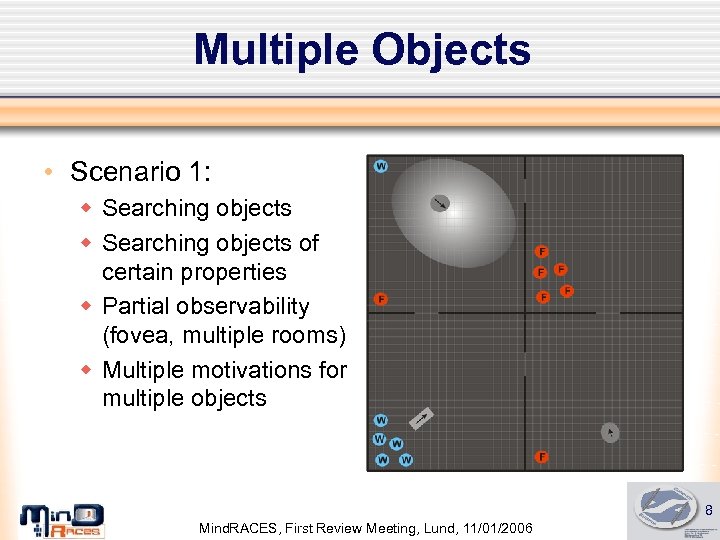
Multiple Objects • Scenario 1: w Searching objects of certain properties w Partial observability (fovea, multiple rooms) w Multiple motivations for multiple objects 8 Mind. RACES, First Review Meeting, Lund, 11/01/2006
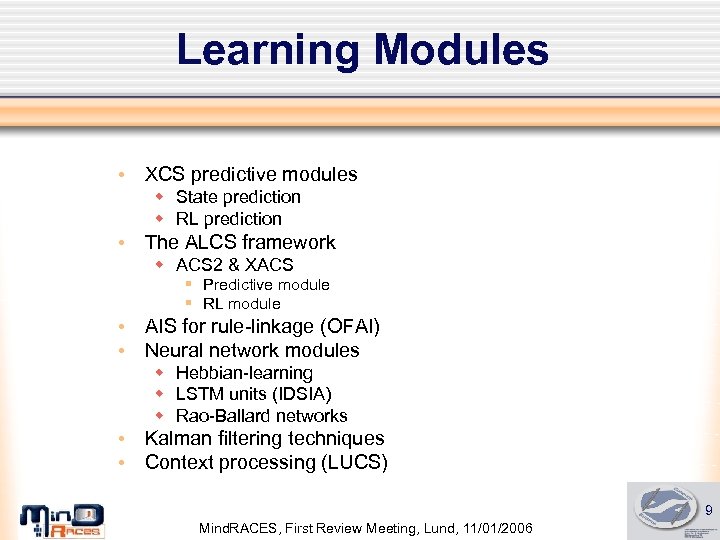
Learning Modules • XCS predictive modules w State prediction w RL prediction • The ALCS framework w ACS 2 & XACS § Predictive module § RL module • AIS for rule-linkage (OFAI) • Neural network modules w Hebbian-learning w LSTM units (IDSIA) w Rao-Ballard networks • Kalman filtering techniques • Context processing (LUCS) 9 Mind. RACES, First Review Meeting, Lund, 11/01/2006
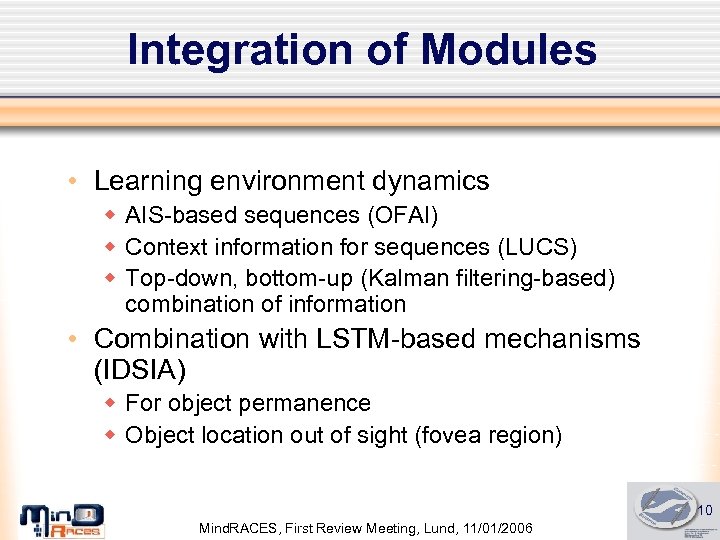
Integration of Modules • Learning environment dynamics w AIS-based sequences (OFAI) w Context information for sequences (LUCS) w Top-down, bottom-up (Kalman filtering-based) combination of information • Combination with LSTM-based mechanisms (IDSIA) w For object permanence w Object location out of sight (fovea region) 10 Mind. RACES, First Review Meeting, Lund, 11/01/2006
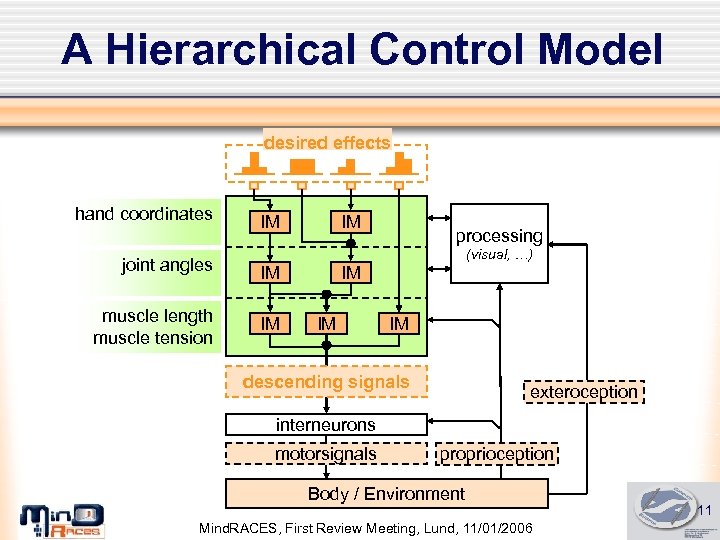
A Hierarchical Control Model desired effects hand coordinates IM IM processing (visual, …) joint angles IM muscle length muscle tension IM IM descending signals exteroception interneurons motorsignals proprioception Body / Environment Mind. RACES, First Review Meeting, Lund, 11/01/2006 11
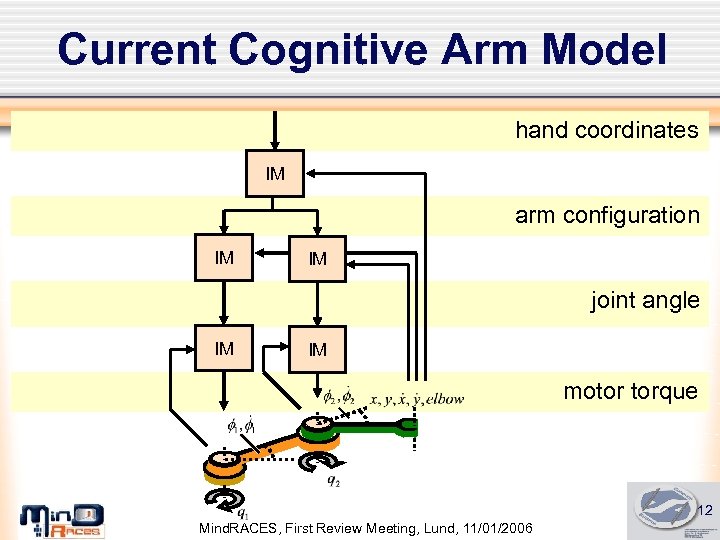
Current Cognitive Arm Model hand coordinates IM arm configuration IM IM joint angle IM IM motor torque 12 Mind. RACES, First Review Meeting, Lund, 11/01/2006
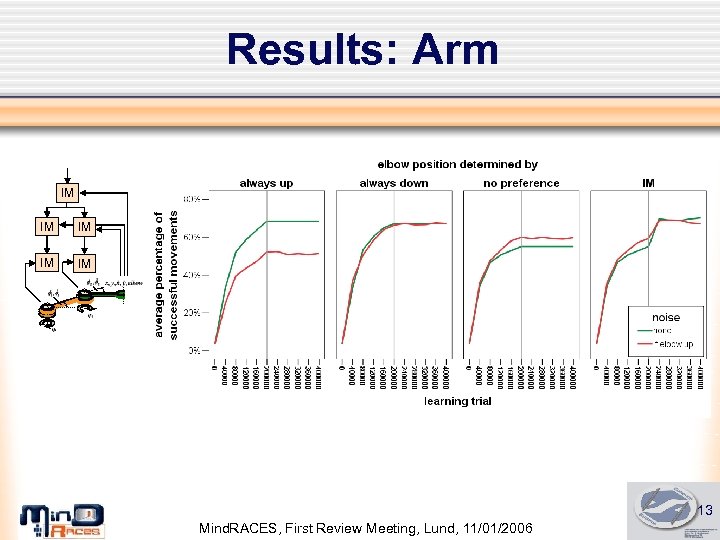
Results: Arm IM IM IM 13 Mind. RACES, First Review Meeting, Lund, 11/01/2006
Summary • Simple simulations w For object recognition w Object manipulation w Development of interactive control structures • Modular system combinations w w w • LSTM integration into XCS / ACS Context processing integration into XCS / ACS Integration of Kalman filtering techniques Rule-linkage with AIS principles Hierarchical combinations Anticipatory, developmental arm control models w Learning to control an arm w Learning the existence of objects § Object recognition § Object behavior § Object persistence 14 Mind. RACES, First Review Meeting, Lund, 11/01/2006
Скачать презентацию Anticipatory Behavior for Object Recognition and Robot Arm
ca27cd9a9ac64aeb190a6d9e35b61bc4.ppt