 Скачать презентацию Antibiotics affecting codon phase -dependent binding of aminoacylt
SSW 11 week.pptx
- Количество слайдов: 18



Antibiotics affecting codon phase -dependent binding of aminoacylt. RNA to the ribosome. Done by: Maulenova R. , Moldakozhayev A. , Naizabayeva D.
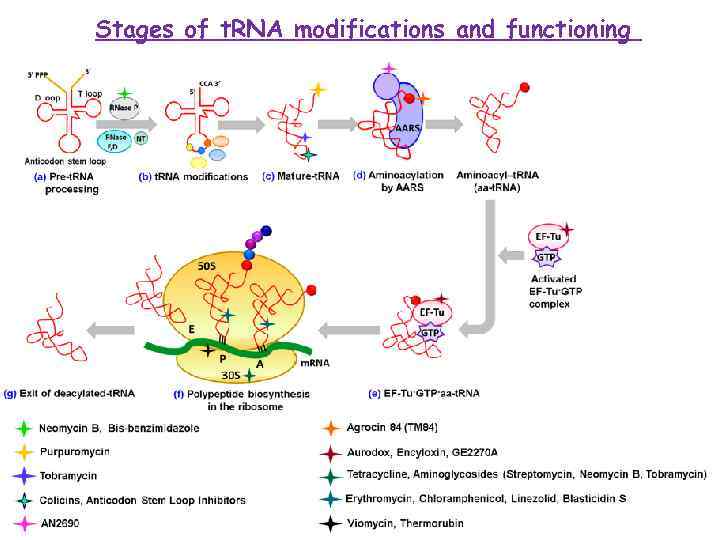
Stages of t. RNA modifications and functioning
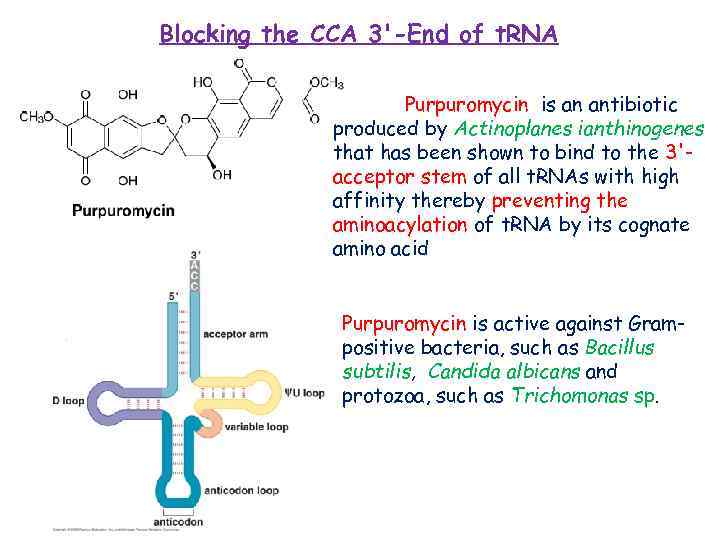
Blocking the CCA 3'-End of t. RNA Purpuromycin is an antibiotic produced by Actinoplanes ianthinogenes that has been shown to bind to the 3'acceptor stem of all t. RNAs with high affinity thereby preventing the aminoacylation of t. RNA by its cognate amino acid Purpuromycin is active against Grampositive bacteria, such as Bacillus subtilis, Candida albicans and protozoa, such as Trichomonas sp.
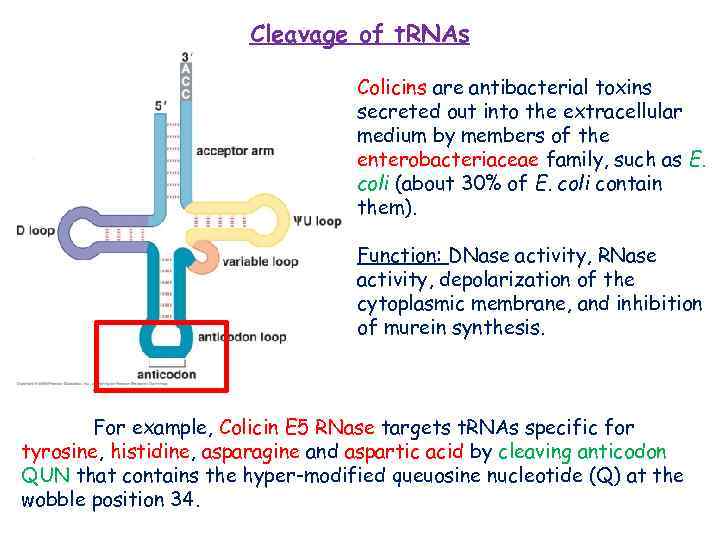
Cleavage of t. RNAs Colicins are antibacterial toxins secreted out into the extracellular medium by members of the enterobacteriaceae family, such as E. coli (about 30% of E. coli contain them). Function: DNase activity, RNase activity, depolarization of the cytoplasmic membrane, and inhibition of murein synthesis. For example, Colicin E 5 RNase targets t. RNAs specific for tyrosine, histidine, asparagine and aspartic acid by cleaving anticodon QUN that contains the hyper-modified queuosine nucleotide (Q) at the wobble position 34.
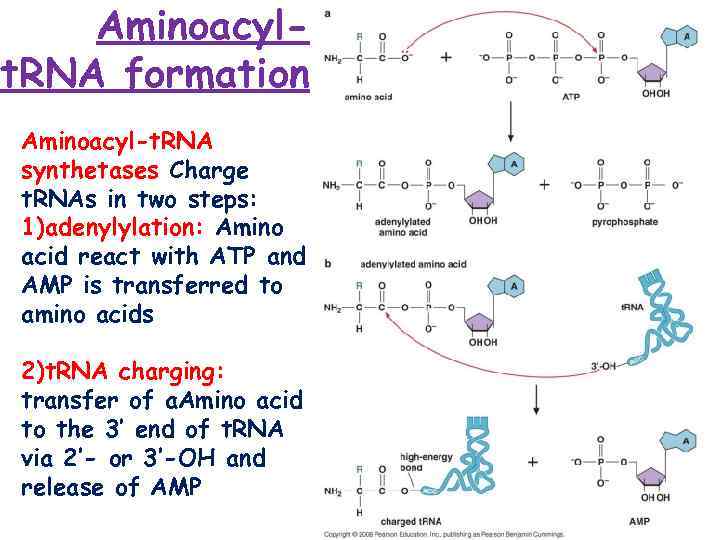
Aminoacylt. RNA formation Aminoacyl-t. RNA synthetases Charge t. RNAs in two steps: 1)adenylylation: Amino acid react with ATP and AMP is transferred to amino acids 2)t. RNA charging: transfer of a. Amino acid to the 3’ end of t. RNA via 2’- or 3’-OH and release of AMP
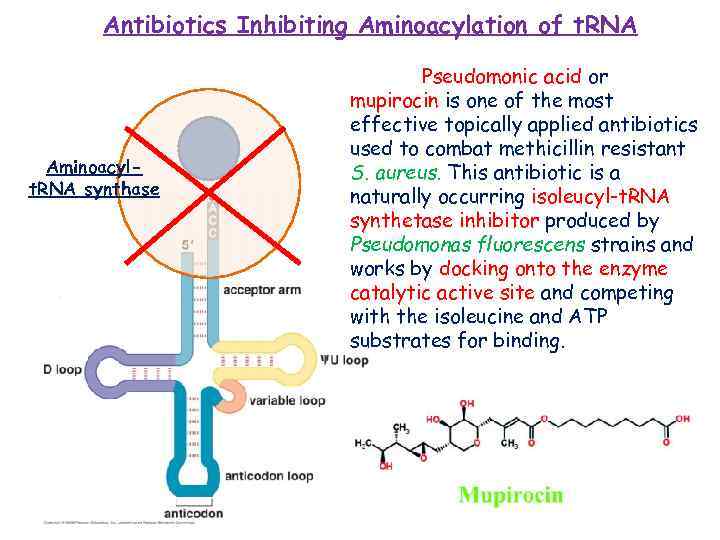
Antibiotics Inhibiting Aminoacylation of t. RNA Aminoacylt. RNA synthase Pseudomonic acid or mupirocin is one of the most effective topically applied antibiotics used to combat methicillin resistant S. aureus. This antibiotic is a naturally occurring isoleucyl-t. RNA synthetase inhibitor produced by Pseudomonas fluorescens strains and works by docking onto the enzyme catalytic active site and competing with the isoleucine and ATP substrates for binding.
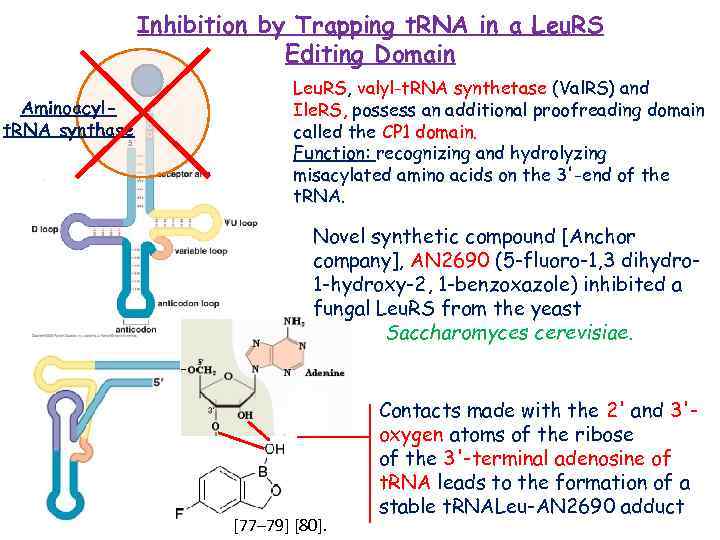
Inhibition by Trapping t. RNA in a Leu. RS Editing Domain Aminoacylt. RNA synthase Leu. RS, valyl-t. RNA synthetase (Val. RS) and Ile. RS, possess an additional proofreading domain called the CP 1 domain. Function: recognizing and hydrolyzing misacylated amino acids on the 3'-end of the t. RNA. Novel synthetic compound [Anchor company], AN 2690 (5 -fluoro-1, 3 dihydro 1 -hydroxy-2, 1 -benzoxazole) inhibited a fungal Leu. RS from the yeast Saccharomyces cerevisiae. [77– 79] [80]. Contacts made with the 2' and 3'oxygen atoms of the ribose of the 3'-terminal adenosine of t. RNA leads to the formation of a stable t. RNALeu-AN 2690 adduct
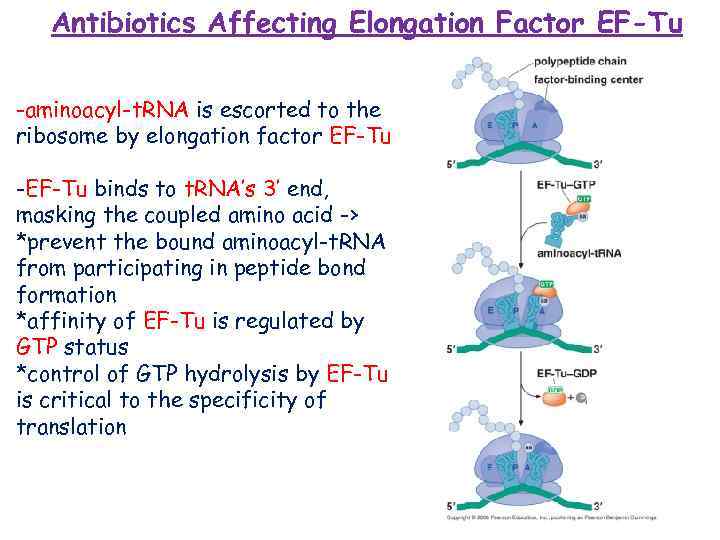
Antibiotics Affecting Elongation Factor EF-Tu -aminoacyl-t. RNA is escorted to the ribosome by elongation factor EF-Tu -EF-Tu binds to t. RNA’s 3’ end, masking the coupled amino acid -> *prevent the bound aminoacyl-t. RNA from participating in peptide bond formation *affinity of EF-Tu is regulated by GTP status *control of GTP hydrolysis by EF-Tu is critical to the specificity of translation
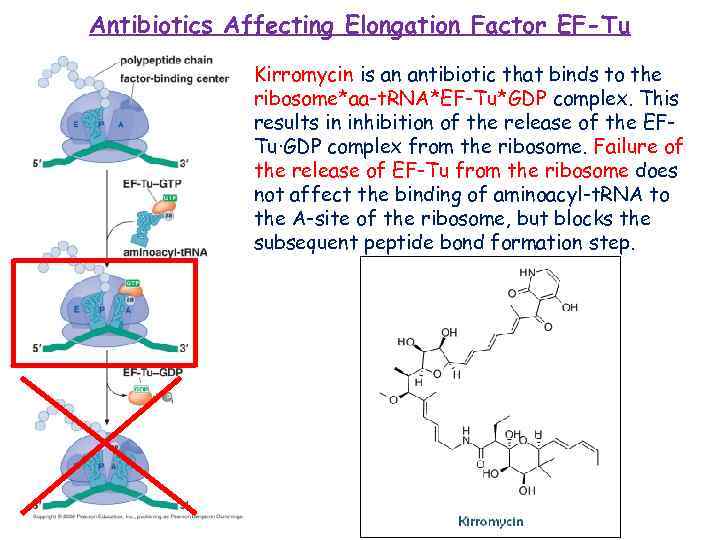
Antibiotics Affecting Elongation Factor EF-Tu Kirromycin is an antibiotic that binds to the ribosome*aa-t. RNA*EF-Tu*GDP complex. This results in inhibition of the release of the EFTu·GDP complex from the ribosome. Failure of the release of EF-Tu from the ribosome does not affect the binding of aminoacyl-t. RNA to the A-site of the ribosome, but blocks the subsequent peptide bond formation step.
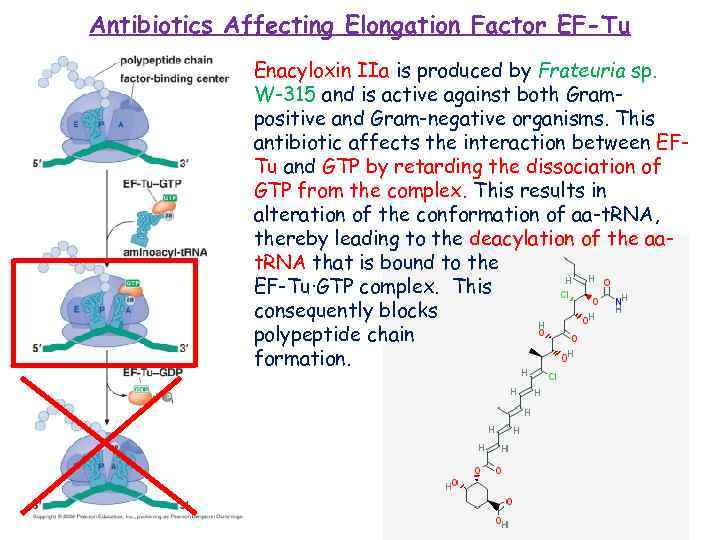
Antibiotics Affecting Elongation Factor EF-Tu Enacyloxin IIa is produced by Frateuria sp. W-315 and is active against both Grampositive and Gram-negative organisms. This antibiotic affects the interaction between EFTu and GTP by retarding the dissociation of GTP from the complex. This results in alteration of the conformation of aa-t. RNA, thereby leading to the deacylation of the aat. RNA that is bound to the EF-Tu·GTP complex. This consequently blocks polypeptide chain formation.
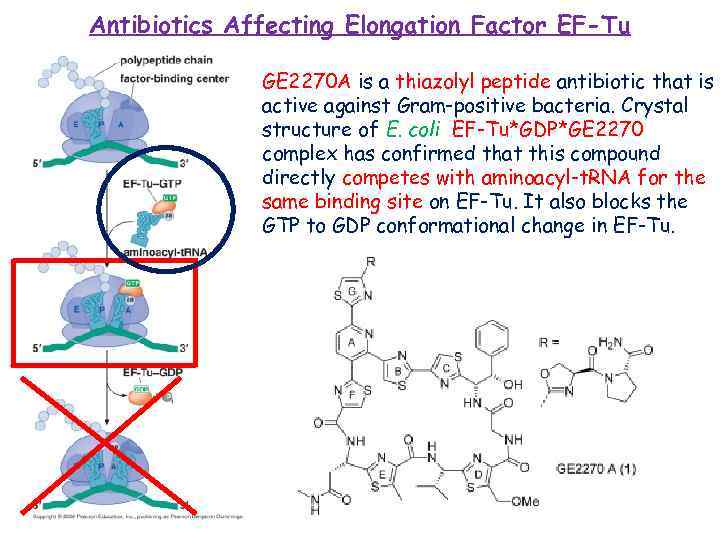
Antibiotics Affecting Elongation Factor EF-Tu GE 2270 A is a thiazolyl peptide antibiotic that is active against Gram-positive bacteria. Crystal structure of E. coli EF-Tu*GDP*GE 2270 complex has confirmed that this compound directly competes with aminoacyl-t. RNA for the same binding site on EF-Tu. It also blocks the GTP to GDP conformational change in EF-Tu.
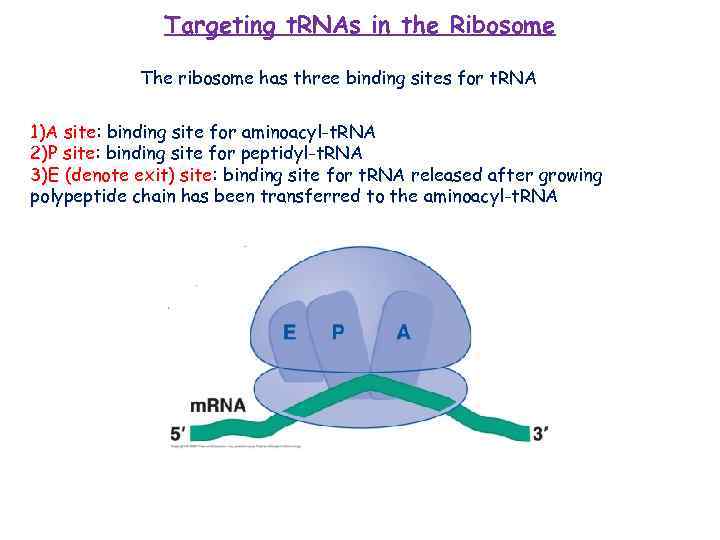
Targeting t. RNAs in the Ribosome The ribosome has three binding sites for t. RNA 1)A site: binding site for aminoacyl-t. RNA 2)P site: binding site for peptidyl-t. RNA 3)E (denote exit) site: binding site for t. RNA released after growing polypeptide chain has been transferred to the aminoacyl-t. RNA
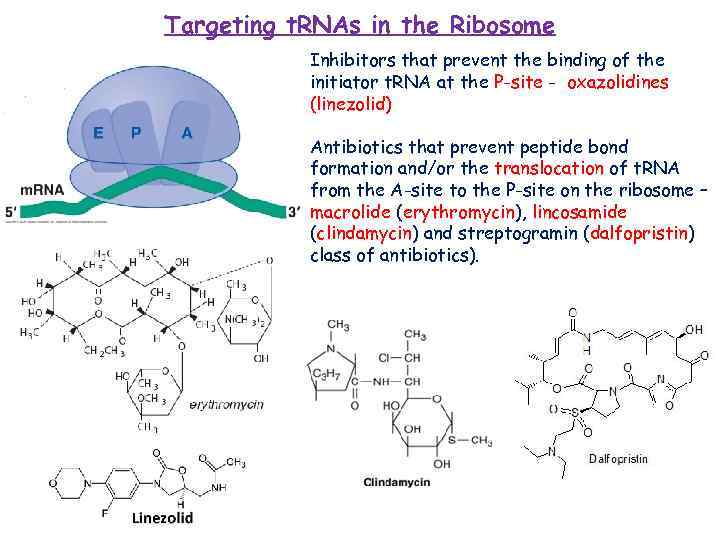
Targeting t. RNAs in the Ribosome Inhibitors that prevent the binding of the initiator t. RNA at the P-site - oxazolidines (linezolid) Antibiotics that prevent peptide bond formation and/or the translocation of t. RNA from the A-site to the P-site on the ribosome – macrolide (erythromycin), lincosamide (clindamycin) and streptogramin (dalfopristin) class of antibiotics).
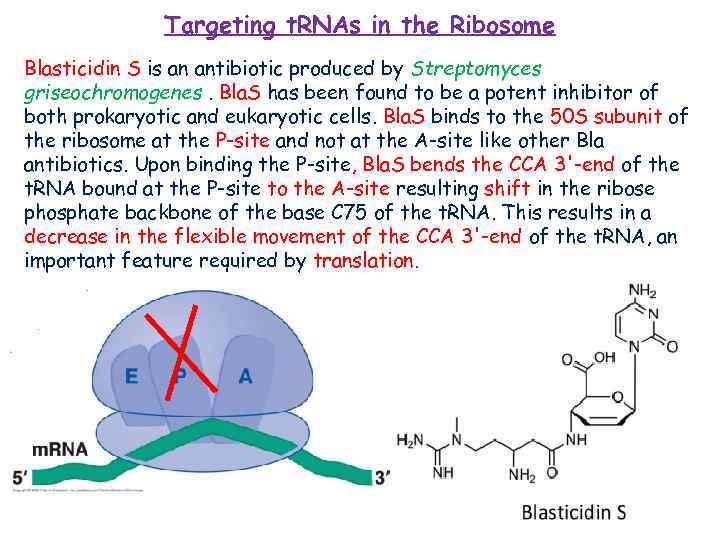
Targeting t. RNAs in the Ribosome Blasticidin S is an antibiotic produced by Streptomyces griseochromogenes. Bla. S has been found to be a potent inhibitor of both prokaryotic and eukaryotic cells. Bla. S binds to the 50 S subunit of the ribosome at the P-site and not at the A-site like other Bla antibiotics. Upon binding the P-site, Bla. S bends the CCA 3'-end of the t. RNA bound at the P-site to the A-site resulting shift in the ribose phosphate backbone of the base C 75 of the t. RNA. This results in a decrease in the flexible movement of the CCA 3'-end of the t. RNA, an important feature required by translation.
REFERENCE 1. Chopra Sh. , Reader J. , t. RNAs as Antibiotic Targets. Int. J. Mol. Sci. 2015, 16, 321 -349 2. Watson J D, Baker T A , Bell S P, Gann A, Levine M, Losick R. Molecular Biology of the Gene. 5 th edition. Pearson education 2004. 3. Kirillov, S. ; Vitali, L. A. ; Goldstein, B. P. ; Monti, F. ; Semenkov, Y. ; Makhno, V. ; Ripa, S. ; Pon, C. L. ; Gualerzi, C. O. Purpuromycin: An antibiotic inhibiting t. RNA aminoacylation. RNA 1997, 3, 905– 913. 4. Landini, P. ; Corti, E. ; Goldstein, B. P. ; Denaro, M. Mechanism of action of purpuromycin. Biochem. J. 1992, 284, 935. 5. Tomita, K. ; Ogawa, T. ; Uozumi, T. ; Watanabe, K. ; Masaki, H. A cytotoxic ribonuclease which specifically cleaves four isoaccepting arginine t. RNAs at their anticodon loops. Proc. Natl. Acad. Sci. USA 2000, 97, 8278– 8283. 6. Chen, J. F. ; Guo, N. N. ; Li, T. ; Wang, E. D. ; Wang, Y. L. CP 1 domain in Escherichia coli leucyl-t. RNA synthetase is crucial for its editing function. Biochemistry 2000, 39, 6726 6731. 7. Rock, F. L. ; Mao, W. ; Yaremchuk, A. ; Tukalo, M. ; Crepin, T. ; Zhou, H. ; Zhang, Y. K. ; Hernandez, V. ; Akama, T. ; Baker, S. J. ; et al. An antifungal agent inhibits an aminoacyl-t. RNA synthetase by trapping t. RNA in the editing site. Science 2007, 316, 1759– 1761.
REFERENCE 9. Wolf, H. ; Chinali, G. ; Parmeggiani, A. Mechanism of the inhibition of protein synthesis by kirromycin. Role of elongation factor Tu and ribosomes. Eur. J. Biochem. 1977, 75, 67– 75. 10. Wolf, H. ; Chinali, G. ; Parmeggiani, A. Kirromycin, an inhibitor of protein biosynthesis that acts on elongation factor Tu. Proc. Natl. Acad. Sci. USA 1974, 71, 4910– 4914. 11. Watanabe, T. ; Okubo, N. ; Suzuki, T. ; Izaki, K. New polyenic antibiotics active against Gram-positive and Gram-negative bacteria. VI. Non-lactonic polyene antibiotic, enacyloxin IIa, inhibits binding of aminoacyl-t. RNA to a site of ribosomes. J. Antibiot. 1992, 45, 572– 574. 12. Aoki, H. ; Ke, L. ; Poppe, S. M. ; Poel, T. J. ; Weaver, E. A. ; Gadwood, R. C. ; Thomas, R. C. ; Shinabarger, D. L. ; Ganoza, M. C. Oxazolidinone antibiotics target the Psite on Escherichia coli ribosomes. Antimicrob. Agents Chemother. 2002, 46, 1080– 1085. 13. Singh, S. B. ; Occi, J. ; Jayasuriya, H. ; Herath, K. ; Motyl, M. ; Dorso, K. ; Gill, C. ; Hickey, E. ; Overbye, K. M. ; Barrett, J. F. ; et al. Antibacterial evaluations of thiazomycin—A potent thiazolyl peptide antibiotic from Amycolatopsis fastidiosa. J. Antibiot. 2007, 60, 565– 571.
REFERENCE 14. Wilson, D. N. ; Schluenzen, F. ; Harms, J. M. ; Starosta, A. L. ; Connell, S. R. ; Fucini, P. The oxazolidinone antibiotics perturb the ribosomal peptidyltransferase center and effect t. RNA positioning. Proc. Natl. Acad. Sci. USA 2008, 105, 13339– 13344. 15. Cone, M. C. ; Petrich, A. K. ; Gould, S. J. ; Zabriskie, T. M. Cloning and heterologous expression of blasticidin s biosynthetic genes from Streptomyces griseochromogenes. J. Antibiot. 1998, 51, 570– 578. 16. Kalpaxis, D. L. ; Theocharis, D. A. ; Coutsogeorgopoulos, C. Kinetic studies on ribosomal peptidyltransferase. The behaviour of the inhibitor blasticidin s. Eur. J. Biochem. 1986, 154, 267– 271.

Thanks for attention!
Скачать презентацию Antibiotics affecting codon phase -dependent binding of aminoacylt
SSW 11 week.pptx