


 Скачать презентацию Anti-Trust Competition Law Compliance Statement INTERTANKO s policy is to
5cbec323cd72d4248683a8c5f16a0392.ppt
- Количество слайдов: 23
 Anti-Trust/Competition Law Compliance Statement INTERTANKO’s policy is to be firmly committed to maintaining a fair and competitive environment in the world tanker trade, and to adhering to all applicable laws which regulate INTERTANKO’s and its members’ activities in these markets. These laws include the anti-trust/competition laws which the United States, the European Union and many nations of the world have adopted to preserve the free enterprise system, promote competition and protect the public from monopolistic and other restrictive trade practices. INTERTANKO’s activities will be conducted in compliance with its Antitrust/Competition Law Guidelines.
 GREENHOUSE GASES FOR SHIPS UPDATE FROM IMO INTERTANKO North American Panel April 2010
 IMO STATUS QUO • MEPC 59 (July 2009) agreed on: – Interim Guidelines on the method of calculation of the EEDI for new ships – Interim Guidelines on voluntary verification of the EEDI – Ship Energy Efficiency Managment Plan (SEEMP) – Guidelines for voluntary use of EEOI – Time line for MBMs
 IMO STATUS QUO • MEPC 60 (March 2010) progress: – Provisional draft for a mandatory regulation on Design and Operational measures (EEDI & SEEMP) – Provisional agreement on the EEDI verification scheme – Intersessional meeting to progress on the EEDI and SEEMP regulation – Expert Group on MBM
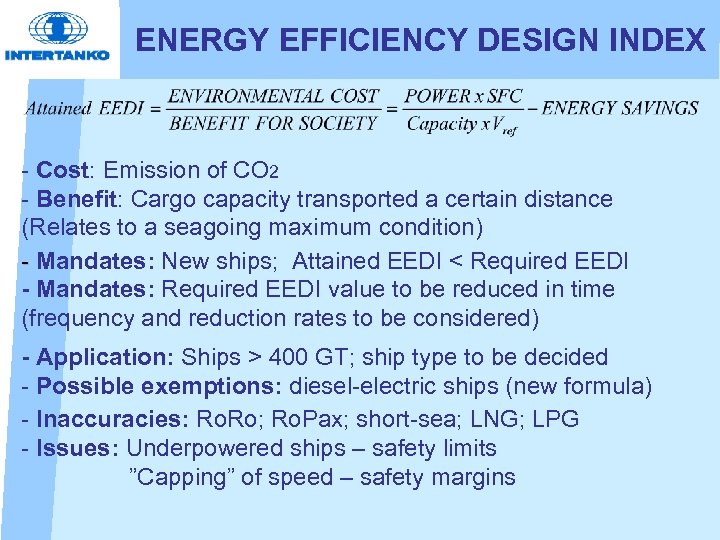 ENERGY EFFICIENCY DESIGN INDEX - Cost: Emission of CO 2 - Benefit: Cargo capacity transported a certain distance (Relates to a seagoing maximum condition) - Mandates: New ships; Attained EEDI < Required EEDI - Mandates: Required EEDI value to be reduced in time (frequency and reduction rates to be considered) - Application: Ships > 400 GT; ship type to be decided - Possible exemptions: diesel-electric ships (new formula) - Inaccuracies: Ro. Ro; Ro. Pax; short-sea; LNG; LPG - Issues: Underpowered ships – safety limits ”Capping” of speed – safety margins
![EEDI Required Base Line EEDI Phase 1 Reduction [15%] [25%] [37%] aa% bb/% Y](https://present5.com/presentation/5cbec323cd72d4248683a8c5f16a0392/image-6.jpg "EEDI Required Base Line EEDI Phase 1 Reduction [15%] [25%] [37%] aa% bb/% Y") EEDI Required Base Line EEDI Phase 1 Reduction [15%] [25%] [37%] aa% bb/% Y yrs. . Y yrs Phase 3 Years [2013 -2017] [2018 -2022] [2023 -2027] X yrs. Phase 2 Phase 1 2 3 cc% DWT
EEDI Required Base Line EEDI Phase 1 Reduction [15%] [25%] [37%] aa% bb/% Y yrs. . Y yrs Phase 3 Years [2013 -2017] [2018 -2022] [2023 -2027] X yrs. Phase 2 Phase 1 2 3 cc% DWT
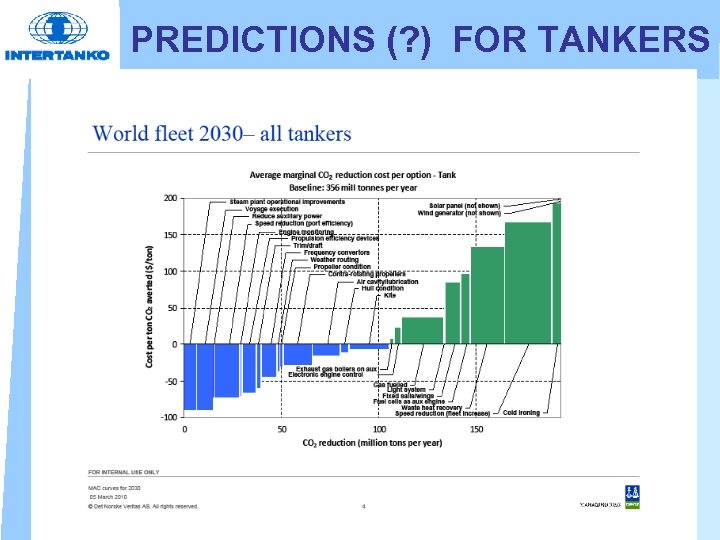 PREDICTIONS (? ) FOR TANKERS
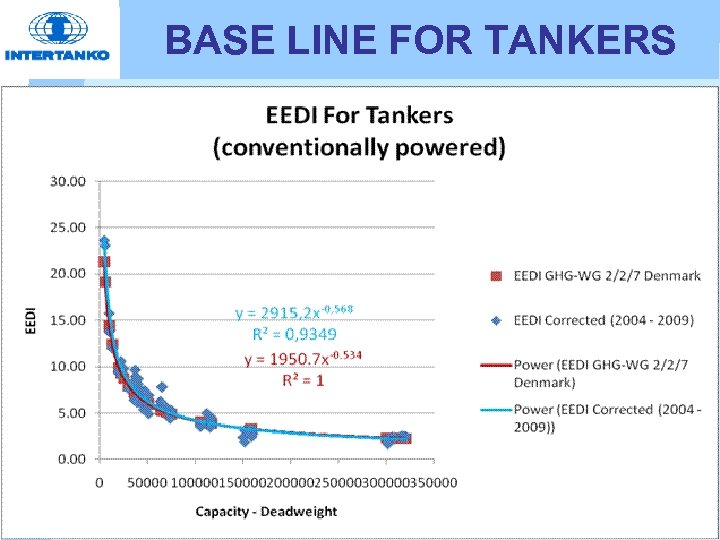 BASE LINE FOR TANKERS
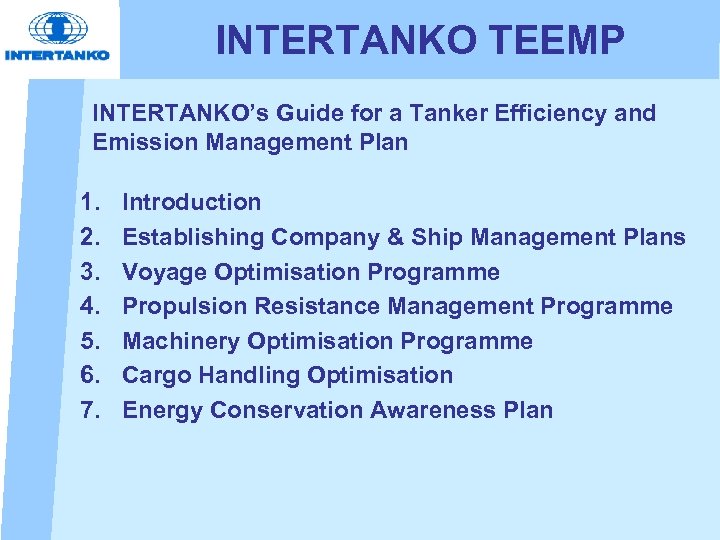 INTERTANKO TEEMP INTERTANKO’s Guide for a Tanker Efficiency and Emission Management Plan 1. 2. 3. 4. 5. 6. 7. Introduction Establishing Company & Ship Management Plans Voyage Optimisation Programme Propulsion Resistance Management Programme Machinery Optimisation Programme Cargo Handling Optimisation Energy Conservation Awareness Plan
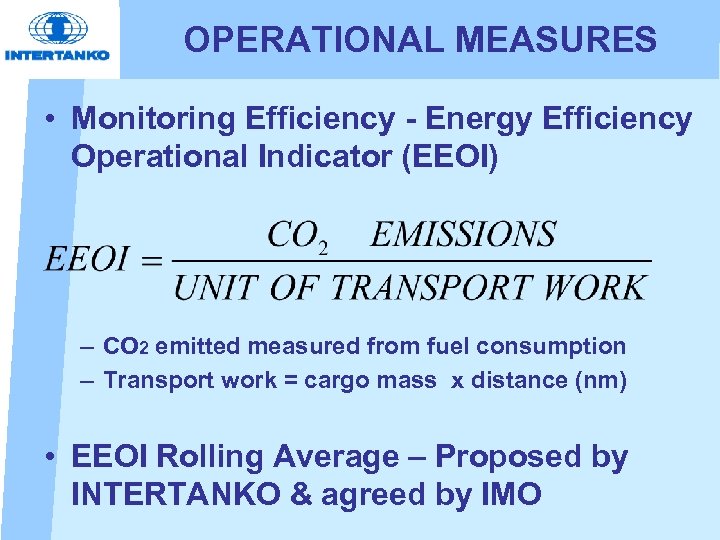 OPERATIONAL MEASURES • Monitoring Efficiency - Energy Efficiency Operational Indicator (EEOI) – CO 2 emitted measured from fuel consumption – Transport work = cargo mass x distance (nm) • EEOI Rolling Average – Proposed by INTERTANKO & agreed by IMO
 MARKET BASED MECHANISMS • Commonalities of MBMs: – – apply to ships in service demand targets ships’ CO 2 emissions will need to be measured creating funds • Suggestions classed in three main categories – all ships pay (GHG FUND; ETS) – all ships pay but some get rewards (Japan) – some ships pay (US and WSC models) • None has a control mechanism to measure the environmental benefit for the funds used
 PRINCIPLES FOR INCENTIVES/PENALTIES • GHG Fund – all ships pay a levy – contribution by fuel consumption (fixed price) – efficient ships receive a reward (Leverage Incentive System - Japan) • ETS (Norway/Germany/France; UK) – all ships buy allowances – difference by number of allowances purchased (market price) • US & WSC MBMs – no costs for ships complying with a required efficiency standard. . . but – US MBM - standards based on EEDI base line with a projected increase of efficiency required – WSC MBM – milder standard than EEDI base line
 GHG COMPENSATION FUND • Ships make a set contribution to the Fund • Collection by registered Bunker Suppliers • Bunker Delivery Note as evidence • Mandatory registration of Bunker Suppliers • Revenues used for - Mitigation, Adaptation and Technology Projects - Non-vessel Specific R&D Projects - Technological Cooperation within IMO - Rewarding most efficient ships (Japanese alternative)
 EMISSION TRADING SCHEME • CAP on net CO 2 emssions for shipping • CAP to be agreed by UNFCCC or IMO with periodical declining trajectory • Carbon allowance = 1 t equivalent CO 2 emission • Allowances (distributed) or sold = CAP • End of each period – ship owners surrender allowances to correspond to the actual fuel consumption: – emissions < CAP – rest allowances can be sold – emissions > CAP – buy additional allowances
 EMISSION TRADING SCHEME • Monitoring – BDN & engine log • Reports (external audited) submitted to a registry • GHG Certificate for ships in compliance • Incentive/penalty - costs of allowances • Allowances for ships may be linked to other carbon markets • Cross over to other carbon markets avoids constraints in growth of shipping
 USA’s MBM ALTERNATIVE Efficiency Index Standard • • Ships to meet required Efficiency Index standard (EIR) EIR uses the EEDI base line formula as a model New Ship delivery: EIR = mandatory EEDI value Existing ships: EIR = EEDI base line value for the ship type & size EIR value gradually and periodically lowered – same % for all In time EIR < EEDI for a ship compliant with new rules! Ship compliance: – attained Efficiency Index (EIA) or – direct and continuous fuel consumption monitoring EIA – calculated; sea test; or continuous monitoring (EEOI type of calculation)
 USA’s MBM ALTERNATIVE Efficiency Index Standard • IMO establish Efficiency Credit (EC) trading for ships • Measuring compliance: EC = (EIR – EIA) x Activity • Activity (over a compliance monitoring period): – actual cargo tonne-miles; – tonne-miles / DWT or – tonne-mile default value for each type and size of ship • EC > 0 – ship sells credits; EC < 0 – ship buys credits • Periodicity: maximum of 5 years with possible earlier updates in case ships adopt technologies • ”Activity” aimed to include efficiency in operations: – operational measures – fleet optimisation • No CAP in activities but. . • Potentially all ships will end up buying credits
 WORLD SHIPPING COUNCIL VESSEL EFFICIENCY SYSTEM (VES) • Combination of US MBM & GHG Fund • Emission targets: – EEDI value and its reduction - new buildings – Less stringent base line and targeted reduction for ships in operations • Ships meeting the target = no additional charges • Less efficient ships = charges/tonne of fuel consumed over the target • IMO establish a Fund to collect charges • Charges proportional to shipping contribution to the total human-made CO 2 emissions
 MBMs - OBSERVATIONS • GHG FUND – regarded as taxation – politically difficult – complexity of bunker purchasing – bunker suppliers need to be part of it • ETS – will require a definition of a ”Cap” – complex enforcement and monitoring – predicted expensive adminsitration – government participation and data exchange – trading administration by each ship owner
 MBMs - OBSERVATIONS • Japanese Leverage Incentive Scheme – difficult standardisation for measurables – difficult monitoring of each ship in operation – uncertainty of the refund scheme • US MBM – EEDI compliant ships have little improvement potentials – strict & complicated enforcement and monitoring – strict improvement requirements – all ships buy credits – how many credits will IMO generate? • WSC MBM – only for non-EEDI compliant ships? – need of more details for full assessment
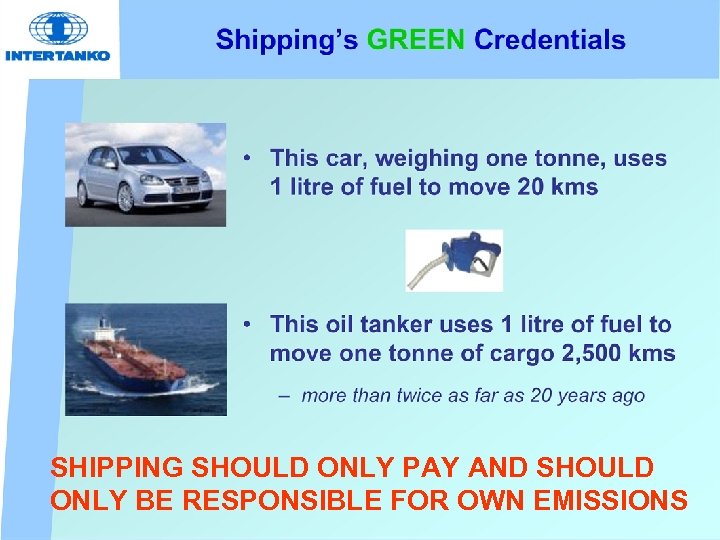 What is in it for me? SHIPPING SHOULD ONLY PAY AND SHOULD ONLY BE RESPONSIBLE FOR OWN EMISSIONS
 POLITICAL DILEMMAS • Need to reconcile: – UNFCCC principle of Common But Differentiated Responsibility (CBDR) – IMO principle of uniform global rules for shipping • • Design & Operational measures only? Market Based Mechanisms added? Global or IMO controlled MBM? New IMO Convention or amendments to MARPOL Annex VI?
 THANK YOU For more information please visit www. intertanko. com dragos. rauta@intertanko. com