 Скачать презентацию Антагонисты допамина в лечении болезни Паркинсона Clinical Pharmacology
Dopamine_Agonists_for_the_Treatment_of_PD.ppt
- Количество слайдов: 71



Антагонисты допамина в лечении болезни Паркинсона Clinical Pharmacology, Efficacy and Safety Peter Jenner, BPharm (Hons), Ph. D, DSc, FRPharm. S, FBPharmacol. S, FKC King’s College London, UK 1
Об авторе Peter Jenner • Профессор фармакологии в школе медико-биологических и медицинских наук в Королевском колледже Лондона. Глава исследовательской группы нейродегенеративных заболеваний. Директор Национального фонда Паркинсона Центр передового опыта. Профессор Дженнер внесла свой вклад в развитие новых терапевтических подходов к лечению болезни Паркинсона. 2
Предисловие В последние годы философия для лечения болезни Паркинсона (БП) был перенесен на более широкое использование без спорыньи агонистов дофамина лекарства, такие как прамипексол и ропинирол, особенно в ранних стадиях болезни. В этой презентации, обоснование их использования в начале PD и в его более поздних стадиях изучается. Исходя из их фармакологических эффектов и более длительным действием, используется для объяснения клинической эффективности агонистов дофамина и приведенный потенциал для индукции дискинезии. Проблемы возникающие при дофаминергических препаратов в общем, такие, как сон атак и компульсивного поведения, объясняются и стратегии их клинического ведения представлены. Наконец, потенциальные фармакокинетические и фармакодинамические взаимодействия исследованы, чтобы гарантировать, что агонисты дофамина используется для лучшего эффекта в лечении ДП и с самой высокой точки зрения безопасности. Yamamoto M, Schapira AH. Expert Rev Neurother 2008; 8(4): 671 -7. Jenner P. Neurology 2002; 58(4 Suppl 1): S 1 -8. 3
Содержание • Роль агонистов дофамина в лечении болезни Паркинсона (БП) • Агонистов дофамина - Фармакологические профиля • Нейропротекция • Нарушения сна при БП • Импульс управления расстройств при БП • Фиброз при БП • Фармакокинетика и лекарственные взаимодействия • Агонисты допамина и PD – 4

Роль агонистов дофамина в лечении болезни Паркинсона 5
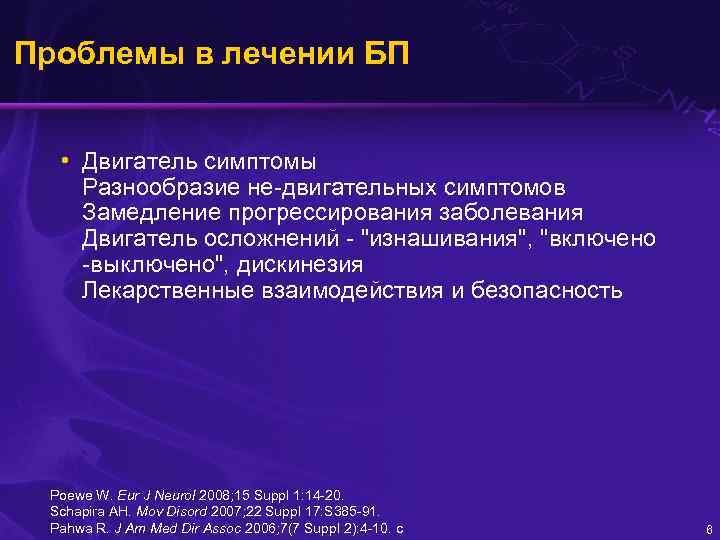
Проблемы в лечении БП • Двигатель симптомы Разнообразие не-двигательных симптомов Замедление прогрессирования заболевания Двигатель осложнений - "изнашивания", "включено -выключено", дискинезия Лекарственные взаимодействия и безопасность Poewe W. Eur J Neurol 2008; 15 Suppl 1: 14 -20. Schapira AH. Mov Disord 2007; 22 Suppl 17: S 385 -91. Pahwa R. J Am Med Dir Assoc 2006; 7(7 Suppl 2): 4 -10. c 6
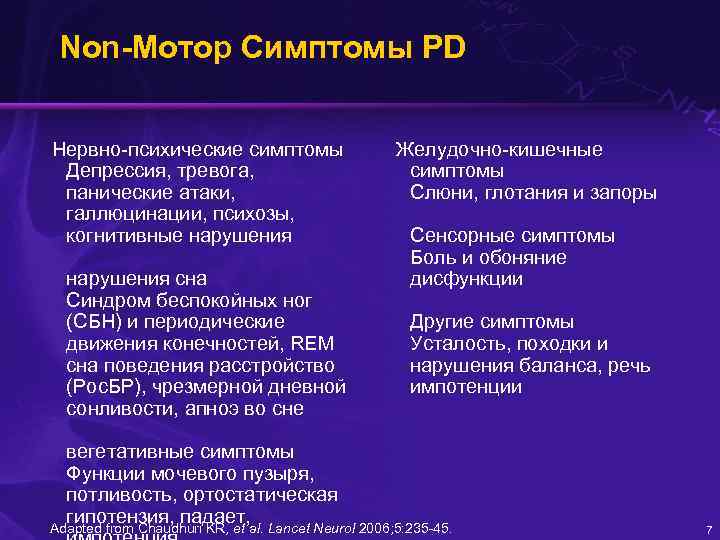
Non-Мотор Симптомы PD Нервно-психические симптомы Депрессия, тревога, панические атаки, галлюцинации, психозы, когнитивные нарушения сна Синдром беспокойных ног (СБН) и периодические движения конечностей, REM сна поведения расстройство (Рос. БР), чрезмерной дневной сонливости, апноэ во сне вегетативные симптомы Функции мочевого пузыря, потливость, ортостатическая гипотензия, падает, Желудочно-кишечные симптомы Слюни, глотания и запоры Сенсорные симптомы Боль и обоняние дисфункции Другие симптомы Усталость, походки и нарушения баланса, речь импотенции Adapted from Chaudhuri KR, et al. Lancet Neurol 2006; 5: 235 -45. 7
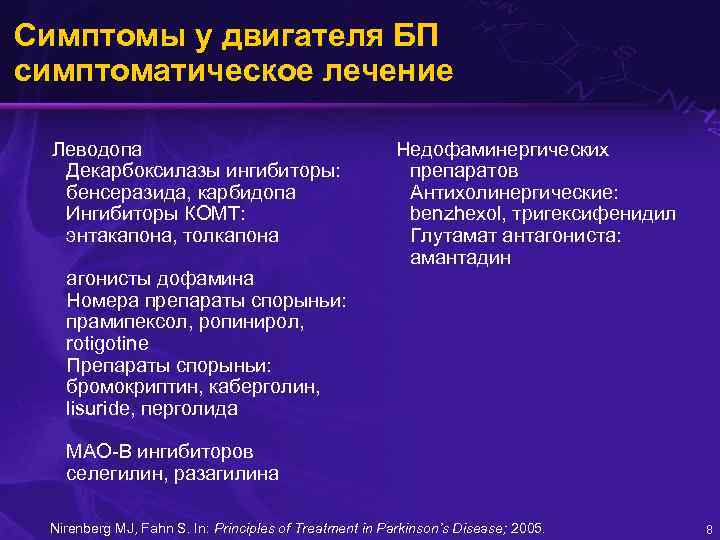
Симптомы у двигателя БП симптоматическое лечение Леводопа Декарбоксилазы ингибиторы: бенсеразида, карбидопа Ингибиторы КОМТ: энтакапона, толкапона агонисты дофамина Номера препараты спорыньи: прамипексол, ропинирол, rotigotine Препараты спорыньи: бромокриптин, каберголин, lisuride, перголида Недофаминергических препаратов Антихолинергические: benzhexol, тригексифенидил Глутамат антагониста: амантадин МАО-В ингибиторов селегилин, разагилина Nirenberg MJ, Fahn S. In: Principles of Treatment in Parkinson’s Disease; 2005. 8
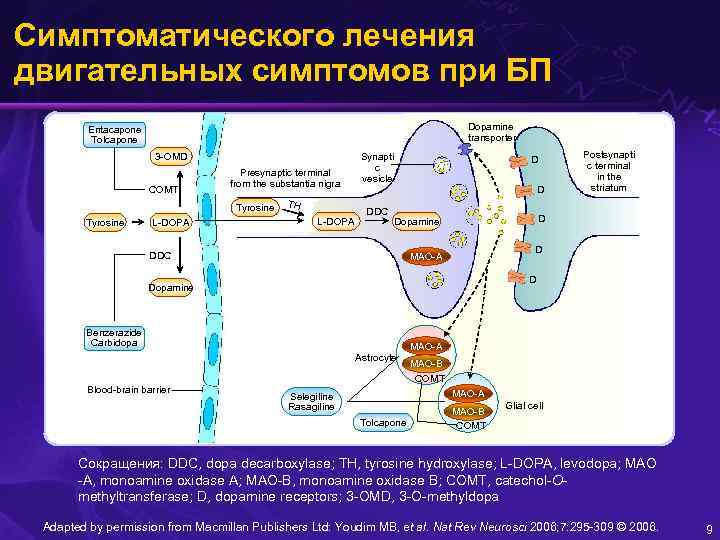
Симптоматического лечения двигательных симптомов при БП Dopamine transporter Entacapone Tolcapone 3 -OMD COMT Presynaptic terminal from the substantia nigra Tyrosine L-DOPA TH L-DOPA Synapti c vesicle DDC D Dopamine DDC D MAO-A D Dopamine Benzerazide Carbidopa MAO-A Astrocyte Blood-brain barrier Postsynapti c terminal in the striatum MAO-B COMT MAO-A Selegiline Rasagiline Tolcapone MAO-B COMT Glial cell Сокращения: DDC, dopa decarboxylase; TH, tyrosine hydroxylase; L-DOPA, levodopa; MAO -A, monoamine oxidase A; MAO-B, monoamine oxidase B; COMT, catechol-Omethyltransferase; D, dopamine receptors; 3 -OMD, 3 -O-methyldopa Adapted by permission from Macmillan Publishers Ltd: Youdim MB, et al. Nat Rev Neurosci 2006; 7: 295 -309 © 2006. 9
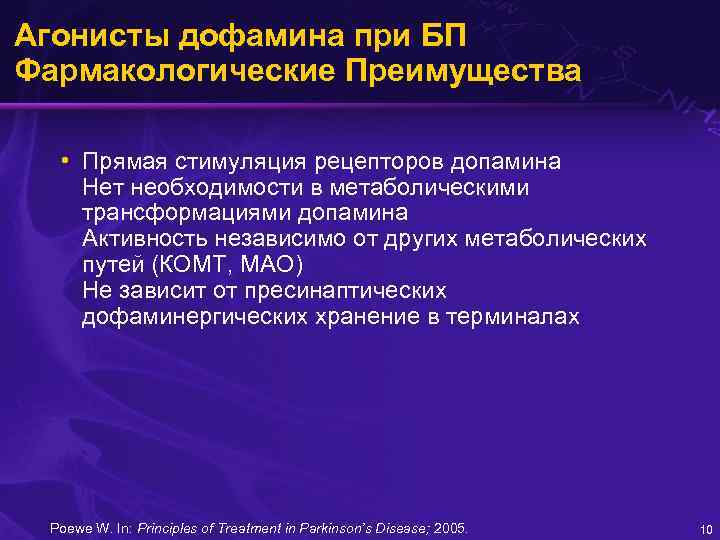
Агонисты дофамина при БП Фармакологические Преимущества • Прямая стимуляция рецепторов допамина Нет необходимости в метаболическими трансформациями допамина Активность независимо от других метаболических путей (КОМТ, МАО) Не зависит от пресинаптических дофаминергических хранение в терминалах Poewe W. In: Principles of Treatment in Parkinson’s Disease; 2005. 10

Агонисты дофамина в лечении БП Терапии первой линии в начале PD Обеспечить контроль двигательных симптомов в течение нескольких лет Низкая частота двигателя осложнений Задержка использования леводопы и связанных с ним осложнений двигателя Предполагаемые воздействия на депрессивные симптомы Предполагаемые нейропротекторное деятельности Хорошо переносится Yamamoto M, Schapira AH. Expert Rev Neurother 2008; 8(4): 671 -7. 11
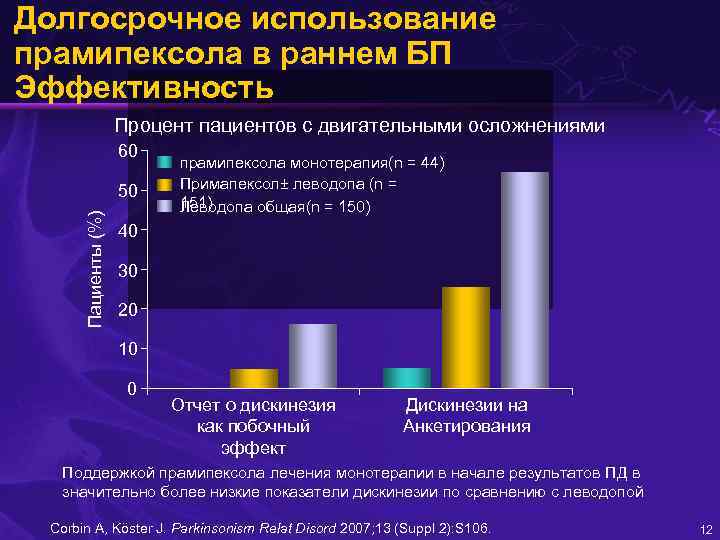
Долгосрочное использование прамипексола в раннем БП Эффективность Процент пациентов с двигательными осложнениями 60 Пациенты (%) 50 прамипексола монотерапия(n = 44) Примапексол± леводопа (n = 151) Леводопа общая(n = 150) 40 30 20 10 0 Отчет о дискинезия как побочный эффект Дискинезии на Анкетирования Поддержкой прамипексола лечения монотерапии в начале результатов ПД в значительно более низкие показатели дискинезии по сравнению с леводопой Corbin A, Köster J. Parkinsonism Relat Disord 2007; 13 (Suppl 2): S 106. 12
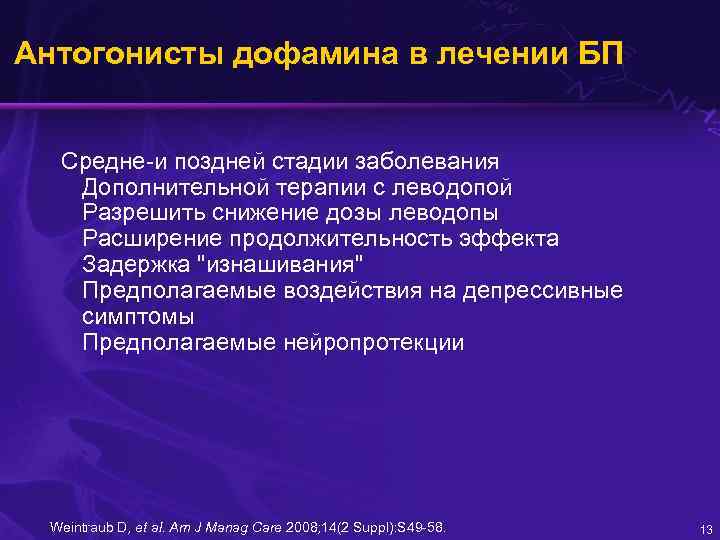
Антогонисты дофамина в лечении БП Средне-и поздней стадии заболевания Дополнительной терапии с леводопой Разрешить снижение дозы леводопы Расширение продолжительность эффекта Задержка "изнашивания" Предполагаемые воздействия на депрессивные симптомы Предполагаемые нейропротекции Weintraub D, et al. Am J Manag Care 2008; 14(2 Suppl): S 49 -58. 13
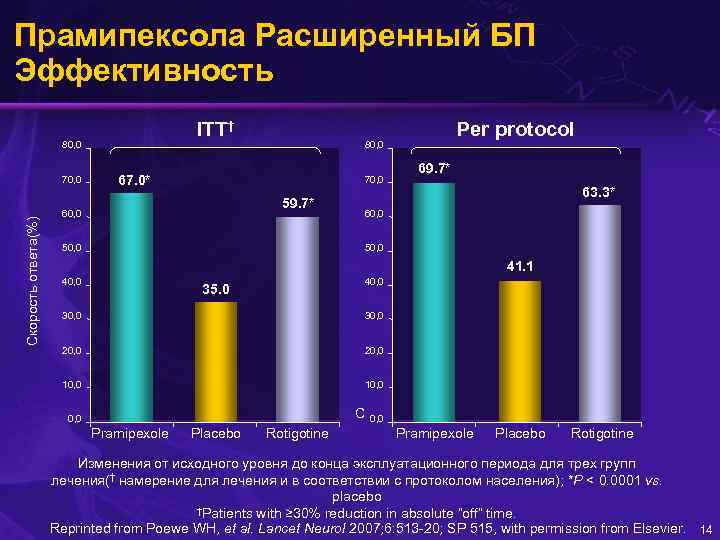
Прамипексола Расширенный БП Эффективность ITT† 80, 0 Скорость ответа(%) 70, 0 80, 0 67. 0* 70, 0 59. 7* 60, 0 Per protocol 50, 0 69. 7* 63. 3* 60, 0 50, 0 41. 1 40, 0 35. 0 30, 0 20, 0 10, 0 C 0, 0 Pramipexole Placebo Rotigotine Изменения от исходного уровня до конца эксплуатационного периода для трех групп лечения(† намерение для лечения и в соответствии с протоколом населения); *P < 0. 0001 vs. placebo †Patients with ≥ 30% reduction in absolute “off” time. Reprinted from Poewe WH, et al. Lancet Neurol 2007; 6: 513 -20; SP 515, with permission from Elsevier. 14

Агонистов дофамина Фармакологические профиля 15
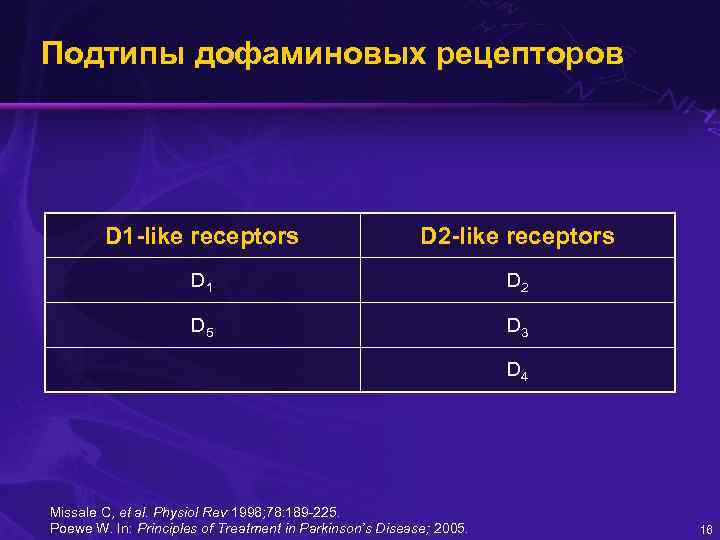
Подтипы дофаминовых рецепторов D 1 -like receptors D 2 -like receptors D 1 D 2 D 5 D 3 D 4 Missale C, et al. Physiol Rev 1998; 78: 189 -225. Poewe W. In: Principles of Treatment in Parkinson’s Disease; 2005. 16
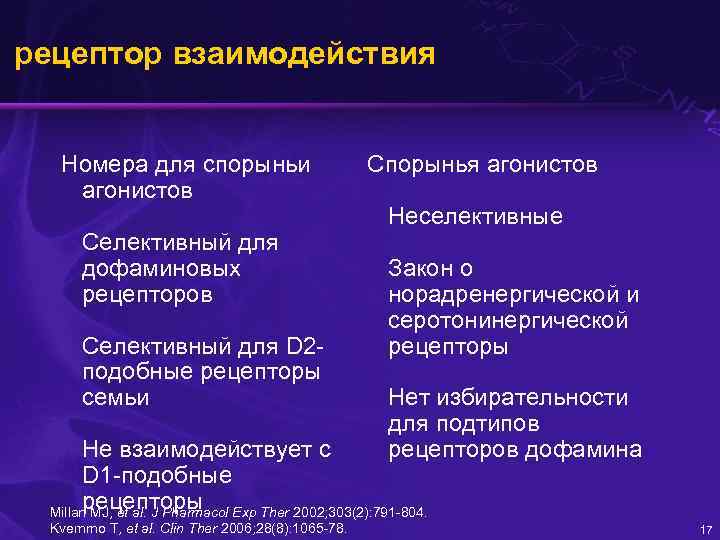
рецептор взаимодействия Номера для спорыньи агонистов Селективный для дофаминовых рецепторов Селективный для D 2 подобные рецепторы семьи Спорынья агонистов Неселективные Закон о норадренергической и серотонинергической рецепторы Нет избирательности для подтипов рецепторов дофамина Не взаимодействует с D 1 -подобные рецепторы Millan MJ, et al. J Pharmacol Exp Ther 2002; 303(2): 791 -804. Kvernmo T, et al. Clin Ther 2006; 28(8): 1065 -78. 17
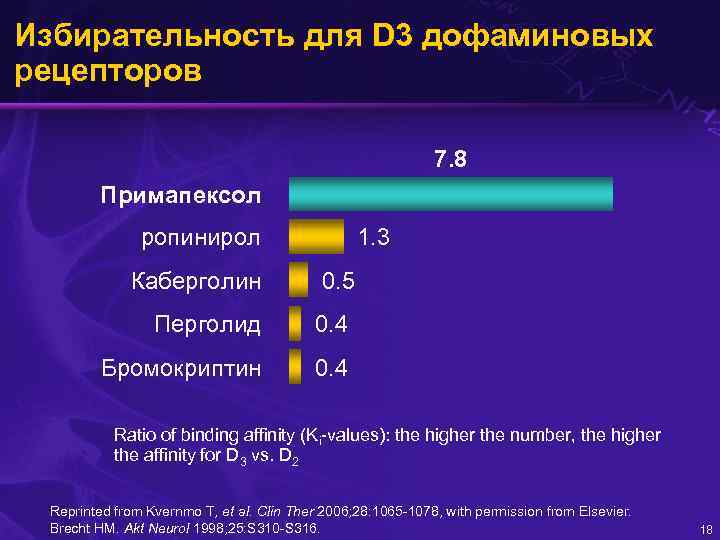
Избирательность для D 3 дофаминовых рецепторов 7. 8 Примапексол 1. 3 ропинирол Каберголин 0. 5 Перголид 0. 4 Бромокриптин 0. 4 Ratio of binding affinity (Ki-values): the higher the number, the higher the affinity for D 3 vs. D 2 Reprinted from Kvernmo T, et al. Clin Ther 2006; 28: 1065 -1078, with permission from Elsevier. Brecht HM. Akt Neurol 1998; 25: S 310 -S 316. 18
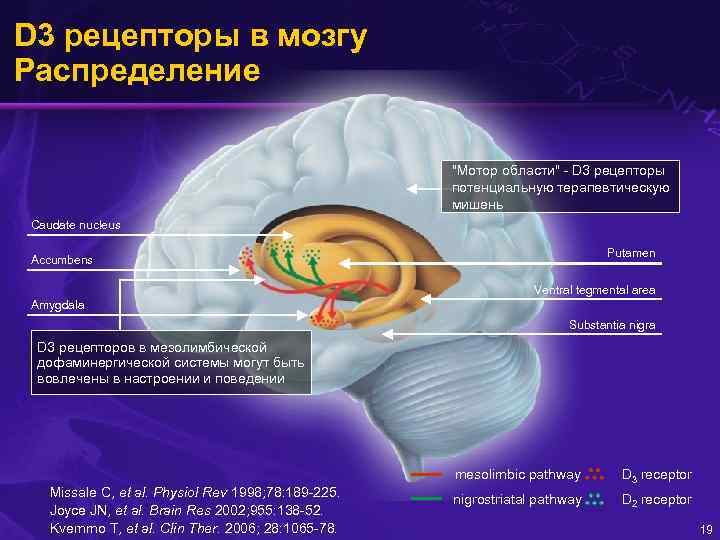
D 3 рецепторы в мозгу Распределение "Мотор области" - D 3 рецепторы потенциальную терапевтическую мишень Caudate nucleus Putamen Accumbens Ventral tegmental area Amygdala Substantia nigra D 3 рецепторов в мезолимбической дофаминергической системы могут быть вовлечены в настроении и поведении mesolimbic pathway Missale C, et al. Physiol Rev 1998; 78: 189 -225. Joyce JN, et al. Brain Res 2002; 955: 138 -52. Kvernmo T, et al. Clin Ther. 2006; 28: 1065 -78. D 3 receptor nigrostriatal pathway D 2 receptor 19

Агонисты дофамина Способ применения и Биодоступность L-DOPA Pramipexole Ropinirole Up to 2000 mg/d 0. 375– 4. 5 (salt) 3– 24 No. of daily doses 3– 8 3 3 Oral bioavailability, % 99% >90 50 1. 5 8– 12 6 Total dosage, mg/d Elimination t 1/2, h Poewe W. In: Principles of Treatment in Parkinson’s Disease; 2005. Deleu D, et al. Clin Pharmacokinet 2002; 41(4): 261 -309. 20
Непрерывная дофаминергической стимуляции (CDS) • Физиологическая стимуляция полосатой дофаминовых рецепторов является непрерывным и тоник Дофаминергической тон теряется в PD Пульсирующего стимуляции короткого действия таких препаратов, как леводопа производит ненормальное ответ и моторных осложнений Длительного действия агонистов дофамина, такие как прамипексол и ропинирол производить непрерывную дофаминергической стимуляции и нижние частоты двигателя осложнений по сравнению с леводопой • Физиологическая стимуляция полосатой Olanow W, et al. Trends Neurosci 2000; 23(10 Suppl): S 117 -26. дофаминовых рецепторов является непрерывным Barone P. Neurology 2003; 61(6 Suppl 3): S 12 -6. 21
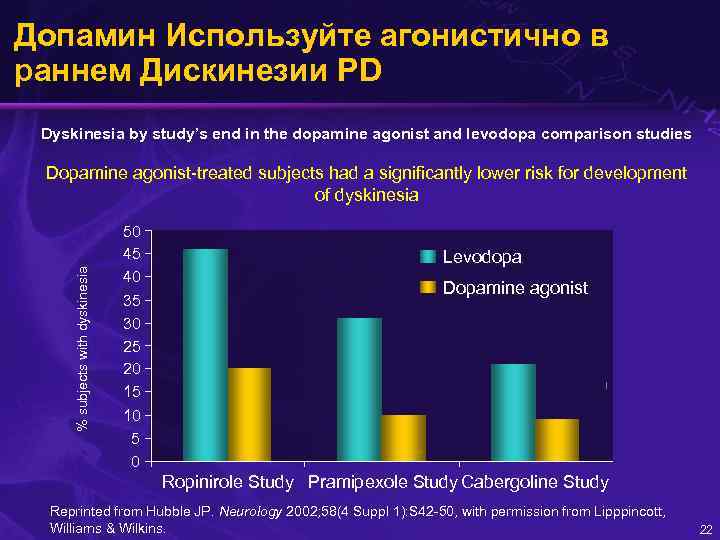
Допамин Используйте агонистично в раннем Дискинезии PD Dyskinesia by study’s end in the dopamine agonist and levodopa comparison studies % subjects with dyskinesia Dopamine agonist-treated subjects had a significantly lower risk for development of dyskinesia 50 45 40 35 30 25 20 15 10 5 0 Levodopa Dopamine agonist Ropinirole Study Pramipexole Study Cabergoline Study Reprinted from Hubble JP. Neurology 2002; 58(4 Suppl 1): S 42 -50, with permission from Lipppincott, Williams & Wilkins. 22
Continuous Dopaminergic Stimulation (CDS) • A useful hypothesis for explaining differences between L-DOPA and dopamine agonist drugs • Not proven clinically or experimentally Nutt JG. Mov Disord 2007; 22(1): 1 -9. 23
Continuous Dopaminergic Stimulation (CDS) in Clinical Practice • Dopamine agonists always compared to L-DOPA • No comparison between short-acting and long-acting dopamine agonists • No comparison of drugs with different half-lives • No comparison of standard oral L-DOPA with more continuous delivery (Exceptions: apomorphine and L-DOPA infusions) Jenner P. Neurology 2004; 62(1 Suppl 1): S 47 -55. Nutt JG. Mov Disord 2007; 22(1): 1 -9. 24
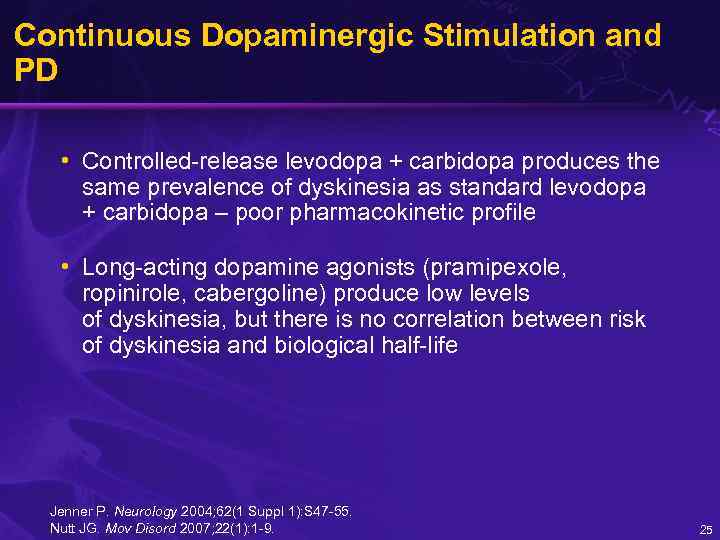
Continuous Dopaminergic Stimulation and PD • Controlled-release levodopa + carbidopa produces the same prevalence of dyskinesia as standard levodopa + carbidopa – poor pharmacokinetic profile • Long-acting dopamine agonists (pramipexole, ropinirole, cabergoline) produce low levels of dyskinesia, but there is no correlation between risk of dyskinesia and biological half-life Jenner P. Neurology 2004; 62(1 Suppl 1): S 47 -55. Nutt JG. Mov Disord 2007; 22(1): 1 -9. 25
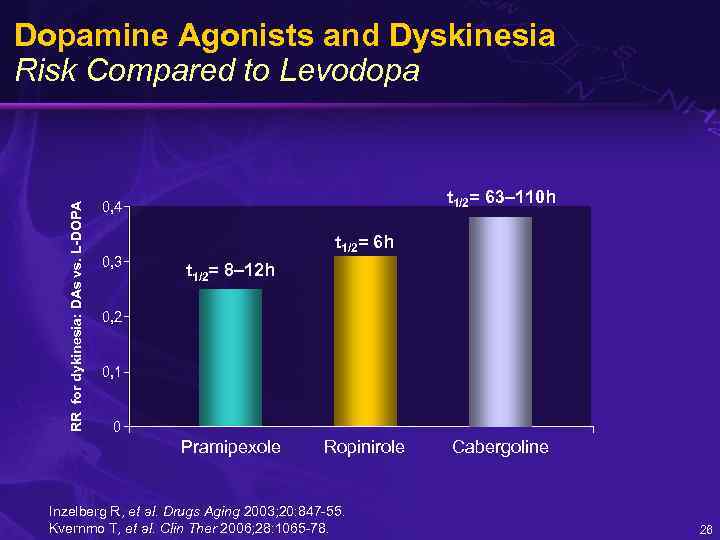
RR for dykinesia: DAs vs. L-DOPA Dopamine Agonists and Dyskinesia Risk Compared to Levodopa t 1/2= 63– 110 h 0, 4 0, 3 t 1/2= 6 h t 1/2= 8– 12 h 0, 2 0, 1 0 Pramipexole Ropinirole Inzelberg R, et al. Drugs Aging 2003; 20: 847 -55. Kvernmo T, et al. Clin Ther 2006; 28: 1065 -78. Cabergoline 26
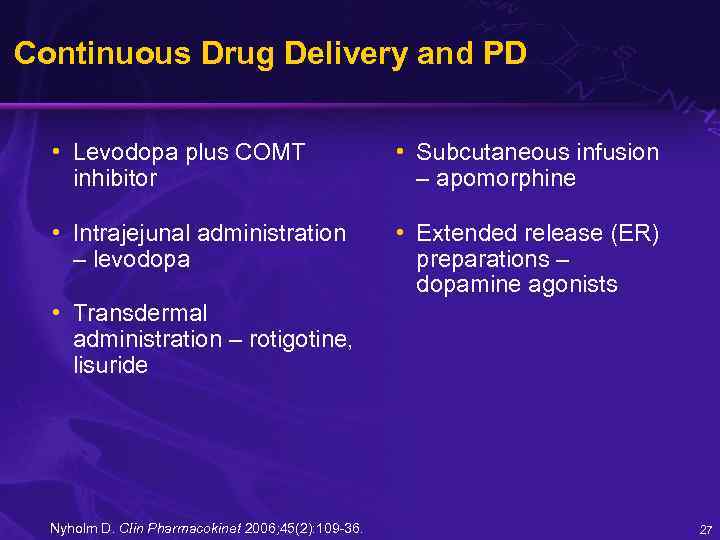
Continuous Drug Delivery and PD • Levodopa plus COMT inhibitor • Subcutaneous infusion – apomorphine • Intrajejunal administration – levodopa • Extended release (ER) preparations – dopamine agonists • Transdermal administration – rotigotine, lisuride Nyholm D. Clin Pharmacokinet 2006; 45(2): 109 -36. 27
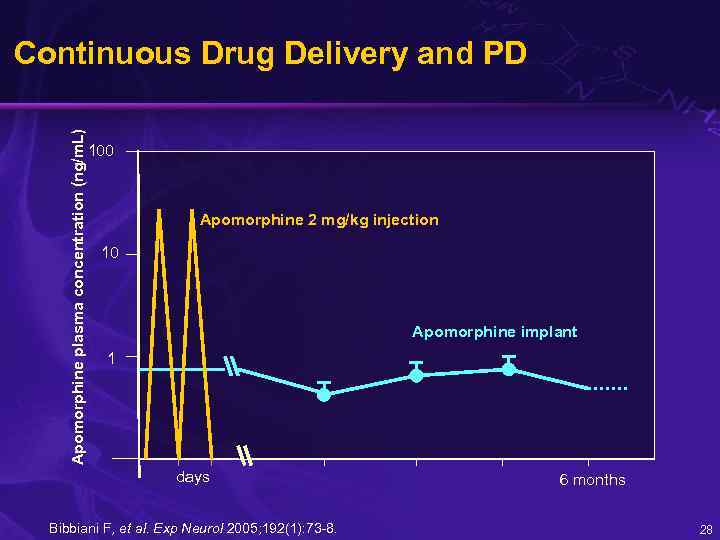
Apomorphine plasma concentration (ng/m. L) Continuous Drug Delivery and PD 100 Apomorphine 2 mg/kg injection 10 Apomorphine implant 1 days Bibbiani F, et al. Exp Neurol 2005; 192(1): 73 -8. 6 months 28
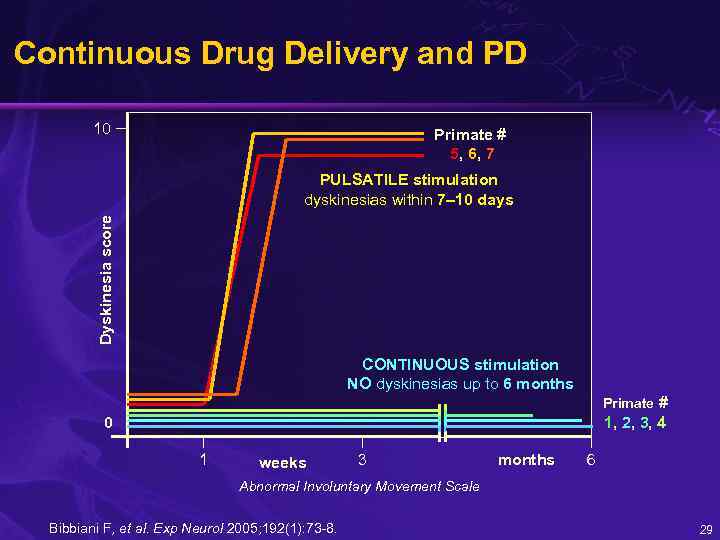
Continuous Drug Delivery and PD 10 Primate # 5, 6, 7 Dyskinesia score PULSATILE stimulation dyskinesias within 7– 10 days CONTINUOUS stimulation NO dyskinesias up to 6 months Primate # 1, 2, 3, 4 0 1 weeks 3 months 6 Abnormal Involuntary Movement Scale Bibbiani F, et al. Exp Neurol 2005; 192(1): 73 -8. 29
![Pramipexole Extended Release (ER) Pramipexole plasma conc. [ng/m. L] Pramipexole Arithmetic mean (linear scale)](https://present5.com/presentation/22167741_165278432/image-30.jpg "Pramipexole Extended Release (ER) Pramipexole plasma conc. [ng/m. L] Pramipexole Arithmetic mean (linear scale)")
Pramipexole Extended Release (ER) Pramipexole plasma conc. [ng/m. L] Pramipexole Arithmetic mean (linear scale) 10 IR tablet 1. 5 mg tid (N=24) ER tablet 4. 5 mg qd fasted (N=24) Plasma concentration time profiles of pramipexole after administration of 4. 5 mg pramipexole ER q. d. or 1. 5 mg pramipexole immediate release (IR) t. i. d under fasted conditions 8 6 4 2 0 96 100 104 108 112 116 120 Time [hours] Pramipexole plasma conc. [ng/m. L] Pramipexole Arithmetic mean (semi-log scale) 10 For IR, only the plasma concentrations after the first two daily dosages were followed 1 IR tablet 1. 5 mg tid (N=24) ER tablet 4. 5 mg qd fasted (N=24) 0. 1 96 100 104 108 112 116 120 Time [hours] Härtter et al. Neurol 2008; 3(S 15): 96(P 1244). All rights reserved. 30
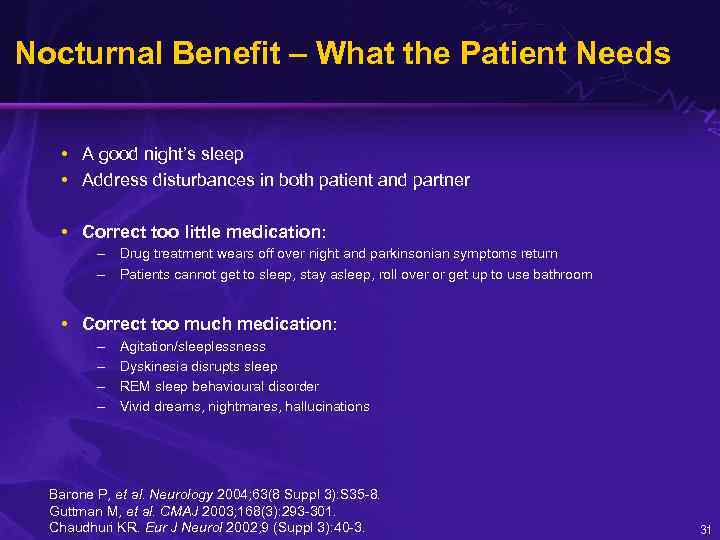
Nocturnal Benefit – What the Patient Needs • A good night’s sleep • Address disturbances in both patient and partner • Correct too little medication: – Drug treatment wears off over night and parkinsonian symptoms return – Patients cannot get to sleep, stay asleep, roll over or get up to use bathroom • Correct too much medication: – – Agitation/sleeplessness Dyskinesia disrupts sleep REM sleep behavioural disorder Vivid dreams, nightmares, hallucinations Barone P, et al. Neurology 2004; 63(8 Suppl 3): S 35 -8. Guttman M, et al. CMAJ 2003; 168(3): 293 -301. Chaudhuri KR. Eur J Neurol 2002; 9 (Suppl 3): 40 -3. 31
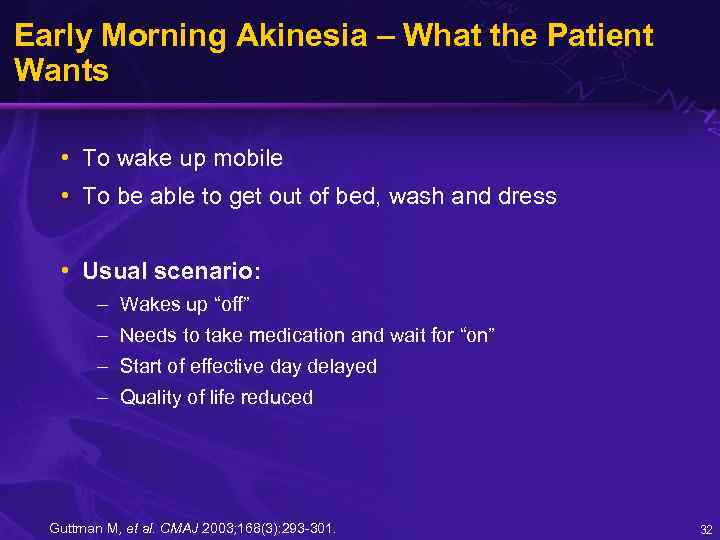
Early Morning Akinesia – What the Patient Wants • To wake up mobile • To be able to get out of bed, wash and dress • Usual scenario: – Wakes up “off” – Needs to take medication and wait for “on” – Start of effective day delayed – Quality of life reduced Guttman M, et al. CMAJ 2003; 168(3): 293 -301. 32
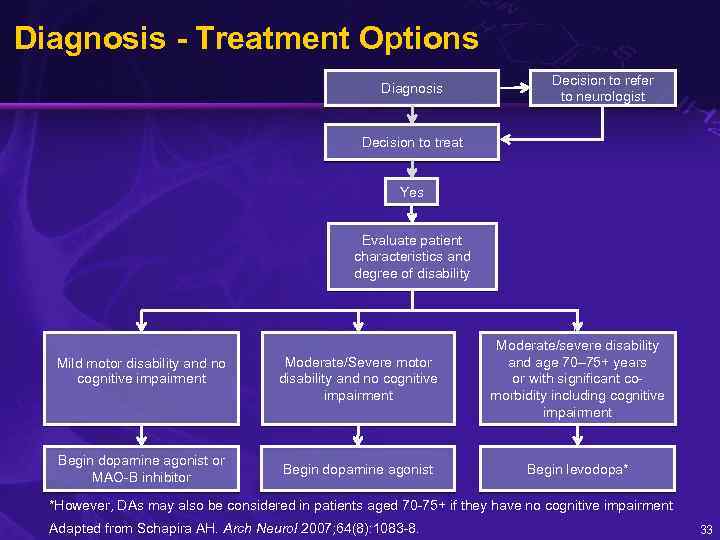
Diagnosis - Treatment Options Diagnosis Decision to refer to neurologist Decision to treat Yes Evaluate patient characteristics and degree of disability Mild motor disability and no cognitive impairment Begin dopamine agonist or MAO-B inhibitor Moderate/Severe motor disability and no cognitive impairment Begin dopamine agonist F Moderate/severe disability and age 70– 75+ years or with significant comorbidity including cognitive impairment Begin levodopa* *However, DAs may also be considered in patients aged 70 -75+ if they have no cognitive impairment Adapted from Schapira AH. Arch Neurol 2007; 64(8): 1083 -8. 33
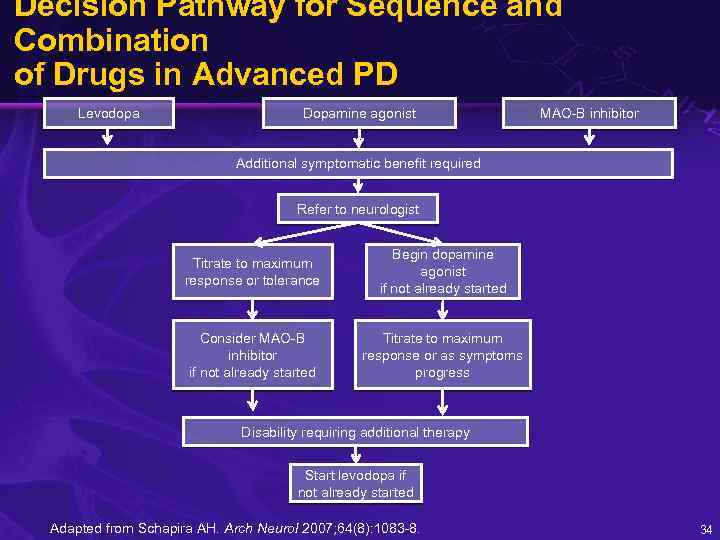
Decision Pathway for Sequence and Combination of Drugs in Advanced PD Levodopa Dopamine agonist MAO-B inhibitor Additional symptomatic benefit required Refer to neurologist Titrate to maximum response or tolerance Begin dopamine agonist if not already started Consider MAO-B inhibitor if not already started Titrate to maximum response or as symptoms progress Disability requiring additional therapy Start levodopa if not already started Adapted from Schapira AH. Arch Neurol 2007; 64(8): 1083 -8. 34
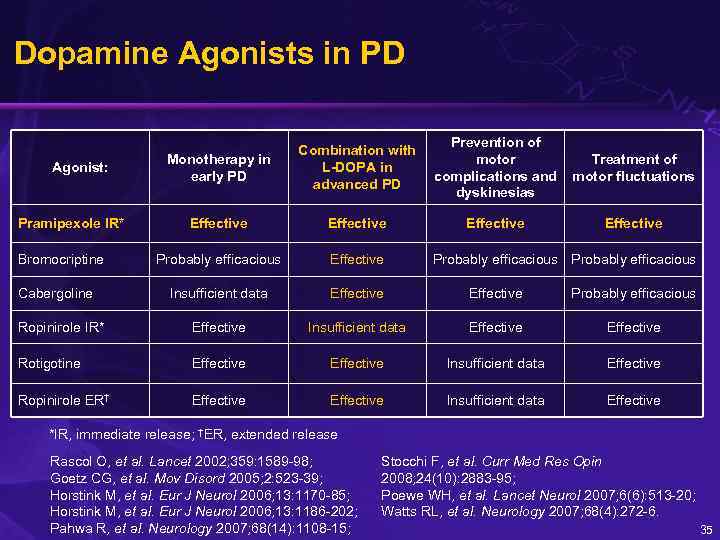
Dopamine Agonists in PD Monotherapy in early PD Combination with L-DOPA in advanced PD Prevention of motor complications and dyskinesias Treatment of motor fluctuations Effective Probably efficacious Effective Insufficient data Effective Probably efficacious Ropinirole IR* Effective Insufficient data Effective Rotigotine Effective Insufficient data Effective Ropinirole ER† Effective Insufficient data Effective Agonist: Pramipexole IR* Bromocriptine Cabergoline Probably efficacious *IR, immediate release; †ER, extended release Rascol O, et al. Lancet 2002; 359: 1589 -98; Goetz CG, et al. Mov Disord 2005; 2: 523 -39; Horstink M, et al. Eur J Neurol 2006; 13: 1170 -85; Horstink M, et al. Eur J Neurol 2006; 13: 1186 -202; Pahwa R, et al. Neurology 2007; 68(14): 1108 -15; Stocchi F, et al. Curr Med Res Opin 2008; 24(10): 2883 -95; Poewe WH, et al. Lancet Neurol 2007; 6(6): 513 -20; Watts RL, et al. Neurology 2007; 68(4): 272 -6. 35
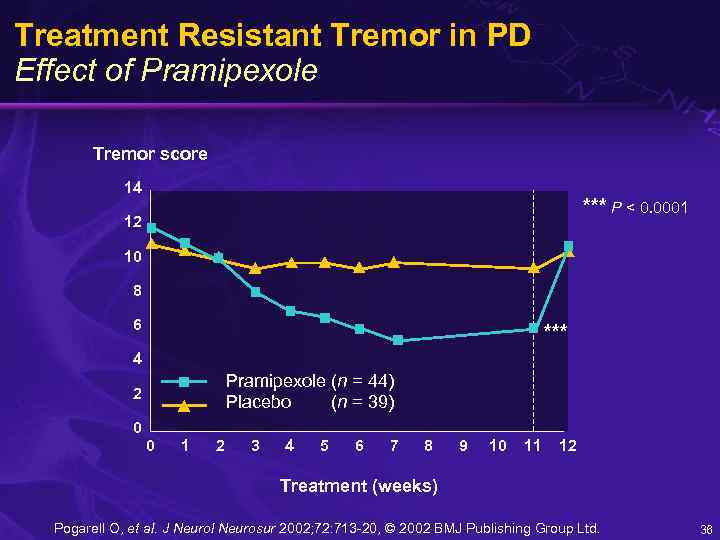
Treatment Resistant Tremor in PD Effect of Pramipexole Tremor score 14 *** P < 0. 0001 12 10 8 6 *** 4 Pramipexole (n = 44) Placebo (n = 39) 2 0 0 1 2 3 4 5 6 7 8 9 10 11 12 Treatment (weeks) Pogarell O, et al. J Neurol Neurosur 2002; 72: 713 -20, © 2002 BMJ Publishing Group Ltd. 36
Neuroprotection 37
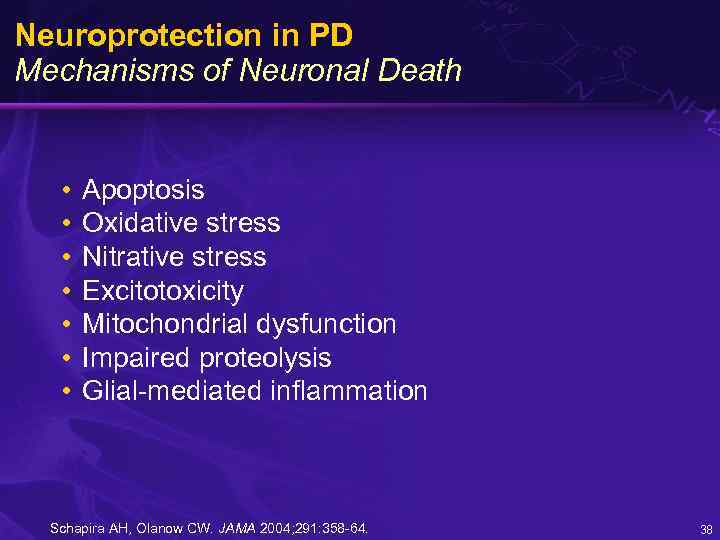
Neuroprotection in PD Mechanisms of Neuronal Death • • Apoptosis Oxidative stress Nitrative stress Excitotoxicity Mitochondrial dysfunction Impaired proteolysis Glial-mediated inflammation Schapira AH, Olanow CW. JAMA 2004; 291: 358 -64. 38
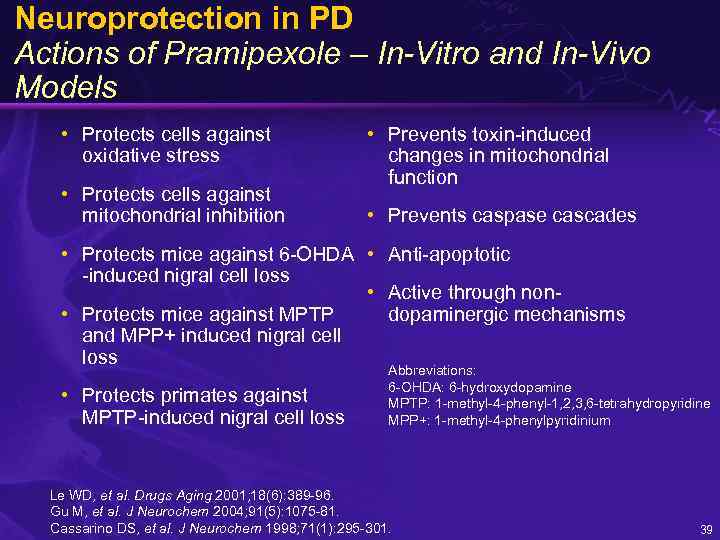
Neuroprotection in PD Actions of Pramipexole – In-Vitro and In-Vivo Models • Protects cells against oxidative stress • Protects cells against mitochondrial inhibition • Prevents toxin-induced changes in mitochondrial function • Prevents caspase cascades • Protects mice against 6 -OHDA • Anti-apoptotic -induced nigral cell loss • Active through non • Protects mice against MPTP dopaminergic mechanisms and MPP+ induced nigral cell loss • Protects primates against MPTP-induced nigral cell loss Abbreviations: 6 -OHDA: 6 -hydroxydopamine MPTP: 1 -methyl-4 -phenyl-1, 2, 3, 6 -tetrahydropyridine MPP+: 1 -methyl-4 -phenylpyridinium Le WD, et al. Drugs Aging 2001; 18(6): 389 -96. Gu M, et al. J Neurochem 2004; 91(5): 1075 -81. Cassarino DS, et al. J Neurochem 1998; 71(1): 295 -301. 39
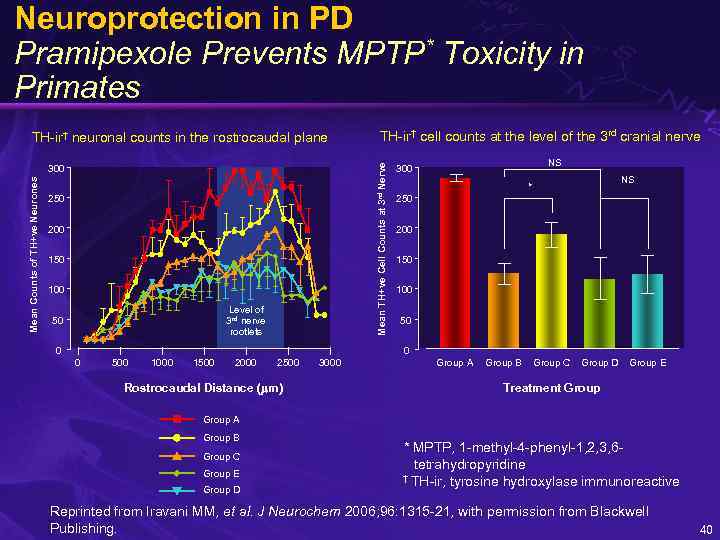
Neuroprotection in PD Pramipexole Prevents MPTP* Toxicity in Primates Mean Counts of TH+ve Neurones 300 250 200 150 100 Level of 3 rd nerve rootlets 50 TH-ir† cell counts at the level of the 3 rd cranial nerve Mean TH+ve Cell Counts at 3 rd Nerve TH-ir† neuronal counts in the rostrocaudal plane 0 NS 300 NS * 250 200 150 100 50 0 0 500 1000 1500 2000 2500 Rostrocaudal Distance ( m) 3000 Group A Group B Group C Group D Group E Treatment Group A Group B Group C Group E Group D * MPTP, 1 -methyl-4 -phenyl-1, 2, 3, 6 tetrahydropyridine † TH-ir, tyrosine hydroxylase immunoreactive Reprinted from Iravani MM, et al. J Neurochem 2006; 96: 1315 -21, with permission from Blackwell Publishing. 40
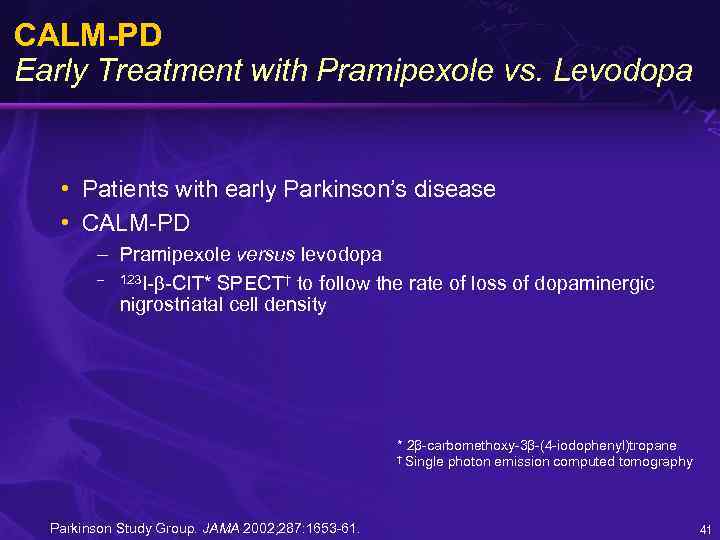
CALM-PD Early Treatment with Pramipexole vs. Levodopa • Patients with early Parkinson’s disease • CALM-PD – Pramipexole versus levodopa – 123 I- -CIT* SPECT† to follow the rate of loss of dopaminergic nigrostriatal cell density * 2β-carbomethoxy-3β-(4 -iodophenyl)tropane † Single photon emission computed tomography Parkinson Study Group. JAMA 2002; 287: 1653 -61. 41
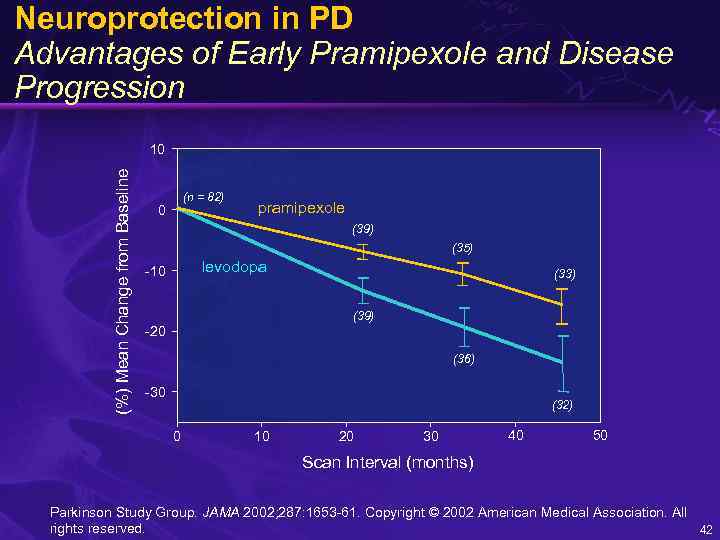
Neuroprotection in PD Advantages of Early Pramipexole and Disease Progression (%) Mean Change from Baseline 10 (n = 82) 0 pramipexole (39) (35) levodopa -10 (33) (39) -20 (36) -30 (32) 0 10 20 30 40 50 Scan Interval (months) Parkinson Study Group. JAMA 2002; 287: 1653 -61. Copyright © 2002 American Medical Association. All rights reserved. 42
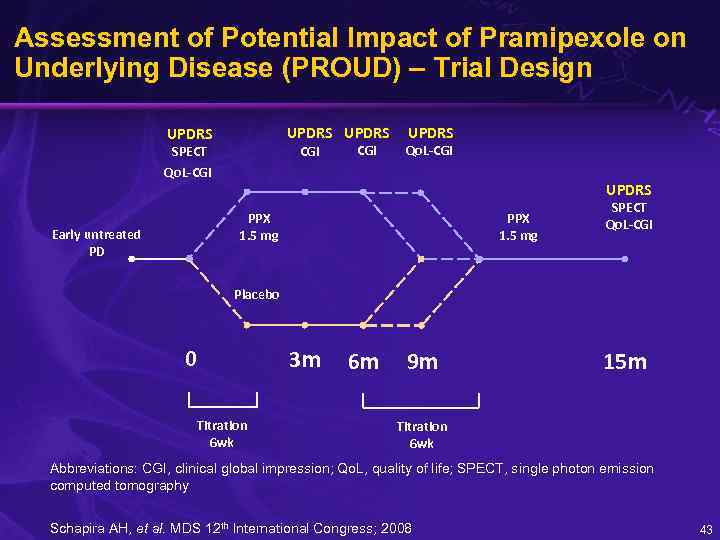
Assessment of Potential Impact of Pramipexole on Underlying Disease (PROUD) – Trial Design UPDRS CGI SPECT Qo. L-CGI UPDRS PPX 1. 5 mg Early untreated PD PPX 1. 5 mg SPECT Qo. L-CGI Placebo 0 Titration 6 wk 3 m 6 m 9 m 15 m Titration 6 wk Abbreviations: CGI, clinical global impression; Qo. L, quality of life; SPECT, single photon emission computed tomography Schapira AH, et al. MDS 12 th International Congress; 2008 43
Sleep Disorders in PD 44
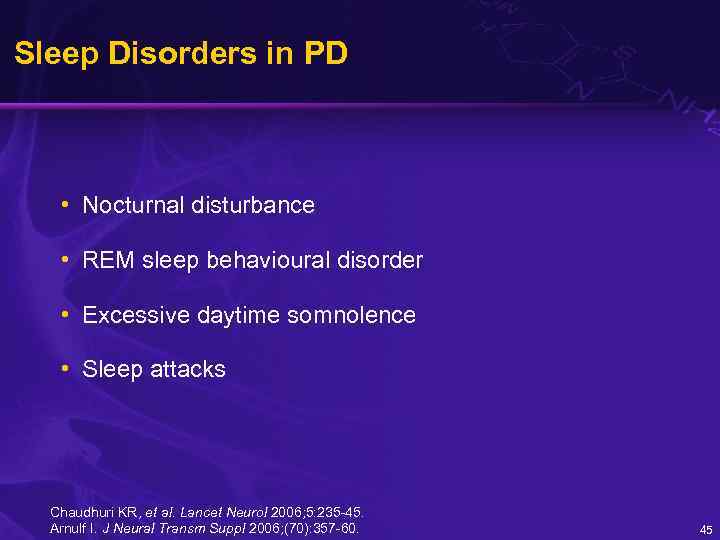
Sleep Disorders in PD • Nocturnal disturbance • REM sleep behavioural disorder • Excessive daytime somnolence • Sleep attacks Chaudhuri KR, et al. Lancet Neurol 2006; 5: 235 -45. Arnulf I. J Neural Transm Suppl 2006; (70): 357 -60. 45
Excessive Daytime Somnolence in PD Treatment Refer to neurologist Decision on the level of individual patient • Improve sleep hygiene • Evaluate for contributing conditions such as depression • Modify dopaminergic medication to use lowest effective dose • Reduce or discontinue antihistamine, hypnotics or stimulant drugs that disrupt the sleep–wake cycle • If persistence or worsening of parkinsonism occurs, use alerting agents such as modafinil Barone P, et al. Neurology 2004; 63(8 Suppl 3): S 35 -8. Phillips B. Neurology 2004; 62(5 Suppl 2): S 9 -16. 46
Sleep Attacks in PD Refer to neurologist • Sudden onset of sleep without warning • Rare but potentially dangerous adverse event • Can occur while driving • Patients advised not to drive • Class effect Arnulf I. J Neural Transm Suppl 2006; (70): 357 -60. Barone P, et al. Neurology 2004; 63(8 Suppl 3): S 35 -8. 47
Impulse Control Disorders in PD 48
Symptoms of Impulse Control Disorders in PD Refer to neurologist or psychiatrist • Dopamine dysregulation syndromes • Abnormal behaviours • Pathological gambling • Compulsive shopping • Punding • Hypersexuality Mamikonyan E, et al. Mov Disord 2008; 23(1): 75 -80. Potenza MN, et al. Nat Clin Pract Neurol 2007; 3(12): 664 -72. 49
Symptoms of Impulse Control Disorders in PD Refer to neurologist or psychiatrist • Reported under dopaminergic treatment including dopamine agonists and L-dopa • Physicians, patients and caregivers should be appropriately informed • Refer to neurologist or psychiatrist if symptoms of abnormal behaviour occur Mamikonyan E, et al. Mov Disord 2008; 23(1): 75 -80. Potenza MN, et al. Nat Clin Pract Neurol 2007; 3(12): 664 -72. 50
Impulse Control Disorders in PD Management Refer to neurologist or psychiatrist • Actively monitor for symptoms of impulse control disorders • Discuss the risks and benefits of treatment • Involve spouse or other family members (with consent of patient) • Ensure medication compliance, checking for hoarding and overuse of medication • Consider altering drug therapy • Refer to neurologist • Refer to psychiatrist Mamikonyan E, et al. Mov Disord 2008; 23(1): 75 -80. Potenza MN, et al. Nat Clin Pract Neurol 2007; 3(12): 664 -72. 51
Fibrosis in PD 52
Fibrosis in PD Refer to cardiologist • Pulmonary fibrosis • Fibrotic valvular heart disease • Rare but potentially serious • Associated with ergot derivatives (bromocriptine, pergolide, cabergoline) • No increased risk under use of non-ergot dopamine agonists (e. g. pramipexole, ropinirole) • Probably associated with serotonergic actions (5 -HT 2 B) of drugs Antonini A, Poewe W. Lancet Neurol 2007; 6(9): 826 -9. Roth BL. N Engl J Med 2007; 356(1): 6 -9. 53
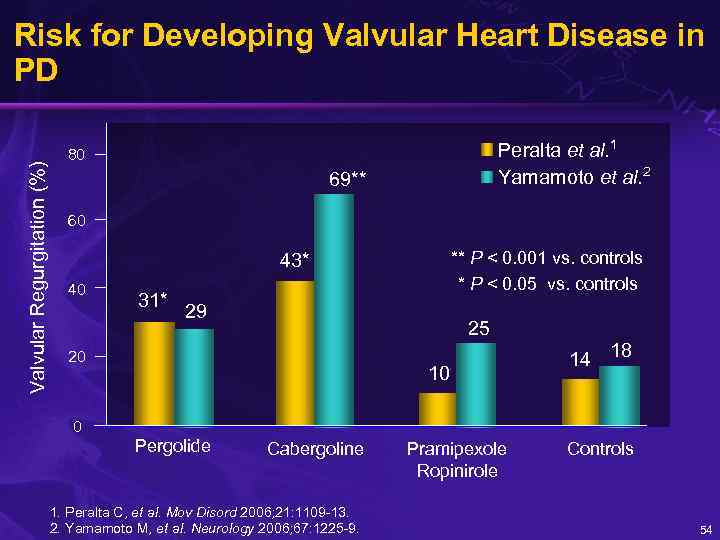
Valvular Regurgitation (%) Risk for Developing Valvular Heart Disease in PD Peralta et al. 1 Yamamoto et al. 2 80 69** 60 ** P < 0. 001 vs. controls * P < 0. 05 vs. controls 43* 40 31* 29 25 20 10 14 18 0 Pergolide Cabergoline 1. Peralta C, et al. Mov Disord 2006; 21: 1109 -13. 2. Yamamoto M, et al. Neurology 2006; 67: 1225 -9. Pramipexole Ropinirole Controls 54
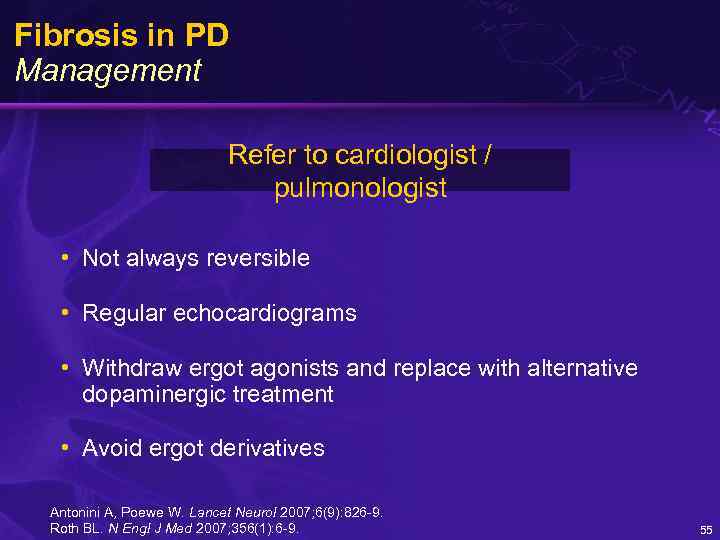
Fibrosis in PD Management Refer to cardiologist / pulmonologist • Not always reversible • Regular echocardiograms • Withdraw ergot agonists and replace with alternative dopaminergic treatment • Avoid ergot derivatives Antonini A, Poewe W. Lancet Neurol 2007; 6(9): 826 -9. Roth BL. N Engl J Med 2007; 356(1): 6 -9. 55
Pharmacokinetics and Drug Interactions 56
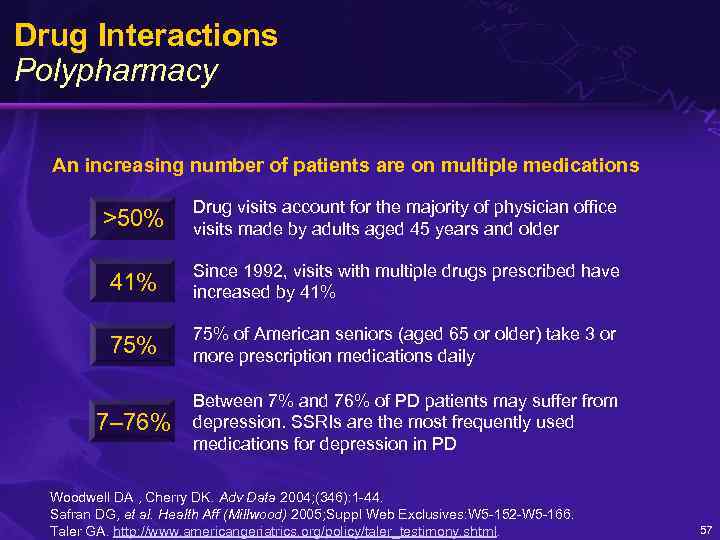
Drug Interactions Polypharmacy An increasing number of patients are on multiple medications >50% Drug visits account for the majority of physician office visits made by adults aged 45 years and older 41% Since 1992, visits with multiple drugs prescribed have increased by 41% 75% of American seniors (aged 65 or older) take 3 or more prescription medications daily 7– 76% Between 7% and 76% of PD patients may suffer from depression. SSRIs are the most frequently used medications for depression in PD Woodwell DA , Cherry DK. Adv Data 2004; (346): 1 -44. Safran DG, et al. Health Aff (Millwood) 2005; Suppl Web Exclusives: W 5 -152 -W 5 -166. Taler GA. http: //www. americangeriatrics. org/policy/taler_testimony. shtml. 57

Effect of Food on Drug Action in PD Influence of food Levodopa Absorption affected by gastric emptying. High dietary protein reduces efficacy by competing for uptake through the blood–brain barrier Ropinirole Increase of Tmax by 2. 5 hours and decrease of Cmax by 25% after high fat meal Pramipexole When taken with food, Tmax increases by 1 hour Tmax = time of maximum plasma concentration Cmax = maximum plasma concentration Tsui JK, et al. Neurology 1989; 39: 549 -52. Brefel C, et al. Br J Clin Pharmaco 1998; 45: 412 -5. Deleu D, et al. Clin Pharmacokinet 2002; 41(4): 261 -309. 58
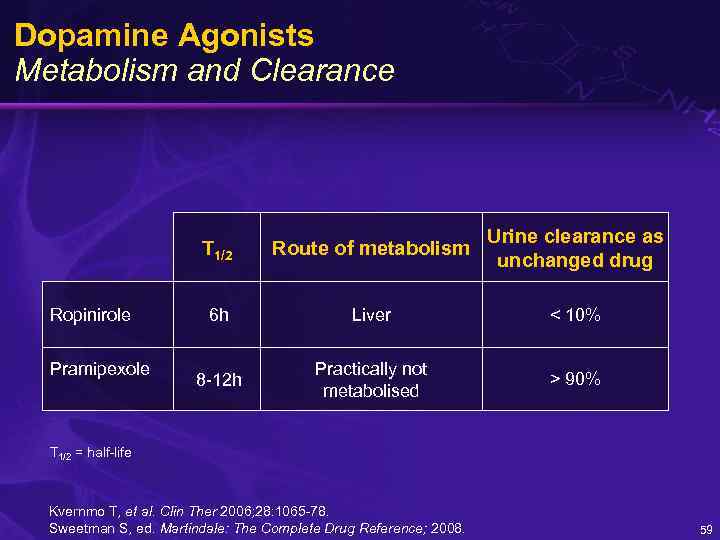
Dopamine Agonists Metabolism and Clearance T 1/2 Ropinirole Pramipexole Route of metabolism Urine clearance as unchanged drug 6 h Liver < 10% 8 -12 h Practically not metabolised > 90% T 1/2 = half-life Kvernmo T, et al. Clin Ther 2006; 28: 1065 -78. Sweetman S, ed. Martindale: The Complete Drug Reference; 2008. 59
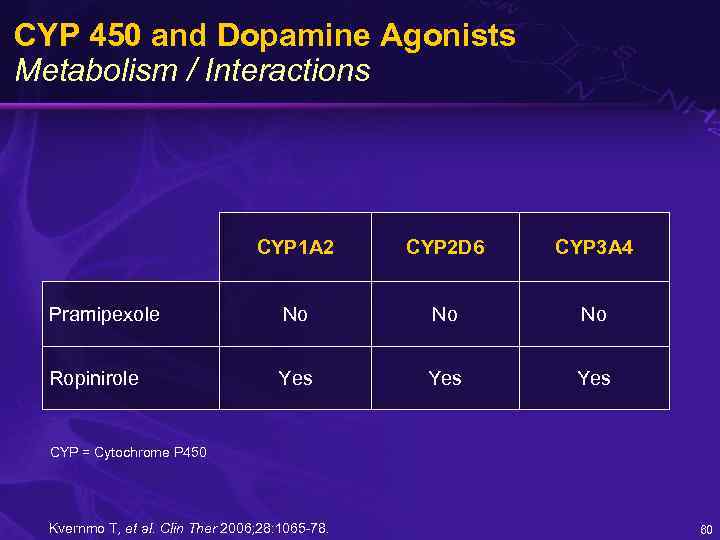
CYP 450 and Dopamine Agonists Metabolism / Interactions CYP 1 A 2 CYP 2 D 6 CYP 3 A 4 Pramipexole No No No Ropinirole Yes Yes CYP = Cytochrome P 450 Kvernmo T, et al. Clin Ther 2006; 28: 1065 -78. 60
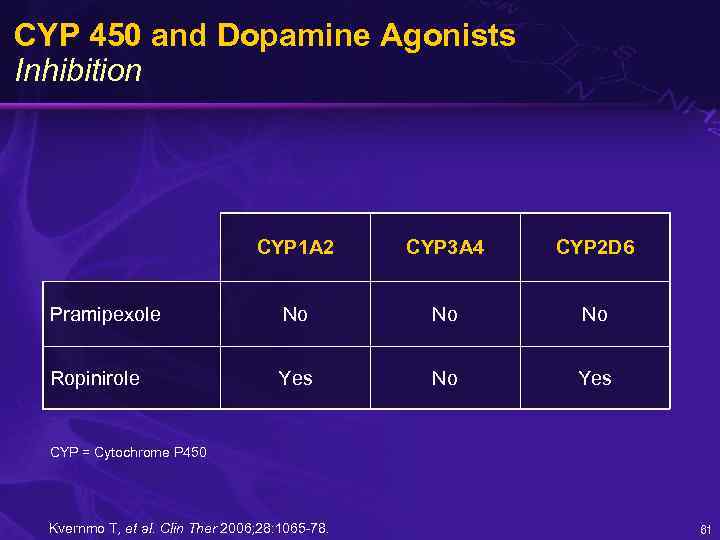
CYP 450 and Dopamine Agonists Inhibition CYP 1 A 2 CYP 3 A 4 CYP 2 D 6 Pramipexole No No No Ropinirole Yes No Yes CYP = Cytochrome P 450 Kvernmo T, et al. Clin Ther 2006; 28: 1065 -78. 61
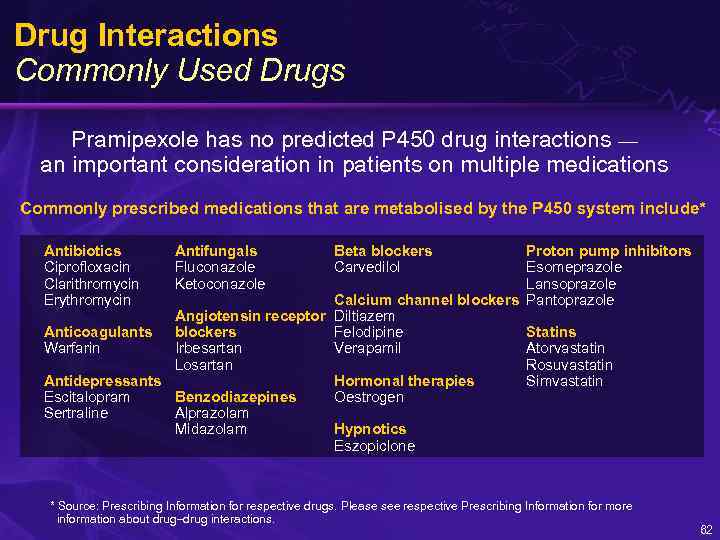
Drug Interactions Commonly Used Drugs Pramipexole has no predicted P 450 drug interactions — an important consideration in patients on multiple medications Commonly prescribed medications that are metabolised by the P 450 system include* Proton pump inhibitors Esomeprazole Lansoprazole Calcium channel blockers Pantoprazole Angiotensin receptor Diltiazem Statins blockers Anticoagulants Felodipine Atorvastatin Irbesartan Warfarin Verapamil Rosuvastatin Losartan Simvastatin Antidepressants Hormonal therapies Benzodiazepines Escitalopram Oestrogen Alprazolam Sertraline Midazolam Hypnotics Eszopiclone Antibiotics Ciprofloxacin Clarithromycin Erythromycin Antifungals Fluconazole Ketoconazole Beta blockers Carvedilol * Source: Prescribing Information for respective drugs. Please see respective Prescribing Information for more information about drug–drug interactions. 62
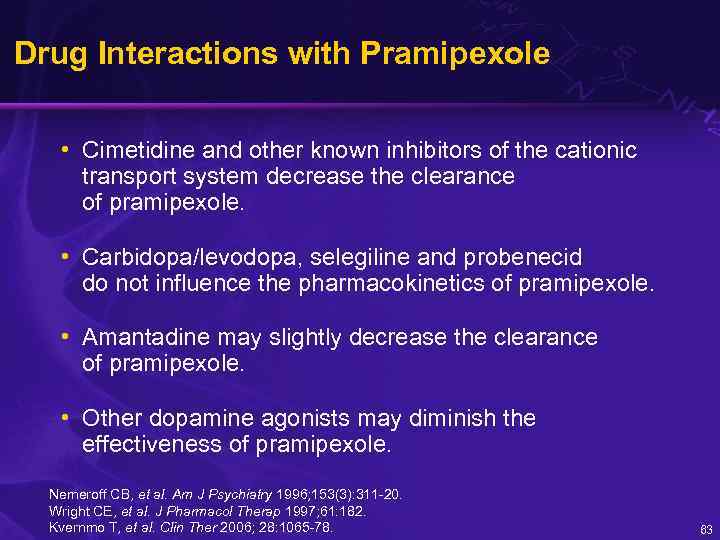
Drug Interactions with Pramipexole • Cimetidine and other known inhibitors of the cationic transport system decrease the clearance of pramipexole. • Carbidopa/levodopa, selegiline and probenecid do not influence the pharmacokinetics of pramipexole. • Amantadine may slightly decrease the clearance of pramipexole. • Other dopamine agonists may diminish the effectiveness of pramipexole. Nemeroff CB, et al. Am J Psychiatry 1996; 153(3): 311 -20. Wright CE, et al. J Pharmacol Therap 1997; 61: 182. Kvernmo T, et al. Clin Ther 2006; 28: 1065 -78. 63
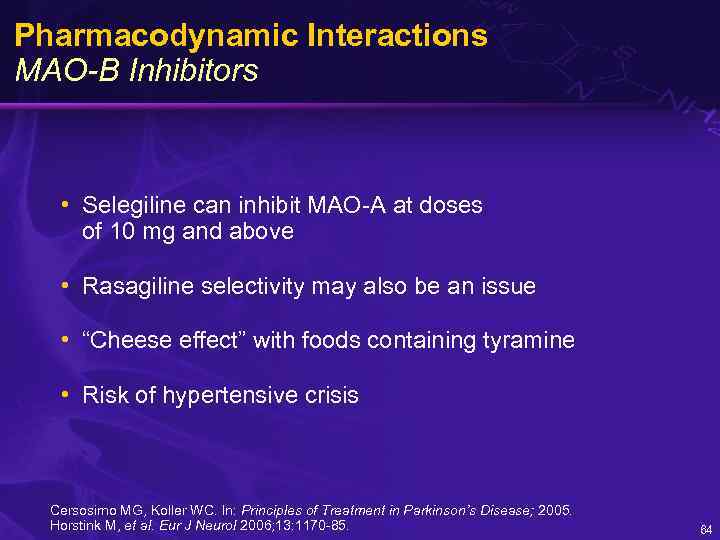
Pharmacodynamic Interactions MAO-B Inhibitors • Selegiline can inhibit MAO-A at doses of 10 mg and above • Rasagiline selectivity may also be an issue • “Cheese effect” with foods containing tyramine • Risk of hypertensive crisis Cersosimo MG, Koller WC. In: Principles of Treatment in Parkinson’s Disease; 2005. Horstink M, et al. Eur J Neurol 2006; 13: 1170 -85. 64
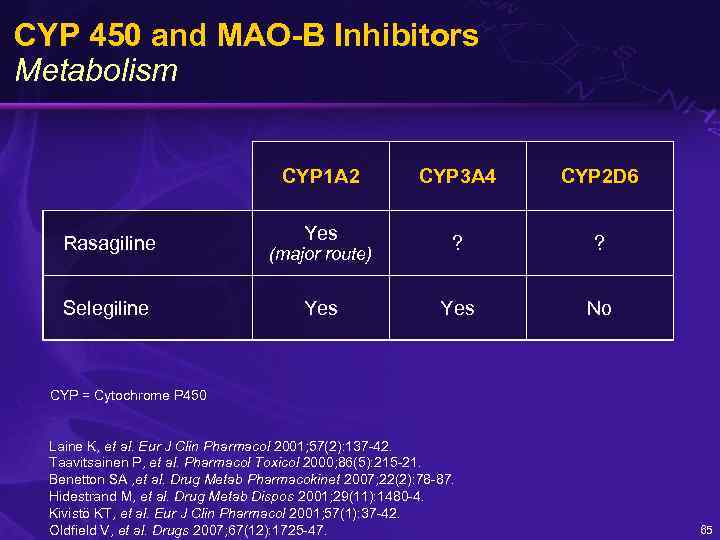
CYP 450 and MAO-B Inhibitors Metabolism CYP 1 A 2 Rasagiline Selegiline CYP 3 A 4 CYP 2 D 6 Yes ? ? Yes No (major route) CYP = Cytochrome P 450 Laine K, et al. Eur J Clin Pharmacol 2001; 57(2): 137 -42. Taavitsainen P, et al. Pharmacol Toxicol 2000; 86(5): 215 -21. Benetton SA , et al. Drug Metab Pharmacokinet 2007; 22(2): 78 -87. Hidestrand M, et al. Drug Metab Dispos 2001; 29(11): 1480 -4. Kivistö KT, et al. Eur J Clin Pharmacol 2001; 57(1): 37 -42. Oldfield V, et al. Drugs 2007; 67(12): 1725 -47. 65
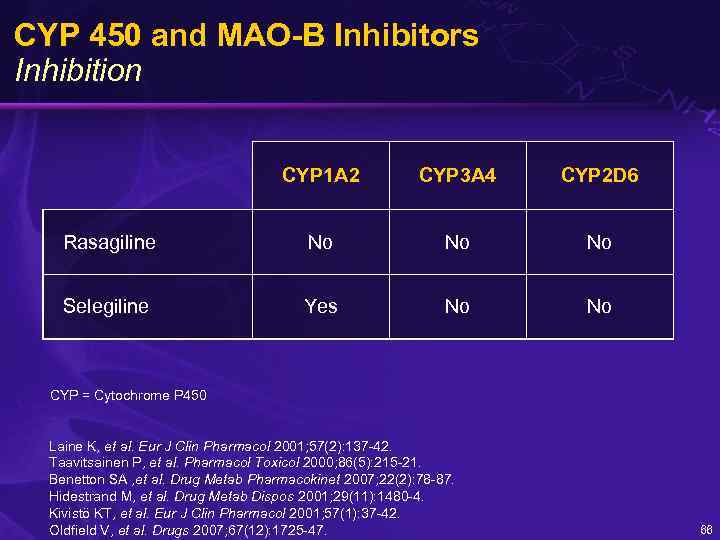
CYP 450 and MAO-B Inhibitors Inhibition CYP 1 A 2 CYP 3 A 4 CYP 2 D 6 Rasagiline No No No Selegiline Yes No CYP = Cytochrome P 450 Laine K, et al. Eur J Clin Pharmacol 2001; 57(2): 137 -42. Taavitsainen P, et al. Pharmacol Toxicol 2000; 86(5): 215 -21. Benetton SA , et al. Drug Metab Pharmacokinet 2007; 22(2): 78 -87. Hidestrand M, et al. Drug Metab Dispos 2001; 29(11): 1480 -4. Kivistö KT, et al. Eur J Clin Pharmacol 2001; 57(1): 37 -42. Oldfield V, et al. Drugs 2007; 67(12): 1725 -47. 66
Pharmacodynamic Interactions MAO Inhibitors • In view of MAO inhibitory effect of rasagiline, concomitant use of antidepressants should be considered with caution because of possible risk for serotonin syndrome. • Selegiline and adjunctive SSRIs should be considered with caution because of possible risk for serotonin syndrome. • Combination of rasagiline and other MAO inhibitors and pethidine is contraindicated because of risk for serotonin syndrome. Oldfield V, et al. Drugs 2007; 67 (12): 1725 -1747. Summaries of product characteristics. 67
Dopamine Agonists and PD Conclusions 68
Dopamine Agonists and PD Conclusions 1 • Dopamine agonists provide effective treatment for the early and midto-late stages of PD. • When used as monotherapy, dopamine agonists are associated with a low incidence of motor complications in comparison to L-DOPA. • The non-ergot drugs, such as pramipexole, are pharmacologically specific and selectively interact with D 2/D 3 dopamine receptors. • Their plasma half-life is longer than for L-DOPA – More continuous drug delivery and dopaminergic stimulation. • Early treatment with DAs like pramipexole may translate into additional clinical benefits – Further research is currently underway to examine the potential to modify disease progression. Yamamoto M, Schapira AH. Expert Rev Neurother 2008; 8(4): 671 -7. Le. Witt PA, Taylor DC. Neurotherapeutics 2008; 5(2): 210 -25. 69
Dopamine Agonists and PD Conclusions 2 • General practitioners should be aware that pulmonary and cardiac valvular fibrosis may occur with ergot derivatives. – In all cases, patients should be referred to the appropriate specialist for assessment. • The potential for drug interactions should be monitored in elderly patients taking multiple medications. • There are few known interactions for dopamine agonists such as pramipexole. Deleu D, et al. Clin Pharmacokinet 2002; 41(4): 261 -309. Kvernmo T, et al. Clin Ther 2006; 28(8): 1065 -78. 70

Supported by an educational grant from Boehringer Ingelheim International Gmb. H Scientific coordination: Armine Najand, MD Produced by: LMS Group 75 rue Guy Môquet 92240 Malakoff France Phone: +33 1 42 53 03 03 Fax: +33 1 42 53 03 02 E-mail: info@lms-group. com www. lms-group. com 71
Скачать презентацию Антагонисты допамина в лечении болезни Паркинсона Clinical Pharmacology
Dopamine_Agonists_for_the_Treatment_of_PD.ppt