


 Скачать презентацию ANSI ASHRAE IESNA Standard 90 1 -2007 Top 10 things
486f6269c92886e7dbb1031f9ce958df.ppt
- Количество слайдов: 39
 ANSI/ASHRAE/IESNA Standard 90. 1 -2007 Top 10 things you should know about the energy standard © 2009 Trane
 ASHRAE Standard 90. 1 Scope of 2007 Update n Incorporates 42 addenda published since 90. 1 -2004 was released © 2009 Trane
 ASHRAE Standard 90. 1 -2007 Purpose “… Provide minimum requirements for the energyefficient design of buildings except low-rise residential buildings” © 2009 Trane
 10 90. 1 applies to the entire building © 2009 Trane
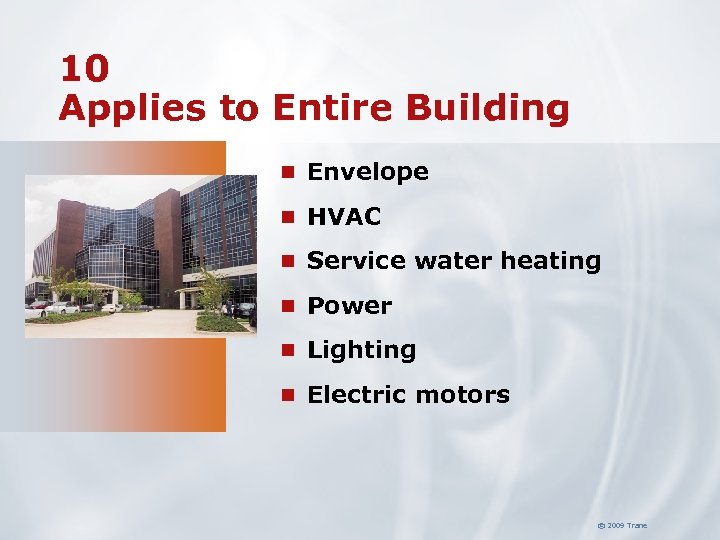 10 Applies to Entire Building n Envelope n HVAC n Service water heating n Power n Lighting n Electric motors © 2009 Trane
 9 Certain system controls are mandatory © 2009 Trane
 9 Mandatory System Controls n Deadband: ≥ 5° F n Automatic shutdown (systems ≥ 15, 000 Btu/h) u 7 -Day time schedules with 10 -hr battery backup, or u Occupancy sensor, or u Manually operated timer with 2 -hr max duration, or u Security system interlock © 2009 Trane
 9 Mandatory System Controls n Setback (Requirements vary for different cooling and heating climates) n Optimum start if system supply air > 10, 000 cfm n Automated shutoff control u Ventilation (outdoor-air) dampers u Exhaust dampers © 2009 Trane
 9 Mandatory System Controls n Zone isolation u 25, 000 ft² maximum zone size on one floor u Shut off airflow u Central systems capable of stable operation © 2009 Trane
 8 Lighting requirements © 2009 Trane
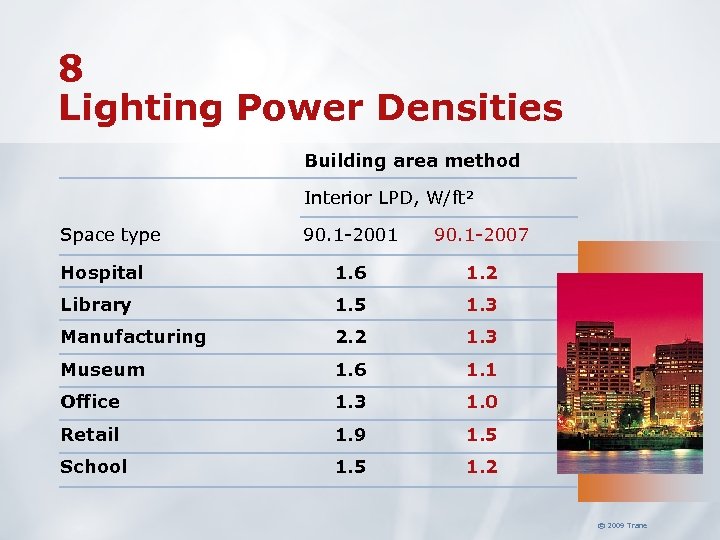 8 Lighting Power Densities Building area method Interior LPD, W/ft² 90. 1 -2001 90. 1 -2007 Hospital 1. 6 1. 2 Library 1. 5 1. 3 Manufacturing 2. 2 1. 3 Museum 1. 6 1. 1 Office 1. 3 1. 0 Retail 1. 9 1. 5 School 1. 5 1. 2 Space type © 2009 Trane
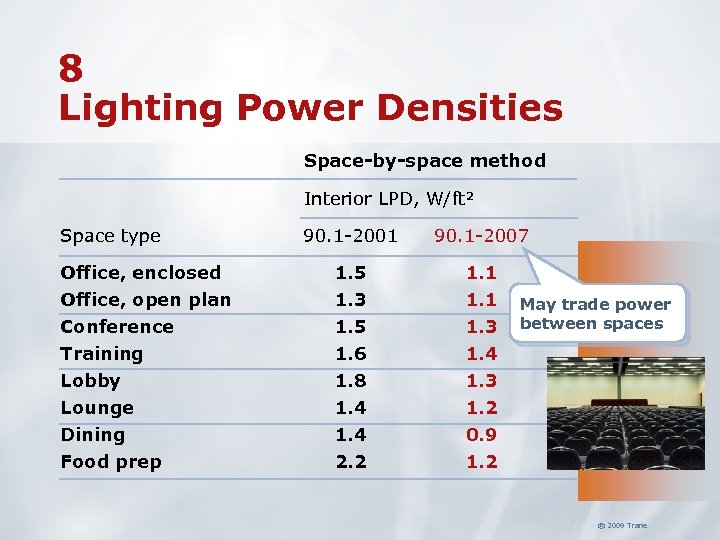 8 Lighting Power Densities Space-by-space method Interior LPD, W/ft² Space type 90. 1 -2001 90. 1 -2007 Office, enclosed 1. 5 1. 1 Office, open plan Conference Training Lobby Lounge Dining Food prep 1. 3 1. 5 1. 6 1. 8 1. 4 2. 2 1. 1 1. 3 1. 4 1. 3 1. 2 0. 9 1. 2 May trade power between spaces © 2009 Trane
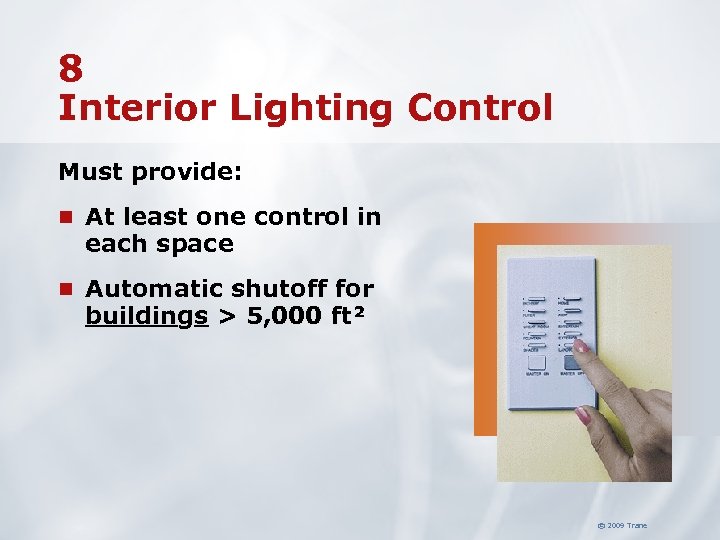 8 Interior Lighting Control Must provide: n At least one control in each space n Automatic shutoff for buildings > 5, 000 ft² © 2009 Trane
 7 Applies to building alterations and additions © 2009 Trane
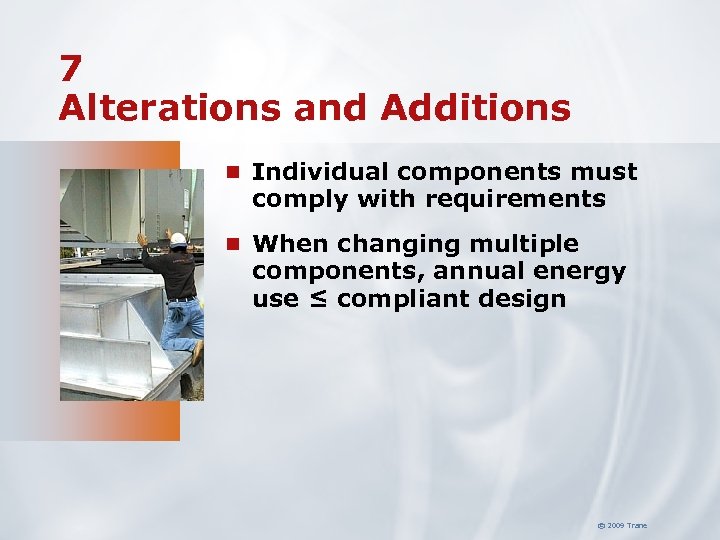 7 Alterations and Additions n Individual components must comply with requirements n When changing multiple components, annual energy use ≤ compliant design © 2009 Trane
 6 Limitation on system fan power © 2009 Trane
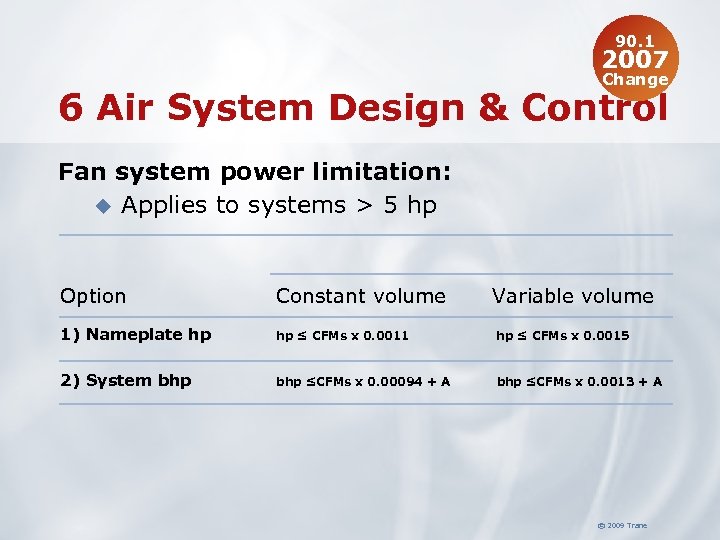 90. 1 2007 Change 6 Air System Design & Control Fan system power limitation: u Applies to systems > 5 hp Option Constant volume Variable volume 1) Nameplate hp hp ≤ CFMs x 0. 0011 hp ≤ CFMs x 0. 0015 2) System bhp ≤CFMs x 0. 00094 + A bhp ≤CFMs x 0. 0013 + A © 2009 Trane
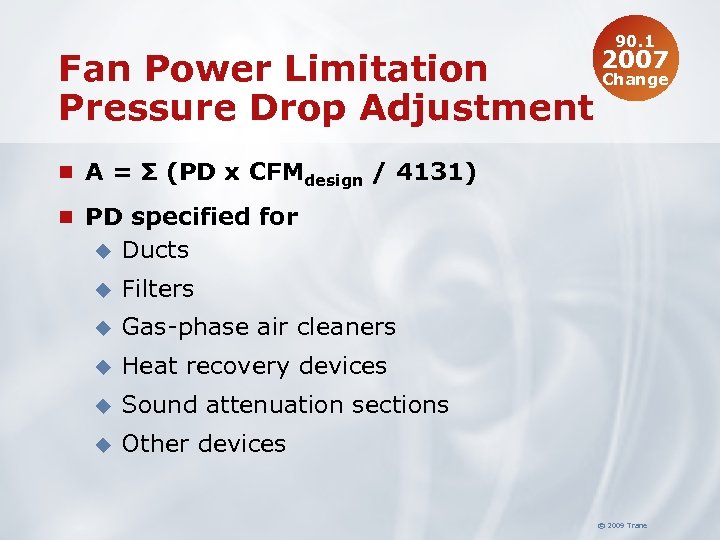 90. 1 2007 Fan Power Limitation Change Pressure Drop Adjustment n A = Σ (PD x CFMdesign / 4131) n PD specified for u Ducts u Filters u Gas-phase air cleaners u Heat recovery devices u Sound attenuation sections u Other devices © 2009 Trane
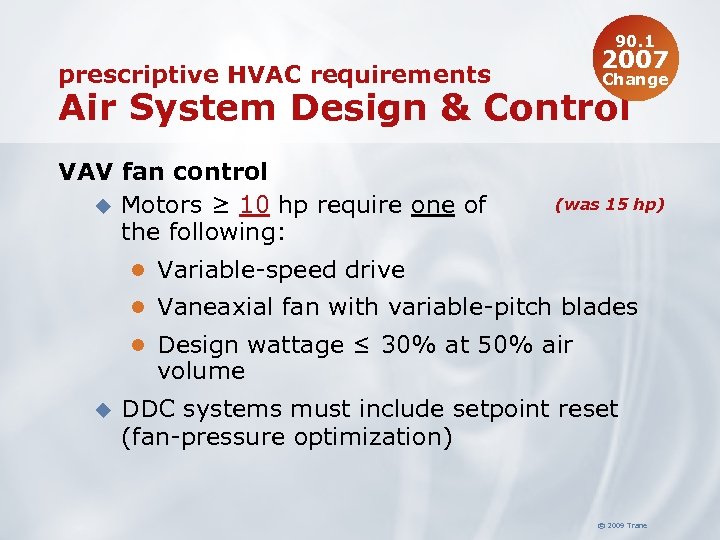 90. 1 2007 prescriptive HVAC requirements Change Air System Design & Control VAV fan control u Motors ≥ 10 hp require one of the following: (was 15 hp) l Variable-speed drive l Vaneaxial fan with variable-pitch blades l Design wattage ≤ 30% at 50% air volume u DDC systems must include setpoint reset (fan-pressure optimization) © 2009 Trane
 5 Limitation on reheat with new energy © 2009 Trane
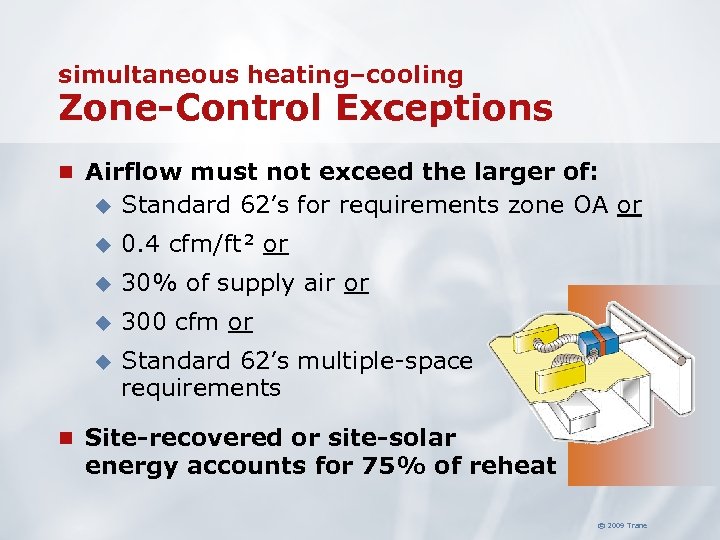 simultaneous heating–cooling Zone-Control Exceptions n Airflow must not exceed the larger of: u Standard 62’s for requirements zone OA or u 0. 4 cfm/ft² or u 30% of supply air or u 300 cfm or u Standard 62’s multiple-space requirements n Site-recovered or site-solar energy accounts for 75% of reheat © 2009 Trane
 simultaneous heating–cooling Dehumidification Exceptions n Reducing supply airflow to 50%, or minimum ventilation rate n Systems < 6. 67 tons that can unload at least 50% n Systems < 3. 3 tons n Systems with specific humidity requirements (museums, surgical suites) n 75% of reheat/recool energy is site-recovered or site-solar © 2009 Trane
 4 Requirement for air- and waterside energy recovery © 2009 Trane
 4 a Airside Energy Recovery n Required if: u u Supply air capacity ≥ 5, 000 cfm Minimum outdoor air ≥ 70% n Recovery system effectiveness ≥ 50% n Exceptions u u Labs, toxic exhaust, etc. Largest exhaust < 75% outdoor air Heating systems in hot climates Cooling systems in cool, marine climates © 2009 Trane
 4 b Waterside Energy Recovery n Must recover condenser heat for service water heating (SWH) if: u Facility operates “ 24/7” and u Heat rejection > 6, 000 Btu/h and u Design SWH load > 1, 000 Btu/h n Where required, meet smaller of: u Recover 60% of rejected condenser heat or u Preheat water to 85°F © 2009 Trane
 3 Fan pressure optimization for DDC/VAV systems © 2009 Trane
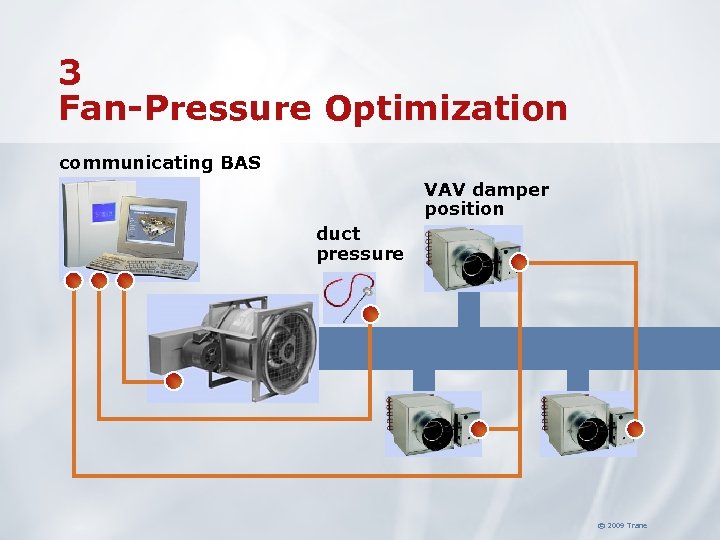 3 Fan-Pressure Optimization communicating BAS VAV damper position duct pressure © 2009 Trane
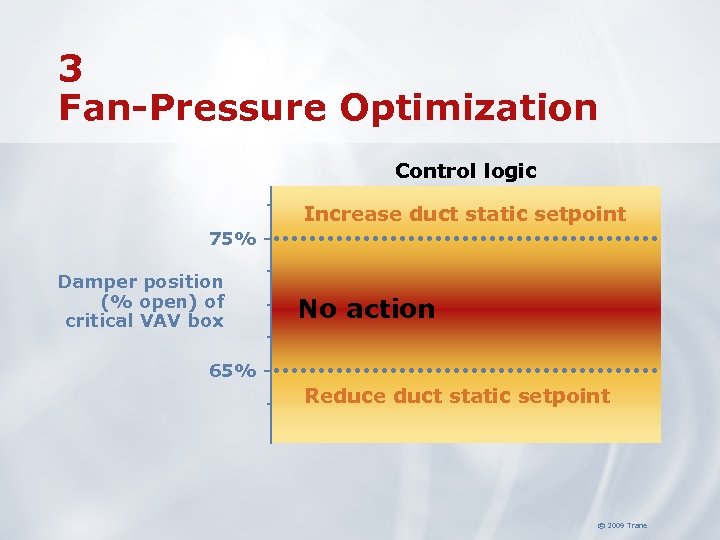 3 Fan-Pressure Optimization Control logic Increase duct static setpoint 75% Damper position (% open) of critical VAV box No action 65% Reduce duct static setpoint © 2009 Trane
 2 Mandatory requirements for equipment efficiency © 2009 Trane
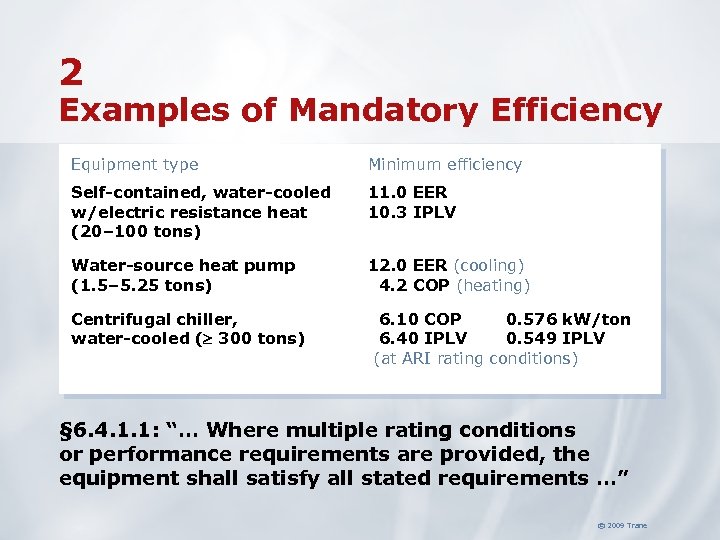 2 Examples of Mandatory Efficiency Equipment type Minimum efficiency Self-contained, water-cooled w/electric resistance heat (20– 100 tons) 11. 0 EER 10. 3 IPLV Water-source heat pump (1. 5– 5. 25 tons) 12. 0 EER (cooling) 4. 2 COP (heating) Centrifugal chiller, water-cooled ( 300 tons) 6. 10 COP 0. 576 k. W/ton 6. 40 IPLV 0. 549 IPLV (at ARI rating conditions) § 6. 4. 1. 1: “… Where multiple rating conditions or performance requirements are provided, the equipment shall satisfy all stated requirements …” © 2009 Trane
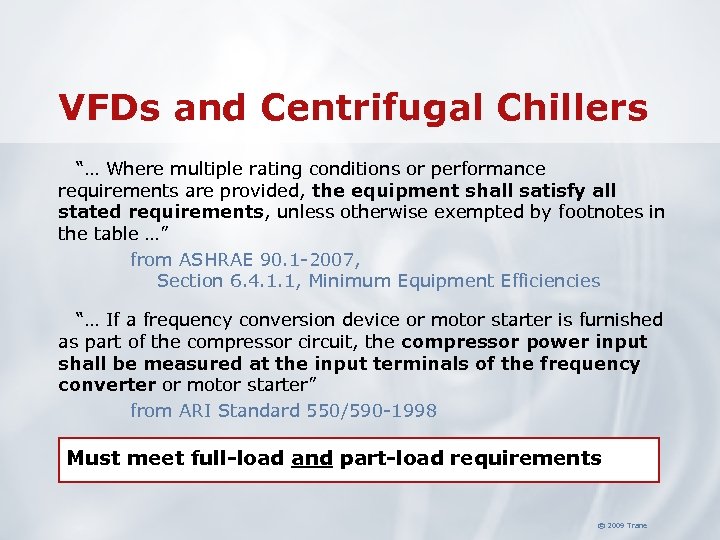 VFDs and Centrifugal Chillers “… Where multiple rating conditions or performance requirements are provided, the equipment shall satisfy all stated requirements, unless otherwise exempted by footnotes in the table …” from ASHRAE 90. 1 -2007, Section 6. 4. 1. 1, Minimum Equipment Efficiencies “… If a frequency conversion device or motor starter is furnished as part of the compressor circuit, the compressor power input shall be measured at the input terminals of the frequency converter or motor starter” from ARI Standard 550/590 -1998 Must meet full-load and part-load requirements © 2009 Trane
 1 Already part of state/local energy codes © 2009 Trane
 ASHRAE Standard 90. 1 and Energy Codes International Energy Conservation Code (IECC) n IECC–Chapter 8 adopts 90. 1 -2004 by reference n IECC–Chapter 7 describes an alternate path for compliance u Includes many provisions of 90. 1 -2004 u ASHRAE is proposing code changes to increase stringency © 2009 Trane
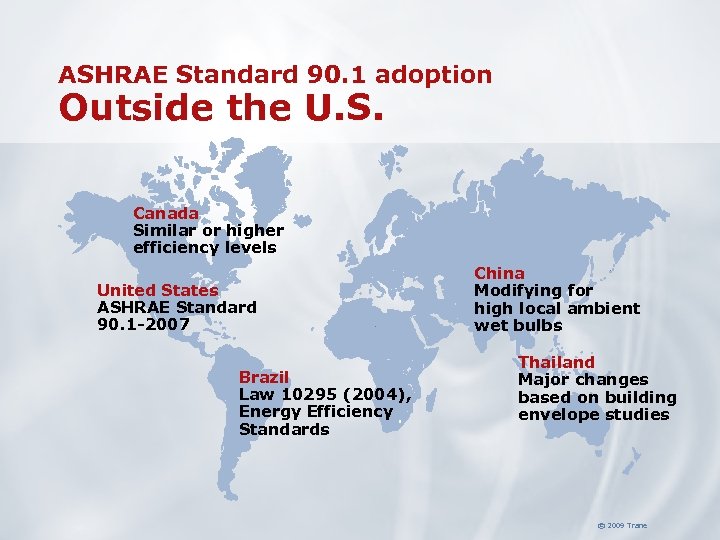 ASHRAE Standard 90. 1 adoption Outside the U. S. Canada Similar or higher efficiency levels United States ASHRAE Standard 90. 1 -2007 Brazil Law 10295 (2004), Energy Efficiency Standards China Modifying for high local ambient wet bulbs Thailand Major changes based on building envelope studies © 2009 Trane
 ASHRAE Standard 90. 1 adoption by U. S. Department of Defense “ 2 -1 MANDATORY ENERGY AND WATER CONSERVATION CRITERIA. Family housing (residential) shall be designed and constructed in accordance with the latest Energy Star standards, per other appropriate service-specific criteria and guidance. Other facilities shall be designed and constructed in accordance with the latest edition of ASHRAE Standard 90. 1. ” —Excerpt from Unified Facilities Criteria http: //www. hnd. usace. army. mil/techinfo/ufc/ 081602_UFC 3 -400 -01. pdf © 2009 Trane
 ASHRAE Standard 90. 1 and LEED®-NC Version 2. 2 n EAp 2: Minimum energy performance u Mandatory provisions of 90. 1 -2004 and l Prescriptive requirements of 90. 1 -2004 or l Performance requirements of 90. 1 -2004 Section 11 n EAc 1: Optimize energy performance u Awards points for improving performance rating of the design building vs. baseline building per 90. 1 -2004 © 2009 Trane
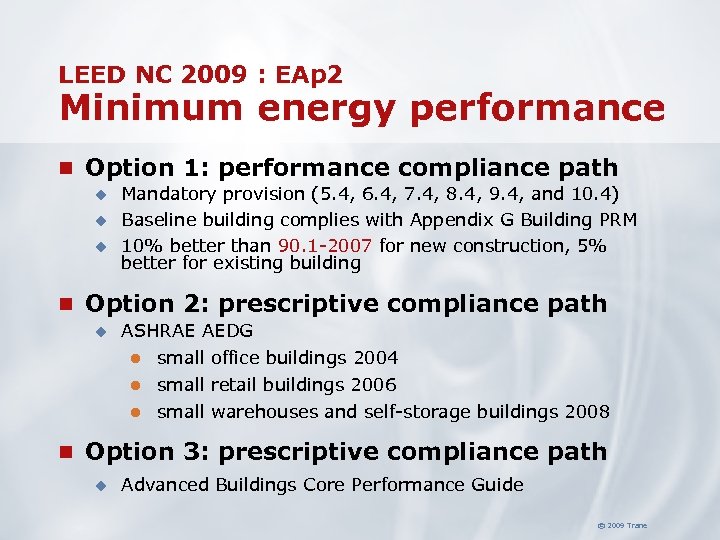 LEED NC 2009 : EAp 2 Minimum energy performance n Option 1: performance compliance path u u u Mandatory provision (5. 4, 6. 4, 7. 4, 8. 4, 9. 4, and 10. 4) Baseline building complies with Appendix G Building PRM 10% better than 90. 1 -2007 for new construction, 5% better for existing building n Option 2: prescriptive compliance path u ASHRAE AEDG l small office buildings 2004 l small retail buildings 2006 l small warehouses and self-storage buildings 2008 n Option 3: prescriptive compliance path u Advanced Buildings Core Performance Guide © 2009 Trane
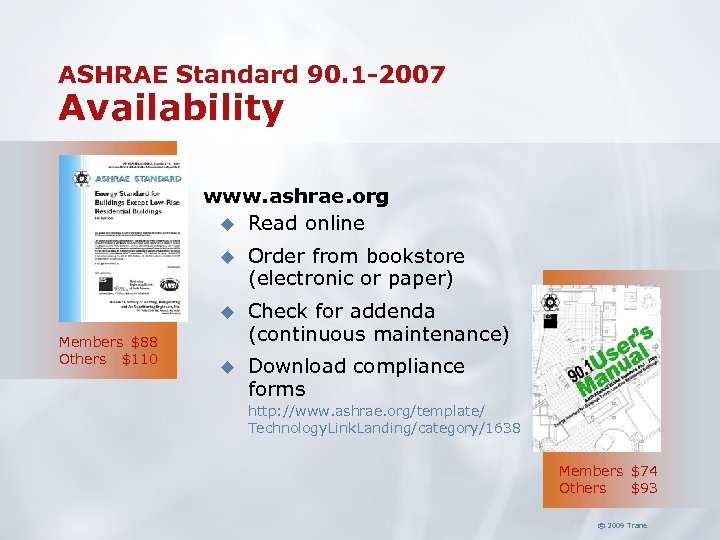 ASHRAE Standard 90. 1 -2007 Availability www. ashrae. org u Read online u u Members $88 Others $110 Order from bookstore (electronic or paper) Check for addenda (continuous maintenance) u Download compliance forms http: //www. ashrae. org/template/ Technology. Link. Landing/category/1638 Members $74 Others $93 © 2009 Trane
 ANSI/ASHRAE/IESNA Standard 90. 1 -2007 Questions? © 2009 Trane