


 Скачать презентацию ANOTHER VIEW OF THE PULLET ISSUE FROM HOUSING
cbfa7cc3caa8dbf5f01c3db856578e1e.ppt
- Количество слайдов: 36
 ANOTHER VIEW OF THE PULLET ISSUE “FROM HOUSING TO 24 WEEKS (OVER 90% PRODUCTION) – THE MOST CRITICAL PERIOD OF PULLETS / YOUNG LAYERS” Kocevski Dragoslav - Drakche, Ph. D, Seminar – VELES March, 2017
 IDEA BEHIND THE PRESENTATION • You follow the technical recommendation and guides and produce (or it has been delivered to You by other producer) PERFECT PULLET at certain age. • You expect a lot of eggs with a good size …. • Start of production is not so good and later production records disappoint You • You are blaming the Genetics • You are blaming the producer of the pullets (rearing management mistakes) • You are blaming the feed or row material quality • BUT, IS IT POSIBLE THAT YOU ARE TO BE BLAMED AND YOUR MISSMANAGEMENT IN FEW WEEKS AFTER HOUSING IS THE COSE OF THIS SITUATION? ?
 IDEA BEHIND THE PRESENTATION • We all like simple things. • FARMERS like very much simple things • Experts offers complicated things • Can experts offer simple things? ?
 Presentation Outline • GROWTH, TRANSFER TO LAYER HOUSE, LIGHTING What does the management guide says 1 • Key question - WHY IS THIS PERIOD HOUSING TO 24 WEEKS (OVER 90%PRODUCTION) SO IMPORTANT? ? ? • HOW TO CONTROL IT or HOW TO BALANCE AND SMOOTLY SWITCH FROM GROWTH TO PRODUCTION? ? - What does the management guide says 2 • How to do it practically
 What does the management guide says 1 GROWTH, TRANSFER TO LAYER HOUSE, LIGHTING • YOU HAVE YOUR COMMERCIAL GUIDES (TECHNICAL MANUALS FOR MANAGEMENT AT DIFFERENT STAGES REARING AND LAYING) • WHAT DO THE MANUALS SAY?
 What does the management guide says 1 GROWTH – CONTROLLED GROWTH The goal of rearing period (GROWTH PERIOD? ? IS REARING PERIOD = GROWTH PERIOD? ? ? ) is to prepare the birds for egg production. • This preparation is successful if at the end of this rearing period we have UNIFORM FLOCK – UNIFORMITY with CORRECT BODY WEIGHT AT MATURITY (ACCORDING TO AGE- 15, 16, 17 or 18 weeks). • ISA Brown is early maturity bird so attention is needed on the growth curve with GOAL OF OBTAINING 1600 g at 5% of lay or as much as we can, closer to this technological (written in the guides) goal. •
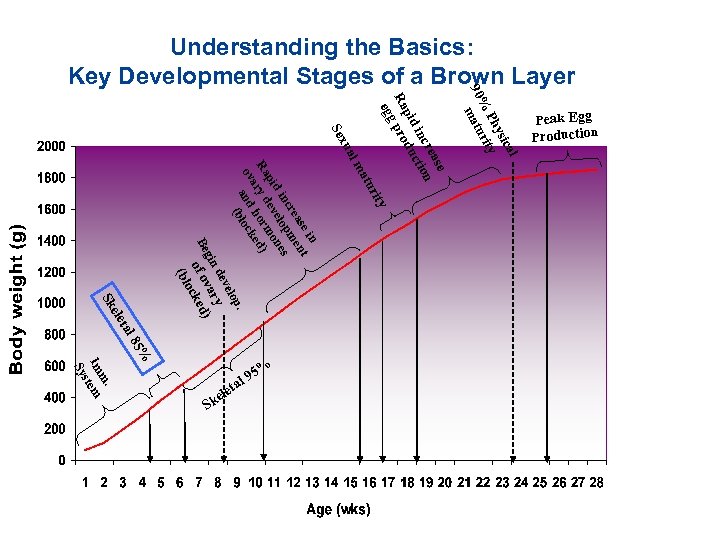 ma ity tur se rea n inc ctio pid du Ra pro egg al xu Se n e i nt as re me inc elop nes o pid ev Ra ry d horm ed) a ov and lock (b eve . lop d ry a ) gin ov Be of cked o (bl al t ele Sk % 85 m. Im tem s Sy Sk el 5% l 9 eta Peak Egg Production cal ysi Ph rity % 90 matu Understanding the Basics: Key Developmental Stages of a Brown Layer
 What does the management guide says 1 • UNIFORMITY – MOST IMPORTANT EVEN MORE IMPORTANT THAN THE AVERAGE BODY WEIGHT ITSELF – EXAMPLE – FEW HUNDREDS OF SMALL BIRDS (OUT OF TEN OR MORE 000) LEFTED IN THE REARING HOUSE WHEN PULLETS MOVING TO THE LAYING HOUSE ARE VERY OFTEN SOLD TO SMALL PRODUCERS AND BECOME VERY GOOD LAYERS AND JUST A WEEK OR MORE LATE IN THEIR START OF PRODUCTION • WHY? ? ? – THEY were uniformly light (small body weight but in a range of + and – that shows excellent uniformity). • Then if they are properly managed in the period after housing in the laying house they will become a good uniform flock where all technological tools are working since they are simulating one bird – THAT IS THE GOAL • FLOCK = INDIVIDUAL BIRD
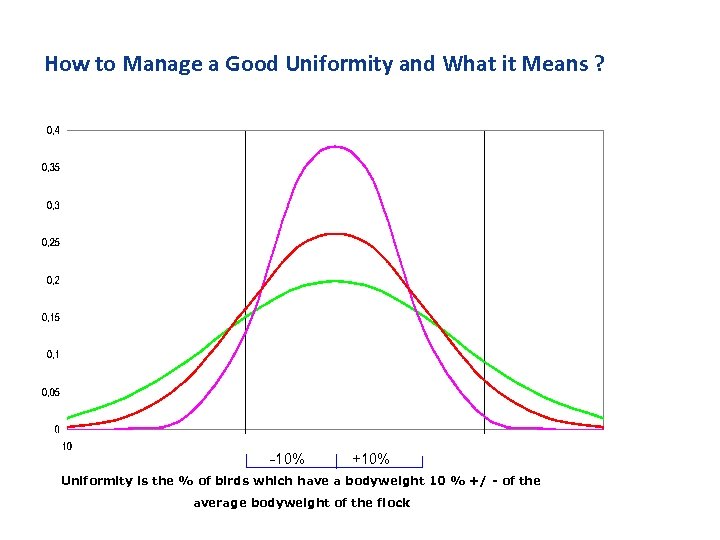 How to Manage a Good Uniformity and What it Means ? -10% +10% Uniformity is the % of birds which have a bodyweight 10 % +/ - of the average bodyweight of the flock
 What does the management guide says 1 BUT WHAT HAPPENS WITH THE GROWTH AND UNIFORMITY AFTER THE HOUSING IN THE LAYING HOUSE IF THE FLOCK OR THE BIRDS ARE UNPROPERLY MANAGED? ?
 What does the management guide says 1 TRANSFERING OF THE BIRDS IN THE PRODUCTION/LAYER HOUSE Transfering of the birds is usual at 16 -17 weeks of age, and most important is to be done before star of lay because it is recognized as very big stress for the birds. If the birds has to transported at long distances it is recommended that this transfer is realized at 15 weeks of age. It has to be realized fast to reduce the stress. After housing : First give water than feed; Give 22 hours of light first day after transfer/arrival - WHAT ABOUT INTENSITY – TABLE BELOW 16 WEEKS? ? ; Check the drinking system - WHAT ABOUT FINDING THE DRINKERS – ESPECIALY IF CHANGING THE DRINKING SYSTEMS FROM xxxx TO NIPLE? ? ; Start feeding 2 -3 hours after housing/arival. Weight or more precisely water loss during the transport is 0. 3 -0. 5% /hour, so the birds are loosing 5 -12% during the transport!
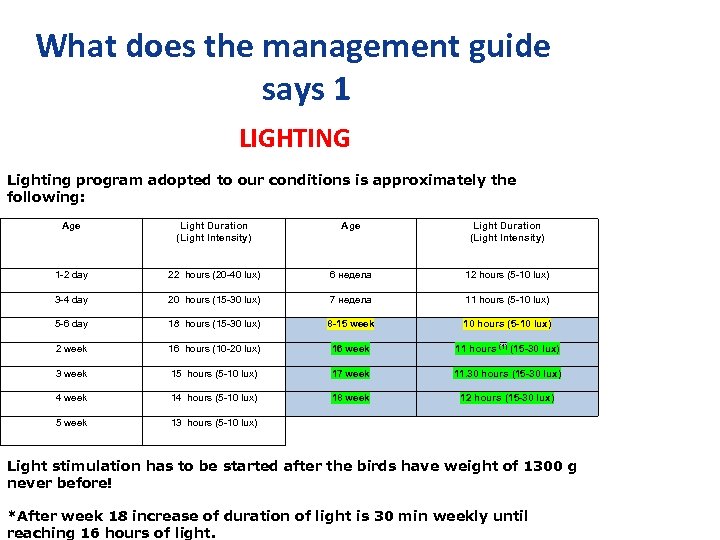 What does the management guide says 1 LIGHTING Lighting program adopted to our conditions is approximately the following: Age Light Duration (Light Intensity) 1 -2 day 22 hours (20 -40 lux) 6 недела 12 hours (5 -10 lux) 3 -4 day 20 hours (15 -30 lux) 7 недела 11 hours (5 -10 lux) 5 -6 day 18 hours (15 -30 lux) 8 -15 week 10 hours (5 -10 lux) 2 week 16 hours (10 -20 lux) 16 week 11 hours (1) (15 -30 lux) 3 week 15 hours (5 -10 lux) 17 week 11. 30 hours (15 -30 lux) 4 week 14 hours (5 -10 lux) 18 week 12 hours (15 -30 lux) 5 week Light Duration (Light Intensity) 13 hours (5 -10 lux) Light stimulation has to be started after the birds have weight of 1300 g never before! *After week 18 increase of duration of light is 30 min weekly until reaching 16 hours of light.
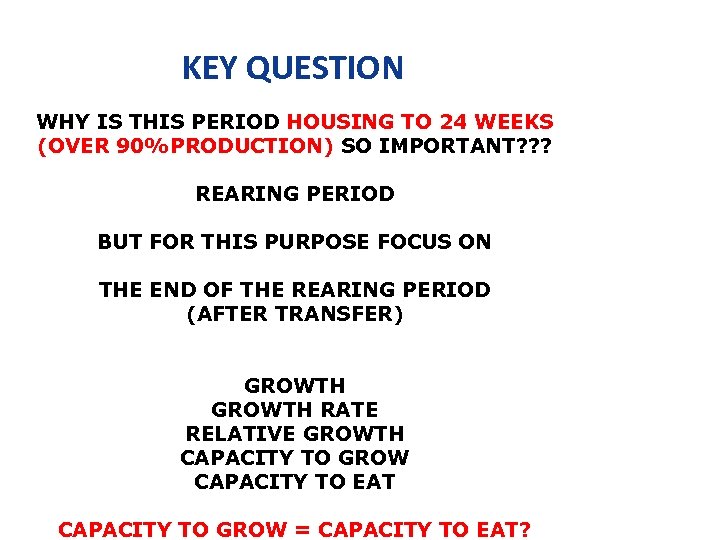 KEY QUESTION WHY IS THIS PERIOD HOUSING TO 24 WEEKS (OVER 90%PRODUCTION) SO IMPORTANT? ? ? REARING PERIOD BUT FOR THIS PURPOSE FOCUS ON THE END OF THE REARING PERIOD (AFTER TRANSFER) GROWTH RATE RELATIVE GROWTH CAPACITY TO GROW CAPACITY TO EAT CAPACITY TO GROW = CAPACITY TO EAT?
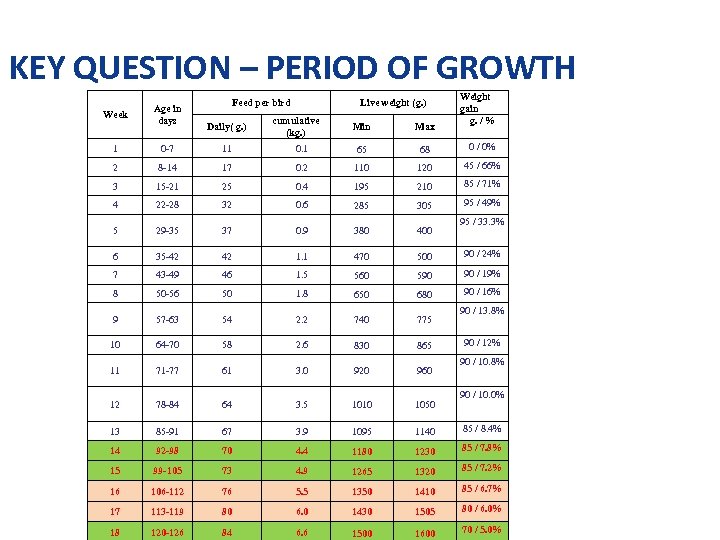 KEY QUESTION – PERIOD OF GROWTH Week Age in days Feed per bird Daily( g. ) Live weight (g. ) cumulative (kg. ) Min Max Weight gain g. / % 1 0 -7 11 0. 1 65 68 0 / 0% 2 8 -14 17 0. 2 110 120 45 / 66% 3 15 -21 25 0. 4 195 210 85 / 71% 4 22 -28 32 0. 6 285 305 95 / 49% 5 29 -35 37 0. 9 380 400 6 35 -42 42 1. 1 470 500 90 / 24% 7 43 -49 46 1. 5 560 590 90 / 19% 8 50 -56 50 1. 8 650 680 90 / 16% 9 57 -63 54 2. 2 740 775 10 64 -70 58 2. 6 830 865 11 71 -77 61 3. 0 920 960 12 78 -84 64 3. 5 1010 1050 13 85 -91 67 3. 9 1095 1140 85 / 8. 4% 14 92 -98 70 4. 4 1180 1230 85 / 7. 8% 15 99 -105 73 4. 9 1265 1320 85 / 7. 2% 16 106 -112 76 5. 5 1350 1410 85 / 6. 7% 17 113 -119 80 6. 0 1430 1505 80 / 6. 0% 18 120 -126 84 6. 6 1500 1600 70 / 5. 0% 95 / 33. 3% 90 / 13. 8% 90 / 12% 90 / 10. 8% 90 / 10. 0%
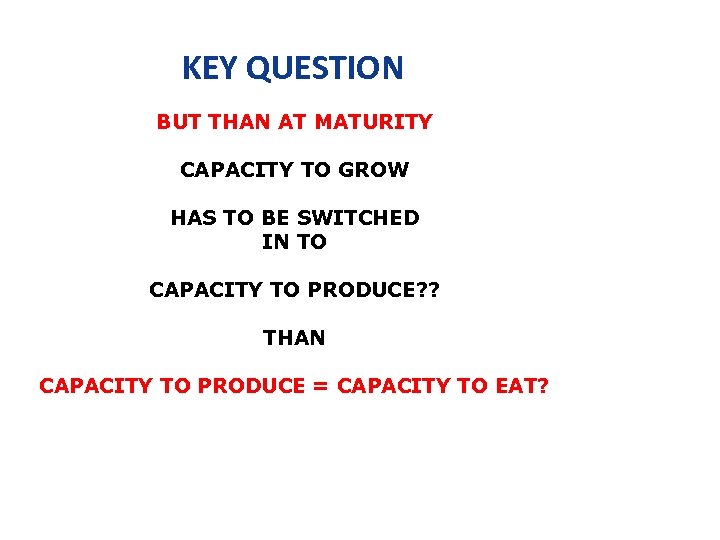 KEY QUESTION BUT THAN AT MATURITY CAPACITY TO GROW HAS TO BE SWITCHED IN TO CAPACITY TO PRODUCE? ? THAN CAPACITY TO PRODUCE = CAPACITY TO EAT?
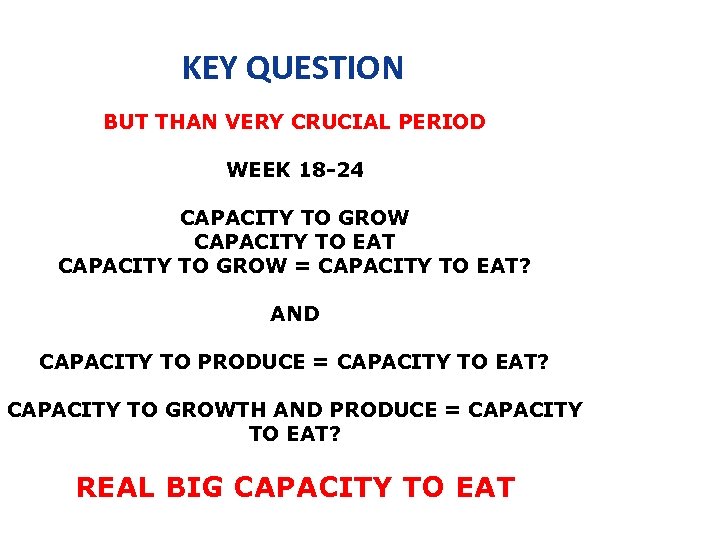 KEY QUESTION BUT THAN VERY CRUCIAL PERIOD WEEK 18 -24 CAPACITY TO GROW CAPACITY TO EAT CAPACITY TO GROW = CAPACITY TO EAT? AND CAPACITY TO PRODUCE = CAPACITY TO EAT? CAPACITY TO GROWTH AND PRODUCE = CAPACITY TO EAT? REAL BIG CAPACITY TO EAT
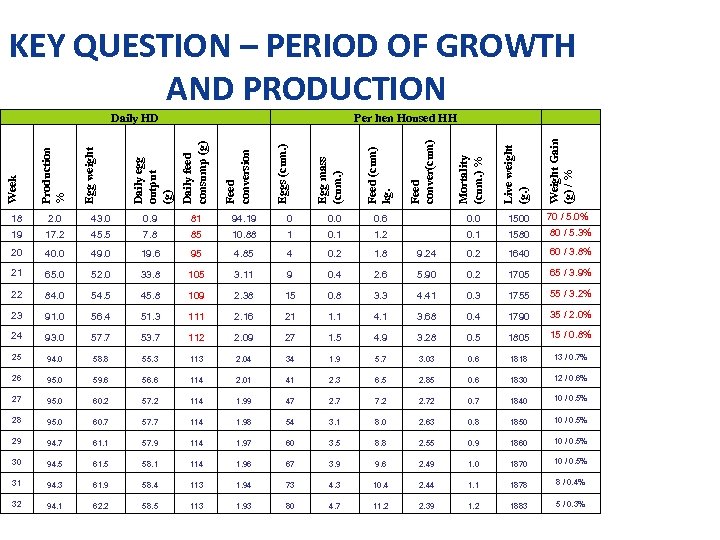 KEY QUESTION – PERIOD OF GROWTH AND PRODUCTION Weight Gain (g) / % 0. 6 0. 0 1500 70 / 5. 0% 19 17. 2 45. 5 7. 8 85 10. 88 1 0. 1 1. 2 0. 1 1580 80 / 5. 3% 20 40. 0 49. 0 19. 6 95 4. 85 4 0. 2 1. 8 9. 24 0. 2 1640 60 / 3. 8% 21 65. 0 52. 0 33. 8 105 3. 11 9 0. 4 2. 6 5. 90 0. 2 1705 65 / 3. 9% 22 84. 0 54. 5 45. 8 109 2. 38 15 0. 8 3. 3 4. 41 0. 3 1755 55 / 3. 2% 23 91. 0 56. 4 51. 3 111 2. 16 21 1. 1 4. 1 3. 68 0. 4 1790 35 / 2. 0% 24 93. 0 57. 7 53. 7 112 2. 09 27 1. 5 4. 9 3. 28 0. 5 1805 15 / 0. 8% 25 94. 0 58. 8 55. 3 113 2. 04 34 1. 9 5. 7 3. 03 0. 6 1818 13 / 0. 7% 26 95. 0 59. 6 56. 6 114 2. 01 41 2. 3 6. 5 2. 85 0. 6 1830 12 / 0. 6% 27 95. 0 60. 2 57. 2 114 1. 99 47 2. 7 7. 2 2. 72 0. 7 1840 10 / 0. 5% 28 95. 0 60. 7 57. 7 114 1. 98 54 3. 1 8. 0 2. 63 0. 8 1850 10 / 0. 5% 29 94. 7 61. 1 57. 9 114 1. 97 60 3. 5 8. 8 2. 55 0. 9 1860 10 / 0. 5% 30 94. 5 61. 5 58. 1 114 1. 96 67 3. 9 9. 6 2. 49 1. 0 1870 10 / 0. 5% 31 94. 3 61. 9 58. 4 113 1. 94 73 4. 3 10. 4 2. 44 1. 1 1878 8 / 0. 4% 32 94. 1 62. 2 58. 5 113 1. 93 80 4. 7 11. 2 2. 39 1. 2 1883 5 / 0. 3% Live weight (g. ) 0. 0 Mortality (cum. ) % 0 Feed (cum) kg. 94. 19 Egg mass (cum. ) 81 Eggs (cum. ) 0. 9 Feed conversion 43. 0 Egg weight 2. 0 Production % 18 Week Daily feed consump (g) Feed conver(cum) Per hen Housed HH Daily egg output (g) Daily HD
 KEY QUESTION - ANSWER THAT IS THE REASON WHY THIS PERIOD FROM HOUSING TO 24 WEEKS (OVER 90% PRODUCTION) IS THE MOST CRITICAL PERIOD OF PULLETS / YOUNG LAYERS
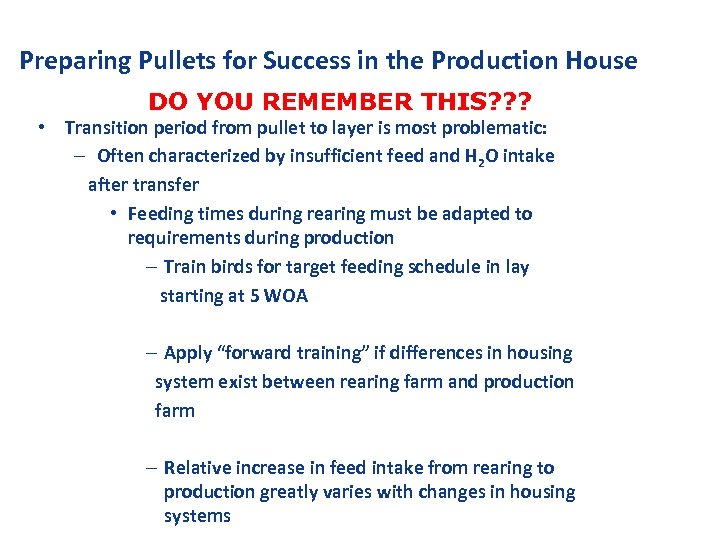 Preparing Pullets for Success in the Production House DO YOU REMEMBER THIS? ? ? • Transition period from pullet to layer is most problematic: – Often characterized by insufficient feed and H 2 O intake after transfer • Feeding times during rearing must be adapted to requirements during production – Train birds for target feeding schedule in lay starting at 5 WOA – Apply “forward training” if differences in housing system exist between rearing farm and production farm – Relative increase in feed intake from rearing to production greatly varies with changes in housing systems
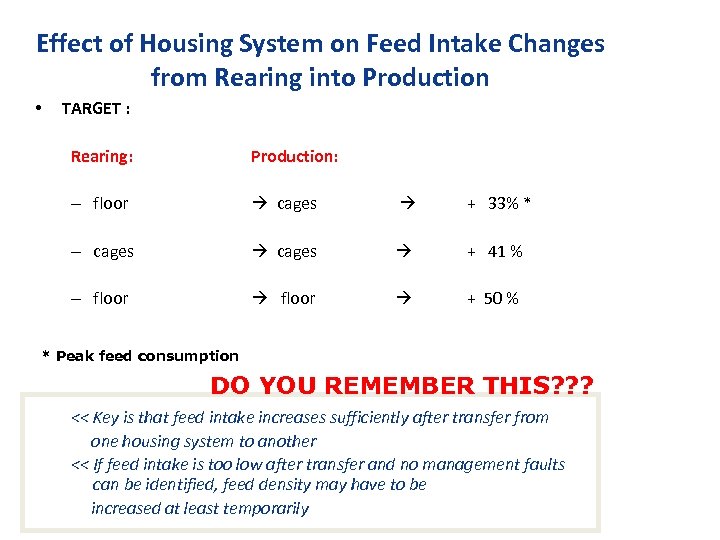 Effect of Housing System on Feed Intake Changes from Rearing into Production • TARGET : Rearing: Production: – floor cages + 33% * – cages + 41 % – floor + 50 % * Peak feed consumption DO YOU REMEMBER THIS? ? ? << Key is that feed intake increases sufficiently after transfer from one housing system to another << If feed intake is too low after transfer and no management faults can be identified, feed density may have to be increased at least temporarily
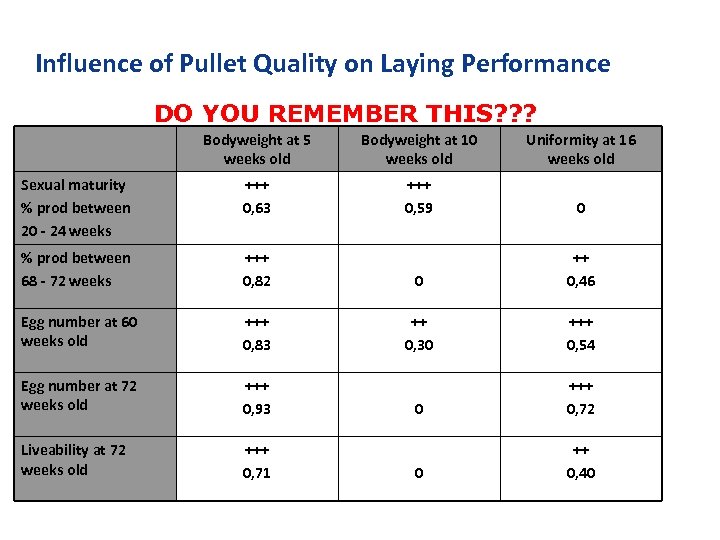 Influence of Pullet Quality on Laying Performance DO YOU REMEMBER THIS? ? ? Bodyweight at 5 weeks old Bodyweight at 10 weeks old Uniformity at 16 weeks old Sexual maturity % prod between 20 - 24 weeks +++ 0, 63 +++ 0, 59 0 % prod between 68 - 72 weeks +++ 0, 82 0 ++ 0, 46 Egg number at 60 weeks old +++ 0, 83 ++ 0, 30 +++ 0, 54 Egg number at 72 weeks old +++ 0, 93 0 +++ 0, 72 Liveability at 72 weeks old +++ 0, 71 0 ++ 0, 40
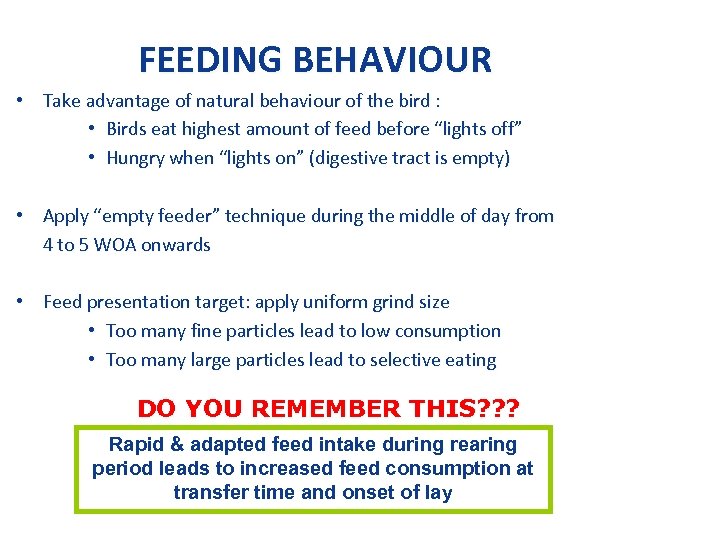 FEEDING BEHAVIOUR • Take advantage of natural behaviour of the bird : • Birds eat highest amount of feed before “lights off” • Hungry when “lights on” (digestive tract is empty) • Apply “empty feeder” technique during the middle of day from 4 to 5 WOA onwards • Feed presentation target: apply uniform grind size • Too many fine particles lead to low consumption • Too many large particles lead to selective eating DO YOU REMEMBER THIS? ? ? Rapid & adapted feed intake during rearing period leads to increased feed consumption at transfer time and onset of lay
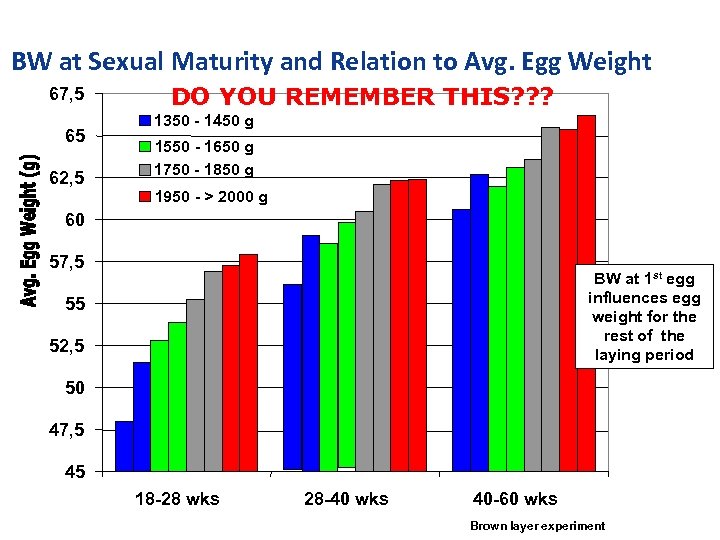 BW at Sexual Maturity and Relation to Avg. Egg Weight 67, 5 65 62, 5 DO YOU REMEMBER THIS? ? ? 1350 - 1450 g 1550 - 1650 g 1750 - 1850 g 1950 - > 2000 g 60 57, 5 BW at 1 st egg influences egg weight for the rest of the laying period 55 52, 5 50 47, 5 45 18 -28 wks 28 -40 wks 40 -60 wks Brown layer experiment
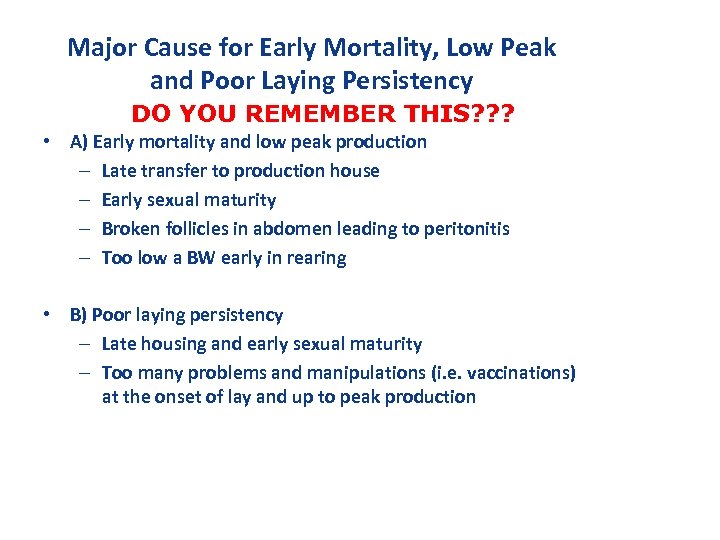 Major Cause for Early Mortality, Low Peak and Poor Laying Persistency DO YOU REMEMBER THIS? ? ? • A) Early mortality and low peak production – Late transfer to production house – Early sexual maturity – Broken follicles in abdomen leading to peritonitis – Too low a BW early in rearing • B) Poor laying persistency – Late housing and early sexual maturity – Too many problems and manipulations (i. e. vaccinations) at the onset of lay and up to peak production
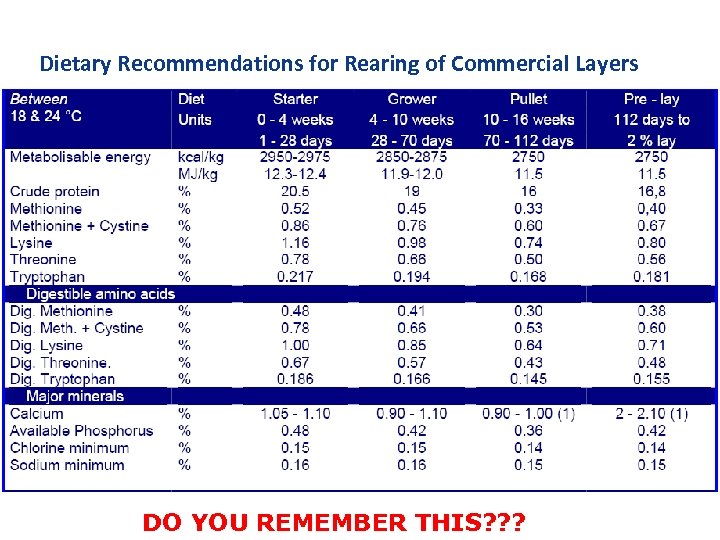 Dietary Recommendations for Rearing of Commercial Layers DO YOU REMEMBER THIS? ? ?
 What does the management guide says 2 HOW TO CONTROL IT or HOW TO BALANCE AND SMOOTLY SWITCH FROM GROWTH TO PRODUCTION? ? • THROUGH MANAGING THE STRESS AND ACOMODATION AFTER TRANSFER/HOUSING IN THE LAYING HOUSE • THROUGH MANAGING THE FEED INTAKE AND FEED INTAKE CAPACITY • YOU HAVE YOUR COMMERCIAL GUIDES (TECHNICAL MANUALS FOR MANAGEMENT AT DIFFERENT STAGES REARING AND LAYING) • WHAT DO THE MANUALS SAY?
 What does the management guide says 2 MANAGING THE STRESS AND ACOMODATION AFTER TRANSFER/HOUSING IN THE LAYING HOUSE DO YOU REMEMBER THIS After housing : - First give water than feed; - Give 22 hours of light first day after transfer/arrival - WHAT ABOUT INTENSITY – TABLE BELOW 16 WEEKS? ? ; - Check the drinking system - WHAT ABOUT FINDING THE DRINKERS – ESPECIALY IF CHANGING THE DRINKING SYSTEMS FROM xxxx TO NIPLE? ? ; - Start feeding 2 -3 hours after housing/arival. - Vitamins (B) -----
 What does the management guide says 2 MANAGING THE FEED INTAKE AND FEED INTAKE CAPACITY Energy Level During the first few weeks of life, meat type chickens just like young pullets are incapable of regulating their energy intake according to the energy concentration of the diet. It takes weeks to develop the digestive tract. During the first 810 weeks, any increase in the energy level is accompanied by an increase in growth. When given the feed in a crumb form, young pullets are able to increase their feed intake. The table below shows the influence of energy level and presentation method on the bodyweight of pullets at 5 weeks of age. 3100 kcal 375 g 412 g 2790 kcal 345 g 405 g Newcombe (1985) After 10 weeks of age, pullets correctly regulate their energy intake according to the energy level of the diet in both hot and temperate climates. Under consumption during that period is often the result of a poor grit size.
 What does the management guide says 2 MANAGING THE FEED INTAKE AND FEED INTAKE CAPACITY Protein Requirements The amino acid requirements are to a large extent dependent on the feed conversion ratio and, therefore on age; that is why, when young the requirements expressed in mg of amino-acids per g of growth are the same as a broiler. Any delay in growth during the first few weeks will be reflected in a reduced bodyweight at 17 weeks and in later performance. It is, therefore, extremely important to use a starter diet for the first 4 or 5 weeks, which has an amino acid/protein ratio similar to that of the broiler.
 What does the management guide says 2 MANAGING THE FEED INTAKE AND FEED INTAKE CAPACITY Development of the digestive system The achievement of good growth and a rapid increase in feed consumption at start of lay depends on the chicken having a well-developed digestive system, especially a good strong gizzard. Using feed of good particle size, giving grit during rearing and/or using limestone granules from 10 weeks will all contribute towards good gizzard development.
 What does the management guide says 2 MANAGING THE FEED INTAKE AND FEED INTAKE CAPACITY The objective is to develop the pullet's ability to eat feed, so that it can increase its consumption by approximately 40% in the first few weeks of lay. During the period 10 - 17 weeks, it is important to develop the digestive system by using diets with an energy concentration less than or equal to that of the layer's diet.
 How to do it practicaly? ? ? We manage the flock properly at rearing following the recommendation Results: -Good (equal or above technology) live weight at week 13 - Good uniformity
 How to do it practicaly? ? ? 1. We offered the birds at the end of rearing period before transfer (week 14 and 15) low density developer diet 2600 -2650 Kcal ME/kg feed. A lot of fiber in it. So called light feed lower specific weight of the feed ? ? ? Ton of such feed has more volume than the regular one 2. We offered high energy density prelay feed to the pullets after transfer at week 16
 How to do it practicaly? ? ? Results 1. We lost some weight gain in week 14 and 15 Instead of having weight gain of 85 g/week we had 45 -55 g/week. But the birds eat more feed 2. After transfer and feeding with prelay feed we had: - Improved feed consumption (increased) - Improved weight gain (increased) - Improved live weight - Better start of lay - Better egg size - Better peak of production
 Summary and Conclusions • Growing period ends not before 28 -30 WOA (mature BW) • USE ALL MENTIONED RECOMMENDATION TO STIMULATE EATING BEHAVIOR after transfer to laying house
 FROM HOUSING TO 24 WEEKS (OVER 90% PRODUCTION) – THE MOST CRITICAL PERIOD OF PULLETS / YOUNG LAYERS