


 Скачать презентацию Anonymous Authentication Andrew Lindell Aladdin Knowledge Systems
a24f784e9b86915cfee4df63a766e4ab.ppt
- Количество слайдов: 64
 Anonymous Authentication Andrew Lindell Aladdin Knowledge Systems & Bar-Ilan University, Israel 0000110101010010000000100 01010000 001010101
 Chat Rooms • A huge success for youth and a huge concern for parents • 2006 survey (of 1500 US youth) by the Crimes against Children research centre – 13% of youth received unwanted sexual solicitations (down from 19% in 2001) – 4% of youth received aggressive solicitations in which solicitors attempted to make offline contact (up from 3% in 2001) Andrew Lindell Aladdin Knowledge Systems
 Chat Anonymity • Why are online sexual solicitations a concern? Aren’t chats anonymous? – Problem 1: 34% of children interviewed posted personal information online where anyone could see it – Problem 2: even when personal information is not explicitly posted, it can be found through multiple sources (e. g. , linked by the user’s pseudonym) ? ? Andrew Lindell Aladdin Knowledge Systems
 Solutions • Education • Parental control • Law enforcement • Technology 0000110101010010000000100 01010000 001010101 – Set up “safe chat rooms” which deploy strong authentication methods – Allow children to access safe chat rooms only – This has its own problems… Andrew Lindell Aladdin Knowledge Systems
 Authenticated Chat Rooms • One of the most attractive aspects of chat rooms is their anonymity – Children can be freed from the bonds of peer pressure and can speak freely – Children can ask advice about embarrassing situations, (seemingly) without fear of being traced • The use of authentication destroys this aspect of chat rooms Andrew: 000011010101 John: 101010000000100 Andrew: 11101010 John: 0101010101 Andrew Lindell Aladdin Knowledge Systems
 Anonymous Authentication • Anonymous authentication – a contradiction in terms – The user authenticates to the server and proves that she is an authorized user – The server has no idea which authorized user is authenticating • Is this really possible? – Yes! Andrew Lindell Aladdin Knowledge Systems
 Other Applications • Professional forums – Technical papers, technical help, discussion forums – These are “great” sources of information for (legal) industrial espionage – If authentication is required (to allow only registered or paying users), the problem becomes far more acute • Whistle blowing – We want to be sure that the report is really from an employee, but we want to protect them… • Social networks Andrew Lindell Aladdin Knowledge Systems
 Another Issue – Revocable Anonymity • Assume anonymous authentication is used • Consider the case that one of the users is harassing others (or a pedophile stole someone’s authentication device and is using it) – The harasser’s account cannot be closed because we don’t know who the harasser is • Revocable anonymity: when needed, and upon court order, can reveal identity – Without court order cannot reveal ID (provably) Andrew Lindell Aladdin Knowledge Systems
 Talk Outline • Privacy – It is important – we all know that – But, why is it important? • Anonymous web surfing – A very brief mention • Anonymous authentication – Definitions – Protocols – Extensions Andrew Lindell Aladdin Knowledge Systems
 Privacy A Concrete Perspective
 Privacy • Everyone here agrees that privacy is important, but why? – Typically • The loss of privacy is an invasion into our personal space • Warren and Brandeis: privacy is “the right to be let alone” • But what concrete damage is incurred? Andrew Lindell Aladdin Knowledge Systems
 Privacy – A Concrete Perspective • We will consider concrete damage that may be incurred due to privacy loss – Understand these concrete damages are crucial for providing secure protocols that actually solve the problem at hand Andrew Lindell Aladdin Knowledge Systems
 Privacy and Self Censorship • Storing user online information (emails, web and chat history and more), will likely result in self-censorship and inhibition – Highly likely if linked to real identity (and otherwise possible due to fear of later linkage) • Think of the following uses of the Internet – Teenagers on chat sites – University forums where students comment on lecturers and courses – Web sites that provide information on sensitive medical issues, sexual health and practice, and psychological first aid Andrew Lindell Aladdin Knowledge Systems
 Privacy – A Naïve Perspective • The above is usually only considered a problem if the user’s online identity is linked to her real-world identity • Business Week/Harris Poll in 2000 – 35% “not at all comfortable” with profiling online actions without linking to real identity – 81% “not at all comfortable” when this profiling is linked to real identity – (My guess: 35% also concerned that link may happen) • No identifier means no invasion of space Andrew Lindell Aladdin Knowledge Systems
 Information Without Identification • If it is 100% guaranteed that a user’s profile can never be connected to their identity, then self censorship is unlikely to occur • Example – online newspaper – Newspaper records history of all articles read and all comments posted – Information used to construct a newspaper tailored to your interests – If identity never provided, this seems fine Andrew Lindell Aladdin Knowledge Systems
 Basic Pseudonyms • Based on this, a basic pseudonym that cannot be linked to the user’s real-world identity solves the problem! • This is false! – And not only because it is impossible to guarantee that a link will never be made Andrew Lindell Aladdin Knowledge Systems
 Privacy Loss Without Identification • Consider the newspaper example – A user’s profile reveals much about their political beliefs, financial status and so on – A newspaper with strong interests can tailor the content to influence the user – Since the newspaper has a lot of information about the user, and the user is not aware of this (or that it is getting tailored content), the user can be unfairly manipulated • This infringes on the user’s personal autonomy Andrew Lindell Aladdin Knowledge Systems
 Pseudonyms? • A pseudonym that cannot be linked to a user’s true identity does not solve the problem at all – In order to manipulate the user, the newspaper only needs to be able to link their history to their current actions Andrew Lindell Aladdin Knowledge Systems
 Industrial Espionage • If a user’s real identity is not known, then the information gathered from a professional forum cannot be used to identify what company the user works for • However, it can be enough to just know that some competitor is researching and developing some product Andrew Lindell Aladdin Knowledge Systems
 Price Discrimination • Consider an online mall that tracks a buyer’s prior purchases and shopping habits • If a seller knows that a buyer does not “shop around”, then they may charge higher prices – The seller has more information about what the buyer is willing to pay than what the buyer has about the price for which the seller is willing to sell – The buyer is not aware of this asymmetry Andrew Lindell Aladdin Knowledge Systems
 Conclusions • Privacy is much more than being “let alone” • Naïve solutions that rely on pseudonyms do not suffice • We need unlinkability between transactions – This is not easy even when no registration or payment, and so no authentication, is required – This is very difficult if authentication is required (registering from scratch or paying again each time is unrealistic) Andrew Lindell Aladdin Knowledge Systems
 Anonymous Web Surfing A Brief Survey
 Anonymous Routing • Necessary infrastructure for anonymous authentication • Two security goals – User anonymity: modify packets so that user requests contain no identifying information – Unlinkability: ensure that an attacker who views Internet traffic (and possibly controls some routers) cannot know which client is interacting with which server • Achieving the goals – User anonymity: not too difficult – Unlinkability: very difficult, depends on traffic Andrew Lindell Aladdin Knowledge Systems
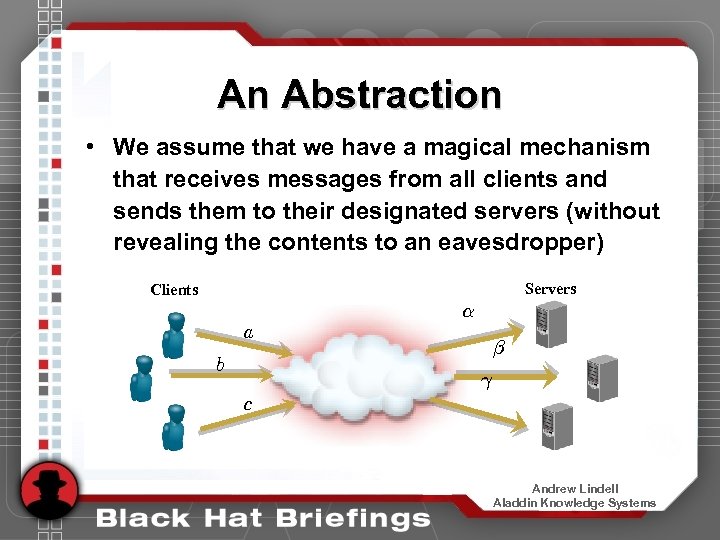 An Abstraction • We assume that we have a magical mechanism that receives messages from all clients and sends them to their designated servers (without revealing the contents to an eavesdropper) Servers Clients ® a b ¯ ° c Andrew Lindell Aladdin Knowledge Systems
 How is Anonymous Routing Achieved • There are numerous methods – Mix-Nets – Onion routing – Dining cryptographers – Crowds • See the paper for references Andrew Lindell Aladdin Knowledge Systems
 Anonymous Authentication What it is, and how it can be achieved
 The High-Level Idea • It is impossible to authenticate a user without knowing something • Anonymous authentication protocols have the following properties – The authenticating server knows that the user belongs to a given set of (authorized) users – The authenticating server has no idea which member of the set has just authenticated • Of course, such a protocol must run on top of an anonymous routing mechanism Andrew Lindell Aladdin Knowledge Systems
 Defining Security • Secure authentication – No unauthorized user should be able to fool the server into granting it access (except with very small probability) – We mainly consider a public-key infrastructure model • Full (perfect) anonymity – Let ` be the size of the set of users being considered – The protocol provides perfect anonymity if after authentication, the server can guess which user 1 authenticated with probability at most ` Andrew Lindell Aladdin Knowledge Systems
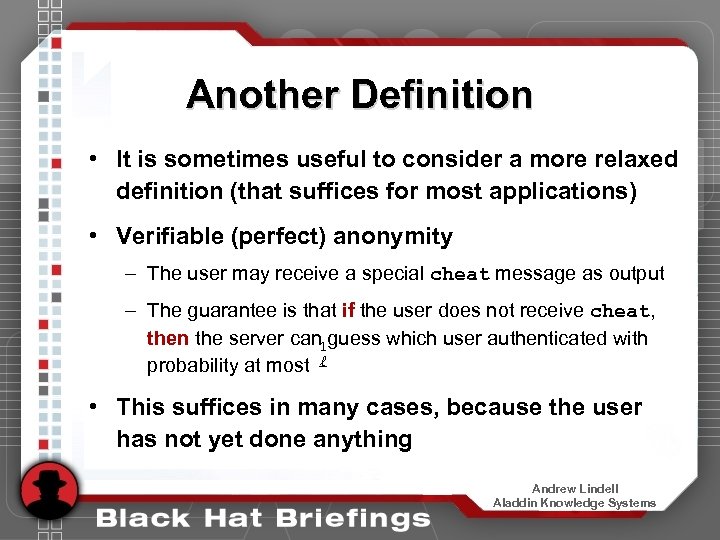 Another Definition • It is sometimes useful to consider a more relaxed definition (that suffices for most applications) • Verifiable (perfect) anonymity – The user may receive a special cheat message as output – The guarantee is that if the user does not receive cheat, then the server can 1 guess which user authenticated with probability at most ` • This suffices in many cases, because the user has not yet done anything Andrew Lindell Aladdin Knowledge Systems
 Solving the Mystery • How is it possible to achieve anonymity? • A naïve idea – Issue all users with the same password/secret key – This achieves perfect anonymity • The problem – Cannot revoke a user’s account without changing everyone’s key! Andrew Lindell Aladdin Knowledge Systems
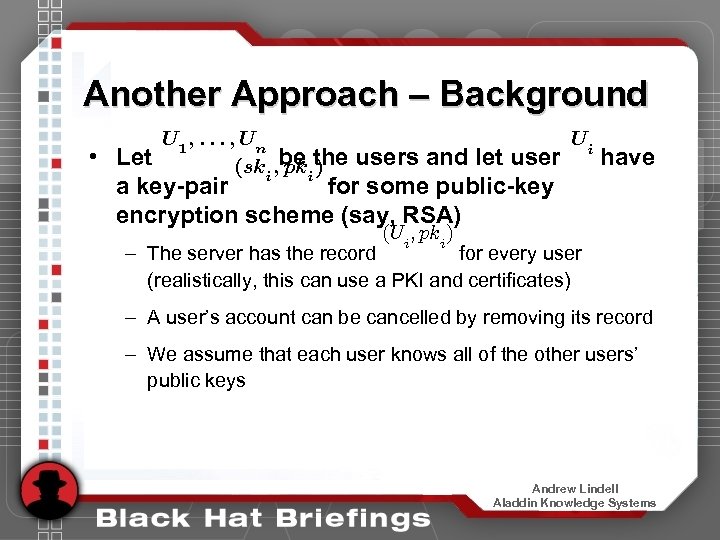 Another Approach – Background U 1 ; : : : ; Un pk ) (ski ; be ithe • Let users and let user a key-pair for some public-key encryption scheme (say, RSA) Ui have (Ui ; pki ) – The server has the record for every user (realistically, this can use a PKI and certificates) – A user’s account can be cancelled by removing its record – We assume that each user knows all of the other users’ public keys Andrew Lindell Aladdin Knowledge Systems
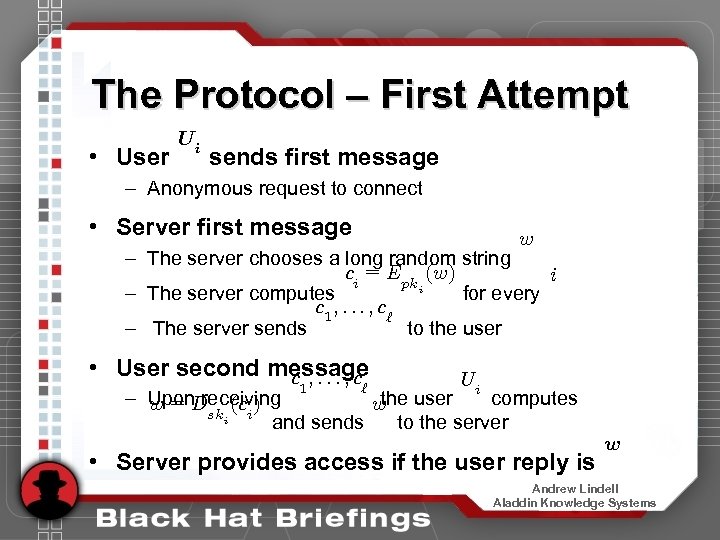 The Protocol – First Attempt • User Ui sends first message – Anonymous request to connect • Server first message w – The server chooses a long random string ci = Epk (w) i i – The server computes for every c 1 ; : : : ; c` – The server sends to the user • User second message c ; : : : ; c 1 ` Ui – Upon receiving the computes w user w = Dsk (ci ) i and sends to the server • Server provides access if the user reply is w Andrew Lindell Aladdin Knowledge Systems
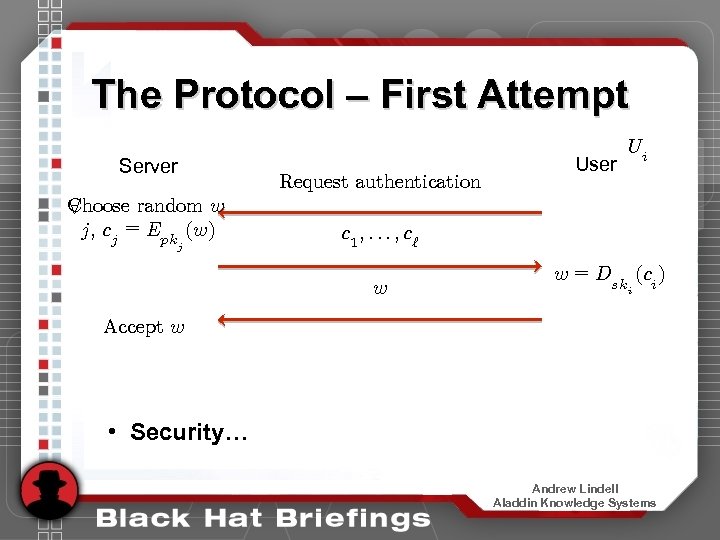 The Protocol – First Attempt Server Choose random w 8 j, c = E (w) j pkj Request authentication User Ui c 1 ; : : : ; c` w w = Dsk (ci ) i Accept w • Security… Andrew Lindell Aladdin Knowledge Systems
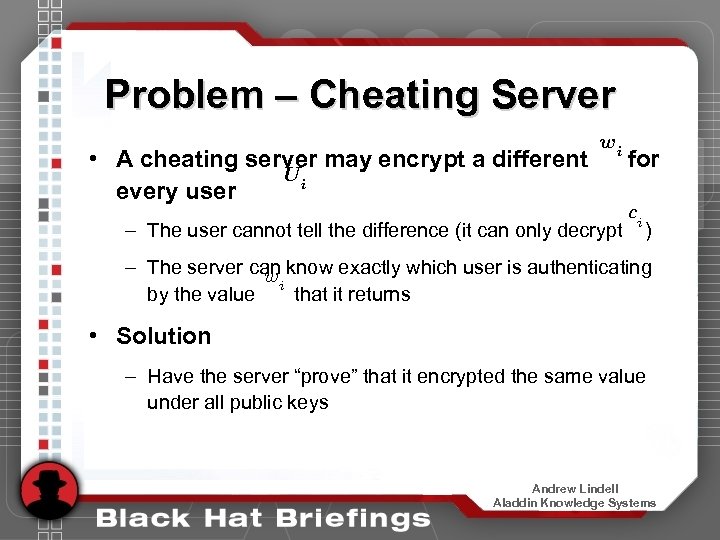 Problem – Cheating Server • A cheating server may encrypt a different Ui every user wi – The user cannot tell the difference (it can only decrypt for ci ) – The server can know exactly which user is authenticating wi by the value that it returns • Solution – Have the server “prove” that it encrypted the same value under all public keys Andrew Lindell Aladdin Knowledge Systems
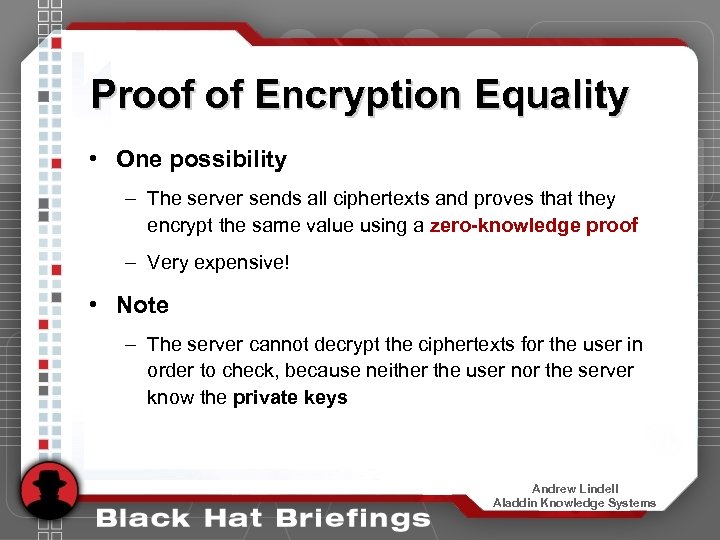 Proof of Encryption Equality • One possibility – The server sends all ciphertexts and proves that they encrypt the same value using a zero-knowledge proof – Very expensive! • Note – The server cannot decrypt the ciphertexts for the user in order to check, because neither the user nor the server know the private keys Andrew Lindell Aladdin Knowledge Systems
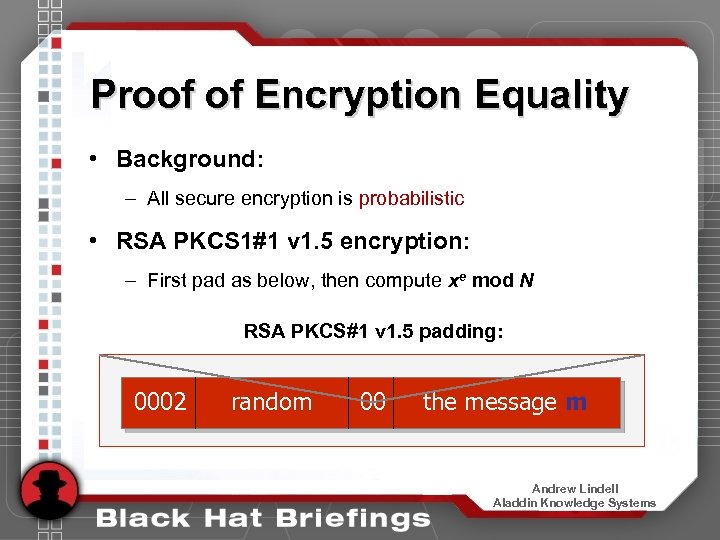 Proof of Encryption Equality • Background: – All secure encryption is probabilistic • RSA PKCS 1#1 v 1. 5 encryption: – First pad as below, then compute xe mod N RSA PKCS#1 v 1. 5 padding: 0002 random 00 the message m Andrew Lindell Aladdin Knowledge Systems
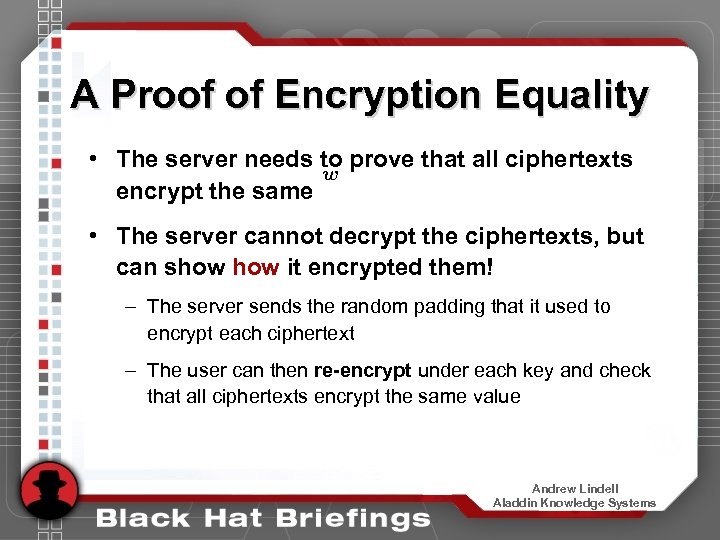 A Proof of Encryption Equality • The server needs to prove that all ciphertexts w encrypt the same • The server cannot decrypt the ciphertexts, but can show it encrypted them! – The server sends the random padding that it used to encrypt each ciphertext – The user can then re-encrypt under each key and check that all ciphertexts encrypt the same value Andrew Lindell Aladdin Knowledge Systems
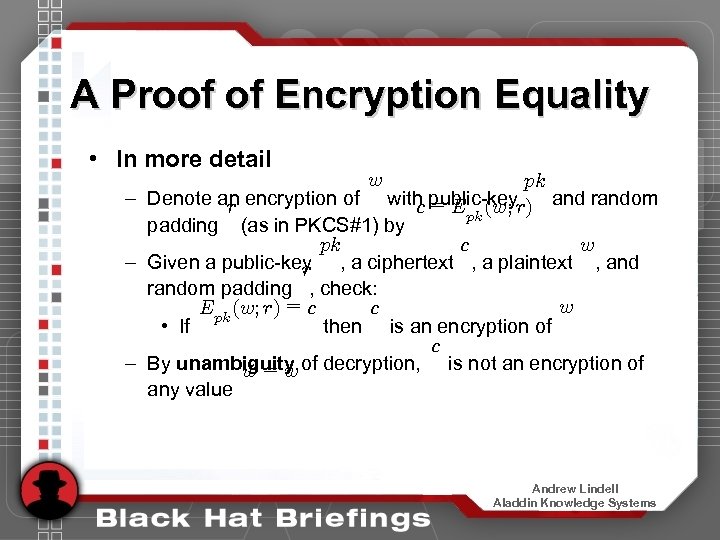 A Proof of Encryption Equality • In more detail w pk – Denote an encryption of with public-keyr) and random c = Epk (w; r padding (as in PKCS#1) by pk c w – Given a public-key , a ciphertext , a plaintext , and r random padding , check: w Epk (w; r) = c c • If then is an encryption of c – By unambiguity of decryption, is not an encryption of w=w ~ any value Andrew Lindell Aladdin Knowledge Systems
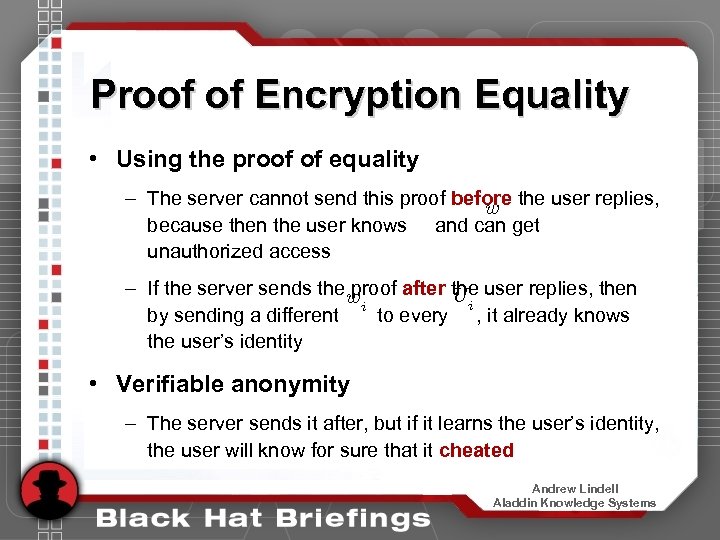 Proof of Encryption Equality • Using the proof of equality – The server cannot send this proof before the user replies, w because then the user knows and can get unauthorized access – If the server sends the w proof after the user replies, then Ui i by sending a different to every , it already knows the user’s identity • Verifiable anonymity – The server sends it after, but if it learns the user’s identity, the user will know for sure that it cheated Andrew Lindell Aladdin Knowledge Systems
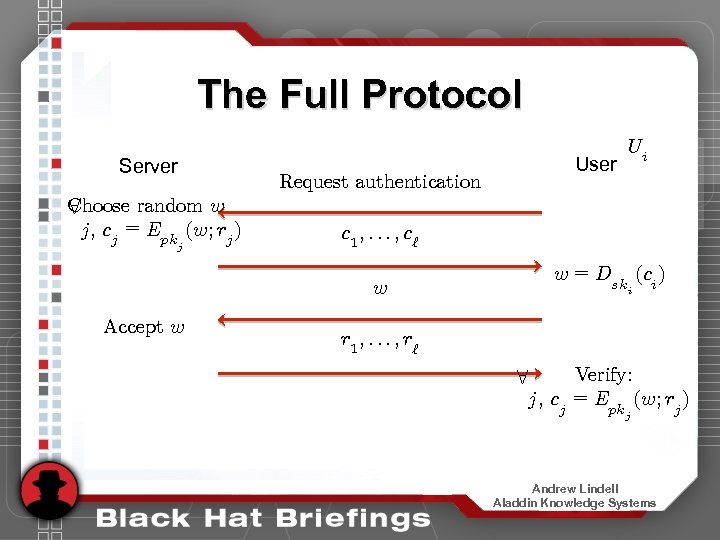 The Full Protocol Server Choose random w 8 j, cj = Epk (w; rj ) j User Request authentication c 1 ; : : : ; c` w = Dsk (ci ) w Accept w Ui i r 1 ; : : : ; r` 8 Verify: j, cj = Epk (w; rj ) j Andrew Lindell Aladdin Knowledge Systems
 Security Analysis • Theorem – If the encryption scheme is secure against chosenplaintext attacks, then the above is a secure authentication protocol that achieves verifiable anonymity • Proof – Secure authentication: only an owner of one of the w secret keys can find – Anonymity: w server doesn’t cheat, all users return the if same value • Formal proof (and definitions) in paper Andrew Lindell Aladdin Knowledge Systems
 Efficiency • Server overhead – Compute one encryption per user (with RSA and small public exponent, not too expensive) • Client overhead – Compute one encryption per user – Compute one decryption (on smartcard) • Important! – Only one decryption on the smartcard – Any encryption scheme can be used and so standard smartcards and PKI can be utilized Andrew Lindell Aladdin Knowledge Systems
 Scalability • What about very large sets of users? – Infeasible to carry out thousands of public-key operations to authenticate a single user • k-anonymity: user is guaranteed to be hidden amongst k other users – We guarantee this, relative to random users – User chooses a random subset including itself and this is the set that is used Andrew Lindell Aladdin Knowledge Systems
 Implementation Issue • The protocol assumes that all users know all of the public keys • How is this accomplished? – If the server posts a set of public-keys (certificates), then how does the user know that they are real? – If 90% are fake, then a user choosing a subset of 100 random users, will actually only be hiding amongst about 10 real users – Conclusion: if the server is not trusted (even at this level), users must share public keys amongst each other Andrew Lindell Aladdin Knowledge Systems
 Achieving Full Anonymity • What if full anonymity is desired? • Background – ring signatures [RST] – A way of signing a message so that only someone from the “ring” could have signed, but it’s impossible to know who actually did • Unforgeability and anonymity – Rings can be formed by anyone, on their own – Initial application: “how to leak a secret” – Construction of [RST]: uses regular RSA, requires one decryption and an additional encryption for every user in the ring Andrew Lindell Aladdin Knowledge Systems
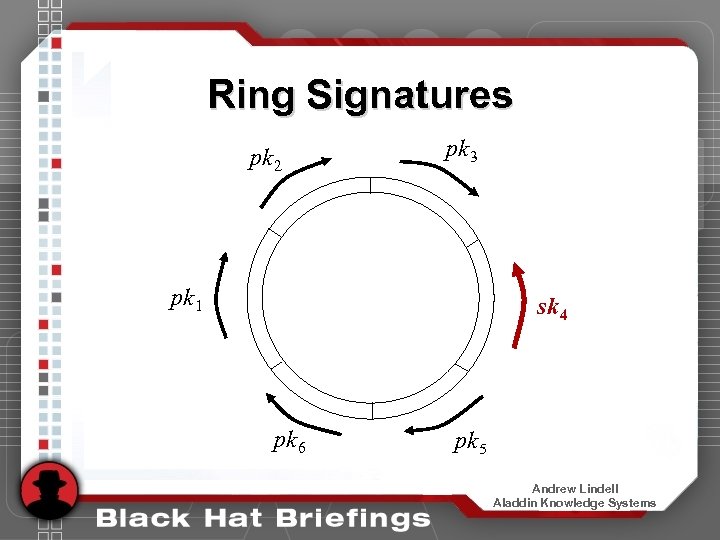 Ring Signatures pk 2 pk 3 pk 1 sk 4 pk 6 pk 5 Andrew Lindell Aladdin Knowledge Systems
 Anonymous Authentication with Ring Signatures • Incorporate ring signatures into SSL – Use SSL with server and client authentication – In SSL, the client authentication is achieved by the client signing on the handshake messages – Use a ring signature instead of a normal one • Security – Secure authentication: from unforgeability of ring signatures – Anonymity: from anonymity of ring signatures Andrew Lindell Aladdin Knowledge Systems
 Protocol Comparisons • Protocol based on encryption – Seemingly higher bandwidth (but user needs to identify subset anyway) – Can use any secure encryption scheme (low requirements) • Protocol based on ring signatures – Lower bandwidth (apart from identifying subset, requires same bandwidth as SSL with regular client authentication) – Assumes strong assumptions: ideal cipher Andrew Lindell Aladdin Knowledge Systems
 Revocable Anonymity • In some cases, anonymity needs to be revoked – Ban access to users who misbehave • Hostile users in anonymous chat • Criminal activity • When anonymous authentication is used, this cannot be done • Revocable anonymity – There exists a court authority who can revoke anonymity when required (and only it can revoke) Andrew Lindell Aladdin Knowledge Systems
 Achieving Revocable Anonymity • There exist solutions, but they are all expensive and require dedicated hardware – They don’t use “standard” encryption techniques • As of yet, we also don’t have a solution that doesn’t require a special-purpose smartcard – We do have solutions that are simple extensions of our protocols Andrew Lindell Aladdin Knowledge Systems
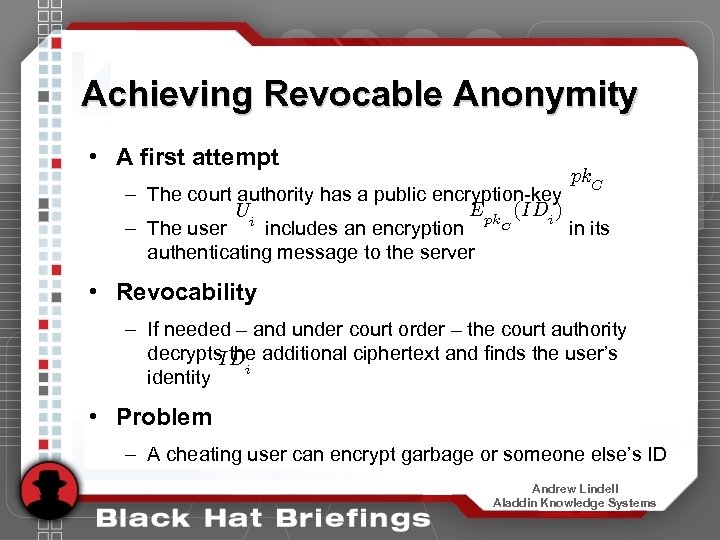 Achieving Revocable Anonymity • A first attempt pk. C – The court authority has a public encryption-key Epk (IDi ) Ui C – The user includes an encryption in its authenticating message to the server • Revocability – If needed – and under court order – the court authority decrypts the additional ciphertext and finds the user’s IDi identity • Problem – A cheating user can encrypt garbage or someone else’s ID Andrew Lindell Aladdin Knowledge Systems
 Solving the Problem • We need to bind the encryption of the user’s identity with its authentication message • We assume that the user is given a smartcard by the organization, and cannot modify it – The organization initializes the keys and so the user cannot replace it with a different smartcard • The requirement: – If the user succeeds in authenticating, then its encrypted identity must be received by the server – We view the user as a man-in-the-middle adversary Andrew Lindell Aladdin Knowledge Systems
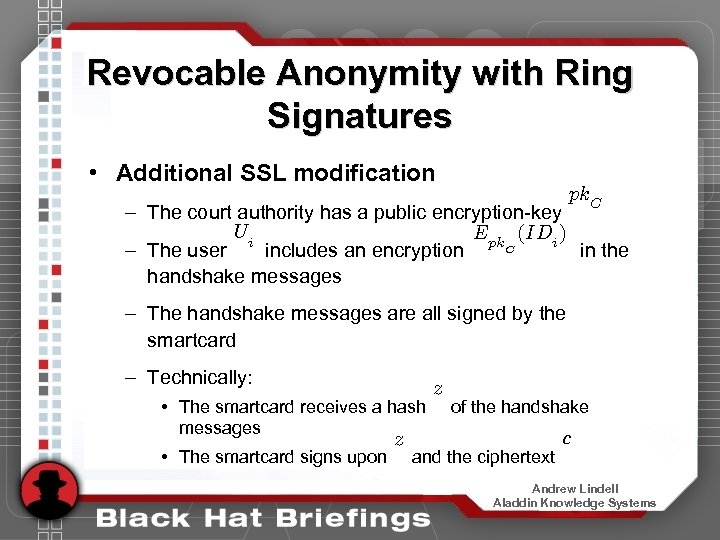 Revocable Anonymity with Ring Signatures • Additional SSL modification pk. C – The court authority has a public encryption-key Ui Epk (IDi ) C – The user includes an encryption in the handshake messages – The handshake messages are all signed by the smartcard – Technically: • The smartcard receives a hash messages • The smartcard signs upon z z of the handshake and the ciphertext c Andrew Lindell Aladdin Knowledge Systems
 Revocable Anonymity with Ring Signatures • Security – The smartcard operations are atomic – If the user modifies the ciphertext (that encrypts identity), the ring signature generated by the smartcard will fail – In this case, the user will fail to gain access Andrew Lindell Aladdin Knowledge Systems
 Revocable Anonymity Using Encryption • It is also possible to achieve a similar effect using our original protocol – The full description appears in the paper Andrew Lindell Aladdin Knowledge Systems
 Password-Based Anonymous Authentication • What if we don’t have a PKI setup? – We wish to use symmetric keys, or passwords (regular, one-time or whatever) • We present a partial solution that can be based on any authentication mechanism (even biometrics) Andrew Lindell Aladdin Knowledge Systems
 High-Level Protocol • Step 1 – standard authentication – The user authenticates using regular, non-anonymous authentication • Step 2 – register temporary public key – After authenticating, the user generates a temporary pk (pk; sk) key pair and sends to the server pk – The server registers as an authorized public-key • Step 3 – disconnect and re-authenticate – The user disconnects and connects again, pk running an anonymous authentication protocol using Andrew Lindell Aladdin Knowledge Systems
 Properties of the Protocol • Security – Authentication: no problems here – Anonymity: this is preserved as long as the server cannot link the anonymous authentication request to the user who just disconnected • Achieving anonymity – User must either register key well before authenticating, or wait until a number of users join – Can use time slots Andrew Lindell Aladdin Knowledge Systems
 Properties of the Protocol • User keys – This protocol intensifies the problem of how users know other users’ public keys – Need to use some trusted bulletin board (not run by the same organization and assuming no collusion) Andrew Lindell Aladdin Knowledge Systems
 Conclusions • Privacy is far more than just the “right to be let alone” – Online entities can learn large amounts of information and use that information against us, giving them an asymmetric advantage – We need unlinkability to preserve our privacy • Anonymous routing is the basic infrastructure needed for preserving privacy (unlinkability) • The above is fine, as long as authentication is not needed Andrew Lindell Aladdin Knowledge Systems
 Conclusions • If authentication is needed, anonymity can still be preserved – We saw two protocols – Implementation has a real cost, but a classic security/efficiency tradeoff makes it realistic (hide inside a not-too-large set of users) – Revocable anonymity is possible (but requires dedicated smartcards; not too bad with the invent of Java. Cards, but still a disadvantage) – Partial solutions based on passwords are also possible Andrew Lindell Aladdin Knowledge Systems
 Future Work • Revocation – Devise protocols that use only standard smartcard operations • Passwords – Provide more satisfactory solutions that have stronger guarantees • System – Come up with other methods of sharing public keys of users, so that server cannot introduce fake ones Andrew Lindell Aladdin Knowledge Systems
 Legal Notice Restricted information and subject to change. Before you access/view this presentation we draw your attention to the following terms and conditions and advise that by accessing, viewing, using or otherwise exploiting this document or its contents you are deemed to agree to these terms and to be bound thereby. The information contained herein is confidential and proprietary to Aladdin. The content herein is disclosed and may be viewed only by intended recipients this presentation solely for the purpose for which it is provided and shall not to be used or relied upon for any other purpose. You shall hold the information in strict confidence and will not use, disclose, copy, transfer or otherwise exploit the information without Aladdin's express prior written approval. The information, and any derivatives thereof is and shall remain the property of Aladdin and no license or other rights to such is granted or implied hereby to have been granted to you, now or in the future. Notwithstanding, that certain information herein has been or may be made public, you are required to regard it as sensitive and confidential and not disclose information, unless Aladdin expressly permitted you to do so in writing. Aladdin may make changes in the product(s) described in this presentation and/or to any specifications, at any time, without notice. Aladdin assumes no responsibility or liability arising from the use of the products described herein, except as expressly agreed to in writing by Aladdin and pursuant to an applicable license. Nothing herein conveys a license or any intellectual property rights whatsoever in the product(s). If you are not willing to be bound by these terms, please do not access or view this document or its contents and return it immediately to Aladdin or otherwise delete it and any copies. © 2007, Aladdin. All rights reserved. All trade and service marks, logos and trade names mentioned herein are subject to trademark rights of Aladdin. Andrew Lindell Aladdin Knowledge Systems
 Thank You!