


 Скачать презентацию Anomalous X-ray Pulsars and Soft Gamma-ray Repeaters Sandro
5eb3558aecac6ce9c7a0a3b97114b653.ppt
- Количество слайдов: 46
 Anomalous X-ray Pulsars and Soft Gamma-ray Repeaters Sandro Mereghetti INAF - IASF Milano Topics in X-ray astronomy - Tuebingen February 2004 S. Mereghetti
 OUTLINE Short review of AXP and SGR properties AXP / SGR relationship 2 recent results XMM-Newton > Variability in AXP 1 E 1048 INTEGRAL > Spectral evolution in bursts from SGR 1806 Topics in X-ray astronomy - Tuebingen February 2004 S. Mereghetti
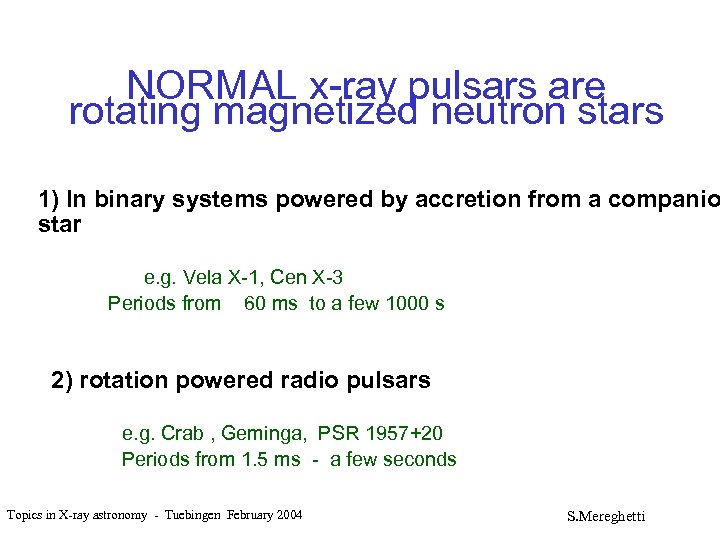 NORMAL x-ray pulsars are rotating magnetized neutron stars 1) In binary systems powered by accretion from a companio star e. g. Vela X-1, Cen X-3 Periods from 60 ms to a few 1000 s 2) rotation powered radio pulsars e. g. Crab , Geminga, PSR 1957+20 Periods from 1. 5 ms - a few seconds Topics in X-ray astronomy - Tuebingen February 2004 S. Mereghetti
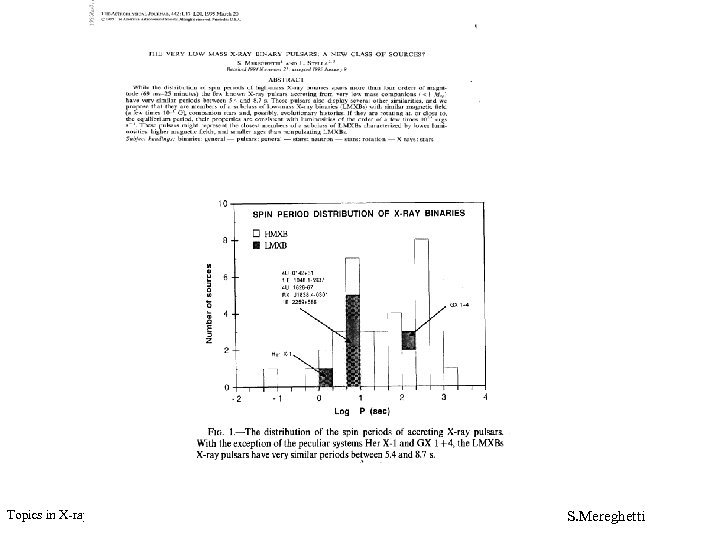
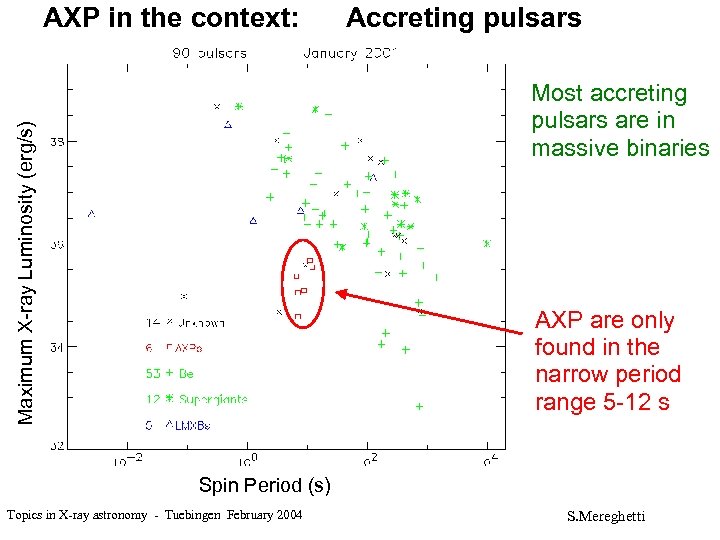 AXP in the context: Accreting pulsars Maximum X-ray Luminosity (erg/s) Most accreting pulsars are in massive binaries AXP are only found in the narrow period range 5 -12 s Spin Period (s) Topics in X-ray astronomy - Tuebingen February 2004 S. Mereghetti
 Topics in X-ray astronomy - Tuebingen February 2004 S. Mereghetti
 AXP PROPERTIES No evidence for massive companion stars limits on ax sin i from timing limits on Fx/Fopt from optical/IR observations Period of a few seconds (6 -12 s) Almost steady spin down Very soft X-ray spectrum k. TBB < 0. 5 ke. V ph > 3 -4 Topics in X-ray astronomy - Tuebingen February 2004 S. Mereghetti
 AXP have very soft X-ray spectra AXP Topics in X-ray astronomy - Tuebingen February 2004 S. Mereghetti
 AXP PROPERTIES 2 ( or 3 ? ) are in SNRs X-ray luminosity Lx = 1034 - 1036 erg s-1 Lx > rotational energy loss for a neutron star Topics in X-ray astronomy - Tuebingen February 2004 S. Mereghetti
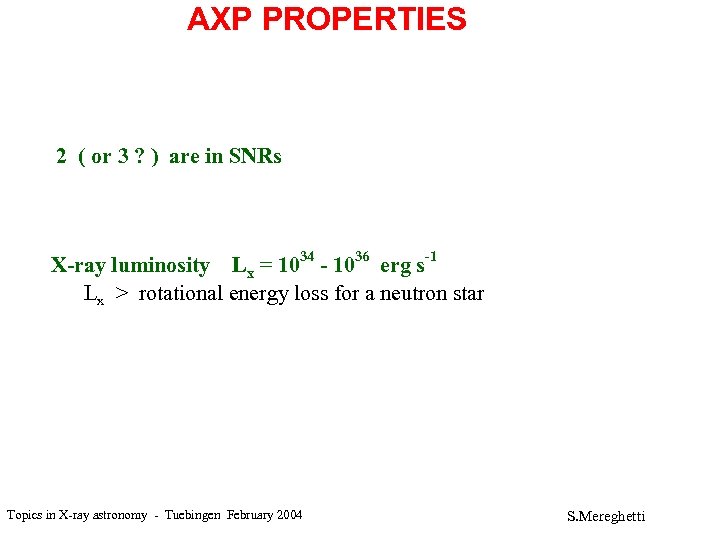
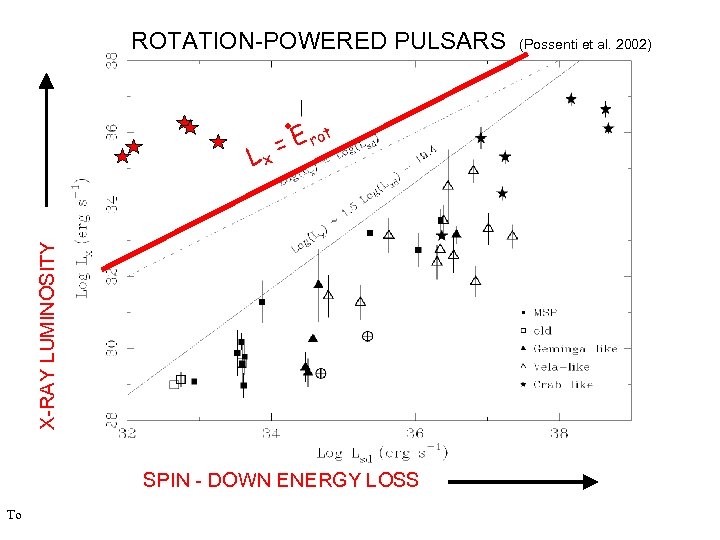 ROTATION-POWERED PULSARS = rot X-RAY LUMINOSITY Lx . E (Possenti et al. 2002) SPIN - DOWN ENERGY LOSS Topics in X-ray astronomy - Tuebingen February 2004 S. Mereghetti
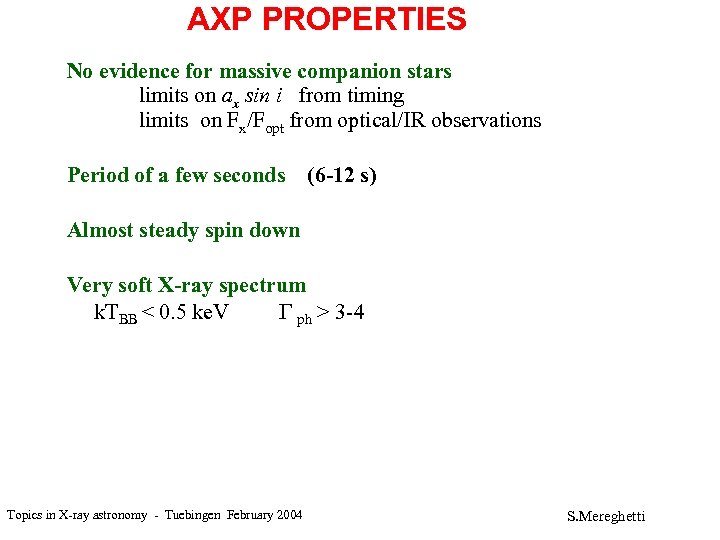
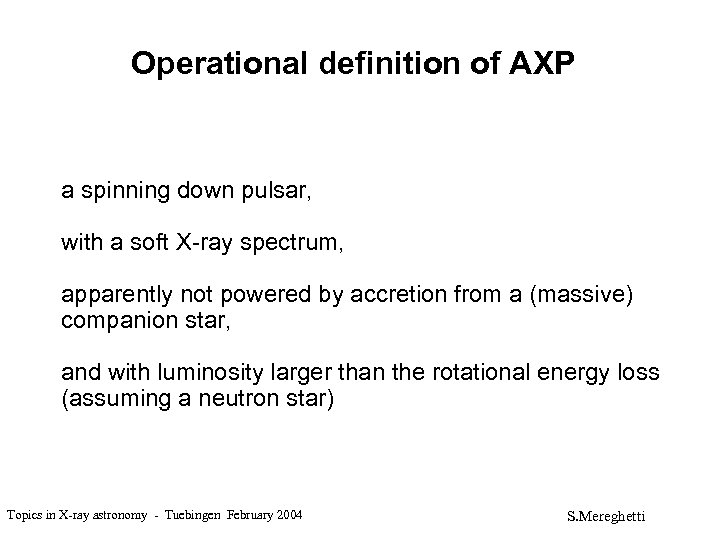 Operational definition of AXP a spinning down pulsar, with a soft X-ray spectrum, apparently not powered by accretion from a (massive) companion star, and with luminosity larger than the rotational energy loss (assuming a neutron star) Topics in X-ray astronomy - Tuebingen February 2004 S. Mereghetti
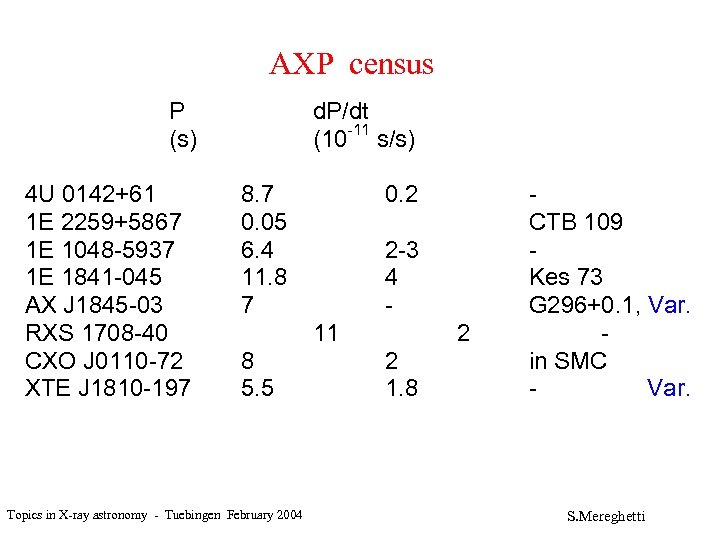 AXP census P (s) 4 U 0142+61 1 E 2259+5867 1 E 1048 -5937 1 E 1841 -045 AX J 1845 -03 RXS 1708 -40 CXO J 0110 -72 XTE J 1810 -197 d. P/dt (10 -11 s/s) 8. 7 0. 05 6. 4 11. 8 7 0. 2 2 -3 4 11 8 5. 5 Topics in X-ray astronomy - Tuebingen February 2004 2 2 1. 8 CTB 109 Kes 73 G 296+0. 1, Var. in SMC Var. S. Mereghetti
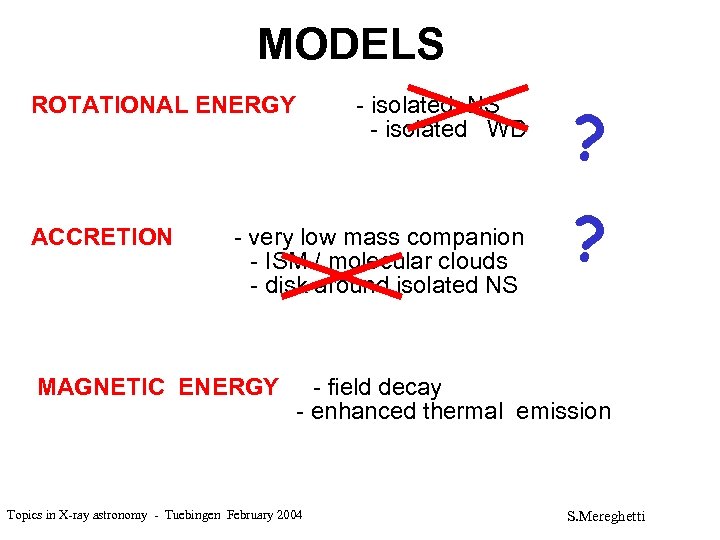 MODELS ROTATIONAL ENERGY ACCRETION - isolated NS - isolated WD - very low mass companion - ISM / molecular clouds - disk around isolated NS MAGNETIC ENERGY ? ? - field decay - enhanced thermal emission Topics in X-ray astronomy - Tuebingen February 2004 S. Mereghetti
 Isolated NS + accretion disk Thorne-Zytkow object (Van Paradijs et al. 1995, Ghosh et al. 1997) fall back after SN explosion (Chatterjiee et al. 2000, Alpar 2001) capture of SNR ejecta by fast moving NS (Marsden et al. 2000, 2001) Topics in X-ray astronomy - Tuebingen February 2004 S. Mereghetti
 Magnetar model (Thompson and Duncan) Isolated NS with B > 1014 Gauss Emission powered by magnetic field decay and/or enhanced cooling Originally developed for SGRs where evidence for high B is stronger due to large flares and bursts Extended to AXP due to similar P and d. P/dt values Topics in X-ray astronomy - Tuebingen February 2004 S. Mereghetti
 Soft Gamma-ray Repeaters • Initially discovered as a peculiar class of Gamma. Ray Bursts • soft • repeating • About 5 currently known (1 in the LMC) • Not always active (long quiescent periods) Topics in X-ray astronomy - Tuebingen February 2004 S. Mereghetti
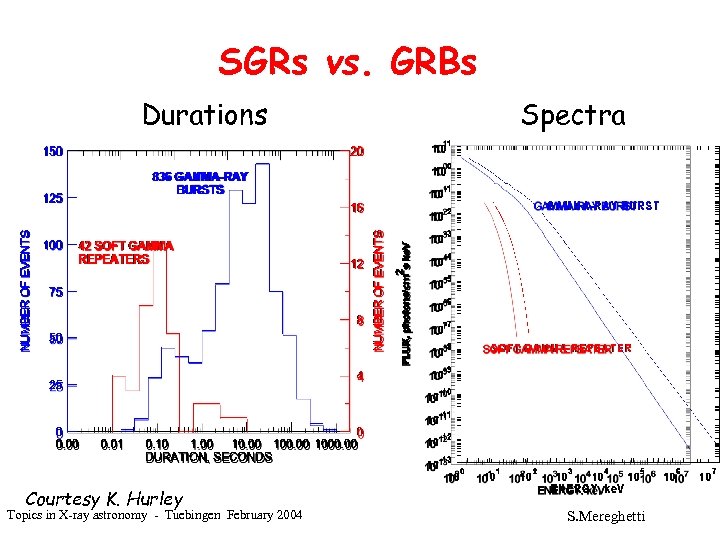 SGRs vs. GRBs Durations Courtesy K. Hurley Topics in X-ray astronomy - Tuebingen February 2004 Spectra S. Mereghetti
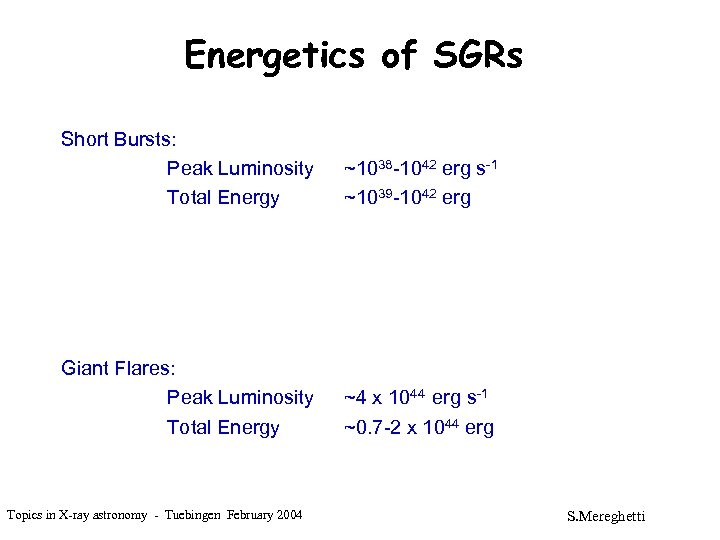 Energetics of SGRs Short Bursts: Peak Luminosity Total Energy ~1038 -1042 erg s-1 ~1039 -1042 erg Giant Flares: Peak Luminosity Total Energy ~4 x 1044 erg s-1 ~0. 7 -2 x 1044 erg Topics in X-ray astronomy - Tuebingen February 2004 S. Mereghetti
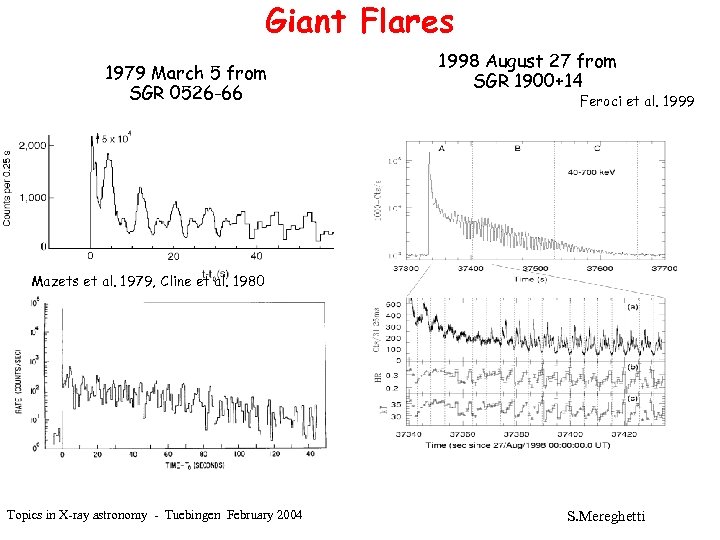 Giant Flares 1979 March 5 from SGR 0526 -66 1998 August 27 from SGR 1900+14 Feroci et al. 1999 Mazets et al. 1979, Cline et al. 1980 Topics in X-ray astronomy - Tuebingen February 2004 S. Mereghetti
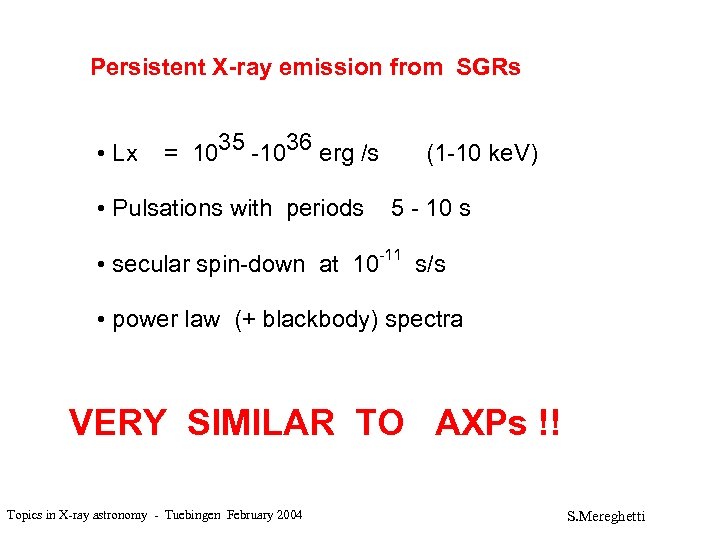 Persistent X-ray emission from SGRs • Lx = 1035 -1036 erg /s • Pulsations with periods (1 -10 ke. V) 5 - 10 s • secular spin-down at 10 -11 s/s • power law (+ blackbody) spectra VERY SIMILAR TO AXPs !! Topics in X-ray astronomy - Tuebingen February 2004 S. Mereghetti
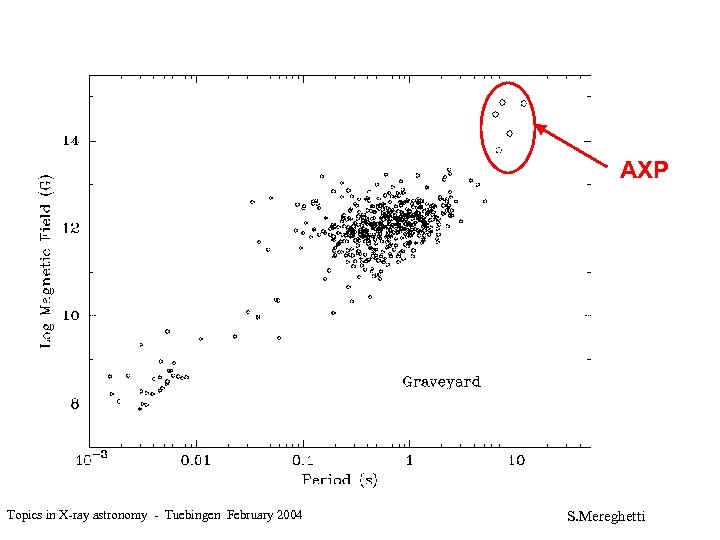 AXP Topics in X-ray astronomy - Tuebingen February 2004 S. Mereghetti
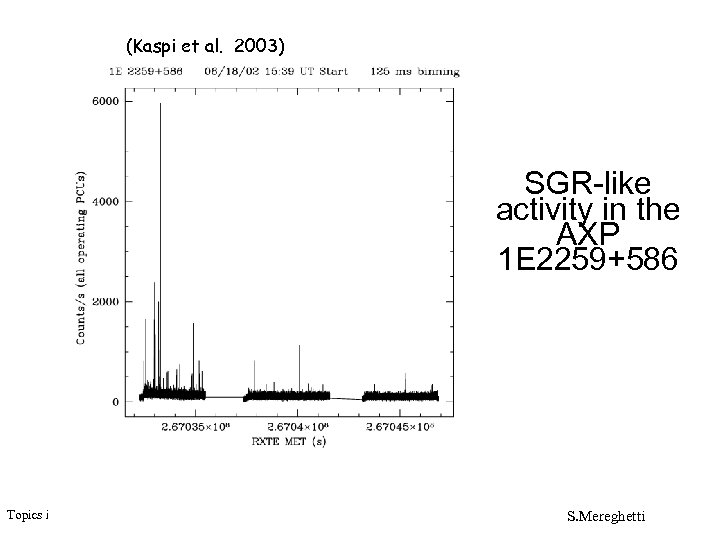 (Kaspi et al. 2003) SGR-like activity in the AXP 1 E 2259+586 Topics in X-ray astronomy - Tuebingen February 2004 S. Mereghetti
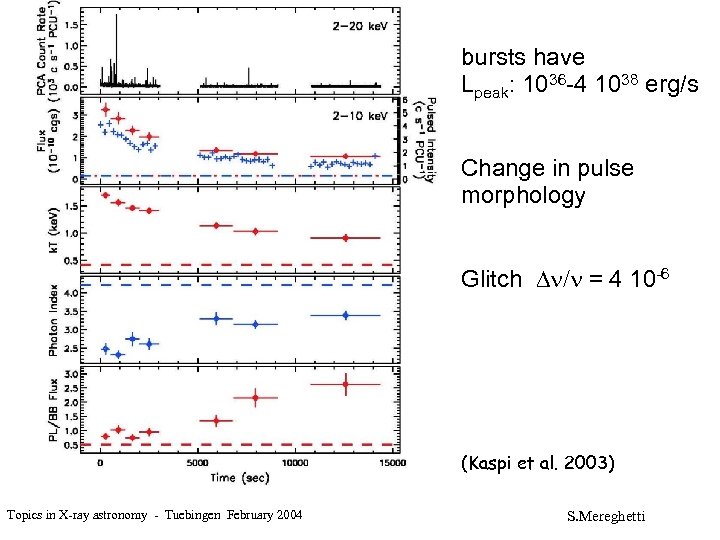 bursts have Lpeak: 1036 -4 1038 erg/s Change in pulse morphology Glitch = 4 10 -6 (Kaspi et al. 2003) Topics in X-ray astronomy - Tuebingen February 2004 S. Mereghetti
 AXP=SGR ? Only observational selection effects introduced a distinction between these sources belonging to the same class of objects: in AXP the quiescent, pulsating emission was discovered first SGR were discovered through their bursts Topics in X-ray astronomy - Tuebingen February 2004 S. Mereghetti
 OUTLINE Short review of AXP and SGR properties AXP / SGR relationship 2 recent results XMM-Newton > Variability in AXP 1 E 1048 INTEGRAL > Spectral evolution in bursts from SGR 1806 Topics in X-ray astronomy - Tuebingen February 2004 S. Mereghetti
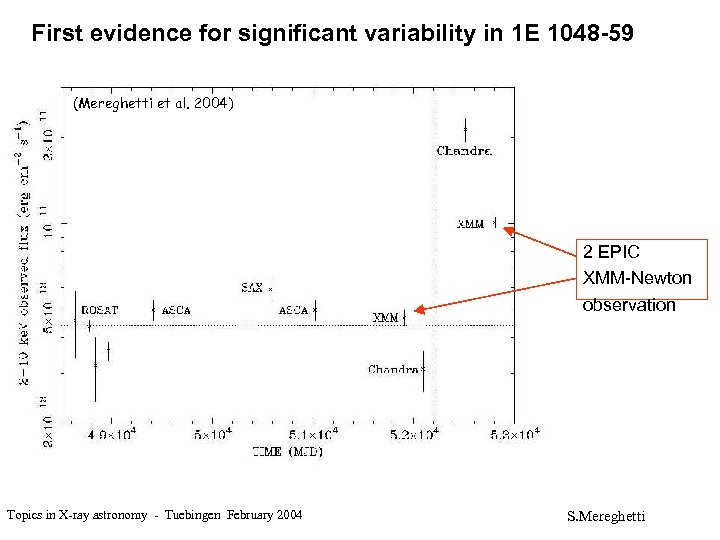 First evidence for significant variability in 1 E 1048 -59 (Mereghetti et al. 2004) 2 EPIC XMM-Newton observation Topics in X-ray astronomy - Tuebingen February 2004 S. Mereghetti
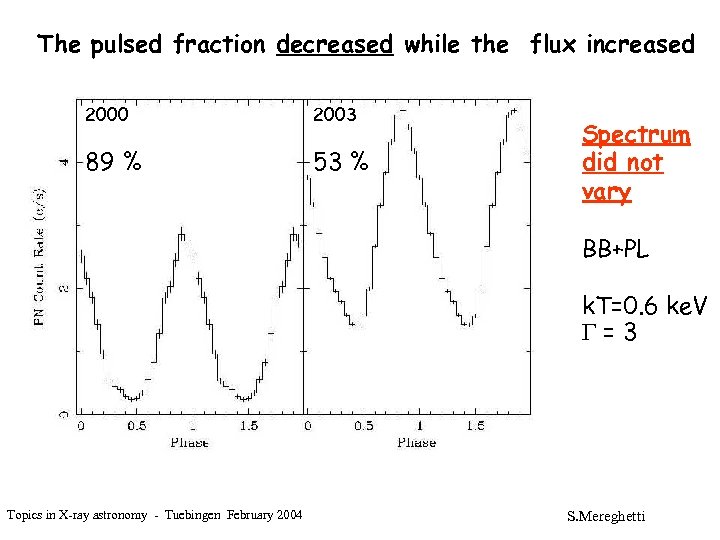 The pulsed fraction decreased while the flux increased 2000 2003 89 % 53 % Spectrum did not vary BB+PL k. T=0. 6 ke. V =3 Topics in X-ray astronomy - Tuebingen February 2004 S. Mereghetti
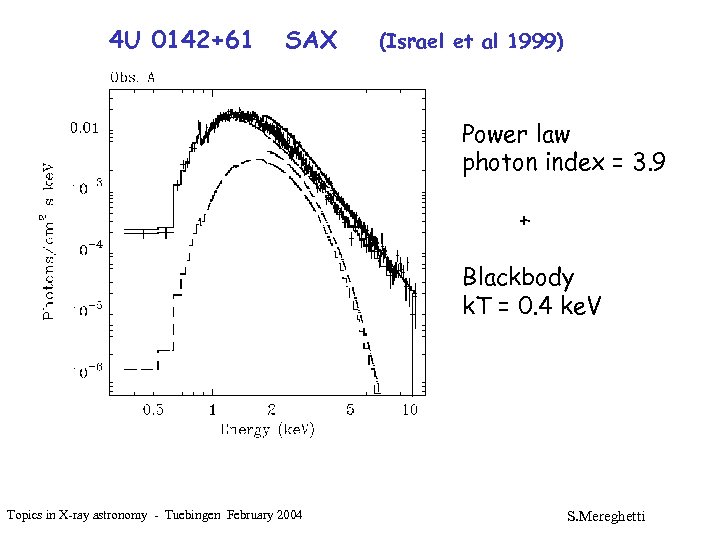 4 U 0142+61 SAX (Israel et al 1999) Power law photon index = 3. 9 + Blackbody k. T = 0. 4 ke. V Topics in X-ray astronomy - Tuebingen February 2004 S. Mereghetti
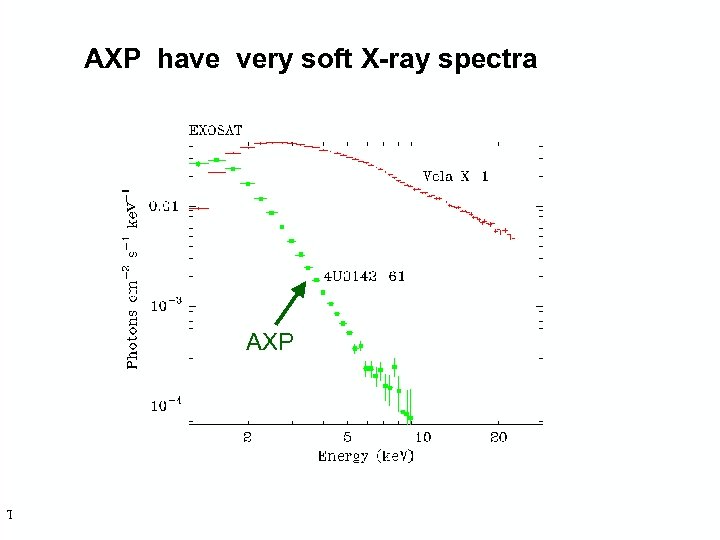
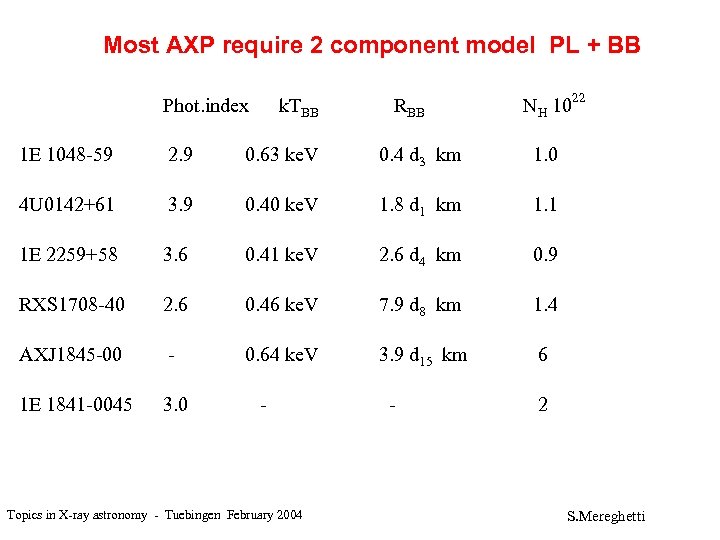 Most AXP require 2 component model PL + BB Phot. index k. TBB RBB NH 1022 1 E 1048 -59 2. 9 0. 63 ke. V 0. 4 d 3 km 1. 0 4 U 0142+61 3. 9 0. 40 ke. V 1. 8 d 1 km 1. 1 1 E 2259+58 3. 6 0. 41 ke. V 2. 6 d 4 km 0. 9 RXS 1708 -40 2. 6 0. 46 ke. V 7. 9 d 8 km 1. 4 AXJ 1845 -00 - 0. 64 ke. V 3. 9 d 15 km 6 1 E 1841 -0045 3. 0 - Topics in X-ray astronomy - Tuebingen February 2004 - 2 S. Mereghetti
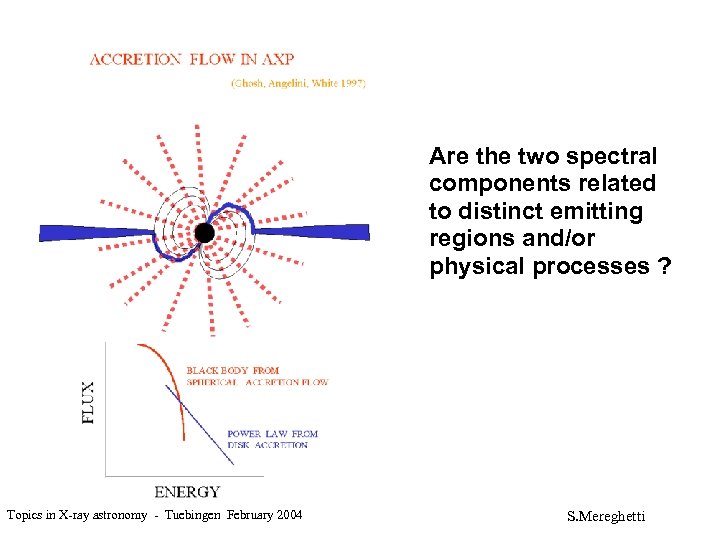 Are the two spectral components related to distinct emitting regions and/or physical processes ? Topics in X-ray astronomy - Tuebingen February 2004 S. Mereghetti
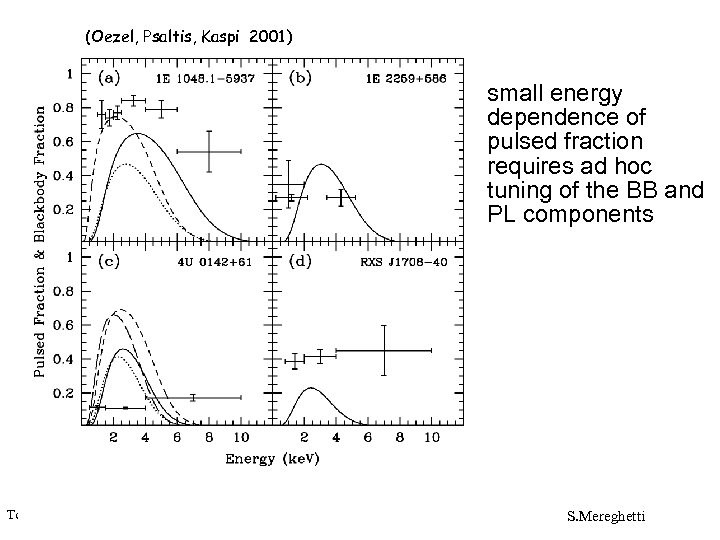 (Oezel, Psaltis, Kaspi 2001) small energy dependence of pulsed fraction requires ad hoc tuning of the BB and PL components Topics in X-ray astronomy - Tuebingen February 2004 S. Mereghetti
 Despite the large flux variation the spectral shape did not vary BB+PL in both observations k. T = 0. 6 ke. V phot. Index = 3 . . . these are the typical parameters seen in this source Topics in X-ray astronomy - Tuebingen February 2004 S. Mereghetti
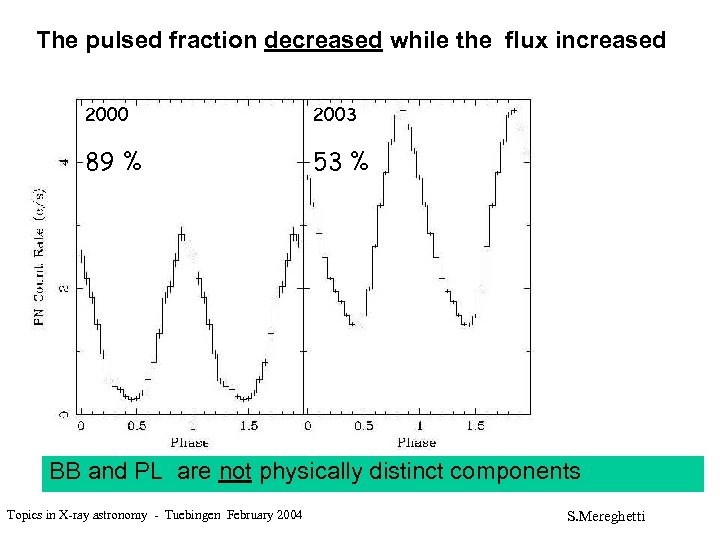 The pulsed fraction decreased while the flux increased 2000 2003 89 % 53 % BB and PL are not physically distinct components Topics in X-ray astronomy - Tuebingen February 2004 S. Mereghetti
 OUTLINE Short review of AXP and SGR properties AXP / SGR relationship 2 recent results XMM-Newton > Variability in AXP 1 E 1048 INTEGRAL > Spectral evolution in bursts from SGR 1806 Topics in X-ray astronomy - Tuebingen February 2004 S. Mereghetti
 SGR 1806 -20 entered a new period of activity in July 2003 An INTEGRAL To. O observation started on 3 September 2003, while the source was still active INTEGRAL continued to observe SGR 1806 -20 (l = 9. 99 deg, b = -0. 24 deg) during the Galactic Center Deep Exposre (GCDE) until mid October 24 bursts were detected by IBIS in real time by the INTEGRAL Burst Alert System (IBAS) and confirmed later by off-line analysis Topics in X-ray astronomy - Tuebingen February 2004 S. Mereghetti
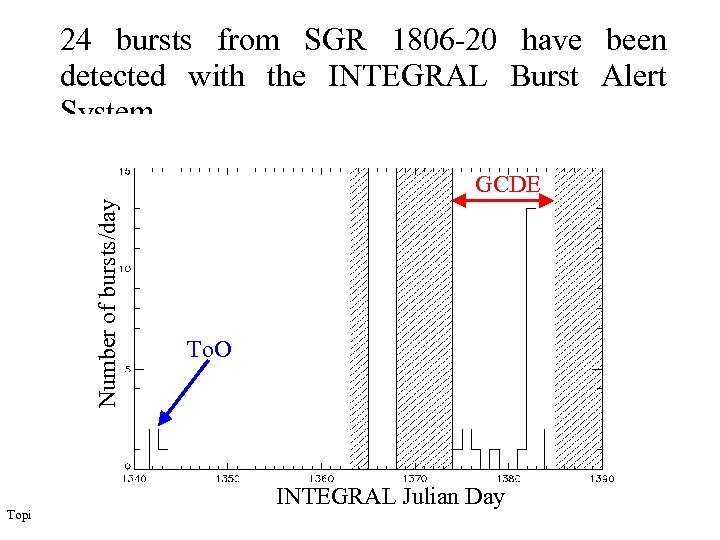 24 bursts from SGR 1806 -20 have been detected with the INTEGRAL Burst Alert System. Number of bursts/day GCDE To. O INTEGRAL Julian Day Topics in X-ray astronomy - Tuebingen February 2004 S. Mereghetti
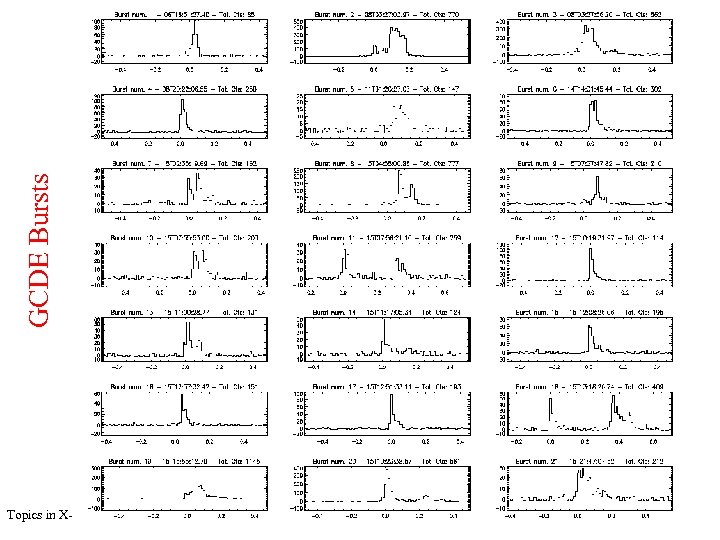 GCDE Bursts Topics in X-ray astronomy - Tuebingen February 2004 S. Mereghetti
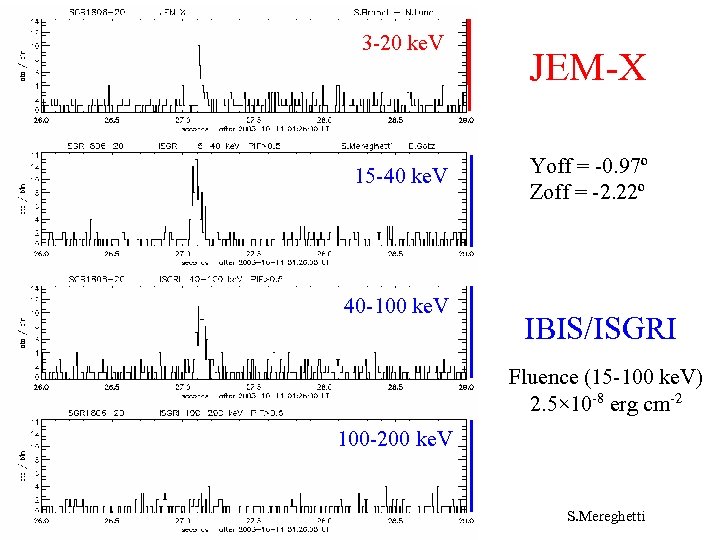 3 -20 ke. V 15 -40 ke. V 40 -100 ke. V JEM-X Yoff = -0. 97º Zoff = -2. 22º IBIS/ISGRI Fluence (15 -100 ke. V) 2. 5× 10 -8 erg cm-2 100 -200 ke. V Topics in X-ray astronomy - Tuebingen February 2004 S. Mereghetti
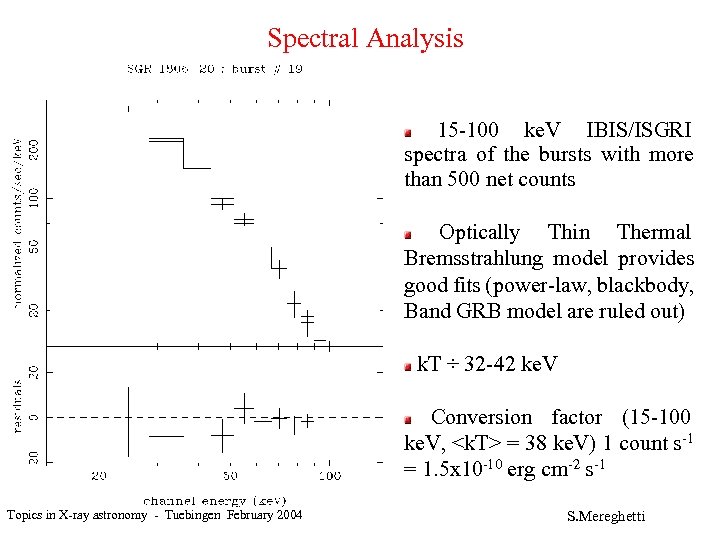 Spectral Analysis 15 -100 ke. V IBIS/ISGRI spectra of the bursts with more than 500 net counts Optically Thin Thermal Bremsstrahlung model provides good fits (power-law, blackbody, Band GRB model are ruled out) k. T ÷ 32 -42 ke. V Conversion factor (15 -100 ke. V,
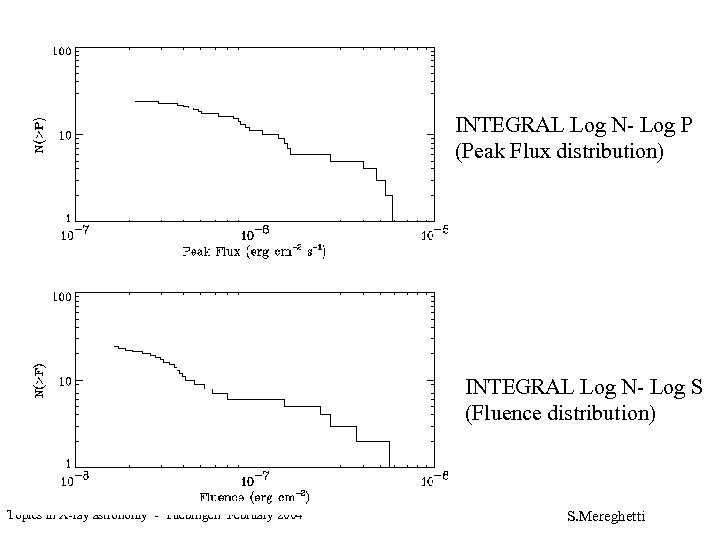 INTEGRAL Log N- Log P (Peak Flux distribution) INTEGRAL Log N- Log S (Fluence distribution) Topics in X-ray astronomy - Tuebingen February 2004 S. Mereghetti
 THE SGR BURSTS OBSERVED BY IBIS ARE NORMAL IN MOST RESPECTS Durations, energy spectra are typical However, the fluences are very low, ~1. 5 x 10⁸ erg/cm 2 , 25 -100 ke. V These are the among the weakest bursts seen from this SGR; thanks to imaging, we are certain that the source is indeed SGR 1806 -20 Topics in X-ray astronomy - Tuebingen February 2004 S. Mereghetti
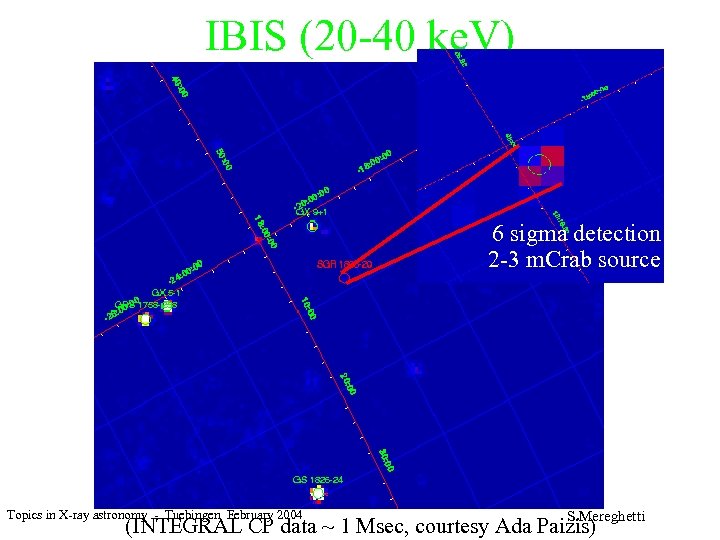 IBIS (20 -40 ke. V) 6 sigma detection 2 -3 m. Crab source Topics in X-ray astronomy - Tuebingen February 2004 S. Mereghetti (INTEGRAL CP data ~ 1 Msec, courtesy Ada Paizis)
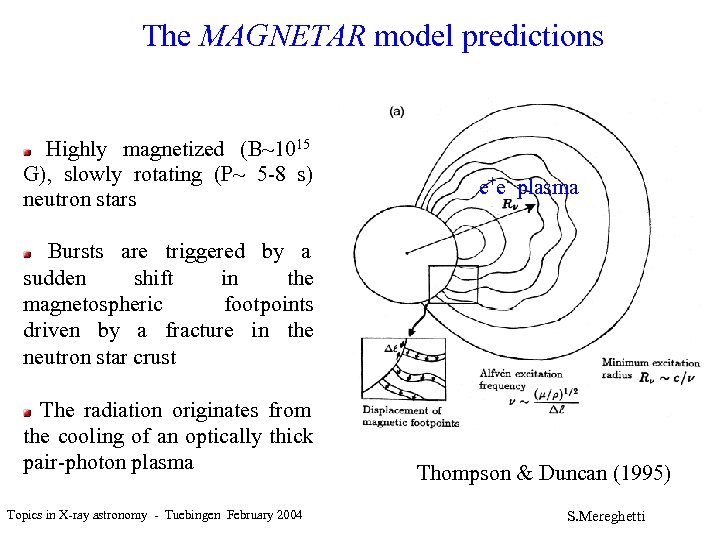 The MAGNETAR model predictions Highly magnetized (B~1015 G), slowly rotating (P~ 5 -8 s) neutron stars e+e- plasma Bursts are triggered by a sudden shift in the magnetospheric footpoints driven by a fracture in the neutron star crust The radiation originates from the cooling of an optically thick pair-photon plasma Topics in X-ray astronomy - Tuebingen February 2004 Thompson & Duncan (1995) S. Mereghetti
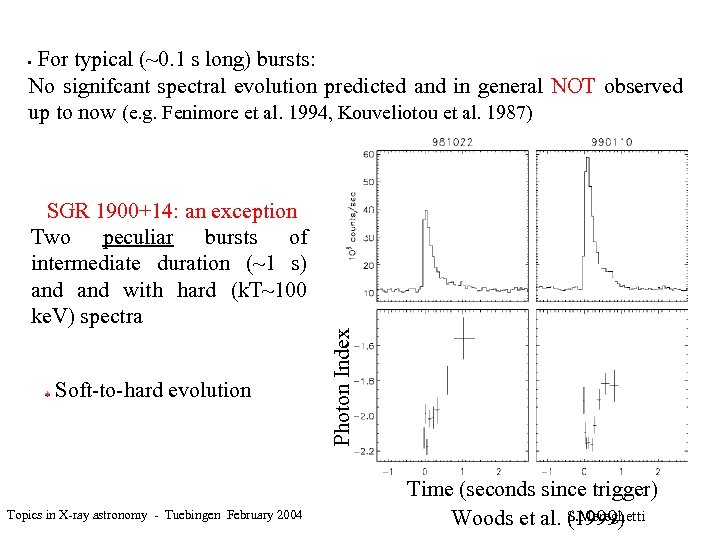 For typical (~0. 1 s long) bursts: No signifcant spectral evolution predicted and in general NOT observed up to now (e. g. Fenimore et al. 1994, Kouveliotou et al. 1987) SGR 1900+14: an exception Two peculiar bursts of intermediate duration (~1 s) and with hard (k. T~100 ke. V) spectra Soft-to-hard evolution Topics in X-ray astronomy - Tuebingen February 2004 Photon Index • Time (seconds since trigger) S. Mereghetti Woods et al. (1999)
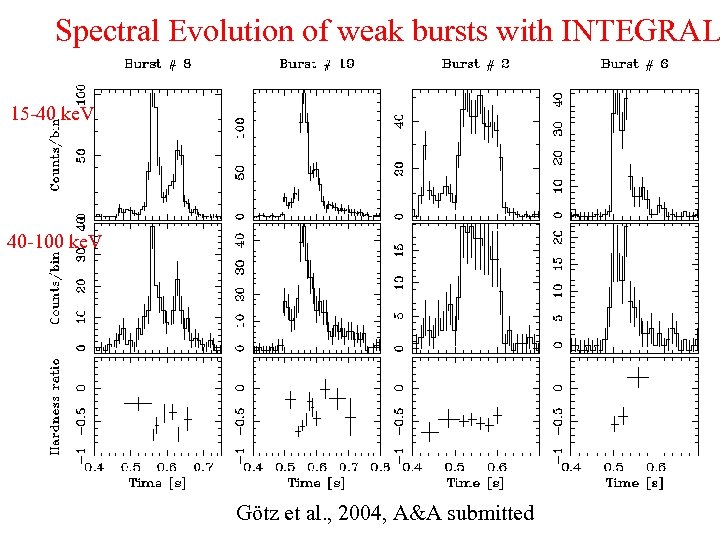 Spectral Evolution of weak bursts with INTEGRAL 15 -40 ke. V 40 -100 ke. V Götz et al. , 2004, A&A submitted Topics in X-ray astronomy - Tuebingen February 2004 S. Mereghetti
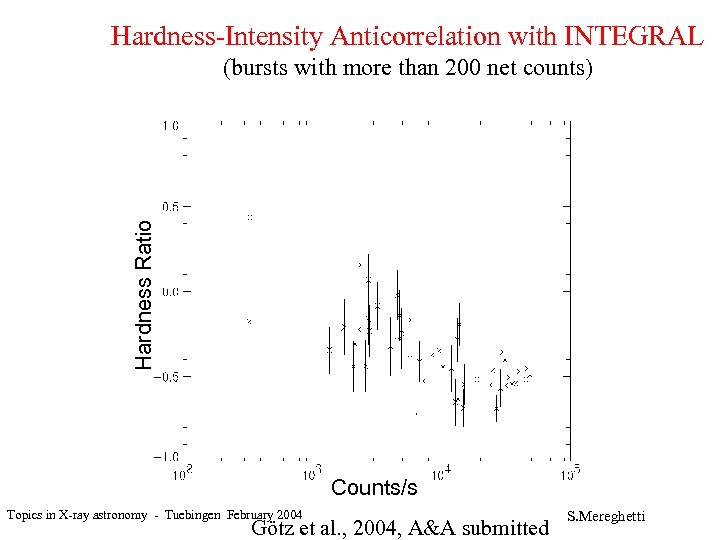 Hardness-Intensity Anticorrelation with INTEGRAL Hardness Ratio (bursts with more than 200 net counts) Counts/s Topics in X-ray astronomy - Tuebingen February 2004 Götz et al. , 2004, A&A submitted S. Mereghetti
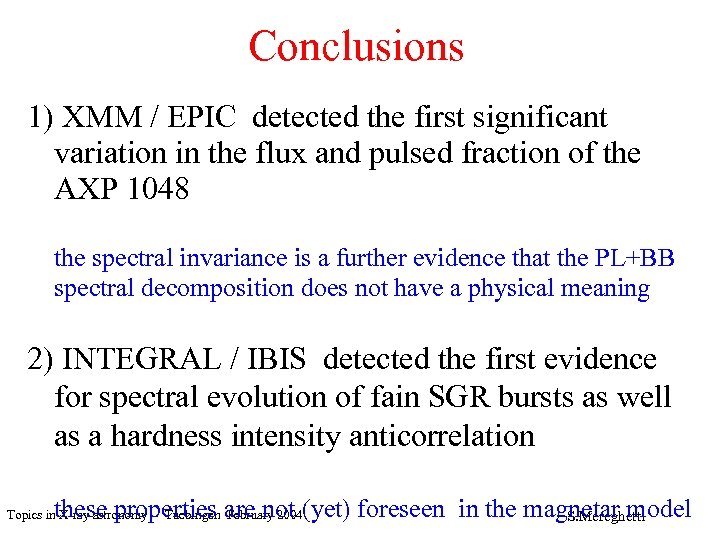 Conclusions 1) XMM / EPIC detected the first significant variation in the flux and pulsed fraction of the AXP 1048 the spectral invariance is a further evidence that the PL+BB spectral decomposition does not have a physical meaning 2) INTEGRAL / IBIS detected the first evidence for spectral evolution of fain SGR bursts as well as a hardness intensity anticorrelation these properties are not (yet) foreseen in the magnetar model S. Mereghetti Topics in X-ray astronomy - Tuebingen February 2004