


 Скачать презентацию Annual Conference 2005 Pennsylvania Department of EDUCATION IT S
d16871eb72b3958de6f21e56e63670b1.ppt
- Количество слайдов: 53
 Annual Conference 2005 Pennsylvania Department of EDUCATION IT’S ALL ABOUT RESULTS: SUPPORTING ALL STUDENTS TO ACHIEVE ADEQUATE YEARLY PROGRESS
 Individuals with Disabilities Education Improvement Act (IDEIA) 2004 P. L. 108 -446 February 22, 2005
 Our Purpose n Creating Awareness n n n Connecting Change to PA’s Context n n n Sharing side-by-side of the law Overview Power. Point Implications for PA’s rules Connecting to Gaskin and other PA requirements Providing Clarity n n Seeking information from USDE Telling parents and schools what happens next
 Gaining Input - Regional Forums n n To provide information on the new law and the changes To obtain field input that informs and guides State Board and PDE Timeline: April 2005 - dates TBA Locations: Regional sites to be determined
 Turnkey Approach – Information and Training n February 22 presentation and notes n Bureau of Special Education and Pa. TTAN to provide training to IU staff n n n IU to provide turnaround training to component districts, charter schools, private schools, and interested parents BSE/Pa. TTAN to train other select groups and will work with parents and advocacy groups to sponsor trainings Statewide videoconference
 Federal Regulations n Office of Special Education Programs announced informal hearings January - February 2005 n n n To gather comments/recommendations regarding changes to parts 300 and 313 of the Code of Federal Regulations (34 CFR) needed to clarify/implement IDEIA Plan for proposed federal regulations July 2005; final federal regulations December 2005 Commitment to an expedited process
 PA State Board of Education & PA Department of Education n State Board – Chapter 14 PDE – Chapter 711 Note: A “red flag” suggests that the new IDEIA may not be implemented until the State Board of Education and/or PDE revise regulations and policy.
 Purpose
 Purpose of Changes n n More emphasis on outcomes, not process Aligning NCLB with IDEIA More federal direction to state level activities Prioritizing specific monitoring outcomes n n n NEW Graduation/dropout rates Disproportionality Participation/performance on statewide assessments FAPE in the least restrictive environment Less adversarial dealings between parents and schools
 Purpose of Changes (cont’d) NEW n n n Reducing paperwork Reducing staff time at meetings Eliminating unnecessary evaluations and meetings Notifying USDE and LEAs where State exceeds Federal requirements Clarifying nonpublic services
 New Funding Formula n n n NEW Establishes 6 year path to reach 40% goal, however The USDE estimate 2005 -06 Federal grant provides only a 2 -3% increase for PA Local Education Agencies (LEAs) States may use up to 10% of state-level activities funds to establish “risk pools” to reimburse school districts for “high-need; lowincidence, catastrophic or extraordinary aid” (PA has a state “Contingency Fund”)
 Early Intervening n NEW Permits school districts to use up to 15% of the Part B grant for “early intervening” as follows: n To develop and implement coordinated early intervening services for students K through 12 who are not identified as disabled but need “additional academic and behavioral support to succeed in a general education environment” n Emphasis is on K through 3 n Professional development n Providing educational and behavioral evaluations, services and supports
 State Advisory Panel n NEW Additional membership includes: n n Parents of children with disabilities (ages birth through 26) Officials who carry out activities of the Mc. Kinney. Vento Homeless Assistance Act Not less than one representative of a vocational, community, or business organization concerned with the provision of transition services A representative from the State child welfare agency responsible for foster care
 Federal Monitoring Priorities NEW n Quantifiable indicators shall be used to monitor the priority areas: n n n Provision of FAPE Child find, effective monitoring, due process resolution sessions, mediation, and a system of transition services Disproportionate representation of racial and ethnic groups (Currently these priority areas are in PA monitoring system, except due process resolution session) n Qualitative indicators, as needed, shall be used to measure performance in the priority areas
 Federal Focused Monitoring NEW Activities shall focus on n Improving educational results and functional outcomes for all children with disabilities n Ensuring that states meet program requirements, particularly those related to improving educational results for children with disabilities n Four levels of federal monitoring response to states
 Equitable Participation NEW Children in private schools enrolled by their parents to be afforded equitable participation determined by proportionate amount of IDEIA funds available to serve these children n IU subgrantee shall consult with private school representatives and representatives of parents of children with disabilities regarding n Child find process n How the consultation process will operate throughout the year to ensure meaningful participation in special education and related services n How, where, and by whom services will be provided
 Equitable Participation (cont’d) n IU subgrantee responsibilities n n n NEW Written affirmation of input from private schools/parents of students with disabilities How, if the private school officials disagree with the LEA on provision or type of services, the LEA shall provide a written explanation of reasons Private school official may file a complaint with the SEA n If private school official disagrees with SEA decision, may appeal to OSEP
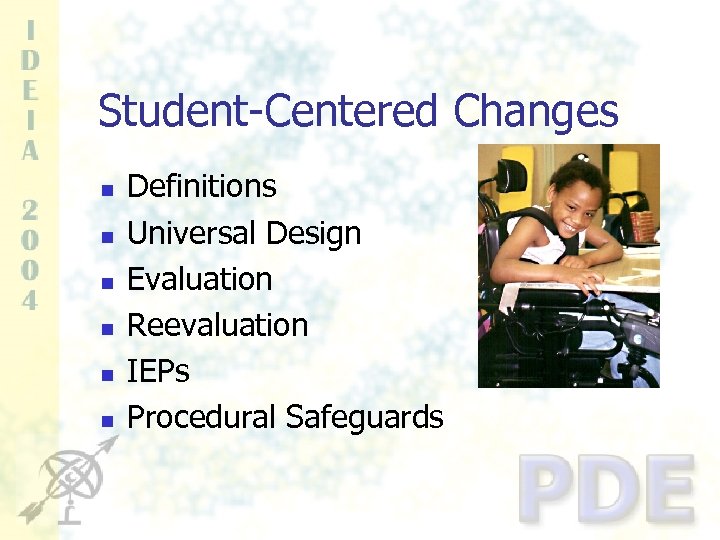 Student-Centered Changes n n n Definitions Universal Design Evaluation Reevaluation IEPs Procedural Safeguards
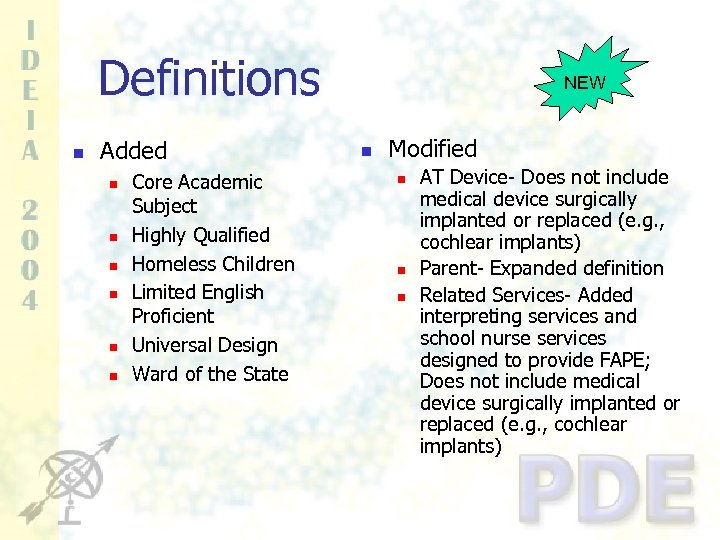 Definitions n Added n n n Core Academic Subject Highly Qualified Homeless Children Limited English Proficient Universal Design Ward of the State NEW n Modified n n n AT Device- Does not include medical device surgically implanted or replaced (e. g. , cochlear implants) Parent- Expanded definition Related Services- Added interpreting services and school nurse services designed to provide FAPE; Does not include medical device surgically implanted or replaced (e. g. , cochlear implants)
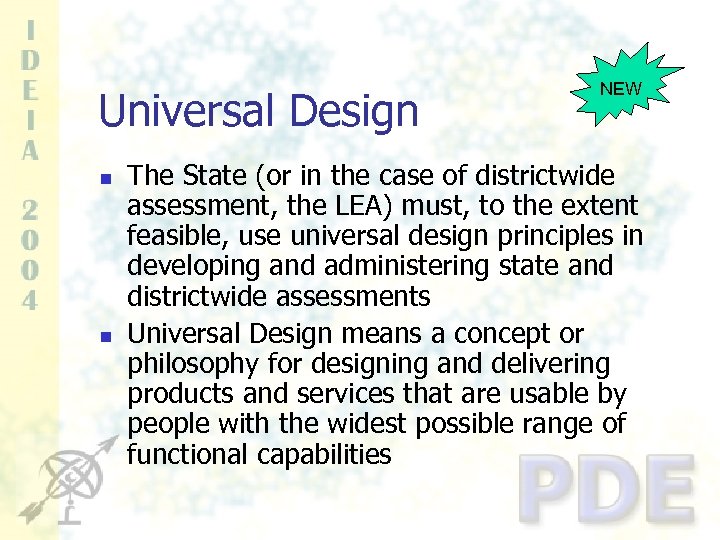 Universal Design n n NEW The State (or in the case of districtwide assessment, the LEA) must, to the extent feasible, use universal design principles in developing and administering state and districtwide assessments Universal Design means a concept or philosophy for designing and delivering products and services that are usable by people with the widest possible range of functional capabilities
 Purpose of Changes: Evaluation n Emphasize need to reduce irrelevant and unnecessary paperwork Emphasize need for flexibility in attendance and scheduling of meetings for parents and LEAs Reduce costs with fewer reevaluations
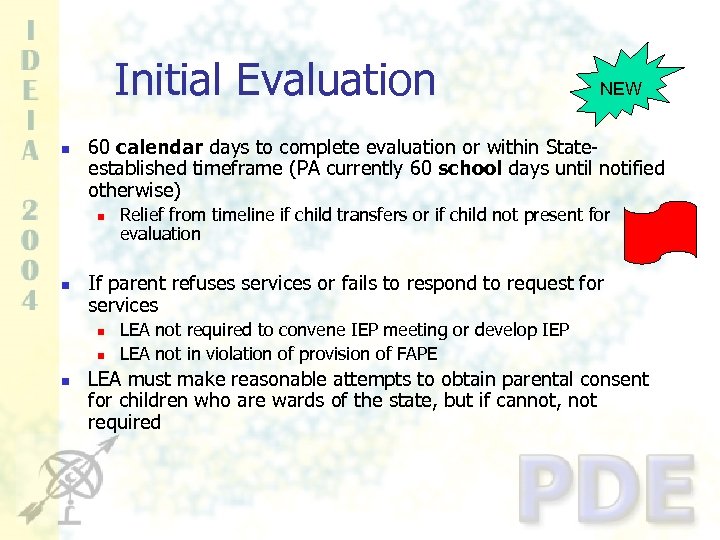 Initial Evaluation n 60 calendar days to complete evaluation or within Stateestablished timeframe (PA currently 60 school days until notified otherwise) n n Relief from timeline if child transfers or if child not present for evaluation If parent refuses services or fails to respond to request for services n n n NEW LEA not required to convene IEP meeting or develop IEP LEA not in violation of provision of FAPE LEA must make reasonable attempts to obtain parental consent for children who are wards of the state, but if cannot, not required
 Evaluation Procedures n n n NEW Assessments provided/administered in language and form most likely to yield accurate academic, development and functional information For children who transfer, sending and receiving schools coordinate efforts to complete evaluation expeditiously For specific learning disability n n LEA not required to consider severe discrepancy between achievement and ability LEA may use response to scientific, research-based intervention
 Evaluation Procedures (cont’d) NEW n n RESPONSE TO INTERVENTION – in response to concerns regarding requiring students to experience failure before being considered for special education services Emphasis on research-based instructional interventions that are documented prior to referral
 Reevaluation n n NEW Not more than once a year At least once every three years unless parent and LEA agree it is unnecessary n PARC Consent Decree requires reevaluation of students with mental retardation at least every two years
 Evaluations Before Change in Eligibility NEW n LEA must provide summary of child’s academic achievement and functional performance, including recommendations on how to assist the child in meeting postsecondary goals n Still required to reevaluate before determining child no longer eligible
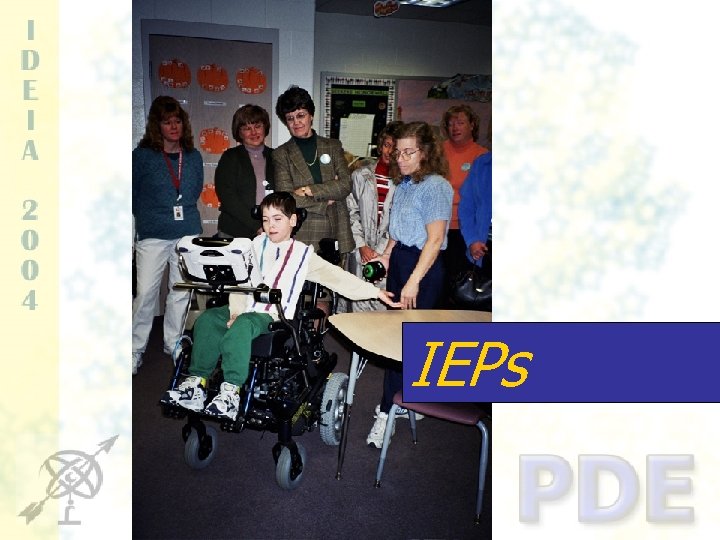 IEPs
IEPs
 Purpose of Changes: IEPs n n n Reduction in paperwork Reduction in meeting time for parents Potential staff time saving Expedite changes to IEP Alternatives to physical meetings
 IEP Team Attendance n n NEW If IEP team member’s areas of expertise not being discussed/modified, team member need not attend if parent/LEA agree in writing If IEP team member's area of expertise is being discussed/modified, IEP team member may be excused if parent/LEA agree in writing and if member’s written input submitted prior to the meeting
 IEP Development NEW Parents and LEA may agree not to convene an IEP meeting to make changes to IEP after the annual meeting n Instead may develop a written document to modify current IEP n Upon request parent receives revised copy of IEP
 IEPs NEW IEP contains statement of n Short-term objectives (STOs)/benchmarks for children with disabilities who take alternate assessments aligned to alternate standards n n n STOs not required for most students with disabilities PDE has developed draft alternate standards to be submitted to State Board for approval Spring 2005 Special ed/related services based on peer-reviewed research to extent practicable
 IEPs: Postsecondary Transition NEW n n n Postsecondary transition planning must begin with IEP in effect at age 16 Course of study at age 14 no longer required Transition planning may begin at any age for a student with a disability
 IEP: Transfer Students n Transfer within state n n LEA must implement current IEP until LEA adopts current IEP or develops new IEP Transfer outside state n n NEW LEA must implement comparable services until LEA conducts evaluation, if necessary, and develops new IEP To facilitate transition, sending and receiving schools take reasonable steps to send/obtain child’s records
 Multi-Year IEP Demonstration NEW n n Purpose: provide opportunity for long-term planning Comprehensive, not to exceed 3 years, designed to coincide with natural transition points USDE Secretary may approve up to 15 states’ proposals USDE Secretary must submit report in 2 years
 Purpose
 Purpose of Changes: Procedural Safeguards n n n Reduce paperwork burden on schools Promote collaborative relationships Additional language to clarify services for homeless children and use of surrogates
 Procedural Safeguards: Surrogate Parents n n n NEW For child who is a ward of the state, judge overseeing child's care may appoint a surrogate who may be an employee of the SEA, the LEA or other agency not involved in the education/ care of the child For unaccompanied homeless youth, LEA must appoint surrogate Surrogate must be appointed within 30 days after determination of need
 Procedural Safeguards Notice (PSN) NEW n LEA obligation to give copy to parents only 1 time per year, except also given upon n n Initial referral or parental request for evaluation First occurrence of filing of due process complaint Parent request With notice of disciplinary change of placement
 Purpose
 Purpose of Changes: Due Process n n Less adversarial IDEIA Promote early resolution of disputes and due process complaints Promote clarification of issues for parents and LEAs Reduce litigation
 Due Process Procedural Safeguards Notice NEW PSN to contain explanation of n Timeline to submit due process complaint (2 years) n Opportunity to resolve the complaint (resolution session) n Timeline for filing civil actions (90 days or as State law allows)
 Due Process Complaint n n NEW Two-year statute of limitations for filing due process complaint notice Parent or LEA may file Requirements for due process complaint notice Either party may dispute whether notice meets requirements
 Due Process Hearing NEW Opportunity to Resolve Due Process Hearing Complaints n n Starts with a specific written complaint from parent/LEA Requires “preliminary meeting” within 15 days to resolve complaints before a hearing begins, unless waived in writing by both parties No attorney for district unless parents have an attorney Attorney fees can be awarded to SEA or LEA under specific circumstances
 Timeline for Requesting Due Process Hearing NEW Hearing must be requested within 2 years of alleged action, unless parent prevented due to n Misrepresentation by LEA that problem was resolved n LEA withheld information from parent
 Award of Attorneys’ Fees NEW The court may award reasonable attorneys’ fees n Against the attorney of a parent who n n n Files a complaint that is frivolous, unreasonable, or without foundation Continued to litigate after the litigation clearly become frivolous, unreasonable, or without foundation Against the attorney of a parent or against the parent if parent’s complaint was presented to harass, cause unnecessary delay, or needlessly increase cost of litigation
 Purpose
 Purpose of Changes: Discipline n n Simplify process of immediate response to dangerous situations Reduce paperwork burden Maintain protections of provision of FAPE Maintain manifestation determination
 Discipline n n NEW For removals of more than 10 school days, when behavior not a manifestation of child's disability, FAPE must be provided but may be provided in an interim alternative educational setting Unilateral removal for drugs, weapons, serious bodily injury violations, whether or not a manifestation of child’s disability, can be for up to 45 school days to interim alternative educational setting n n Parent must be notified with PSN FAPE must be provided Manifestation determination must be conducted FBA, behavior intervention services must be provided
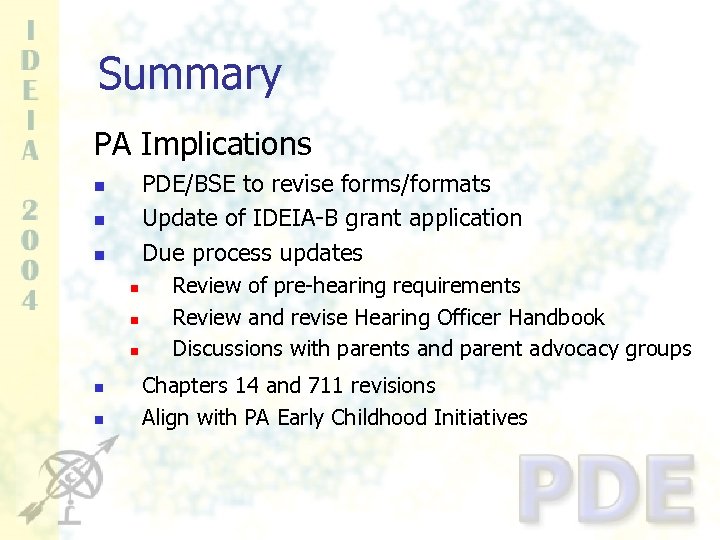 Summary PA Implications PDE/BSE to revise forms/formats Update of IDEIA-B grant application Due process updates n n n n Review of pre-hearing requirements Review and revise Hearing Officer Handbook Discussions with parents and parent advocacy groups Chapters 14 and 711 revisions Align with PA Early Childhood Initiatives
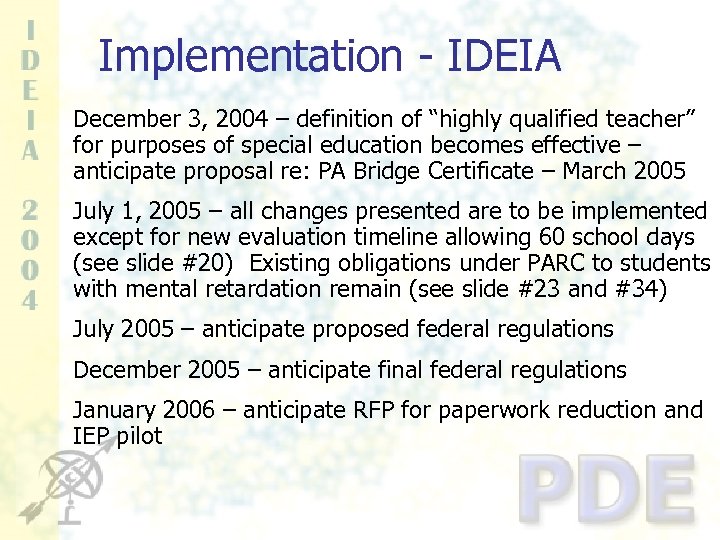 Implementation - IDEIA December 3, 2004 – definition of “highly qualified teacher” for purposes of special education becomes effective – anticipate proposal re: PA Bridge Certificate – March 2005 July 1, 2005 – all changes presented are to be implemented except for new evaluation timeline allowing 60 school days (see slide #20) Existing obligations under PARC to students with mental retardation remain (see slide #23 and #34) July 2005 – anticipate proposed federal regulations December 2005 – anticipate final federal regulations January 2006 – anticipate RFP for paperwork reduction and IEP pilot
 P. L. 108 -446 CRS Report available @ http: //www. pennyhill. com/education/rl 32716. html This presentation and other related materials will be available @ Pa. TTAN website beginning March 2, 2005. http: //www. pattan. k 12. pa. us
 P. L. 108 -446 available @ http: //frwebgate. access. gpo. gov/cgibin/getdoc. cgi? dbname=1 08_cong_public_laws&docid=f: publ 446. 108. pdf If you print, please note that it is 162 pages. If you want a text file, go to: http: //frwebgate. access. gpo. gov/cgi- bin/getdoc. cgi? dbname=108_cong_public_laws&docid=f: publ 44 6. 108
 Annual Conference 2005 Pennsylvania Department of EDUCATION IT’S ALL ABOUT RESULTS: SUPPORTING ALL STUDENTS TO ACHIEVE ADEQUATE YEARLY PROGRESS